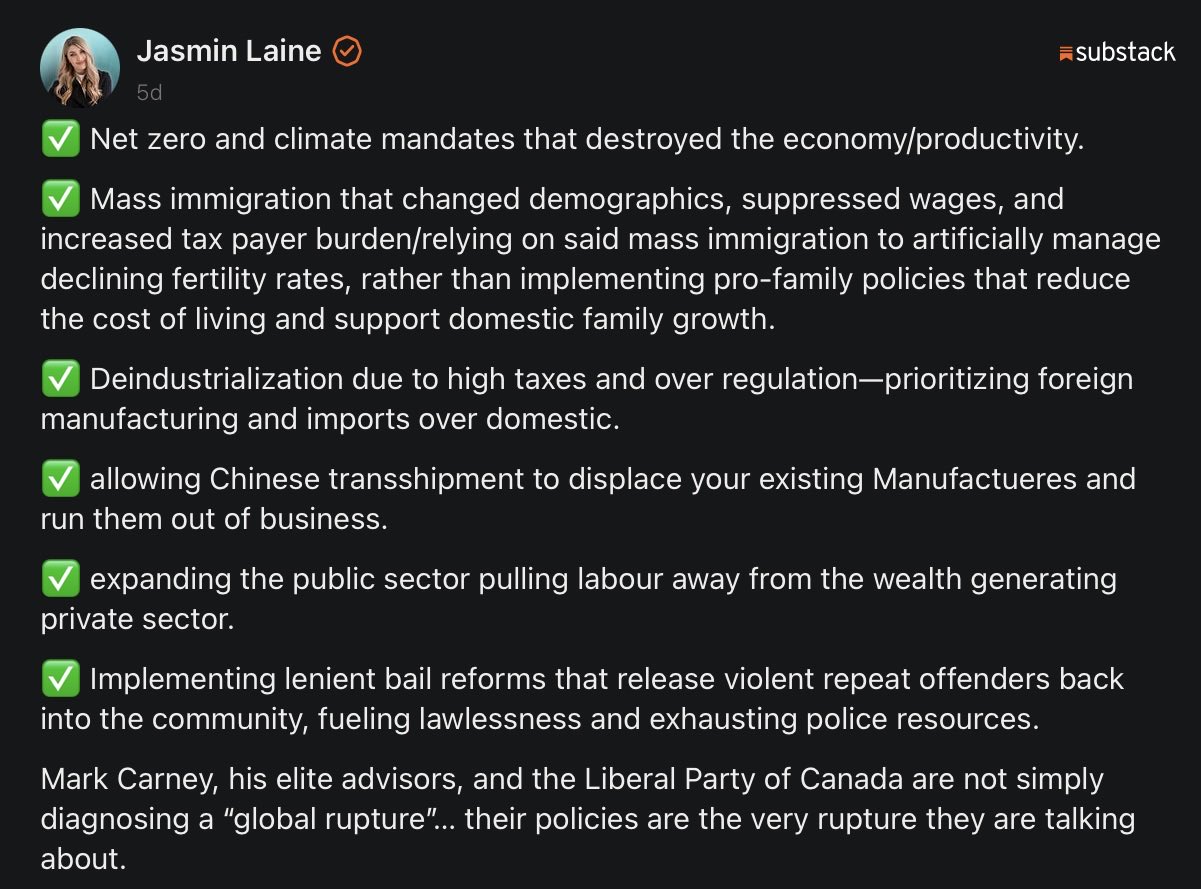
On the social media site formerly known as Twitter, L. Wayne Mathison responds to a Substack Notes post by Jasmin Laine:
I agree with Jasmin. What Carney calls a “global rupture” is, in many respects, the accumulated consequence of political decisions made right here in Canada.
For more than a decade, Liberal governments have pursued policies whose economic consequences deserve far more scrutiny.
Climate mandates and regulatory costs have made investment and industrial development more difficult. Immigration expanded faster than housing, infrastructure and public services could reasonably accommodate. Rather than addressing why young Canadians struggle to afford homes and raise families, Ottawa increasingly relied on immigration to sustain population and labour-force growth.
High taxes, regulatory uncertainty and unfair foreign competition have weakened the conditions for domestic manufacturing. Government employment expanded much faster than private-sector employment, while productivity and business investment remained persistent concerns.
And years of public frustration over repeat violent offenders exposed serious weaknesses in our bail and justice systems.
These problems have different causes, and global pressures are real. But governments must accept responsibility for the consequences of their own decisions.
Carney speaks about rebuilding Canadian sovereignty, competitiveness and economic security. Those are worthwhile objectives. The question is whether his government is prepared to reconsider the policies that contributed to Canada’s vulnerabilities.
You cannot spend years weakening the foundations of an economy and then describe the resulting cracks as an unexpected global rupture.
Jasmin is asking the question every government should face: How much of the problem are you actually responsible for creating?