Quotulatiousness

March 8, 2025

The Federal Court of Canada rules in favour of Trudeau’s authoritarian instincts and actions

Filed under: Cancon, Law, Politics — Tags: , , , , — Nicholas @ 05:00

Apparently we’ve all been under a delusion that Parliament was the paramount elected body and therefore that the Prime Minister needed to operate within the rules of Parliament. The Federal Court saw it otherwise, as Dan Knight explains:

Arms of the Federal Court of Canada

If you’ve been following this case, you already know what’s at stake: whether Justin Trudeau — Canada’s most brazenly authoritarian Prime Minister in modern history — can shut down Parliament whenever he finds it politically inconvenient. Well, today, the Federal Court of Canada, in all its wisdom, just gave him the green light.

Chief Justice Paul S. Crampton released his decision, and while he acknowledged that the courts do have the power to review the Prime Minister’s use of prorogation, he ultimately ruled that Trudeau didn’t exceed his constitutional authority. That’s right — according to the Federal Court, it’s perfectly fine for a sitting Prime Minister to shut down Canada’s elected legislature while his party scrambles to pick a new leader. It’s fine to suspend oversight at a time when Canada is facing real, tangible threats, including Trump’s tariff war. It’s fine to use a legal loophole to avoid answering for one of the biggest financial scandals in Canadian history — the SDTC affair, which saw millions of taxpayer dollars funneled into thin air.

Let’s be very clear about what happened here. On January 6, 2025, Justin Trudeau stood at a podium and declared that Parliament — Canada’s most important democratic institution — was “paralyzed”. He said it was no longer working, that it needed a reset, and that in the meantime, he was resigning. Oh, and conveniently, during that time, the Liberal Party would be selecting a new leader.

Pause for a second and consider that. He wasn’t just shutting down debate on a single issue. He wasn’t suspending a single bill. He was shutting down Parliament entirely — the very institution meant to hold his government accountable.

Now, the Justice Centre for Constitutional Freedoms (JCCF) immediately called this out for what it was — an unlawful, undemocratic, and unconstitutional seizure of power. They filed a legal challenge, and in that case, they pointed out some pretty basic, irrefutable facts:

First, Parliament was not paralyzed. In the weeks leading up to prorogation, four separate bills had been passed. Does that sound like a government that isn’t functioning? Or does it sound like a Prime Minister who was simply looking for an excuse to silence his critics?

Second, and more importantly, Trudeau wasn’t shutting down Parliament to “reset” anything — he was doing it to save his own party. His government was crumbling. His ministers were resigning. His own caucus was at war with itself. And just as an election loomed over his head, he pulled the plug on Parliament, giving his party a clean slate while robbing opposition parties of their ability to challenge him.

And here’s the part the mainstream media will never report — this move wasn’t just about Trudeau’s political survival. It was also a blatant attempt to escape scrutiny over his government’s refusal to release documents related to the Sustainable Development Technology Canada (SDTC) scandal. If you don’t know what that is, it’s simple: Parliament ordered the Trudeau government to hand over records about how millions of taxpayer dollars mysteriously disappeared into politically connected environmental companies. The Trudeau government refused, defied Parliament, and then shut Parliament down before anyone could hold them accountable.

Murder in the Name of Democracy – War Against Humanity 002

The Korean War by Indy Neidell
Published 7 Mar 2025

The battles on the Korean peninsula started long before 1950. Today Sparty looks back at the uprising and insurgency on Jeju Island in 1948, the threat of Communist revolt, and the harsh reaction of the Korean government. This really was the war before the war.
(more…)

Kevin Zucker on “The Big Fat Surprise”

Filed under: Media, Politics, USA — Tags: , , , , , — Nicholas @ 03:00

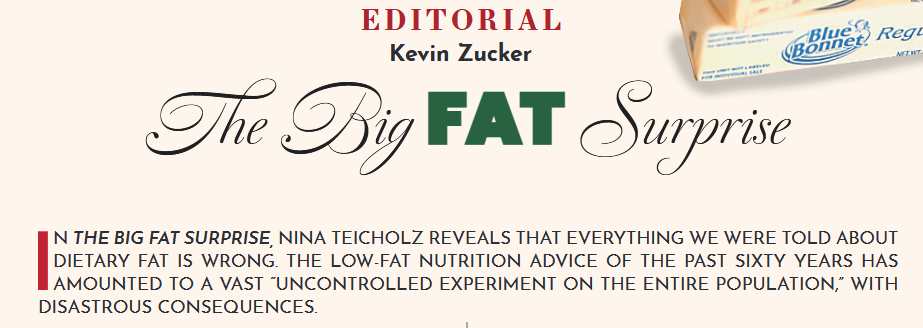
I just got the most recent free Wargame Design PDF from Operational Studies Group and found that Kevin Zucker, the head of the company and one of the best wargame designers ever, had indulged in a little bit of non-wargame writing to open this issue:

For decades, Teicholz tells us,

    … we have been told that the best possible diet involves cutting back on fat, especially saturated fat, and that if we are not getting healthier or thinner it must be because we are not trying hard enough. But what if the low-fat diet is itself the problem? What if the creamy cheeses, the sizzling steaks are themselves the key to reversing the epidemics of obesity, diabetes, and heart disease? Misinformation about saturated fats took hold in the scientific community, but recent findings have overturned these beliefs. Nutrition science has gotten it wrong, through a combination of ego, bias, and premature consensus, allowing specious conclusions to become dietary dogma.1

We are conditioned to think that some specialist always knows better than we do. Despite the common wisdom, I always ate butter, not margarine, despite the “experts”, because I trusted my instincts.2 With experts influencing you to disregard your senses and what you already know, you can learn to believe the opposite of what is natural and true … “Boys and girls are the same”; “men and women are the same”. The French structuralists, who have somehow taken over academia, talk as if the whole world is merely a verbal construct, and whatever we speak becomes literally true if repeated enough.3

In the 1960’s and ’70’s, males joined the feminine on a quest for identity through music, love and drugs. I too was taken-in by the “men and women are the same” argument, and fancied myself a feminist. For me, that illusion was eventually shattered upon contact with reality. Today, instead of liberation, in many quarters the feminine principle is actively denied and suppressed; to prove a point, many women have short-circuited their feminine side, while masculinity is reviled as toxic. So now we have feminized men and masculine women, and neither side is happy. Seventy percent of divorces are initiated by women.

During the recent campaign, women’s anger was used to divide the sexes. A wife filed for divorce in November because her spouse voted for the wrong candidate. Supporters of the two sides cannot even be in the same house, much less discuss their differences rationally. After all, someone might get “triggered”, a brand-new coinage that promotes a fatal lack of reflection. The media have abandoned the fig leaf of nuance and balance and have hit their stride in stirring up fear and polarizing hatred.

The main tool of the demagogue is to stir up one group against another: divide and conquer. How does a society remove the influence of demagogues? History shows that once democracy is destroyed, it doesn’t just grow back. Undemocratic methods, such as censorship, brainwashing, propaganda, and the stifling of dissent, cannot “protect” democracy — just the opposite. A government is only an instrumentality of power, and it is only as democratic as its administrative cogwheels. Power is either administered democratically or it is usurped by a strong man, by the administrative state, or by oligarchs such as the World Economic Forum (who meet regularly in Davos, Switzerland). So that is the choice we face at the moment. Ten years ago, a study by professors Martin Gilens and Benjamin Page found America to be no longer a democracy, but a functional oligarchy. Aside from the eternal vices of greed and projection, we urgently need a strong repudiation of the folly of structuralism. This conversation should be taking place in academia, whose original purpose was to foster such discussions, but academia has now become the stronghold of “safe spaces” where open dialogue cannot be held.

The main reason for studying history, in my view, is to understand the present moment: Where are we, where did we come from, how did we get here, where are we going?4

Today, I am hopeful, for the first time since January 2009. In a chat with my good friend John Prados, I remarked, “Surely, like the proverbial stopped clock, by sheer accident, Trump might be correct about a few things”.

“No, Kevin, everything he says is a calculated lie,” reducing politics to a cartoonish level. We are, after all, the first generation raised on cartoons, where good and evil are simplistically segregated into representative types. Donald Trump has been cast as “Bluto”. The President has certainly brought grist for the mill by his tweet of 15 February, echoing Napoleon: “He who saves his country does not violate any law”.5 We might not have Trump in office today if his first campaign hadn’t been assisted by the Clinton machine in 2016. He was the candidate they wanted to run against, so they promoted his tweets and made a star out of him — just to help him in the primaries. Unfortunately, they created a monster.

It is obvious that the two candidates in the recent election are not the best our country has to offer. This reveals the absolute corruption of the political system. It has been obvious for some time that most of our institutions are vastly corrupt, with disastrous consequences for all of us. As a historian it is not my job to take sides or make predictions about the future. In my view, no one can predict the future: neither of the stock market, nor even tomorrow’s weather. A historian has to be concerned with facts, known, established and well-documented, not gloomy prognostications. Many pundits make their gravy by spouting dire predictions, but there is no one to hold them to account if they are inaccurate or flat-out lies. The voices of hysteria are still tooting like they hadn’t been repudiated at the ballot box.

I was asked recently, which sources of information I trust. I don’t trust any of them. I agree with Suzanne Massie, a scholar of Russian history: “Trust, but verify”. With historical research, a single source is insufficient, especially on controversial issues. As you dig deeper, you find a more three-dimensional view that often lays bare the simplistic assumptions of your primary source.

I cannot claim to have any particular insight into the first five weeks of the Trump Administration, but I look forward to seeing how it all turns out.


    1. The Big Fat Surprise: Why Butter, Meat and Cheese Belong in a Healthy Diet, Simon & Schuster, 2014. Nina Teicholz

    2. Margarine can also affect the nervous system and lead to depression and mental illness.

    3. https://humanidades.com/en/structuralism/

    4. D’où Venons Nous, Que Sommes Nous, Où Allons Nous — Paul Gauguin

    5. Celui qui sauve sa patrie ne viole aucune loi—Maximes et pensées de Napoléon by Honoré de Balzac (1838), a compilation of aphorisms attributed to the emperor.

Joslyn M1862 and M1864 Carbines

Filed under: History, Military, USA, Weapons — Tags: , , , , — Nicholas @ 02:00

Forgotten Weapons
Published 15 Jun 2015

While US infantry forces during the Civil War had only limited access to the newest rifle technology, cavalry units adopted a wide variety of new carbines in significant numbers. Among these were a design by Benjamin Joslyn. It first appeared in 1855 designed to use paper cartridges, but by the time the US Army showed an interest Joslyn had updated the weapon to use brass rimfire ammunition. The first version purchased by the government was the 1862 pattern carbine, of which about a thousand were obtained. Many more were ordered, but it took Joslyn a couple years to really get his manufacturing facility and processes worked out. By the time he had this all straightened out, the design had been updated again to the 1864 pattern, addressing several minor problems with the earlier version. Ultimately more than 11,000 of the 1864 pattern carbines were purchased by the Union, chambered for the same .56-.52 cartridge as the Spencer carbines also in service.

QotD: India’s post-independence economic mistake

Filed under: Economics, Government, History, India, Quotations — Tags: , , , — Nicholas @ 01:00

Nehru – influenced by the Webbs and other Fabians of course – decided that the way to develop a peasant economy into a rich country was to have strong and centralised control of that economy. This was, of course, purblind and rancid idiocy.

Strong and centralised control is something that only a rich country can afford because only a rich economy can weather the costs – the inefficiencies, the politically directed nonsenses – that such control insists upon.

Of course, rich countries shouldn’t make themselves poorer in this manner either but an already poor place can’t afford to have them – because if it does then people die.

India’s poor because of that attempt at socialist development. Something we can prove by the manner in which development sped up when even some portion of the socialism was dropped. Sure, the Webbs set up the LSE, the place I started to learn my economics but they were responsible for far greater evils than my views as well.

Tim Worstall, “A Sad Lesson About India’s History”, Continental Telegraph, 2020-05-01.

March 7, 2025

Trump marks the overdue end of the Long Twentieth Century, part 2

Filed under: History, Media, Politics, USA — Tags: , , , , , — Nicholas @ 05:00

In The Conservative Woman, N.S. Lyons continues his essay contending that the arrival of Donald Trump, version 2.0, may finally end the era we’ve been living in since immediately after the end of WW2:

The Long Twentieth Century has been characterized by these three interlinked post-war projects: the progressive opening of societies through the deconstruction of norms and borders, the consolidation of the managerial state, and the hegemony of the liberal international order. The hope was that together they could form the foundation for a world that would finally achieve peace on earth and goodwill between all mankind. That this would be a weak, passionless, undemocratic, intricately micromanaged world of technocratic rationalism was a sacrifice the post-war consensus was willing to make.

That dream didn’t work out, though, because the “strong gods” refused to die.

Mary Harrington recently observed that the Trumpian revolution seems as much archetypal as political, noting that the generally “exultant male response to recent work by Elon Musk and his ‘warband’ of young tech-bros” in dismantling the entrenched bureaucracy is a reflection of what can be “understood archetypally as [their] doing battle against a vast, miasmic foe whose aim is the destruction of masculine heroism as such”. This masculine-inflected spirit was suppressed throughout the Long Twentieth Century, but now it’s back. And it wasn’t, she notes, “as though a proceduralist, managerial civilization affords no scope for horrors of its own”. Thus now “we’re watching in real time as figures such as the hero, the king, the warrior, and the pirate; or indeed various types of antihero, all make their return to the public sphere”.

Instead of producing a utopian world of peace and progress, the open society consensus and its soft, weak gods led to civilizational dissolution and despair. As intended, the strong gods of history were banished, religious traditions and moral norms debunked, communal bonds and loyalties weakened, distinctions and borders torn down, and the disciplines of self-governance surrendered to top-down technocratic management. Unsurprisingly, this led to nation-states and a broader civilization that lack the strength to hold themselves together, let alone defend against external threats from non-open, non-delusional societies. In short, the campaign of radical self-negation pursued by the post-war open society consensus functionally became a collective suicide pact by the liberal democracies of the Western world.

But, as reality began to intrude over the past two decades, the share of people still convinced by the hazy promises of the open society steadily diminished. A reaction began to brew, especially among those most divorced from and harmed by its aging obsessions: the young and the working class. The “populism” that is now sweeping the West is best understood as a democratic insistence on the restoration and reintegration of respect for those strong gods capable of grounding, uniting and sustaining societies, including coherent national identities, cohesive natural loyalties, and the recognition of objective and transcendent truths.

Today’s populism is more than just a reaction against decades of elite betrayal and terrible governance (though it is that too); it is a deep, suppressed desire for long-delayed action, to break free from the smothering lethargy imposed by proceduralist managerialism and fight passionately for collective survival and self-interest. It is the return of the political to politics. This demands a restoration of old virtues, including a vital sense of national and civilizational self-worth. And that in turn requires a rejection of the pathological “tyranny of guilt” (as the French philosopher Pascal Bruckner dubbed it) that has gripped the Western mind since 1945. As the power of endless hysterical accusations of “fascism” has gradually faded, we have – for better and worse – begun to witness the end of the Age of Hitler.

“The Resistance” achieves lame nirvana

Filed under: Media, Politics, USA — Tags: , , , — Nicholas @ 04:00

President Donald Trump is a boisterous, noisy distraction in so many ways and rubs a heck of a lot of people the wrong way in everything he does … and yet the politicians who oppose him seem to be engaged in a scientific experiment to discover just how cringeworthy they can be:

“REMINDER: It Is Offensive And Possibly Illegal To Photoshop Anything On These Democrats’ Signs That Would Make Them Look Foolish.
The Babylon Bee, https://x.com/TheBabylonBee/status/1897140039777239181/photo/1

Remember when the phrase “the Resistance” would conjure up visions of sexy French youths in berets battling actual Nazis? Now all it brings to mind is ageing dullards in pink suits holding up signs saying “This is not normal” while sporting the most turbo-smug look on their faces. As US president Donald Trump spoke to a joint session of Congress last night, “across the aisle the Resistance was stirring”, gushed the Guardian‘s DC reporter. His piece was illustrated with a pic of some congresswoman in pearls and a balding Democrat looking aghast as Trump talked. Seriously, if this is “the Resistance”, the world’s tyrants can rest easy.

Yesterday’s “Democrat fightback” and “resistance to Trump’s rhetoric” – journalists are literally calling it that – was next-level cringe. It occurred during Trump’s 100-minute speech, the longest Congress talk in 60 years. As Trump bashed Joe Biden and bigged up Elon Musk, the Dems came over all soixante-huitard. Fury coursed through their ranks. Then the revolt started. The Squad’s Rashida Tlaib held up a scrawled sign saying “That’s a lie!”. Dem representative Al Green “shook his cane and pointed his finger” and cried “You have no mandate” to cut Medicaid. How the regime must have quaked at the sight of this revolution!

The way some hacks are talking about this tantrum masquerading as a protest you’d think it was a modern-day storming of the Bastille. The Dems’ “stirring” acts of rebellion will have “given hope to the Resistance” and sent a message to “the world”, said the Guardian. Nurse! Even leftists who’ve been disappointed with the Dem establishment seemed to get a moral kick from this political pantomime. So far, the “resistance” to the Trumpist tyranny has been “splintered”, but now we know it’s “getting better”, fawned Vox. Perhaps, it said, we’ll soon see the “aggressive resistance” we really need.

Can these people hear themselves? Overpaid politicians holding up mass-produced black placards with hackneyed complaints like “False” and “Liar” are not “the Resistance” – they’re the establishment cosplaying as campus radicals for likes and headlines. In one especially squirming scene, some Dems “removed their outer business wear” to reveal black t-shirts with the word “RESIST” in “bold white letters”. Their delusions of radicalism are off the scale. Resistance is when young Iranian women rip off their hijabs or Kurdish revolutionaries fight the neo-fascists of ISIS, not when politicians on $174,000 a year put on a t-shirt their stressed intern ordered from some hip printer on 7th Street.

Bricking the internet

Filed under: Business, Media, Technology — Tags: , , , , , — Nicholas @ 03:00

In The Line, Phil A. McBride explains how the “net giants” have steadily nibbled away at the built-in resilience of the original internet design so that we’re all far more vulnerable to network outages than ever before:

The Internet was originally conceived in the 1960s to be a resilient, disparate and distributed network that didn’t have any single point of failure. This is still true today. While there are large data centres around the world that aggregate traffic, we don’t depend on them. If one were to go offline, things would slow down, but the data would still flow.

The advent of the cloud, though, has completely changed how we use the Internet, especially in the worlds of business, education and government. And the cloud, alas, is not nearly as resilient.

Fifteen years ago, your average small or medium business would have their own servers. Those servers would be used to send/receive email, store files, and run various business or collaborative applications. Some of these servers may have been hosted offsite at a data centre to provide better security or speed of access, but the physical infrastructure belonged to someone — it was something you could touch and, more importantly, account for. Many companies kept their servers on site.

If a company’s server or network went down, it affected that company. They couldn’t send or receive email, they couldn’t open files, collaborate with staff or clients. They were offline.

But only they were offline.

Fast forward to today. Microsoft 365 dominates the corporate productivity services market with an estimated 45-50 per cent market share worldwide, with Google Workspace coming second, with around 30-35 per cent. This means that approximately 80 per cent of businesses are dependent on one of two vendors for their ability to transact business and communicate at even the most basic level.

Government and government-provided services, like education, health care and defence, are just as reliant on these services as the business world.

In today’s world, when Microsoft’s or Google’s services suffer a hiccup, it doesn’t affect one business. Or ten, or a hundred. Tens of thousands of business, and government offices and civil society institutions, all go offline. Simultaneously. Mom-and-pop stores, multi-billion-dollar corporations, elementary schools, hospitals, entire governments, all go out, all at once.

And we haven’t even talked about how Amazon, Microsoft and Google control almost two-thirds of the world’s web/application hosting market share. If one or all of those services go down, most of the websites you go to on a regular basis would suddenly become unreachable.

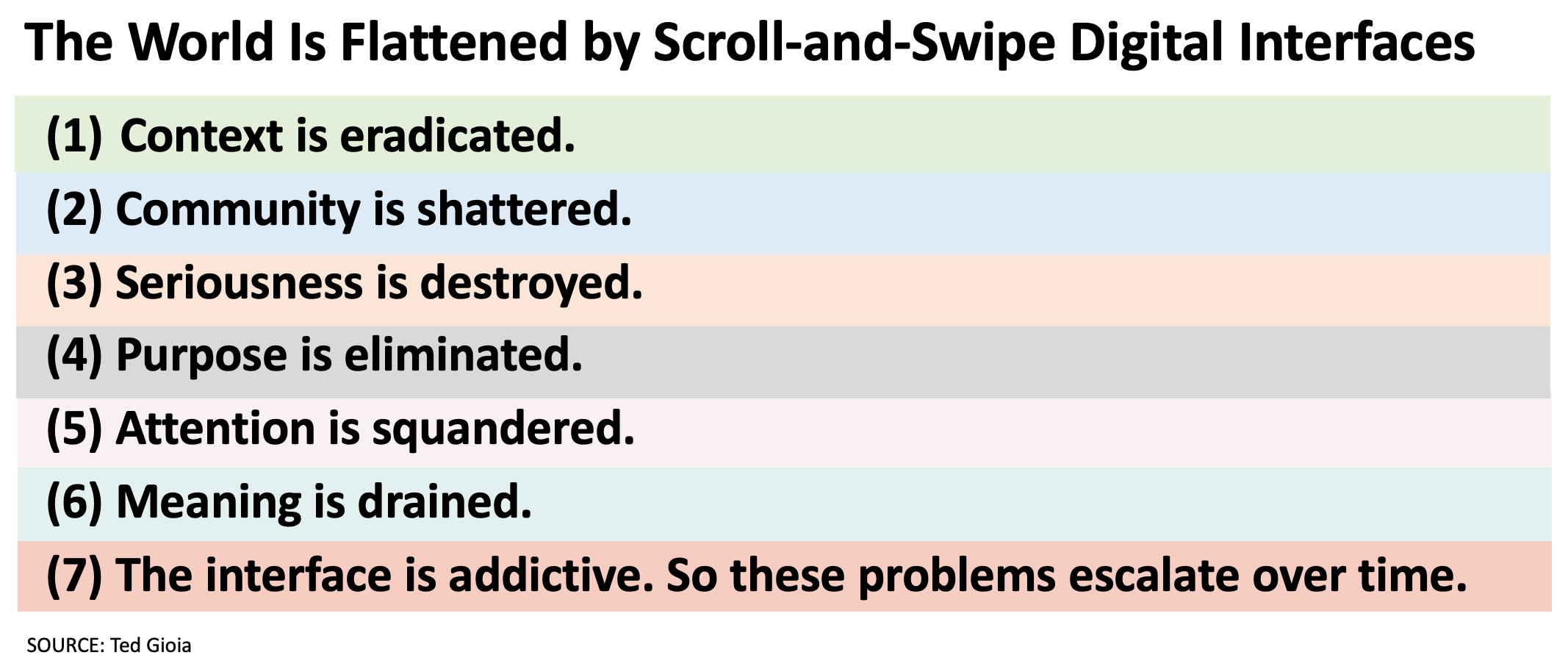
Kinda-sorta related to the above is Ted Gioia‘s “State of the Culture” post:

So remember the first rule: The culture always changes first. And then everything else adapts to it.

That’s why teens plugged into the most lowbrow culture often grasp the new reality long before elites figure it out. This was true 50 years ago, and it’s still true today.

So that’s our second rule: If you want to understand the emerging culture, look at the lives of teens and twenty-somethings — and especially their digital lives. (In some cases those are their only lives.)

The web has changed a lot in recent years, hasn’t it? Not long ago, the Internet was loose and relaxed. It was free and easy. It was fun. There wasn’t even an app store.

We made our own rules.

The web had removed all obstacles and boundaries. I could reach out to people all over the world.

The Internet, in those primitive days, put me back in touch with classmates from my youth. It reconnected me with friends I’d made during my many trips overseas. It strengthened my ties with relatives near and far. I even made new friends online.

It felt liberating. It felt empowering.

But it also helped my professional life. I had regular exchanges with writers and musicians in various cities and countries—without leaving the comfort of my home.

I made new connections. I opened new doors.

And this didn’t just happen to me. It happened to everybody.

“The world is flat,” declared journalist Thomas Friedman. All the barriers were gone — we were all operating on the same level. It felt like some imaginary Berlin Wall had fallen.

That culture of flatness changed everything. Ideas spread faster. Commerce moved more easily. Every day I encountered something new from some place far away.

But then it changed.

Twenty years ago, the culture was flat. Today it’s flattened.

I still participate in many web platforms — I need to do it for my vocation. (But do I really? I’ve started to wonder.) But now they feel constraining.

Even worse, they now all feel the same.

Instead of connecting with people all over the world, I now get “streaming content” 24/7.

Facebook no longer wants me stay in touch with friends overseas, or former classmates, or distant relatives. Instead it serves up memes and stupid short videos.

And they are the exact same memes and videos playing non-stop on TikTok — and Instagram, Twitter, Threads, Bluesky, YouTube shorts, etc.

Every big web platforms feels the exact same.

That whole rich tapestry of my friends and family and colleagues has been replaced by the most shallow and flattened digital fluff. And this feeling of flattening is intensified by the lack of context or community.

The only ruling principle is the total absence of purpose or seriousness.

The platforms aggravate this problem further by making it difficult to leave. Links are censored. Intelligence is punished by the dictatorship of the algorithms. Every exit is blocked, and all paths lead to the endless scroll.

All this should be illegal. But somehow it isn’t.

Soviet Invasion of Finland: Winter War 1939-40

Filed under: Europe, History, Military, Russia, WW2 — Tags: , , , , , — Nicholas @ 02:00

Real Time History
Published 18 Oct 2024

November 1939. Germany and the Soviet Union have conquered Poland, and Germany is at war with France and Britain. Moscow is free to do as it pleases in Eastern Europe and sets its sights on Finland – but the Winter War will be a nasty surprise for Stalin.

Corrections:
02:19 The dot marking Leningrad is about 80km too far east, it’s of course directly at the far eastern end of the Gulf of Finland.
(more…)

QotD: Infantry combat and esprit de corps

What about the personal relationships that are formed in the context of conflict? Surely, the “band of brothers” is a truly universal experience, right (but note on the complexities of Shakespeare’s Henry V)? Surely the social bonds that held Easy Company together in 1944 and 1945 are the same as those from 1415? Or 415?

Well, no. Not quite.

We can approach this question through the idea of cohesion – the moral force that holds a group of combatants together on the battlefield under the intense emotional stresses of combat. The intense bonds that soldiers form in modern armies (particularly those in the European pattern) are not an accident, but a core part of how those armies, institutionally, seek to build cohesion. [W]e discussed briefly the emergence of the extensively drilled and disciplined “mechanical” soldier of Early Modern Europe, noting that this approach wasn’t necessary for the effective use of firearms (the Ottoman Janissaries, for instance, were quite good with firearms, but were not trained and organized in this way), but rather was a product of elite aristocratic (read: officer) disdain for their up-jumped peasant soldiers and thus the assumption by those aristocrats that the only way to get such men to fight effectively was to relentlessly drill them.

Now the funny thing about this system is that it clearly worked, but not for the reasons its aristocratic pioneers believed. It was only really after the Second World War that systematic study began to be made of unit cohesion (e.g. S.L.A. Marshall, Men Against Fire (1947), though subsequent literature on the topic is voluminous and Marshal’s work has its problems, but its conclusions are broadly accepted having been confirmed in subsequent studies) [NR: Some discussion on Marshall and his theories here]. What emerged quite clearly was that it wasn’t “the cause” or patriotism that held troops together under fire, but group cohesion born out of an intense need not to let fellow soldiers in the unit down. In short, what held units together and made them fight more effectively was (in part, there are many conclusions in Men Against Fire) the strong social bonds between comrades.

And, in fact, the drill and discipline of early modern European armies unintentionally did quite a lot of cohesion building things. Soldiers were removed from civilian society (isolation from larger groups builds unit cohesion), split into very small groups (keeping the core group that coheres below Dunbar’s number aids in group cohesion; thus why the platoon is a natural unit size) and then pushed through difficult and unpleasant training (that drill and discipline) creating a sense of unique shared experience and sacrifice. All of which doesn’t render men machines, but it does create strong social bonds within the units that will keep the men fighting even when they care little for their cause (which they generally did in this period; one does not find a super-abundance of patriotism among, say, the Army of Flanders).

And there is a tendency to point to this cohesion, its modern source in “toughening” boot camp and to say, “aha! That is the true universal about effective soldier-warriors!” Except – and you knew there was going to be an except – except it isn’t. Systems built on the use of drill and discipline for the development of unit cohesion through social bonds are actually, historically speaking, quite rare. We see systems like that in use by the Romans from the Middle Republic forward (but significantly faded by the end of late antiquity; the Byzantine army doesn’t seem to function this way), in China from the Han Dynasty onward, in Japan for the ashigaru infantry from the Sengoku period, and in Europe from the Early Modern period. That sounds like a lot, but that is relatively small minority of the historical period and even then in a relatively small minority of places. It is, for instance, a period that only covers about half of the historical period in Western Europe, the place most often associated with this very system of organization (though that association is perhaps unfair to East Asia).

Instead, most societies relied on existing social bonds formed outside of the experience of war for cohesion. Greek hoplite armies, for instance, generally formed up by polis (read: city) and then within those blocks by still smaller and smaller social divisions, so that family and neighbors would be standing shoulder to shoulder in the battle line (Sparta does this through the system of communal messes, the syssitia, but the idea that you fought alongside the men you dined with socially – your neighbors, generally – was perfectly normal in most Greek cities). That was intentional – it allowed the phalanx to cohere through the social pressure not to be seen as a coward before the men who meant the most to you, whose shaming gaze you would have to endure in civilian life. The same pressures, by the well, held together the (mostly volunteer) armies of the American Civil War (on this, see, McPherson, For Cause and Comrades (1997)).

By contrast, “warrior” classes often rely on a sort of class solidarity along with the demand of an individual military aristocrat to be individually militarily excellent. Richard Kaeuper quips of the literature of the medieval knightly class that it was filled with “utterly tireless, almost obsessional emphasis placed on personal prowess” (R.W. Kaeuper, Chivalry and Violence in Medieval Europe (1999)). We’ve talked a fair bit about the values of mounted aristocrats, both in their role as combatants and in their roles as generals and those values are relatively disconnected from discipline-induced forms of buddy-cohesion. Of course exactly what “good generalship” or “good officership” looks like varies wildly from place to place – Alexander was expected to command his cavalry from the front; Roman emperors rarely took the battlefield and when they did they commanded from the rear since it would be foolish to risk the “brain” of the army in personal combat and in any event someone at the front of a cavalry charge can hardly direct the rest of the army.

One of the things I find most striking about the “warrior ethos” advanced by writers like Pressfield is that it accepts as normal the unique nature of the bonds that hold soldiers together in battle, assuming this bond and its shared sacrifice to be at once unique to combat and also transcendent to all combatants. But one of the key points made very well in Sebastian Junger’s War (2010) and later Tribe (2016) is just how strange that experience is, historically. Junger notes that in earlier societies, soldiers would have returned from war into communities (often small, agricultural communities or tribal communities) every bit as close-knit as the infantry platoon – and indeed, often involving literally the same people as the infantry platoon. Instead, the intense feeling of uniqueness that modern soldiers feel about the bonds of combat is because of the historically unusual deracination produced by modern societies by the industrial revolution and the post-industrial period.

Bret Devereaux, “Collections: The Universal Warrior, Part IIb: A Soldier’s Lot”, A Collection of Unmitigated Pedantry, 2021-02-05.

March 6, 2025

Passionate belief in historical untruths

Filed under: Britain, Cancon, History — Tags: , , , , , , — Nicholas @ 05:00

As mentioned in earlier posts, one of the most toxic exports from Australia to the rest of the Anglosphere has been the academic indulgence in believing that “settler colonialism” explains everything about the history of Canada, Australia, New Zealand and anywhere else the British diaspora touched:

Welby in Zanzibar

Throughout the English-speaking world elites are falling over themselves to believe the very worst of their own countries.

In Britain, the Church of England has committed itself to spend an initial £100 million on slavery-reparations in response to the discovery that its endowment had “links” with African enslavement. “The immense wealth accrued by the Church … has always been interwoven with the history of African chattel enslavement”, a document explains. “African chattel enslavement was central to the growth of the British economy of the 18th and 19th centuries and the nation’s wealth thereafter”. And this has “continuing toxic consequences”.

Yet almost none of this is true. The evidence shows that the Church’s endowment fund was hardly involved in the evil of slave-trading at all. Most economic historians reckon the contribution of slave-trading and slavery to Britain’s economic development as somewhere between marginal and modest. And between abolition in 1834 and the present, multiple causes have intervened to diminish slavery’s effects.

Consonant with his church’s policy, the (then) Archbishop of Canterbury, Justin Welby preached a sermon in Christ Church Cathedral, Zanzibar last year, in which he criticised Christian missionaries for treating Africans as inferior and confessed that “we [British] must repent and look at what we did in Zanzibar”.

Really? What the British did in Zanzibar during the second half of the 19th century was to force the Sultan to end the slave-trade. Indeed, the cathedral in which the archbishop was preaching was built over the former slave-market. And here’s what the pioneering missionary David Livingstone wrote about black Africans in 1871: “I have no prejudice against [the Africans’] colour; indeed, anyone who lives long among them forgets they are black and feels that they are just fellow men…. If a comparison were instituted, … I should like to take my place among [them], on the principle of preferring the company of my betters”.

[…]

St. John Baptiste church was one of many local churches to go up in flames during Justin Trudeau’s performative national guilt trip over “unmarked mass graves” at former Residential Schools across Canada.

Which bring us to Canada. The May 2021 claim by a Kamloops Indian band to have discovered the remains of 215 “missing children” of an Indian Residential School was quickly sexed up by the media into a story ‘mass graves’, with all its connotation of murderous atrocity. The Toronto Globe and Mail published an article under the title, “The discovery of a mass gravesite at a former residential school in Kamloops is just the tip of the iceberg”, in which a professor of law at UBC wrote: “It is horrific … a too-common unearthing of the legacy, and enduring reality, of colonialism in Canada”. Prime Minister Justin Trudeau ordered Canadian flags to be flown at half-mast on all federal buildings to honour the murdered children. Because the Kamloops school had been run by Roman Catholics, some zealous citizens took to burning and vandalising churches, 112 of them to date. The dreadful tale was eagerly broadcast worldwide by Al Jazeera.

Yet, four years later, not a single set of remains of a murdered Indian child in an unmarked grave has been found anywhere in Canada. Judging by the evidence collected by Chris Champion and Tom Flanagan in their best-selling 2023 book, Grave Error: How the Media Misled us (and the Truth about the Residential Schools), it looks increasingly probable that the whole, incendiary story is a myth.

So, prime ministers, archbishops, academics, editors, and public broadcasters are all in the business of exaggerating the colonial sins of their own countries against noble (not-so-very) savages — from London to Sydney to Toronto. Why?

The Iron Curtain Descends – W2W 10 – News of 1946

TimeGhost History
Published 5 Mar 2025

1946 sees the world teetering on the brink of a new global conflict. George Kennan’s long telegram outlines Moscow’s fanatical drive against the capitalist West, while our panel covers escalating espionage, strategic disputes over Turkey, and the emerging ideological battle between the U.S. and the USSR. Tune in as we break down the news shaping the dawn of the Cold War.
(more…)

As Trump’s tariffs begin to bite, Canadians strike back at … King Charles and Wayne Gretzky?

Filed under: Cancon, Media, Politics — Tags: , , , , , — Nicholas @ 03:00

As if more evidence were needed that Canadians aren’t well-served by our political leaders, social media personalities and legacy media types are pointing at uninvolved figures to be rounded up as the targets of maple-flavoured Two Minutes’ Hate sessions:

Canada’s latest Emmanuel Goldstein replacement, “The Great One” aka Wayne Gretzky

You can’t have an outburst of nationalism without purity tests coming into play, and two prominent Canadian figures have failed theirs in the court of chattering-class opinion: Wayne Gretzky and King Charles III, of all people.

In recent consecutive days, hilariously, The Globe and Mail‘s website published the following headlines to its online readers’-letters pages: “Wayne Gretzky’s fall from grace is a long time coming”; “Let Wayne Gretzky feel some pain”; and “Wayne Gretzky has always been held in the highest regard … now, he is dead to me”.

Gretzky is friendly with President Trump, you see, which is unacceptable. And if Gretzky isn’t willing to publicly disavow Trump, he should be using his influence to sit Trump down and explain that Canada will never be the 51st state … at which point, presumably, something useful is supposed to happen. It’s never clear what that useful thing would be, beyond a cheap nationalist thrill.

Gretzky’s Yankeeism was confirmed when he served as honorary captain of Team Canada in the final game of the 4 Nations tournament in Boston. (Imagine if he hadn’t served as honorary captain!) He gave the American players a thumbs up — which in any other context would have been considered simple good sportsmanship. He didn’t wear a Team Canada sweater, but rather a suit — which in any other context wouldn’t even have been noticed. He didn’t wear his Order of Canada pin — well, now we’re just grasping at straws.

It’s funny that the same kind of people who have no time for the Crown under normal circumstances (even if they’re not quite out-and-out republicans) are delighted to pile on to any accusations that King Charles isn’t doing … something … to fight off the Bad Orange Man for us:

This brings us to our head of state, and the baffling calls in recent days for him to shake his sceptre toward Washington and declare that Canada shall never never never be the 51st state. If these calls were coming just from anti-monarchists, it would be understandable (though it’s odd to hear them suddenly demanding that the sovereign speak on our behalf). But all kinds of otherwise reasonable people jumped aboard as well, as if this was something the King should self-evidently be doing.

It is self-evidently not what the King should be doing — certainly not before receiving advice from the Canadian prime minister, and probably not at all. Charles’s mother wouldn’t have mouthed off, and I have to wonder if she would have gotten the same criticism were she still alive to see this mess.

Indeed, I think a moment like this is precisely when having an apolitical head of state — maybe even one that doesn’t live here — is most valuable. We have more than enough people, elected and unelected, completely and vocally embroiled in the Trump Tariff Wars, pursuing some combination of national, partisan and personal gain. Isn’t it nice to have precisely the sort of democratic constancy the United States now lacks? You don’t throw away an anchor, however rusty, with a gale on the horizon.

HMCS Bonaventure – The Pride of Canada’s Fleet

Filed under: Britain, Cancon, History, Military — Tags: , , , , , , — Nicholas @ 02:00

Skynea History
Published 22 Oct 2024

For today’s video, we’ll be looking at the last of Canada’s aircraft carriers. Not typically a navy you associate with that kind of ship, but the Canadians actually operated three during the Cold War.

The third, HMCS Bonaventure, is an interesting one. A small ship, that operated aircraft at the very edge of her capability. And routinely baffled American pilots in the process.

Yet, she was also a ship that came to an end before her time. Decommissioned and scrapped, right after an expensive (and extensive) mid-life overhaul. In what is generally seen as a bad political move, more than anything to do with her capabilities.
(more…)

QotD: Old Etonians

If you’d told somebody in the mid 2000s that David Cameron would become Prime Minister, they would have laughed in your face. If you then told them that a few years later Boris Johnson would be one of his successors, they’d consider you bonkers. This was Blairite Britain – gone were the days of Macmillan, Douglas-Home, and the coterie of other prime ministers educated at that same dusty institution – the hegemony of the Old Etonian was firmly over. Yet Cameron became the 19th Prime Minister educated there, and Boris the 20th, making five out of the fourteen prime ministers elected during Queen Elizabeth II’s reign Old Etonians.

When I first started there, the traditions seemed daunting, and while you had a week of grace period to find your feet, it took a lot longer for the novelty truly to wear off. Dressed in a tailsuit that makes you look like a penguin, and that even the production team of Downton Abbey would question, it’s a complete culture shock. Teachers become “beaks”; homework becomes “EW (short for Extra Work)”, and the threat of “tardy book” (a punishment where you have to get up early to report to the School Office) is ever present. Your life is governed by a tutor, housemaster, and dame (a surrogate mother for your time there, and the most influential person in your day-to-day life), and outside of lessons (known as “schools”) you’re left to your own devices. It’s a sink or swim situation, and some can’t hack the overload of independence.

You’re constantly surrounded by things named after great men who have come before you – whether that be John Maynard Keynes (an economics society) or William Gladstone (a library) – and you can’t help but see yourself as heir to some great dynasty. Sitting in Upper School – a large schoolroom now mainly used for talks by visiting speakers – the walls are lined with marble busts of illustrious Old Etonians past, and it’s not hard to daydream about joining them. In our first ever assembly the head master put it best: “If you know that some interesting people have gone on to do some interesting things, whether it’s George Orwell or the Duke of Wellington, that does implicitly ask the question, why not you?” Success never seems far away, and often you’re regaled with tales about the time your beak caught a famous actor smoking, or how awful a pupil a noted academic once was. Neither does service, particularly when you pass the memorial boards for the First World War (as you do daily on the way to chapel): 1157 Old Etonians died, and 37 Old Etonians have won the Victoria Cross – 17 more than any other school.

In your final years, it’s fun to try and work out who’s going to be most successful after leaving, and – it never seems too outlandish – who among you could be a future prime minister. The people you consider are never confined to a particular group – it’s not “one of the debaters” or “one of the Rugby XV” – in fact, it’s often those who you can’t seem to categorize, or transverse the groups that are most magnetic. To get into Eton, you have to do well in the infamous “List Test”, composed of a computerized assessment and an interview with one of the beaks. For an eleven year old, it can be brutal (one boy left crying midway through our test), particularly as you don’t know what they want: they’re not looking for candidates that fit a particular box. Potential is valued more than current ability, and the greatest asset is that of being interesting. With only one in five getting an offer (odds stiffer than Oxbridge), and after five years of being expected to perform at the highest level, it’s unsurprising that students end up so successful.

Ivo Delingpole, “Boris and the Spirit of Eton”, Die Weltwoche, 2020-01-29.

« Newer PostsOlder Posts »

Powered by WordPress