
… every time I buy “organic”, I feel like I’m sending a reinforcement to several different forms of vicious stupidity, beginning with the term “organic” itself. Duh! Actually, all food is “organic”; the term just means “chemistry based on carbon chains”.
Take “no GMOs” for starters. That’s nonsense; it’s barely even possible. Humans have been genetically modifying since the invention of stockbreeding and agriculture; it’s what we do, and hatred of the accelerated version done in a genomics lab is pure Luddism. It’s vicious nonsense, too; poor third-worlders have already starved because their governments refused food aid that might contain GMOs. And without GMOs it’s more than possible that the new wave of wheat rust, once it really gets going, might condemn billions to death.
Vegan? I’ve long since had it up to here with the tissue of ignorance and sanctimony that is evangelical veganism. Comparing our dentition and digestive tracts with those of cows, chimps, gorillas, and bears tells the story: humans are designed to be unspecialized omnivores, and the whole notion that vegetarianism is “natural” is so much piffle. It’s not even possible except at the near end of 4000 years of GMOing staple crops for higher calorie density, and even now you can’t be a vegan in a really cold climate (like, say, Tibet) because it’ll kill you. In warmer ones, you better be taking carnitine and half a dozen vitamins or you’re going to have micronutrient issues sneak up on you over a period of years.
OK, I give on gluten-free. Some people do have celiac disease; that’s a real need. But “no trans fat”? Pure faddery, or the next thing to it. The evidence indicting trans fats is extremely slim and surrounded by a cloud of food-nannyist hype. I hate helping to keep that sort of balloon inflated with my dollars.
Who could be against “fair trade”? Well, me … because the “fair trade” crowd pressures individual growers to join collectives with “managed” pricing. If you’re betting that this means lazy but politically adept growers with poor resource management and productivity prosper at the expense of more efficient and harder-working ones, you’ve broken the code.
Finally, “pesticide-free”. Do I like toxic chemicals on my food? No … but I also don’t fool myself about what happens when you don’t use them. This ties straight back to the general cluster of issues around factory farming. Without the productivity advantages of pesticides, synthetic fertilizer, and other non-“organic” methods, farm productivity would plummet. Relatively wealthy people like me would cope with reduced availability by paying higher prices, but huge numbers of the world’s poor would starve.
I buy “organic” food because it tastes better and I can, but I feel guilty about reinforcing all the kinds of delusion and superstition and viciousness that are tied up in that label. We simply cannot feed a world population of 6.6 billion without pesticides and factory farming and GMOs and preservatives in most bread; now, and probably forever, “organic” food will remain a luxury good.
Try telling its political partisans that, though. Hyped on their belief in their own virtue, and blissfully ignorant about scale problems, they have already engineered policies that have cost thousands of lives during spot famines. The potential death toll from (especially) anti-GMO policies is three orders of magnitude higher.
And my problem reduces to this: how can I buy the kind of food I want without supporting dangerous delusions?
Eric S. Raymond, “Organic guilt”, Armed and Dangerous, 2010-08-23.
January 1, 2021
QotD: Buying “organic” food
November 30, 2020
QotD: Grandstanding, or more properly, cant
To cant is to utter moral sentiment far in excess of what is felt or could ever be felt. The purpose of cant is either to present the person who utters it as morally superior to others or to himself as he really is, or to shut other people up entirely. These purposes are not mutually exclusive, of course.
Cant is not new in the world, though the authors of this book offer no history of it. “Of all the cants that are canted in this canting world …” Laurence Sterne wrote more than quarter of a millennium ago, and Doctor Johnson suggested that his interlocutor should clear his mind of cant. My late friend, Peter Bauer, when elevated to the House of Lords, took “Let us be free of cant” as his heraldic motto, but far from ushering in an era free of it, subsequent years have proved a golden age of cant. The social — or antisocial — media have been a powerful catalyst of cant.
Theodore Dalrymple, “The Expanding Tyranny of Cant”, The Iconoclast, 2020-08-26.
November 21, 2020
QotD: Using a “wokescreen”
It is, essentially, a new iteration of an old rule: the one stating that the person commonly to be found complaining most vociferously about a particular vice is the one disproportionately likely to be guilty of said vice.
Through decades past, this rule applied to people who were literally in the clerical class. It was, for instance (see the late Cardinal Keith O’Brien), the priest or bishop who denounced homosexuality in the most vociferous terms who would turn out to have their own peculiar interpretation of “the laying on of hands”, tending to revolve around the knees of young male seminarians.
And there is sense in this of course. Through overt displays of moral opprobrium, the petitioner imagines that everyone’s attention will be diverted. Through stressing their virtue overmuch, however, such people raise a perceptible flag to anyone with an eye for human hypocrisy.
Today, of course, the clerical class is not the clergy. It is generally a rich, massively protected, metropolitan and often corporate or corporate-backed class which poses as the defender and then enforcer of all the easiest, least-controversial causes of the time. These shift, naturally, but today a person who wishes to cloak themselves in virtue will talk up their “anti-racism” credentials; will talk about “feminism” as though women’s rights have only just occurred to them; they will stress their green credentials; and of course they will rush to the defence of anyone who claims to identify as a tree or a hedgerow and assert that said person’s right to so identify is not just ancient and long-established but biologically incontrovertible. All give off immense warning-signs.
Douglas Murray, “Do you know what a wokescreen is?”, UnHerd, 2020-08-13.
October 24, 2020
“So – a Truth and Reconciliation Commission in America?”
Arthur Chrenkoff responds to this tweet from Robert Reich:
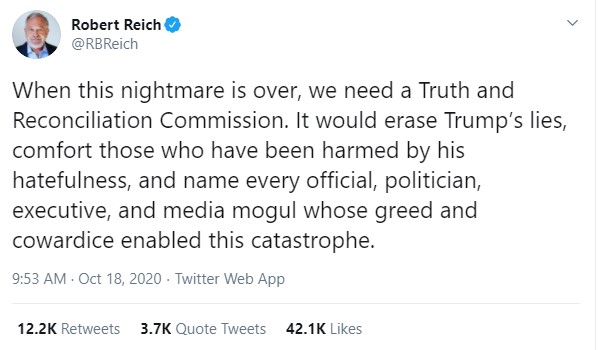
In case you are unfamiliar with the term, the Truth and Reconciliation Commission was instituted in the post-apartheid South Africa as a way of non-violently and non-punitively coming to terms with the painful racist past. It was a forum where the victims of human right abuses were able to testify about their experiences, and where some of the perpetrators could respond on record – ideally with some contrition – and request amnesty for their misdeeds. It was an exercise in “not forgotten, but possibly forgiven”, a way forward in transition to democracy that would not have to involve mass incarceration of those connected with the old regime. While criticised by many, this model of community healing is thought to have been quite successful in as much as it has been replicated in numerous other countries around the world as a way of dealing with the past and moving on. As the Good Book says, “the truth shall set you free”.
So – a Truth and Reconciliation Commission in America? You don’t have to have actually lived in a totalitarian society (even if, like with yours truly, it helps) to be taken aback at the insensitivity and the sheer tone deafness exhibited by a privileged member of the American elite (Clinton’s Labor Secretary, Berkley professor, 1 million Twitter followers) comparing the last four years in the United States to the four decades of South African apartheid or a quarter of a century of a military dictatorship in some coup-prone South American republic. Are these people really so lacking in self-awareness?
The answer is yes, and in turn it points to a more interesting socio-political phenomenon. For the past few decades, intellectuals (the great majority at various distances to the left of centre) have been looking at activists and dissidents outside of the developed, democratic “First World” – people like Nelson Mandela and Archbishop Desmond Tutu in South Africa, Ang Sang Suu Kyi in Burma/Myanmar, academics and trade unionists throughout Latin America fighting against right-wing dictatorships, and to a lesser extent those in opposition to communist dictatorships like the Dalai Lama, Lech Walesa in Poland, Vaclav Havel in Czechoslovakia, and Sakharov, Sharansky, Solzhenitsyn and others in the Soviet Union – and I think their main, if secret, reaction was envy and guilt.
Guilt because their own lives in the West were by and large safe, secure, privileged and prosperous, while their counterparts (intellectuals, artists, community leaders) in the Second and the Third World (now developing world) were putting their lives, freedom and livelihoods on the line for the principles and ideals they believed in. And envy because, as the stakes were so much higher “over there”, the lives of all these dissidents, oppositionists and human rights activists seemed so much more meaningful – and, yes, exciting. While you were pondering on the next New York Times op-ed you are going to write, while turning up to your monthly faculty meeting in your new Prius, somewhere in Africa or Asia or Latin America a prisoner of conscience was on a hunger strike, actually living the ideas you believed in and not just writing about them. Sure, it’s terrible, yet how much more interesting and consequential than your placid and predictable existence of mortgage repayments and the Monday morning undergraduate class in political theory?
October 7, 2020
Canada’s new documentary monoculture – many now “skew the truth by reinforcing the viewpoint du jour“
In The Line, Christina Clark explains why she’s no longer in the business of making documentaries in Canada:

Many of the stories now told through documentary skew the truth by reinforcing the viewpoint du jour. Interviews and scenes that break with the chosen narrative, that offer something other than a black-and-white approach to society and the complexities of humanity, happen off camera or end up on the editing room floor. This is all in an effort to promote diverse voices and the political opinions that allegedly support them. But when we lay claim to a singular viewpoint or dismiss a perspective because the creator’s or the subject’s skin tone or gender does not fit the narrative of inclusion, we are actually removing diversity from the storytelling equation. And what we’re left with are one-sided storylines that reinforce an echo chamber of virtue signalling.
I can no longer deny the dysfunctional approach to telling half-truths and undermining alternate viewpoints in my industry in the name of securing public funding for programming that fails to resonate with the public that is paying for it. Over the last year, I’ve been turning down contracts and finding an exit strategy. I’m pre-emptively cancelling myself.
Documentary was once considered Canada’s national art form. Part of our country’s success with the medium can be attributed to the creation of our National Film Board (NFB), established to “make and distribute films designed to help Canadians in all parts of Canada to understand the ways of living and the problems of Canadians in other parts.” The NFB was founded to provide public funding to storytellers to show us who we are, as a country, as citizens.
To secure public funding for a documentary film or program in Canada, producers typically need to have a broadcaster already signed on to the project. Then, they can apply to funds like the Canada Media Fund, Telefilm or Rogers. Without a broadcaster licence, you cannot apply for public funding. The criteria for licencing a film or television series has narrowed in recent years — not unlike the audiences these programs are targeting.
Take, for example, the Creative Relief Fund that the CBC put together during the early months of COVID to award $2 million in development and production funding for new projects, ranging from fiction and non-fiction television to documentary shorts to plays and podcasts. This was an enticing invitation for creators in lockdown. During this time, friends and colleagues of mine in the industry were messaging each other back and forth, offering feedback on each other’s ideas, as we were all intending to apply. These are some questions we all wondered aloud, in the safety of our private chats: “Do you think this story is diverse enough?” “This story might be too white …” “I don’t think the language is woke enough, do you think they’ll see the bigger story here?” That’s because many broadcasters have “Inclusion and Diversity Plans” that you have to fill out for your project, that track the racial and gender makeup of your crew and your interviewees. While it is not explicitly mandatory to accommodate broadcasters’ criteria for diversity, a lot of filmmakers already know before they even pitch an idea that their chances of getting greenlit are greater if they do.
September 28, 2020
It’s been a while since these stickers occupied pride of place on every Prius bumper, hasn’t it?
Arthur Chrenkoff wonders “Whatever happened to ‘Free Tibet’?”
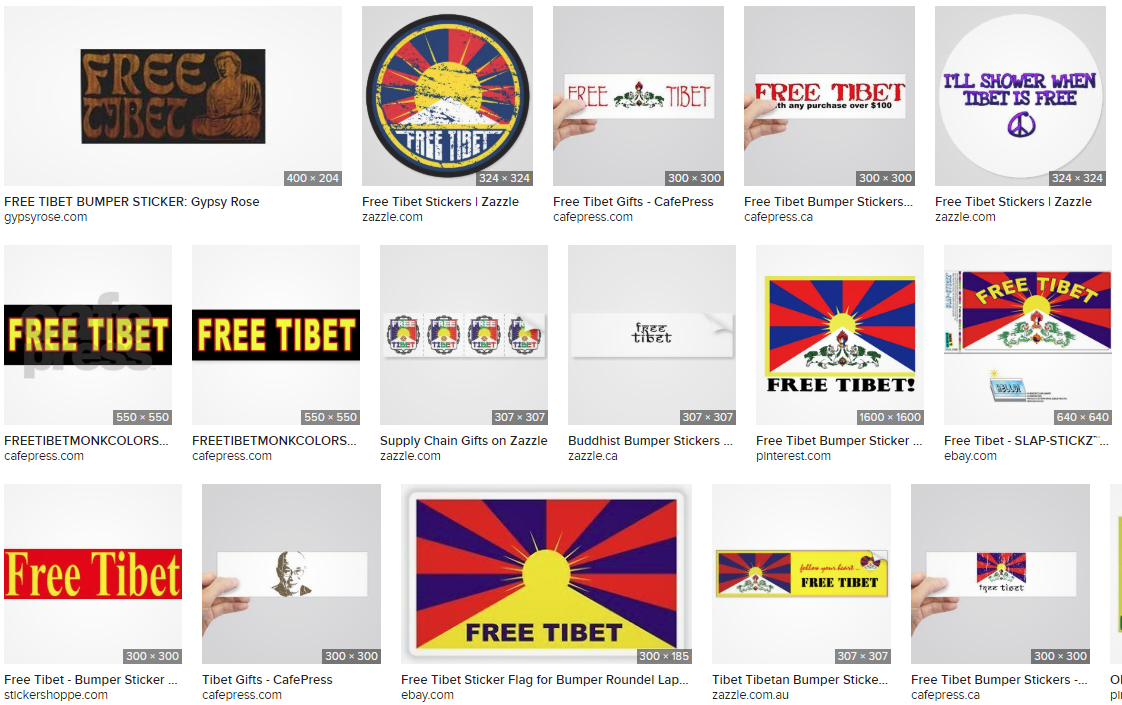
With its heyday probably twenty years ago, it used to be a major cause celebre for artists and activists, with bumper stickers adorning countless cars, including – proverbially – the early Priuses. It was mostly a thing of the left (certainly in Australia it was largely associated with the Greens) and the hippies and New Agers enchanted by the wit and wisdom of the Dalai Lama, spruiking his version of Buddhism from exile. This probably scared many people off, which is a pity because the question of Tibetan independence shouldn’t be judged on the merits of its incense burning Western supporters.
So what happened? Tibet is certainly still not free – if anything the things have gotten worse on the rooftop of the world – but the campaign has largely dropped out of the public consciousness. I don’t quite know the answer myself. Maybe some political causes, like fashion trends, have limited life spans. Maybe the left has learned to stop worrying and live with China as one of the few viable alternatives to the “Western neoliberal world order”. Maybe China has become too rich and powerful to hope that candle-lit vigils for Lhasa will do any good.
So what’s been happening in Tibet lately, just out of interest?
September 16, 2020
The Canadian echo chamber on American political issues
Ben Woodfinden’s latest for The Dominion looks at the weird effects political passions in the United States have on political stances in Canada:

Restricted and prohibited weapons seized by Toronto police in a 2012 operation. None of the people from whom these weapons were taken was legally allowed to possess them.
Screen capture from a CTV News report.
Participatory media increasingly defines and shapes our discourse. It submerges us in a broader reality but only does so by filtering it into a digital reality that offers a distorted reflection rather than picture of the real world. This has been going on for at least a decade now, but the pandemic has accelerated this transformation of our discourse and politics. By locking us in our homes the pandemic forces us to view the world through a digital lens even more than we already did, and in a world where we’re all viewing everything through our screens that digital reality becomes closer and closer to our primary reality.
One of the specific, and most pernicious effects of this, as I lamented in The Critic is that it turns us all into online Americans participating in their politics through the digital medium, rendering us virtual participants and not just foreign observers. I won’t repeat myself too much, I’d recommend just reading the piece [link], but the online realm is American, and what digital politics does is make politics everywhere more American. We participate in it as a game and a form of entertainment. This bleeds back into our own politics.
Americanized Discourse
Gun politics is one particular political issue where Americanized discourse is most pronounced. It captures perfectly how Americanization plays out. Every time there is some sort of tragic shooting or discussion of gun violence in Canada the debates play out in depressingly predictable ways. Progressives and Liberals paint a picture in which Canada suffers from the kind of rampant gun violence and mass proliferation of firearms as in America. This is the framing used to justify often highly symbolic or ineffective new gun laws and restrictions that, while often not all that effective, make the Liberals and progressives seem like the party for gun control in the face of this rampant violence. But only if you pretend we live in America.
And it’s not just the Liberals and progressives who play this game. Listen to some of the more vocal advocates of “gun rights” in Canada and you’d think we have a second amendment in the Charter. One side wants to make it seem like Canadians are walking around with and easily able to acquire assault weapons, the other side wishes it were so! The reality of course lies somewhere in between. Gun possession is heavily regulated, but lawful citizens can still buy firearms if they want to, and there is no explicit right in the Charter that prevents the government from regulating and restricting firearms. Talking about gun “rights” in Canada is itself quite a foreign and imported concept. At the same time we don’t have an epidemic of gun violence, and while we have experienced some horrific mass shootings, like the recent Nova Scotia tragedy, gun violence in Canada pales in comparison to the United States.
But because both sides are essentially happy to help paint a phantasmic picture of gun violence and/or gun regulations in Canada, we end up with a surreal politics around guns. Sensible debates around guns are made harder by this because debates take place on top of a framing and narrative that draws explicitly on American political culture more than it does Canada’s. Both sides want to take on American roles and are happy to contribute to this framing.
Gun politics is just one example, and there are so many others. Our discourse is so often built around framings that make it seem as if the issues and political cleavages here are indistinguishable from American ones, but it only happens because we import American framing and narratives into our own discourse and then build are arguments around these phantasms. We, like many other countries around the world, are in the middle of a moment of racial reckoning, or whatever you want to call it, because of something that happened in Minneapolis, not in Canada.
Racism is a real thing in Canada, no honest person should deny this, because there is racism in absolutely every country and society. But in the wake of George Floyd’s killing we ended up having a conversation about racism that reflected the particular ways racism works in America.
September 5, 2020
Kareem Shaheen on the shame of mask-shaming
In The Line, Kareem Shaheen — who is a mask-wearer and was one before they were made mandatory — explains why shaming anti-maskers is a terrible way to encourage compliance, but a great way to virtue-signal:
“Covid 19 Masks” by baldeaglebluff is licensed under CC BY-SA 2.0


The mask shaming mirrors the way social media has warped our culture. The Twitter and ‘gram “in crowd” flaunt its mask use to demonstrate an ostensibly superior grasp of morals and science — and to bully those who don’t follow its cues. Those who perceive themselves to be on the outside of this circle can’t help but cringe at the manipulation and grandstanding behind these seemingly well-intentioned gestures.
Mask resistance, then, becomes a virtue signal of its own.
And, of course, Twitter itself has been a cesspool of counter-productive shame. Back in July, the hashtag #NoMasks trended, which gave the illusion of a groundswell of opposition against mandatory masking laws. But an analysis by First Draft, a nonprofit based in the United Kingdom, examined 8,000 Twitter accounts that used the hashtag. It found that the majority of people who tweeted #NoMasks were actually pro-mask. Their condemnation of the supposed anti-mask contingent actually boosted #NoMasks, bringing more people in contact with related conspiracy theories and arguments against wearing masks.
The moralizing is all the more galling because our own governments were forced to do an embarrassing about-face on their efficacy.
In the early weeks of the pandemic, health agencies in Canada and the United States recommended against wearing masks because there was insufficient evidence that they could prevent the spread of the virus, remember? They said that masks would provide a sense of false security, and suggested that we were all too dumb to know how to wear them properly.
This despite widespread use of masks in Asia, and while there was a growing consensus in hard-hit parts of Europe that they were effective and necessary.
With so much confused messaging, it’s no mystery that so many people are now skeptical about wearing masks. Sure, some of the most ardent mask-haters are also Q-Anon-spouting, anti-vaxxer crystal-healing masks-are-fascism conspiracy theorist kooks. But not all them fit that description.
And the problem with all of this is that if you’re actually trying to convince people to wear masks — as opposed to merely demonstrating your own superior morality via the veil — shame is one of the least effective methods of persuasion.
August 23, 2020
Trudeau’s hopes for re-election hinge on promising “an organic chicken in every pot and a solar panel on every shed”
The Line wonders who the hell the Liberals think they are:
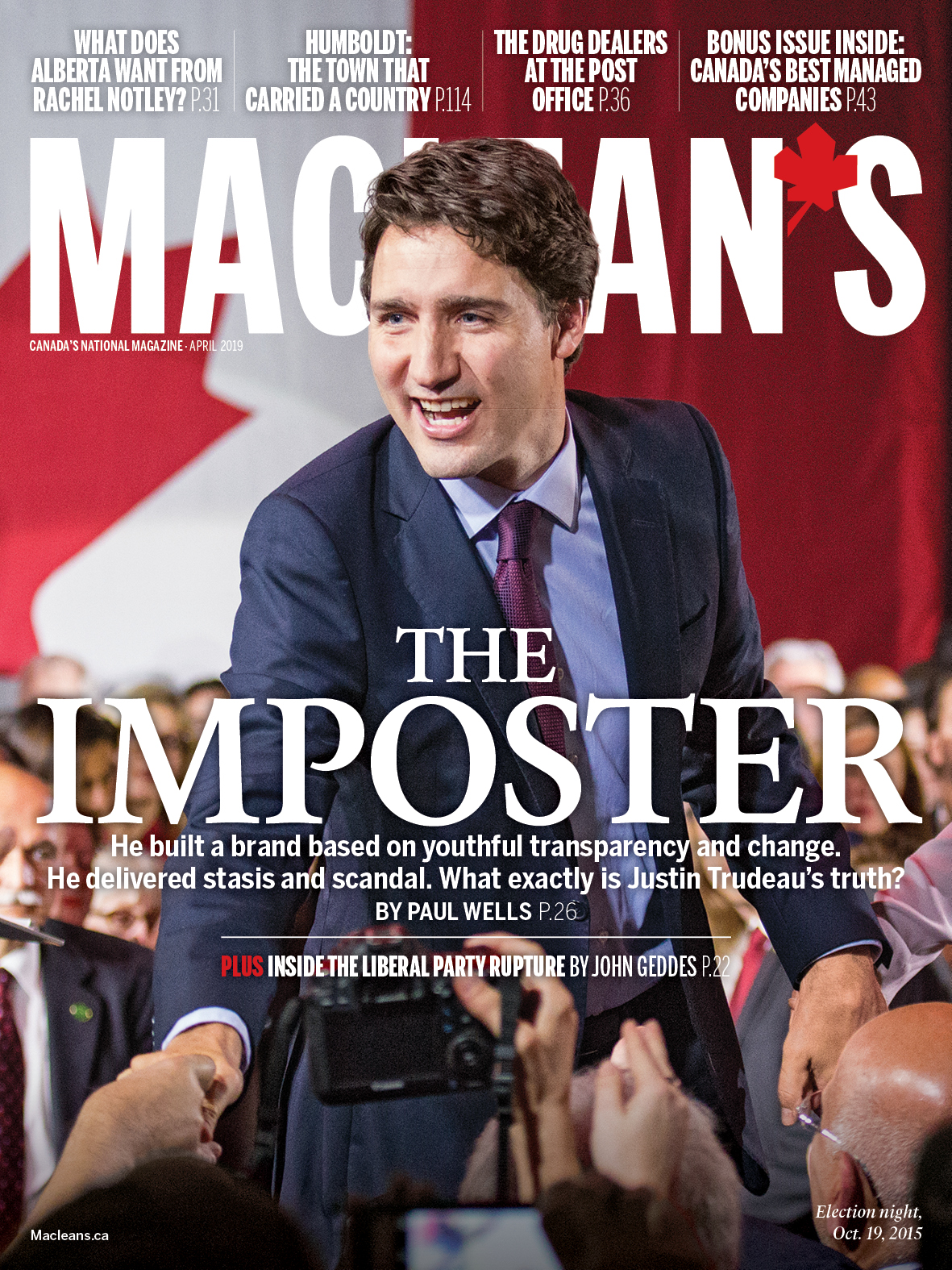
It may have been easy to miss amid the news coming out of Ottawa, but as the government lost its finance minister, appointed Chrystia Freeland to yet another job, prorogued parliament, halted testimony into its latest scandal, prepared for the announcement of a new Conservative Party of Canada leader and braced for a likely second wave of COVID-19, the prime minister promised to announce a transformative agenda. One that promises sweeping social change, and a wholesale re-invention of our economy in line with the greenest ambitions. We here at The Line have but one question.
Who the hell do these people think they are?
It is obvious to anyone who has been reading the news and possesses even residual brain function why the prime minister would like to be talking about a plan for transformative change. Talking about all the amazing things he could do for Canadians with borrowed money beats talking about his government’s bumbling of the WE file and the departure of now-former finance minister Bill Morneau.
Promising an organic chicken in every pot and a solar panel on every shed is obviously more appealing to Trudeau than repeating the last month. But it is astonishing to us — as jaded as we have undeniably become — that the government is talking about this instead of the necessary steps needed to shore up this country ahead of a likely second wave of COVID-19.
This government has a mandate to respond to the emergency, by mere unlucky virtue of being in power at the moment the virus hit. It is the duty of every Canadian government to safeguard the wellbeing of the population, full stop. But the emergency, contrary to what you may believe if you’ve been reading Liberal Party HQ memos, is not over. We have an urgent need to secure more medical equipment, to harden our long-term care facilities, to prevent any further lockdowns from derailing a fragile economic recovery, to ensure the resiliency of critical supply chains, and to shore up our health-care system. This is what every Canadian official should be focused on right now.
[…]
But can anyone maintain faith that the Liberals will stick to their knitting when we hear buzzwords like “transformative” social change? Sweeping climate-change reforms? Engineering a new green economy? They are all fine notions — let’s put them to the people and vote on them. Until calling that election is feasible (mid-pandemic, it is not) this government simply does not have the mandate to undertake such far-reaching efforts.
It’s easy to forget now, but only nine months ago this government was reduced to a minority of seats in parliament. The Liberals lost the popular vote, and saw one million of their own prior voters abandon them. They are only in government because the Conservatives, to the surprise of no one, found several novel and exciting new ways to fail.
August 14, 2020
From protests to riots to …
In the Claremount Review of Books, Angelo M. Codevilla looks at historical patterns that may prefigure what is going on in major urban areas today:
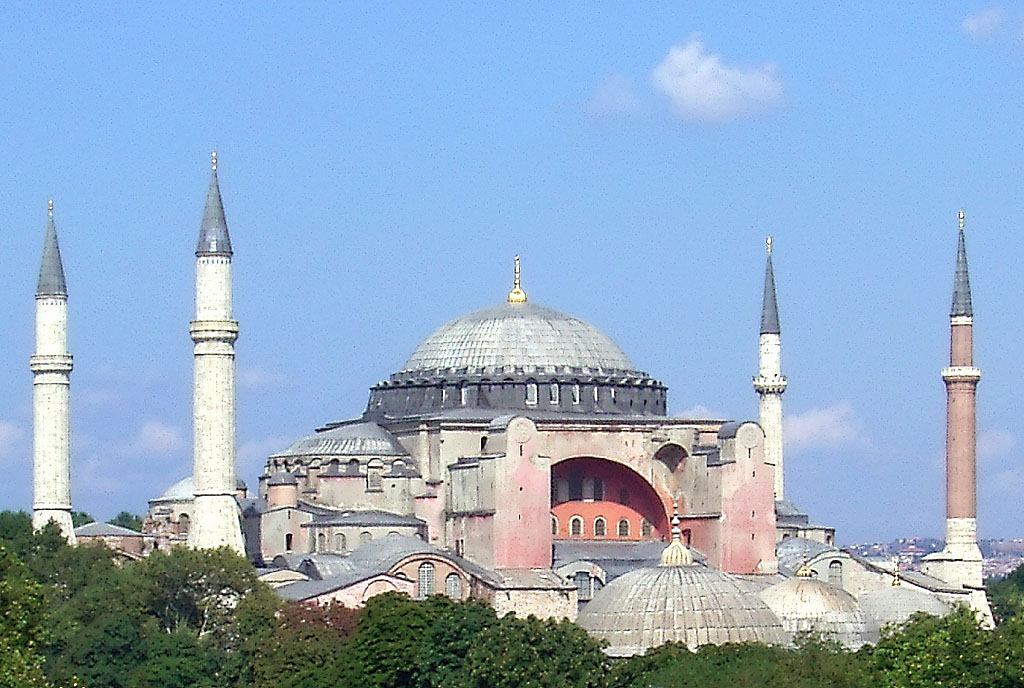
Hagia Sophia in the Faith district of Istanbul, 18 November 2004.
Photo by Robert Raderschatt via Wikimedia Commons.
The Americans who confess other people’s racism absolve themselves inexpensively by a moral mechanism common to humanity: the more I profess to hate evil, the more I showcase my own goodness. Such confessions, however, have a particular history of tragedy in Christian civilization. Again and again over the centuries, persons who have imagined themselves cleansed by ritual confessions have believed themselves elevated above the rest of humanity and, hence, entitled to oppress or even annihilate those around them. Today’s self-purifiers, arms outstretched in supine submission, who then countenance violence against persons, property, and cultural symbols, are mostly unwitting protagonists in yet another chapter of a hoary history.
Although Judeo-Christianity teaches that perfection is not of this world, nevertheless the Old Testament (see the Book of Daniel) and the New (Revelation, chapter 20) refer tangentially to a final state in human affairs in which all evil will have been defeated and the virtuous will have triumphed over their enemies. In the Book of Revelation, this final stage is to last for a thousand years. Jesus Christ’s warnings notwithstanding, people have hearkened periodically to “false prophets” who brandish the prospect of ultimate vengeance over evil. Between the 11th and 16th centuries, any number of movements of this sort used ritual confessions to cleanse themselves, and energized the mobs that waged Europe’s bloodiest wars of that age. Thereafter, though such movements secularized their terms, they fit into the same moral and intellectual categories. Now as ever, they are about destroying civilization in the name of altering the human condition.
But whereas revolutionary movements from the Middle Ages to roughly the middle of the 20th century opposed the ruling classes wholeheartedly and found no friends among them, this generation’s movements have intense, problematic relations with those classes, about which more below.
Today we see scenes of monuments which had stood for decades, now destroyed and defaced, as well as the forceful cancellation of names from circulation. Smashing others’ idols was, and remains, a staple of tribal warfare. The Old Testament recalls the divine command to destroy idols, and the clashes between Christian and Muslim armies always aimed as much at symbols as at people. The Song of Roland contains a lyrical account of Charlemagne’s iconoclasm in his campaign against the Saracens. In the 6th century, Emperor Justinian made Constantinople’s Hagia Sophia cathedral the Christian world’s biggest and most important church. The Muslims who added that city to the Ottoman Empire in 1453 killed its priests, toppled its statues, and made it into the principal mosque of the Muslim caliphate at war with Christendom. In 1923, Kemal Atatürk, Turkey’s modernizer, turned the building into a museum in order to end that war. But in July 2020 Turkey’s Islamist president Recep Erdogan, consistent with his hostility to Judeo-Christian civilization, turned it into a mosque again and began covering up what remain of the Christian frescoes on its walls. Destroying symbols, however, has had no place within Christian civilization. As the equivalent of torturing dead men, it has always been the work of cowards likelier to run from living enemies. On the other hand, war against statues, paintings, books, biographies, etc., has been a defining feature of civilization’s revolutionary enemies, consistent with their chosen identities as alien tribes.
What follows is a glance at the bloody history of this little-known flaw. It is a tale whose cautionary moral Aleksandr Solzhenitsyn best expressed: the line between good and evil runs not between persons — never mind between parties, classes, or races — but down the middle of every human heart. That is central to our civilization.
H/T to David Warren for the link.
August 9, 2020
Canadian Art magazine’s “woke suicide pact”
As a cultural barbarian and all-around Neanderthal, it will come as little surprise to both my readers that I’d never even heard of Canadian Art magazine. As a result, the recent decision to cease publication due to the unresolved (and almost certainly unresolvable) issues of needing to be funded by rich white people:
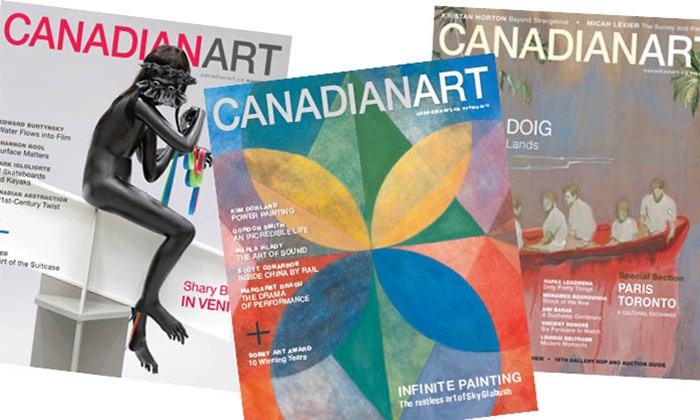
These evils were explained in a long article published by Canadian Art‘s former editor-in-chief, David Balzer (self-described “gay, fag, queer. Ambivalent Libra“), in which he complains that the progressive agenda of the magazine he edited was forever being undercut by the need to solicit funds from wealthy white donors. Or, as he describes it, the pursuit of: “white, liberal money — the champagne socialists.”
Shockingly, these donors are not especially fond an incessant slew of articles with titles such as Drop the Charges and Defund the Police, Says New Artists’ Letter for Black Lives, Give Us Permanence — Ending Anti-Black Racism in Canada’s Art Institutions, and A Crisis of Whiteness in Canada’s Art Museums.
Balzer’s analysis of the growing tension between establishment donor and do-good editor is spot on:
Most boards, which are also majority white, are [interested] in going to where they believe the money is. So the argument goes: It takes a certain talent, panache, to be president, director, or CEO, to open those pocketbooks, and without these skills, culture cannot run. This argument implies that culture cannot run if its backrooms are not white … Many corporate partners make possible the lavish, yearly fundraising galas that cultural organizations host: ostentatious displays of whiteness and wealth that are the public-facing versions of the aforementioned work done by white presidents, directors and CEOs.
It’s a problem that every charity, art outlet, and activist organization in Canada will face. Supporting the arts is rarely an act of pure altruism. It has always been a status flex by the well-connected barons and baronesses of privilege. At its most cynical, arts funding is a high-class game of reputation laundering.
August 1, 2020
“All style and no substance made it the perfect match for Trudeau”
Andrew Lawton on the Prime Minstrel’s performance in “explaining” his role in the WE scandal:
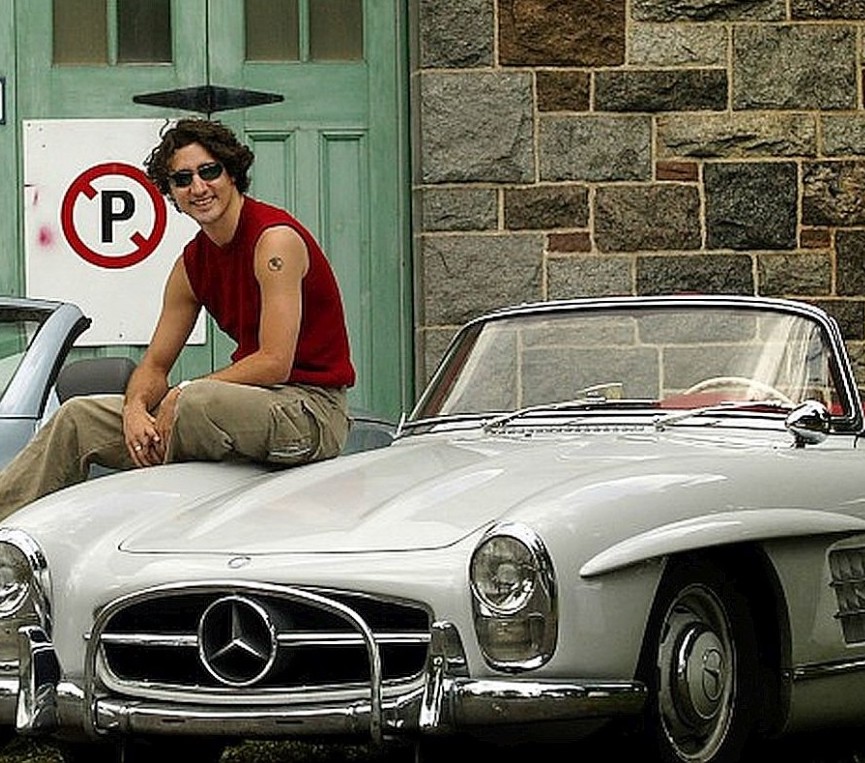
“Don’t look at me – I’m just the prime minister.”
That about sums up Justin Trudeau’s defense in a Canadian scandal starring grifters, shell corporations, virtue signallers and a federal ethics probe.
The WE-Scam, as it’s come to be known in Canadian circles, is, on its surface, a simple one.
Trudeau’s government created a $912 million government program to pay students to volunteer – formerly known as “working” if memory serves – and outsourced the administration of it to WE Charity, one of those purported international development charities more known for holding glitzy, celebrity-filled parties than digging any wells in Africa.
All style and no substance made it the perfect match for Trudeau.
WE would have netted about $44 million from the program had the government not pulled the plug amid the backlash. The charity would also have had a budget to pay teachers up to $12,000 each to funnel their students into the paid volunteer channels.
The program itself was a boondoggle, but bad policy became a scandal because Trudeau and virtually everyone in his immediate family have personal and financial connections to WE, as do at least two of his cabinet ministers, not to mention his chief of staff – all of whom say their relationships had nothing to do with WE getting the sole-sourced contract.
After weeks of ducking scrutiny from his political opponents, Trudeau made a rare appearance before the parliamentary finance committee Thursday, though his testimony was heavy on the sanctimony and light on the details.
July 13, 2020
Sarah Hoyt on noblesse oblige
In the latest edition of the Libertarian Enterprise, Sarah Hoyt explains how noblesse oblige can and is used as a tool to benefit the powerful:
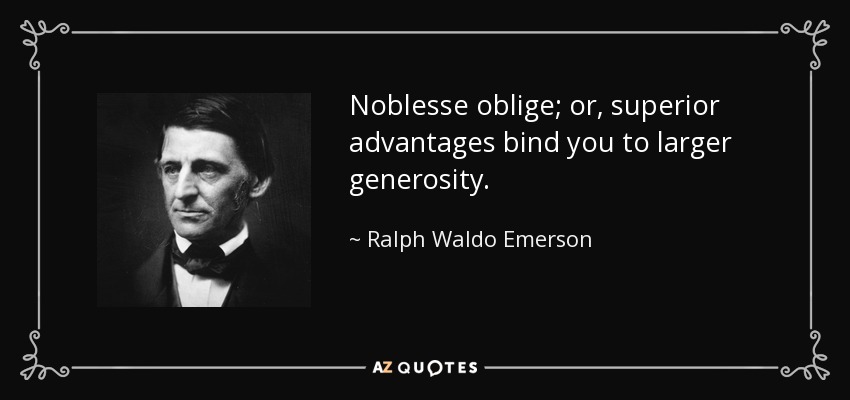
Of all the traps a culture can fall into, the fact that Americans tend to fall into Noblesse Oblige traps says very good things about us. It also doesn’t make the trap any less dangerous.
Noblesse Oblige, aka “nobility obligates” was a way that the excesses of a hierarchical society was kept in check. While the peasants were obligated to obey the nobleman, the nobleman was obligated to look after them/not put extreme demands on them/behave in certain paternalistic ways. (One of these days I need to do a post on paternalistic versus patriarchal. remind me.)
It is what is notably lacking from ideologically driven totalitarianisms and hierarchies, probably because their basis being atheistic they don’t seem the humans they have power over as being worth anything or commanding any duty from them. This is why in places like Cuba, Venezuela or China, the officials of the “democratic” government give themselves airs as long-suffering public servants while treating the people under their power worse than any of us would treat a stray animal (let alone a pet.)
In the US — where the citizen is king! — we have evolved a form of noblesse oblige best described as “Them who can, do what they can for those who can’t.”
[…]
But the noblesse oblige that affects the common individual in America is the foundation of worse traps.
Most of the idiotic compliance with ridiculous Winnie the Flu rules and restrictions hooked directly into Noblesse Oblige. For instance, the brilliant idea that you should wear masks to show you care even though we pretty much know they are completely ineffective and quite deleterious for a vast swath of people.
The idea that our kids should be forced to perform “volunteer” labor to graduate school, to “teach them to care for others.” The idea that you can always do a little more/sacrifice a little more for “those worse off” (Who often aren’t.)
When Noblesse Oblige turns into toxic altruism, it can take society apart.
Much of the “Green” mania is part of the noblesse oblige trap. They’re trying to convince us that if we just do these little things — most of them counterproductive, like, say recycling, which uses more resources and causes more issues than just using stuff — we’ll make it better for everyone.
In a bigger sense, they’re trying to make it so that we commit polite suicide so that “others live better.”
It can result in truly horrible racism, too. A great part of the left’s being convinced, say, that meritocracy is white supremacy comes from the fact that, being white, (and racist) they assume that they’re more competent than any other race, and therefore following “merit” causes white people to rise to the top.
June 17, 2020
“We don’t need no stinkin’ badges!”
Theodore Dalrymple on the use of badges within the NHS to virtue signal and compel compliance in the unwilling:
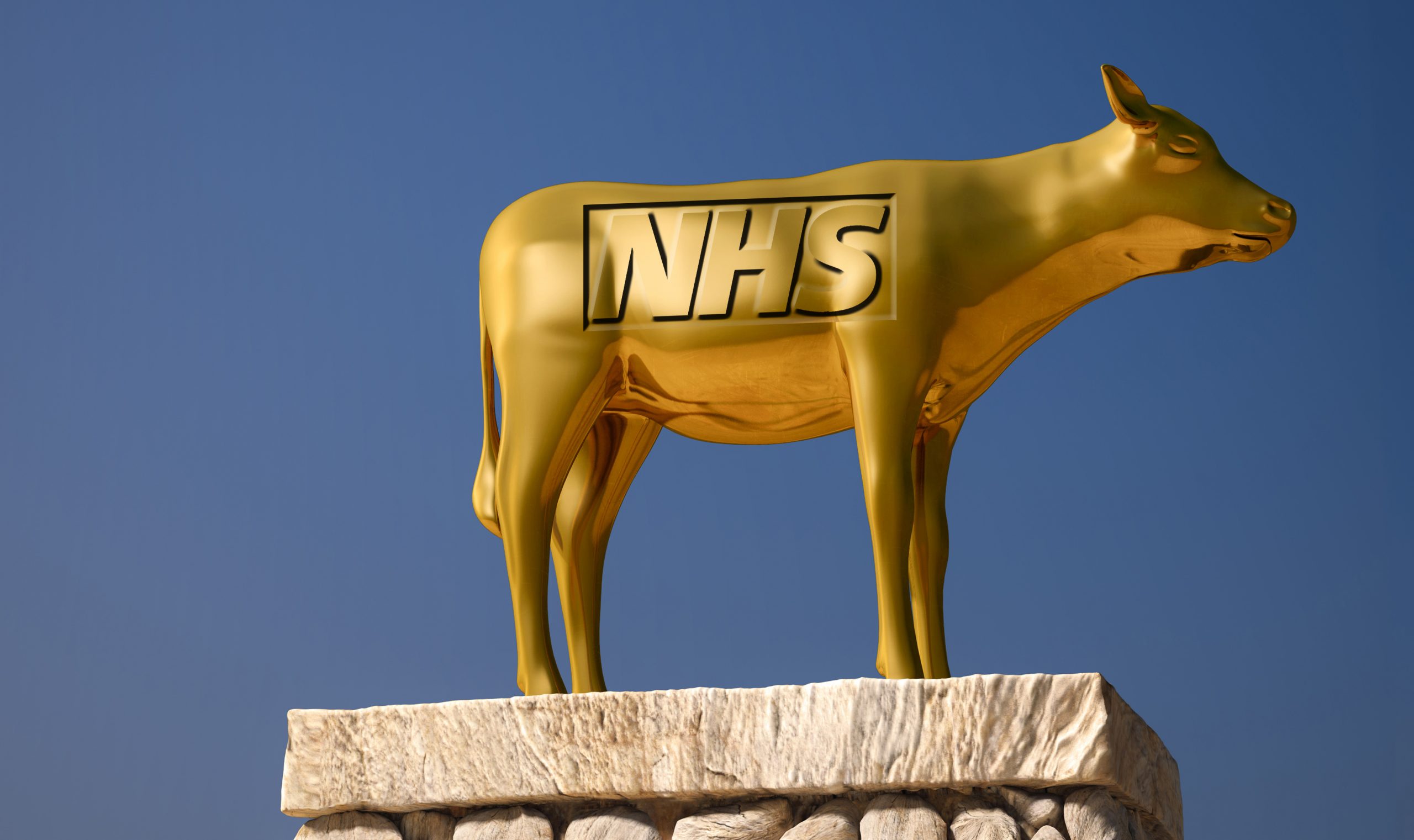
Not actually the official symbol of Britain’s National Health Services … probably.
In Britain’s highly-centralized, almost Soviet-style healthcare system, the National Health Service, staff are being encouraged all over the country to wear little rainbow-coloured metal badges to show that they are homosexual, bisexual, and transsexual-friendly, and do not discriminate against them. The wearing of these badges is voluntary, but about 3,000 of the staff of Guy’s and St Thomas’ Hospitals, for example, now wear them. The self-congratulatory website of those ancient hospitals — St. Thomas’ is over 800 years old and Guy’s was founded in 1721, now combined into one administrative unit — says:
The badges are just one way to show that Guy’s and St Thomas’ is an open, non-judgmental and inclusive place for people that identify as LGBT+ [which] stands for lesbian, gay, bisexual and transgender). The + simply means we are inclusive of all identities, regardless of how people identify themselves.
This language, which combines the unctuous with the bureaucratic, is typical of the way British hospital administrators express themselves nowadays. And if, as Buffon said, the style is the man himself, we may justly fear for a semi-totalitarian future.
By implication, the badges bully the staff, for if any of them refuse to wear one, their refusal is likely to be taken to mean that their minds are closed, judgmental (in the sense of being censorious, for even the attempt to avoid making judgments is itself based on a judgment), and exclusionary. It is to imply that they would deliberately treat any patients in the above mentioned categories differently and worse from all other patients. Wear the badge or declare yourself to be a bigot.
This is an insult to all those people who worked before the advent of the badges (or who now refuse to wear them) who strove and continue to strive always to treat patients to the best of their ability, irrespective of the many categories into which any individual patient falls. In my experience, the great majority of doctors have always tried to do this.
Let me give an example. Working as I did as a doctor in prison, I met many men who had done terrible things. I treated them, as a matter of course, to the best of my ability. I remember, for example, a man who had strangled three children and then impaled them on railings. Though I did not think he was a good man, and in that sense passed a judgment on him within the privacy of my mind, I treated him for his bronchitis exactly as I would have treated anyone else with bronchitis. I did not find this difficult in the least and do not claim any special merit for having done so, for it is only what all my colleagues in the profession did — as a matter not only of course, but of principle.
A couple of years ago, I read the diary of one of Marshal Pétain’s doctors during the latter’s imprisonment after World War II. The doctor had been a member of the Resistance and had no reason to love Pétain, to say the least: Pétain’s supporters would have had not a second thought about killing him if he had fallen into their power. Yet, as the diary makes clear, the doctor treated Pétain, who by then was demented, with the greatest humanity. Moreover, the doctor refused to publish his diary, despite the financial advantage of doing so, because he thought that publishing it would be to break patient confidentiality. It was only after his death, and more than half a century after Pétain’s, that the diary was published. The doctor’s adherence to his medical ethics was impressive, and he needed no badge to proclaim his virtue.
June 4, 2020
Trudeauvian “performative sanctimony” on display … again
Chris Selley on the Prime Minstrel’s latest attempt to virtue signal on racial issues:
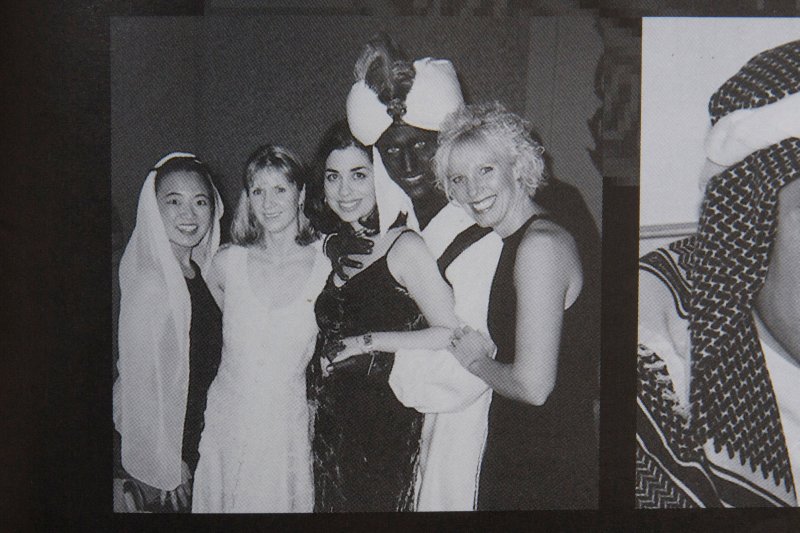
Justin Trudeau with dark makeup on his face, neck and hands at a 2001 “Arabian Nights”-themed party at the West Point Grey Academy, the private school where he taught.
Photo from the West Point Grey Academy yearbook, via Time
In agonizing for 21 seconds before answering a question about President Donald Trump’s threat to send the military after civilian protesters in American cities, Prime Minister Justin Trudeau likely risked causing as much trouble as he was hoping to avoid. Those who would like to see him denounce the president in full throat might be as annoyed as those who think he should accept there’s nothing Canada can really do to help and look out for our own best interests while the socio-political nightmare plays out.
Trudeau’s response wasn’t anything inspiring or novel or revolutionary. “It is a time for us as Canadians to recognize that we too have our challenges — that black Canadians and racialized Canadians face discrimination as a lived reality every single day,” he said. “There is systemic discrimination in Canada, which means our systems treat Canadians of colour, Canadians who are racialized, differently than they do others.”
He continued: “We need to see that, not just as a government and take action, but we need to see that as Canadians. We need to be allies in the fight against discrimination. We need to listen, we need to learn and we need to work hard to figure out how we can be part of the solution on fixing things.”
But here, at least, he was getting to the nub of the issue: To the extent the federal government can make things better for marginalized Canadians, Trudeau is the guy driving the boat. To read some of his ministers’ pensées, you would think they were just regular folks.
[…]
In the meantime, however, you can bet the farm we will soon learn that the Liberals’ changes to impaired driving laws — allowing police to stop and breathalyze drivers without any suspicion of impairment — have disproportionately affected black and Indigenous drivers in particular. Literally everybody saw it coming except Trudeau and his ministers.
OK, I’m kidding — they saw it coming too. They might want to log off, dial down the performative sanctimony and think on that a while.


