Quotulatiousness

June 1, 2025

Ted Gioia on stopping AI cheating in academia

Filed under: Britain, Education, Media, Technology, USA — Tags: , , , — Nicholas @ 03:00

I’ve never been to Oxford, either as a student or as a tourist, but I believe Ted Gioia‘s description of his experiences there and how they can be used to disrupt the steady take-over of modern education by artificial intelligence cheats:

How would the Oxford system kill AI?

Once again, where do I begin?

There were so many oddities in Oxford education. Medical students complained to me that they were forced to draw every organ in the human body. I came here to be a doctor, not a bloody artist.

When they griped to their teachers, they were given the usual response: This is how we’ve always done things.

I knew a woman who wanted to study modern drama, but she was forced to decipher handwriting from 13th century manuscripts as preparatory training.

This is how we’ve always done things.

Americans who studied modern history were dismayed to learn that the modern world at Oxford begins in the year 284 A.D. But I guess that makes sense when you consider that Oxford was founded two centuries before the rise of the Aztec Empire.

My experience was less extreme. But every aspect of it was impervious to automation and digitization — let alone AI (which didn’t exist back then).

If implemented today, the Oxford system would totally elminate AI cheating — in these five ways:

(1) EVERYTHING WAS HANDWRITTEN — WE DIDN’T EVEN HAVE TYPEWRITERS.

All my high school term papers were typewritten — that was a requirement. And when I attended Stanford, I brought a Smith-Corona electric typewriter with me from home. I used it constantly. Even in those pre-computer days, we relied on machines at every stage of an American education.

When I returned from Oxford to attend Stanford Business School, computers were beginning to intrude on education. I was even forced (unwillingly) to learn computer programming as a requirement for entering the MBA program.

But during my time at Oxford, I never owned a typewriter. I never touched a typewriter. I never even saw a typewriter. Every paper, every exam answer, every text whatsoever was handwritten—and for exams, they were handwritten under the supervision of proctors.

When I got my exam results from the college, the grades were handwritten in ancient Greek characters. (I’m not making this up.)

Even if ChatGPT had existed back then, you couldn’t have relied on it in these settings.

(2) MY PROFESSORS TAUGHT ME AT TUTORIALS IN THEIR OFFICES. THEY WOULD GRILL ME VERBALLY — AND I WAS EXPECTED TO HAVE IMMEDIATE RESPONSES TO ALL THEIR QUESTIONS.

The Oxford education is based on the tutorial system. It’s a conversation in the don’s office. This was often one-on-one. Sometimes two students would share a tutorial with a single tutor. But I never had a tutorial with more than three people in the room.

I was expected to show up with a handwritten essay. But I wouldn’t hand it in for grading — I read it aloud in front of the scholar. He would constantly interrupt me with questions, and I was expected to have smart answers.

When I finished reading my paper, he would have more follow-up questions. The whole process resembled a police interrogation from a BBC crime show.

There’s no way to cheat in this setting. You either back up what you’re saying on the spot — or you look like a fool. Hey, that’s just like real life.

(3) ACADEMIC RESULTS WERE BASED ENTIRELY ON HANDWRITTEN AND ORAL EXAMS. YOU EITHER PASSED OR FAILED — AND MANY FAILED.

The Oxford system was brutal. Your future depended on your performance at grueling multi-day examinations. Everything was handwritten or oral, all done in a totally contained and supervised environment.

Cheating was impossible. And behind-the-scenes influence peddling was prevented — my exams were judged anonymously by professors who weren’t my tutors. They didn’t know anything about me, except what was written in the exam booklets.

I did well and thus got exempted from the dreaded viva voce — the intense oral exam that (for many students) serves as follow-up to the written exams.

That was a relief, because the viva voce is even less susceptible to bluffing or games-playing than tutorials. You are now defending yourself in front of a panel of esteemed scholars, and they love tightening the screws on poorly prepared students.

(4) THE SYSTEM WAS TOUGH AND UNFORGIVING — BUT THIS WAS INTENTIONAL. OTHERWISE THE CREDENTIAL GOT DEVALUED.

I was shocked at how many smart Oxford students left without earning a degree. This was a huge change from my experience in the US — where faculty and administration do a lot of hand-holding and forgiving in order to boost graduation rates.

There were no participation trophies at Oxford. You sank or swam — and it was easy to sink.

That’s why many well-known people — I won’t name names, but some are world famous — can tell you that they studied at Oxford, but they can’t claim that they got a degree at Oxford. Even elite Rhodes Scholars fail the exams, or fear them so much that they leave without taking them.

I feel sorry for my friends who didn’t fare well in this system. But in a world of rampant AI cheating, this kind of bullet-proof credentialing will return by necessity — or the credentials will get devalued.

(5) EVEN THE INFORMAL WAYS OF BUILDING YOUR REPUTATION WERE DONE FACE-TO-FACE — WITH NO TECHNOLOGY INVOLVED

Exams weren’t the only way to build a reputation at Oxford. I also saw people rise in stature because of their conversational or debating or politicking or interpersonal skills.

I’ve never been anywhere in my life where so much depended on your ability at informal speaking. You could actually gain renown by your witty and intelligent dinner conversation. Even better, if you had solid public speaking skills you could flourish at the Oxford Union — and maybe end up as Prime Minister some day.

All of this was done face-to-face. Even if a time traveler had given you a smartphone with a chatbot, you would never have been able to use it. You had to think on your feet, and deliver the goods with lots of people watching.

Maybe that’s not for everybody. But the people who survived and flourished in this environment were impressive individuals who, even at a young age, were already battle tested.

May 29, 2025

“Kollidge Inglish Majors kan so reed gud!”

Filed under: Education, Media, USA — Tags: , , — Nicholas @ 03:00

On Substack, Kitten provides a sample of the many, many, many, many reactions to an earlier viral piece called College English majors can’t read:

I think it’s safe to say that “lack of funding” isn’t the problem

Well, that was a wild ride. As of the time of this writing, College English majors can’t read has 120,000 views and 535 comments. Comments and restacks are still rolling in but not at the furious pace they were in the few days after publication. It went viral on twitter, with my tweet announcing the article getting 768 retweets and 1.5M views, with thousands of comments spread across various quote tweets. It was shared to Reddit in several different threads, many of which themselves spawned hundreds of comments. It went viral on Hacker News. It was shared on Vox Day. It was published on Revolver News. Hundreds of people linked it in their Instagram and Facebook posts. A bunch of people shared it on Slack or Microsoft Teams. And most endearing of all, thousands of people forwarded the newsletter around by email like an AOL chain letter from your grandma (Fwd:Fwd:Re:Fwd: You won’t BELIEVE what they are teaching in college now!!!!)

[…]

The people have spoken, and they speak in a single clear voice: they want to hear about how dumb college kids are. They want to bathe in delicious schadenfreude. They want all the embarrassing and gory details about how Suzie in Kansas couldn’t figure out what a megalosaurus is, how heavily she breathed during the 16 seconds she tapped Google searches into her phone before giving up. And their bloodlust will be slaked one way or another.

[…]

The title is inaccurate, college kids can read fine

I got this comment a bunch of different times, and I think that one particular guy made the same comment at least four different times that I saw, in different places. Basically, this nitpicking goes: these kids can read just fine, they just have trouble understanding and interpreting hard texts, and this means the title is sensational and not literally true. This is a fair point, and I deeply treasure our nation’s strategic reserve of turbospergs ready to call out technical inaccuracies wherever they rear their ugly heads. I should note for the turbospergs reading this that “rearing their ugly heads” is figurative language, article titles do not have bodies and do not move, you have me dead to rights on that one.

But most readers were quick to chide the spergs that this is an article about different levels of functional literacy, and that “read” can have different connotations depending on the context. Obviously we’re talking about more than just sounding out the words on the page in this case. And also, College English majors can’t read is just a much better title than the long but more technically accurate one you would have me write instead.

The study is bad and you can’t believe its results

A lot of people made this comment in one form or another, for a variety of reasons. If you want to read a detailed takedown, I suggest this long post by Holly MathNerd. She has a lot of different objections about the methodology and how the results generalize to the population of college kids. It’s worth reading and taking seriously if you’re the scientific minded type, she knows what she’s talking about.

One very large objection that should give you pause: there are multiple layers of potential selection bias taking place. We’re looking at just a couple schools in Kansas at a single point in time, not a nationally representative sample of students. These aren’t exactly top-tier schools, of course they don’t have the best kids! And worse, they recruited study participants the way they always recruit undergrads for this kind of study, by asking for volunteers in class or even by hand-selecting students and encouraging them to join up. This means the researchers weren’t getting a random sample of their students, they were getting the kids who were dumb enough to waste their time on a silly research task. Or even worse: they picked problematic kids on purpose to prove a point.

This is a fair criticism, and I don’t want to minimize it, but I don’t think it ultimately matters much. The reason is that we know how these kids tested on the ACT Reading subtest and how that compares to the national standard.

    The 85 subjects in our test group came to college with an average ACT Reading score of 22.4

The national average for college students on the ACT Reading subtest is 21.2, so these kids are a bit above average nationally. (20 to 23 is considered a competitive score for admission to most schools, with 24 to 28 being the standard for more selective schools). This is reasonably strong evidence that they are not significantly dumber than typical college students nationwide. Maybe not representative, sure, but certainly not dumber than average.

And despite being competitive for admission according to Educational Testing Service, 22.4 is not a good score!

    According to Educational Testing Service, [students with a score of 22.4] read on a “low-intermediate level”, able to answer only about 60 percent of the questions correctly and usually able only to “infer the main ideas or purpose of straightforward paragraphs in uncomplicated literary narratives”, “locate important details in uncomplicated passages” and “make simple inferences about how details are used in passages”

So maybe these results don’t actually generalize to students nationwide, maybe this wasn’t a fair sample. But if you’re skeptical on the question of generalization, another way to view this study is as an ethnography rather than a quantitative result — the researchers discovered and documented a group of college English majors with truly terrible reading comprehension. Whether or not this result generalizes to college kids everywhere, these particular kids exist. And they can’t read. Personally I think the ethnographic details are what make this study so evocative, and I wish more research took this form. My hunch is nobody would be talking about this at all without these details — distilled down to a raw quantitative result (half of kids score below median on test, news at 11), nobody would care.

April 15, 2025

QotD: PhD delusions of (universal) competence

Filed under: Education, Quotations, USA — Tags: , , , , , — Nicholas @ 01:00

My guess – and this is only a guess – is that it’s part of their comprehensive delusion of competence. Just as your Basic College Girl assumes that her 1100 (or whatever slightly-above-average is now) SAT score makes her a genius without portfolio, so those with PhDs assume that their sheepskin is proof that they can master any subject they put their minds to. It’s not that rude mechanicals like plumbers and whatnot are doing something they can’t; they’re doing something they shouldn’t have to, by virtue of their superior intellects and social standing (that the same people who assume trade labor is for dirty, sweaty, smelly proles are also the most vocal champions of The Working Class™ is so ironic, Alanis Morissette must be weeping salty tears of joy right now, is infuriating but irrelevant).

And the delusion of competence is truly a thing to behold. They expend enormous effort in maintaining it. Just as the “gender is just a social construction” feminist somehow retains her belief in this every time she has to call the stock boy over to help her lift the can of economy-sized kitty litter, so the other eggheads shrug it off when they have to call in tradesmen to perform the simplest household maintenance. I think I’ve told this story before, but it’s worth repeating as an illustration:

Back in grad school, I was invited to a back-to-school shindig at the Department Chair’s house. She made sure to tell us that the only toilet in the house (she lived in a breathtakingly restored Victorian; it must’ve cost close to a million all in) wouldn’t work unless you followed the elaborate five-step process she and her “domestic partner” had worked out over months of trial and error. Said process was helpfully taped on the tank lid for us. They were on the plumber’s list, she said, but it would be a while (“you know how those people are,” wasn’t stated outright, but very clearly, sneeringly implied).

I had few beers, the inevitable happened, and so I meandered upstairs to throw a whiz. After zipping up, I followed the elaborate handle-jiggling procedure … and, well, look, y’all, I’m far closer to those helpless eggheads than I am to Mr. Fix-it. I have ten thumbs, and thank god I never had to do one of those “spatial rotation” tasks for real back in grade school, or they’d have stuck me on the short bus. But even I know when a toilet float bobber is stuck. So I lifted the lid, turned the little screw, flushed twice more to double-check my handiwork, and went back downstairs to report my success …

They looked at me like I’d just contracted leprosy, y’all. Instead of being happy that I’d saved them a lot of effort, not to mention a fair amount of money, they were disgusted. I mean, I’d done a menial’s job. With my hands. On the one hand, I suppose it was proof that people with PhDs can master very, very, very basic plumbing. But on the other … eeeeewwww. I was a class traitor!

Severian, “Gettin’ Jiggy in College Town”, Founding Questions, 2021-10-08.

April 11, 2025

QotD: Teaching in modern universities

Leys’s essays often combine delicacy with deep irony — a combination that few writers, especially in our times of stridency and parti pris, achieve. Here, for example, is the beginning of his essay “An Introduction to Confucius”: “If we consider humanity’s greatest teachers of wisdom — the Buddha, Confucius, Socrates, Jesus — we are struck by a curious paradox: today, not one of them could obtain even the most modest of teaching posts in any of our universities”. We laugh — which, of course, is the best tribute to the seriousness of the point that he is making. He goes on to explain, “The reason is simple: their qualifications are insufficient — they have published nothing”.

In two sentences, Leys has pinned, like a butterfly to an entomologist’s board, the bureaucratic sickness that has overtaken our institutions of higher learning (and not only those institutions). There is no madness more difficult to treat than that which believes itself sane, and there is no irrationality greater than that which believes itself perfect. It is no surprise that Leys retired early from his university chair because the university no longer bore any resemblance to what it had once been and misled students and the rest of society into believing it still was. A community of scholars had become an organization of foremen on a production line.

Theodore Dalrymple, “Rare and Common Sense”, First Things, 2017-11.

April 3, 2025

QotD: When the History Department at Flyover State committed slow motion suicide

Filed under: Education, History, Politics, Quotations, USA — Tags: , , , , — Nicholas @ 01:00

It started when they hired a radical feminist lesbian. Radical by ivory tower standards, I mean, which as you can imagine is a bar so high, Mt. Everest could limbo under it without breaking a sweat. This was the kind of “scholar” whose work was like that dude we mentioned a while back, who claimed that the US Civil War was really about “gay rights” — something that’s not merely wrong, but impossible, as the mid-19th century lacked the conceptual vocabulary to even suggest such a thing. In other words, they hired this persyn to be professionally obnoxious, and xzhey were happy to oblige.

Now, you have to understand something about the academy at this point: Though these people are profoundly ideologically enstupidated, they’re still pretty cunning where their wallets are concerned. Indeed, that’s the whole reason they allow “scholarship” on left-handed LatinX truck drivers in the Ming Dynasty or whatever that persyn’s book was, to pull that kind of stunt — only “original” “research” gets published, and since all the true facts have been ascertained long ago, you have to make shit up if you want tenure. Publish or perish, baby!

A clever plan, but with one teensy tiny flaw: “Tenure” requires a university, and universities require students, which means that, while pretty much all professors hate teaching, they have to do it … and not only that, they have to actually appeal to those icky little deplorables, the students, in sufficient numbers to keep the faculty employed. If, back in your own college days, you wondered if maybe the only reason Western Civ I or whatever was required was that it gave Professor Jones something to do, congrats, you were right. But you can’t require History majors, and there’s only enough Western Civ to go around, which means you have to have 200- through 400-level classes that students actually want to take …

You can see where this is going, and to their credit, some of the faculty at Flyover State saw it, too. At the time, there were still enough upperclassman History majors (and grad students) that the class on LatinX truck drivers in the Ming Dynasty would fill … barely … but that situation obviously would not continue. Nor could you simply stick the new hire in Western Civ classes, because in addition to the other obvious problems, of course xzhey would immediately turn “Western Civ I” into “LatinX truck drivers in the Ming Dynasty … and maybe, if there’s time, the Roman Empire or some shit.”

You know what the Department ended up doing (hint: nothing), and so the first semester after the new hire went exactly like you knew it would. And so did the next, and the next, because as we all know, chicks of both sexes and however-many-we’re-up-to-now genders are herd animals. Hiring the radical lesbian gave all the slightly-less-radical lesbians, again of both sexes and however-many genders, permission to let their freak flag fly. Which, of course, they did. Pretty soon you couldn’t find a History class that wasn’t some bizarre, micro-specialized SJW mad lib. Sure, they’d still call it “The US in the Civil War Era” or “Modern Germany” or whatever, but the course description made it perfectly clear that the class was really about transsexual cabaret acts on the New York Bowery … and maybe, if there’s time, secession or some shit.

And soon enough there were no more History majors, and thus no more History Department. At one of the small schools that collectively make up “Flyover State”, the former History, Psychology, and Classics departments have been folded into something called the “Humanities Department” … to which, last I heard, the former English Department will soon be added.

Severian, “The Dunbar Problem”, Founding Questions, 2021-10-06.

March 28, 2025

Mistaking popular fiction for real life

Filed under: Britain, Media, Politics, USA — Tags: , , , , , , — Nicholas @ 05:00

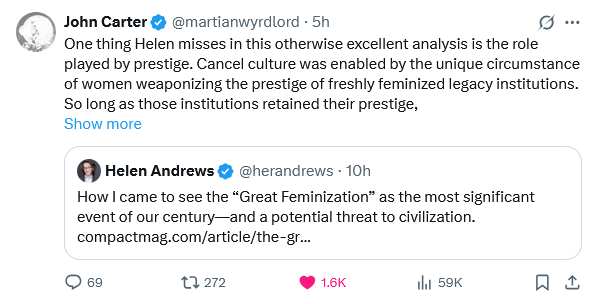
At Postcards from Barsoom, John Carter recounts an odd but revealing experience with a young progressive entity:

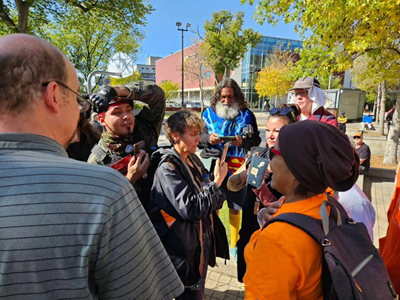
Image by Paul Jackson

Some years ago I was provided a fascinating psychological experience in the form of a young graduate student in the English literature program, whom I encountered because they (you heard me) was (God that’s grammatically awkward) married to a colleague. She (I’m not doing this anymore) specialized in the study of propaganda, by which of course she meant everything her backwards conservative parents in Nowhere, Nebrahoma believed, and not anything she believed. One evening, after enthusiastically explaining the symbolism of the inverted pentagram tattooed on her shoulder, she informed me with invincible confidence that not only was gender an arbitrary social construction, but that even the idea of biological sex was nothing more than convention. Her reasoning, which I presume she’d gleaned from a seminar on radically liberatory queer theory, was that testosterone levels fluctuated during the day, so “males” changed their degree of “maleness” all the time, and how can something that’s constantly changing be used as the basis for a hard binary distinction?

“But that’s not how biological sex is defined,” I replied. “Testosterone is just a hormone. It’s only present in vertebrates. Insects don’t have it, and neither do plants, but they still have biological sex. Sex is defined according to whether an organism produces mobile gametes or sessile gametes, which is basically universal across multicellular life forms.”

“I don’t understand what that means,” she chirped, still thinking we were playing language games. “Like I don’t know what a ‘sessile gamete’ is.”

“Oh,” I responded helpfully, “A gamete is just a reproductive cell. Sessile means it doesn’t move. So –”

The horrible reality of what I was saying dawned upon her. “I just realized that this isn’t a conversation I should be having,” she cut me off, and walked away.

It was remarkable. The mindworm parasitizing her consciousness had detected a threat to its structural integrity, and ordered its host to remove herself from the interaction before she consumed a malinformative infohazard. She didn’t even pretend that this wasn’t what she was doing. I’d never before seen something quite like it.

There’s a long-standing joke that liberals don’t know things, that their entire worldview seems to be formed by the ersatz experiences of visual entertainment. When they discuss the war in Ukraine, they express it in terms of Marvel comic book movies or Star Wars; when thinking of President Trump, in terms of Harry Potter. Black people are all wise and benevolent and great dancers because this is what Fresh Prince and Morgan Freeman told them; white men are all inbred stupid Klansmen because of Mississippi Burning and Roots; girls are just as strong as boys (stronger, actually) because Black Widow kicks butt; and so on. Even their favourite point of historical reference – World War Two, the Nazis, Hitler – seems to be almost entirely a palimpsest of Steven Spielberg movies like Saving Private Ryan and Schindler’s List.

It isn’t just that they use fictional references as metaphors or allusions. That’s a very human thing to do, and the right is certainly no stranger to Tolkien analogies. But liberals seem to do this a lot, with only the most tenuous connection back to reality. Their inner world is a series of self-referential fantasies. The right uses fictional references as metaphors to explain facts; the left substitutes fictional metaphors for facts, and then forgets that it does this.

The recent Netflix drama Adolescence is a striking case in point. It portrays the fictional story of a 13-year-old white boy who stabs a female classmate to death because his brain was twisted into a pretzel by exposure to the incel subculture over social media. Following its premier, the British government has been using it to gin up a moral panic, with calls to censor social media to tackle the urgent problem of toxic masculinity.

March 24, 2025

QotD: Communism and western intellectuals

Filed under: China, History, Politics, Quotations — Tags: , , , — Nicholas @ 01:00

It is a curious fact that Communist dictatorships were at their most popular among Western intellectuals while they still had the courage of their brutality. Once they settled down to gray, everyday oppression and relatively minor acts of violent repression (judged, of course, by their own former high, or low, standards in this respect), they ceased to attract the extravagant praises of those intellectuals who, in their own countries, regarded as intolerable even the slightest derogation from their absolute freedom of expression. It is as if not dreams but totalitarian famines and massacres acted as the Freudian wish fulfillment of these Western intellectuals. They spoke of illimitable freedom, but desired unlimited power.

Mao Zedong was the blank page or screen upon which they could project the fantasies that they thought beautiful. China was a long way off, its hundreds of millions of peasants inscrutable but known to be impoverished and oppressed by history; its culture was impenetrable to Westerners without many years of dedicated and mind-consuming study; Western sinologists, almost to a man, upheld the Maoist version of the world, some of them for fear of losing their access to China if they did not, and thereby created the impression that Maoism was intellectually and morally respectable; and so perfect conditions were laid for the most willing and total suspension of disbelief. Mao’s Thoughts — that is to say, clichés, platitudes, and lies — were treated by intelligent and educated people as if they were more profound, and contained more mental and spiritual sustenance, than Pascal’s. As so often before, mere reality as experienced by scores of millions of people was of little interest to intellectuals by comparison with the schemata in their minds and their own self-conception. “Let the heavens fall so long as I feel good about myself” was their motto. One didn’t know whether to laugh or cry.

Theodore Dalrymple, “Rare and Common Sense”, First Things, 2017-11.

March 22, 2025

“Humiliate yourself before us,” I was being told, “And we still won’t hire you, lol”

Filed under: Cancon, Education, Media, Politics, USA — Tags: , , , , , — Nicholas @ 05:00

The accelerating downfall of the academic-political complex is the subject of John Carter’s most recent post at Postcards from Barsoom:

University College, University of Toronto, 31 July, 2008.
Photo by “SurlyDuff” via Wikimedia Commons.

Look. In any given case, for any given scientist working inside the university system, there are exactly two possibilities.

One: they embraced all of this with cheerful, delirious, evangelical enthusiasm. Religious devotees of the unholy cause of converting every institution to the One False Faith of Decay, Envy, and Incompetence, they have spent the last decade or more enforcing campus speech codes, demanding inclusive changes to hiring policies, watering down curricular requirements to improve retention of underrepresented (because underperforming) equity-seeking demographics, forcing their research collaborations to adopt codes of conduct, and mobbing any of their colleagues who voiced the mildest protest against any of this intellectual and organizational vandalism.

Two: they had reservations, but went along with it all anyhow because what were they to do? They needed jobs; they needed funding; and anyhow they didn’t go into STEM to fight culture wars. As the article says, “They’d prefer to just get back to the science,” and the easiest way to get back to the science was to just go along with whatever the crazies were demanding. Even if the crazies were demanding that they abandon any pretense of doing actual science.

The first group are enemies.

The second are cowards.

Both deserve everything they get.

And I am going to enjoy every moment of them getting it.

Look, I am going to vent here a bit, okay? Because the mewling in this article succeeded in getting under my skin.

Not long ago I was considered a promising early career scientist, with an excellent publication record for my field, a decent enough teaching record, and all the rest of it. After several years as a semi-nomadic postdoc – which had followed several years as a semi-nomadic graduate student – it was time to start looking for faculty positions. My bad luck: Fentanyl Floyd couldn’t breathe, and the networked hive consciousness of eggless harpies infesting the institutions was driven into paroxysms of preening performative para-empathy.

What this meant was two things. First, more or less every single university started demanding ‘diversity statements’ be included in faculty application packages, alongside the standard research statements, teaching statements, curriculum vitae, and publication list. The purpose of the diversity statement was to enable the zampolit in HR and the faculty hiring committee to evaluate the candidate’s level of understanding of critical race theory, gender theory, intersectionality, and all the rest of the cultural Marxist anti-knowledge; to identify candidates who had already made contributions to advancing diversity; and to identify candidates who had well-thought-out ten-point plans to help advance the department’s new core principle and overriding purpose, that being: diversity.

The second thing it meant was that hiring policies now implicitly – in the United States – and explictly (in Canada) mandated diversity as an overriding concern in hiring. As everyone knows, this means that if you’re a heterosexual cisgendered fucking white male, you are not getting hired.

In other words, I was now expected to write paeans praising the very ideology that had erected itself as an essentially impermeable barrier to my own employment, pledging to uphold this ideology myself and enforce it against others who look like me. “Humiliate yourself before us,” I was being told, “And we still won’t hire you, lol.”

Having some modicum of self-respect, I refused to go along with this. This meant that I simply could not apply for something like 90% of the available positions. And when I did apply to positions that didn’t require a diversity statement, and successfully got an interview, guess what? One of the first questions out of the mouth of one of hiring committee members would be “what will you do for diversity”, or “I see you didn’t mention diversity in your teaching statement …” See, even if it isn’t mandated by the administration, that doesn’t stop the imposter-syndrome-having activist ladyprofs from insinuating the diversity test on their own initiative. I once had a dean, a middle-aged Hispanic woman, tell me “women in science are very important to me” right at the beginning of the interview; I very nearly got that job, because everyone on the committee wanted me, but later – after they inexplicably ghosted – found out that she’d nixed it. They just didn’t hire anyone.

Right around the same time, of course, we were in the thick of the COVID-19 scamdemic. You remember, the one that was just the flu, bro, until it became the new Black Death that definitely did not come from a laboratory shut up you conspiracy theorist; which couldn’t be stopped by masks so don’t be silly until suddenly masks were the only thing that could save you; which led to us all being locked in our houses for a year because some idiot wrote a Medium article called “the dance of the hammer with your soft skull” or whatever which then went viral inside the hysterosphere; which motivated the accelerated development of a novel mRNA treatment that no one was going to get because you couldn’t trust the Evil Orange Man’s bad sloppy science until suddenly it was safe and effective and then overnight absolutely mandatory and anyone who refused to take it should be sent to a camp.

Yeah, remember that?

I guarantee you that every single credentialed scientist in that article was on board for all of it.

How do I know this?

Because they all were.

QotD: The Dunbar Number in the ivory tower

Filed under: Education, Quotations, USA — Tags: , , — Nicholas @ 01:00

As we know, college people are all Leftists, and if Leftists were capable of seeing the skull-fuckingly obvious consequences of their actions, they wouldn’t be Leftists. But I think it’s actually more basic than that. The answer, I submit, involves the Dunbar Number [link], which I’m using as a stand-in for the network of personal relationships that defines any bureaucracy.

Leave your logical brain aside for a second — I’ll pause, to let you pound as many shots as necessary — and think like a chick. Declining enrollment numbers are just a line on a graph. Indeed, the students themselves are mostly an abstraction — professors hate teaching and avoid it whenever possible, which, thanks to grad students, research sabbaticals, and the like, is fairly often. But that radical-even-by-academic-standards lesbian? She’s right there. All the time.

If you’ve never been inside the ivory gulag, it’s hard to convey just how tiny and all-encompassing that world is, but I’ll try. Imagine you’re just out of school and living with two roomies (for the one or two young folks who might still remain among the readership: It was once considered a good thing to move away from home, so much so that even if they had the opportunity to live in Mom’s basement after graduation — even if it would make great financial sense to do so — young folks would endure quite a bit of deprivation in order to make their own way in the world. This often necessitated living in crappy apartments in a dodgy part of town with one or more roommates, for several years). Your roomies do what young guys do — sometimes their girlfriends move in; sometimes they move out; sometimes their friends crash on the couch — but here’s the kicker: Everyone involved does the same job at the same company, such that you’re effectively always at work. Anything you do at “home” gets brought into the office, because everyone you live with — and everyone you could potentially ever live with — is there.

Imagine living life like that. That’s the ivory tower.

Severian, “The Dunbar Problem”, Founding Questions, 2021-10-06.

March 19, 2025

The Trumpocalypse – “The outlook for universities has become dire”

Filed under: Education, Media, Politics, USA — Tags: , , , , , — Nicholas @ 05:00

John Carter suggests that American higher education needs to find a new funding model that doesn’t depend on governments to shower their administrative organizations with unearned loot:

Shortly after taking power, the Trump administration announced a freeze on academic grants at the National Science Foundation and the National Institute for Health. New grant proposal reviews were halted, locking up billions in research funding. Naturally, the courts pushed back, with progressive judges issuing injunctions demanding the funding be reinstated. Judicial activism has so far met with only mixed success: the NSF has resumed the flow of money to existing grants, but the NIH has continued to resist. While the grant review process has been restarted at the NSF, the pause created a huge backlog, resulting in considerable uncertainty for applicants.

The NIH has instituted a 15% cap to indirect costs, commonly referred to as overheads. This has universities squealing. Overheads are meant to offset the budgetary strain research groups place on universities, covering the costs of the facilities they work in – maintenance, power and heating, paper for the departmental printer, that kind of thing. Universities have been sticking a blood funnel into this superficially reasonable line item for decades, gulping down additional surcharges up to 50% of the value of research grants, a bounty which largely goes towards inflating the salaries of the little armies of self-aggrandizing political commissars with titles like Associate Vice Assistant Deanlet of Advancing Excellence who infest the flesh of the modern campus like deer ticks swarming on the neck of a sick dog. Easily startled readers may wish to close their eyes and scroll past the next few images btw, but I really want to make this point here. When you look at this:

A 15% overhead cap, if applied across the board, has an effect on the parasitic university administration class similar to a diversity truck finding parking at a German Christmas market. Thoughts and prayers, everyone.

Meanwhile at the NSF, massive layoffs are ongoing, and there are apparently plans to slash the research budget by up to 50%. While specific overhead caps haven’t been announced at the NSF yet, there’s every reason to expect that these will be imposed as well, compounding the effect of budget cuts.

There is no attempt to hide the motivation behind the funding freeze, which is obvious to both the appalled and the cuts’ cheerleaders. Just as overheads serve as a blood meal for the administrative caste, scientific research funding has been getting brazenly appropriated by political activists at obscene scales. A recent Senate Commerce Committee report found that $2 billion in NSF funding had been diverted towards DEI promotion under the Biden administration. In reaction to this travesty, as this recent Nature article notes, there are apparently plans to outright cancel ongoing grants funding “research” into gay race communism. DEI programs, formerly ubiquitous across Federal agencies, have already been scrubbed both from departmental budgets and web pages. Indeed, killing those programs was one of the first actions of the MAGA administration.

The outlook for universities has become dire, and academics have been sweating bullets all over social media. Postdocs aren’t being hired, faculty offers are being rescinded, careers are on hold, research programs are in limbo. This comes at the same time that budgets are being hit by declining enrolment due to the demographic impact of an extended period of below-replacement fertility along with rapidly declining confidence in the value of university degrees, with young men in particular checking out at increasing rates as universities become tacitly understood as hostile feminine environments. They’re hitting a financial cliff at the same point that they’ve burned through the sympathy of the general public.

The entire sector is in grave danger.

Politically, going after research funding is astute. Academia is well known to be a Blue America power centre, used to indoctrinate the young with the antivalues of race Marxism, provide a halo of scholarly legitimacy to the left’s ideological pronouncements, and hand out comfortable sinecures to left-wing activists. The overwhelming left-wing bias of university faculties is proverbial. The Trump administration is using the budgetary crisis as a handy excuse to sic its attack DOGE on the unclean beast – starting with cutting off funding to the most ideological research projects, but apparently also intending to ruin the financial viability of the progressives’ academic spoils system as a whole.

Cutting the NSF budget by half may seem at first glance like punitive overkill, and no doubt the left is screeching that Orange Hitler is throwing a destructive tantrum like a vindictive child and thereby endangering American leadership in scientific research. After all, for all the attention that NASA diversity programs have received, the bulk of research funding still goes to legitimate scientific inquiry, surely? However, the problems in academic research go much deeper than its relentless production of partisan activist slop. Strip out all of the DEI funding, fire every equitied commissar and inclusioned diversity hire, and you’re still left with a sclerotic academic research landscape that has spent decades doing little of use – or interest – to anyone, and doing this great nothing at great expense.

March 16, 2025

Sir Wilfred Laurier is apparently the next designated target for the decolonialization mobs

Filed under: Cancon, History, Media, Politics — Tags: , , , , , — Nicholas @ 03:00

Having run out of ways to desecrate the memory of our founding prime minister, the shrieking harpies seem to have designated the best Liberal prime minister in Canadian history to be unpersoned this time:

Sir Wilfrid Laurier, Prime Minister of Canada (1896-1911)

The so-called “Laurier Legacy Project” began in 2022 when the eponymous post-secondary institution in Kitchener-Waterloo, Ontario, decided to conduct a “scholarly examination of the legacy and times” of Canada’s seventh prime minister (1896-1911). The academic investigation was launched in the wake of the murder of George Floyd in the U.S. and the suspected but unconfirmed discovery of unknown graves near the site of a former residential school in Kamloops, B.C. Institutions were facing pressure to publicly demonstrate they were taking immediate action against colonial legacies.

But was the school really committed to “conducting a scholarly examination” of Laurier? One that would weigh evidence, consider context, and arrive at a conclusion? Spoiler alert: of course not.

The university’s own website is a dead giveaway. A page titled “Who was Wilfrid Laurier?” begins with a single paragraph summarizing the former prime minister’s accomplishments, noting his ability to forge compromise, his participation in the construction of a second transcontinental railway, and the addition of two provinces, Saskatchewan and Alberta.

The rest of the answer to the question “Who is Wilfrid Laurier?” is four negative paragraphs detailing his record on Indigenous relations, restrictive immigration policies, and his role in “actively support[ing] the expansion of British imperialism on the African continent through his involvement in the South African War”. The page offers no hint of balance or objectivity. Perhaps this is what we have come to expect when institutions engage in historical investigations: the judgement has already been made. It’s just the path to get there that remains.

While the Laurier Legacy Project began in 2022, it is relevant today because the university quietly published its conclusion last fall. The report, written by post-doctoral fellow Katelyn Arac, called for 17 recommendations, most of which relate to the university and its extensive DEI policies. These included creating scholarships for communities “marginalized by Laurier” as well as building “artistic displays … in equity-deserving communities”. But few of the recommendations had to do with the actual legacy of the former prime minister.

Much like the school’s website, however, the language of the report made its bias known. Dr. Arac admitted her focus was on policy decisions related to “immigration and relations with Indigenous peoples”. She went on: “These policies were designed with two objectives in mind — assimilation and/or erasure; in other words, the eradication of Indigenous peoples in the land we now call Canada through policies of settler-colonialism”.

The report is part of an unfortunate trend in history today: measuring historical figures by a process of selective evidence. Rather than look objectively at the legacy of Canada’s first francophone prime minister, the project set out to investigate only where Laurier could be seen to have failed. And there were failures. That is part of history and governing.

March 10, 2025

QotD: The “Basic College Dude” of the 2020s

Filed under: Education, Quotations, USA — Tags: , , , , , — Nicholas @ 01:00

… though I have written probably 50,000 words on the Basic College Girl over the years, I have spent almost no time on her opposite number, hereby christened the Basic College Dude (BCD). Admittedly some part of this is structural: There just aren’t that many Persyns of Penis in college these days — nationwide, college enrollment is something like 65% female and climbing; I bet there are more than a few small colleges that, while technically coed, are almost exclusively female. Also, I taught mostly freshman-level History classes, and since I was one of the few dinosaurs who didn’t make attendance a part of the class grade, only the congenital rule-followers, i.e. chicks, showed up.

But mostly it’s just because none of them stick in my memory. The #1 characteristic of the Basic College Dude is that even if he’s there, he’s not there. He’s checked out — mentally, emotionally, spiritually (if that even means anything anymore). Unlike the girls, all of whom seem to be in 72 different clubs and organizations (and list them all on their email auto-signatures, such that by junior year, their honorifics are longer than my entire resume), the guys don’t seem to do much of anything. How do they while away their hours? I assume with social media, like everyone, and with video games and blackout drinking …

… the latter of which I have seen, a lot, and if you’ll permit a brief digression, if you really want to know how fucked our society is, go to a student bar on a Friday night. I myself was a bit of a party animal in college, and like everyone I went over the line a few times, but college kid drinking these days is almost Soviet — they’re aiming to get knee-walking, gutter-puking, total-blackout shitfaced, and they set about it as grimly and efficiently as possible. The girls, too, with the added bonus that they’re all on Ambien and Klonopin and every other happy pill you’ve ever heard of, which makes for some interesting, by which I mean terrifying, behavior …

[…]

But mostly it’s because college dudes have had their libidos beaten out of them. […]

Not only does the BCD not know how to do this, as Nikolai says, he apparently doesn’t actually want to. Constant stimulation by blinking screens, shit diets, and a lifetime of indoctrination have reversed the sexual dilithium crystals. Heartiste used to go on about this, and while I’m no biochemist, either, I think his theory is sound: There’s so much environmental estrogen floating around that men develop the emotional equivalent of gynecomastia, while women turn butch. Throw nth wave feminism into the mix, and you’ve got women acting like the crudest, most obnoxious male stereotypes (they call this “being strong and empowered”), while the men mope and sigh to their diaries.

The end result is that the BCD walks around like he’s shellshocked. He does the bare minimum, hoping to just grind it out without any further affronts to his basic human dignity … but so mal-educated is he, that the phrase “basic human dignity” doesn’t even register with him.

Severian, “The Basic College Dude”, Founding Questions, 2021-10-05.

March 4, 2025

QotD: Twitter-thought and the basic university student

Filed under: Education, Media, Quotations, Technology — Tags: , , , — Nicholas @ 01:00

Like most people, I gave [Twitter] a look-see when I first heard about it. I quickly concluded that it wasn’t for me. Not because it was vapid garbage, you understand — Facebook was always vapid garbage, but it had some utility for all that, as Twitter does — but because I just don’t think in discrete chunks the way Twitter requires. I just can’t process the fact that “replies” are their own distinct utterances, devoid of all other context, that can come in at random times. A Twitter “thread” is a mad babble of people shouting past each other; it’s not “communication” in any sense my brain can handle, so I dropped it …

Alas, Twitter is still a thing that exists, so even though I tried it for about five minutes and promptly forgot all about it, my students didn’t … which explains, like nothing else can, their bizarre approach to classwork. For every quiz I gave, no matter how straightforward the question, I’d have at least one barracks lawyer coming to me afterwards, trying to weasel her (always her, mentally if not biologically) way back into some points, with some elaborate rationale why her picking the wrong answer was really my fault, because in class I said “The Russians won the Battle of Stalingrad” and the question on the quiz was “Who lost the Battle of Stalingrad?” and how is she supposed to be expected to recognize that “lost” is the opposite of “won” when it comes to battles and blah blah blah (thanks, Greta!).

Or the other depressingly common thing, which was when that same kid, who went to the fucking mattresses for one point on one quiz — which amounts to something like 0.01% of her final semester grade — just didn’t turn in the term paper. This happened at all academic levels, from community college (where you often lose half a class or more by the end of a semester) all the way up through the SPLACs, which cost something in the neighborhood of $70K a year all in. I never could figure this out — I mean, how can they not know that the term paper is 30% of your final grade, while all the quizzes put together amount to 10%? — but then it hit me: Twitter.

Everything on social media has, of necessity, equal weight, in that whatever’s in your feed at the present time is the only thing that exists. So when Snowflake was in “schoolwork” mode and missed that one question on that one quiz, it was the only thing that mattered in her world. My quiz was at the top of her Twitter feed, so she had to put all her energy into battling me for it. By the end of the semester, though, she was in “sorority” mode, or “getting ready for that kickass ski vacation” mode, or “beefing with that basic bitch Becky” mode, so my term paper barely registered — if she bothered to turn anything in at all, it was copy-pasted straight from wikipedia, because who cares, when Becky is out there on Twitter, h8ing?

Severian, “Also Sprach Froggy”, Founding Questions, 2021-09-30.

February 18, 2025

Canadian academic life now entails mandatory indoctrination about “settler colonialism”

In Quillette, Jon Kay talks about the pervasive indoctrination of Canadian university students in that invasive intellectual weed from Australia, “settler colonialism”:

Last month, I received a tip from a nursing student at University of Alberta who’d been required to take a course called Indigenous Health in Canada. It’s a “worthwhile subject”, my correspondent (correctly) noted, “but it won’t surprise you to learn [that the course consists of] four months of self-flagellation led by a white woman. One of our assignments, worth 30%, is a land acknowledgement, and instructions include to ‘commit to concrete actions to disrupt settler colonialism’ … This feels like a religious ritual to me.”

Canadian universities are now full of courses like this — which are supposed to teach students about Indigenous issues, but instead consist of little more than ideologically programmed call-and-response sessions. As I wrote on social media, this University of Alberta course offers a particularly appalling specimen of the genre, especially in regard to the instructor’s use of repetitive academic jargon, and the explicit blurring of boundaries between legitimate academic instruction and cultish struggle session.

Students are instructed, for instance, to “commit to concrete actions that disrupt the perpetuation of settler colonialism and articulate pathways that embrace decolonial futures”, and are asked to probe their consciences for actions that “perpetuate settler colonial futurity”. In the land-acknowledgement exercise, students pledge to engage in the act of “reclaiming history” through “nurturing … relationships within the living realities of Indigenous sovereignties”.

My source had no idea what any of this nonsense meant. It seems unlikely the professor knew either. And University of Alberta is not an outlier: For years now, whole legions of Canadian university students across the country have been required to robotically mumble similarly fatuous platitudes as a condition of graduation. It’s effectively become Canada’s national liturgy.

After my tweet went viral, I was contacted by a US-based publication called The College Fix, which covers post-secondary education from a (typically) conservative perspective. Like many observers from outside Canada, reporter Samantha Swenson couldn’t understand why Canadian students were being subjected to this kind of indoctrination session. “I hope you can answer,” she wrote: “Why do schools make mandatory classes like these?”

I sent Swenson a long 13-paragraph answer — which, at the time, felt like a waste of my time: I assumed the reporter would pluck a sentence or two from my lengthy ramble, and the rest of my words would fall down a memory hole.

So when her article did come out — under the title, Mandatory ‘Indigenous Health’ class for U. Alberta nursing students teaches ‘systemic racism’ — I was pleased to see that I’d been quoted at length. I especially appreciated the fact that Swenson had kept in my point that educating Canadians (especially students in the medical field) about Indigenous issues is important work; and that courses such as Indigenous Health in Canada would provide value if they actually served up useful facts and information, instead of self-parodic faculty-lounge gibberish about “decolonized futurities”.

February 11, 2025

QotD: Scientists, in their natural habitat

Filed under: Bureaucracy, Education, Humour, Quotations, Science — Tags: , — Nicholas @ 01:00

Now, do you accept the traditional image of scientists as sober, serious, disinterested seekers of truth? Or do you have more of a Biscuit Factory sort of view of them, where quite a lot of them are very flawed human beings, egotistical shits bent on climbing the greasy pole and treading on people to get to the top? Bullshitters and networkers and operators? Actually, I think the former types do exist, there are good, serious scientists out there (including some of my personal friends, and quite a few readers of this blog), but there are an awful lot of the latter types, especially at the top, and it’s rare to hear of a science department that isn’t full of bitter hatreds and jealousies and vendettas, where every Professor turns into an arsehole no matter how nice they seemed when they were a graduate student.

Hector Drummond, “Soap-opera science”, Hector Drummond, 2020-03-29.

« Newer PostsOlder Posts »

Powered by WordPress