Quotulatiousness

October 17, 2025

Civilizational collapse is … female

On her Substack, Janice Fiamengo addresses the unpalatable contention that female power leads to civilizational disaster:

Liberty Leading the People by Eugene Delacroix

Multiple surveys (see, for example, with thanks to James Nuzzo, here, here, here, here, here and here) suggest that when women hold power, they pursue typically feminine preferences and policies. Female-led institutions become more oriented to social justice than objective truth. Feelings matter above facts, context above law, and victimhood above expertise.

Protecting and promoting the allegedly vulnerable — through censorship, shaming, coercion, or lawbreaking/lawfare — becomes a greater priority than excellence or impartiality. Truth-tellers find themselves cancelled, Nobel prize winners reduced to tears, laws and policies applied unequally, white men accused and vilified, criminals cossetted, mental illnesses affirmed, and destructive policies embraced. No one who has paid attention over the past 20 years can be surprised by the findings.

Moreover, our ability to discuss this feminine revolution in values is hampered by the very logic of the revolution, as I will show. Both women and men, deeply disinclined to “harm” women, fail to confront the problem adequately.

Two discussions of the subject — an essay by two social psychologists at Quillette and, more recently, a conference speech by a feisty conservative woman — draw a line under the seeming inevitability of the west’s collapse. Even faced with that alarming prospect, most pundits cannot bear to imagine an alternative to the female-led assault on our core institutions.


Cheering on Women’s Empowerment

A 2022 article in Quillette, “Sex and the Academy“, provides a stark illustration of my thesis. The subtitle rules out the very conclusion the data supports, with the authors emphasizing that “The inclusion of women in higher education is a great achievement for Western liberal societies. How is this changing academic culture?”

The “great achievement”, as it turns out, will almost certainly be a lethal one.

The article was written by two academics, Cory Clark and Bo Winegard, both PhDs in social psychology. Winegard, a male scholar, had an unfortunate run-in with academic orthodoxy that led to his loss of employment; Clark, a female scholar, has a secure academic position. Both authors express enthusiasm for the takeover of academia by women even as they point out its damaging consequences. Neither one advocates any form of resistance, no matter how mild, to feminine academia’s assault on truth.

Summarizing the results of many surveys, Clark and Winegard demonstrate that while a majority of men favor free speech and the advancement of knowledge over emotional comfort, a majority of women prefer conformity, safety, and the protection of victim groups’ feelings. Not all women are indifferent to the traditional underpinnings of western civilization (and not all men support those underpinnings), but the general trends are clear.

Women are significantly more likely than men to support the cancellation of controversial speakers or the suppression of controversial research.

Women also tend to favor the existence of snitch lines to report people who cause offence. Women are more supportive than men of diversity quotas that exclude white men from consideration for prizes, positions, and promotions. (It would be interesting to know how many white women support diversity quotas that exclude white women from consideration for prizes, positions, and promotions.)

[…]

Asserting that both sides are pursuing worthy goals, the authors downplay the shock value of the findings, which show that women are, overall, less interested in truth and accuracy than men are. Imagine assessing such a finding as anything but catastrophic. Imagine calling the disregard for truth moral.

In place of truth, women value a utopian ideology that they perceive — usually without any consistency or adherence to fact, but nonetheless granted by Clark and Winegard — as “morally desirable”. But morally desirable for whom, and to what end? The use of the phrase, a misnomer, demonstrates how thoroughly the authors themselves are in thrall to the corrosive feminine culture they examine.

There is nothing moral (or generally desirable) about the suppression of truth-seeking research when it conflicts — or is perceived to conflict — with an allegedly emancipatory social goal. There is nothing morally desirable or indeed “protective” about shouting down an academic speaker because of the alleged harm of the speech. Naturally, social justice proponents would be outraged if their speeches were shouted down or their research blocked and censored.

I saw a link to this Helen Andrews article which seems to go well with Janice Fiamengo’s article linked above describing the “Great Feminization”:

… Cancel culture is simply what women do whenever there are enough of them in a given organization or field. That is the Great Feminization thesis, which the same author later elaborated upon at book length: Everything you think of as “wokeness” is simply an epiphenomenon of demographic feminization.

The explanatory power of this simple thesis was incredible. It really did unlock the secrets of the era we are living in. Wokeness is not a new ideology, an outgrowth of Marxism, or a result of post-Obama disillusionment. It is simply feminine patterns of behavior applied to institutions where women were few in number until recently. How did I not see it before?

[…]

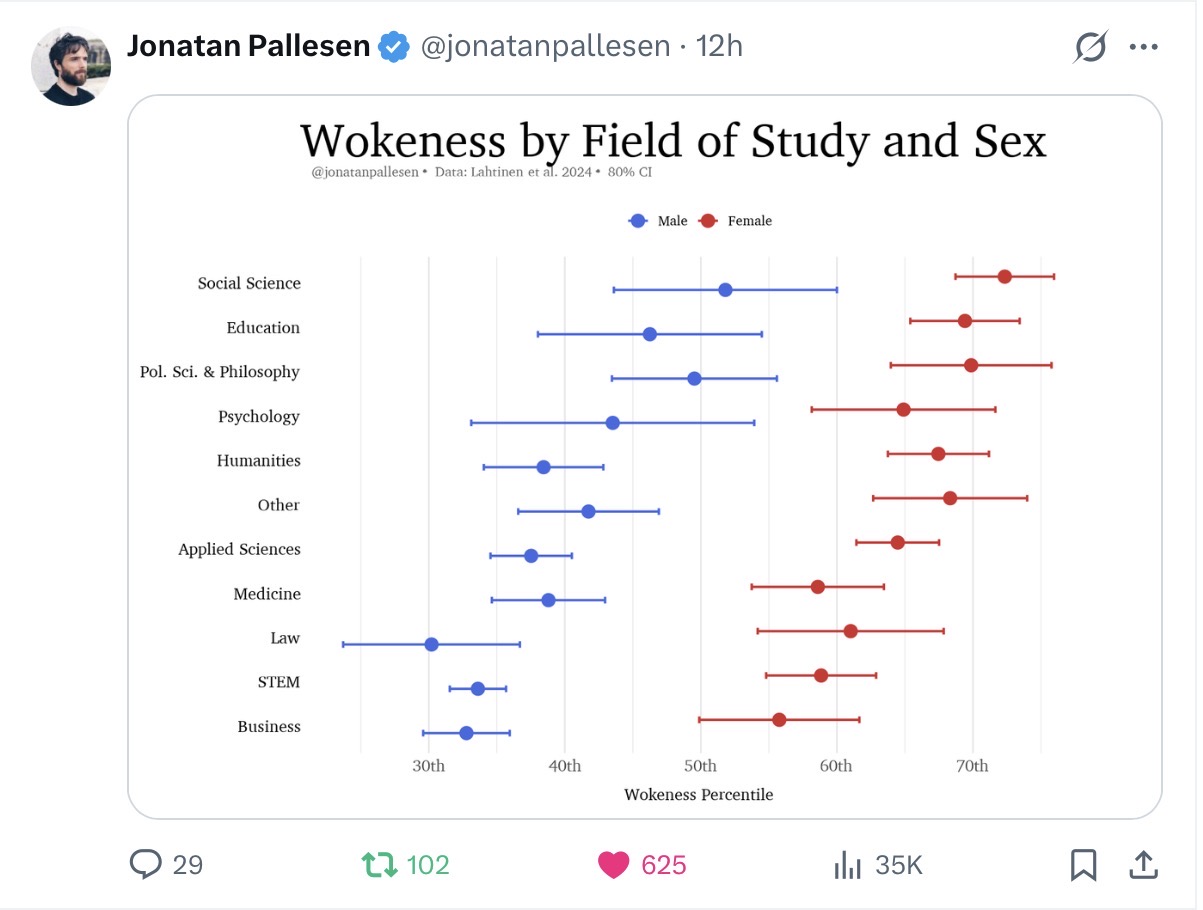
The substance fits, too. Everything you think of as wokeness involves prioritizing the feminine over the masculine: empathy over rationality, safety over risk, cohesion over competition. Other writers who have proposed their own versions of the Great Feminization thesis, such as Noah Carl or Bo Winegard and Cory Clark, who looked at feminization’s effects on academia, offer survey data showing sex differences in political values. One survey, for example, found that 71 percent of men said protecting free speech was more important than preserving a cohesive society, and 59 percent of women said the opposite.

The most relevant differences are not about individuals but about groups. In my experience, individuals are unique and you come across outliers who defy stereotypes every day, but groups of men and women display consistent differences. Which makes sense, if you think about it statistically. A random woman might be taller than a random man, but a group of ten random women is very unlikely to have an average height greater than that of a group of ten men. The larger the group of people, the more likely it is to conform to statistical averages.

Female group dynamics favor consensus and cooperation. Men order each other around, but women can only suggest and persuade. Any criticism or negative sentiment, if it absolutely must be expressed, needs to be buried in layers of compliments. The outcome of a discussion is less important than the fact that a discussion was held and everyone participated in it. The most important sex difference in group dynamics is attitude to conflict. In short, men wage conflict openly while women covertly undermine or ostracize their enemies.

Bari Weiss, in her letter of resignation from The New York Times, described how colleagues referred to her in internal Slack messages as a racist, a Nazi, and a bigot and—this is the most feminine part—”colleagues perceived to be friendly with me were badgered by coworkers.” Weiss once asked a colleague at the Times opinion desk to get coffee with her. This journalist, a biracial woman who wrote frequently about race, refused to meet. This was a failure to meet the standards of basic professionalism, obviously. It was also very feminine.

Men tend to be better at compartmentalizing than women, and wokeness was in many ways a society-wide failure to compartmentalize. Traditionally, an individual doctor might have opinions on the political issues of the day but he would regard it as his professional duty to keep those opinions out of the examination room. Now that medicine has become more feminized, doctors wear pins and lanyards expressing views on controversial issues from gay rights to Gaza. They even bring the credibility of their profession to bear on political fads, as when doctors said Black Lives Matter protests could continue in violation of Covid lockdowns because racism was a public health emergency.

[…]

The Great Feminization is truly unprecedented. Other civilizations have given women the vote, granted them property rights, or let them inherit the thrones of empires. No civilization in human history has ever experimented with letting women control so many vital institutions of our society, from political parties to universities to our largest businesses. Even where women do not hold the top spots, women set the tone in these organizations, such that a male CEO must operate within the limits set by his human resources VP. We assume that these institutions will continue to function under these completely novel circumstances. But what are our grounds for that assumption?

The problem is not that women are less talented than men or even that female modes of interaction are inferior in any objective sense. The problem is that female modes of interaction are not well suited to accomplishing the goals of many major institutions. You can have an academia that is majority female, but it will be (as majority-female departments in today’s universities already are) oriented toward other goals than open debate and the unfettered pursuit of truth. And if your academia doesn’t pursue truth, what good is it? If your journalists aren’t prickly individualists who don’t mind alienating people, what good are they? If a business loses its swashbuckling spirit and becomes a feminized, inward-focused bureaucracy, will it not stagnate?

If the Great Feminization poses a threat to civilization, the question becomes whether there is anything we can do about it. The answer depends on why you think it occurred in the first place. There are many people who think the Great Feminization is a naturally occurring phenomenon. Women were finally given a chance to compete with men, and it turned out they were just better. That is why there are so many women in our newsrooms, running our political parties, and managing our corporations.

On the social media site formerly known as Twitter, John Carter comments on Helen Andrews’ article:

One thing Helen misses in this otherwise excellent analysis is the role played by prestige. Cancel culture was enabled by the unique circumstance of women weaponizing the prestige of freshly feminized legacy institutions. So long as those institutions retained their prestige, what the people who ran them said really mattered.

Unfortunately for the ladies (but luckily for civilization), this is self-limiting, because prestige is fundamentally an emergent property of masculine competence hierarchies. We see this demonstrated whenever a profession becomes coded as women’s work: its prestige immediately crashes. Feminists have complained about this for years, though of course they misunderstand the mechanism (prestige is a component of male sexual attractiveness, but not of female, and this is biologically hard-wired).

This prestige collapse is now affecting essentially every coopted, feminized institution — universities, news media, publishing houses, movie studios, large corporations, various government agencies, hospitals, courts, churches, all of them wield far less cultural power than they did even a few years ago. The only people who really care what these legacy institutions say are the women who took them over. To everyone else, the angry sounds they make are nothing more than background noise.

This is probably the main reason for the vibe shift. Once the prestige of feminized institutions declined below a certain threshold, their ability to enforce social consensus began to evaporate.

It’s also probably no accident that the Trump administration seems to care a lot more about what the anons of the Online Right say than it does about the opinion of the universities or the news media. All the intelligent young men got pushed out of the institutions, and those ionized particles of free male energy then began to self-assemble online into an ad hoc competence hierarchy where prestige is measured by clout rather than professional degrees, job titles, or institutional affiliations. The anon swarm is entirely informal, meaning that its outcomes are not amenable to antidiscrimination legislation or to procedural manipulation; you can screw with the algo all you want but you can’t actually force people to care what women say just because they’re women (thereby placing women into the position of openly trading in thirst, which gets them attention but certainly doesn’t mean that anyone has to pretend to take them seriously).

All that’s happened so far is that people’s attention has been redirected away from crazy woke females and towards the influencers of the online right. The fever has broken but society is a long way from recovered. The institutions are still under the control of crazy woke females, and this is extremely bad, especially because they are – for biological reasons related to childlessness — only going to get crazier as time goes on. Fortunately no one really cares what they say anymore, so as they throw tantrums as the institutions are reclaimed over the next decade or so, their protests won’t register as anything but irrelevant toddler noise.

October 11, 2025

Toddler politics – don’t discuss, just shriek and cry and hit

Filed under: Cancon, History, Media, Politics — Tags: , , , , , , , — Nicholas @ 05:00

At Woke Watch Canada, T.G. Kelemen illustrates the difficulty of trying to have a logical discussion with someone who refuses to engage intellectually as an adult and instead pours everything into the kind of emotional incontinence toddlers indulge in:

Source: Frances Widdowson, Facebook

It’s 2025.

Ask a question, get a tantrum. Make a point, get a protest.

And if you’re unlucky enough to be a calm, middle-aged academic like Frances Widdowson, who dared to speak plainly about a hoax everyone else is pretending is holy scripture, you don’t get debate.

You get a mob.

You get walls pounded. Doors blocked. Students shrieking like toddlers in a sugar crash. And who’s leading it?

Not war-hardened political activists. Not deep-thinking men of conscience.

No — it’s women. Grown women. Educated. Empowered. Enraged.

But not enlightened.

Welcome to the “regressive” West, where a large and growing portion of womanhood has been educated not to argue, but to erupt. To scream instead of speak. To censor instead of counter. To “feel”, and then enforce those feelings on everyone else.

What used to be a bad breakup is now a political position.

What used to be a mood swing is now being proposed as legislation.

Kamloops: Hysteria and Mass Psychosis

Let’s rewind. Canada. 2021. The Kamloops Indian Residential School story breaks. “Unmarked mass graves”, they say. “215 children”, they whisper. Every outlet repeats it. Politicians take a knee. Flags at half-mast. Even the Pope apologizes, having already formally done so twice, with countless statements of regret.

No bodies are found. No evidence. No excavation. One inconclusive radar scan and a theory.

And still: nothing.

But the narrative’s already set. When Frances Widdowson says, when she suggests maybe we need evidence before enshrining national guilt into law, she’s hounded. Not with counter-arguments. Not with facts.

With a toddler’s unhinged rage.

The women who confronted Widdowson aren’t showing the understandable, righteous anger mature people show in response to obvious injustice. No. What we have is full-grown girl-children who aren’t getting their way throwing their emotional and psychological scat in her face. Why? Simply for disagreeing with them.

In February 2023, invited to speak at the University of Lethbridge, Widdowson faced similar militant protest. The lecture was shut down. Protesters, mostly female, banged on walls, wailed through the halls, and demanded she be de-platformed. One group called her a “residential school denier”. Another called her “unsafe”. Some students cried in interviews, claiming trauma.

Trauma? From a talk you didn’t even attend?

That’s the playbook now. You don’t have to hear the words. Just say you were harmed. The more you feel, the more you’re right. Welcome to emotional absolutism where logic is violence and hysteria is virtue.

Can modern women handle the responsibility their suffrage and freedom demands? Judging their own behavior, the answer is a resounding no.

September 14, 2025

QotD: Intersectionality theory

I don’t think that Intersectionality Theory is a type of conspiracy theory for one obvious reason: conspiracy theories always involve some element of secrecy and there is nothing secret about it! The people who practice this fatuous and polarizing set of ideas are only too happy to tell the world about their plans for taking over the academy and eventually the world with their ideology. They publish it in journals and books, pronounce it from podiums and lecterns, and scream it at protests.

More importantly, however, I do agree with Christina Hoff Sommers that Intersectionality Theory is dangerous for humanity, dissolving the complexity of human nature and culture down to an overly simple Manichean model of Oppressor and Oppressed, Them and Us, Good and Evil, and Black and White (literally and figuratively). It’s is another instantiation of Identity Politics and it is dangerous because it threatens to reverse everything that the Civil Rights movement fought to obtain, and it is the very opposite of what Dr Martin Luther King Jr. dreamed about in his most famous speech:

    I have a dream that my four little children will one day live in a nation where they will not be judged by the color of their skin but by the content of their character.

Michael Shermer, interviewed by Claire Lehmann, “The Skeptical Optimist: Interview with Michael Shermer”, Quillette, 2018-02-24.

September 12, 2025

Canada’s temporary foreign worker programs

Filed under: Bureaucracy, Cancon, Education, Government, Health, Media, Politics — Tags: , , , , , , — Nicholas @ 05:00

At Acceptable Views, Alexander Brown calls for the end to the Canadian federal temporary immigration scam programs:

It’s not hyperbole to say that Canada has built an entire economy on exploiting cheap, foreign labour through TWFP, as well as the International Mobility Program (IMP). These are two slightly different programs that allow foreign nationals to work in Canada, with most going to Ontario. But contrary to its name, there is nothing “temporary” about the TFWP. Its original purpose was to remedy proven labour shortages while Canadians were hired and trained to eventually do the jobs in question. Meanwhile, the IMP allows international students to work—with or without a proven labour shortage—while they’re studying in Canada.

Between 2019 and 2023, the TFWP increased by 88 percent and the IMP increased 126 percent. They account for close to 1.58 million work permit holders, equal to roughly 7 percent of Canada’s labour force.

Taken together, the results of the TFWP and IMP are deplorable. The TFWP allows foreign nationals to be recruited abroad in vast numbers, brought to Canada, housed in degrading conditions, paid the minimum wage, forced to work long hours, pressured into not joining a union, and required to work for only one employer. Yes, the IMP is more flexible, but it’s more pernicious because it does not even pretend to address labour shortages.

Both schemes are also of course bad for Canadians themselves. The problem is especially grievous for young Canadians trying to get started in the labour market. Canada lost 40,800 jobs this past July, the unemployment rate is now 6.9 percent, and youth unemployment (those between 15 and 24 years old) is now 14.6 percent.

Both the TFWP and IMP are used as business models. Hiring foreign nationals at minimum wage keeps prices low and profits high—most notoriously in the hospitality and trucking sectors, but no industry seems untouched now.

Addicted to cheap foreign labour

The use of the TFWP in the healthcare sector, for example, has grown by an appalling 1,700 percent since 2000. That dramatic rise has no doubt been abetted by the absence of uniform standards and credential recognition among Canadian provinces. If medical personnel could move easily from one province to another, shortages could be filled by Canadians. But historically this has not been possible, and so medical institutions have had to turn to the TFWP. Ontario’s recent determination to solve this problem by speeding up recognition of 50 “in-demand” professions from other provinces is a step in the right direction, and hopefully not too little too late.

Meanwhile, the IMP is a vehicle for outright fraud, ranging from fake acceptance letters from bogus “colleges” to elaborate human-trafficking schemes. Not long ago, nearly 50,000 holders of foreign student visas were working and attempting to settle here, rather than studying at any Canadian university or college. Most were migrants from India, and some were trying to cross the border illegally into the United States. The RCMP is now working with Indian law-enforcement to investigate alleged links between dozens of “colleges” in Canada and two “entities” in India allegedly facilitating passage into the U.S. When we reflect that an astounding 4.9 million temporary visas are set to expire this year, we have reason to believe that this abuse, exploitation, and fraud are on a much larger scale that we understand.

The consequences for young Canadians

Both the TFWP and the IMP serve to keep wages artificially low and profits high, and to price Canadians out of the job market. It wouldn’t be wrong to view these programs as distortionary government subsidies or welfare for unproductive businesses. The effects disproportionately harm younger Canadians who are priced out of the labour market, given that temporary workers overwhelmingly earn less than the median wage. And yet, we’re constantly hectored about labour shortages, Canadians’ “unwillingness” to do certain jobs, and the need for foreign workers.

It shouldn’t take much intellectual effort to see that the use of foreign labour and the difficulties of employing younger Canadians are two sides of the same ugly coin. Foreign workers are more cooperative because they are bound to their employers like serfs. They face normally insurmountable barriers to joining unions and have no attachment to the community in which they’re expected to work. In comparison, the domestic population is generally better educated and rooted in the local community.

Young Canadians can afford to be discriminating and should rightly expect higher wages than foreign nationals. Employers should instead work harder to invest in and reward their domestic workforce. In any other era, this would have been obvious. But now there is little incentive for businesses to look beyond cheap, foreign labour.

To get an idea of the magnitude of our collective failure here, consider the following fact. A 2024 study by RBC Economics revealed that Canadian businesses are sitting on a stockpile of cash worth almost a third of our country’s GDP. In other words, Canadian companies have the means to invest in hiring and training Canadians, but simply refuse to do so. The results of this refusal are stagnant wages, structural unemployment, and a de-skilling of the domestic population.

September 1, 2025

QotD: The Ivy League

Filed under: Bureaucracy, Education, Government, Humour, Quotations, USA — Tags: , , , — Nicholas @ 01:00

I’ve been around Ivy Leaguers, y’all, and everything you think is true about them IS true, in spades. The Ivy League is “elite”, all right, but it’s surely not because of the education.

The Ivies are now what they’ve pretty much always been — the equivalent of those Higher Party Academies in Moscow. They’re finishing schools for the Apparat. Oh sure, you can probably find a graduate of Ohio State or some such place at Quantico or Foggy Bottom … but I promise you, he hears about it every single day of his life. If they don’t actually teach classes called “How to be a Toady in the DOJ” and “Catching a Senator’s Farts” at Dartmouth, they might as well.

Take your Basic College Girl, make her unisex, crank her up way past eleven on meth and steroids, and that’s the typical Ivy League grad. And they all go directly into Government. Just in case you still cherished some vague hope we could vote our way out of this, remember that guys like Robert McNamara and McGeorge Bundy were the absolute best the Ivy League has produced in the modern era. The Democratic People’s Republic of Vietnam says hi!

Severian, “First Mailbag of the New Year”, Founding Questions, 2022-01-07.

Update, 2 September: Welcome, Instapundit readers! Please do have a look around at some of my other posts you may find of interest. I send out a daily summary of posts here through my Substackhttps://substack.com/@nicholasrusson that you can subscribe to if you’d like to be informed of new posts in the future.

August 27, 2025

QotD: A critical bureaucratic talent

Filed under: Bureaucracy, Humour, Quotations — Tags: , , — Nicholas @ 01:00

“Gentlemen! Gentlemen!” The Patrician raised his hands in a conciliatory fashion. “It seems to me,” he went on, taking advantage of the brief pause, “that what we have here is a strictly magical phenomenon. I would like to hear from our learned friend on this point. Hmm?”

Someone nudged the Archchancellor of Unseen University, who had nodded off.

“Eh? What?” said the wizard, startled into wakefulness.

“We were wondering,” said the Patrician loudly, “what you were intending to do about this dragon of yours?”

The Archchancellor was old, but a lifetime of survival in the world of competitive wizardry and the byzantine politics of Unseen University meant that he could whip up a defensive argument in a split second. You didn’t remain Archchancellor for long if you let that sort of ingenuous remark whizz past your ear.

“My dragon?” he said.

“It’s well known that the great dragons are extinct,” said the Patrician brusquely. “And, besides, their natural habitat was definitely rural. So it seems to me that this one must be mag—”

“With respect, Lord Vetinari,” said the Archchancellor, “it has often been claimed that dragons are extinct, but the current evidence, if I may make so bold, tends to cast a certain doubt on the theory. As to habitat, what we are seeing here is simply a change of behavior pattern, occasioned by the spread of urban areas into the countryside which has led many hitherto rural creatures to adopt, nay in many cases to positively embrace, a more municipal mode of existence, and many of them thrive on the new opportunities thereby opened to them. For example, foxes are always knocking over my dustbins.”

He beamed. He’d managed to get all the way through it without actually needing to engage his brain.

Terry Pratchett, Guards! Guards!, 1989.

August 20, 2025

QotD: Most “mass movements” really do need that “vanguard” to start moving

Filed under: History, Politics, Quotations — Tags: , , , , , , — Nicholas @ 01:00

Let us stipulate that Socialism’s appeal to the proles is “I offer you a good time”. Orwell takes this as read, but it also follows from the premises laid out earlier in the essay. Orwell equates “ease, security and avoidance of pain” with “comfort, safety, short working-hours, hygiene, birth-control and, in general, common sense”. The Commies explicitly promise the proles those things; he could’ve lifted that phrase straight from the Webbs’ most doe-eyed propaganda leaflet.

And yet, as Orwell knows better than anyone, the proles can’t do it on their own. You really do need a vanguard of the proletariat. As Orwell himself notes, Hitler was backed by the big industrialists, and if you really want to needle the eggheads in your life, point out how quickly and thoroughly the German professors knuckled under […] They couldn’t wait to lick his jackboots, any more than his British and American colleagues could wait to kiss Stalin’s ass. They called themselves a “workers’ party”, but in the early days [German fascists] were almost exclusively found among the dueling fraternities – and professors! — of the German university system.

In other words, maybe the proles don’t need nothin’ but a good time, like the old song says, but though the proles are the “mass” of “mass movement”, the “movement” part gets started considerably higher up the social ladder … that is, with guys like Orwell. Guys who know, deep in their bones, that there’s more to life than hygiene, short working hours, birth control, etc. Because he’s one of the great prose stylists, it’s not as apparent in Orwell, but in lesser hands than his you can smell the contempt dripping off every sentence an egghead writes about the proles …

It’s not that the proles want hygiene, birth control, etc. It’s what they need. What they deserve, when you come right down to it, because that’s what you do with livestock — keep ’em clean and well fed, and of course control their breeding. You could take the most purple passage of “animal rights” eco-lunacy and set it side by side with the Webbs’ Soviet Communism: A New Civilization, and see no difference at all. Sure, every aspect of our lives is managed for us by Our Betters, but at least we’re free range!

Severian, “Bonfire of the Vanities II”, Founding Questions, 2021-12-29.

August 18, 2025

QotD: Dostoevsky’s Demons can be read as “one long, savage parody of Fathers and Sons

Filed under: Books, History, Politics, Quotations, Russia — Tags: , , , , , — Nicholas @ 01:00

To understand what happens next [in Dostoevsky’s Demons], it helps to have read some Turgenev. His most famous work, Fathers and Sons, is of a piece with the most lurid boomer fantasies. The basic plot is that there are some genteel Russian liberals, good New York Times readers, people with all the right views. Their kids come back from college and are espousing all this weird stuff: stuff about white fragility and transgenderism and boycotting Israel, stuff that makes their nice liberal parents extremely uncomfortable. But it’s okay, you see? The kids magnanimously realize that their parents were once cool revolutionaries too, and the parents make peace with the fact that the kids are just further out ahead than they are, and everybody feels good about themselves because if the kids have seen far, it’s only by standing on the shoulders of giants. The important thing to understand is that everything about this plot is identity validation wish-fulfillment for the boomer liberal parents (like Turgenev himself). It’s the political equivalent of that YouTube genre where Gen Z Afro-American kids rock out to Phil Collins.

The macro-structure of Demons mirrors this so closely, you can almost read the book as one long, savage parody of Fathers and Sons.1 The sunny opening section is a satire of the boomer liberals, and the big vibe shift part way in is their kids coming back from college. But that’s where things go off the rails. In this book, the next generation shares their parents’ anti-religious and anti-monarchist attitudes, but unlike in Fathers and Sons, the kids in Demons are disgusted by the hypocrisy and cowardice of their genteel liberal parents, and eager to plunge Russia into a hyper-totalitarian nightmare. The exact contours of that nightmare are something they frequently argue about and change their minds over, but they can all agree that it will need to begin with an enormous mountain of skulls, and that their town is as good a place as any to start.

Dostoevsky’s other works put individuals front and center, his stories have unbelievably rich characterization (Nietzsche once said that Dostoevsky was the greatest psychologist to ever live), because for Dostoevsky the very highest stakes, the most important questions in the world, were about the damnation or salvation of individual souls. But Demons is different: here the characters all blur together, their names are disgorged to you in a never-ending torrent, and only a few of them are distinctive in any way.2 How could Dostoevsky think these people don’t matter? It’s because they aren’t real people anymore. It’s because they’re possessed. Their brains have been scooped out and all you can see in their eyes is a writhing mass of worms. Their ideas and ideologies have hollowed them out and are wearing their skins as suits.

But what if the ideas don’t matter either? It’s easy to interpret the second half of Demons as a novel of ideas, but it really isn’t. Your first clue is that the ideas are just so goofy. There’s one guy who thinks that by killing himself he will become God (don’t ask, it’s Dostoevsky, man). Another has written a book with ten chapters, explaining how “Beginning with the principle of unlimited freedom I arrive at unlimited despotism”, and proposing a method of brainwashing for reducing ninety percent of humanity to a mindless “herd”. Yet another thinks that everything can be solved by killing one hundred million people, but laments that even with very efficient methods of execution this will take at least thirty years.3 My own favorite might be the guy who refuses to explain what his system is, but just smugly declares that since everybody is going to end up following it eventually, it’s pointless for him to explain it.

John Psmith, “REVIEW: Demons, by Fyodor Dostoevsky”, Mr. and Mrs. Psmith’s Bookshelf, 2023-07-17.


  1. Further evidence for this reading: the book contains a character, the great writer “Karmazinov”, who is a straightforward expy of Turgenev himself.
  2. That said if you do need to keep track of them, this alignment chart made by some genius on the internet is a pretty handy guide: link.
  3. This one probably seems less funny after the 20th century than it did when Dostoevsky wrote it.

July 26, 2025

The desperate narcissism of the “Cool Professor”

Filed under: Education — Tags: , , — Nicholas @ 05:00

Freddie deBoer on the pathetic academic specimen sometimes known as “Bob” or “Biff” or “Lizzie” — the dreaded self-imagined “cool professor”:

“heh, probably never expected to have a professor with full sleeve tattoos, huh? well, that’s not the last time your mind’s gonna be blown this semester …”
Image and caption from Freddie deBoer’s Substack

Let me tell you about the saddest figures in the American university. They wear black jeans and Chuck Taylors to class, except maybe on the first day, when they stroll in wearing semi-ironic suits designed to contrast with their ample tattoos. Their syllabuses are printed in Helvetica. They mention Chappell Roan in the first fifteen minutes of the first day of class. They tell their students, with a wink, that they don’t believe in grades — why, who are they to judge their students! They encourage everyone in class to call them by their first names, or perhaps a contrived nickname. They hope to blow everyone’s minds when they theatrically announce that in their classes, students pick the readings, because the students are the ones who really know what’s worthy of their time. They describe themselves as “friends” or “guides” or “partners”, not as teachers or professors. They disdainfully invoke the words “rigor” and “standards” only with ironic scare quotes and want you to know that they don’t believe in deadlines. They subtweet the provost on BlueSky. They are the Cool Professors. And they are frauds.

The Cool Professor fundamentally does not want to teach, as teaching requires the teacher to sometimes be the bad guy. The Cool Professor can’t stand to be the bad guy, chafes at the very idea. That’s the core of all of this. The posture, the cultivated aesthetic of rejection, the performance of cool — none of it’s about students, even though Cool Professors will not shut the fuck up about how they run a “student-centered classroom”. Their affect isn’t about pedagogy. It’s about insecurity and narcissism, their desperate need to be perceived as the rare exception, the rogue academic, the anti-institutional rebel. Cool Professors aren’t trying to liberate students. They’re trying to be loved, and in being loved by students stave off their horror about growing old. And if that means letting students drift intellectually, if that means mistaking chaos for creativity, if that means failing to ever give anyone a hard but necessary lesson, then so be it. Because the thing the Cool Professor wants to avoid at all costs is being perceived as an authority figure, and that is precisely what students most need them to be.

It’s a common misunderstanding, particularly among faculty who feel alienated from the bureaucracy of the university or who fancy themselves transgressive thinkers, that teaching should never be hierarchical. The idea is that it’s somehow oppressive to know more than your students or to presume to evaluate their performance; that knowing more than your students and evaluating their performance are publicly understood to be core parts of being a teacher typically goes ignored. Many who consider themselves modern or progressive in the academy insist that education should be horizontal, an equal exchange between learner and guide, that the classroom is a site of resistance or liberation. But these ideas, while maybe flattering to the professor’s ego and superficially appealing to a certain kind of idealist, are incoherent. They’re built on a fundamental category error: mistaking the classroom for a club meeting, or a dinner party, or a DSA breakout session. The classroom is none of those things. It’s a site of instruction, and in a site of instruction one party knows more than the other; one party evaluates the other; one party is, necessarily, in charge.

(And, for the record, the fundamental dictate of critical pedagogy is always and forever self-defeating: if you inspire your students to rebel against your authority in your own classroom, they’re still following your lead and thus not rebelling at all. The ubiquitous goal of prompting students to resist top-down education, whatever that means, is unachievable, because if you do prompt them to resist, they’re actually complying with your desires, not resisting them. It’s a good old fashioned paradox and not one you can bluff your way out of with abstruse academic vocabulary.)

The plain fact that a teacher must necessarily have some sort of control over the classroom space that the students do not makes people uncomfortable. Authority always does. But then, the job of a teacher is not to minimize discomfort; indeed, a good teacher will necessarily make their students uncomfortable, on occasion, as it’s often only in the space of genuine discomfort that we’re inspired to achieve our deepest growth. The professor’s job to be responsible for the intellectual development of students, which inevitably involves making judgments: what is true, what is false, what is well argued, what is sloppy, what is insightful, what is clichéd. If you aren’t willing to say those things, if you shrink from judgment, you’re abandoning the role you signed up for, you’re copping out. You’re indulging yourself, and your own flattering self-mythology, at the expense of the people you’re supposed to be teaching.

July 22, 2025

QotD: Social assistance as a Western cargo cult

Filed under: Education, Government, Quotations, USA — Tags: , — Nicholas @ 01:00

Part of the problem with social policy here in America is that it is conducted like a South Pacific Cargo Cult. We looked around and saw that the majority of successful people owned their own homes and had college degrees, so we figured that if we grabbed any old slacker and subsidized them a home and a college degree, then they, too, would become successful. It’s got cause and effect completely out of whack.

Tamara Keel, “From a conversation elsewhere…”, View From The Porch, 2020-06-10.

July 2, 2025

QotD: The bane of socialism — boredom

Filed under: Economics, History, Politics, Quotations — Tags: , , , , , — Nicholas @ 01:00

… even the Yankee Leviathan at the very height of its powers couldn’t have made Socialism work long term, for as the Bolshies discovered, there’s more to life than just shit, shoes, and bread. The old proverb says “A man with an empty belly has one problem; the man with a full belly has a thousand”, and like most old proverbs it’s 100% true. It’s no surprise our modern cat ladies — of both sexes and all however-many-we’re-up-to-now genders — don’t realize this, as you can overfeed a housecat into total somnolence, but anyone who has ever had so much as a dog knows what happens when all its immediate physical needs are satisfied: it grows bored.

Most “bad” dogs aren’t actually bad. They’re not misbehaving because they’re willful, or mean, or whatever. They’re just bored out of their fucking skulls, because the kind of bugman who gets a dog these days has no idea that you actually have to play with it, and pet it, and interact with it, in much the same way you have to interact with a young human. Given a dog’s limited intellect, the only thing it can think of to do to alleviate its boredom is chew on things, or dig in the yard, or piss on the rug, or, if all else fails, chew its own fur off.

Being slightly more complex critters, humans have more options, but bore a human enough — overfill his material needs, so that he’s stuffed to somnolence, but take his sense of purpose away — and you’ll see the exact same dog behaviors. Why do you think they shove all that metal shit in their faces? And no, I am absolutely not joking. Why all the huge, gaudy, gross tattoos? The constant changes of hair color and style?

Have you ever asked them?

Again, I’m 100% not joking. I know most of y’all avoid SJWs like the plague, and that’s a smart move, can’t blame you for it, but if you do, you’ll just have to trust me: I was in academia for a long time, so I was around not just SJWs, but bleeding-edge lunatic SJWs, and I asked them about it. One must be discreet about this, of course — hey, I’m thinking of getting a roll of toilet paper tattooed on my bicep, to remind me that We’re In This Together, what do you think? — but it’s fairly easy to do. And every time, they’d spin me some elaborate tale of how deep and meaningful it all is.

No, really. By some mental process I can’t begin to reproduce, getting Ruth Bader Ginsburg’s face tattooed on your calf is, to them, striking a blow at ambient civilization. That is the literal truth of their motivation. It’s the same reason the dog digs in the backyard, or pisses on the rug, or chews its own fur off: That’s the only agency it has, the only purpose it can find.

Severian, “Purpose”, Founding Questions, 2021-12-06.

June 26, 2025

QotD: Credentialism versus meritocracy

Filed under: Bureaucracy, Education, Government, Quotations, USA — Tags: , , , , , — Nicholas @ 01:00

Returning briefly to the running theme of Vietnam, what all the “happy little hotdogs” had in common was: They were all Harvard men. Kennedy was a Harvard graduate. McGeorge Bundy had been a Dean at Harvard. McNamara was a Harvard b-school grad. John McNaughton was a Harvard professor. Maxwell Taylor was a West Pointer, but all the other happy little hotdogs said “he was the kind of general Harvard would produce”; they could think of no higher compliment.

Harvard’s motto is “Veritas” — truth — but it ought to be “ludificationes pertinet“, which the internet informs me is how you say “delusions of competence” in Latin. I meant it when I said that the “Ministry of Talent”, as these jerkoffs unironically called themselves, actually had some serious brainpower and real accomplishments … but the Peter Principle is also true, and though they had some real brains and actual accomplishments, neither their brains nor their accomplishments at Harvard translated to anything out in the real world, any more than some Late Republic social climber’s “experience” as curule aedile translated to anything real in their world.

Just as the Roman Senate had no idea how to deal with a Julius Caesar, then, despite it all, so no American “leader” had any idea how to deal with a guy like Ho Chi Minh, even though he, like Caesar, had always been perfectly open and forthright about what he was doing and why. It never occurred to “the best and brightest” to even ask the question “What does Ho Chi Minh want?”, because after all, Ho Chi Minh wasn’t a Harvard man.

And all this was 60 years ago. These days, the AINO cursus honorum is so widespread that every kid who manages to fill out a college app has a resume that would give McGeorge Bundy an erection lasting more than four hours. You’ll have to trust me on this, I guess, but I wouldn’t be surprised to learn that Flyover State — which is respectable but rinky-dink; the kind of outfit where you see their team losing a late December bowl game and you think “Gosh, I guess that state has a third college in it” — had several hundred student organizations …

… all of which seem to exist for no other reason than to have “officers”, to which these little social climbers can be “elected”, the better to pad their law, med, and grad school apps. By the end of my career, probably 3/4 of the students who ever sent me an email had an auto-signature on it, and that auto-signature was longer than my entire CV. President of this, Vice-Treasurer of that, Assistant Grand Poobah (junior grade) of the other thing. Grandpa Simpson was a piker compared to these kids:

    I’m an Elk, a Mason, a Communist. I’m the president of the Gay and Lesbian Alliance for some reason. Ah, here it is. The Stonecutters!

Instead of giving potential movers and shakers some practical experience, our modern cursus honorum casts the widest possible net for sociopathy. McGeorge Bundy is your absolute best case scenario. He wasn’t actively evil; he was just a goofy egghead who thought he was way smarter and more accomplished than he actually was, because he’d never been in a position to find out otherwise. (An anecdote that tells you everything you need to know, courtesy of Wikipedia: “When applying to Yale, Bundy wrote on the entrance exam ‘This question is silly. If I were giving the test, this is the question I would ask, and this is my answer.’ Despite this, he was still admitted to Yale as he was awarded a perfect score on his entrance exam”).

Think about that the next time you go to the doctor. Even if your MD — or, much more likely these days, PA — isn’t a prize graduate of Bollywood Upstairs Medical College, xzhey most likely spent xzheyr college years as an Elk, a Mason, a Communist …

Your worst case scenario is, of course, another Caesar. A fake and gay one, it goes without saying — this being Clown World — but a fake and gay Caesar can still do tremendous damage, because they’re the worst of both worlds: Bundy-level goofs, and angry ethnic sociopaths with huge chips on their shoulders. These are the kids who have been “team leads” doing “original research” since about age 12. Not only have they never failed, they’ve never been exposed to the merest hint of the possibility of failure. All their “success” is theirs by right. They have Caesar’s vaulting ambition, his utter disregard for tradition, his absolute cutthroat ruthlessness … and none of his experience, to say nothing of his competence.

Severian, “Cursus Honorum”, Founding Questions, 2021-12-27.

June 14, 2025

QotD: University students or NPCs?

Filed under: Education, Quotations, USA — Tags: , , , , — Nicholas @ 01:00

When I first started teaching, for instance, I had to constantly remind myself that my charges were just teenagers. At most they were 21, 22 tops, which is basically the same thing. So much of the crap they pulled, then, was just typical teenager stuff. All they really needed to straighten themselves out was two good head knocks and a swift kick in the ass, which life would soon provide. I did exactly the same sort of dumb stuff back in my own undergrad days – maybe not as bad, but it was a difference of degree, not kind. They’d be ok in a few years.

A few semesters on, and that no longer applied. Sure, sure, they were still teenagers, and still pulled typical teenager capers … but a new set of behaviors crept in. I can’t describe them exactly, in detail, but the overall impression was: here’s someone doing a pretty good impersonation of a teenager. Most every kid goes through the faux-sophisticate stage, usually somewhere around age 12, and this kinda looked like that — young kids pretending to be a lot older — but it also looked a lot like the opposite end of the spectrum. Not quite “hello, fellow teens!” — not yet — but there was something like that going on, too. It was weird, but I figured it was mostly in my head — I’ve always been a grouchy old man, but now I was actually chronologically old enough to let my freak flag fly, so I assumed that’s what I was doing. They’re not changing, I am

Fast forward a few more semesters, and nope, it’s definitely them. The kids at the tail end of my career still looked like bargain basement Rich Littles, doing impersonations of teenagers, but their act was terrible. Remember a few years back, when Facebook or Twitter or whoever tried to make an AI chat bot, and it immediately turned super racist? Not that these kids were racists — they were the furthest thing from that — but they all seemed to have a small stock of crowdsourced responses. And that’s ALL they had, so no matter what the situation, they’d shoehorn it in to one of their canned affects, because that’s all they had.

By the very end, interacting with them was like playing one of those old text-adventure games from the very dawn of the personal computer, like Zork. They’d respond to commands, but only the right commands, in the exact word order. No deviations allowed, and of course their responses were equally programmed.

Severian, “Terminators”, Founding Questions, 2021-12-04.

June 11, 2025

The coming “Dissolution of the Universities”

At Postcards from Barsoom, John Carter provides a useful summary of the situation in England at the time of the Reformation which brought King Henry VIII to seize the wealth and property of the monasteries and other Christian establishments and why he was probably right to do so. Then he shows just how the modern western universities now find themselves in a remarkably similar position today:

The well-preserved ruins of Fountains Abbey, a Cistercian monastery near Ripon in North Yorkshire. Founded in 1132 until dissolved by order of King Henry VIII in 1539. It is now owned by the National Trust as part of the Studley Royal Park, a UNESCO World Heritage Site.
Photo by Admiralgary via Wikimedia Commons.

Our own university system is on the cusp of a similar collapse. This may seem outrageous, given the size, wealth, and massive cultural importance of universities, but at the dawn of the 16th century, the suggestion that monasteries would be dismantled across Europe within a generation would have struck everyone – even their opponents – as absurd.

The Class of 2026

The rot in academia is already proverbial. Scholarly careerism, declining curricular standards, the replication crisis, a demented ideological monoculture, administrative bloat … a steady accumulation of chronic cultural entropy has built up inside the organizational tissue of the academy, rendering universities less effective, less trustworthy, less affordable, and less useful than ever before in history. We see a parallel here with the moral laxity of 16th century monastic life, where religious vows were more theoretical than daily realities for many monks. Does anyone truly think that Harvard professors take Veritas at all seriously?

At the same time, universities have become engorged on tuition fees, research grants, and endowments, providing an easy and luxurious life for armies of well-paid and under-worked administrators, as well as for those professors who are able to play the social games necessary to climb the greased pole of academic promotion. Everyone knows that academia is in a bubble, and as with any bubble, correction is inevitable, and the longer correction is postponed by the thicket of interlocking entrenched interests that have dug themselves into the system, the uglier that correction was always going to be.

Just as the printing press rendered the monastic scriptoria entirely redundant, the Internet has placed universities under increasing threat of obsolescence. Libraries and academic publishing have already been rendered useless by preprint servers. It is no longer, strictly speaking, necessary to attend a university to learn things: the Internet has every tool an autodidact could desire, and insofar as it doesn’t – for instance, university presses and private journals charging outrageous fees for their books and papers – this is due to the academy jealously guarding its treasures with intellectual property law rather than any limitation of the technology. One can easily make the argument that academia has become an obstacle, rather than an organ, of information dissemination.

Still, universities have so far managed to hold on to their relevance due to their lock on credentialization: no one really cares how many How-To videos you watched at YouTube U, because – in theory – a university degree means that there was some level of human verification that you actually mastered the material you studied.

Large Language Models, however, are delivering the killing blow. Just as the printing press collapsed the cost of reproducing text, AI has collapsed the cost of producing texts. This is actually worse news for universities than Gutenberg was the monasteries: movable type made scriptoria unnecessary, but LLMs haven’t only made universities obsolete, they’ve made it impossible for universities to fulfil their function.

Universities rely on undergraduate tuition fees for a major part of their income. Large research schools derive a significant fraction from research grants, and the more prestigious institutions often receive substantial private donations, but for the majority of schools it is the fee-paying undergraduate that pays the bills. This is already a problem, because enrolment is already declining, partly for demographic reasons (the birth rate is low), and partly because academia has been increasingly coded as women’s work, leading to young men staying away.

In theory, undergraduate students are paying for an “education”. They are gaining essential professional skills that will make them employable in well-remunerated white collar professions, or they are broadening their minds with a liberal arts education that provides them with the soft skills – critical thinking, the ability to compose and parse complex texts, a depth of historical and philosophical understanding of intricate social and political issues – that prepare them for careers in elite socioeconomic strata.

Everyone, however, has long since understood that this narrative of “education” is a barely-plausible polite fiction, like those little scraps of fabric exotic dancers wear on their nipples so everyone can pretend they aren’t showing their boobs. Students know it’s a lie, professors know it’s a lie, administrators know it’s a lie, and employers certainly know it’s a lie. What students are actually paying for is not an education, but a credential: they could not possibly care less about the “education” they’re receiving, so long as they receive a piece of paper at the end of their four years which they can take to an employer as evidence that they are not cognitively handicapped, and are therefore in possession of the minimal level of self-discipline and intelligence required to handle routine tasks at the entry-level end of the org chart. Thus the venerable proverb among students that “C’s and D’s get degrees”. It doesn’t matter if you did well: employers don’t generally care about your GPA. All that matters is that you do the minimal possible level of work to squeak through. As a general rule, your time as a student is better spent grinding away in the library as little as possible while enjoying yourself to the maximum extent that you can in order to develop social networks you can draw upon later.

Until recently, graduate school ensured that there was still some vestigial motivation for genuine intellectual engagement. Corporate America might not care about your transcript, but if you wanted an advanced degree, graduate schools most certainly did. Those students with greater academic ambitions than a Bachelor’s degree could therefore generally be relied on to actually apply themselves, thereby making the professoriate’s efforts delivering lectures, preparing homework assignments, and grading exams somewhat less of a pantomime. DEI, however, was already eating its way through even this. As graduate school admission became more about protected identities and less about intellectual mastery, and as graduate programs were themselves rendered easier in order to improve retention of underqualified diversity admits, it started to become less important to study hard even if one wanted to enter grad school.

To the point. In 2022, ChatGPT became available. Almost overnight undergraduate students began using it to write their essays for them. Its abuse has now become essentially ubiquitous, and not only for essays: ChatGPT can write code or solve mathematical problems just as easily as it can generate reams of plausible-sounding text. It might not yet do these things well, but it doesn’t have to: remember, C’s and D’s get degrees.

June 8, 2025

“If the New York Times notices the Buddha, the enlightened one has already left town”

Ted Gioia points out that momentous changes in society are not often noticed until they’ve taken place, and provides ten warning signs of such a change happening right now:

Would you believe me if I told you that the biggest news story of our century is happening right now — but is never mentioned in the press?

That sounds crazy, doesn’t it?

But that is often the case when a bold new worldview appears.

  • How long did it take before the Renaissance got mentioned in the town square?
  • When did newspapers start covering the Enlightenment?
  • Or the collapse in mercantilism?
  • Or the rise of globalism?
  • Or the birth of Christianity or Islam or some other earthshaking creed?

The biggest changes often happen long before they even get a name. By the time the scribes notice, the world is already reborn.

You can take this to the bank: If the New York Times notices the Buddha, the enlightened one has already left town.

For example, the word Renaissance got introduced two hundred years after the start of the Renaissance. The game was already over.

The same is true of most major cultural movements — they are truly the elephants in the room. And the elites at the epicenter of power are absolutely the last to notice.

Tiberius may run the entire Roman Empire, but he will never hear the Good News.

There’s a general rule here — the bigger the shift, the easier it is to miss.

We are living through a situation like that right now. We are experiencing a total shift — like the magnetic poles reversing. But it doesn’t even have a name — not yet.

So let’s give it one.

Let’s call it: The Collapse of the Knowledge System.

We could also define it as the emergence of a new knowledge system.

In this regard, it resembles other massive shifts in Western history — specifically the rebirth of humanistic thinking in the early Renaissance, or the rise of Romanticism in the nineteenth century.

In these volatile situations, the whole entrenched hierarchy of truth and authority gets totally reversed. The old experts and their systems are discredited, and completely new values take their place. The newcomers bring more than just a new attitude — they turn everything on its head.

That’s happening right now.

The knowledge structure that has dominated everything for our entire lifetime — and for our parents and grandparents — is collapsing. And it’s taking place everywhere, all at once.

If this were just an isolated situation — a problem in universities, or media, or politics — the current hierarchy could possibly survive. But that isn’t the case.

The crisis has spread into every sector of society which relies on clear knowledge and respected authority.

The ten warning signs

« Newer PostsOlder Posts »

Powered by WordPress