
There are a bazillion ways to rig a ship (a lot of them with really fun names), but all sails function in one of two basic ways. First it’s worth noting every ship operates in both a “true wind” (the direction the wind is actually blowing) and an apparent wind, which is the combination of the true wind with the direction the ship is sailing and its speed; the apparent wind is what matters for sail dynamics because that’s the wind that the sails experience. If a ship is sailing at 8 knots and the wind is moving at 12 knots, but the ship and the wind are moving in the same direction, the apparent wind the ship experiences is just 4 knots. On the other hand, if the wind speeds remain the same but we have the same ship moving perpendicular to the wind, the apparent wind is going to actually be 14.4 knots and come from a direction between the ship’s heading and the wind’s source.
Square sails, which are rigged perpendicular to the direction of the ship work by having the wind strike the sail and pile up into it, which creates a high pressure zone behind the sail (because all of the air, blocked by the sail, is “stacking up” there) and a low pressure zone in front of the sail, which pushes the ship forward, technically a function of aerodynamic drag. The upside is that square sails can produce a lot of power, which is handy for big, heavy ships, especially in areas with predictable and favorable winds (such as the Atlantic trade winds). The downsides are two: on the one hand, top speed is limited because the faster the ship goes, the lower the apparent wind on the sails, which in turn reduces how much they can push the ship. On the other hand, square sails only work if the ship is moving in more-or-less the same direction as the wind is, within about 60 degrees or so (so the ship has a c. 120 degree range of movement relative to the wind). Moreover, for square sails to work, the air hitting them from behind needs to be substantially confined by their shape; this is why square sails are made to billow outward into an arcing shape as the wind hits them, instead of being held taught and fully flat against the mast.
Triangular or lateen or fore-and-aft sails work on a different principle. They are arranged parallel to the direction of the ship (that is, fore-and-aft of the mast, thus the term) and want to also be close to parallel to the wind (both square and triangular sails can, in some configurations, be moved around the mast to a degree to get an ideal direction to the wind). The way they work is that the wind hits the sail on its edge and the air current splits around the sail, but not evenly; the sail is turned so that the back side takes more wind, causing the sail to billow out, creating a wing-like shape when viewed from above. That in turn acts exactly like a wing, creating a high pressure zone behind the sail and a low pressure zone in front of the sail and thus generating aerodynamic lift as the wind passes over the surface (rather than pressing up behind it) the same way that an airplane’s wings keep it in the air. The clever part about this is that the lift generated doesn’t have to be in the same direction the wind is going, so a ship using these kinds of sails can move up to within around 45 degree of the wind (sailing “close hauled” – a ship rigged like this thus has a much larger 270 degree range of motion relative to the wind). Also – as noted above – depending on the ship’s “point of sail” (direction of movement relative to the wind), accelerating may not decrease the wind’s apparent speed (because you may not be sailing directly away from it), and so triangular sails often function better in light winds, sailing into the wind, and at very high speeds (but they provide less power for large, heavy ships sailing with the wind). And again, there is a lot of complexity in terms of the different functions of these types of sails, but we’re really just trying to make a fairly simple point here so everyone please forgive the simplification.
And that’s it: all sails work on one of those two principles (at any given time); the point in discussing this is to note that we’re dealing not with aesthetics here but with objects that need to interact in fairly fundamental ways with aerodynamics and so have shapes that are dictated by that function (and also, sails are cool). You can combine those two principles in a lot of exciting ways to create different “rigs” with different sailing qualities, but you those principles are your options – you cannot create some other kind of sail which works on different principles. Indeed, most of the more complex sailplans of larger ships use a combination of square and lateen sails, but each sail in the plan must be using one of these two principles; there are no other options.
And those of you looking back at what these ships [in Rings of Power] look like may have already guessed the problem here. These are clearly square-rigged ships; the sails are all perpendicular to the ship’s direction and the sail shape is symmetrical over the keel (that is, same shape on the port and starboard) and are unable to be angled in any event. But every single sail has a gigantic hole in the center because of the split mast. So the air you want to build up behind the sail is instead flowing through the hole between the masts. The sails even angle slightly, curling backwards at their outer edges channeling the air towards the gaps. But that air flowing through the gaps is going to lessen (not remove, but substantially lesson) the pressure differential over the sail which will cut the drag the sails generate which will make the ship much slower.
What is worse is that between the two masts and between the foremast and the bowsprit, the ships mount additional secondary sails. Now in a rig-plan that made any sense, these would be triangular sails in both shape and principle (e.g. gaff-rigged sails incorporated into a square-rig sailing pattern common for full rigged ships as well as staysails between the masts or between the foremast and the bowsprit, also common for full rigged ships), but the designers here have only managed one of those two things. The sails are triangular in shape, but are positioned perpendicular to the wind direction and then symmetrically matched. That means they both do nothing with the wind moving through that center channel we’ve created, but also their triangular shape is entirely useless because they’re functioning on drag instead of lift.
It’s not that this sail plan wouldn’t work: the big sails would create at least some aerodynamic drag which would push the ship forward. But this is a sail plan which would work much more poorly than a far more basic plan with just a single central mast mounting a single very large square sail. You could even keep the exotic junk-style sail supports (they’re called battens; everything on sailing ships has a funny name) if you wanted and just make the ships junk-rigged! Or, if you want a lot of fancy sails which aren’t in square shapes, you could go with a multi-masted dhow or xebec sail plan which would give you lots of overlapping triangular sails and also fit the Mediterranean/Roman vibe you were going for.
Moreover, while these sails aren’t square shaped, this is a pure “square sail” ship rig, which for ocean-going ships ostensibly used by great mariners is awful. Square sails only work well when running before the wind: they “tack” (zig-zagging from one close-hauled point of sail to another to climb up the wind) really poorly; some pure square-rigged ships cannot tack at all without the assistance of rowers. That’s is part of the reason why “full rigged” square-sailed age of sail ships nevertheless had triangular sails in gaff-rigging or as stay-sails or what have you, to enable the ship to tack effectively (the fancy term for this is how “weatherly” a ship is: how able it is to sail close to the wind; weatherlyness also depends on hull shape and a host of other factors). With a pure square-sail setup, these ships can only go in the direction of the wind, which is going to make it impossible to use them effectively as ocean-going ships because the prevailing winds on the ocean are very consistent: they will almost always be blowing the same way, which means these ships can sail out, but then can’t sail back. In short these ocean-going mariners have ships which cannot go on the oceans.
And of course this has been a theme of these posts but please, showrunners: when you are doing the visual design for a fantasy-historical society, you are not going to outsmart centuries of professional shipwrights with a brainstorming meeting and some concept art. So instead of trying to show that the Númenóreans are great mariners (“the sea is always right!”), which is the point of giving their super-cool ships so much screentime and is an essential thing to establish about their society, by making up a ship design that is going to end up invariably being much worse than historical designs, just go adopt a historical design that was successful. For my part, I’d have probably contrasted traditional Elven ships with a single sail-type (probably square) on a single mast with the advanced Númenóreans using lots of lateen sails.
That said, the fact that the Númenórean ships are terrible is fine because frankly, I wouldn’t want to sail to this battle either.
Bret Devereaux, “Collections: The Nitpicks of Power, Part III: That Númenórean Charge”, A Collection of Unmitigated Pedantry, 2023-02-03.
June 16, 2023
QotD: Sailing ships in the real world versus sailing ships in Rings of Power
June 12, 2023
Why Modern Movies Suck – The Strong Female Character
The Critical Drinker
Published 10 Jun 2023One of the most tiresome tropes of the past ten years in moviemaking is the “Strong Female Character”. Not women who are smart, capable, well written and complex, but bland, boring, superficially “strong” characters designed to pander to simplistic ideals of female empowerment.
(more…)
QotD: Cities in the pre-modern era
I find myself interested in pre-modern economies and militaries in roughly equal measure (in part because both are such crucial elements of state or societal success or failure). One of the reasons is that they are so interconnected: how military force is raised, supplied, maintained and projected is deeply dependent on how the underlying economy (which supplies the men, food, weapons and money) is structured and organized. And military institution and activities often play an important role in shaping economic structures in turn. So even if you are just here for the clashing of swords, remember: every sword must be forged, and every swordsman must be fed.
(Additional aside: I am assuming a west-of-the-Indus set of cereals: grain, barley and millet chiefly. Specifically, I am not going to bring in rice cultivation – the irrigation demands and density of rice farming changes a lot (the same is also true, in the opposite direction, to agriculture based around sorghum or yams). Most (western) fantasy and historic dramas are not set in rice-planting regions (and many East Asian works seem to have a much better grasp on where rice fields go and need no correction), so I’m going to leave rice out for now. I’m honestly not qualified to speak on it anyway – it is too different from my own area of research focus, which is on a Mediterranean agricultural mix (wheat, barely, olives, grapes), and I haven’t had the chance to read up on it sufficiently).
Lonely Cities
There’s a certain look that castles and cities in either historical dramas or fantasy settings set in the ancient or medieval world seem to have: the great walls of the city or castle rise up, majestically, from a vast, empty sea of grassland. […] These “lonely cities” are everywhere in fantasy and historical drama. I think we all know something is off here: cities and other large population centers do not simply pop up in the middle of open fields of grass, generally speaking. So if this shouldn’t all be grassland, what should be here? Who should be here?
What is a City For?
I think we need to start by thinking about why pre-modern towns and cities exist and what their economic role is. I’ll keep this relatively brief for now, because this is a topic I’m sure we’ll return to in the future. As modern people, we are used to the main roles cities play in the modern world, some of which are shared by pre-modern cities, and some of which are not. Modern cities are huge production centers, containing in them both the majority of the labor and the majority of the productive power of a society; this is very much not true of pre-modern cities – most people and most production still takes place in the countryside, because most people are farmers and most production is agricultural. Production happens in pre-modern cities, but it comes nowhere close to dominating the economy.
The role of infrastructure is also different. We are also used to cities as the center-point lynch-pins of infrastructure networks – roads, rail, sea routes, fiber-optic cable, etc. That isn’t false when applied to pre-modern cities, but it is much less true, if just because modern infrastructure is so much more powerful than its pre-modern precursors. Modern infrastructure is also a lot more exclusive: a man with a cart might visit a village where the road does not go, but a train or a truck cannot. The Phoenician traders of the early iron age could pull their trade ships up on the beach in places where there was no port; do not try this with a modern container ship. Infrastructure is largely a result of cities, not their original purpose or cause.
So what are the core functions of a pre-modern city? I see five key functions:
- Administrative Center. This is probably the oldest purpose cities have served: as a focal point for political and religious authorities. With limited communications technology, it makes sense to keep that leadership in one place, creating a hub of people who control a disproportionate amount of resources, which leads to
- Defensive/Military Center. Once you have all of those important people and resources (read: stockpiled food) in one place, it makes sense to focus defenses on that point. It also makes sense to keep – or form up – the army where most of the resources and leaders are. People, in turn, tend to want to live close to the defenses, which leads to
- Market Center. Putting a lot of people and resources in one place makes the city a natural point for trade – the more buyers and sellers in one place, the more likely you are to find the buyer or seller you want. As a market, the city experiences “network” effects: each person living there makes the city more attractive for others. Still, it is important to note: the town is a market hub for the countryside, where most people still live. Which only now leads to
- Production Center. But not big industrial production like modern cities. Instead it is the small, niche production – the sort of things you only buy once-in-a-while or only the rich buy – that get focused into cities. Blacksmiths making tools, producers of fine-ware and goods for export, that sort of thing. These products and producers need big markets or deep pockets to make end meet. The majority of the core needs of most people (things like food, shelter and clothes) are still produced by the peasants, for the peasants, where they live, in the country. Still, you want to produce goods made for sale rather than personal use near the market, and maybe sell them abroad, which leads to
- Infrastructure Center. With so much goods and communications moving to and from the city, it starts making sense for the state to build dedicated transit infrastructure (roads, ports, artificial harbors). This infrastructure almost always begins as administrative/military infrastructure, but still gets used to economic ends. Nevertheless, this comes relatively late – things like the Persian Royal Road (6th/5th century BC) and the earliest Roman roads (late 4th century BC) come late in most urban development.
Of course, all of these functions depend, in part, on the city as a concentration of people. but what I want to stress – before we move on to our main topic – is that in all of these functions the pre-modern city effectively serves the countryside, because that is still where most people are and where most production (and the most important production – food) is. The administration in the city is administering the countryside – usually by gathering and redistributing surplus agricultural production (from the countryside!). The defenses in the city are meant to defend the production of the countryside and the people of the countryside (when they flee to it). The people using the market – at least until the city grows very large – are mostly coming in from the country (this is why most medieval and ancient markets are only open on certain days – for the Romans, this was the “ninth day”, the Nundinae – customers have to transit into town, so you want everyone there on the same day).
(An aside: I have framed this as the city serving the economic needs of the countryside, but it is equally valid to see the city as the exploiter of the countryside. The narrative above can easily be read as one in which the religious, political and military elite use their power to violently extract surplus agricultural production, which in turn gives rise to a city that is essentially a parasite (this is Max Weber’s model for a “consumer city”) that contributes little but siphons off the production of the countryside. The study of ancient and medieval cities is still very much embroiled in a debate between those who see cities as filling a valuable economic function and those who see them as fundamentally exploitative and rent-seeking; I fall among the former, but the latter do have some very valid points about how harshly and exploitatively cities (and city elites) could treat their hinterlands.)
Consequently, the place and role of almost every kind of population center (city, town or castle-town) is dictated by how it relates to the countryside around it (the city’s hinterland; the Greeks called this the city’s khora (χώρα)).
Bret Devereaux, “Collections: The Lonely City, Part I: The Ideal City”, A Collection of Unmitigated Pedantry, 2019-07-12.
June 5, 2023
The poster child for truly antisocial behaviour
Not following the news closely, I don’t think I’d heard of “Mizzy” until perhaps a week or two back, but if he’d tried pulling this kind of behaviour in the US, his career would likely have been a lot shorter and much more violent:

Screen capture from a YouTube video
What’s the big deal about Mizzy? Surely one idiot 18 year old doesn’t merit the full glare of the British media, you may be thinking (at least if you haven’t been paying attention). Certainly the Guardian didn’t seem to think so — lagging two days behind reporting of the story in the Daily Mail, Telegraph, Independent and BBC. We at the Critic were kind enough to point this out and the Guardian have since seen fit to lower themselves to the story — an unhelpful distraction no doubt from more serious stories their exhaustive coverage of Philip Schofield’s departure from British breakfast TV.
One reason to care, is that despite claims to be a mere prankster, Mizzy’s actions are profoundly serious, terrifying to his victims, and suggest an escalating pattern of behaviour that could very plausibly lead to greater crimes. In a series of videos clearly intended to menace his targets, he decided to steal a dog from an old lady, burst into the home of a young family, and, in one truly shocking incident, comes up to a woman alone at night and asks her if she wants to die. It’s obvious, taken together, that these incidents are not pranks taken too far, but deliberate and calculated attempts to terrify and intimidate innocent people, often women, children or the elderly.
Anyone who has been subject to what we often euphemistically call “anti-social behaviour” and middle class columnists like to frame as teenagers with “too little to do” (blame the closed youth centre or something), knows all too well what Mizzy is up to. It’s the local drug addict who always follows you late at night, leering. It’s the teenagers who let their pitbull bark and snarl at you, smirking all the while. It’s the men who sit outside your house drinking, and stare at you as you walk down the road. Men and boys who take pleasure in the fear of others, often to compensate for absences in their own life — a job, a father, a girlfriend, a future. And sometimes the absence has no obvious explanation — there’s just something missing inside, a hole that demands to be filled, an appetite for brutality and cruelty muzzled but not tamed by modern society.
So what’s so special about Mizzy? He’s got a TikTok channel, on which he proudly posts these petty acts of barbarity for the pleasure of his thousands of followers. And this fact tells a story, an important story, about both the present and future of British society.
In the present, it’s a tale of an unpoliced and anti-social public realm; an increasingly familiar and despairing story of police and judicial passivity in the face of open criminality. Under Blair we reclassified petty crime as “anti-social behaviour” and instead of prison, or a suspended sentence and an ankle monitor, judges handed down things along the lines of “you must not be in the East Shield shopping centre after 10pm”. ASBO recipients, having been briefly hauled up, generally swiftly resume their trajectory towards criminality, creating more victims in the process.
Mizzy, having spent months openly terrorising people, was, amidst national attention and outrage, given the successor to the ASBO — a CBO (Criminal Behaviour Order). Shortly after appearing on national TV and complaining that he was the victim of racism, and only two days after receiving his CBO, Mizzy had already breached its terms, having posted yet more videos.
So much for the present — but what does the tiresome tale of narcissism and cruelty tell us about our future? Nothing good. Mizzy has blended street thuggery with online harassment, creating entertainment out of fear and pain. He’s part of a new flamboyant and triumphalist form of bullying and criminality, which finds an enthusiastic audience online.
Joe Baron instantly recognized Mizzy’s type from his own experiences as a teacher:
Piers Morgan is right. Mizzy is a moron. For those of you unfamiliar with the story, “Mizzy” is 18-year-old Bacari-Bronze O’Garro, who attracts followers on TikTok by filming himself engaged in criminal activity. He terrifies families by invading their homes, steals the dogs of elderly women, physically assaults unsuspecting commuters, and threateningly asks random people if they’d like to die.
[…]
As a teacher I recognised him immediately. So many youngsters betray the same peculiarities: entitled, self-satisfied and utterly irresponsible.
Why are these traits so commonplace among our young people? There are several reasons, bad parenting being the most notable. Either through fear or convenience, parents no longer discipline their children. If a teacher attempts to do so, the parents often complain, presumably in a bid to appease their volatile offspring and maintain a quiet life at home.
This month, I had a furious encounter with a parent who could only be described as deranged. My crime: issuing her daughter with a 30-minute detention for forgetting her exercise book. In an earlier incident, another parent physically assaulted a colleague, attempting to strangle him for disciplining his daughter. She had slapped a book out of his hand during classroom changeover. Anxious and stressed, my colleague left the school soon after, and several weeks later, his attacker’s daughter viciously assaulted another pupil, who then needed hospital treatment.
Parents also have to take responsibility for the devastating effects of divorce on their children. Nearly half of all marriages end in failure. That’s a huge number of broken homes and broken children. And it often leads to poor behaviour. Fecklessness begets fecklessness. When will we wake up to this reality and encourage prospective parents to take their vows more seriously? That’s if there is a marriage in the first place. Or even a father present in the home.
Furthermore, adults have surrendered their authority to children. For example, recalcitrant pupils are not effectively disciplined because, contrary to the Christian doctrine of Original Sin, children are now seen as pure, infallible and morally unimpeachable, and adults as iniquitous and corrupting influences. Consequently, a child’s misbehaviour must be the fault of the adult or teacher. In addition, if a child should make a statement concerning an incident, and the statement contradicts his or her teacher’s version of events, the child’s claims must take precedence, even if they’re completely bogus.

June 3, 2023
What are you going to believe? The official Narrative™ or your lyin’ eyes?
Jeff Goldstein rounds up just a few incidents that gained media notoriety for their racist overtones, only to be quietly dropped and ignored once the truth came out:

A screenshot from a video showing Nick Sandmann confronted by activist Nathan Phillips at the steps of the Lincoln Memorial in Washington DC, 18 January, 2019.
Wikimedia Commons.
Covington Catholic High School’s Nick Sandmann never tried to stare down a phony Native American activist. Smugly or otherwise. And we all should have known it.
Morgan Bettinger never threatened to run over BLM protesters, nor did she make any of the supposedly racist remarks Zyahna Bryant claimed she did. Bryant — a “social justice” activist and Marxian race hustler — can perhaps be trusted to review a new Applebee’s dessert pie, but on all other subjects, the wise move would be to adopt a skeptical pose when engaging with her, if not simply dismiss out of hand anything spilling from her mouth save maybe a tasty fruit filling.
Michael Brown never said “hands up, don’t shoot!” Jacob Blake is not a hero or a civil rights icon — nor should be George Floyd or Trayvon Martin.
Christian Cooper did indeed threaten to take Amy Cooper’s dog. Justin Neely was a crazed homeless man and career criminal who absolutely threatened people on a subway train. Daniel Penny has never been a white supremacist.
Time and time again, the left creates its own mythology, then repeats it until the rest of us just kind of accept it as at least somewhat fairly described. And that’s a fatal mistake, both intellectually and practically.
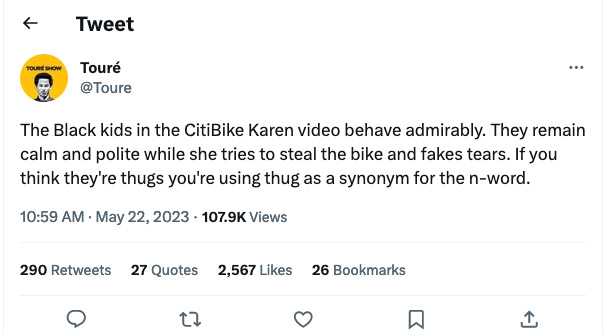
Physician’s assistant Sarah Comrie, six-months pregnant and coming off of a twelve hour shift in Bellevue Hospital’s neonatal ward, never approached a group of five black teenagers, all of them males, and tried to steal a bike they’d rented — though the mental image of five black teenagers pressed ridiculously together groin to ass on a rented bike peddling down a New York City street on their way to, what? — church? A Hamilton matinée? — I have to admit amuses me enormously.
Similarly, the five male teens who laid claim to the bike never acted “admirably,” as yet another race hustler attempted to frame the interaction; in fact, during the 90-second viral video clip, the men can be seen and heard hectoring the pregnant woman, taunting her, cursing at her, putting hands on her several times, and intentionally creating a “Karen” narrative in real time. Nevertheless, we’re told that if we believe our own eyes — and identify thuggish behavior as belonging to those who act thuggishly, and with what it appears is thuggish relish — then what we’re doing is “using thug as a synonym for the n-word”.
— And yet, the person making that claim is naturally the one who is interested in drawing that connection — in a rhetorical maneuver that has become so trite and boring that I wish I could stop pointing it out: the gambit is meant to forestall any pushback on the preferred and implied racial narrative the grifters are hoping to shape and add to their civic mythologies, while also and simultaneously deterring people from honestly assessing what they’ve witnessed — however out of context and fraught that may be — for fear of being labeled “racist” and publicly scapegoated as a symbol for venal “whiteness” that is now central to the leftist’s “anti-racism” and CRT projects.
June 2, 2023
A potential sign of resistance?
Severian on the odd phenomena of people who’ve begun to discover they didn’t need to accept the ever-more-woke products of the entertainment industry and, more recently, major retailers and brewers:

Bud Light’s latest brand ambassador, Dylan Mulvaney
The Third Law of SJW — “SJWs always double down” — is really going to get tested with these things [woke reboots/remakes of popular TV shows, movies, etc.], but we need to hope they keep the faith. We want them to double, triple, quadruple down. The material basis of Clown World is the assumption that people simply can’t live without iCrap. As I noted, lots of people did indeed seem to enjoy the Covid lockdowns, and they weren’t all aspiring Laptop Class leftoids, either. Lots of moms found out that they rather enjoyed spending time with their kids, rather than putting in an extra twenty hours a week down at the law firm. Lots of suburban dads found a new sense of accomplishment doing little projects around the house.
In other words, people found out that not only could they just “make do”, they actually kinda enjoyed “making do”. Lots of them went right back to their old ways the minute they could, of course, but not all of them … and now, #Woke Capital is basically doing the job for us. They’re daring us to not go to the movies, the same way Fox News is daring us to cut the cord entirely (they figure that hey, we get $x a month from the cable subscription fee regardless of whether anyone watches or not, so why not give in to our natural inclinations and become MSNBC Lite?).
They’re daring us to cut the cord, throw the Pocket Moloch in the nearest lake, and get what we need from local sources — including entertainment. And who knows what might happen if we start actually talking to our neighbors? If, as with the lockdowns, the guy who lives down the street ceases to be “the dude with the green Honda” and becomes Bob, a real person?
Challenge accepted, motherfuckers.
May 31, 2023
Alvin Toffler may have been utterly wrong in Future Shock, but I suspect his huge royalty cheques helped soften the pain
Ted Gioia on the huge bestseller by Alvin Toffler that got its predictions backwards:
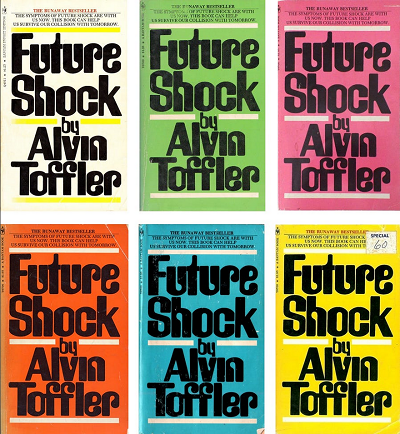
Back in 1970, Alvin Toffler predicted the future. It was a disturbing forecast, and everybody paid attention.
People saw his book Future Shock everywhere. I was just a freshman in high school, but even I bought a copy (the purple version). And clearly I wasn’t alone — Clark Drugstore in my hometown had them piled high in the front of the store.
The book sold at least six million copies and maybe a lot more (Toffler’s website claims 15 million). It was reviewed, translated, and discussed endlessly. Future Shock turned Toffler — previously a freelance writer with an English degree from NYU — into a tech guru applauded by a devoted global audience.
Toffler showed up on the couch next to Johnny Carson on The Tonight Show. Other talk show hosts (Dick Cavett, Mike Douglas, etc.) invited him to their couches too. CBS featured Toffler alongside Arthur C. Clarke and Buckminster Fuller as trusted guides to the future. Playboy magazine gave him a thousand dollar award just for being so smart.
Toffler parlayed this pop culture stardom into a wide range of follow-up projects and businesses, from consulting to professorships. When he died in 2016, at age 87, obituaries praised Alvin Toffler as “the most influential futurist of the 20th century”.
But did he deserve this notoriety and praise?
Future Shock is a 500 page book, but the premise is simple: Things are changing too damn fast.
Toffler opens an early chapter by telling the story of Ricky Gallant, a youngster in Eastern Canada who died of old age at just eleven. He was only a kid, but already suffered from “senility, hardened arteries, baldness, slack, and wrinkled skin. In effect, Ricky was an old man when he died.”
Toffler didn’t actually say that this was going to happen to all of us. But I’m sure more than a few readers of Future Shock ran to the mirror, trying to assess the tech-driven damage in their own faces.
“The future invades our lives”, he claims on page one. Our bodies and minds can’t cope with this. Future shock is a “real sickness”, he insists. “It is the disease of change.”
As if to prove this, Toffler’s publisher released the paperback edition of Future Shock with six different covers — each one a different color. The concept was brilliant. Not only did Future Shock say that things were constantly changing, but every time you saw somebody reading it, the book itself had changed.
Of course, if you really believed Future Shock was a disease, why would you aggravate it with a stunt like this? But nobody asked questions like that. Maybe they were too busy looking in the mirror for “baldness, slack, and wrinkled skin”.
Toffler worried about all kinds of change, but technological change was the main focus of his musings. When the New York Times reviewed his book, it announced in the opening sentence that “Technology is both hero and villain of Future Shock“.
During his brief stint at Fortune magazine, Toffler often wrote about tech, and warned about “information overload”. The implication was that human beings are a kind of data storage medium — and they’re running out of disk space.
May 23, 2023
QotD: Cavalry operations in Rings of Power versus cavalry operations in history
By contrast [in Rings of Power], the Númenóreans rush to the battle at a full gallop, apparently the whole way or at the very least for hours through the morning. Horses will be vary, but generally two to three miles is the maximum distance most horses can gallop before fatigue sets in (for most horses this distance is going to be shorter), which they’re going to cover in about six minutes. The gallop is a very fast (25-30mph), very short sprint, yet Galadriel has this whole formation at full gallop even before she can see their destination. And I just want to remember here the absurdity that these horsemen do not even know there is a battle to ride to; for all they know this is a basic scouting effort (which might be better accomplished slowly and without wearing down all of the horses). Théoden at least has the excuse that he’s on the clock and knows it!
The way we are then shown the cavalry arriving is very confusing to me. The speed of their arrival makes at least some sense. We have already established that both Arondir and Adar are incompetent commanders so the fact that they have set no scouts or lookouts checks out. Pre-modern and early-modern cavalry could effectively out-ride news of their coming, and so show up unexpectedly in places with very little warning. Not this little warning, mind you – the time from the first sound of hoof-falls (heard by Elves – the orcs evidently hear nothing) to the cavalry deluging the village is just about fifteen seconds; horses move fast but they do not move that fast (at full gallop a horse might cover 150-200 meters in those fifteen seconds and the orcs would absolutely hear them coming before they saw them). But the idea in general that the Númenórean cavalry could appear as if out of nowhere to the orcs checks out – that was one of the major advantages of cavalry operations.
Bret Devereaux, “Collections: The Nitpicks of Power, Part III: That Númenórean Charge”, A Collection of Unmitigated Pedantry, 2023-02-03.
May 15, 2023
“Donald Trump is, as a performer, in a class of his own. From the second the show began, he was in command: withering, funny, sharp, powerful.”
I didn’t watch the CNN broadcast that Andrew Sullivan is reluctantly praising here — he still hates and fears Donald Trump, but he has to acknowledge the man’s abilities:

The reason so many are freaking out about CNN’s astonishing ad for the Trump re-election campaign this week is that he was on tip-top form. Donald Trump is, as a performer, in a class of his own. From the second the show began, he was in command: withering, funny, sharp, powerful. He may be one of the most effective and pathological demagogues I’ve ever encountered: capable of lying with staggering sincerity, of making up stories with panache: shameless, and indefatigable.
Now think of Joe Biden, peace be upon him. He can barely get a sentence out without a mumble, a slur, or a confused expression. He seems frail and distant. In a direct contrast between the two old men, there will surely be some voters — and maybe many — who simply back the man who seems capable of doing the job vigorously for four more years. There hasn’t been this kind of contrast since Clinton-Dole (and Dole in 1996 was sharp AF) and Reagan-Mondale (it took Reagan’s debate genius to destroy the concern). Trump, in stark contrast, bulldozed the host Kaitlan Collins, who was far more in charge of facts and details than Biden will ever be.
Shamelessness has a huge appeal. It’s why we can’t see a production of Richard III without at some points egging on the child-murderer. And I confess that watching the deposition conducted by Robbie Kaplan, he got me. When Trump says to Kaplan, after dismissing Carroll as “not his type”, “You would not be my choice of mine either, to be honest with you. I hope you’re not insulted”, I LOLed. It was disgusting — but how could you not laugh at the effrontery?
At one point in the CNN show, Trump took the performance up a notch — sympathizing with E Jean Carroll’s husband:
He was a newscaster, very nice man. She called him an ape, happens to be African-American. Called him an ape — the judge wouldn’t allow us to put that in. Her dog or her cat was named “Vagina”, the judge wouldn’t allow to put that in.
Sorry, but the way he delivered the word “vagina” was worthy of a good stand-up. And the affect — the lone ranger telling the truth while prissy elites tut-tut — channels a vast swathe of the public mood.
The issues are also turning Trump’s way. As Title 42 expires today, a huge influx of fraudulent “asylum” seekers is on the verge of overwhelming what border we have left — some with court dates as far away as 2027. Virtually none will be deported ever. A Marine veteran has been charged with manslaughter after manhandling an out-of-control black man on the subway: a trial that’s catnip for the right. People have vague memories of a pre-Covid economic boom and associate it with Trump. Ukraine will be an increasing headache for Biden, as horrible decisions loom at some point if Ukraine can’t win full liberation of their country.
Biden is tethered to Kamala Harris, who will be seen by many as a possible president by default if Biden kicks the bucket in a few years. And she is an even worse politician and manager than Hillary Clinton. The MSM has spent the last few months attempting to destroy the only viable alternative to Trump, DeSantis, because they’ve actually convinced themselves of a looming “Biden blowout“.
I say the emergency is still here; that Trump is more likely than not returning to the White House as of now; and the interlude of these few precious years when this monster wasn’t daily assaulting our constitution, sanity, and our sense of decency is over.
Get used to it; and strap yourselves in.
May 13, 2023
Arnold Ridley – “Private Charles Godfrey” – a real story from Dad’s Army
The History Chap
Published 1 Feb 2023The story of Arnold Ridley — Private Charles Godfrey — Dad’s Army
After my last video all about Lance Corporal Jones in Dad’s Army I have been inundated by requests for the real story of another character from the classic comedy series: Private Godfrey.
Private Charles Godfrey, played by Arnold Ridley, is an ageing and slightly doddery member of the Walmington-on-Sea Home Guard platoon. His comrades are somewhat surprised and concerned when he announces that he was a conscientious objector during the First World War. However, thanks to his sister, the platoon learn his real (well, fictitious as it is a TV comedy show) story. Godfrey was indeed a conscientious objector but like many others he did volunteer to serve his country – just not to kill. Many men who felt likewise, joined the Army Medical Corps. Whilst not fighting they not only served their country and played a valuable role in the war effort but they also put themselves in harm’s way. Many of them became stretcher bearers, going out into no man’s land to fetch the wounded to safety. And many were decorated for their bravery.
William Coltman, became the most decorated NCO in the entire British army during the First World War … and he never fired a shot in anger!I will be telling the story of William Coltman VC in the near future.
Private Charles Godfrey was awarded the Military Medal for bravery during the battle of the Somme.
What makes Godfrey’s character all the more fascinating is that his actor, Arnold Ridley, was no conscientious objector but a volunteer in World War One. he was severly injured at the battle of the Somme in 1916 and discharged the following year.
Indeed, his injuries would influence how he played his character in Dad’s Army.
After the war, Ridley became a play writer. Arnold Ridley penned over 30 pays, the most famous of which was The Ghost Train written in 1923.
At the outbreak of the Second World War he once more volunteered to serve his country. Following the battle of Boulogne in 1940, he was evacuated to Britain, having been injured, once more, he was again given a medical discharge.
For the rest of the war he worked for ENSA – the forces entertainment organisation — and was a member of his local Home Guard. He continued his acting career through the 1940’s and 50’s before landing the role of Private Charles Godfrey in Dads Army in 1968. He was ever-present until the show ended in 1977. By then he was 81 years old.
Arnold Ridley died in 1984 and is buried in Bath Abbey.
(more…)
QotD: The inherent absurdity of “Canadian content”
But the real folly of CanCon is not that it is impractical, or prone to abuse, or even unnecessary, though it is all of those things. It is rather that it is nonsensical at its root, in its very purpose – again, so far as anyone can define it. Is the point, after all, artistic or political? But it cannot be artistic: there is no theory of aesthetics that prefers that Canadian artists should make Canadian art that teaches Canadians how Canadian they are.
It is, rather, a political project: the inculcation of national feeling in the public, for the purpose of creating a political community, separate and distinct from the colossus to the south. Without the Maginot Line of CanCon quotas, it is suggested, we would be overwhelmed: first the artists, then the country.
But note the assumptions built into this emotive appeal: that a separate nationality cannot be maintained without cultural difference; that our cultural differences with the Americans are both sufficient in themselves to justify our statehood and yet so fragile as to be washed away in an instant; that, left to their own choices, Canadians would unhesitatingly choose the products of an incomprehensibly alien culture over their own; and that, by virtue of this diet of foreignism, we would no longer be Who We Are as Canadians. Therefore we must not be left to our own choices.
Which is nonsense, because we would still be Who We Are, even in that hypothetical dystopian future: it might not be Who We Were, but so what? The Who We Are we are now at such pains to preserve is itself vastly different from Who We Were before.
And who, in the end are we? As the comedian Martin Short once put it: “we’re the people who watch a lot of American TV”. The wholesale ingestion of a foreign culture – albeit much of it made by expat Canadians – is an integral part of our distinct national identity, an irony that must forever elude our cultural nationalists.
Andrew Coyne, “The concept of CanCon is pure folly. That’s the problem at the heart of Bill C-11”, The Globe and Mail, 2023-02-08.
May 8, 2023
Grrrrrrl Power is the only acceptable mode for new female characters, it seems
Janice Fiamengo on the strictly monotone representation of female characters in recent years:
The trend to make female movie characters tough and abrasive has been proceeding for some time. We can all predict that the new partner in the police procedural, let’s say a petite black woman whose entrance surprises (and thus reveals the bigotry of) the white man she’ll be working with, will turn out to be the biggest badass on the force. She’ll almost certainly save her partner’s life — and unearth a crime-solving detail he’d overlooked — before the first episode is over. At the same time, viewers will be treated to her sneering refusal of the partner’s banter, her steely gaze, and her fearless embrace of outrider status. She’s a woman with wise-cracking disdain for men as a group who takes quick revenge for even the smallest hint of sexism, benevolent or otherwise, from her fellow officers. And she quickly earns not only their respect but also their unwilling awe.
Whether police officers, first responders, detectives, firefighters, FBI — or, for that matter, nurses, ER doctors, politicians, or lawyers — the message is clear: these women are at least as capable and fearsome as any man: tough-minded, smart as a whip, and street-wise. Even in this era of agitation about the trans peril to women’s sports, the fictional females are as physically strong and combat-ready as any male, their fists and kicks aimed with staggering accuracy. Even tiny Lucy Tara on NCIS Hawai’i comes to the rescue of her far-larger male colleagues in impressive physical struggles with suspects.
But physical characteristics, the notable fearlessness and strength, are to some extent less striking than the women’s personalities and demeanor. An entire character transformation has been taking place, as traditionally feminine characteristics have been decisively minimized and masculine bravura brought to the fore. These women are, seemingly without effort, brusque, foul-mouthed, and contemptuous, particularly of male authority — and we’re to love them for it. They’re often beautiful, but they never try to be. With hair pulled back and aggressive booted stride, they are independent, uninterested in male approval, and largely indifferent to men as romantic partners, unless they are shown pursuing their occasionally voracious sexual needs, at which times their approach is direct and unsentimental. After an evening of bronco-riding athleticism, they wake up in a tousled bed with a slight grimace and duck out of the lover’s offer of breakfast. They’re not interested in commitment or any continued intimacy. A call comes in on their cell phone, they pull on their clothes nonchalantly, and walk out of the man’s life. They’ve already forgotten him as they prepare to conquer evil once again.
A popular new Netflix series, The Diplomat, takes these now-standard elements to the next level, profiling an ambitious, sexy, oft-frowning, brilliant, and explosively hot-tempered woman, Kate Wyler, who engages in uncontrolled physical and verbal abuse of her husband without remorse or narrative comeuppance. Though one might expect that a portrait of reckless physical violence by one spouse against another would be evidence at least of a serious character flaw — if not criminality (as it certainly would be if the male spouse were delivering the blows) — it is not at all clear in this case that the character’s actions deserve any condemnation. Her violence is simply the most extreme manifestation of her (rather admirable and plucky) unconventionality in breaking the rules of propriety in order to save the liberal world order.

Father Ted as Ireland’s answer to Fawlty Towers
Conor Fitzgerald on the tragically short run of the classic Irish comedy Father Ted:
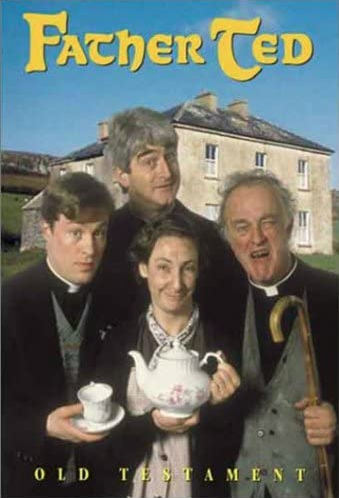
Fondly remembered and occasionally quoted, Father Ted has its place in the broad canon of the British sitcom. But in Ireland, even 25 years since its finale, it has always been so much more. Its status is closer to Fawlty Towers in England or Cheers in the United States: the national sitcom, a piece of light entertainment that nevertheless Says Something Meaningful About Us.
Not only was Father Ted one of the few successful TV representations of Ireland, it was made during Ireland’s version of the Swinging Sixties, our flux decade of the Nineties. The accelerating collapse of the Church and the exposure of longstanding political corruption coincided with the dawn of the Celtic Tiger years, lending peripheral Ireland a sense of self-conscious modernity. It was a unique national turning point, where our 19th-century past seemed to co-exist with our 21st-century future. In reflecting this upheaval, Father Ted has become not just a social historical document, but a portent of where Ireland stands today.
It’s not the sort of thing that national epics are normally made of. The programme is about three Catholic Priests — Fathers Ted Crilly, Dougal McGuire, and Jack Hackett — on Craggy Island, a remote settlement off the west coast of Ireland. All three priests have been exiled to this purgatory by the terrifying Bishop Len Brennan (their misdemeanours are never referred to directly, but Ted often makes oblique reference to the fact that “the funds were only resting in my account”). Most episodes revolve around an absurdist version of Church life, Ted’s schemes to escape the island and their interactions with the island’s townsfolk.
Rarely for domestic Irish TV, it was a sitcom written by Irish people and it was set within a central Irish institution, the Catholic Church. And the dearth of representations of Irish people in entertainment meant it crystallised many Irish archetypes for the first time. Ireland itself hadn’t always been a welcoming place for satirists. Ted star Dermot Morgan knew this well — his major project before Ted had been a political comedy radio show named Scrap Saturday, which upset all the wrong people, and was eventually cancelled amid allegations of political interference.
Unlike Scrap Saturday, Ted never sought to be political or self-consciously “relevant”. But Craggy Island is a capsule of Irish life at this time of major social change — not least for gender relations and the Church. Take one married couple, John and Mary, who own the corner shop on Craggy Island. They contrive to show a winsome, loving front to the priest whenever they encounter him, but turn to violent bickering once his back is turned. At one point, Mary tries to drown John in a bucket of water; at another, Father Ted comes into the shop and finds John has locked Mary in a cupboard. When he leaves, they’re arguing over a shotgun.
This peck-and-scratch marriage is still funny, but in 2023 the laughter it provokes is nervous. It’s a product of an Irish society still processing the reality of divorce, only legalised by a referendum in Ireland in 1995, the same year Ted first aired. Though it was not uncommon at that time for people to separate, the divorce campaign had been ugly and emotional. One billboard for No bore the slogan “Hello divorce, goodbye daddy”. The referendum was passed by the tiny margin of 9,000 votes.
Divorce was only one step in the very gradual withering of religious power in Ireland — far more gradual than the rest of Europe. Remember that abortion was only legalised in Ireland five years ago. When Ted was broadcast, the Church was formally still one of the central pillars of Irish life, but its authority rang hollow. Priests often felt like administrators of a vanished country. And on remote Craggy, Ted, Dougal and Jack mirror this directly. All good sitcoms feature characters who are trapped, but Ted is doubly so: first on his island; and second in an institution people are coming to see as irrelevant. He is still an essential member of the community, more than just a ceremonial functionary for weddings and funerals. But it’s just not clear what the essential thing he does is anymore, beyond being a common reference point that deserves token respect.
May 2, 2023
Dad’s Army: What Was The Military Career of Lance Corporal Jones?
The History Chap
Published 25 Jan 2023Lance Corporal Jack Jones is one of the most loved characters in the classic British comedy Dad’s Army. Constantly referring to his exploits in the Sudan, the North West Frontier (India) and the First World War.
So I thought I would make a short video exploring his long (& fictitious) military career.
The local butcher, Jack Jones, is a member of Walmington-on-Sea Home Guard during World War Two. This fictitious Home Guard unit are the stars of the classic BBC comedy: Dad’s Army.
What I found amazing is that the BBC created a back story for the character of Lance Corporal Jones. researching the medal ribbons that Jones wears on his Home Guard uniform I have put together a timeline of his military career in the 1st battalion, Warwickshire Regiment.
The story starts when young Jack Jones joins the Royal Warwickshire’s in 1884 as a drummer boy. He is to spend 31 years serving in the British army where he participates in the Gordon Relief Expedition, the re-conquest of Sudan under General Kitchener, the Boer War, the North West Frontier of India, and the First World War.
April 27, 2023
“… the Department of Defense is rejoicing that Tucker Carlson has been driven off of Fox News”
Chris Bray on the odd phenomenon of the US military formally having opinions on who is sitting at the big desk for Fox News these days:
In 2001, I was a nominal infantryman assigned to some exceptionally tedious duty at Fort Benning, Georgia. That spring, the Chief of Staff of the United States Army decided to symbolically make the whole army feel elite by changing the uniform and putting everyone into the black beret that had been unique to the Ranger battalions. See, now you have a special hat, so morale and esprit de corps and stuff.
Because I was in the infantry, surrounded all day every day by infantrymen, I can report the absolutely rock-solid consensus in the combat arms branches with complete confidence: we wondered why we were being led by idiots.* Quietly, but not quietly enough, we said things like, “See, the lethality of a combat force is tied directly to the quality of its fashion design“. A series of impromptu briefings and formal training sessions reminded us that we were not allowed to express open contempt for our senior leaders, so shut up about the dumbassery with the berets.
In retrospect, I think history shows us that new hats really were the most pressing challenge facing the American military as we rolled into the summer of 2001, but whatever.
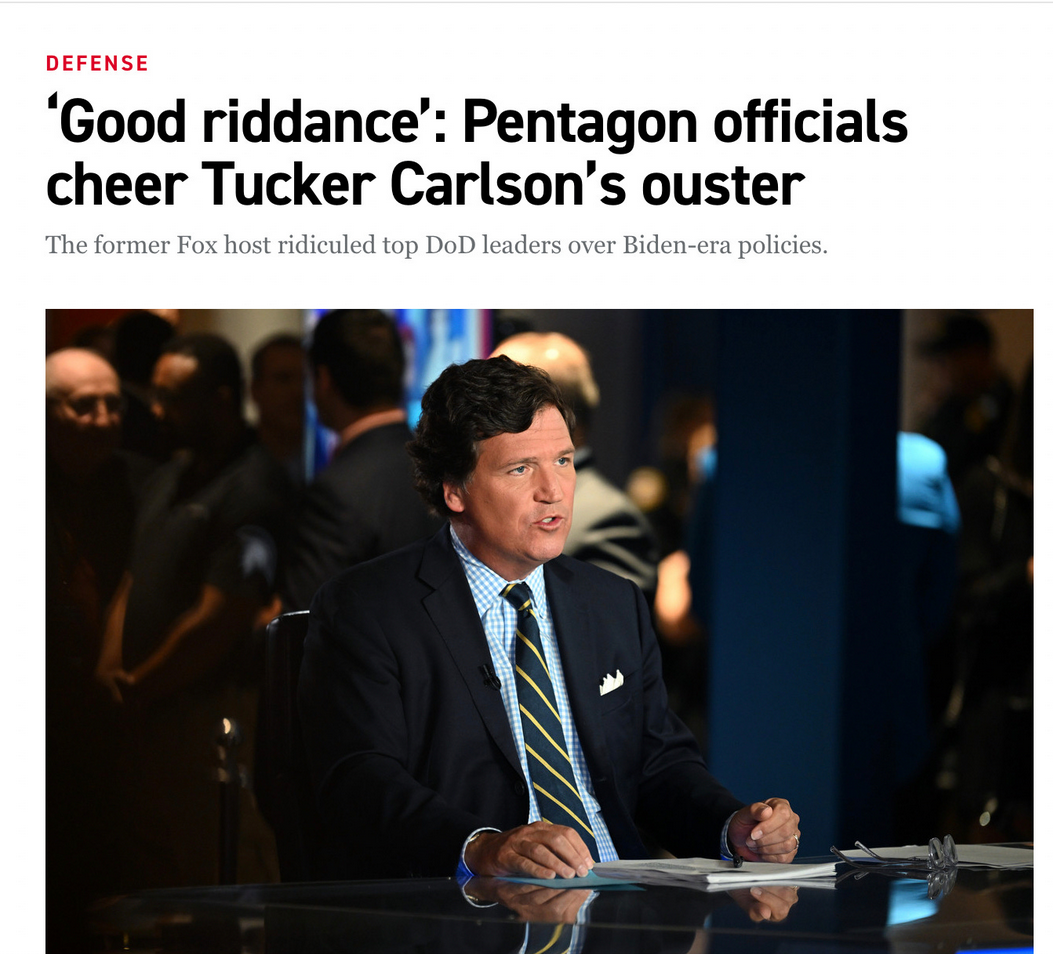
So Politico, the most reliably wrong publication in the history of the known universe, reports this week that the Department of Defense is rejoicing that Tucker Carlson has been driven off of Fox News.
See, Tucker Carlson was an authoritarian, a Trumpian protofascist. For example, he criticized the leadership of the military, who therefore rejoiced in his departure. Anti-authoritarianism, on the other hand, is when the leaders of the armed forces have a hand in shaping the culture and deciding who’s allowed to speak in the public sphere. Fascism is open discourse, so we need the military to say who should be on television so we can have freedom.
[…]
See, it’s good when the military “smites” civilian critics and expresses “revulsion” for them. In fascist countries, critics of the military are just allowed to speak freely. The culture has gone full Alice In Wonderland, and freedom is compliance.
* See also the switch from BDUs and ACUs.


