
Overly Sarcastic Productions
Published Oct 31, 2017It is a tale. A tale of a man … and a MONSTER!
It’s finally time to talk Frankenstein! Part sci fi, part horror, part opinion piece on the dangers of hubris, this classic story reminds us all to appreciate what’s really important to us: friends, family, loved ones, and most importantly, NOT creating twisted mockeries of God’s creations in an attempt to reach beyond the veil of life itself.
Nnnnnnnow here is a riddle to guess if you can,
sings the tale of Frankenstein!
Who is the monster and who is the man?~
October 30, 2024
Halloween Special: Frankenstein
Comments Off on Halloween Special: Frankenstein
September 17, 2024
QotD: “Megacorporations” in history and fiction
I think it is worth stressing here, even in our age of massive mergers and (at least, before the pandemic) huge corporate profits, just how vast the gap in resources is between large states and the largest companies. The largest company by raw revenue in the world is Walmart; its gross revenue (before expenses) is around $525bn. Which sounds like a lot! Except that the tax revenue of its parent country, the United States, was $3.46 trillion (in 2019). Moreover, companies have to go through all sorts of expenses to generate that revenue (states, of course, have to go about collecting taxes, but that’s far cheaper; the IRS’s operating budget is $11.3bn, generating a staggering 300-fold return on investment); Walmart’s net income after the expenses of making that money is “only” $14.88bn. If Walmart focused every last penny of those returns into building a private army then after a few years of build-up, it might be able to retain a military force roughly on par with … the Netherlands ($12.1bn); the military behemoth that is Canada ($22.2bn US) would still be solidly out of reach. And that’s the largest company in the world!
And that data point brings us to our last point – and the one I think is most relevantly applicable for speculative fiction megacorporations – historical megacorporations (by which I mean “true” megacorps that took on major state functions over considerable territory, which is almost always what is meant in speculative fiction) are products of imperialism, produced by imperial states with limited state capacity “outsourcing” key functions of imperial rule to private entities. And that explains why it seems that, historically, megacorporations don’t dominate the states that spawn them: they are almost always products and administrative arms of those states and thus still strongly subordinate to them.
I think that incorporating that historical reality might actually create storytelling opportunities if authors are willing to break out of the (I think quite less plausible) paradigm of megacorporations dominating the largest and most powerful communities that appear so often in science fiction. What if, instead of a corporate-dominated Earth (or even a corp-dominated Near-Future USA), you set a story in a near-future developing country which finds itself under the heel of a megacorporation that is essentially an arm of a foreign government, much like the EIC and VOC? Of course that would mean leavening the anti-capitalist message implicit in the dystopian megacorporation with an equally skeptical take about the utility of state power (it has always struck me that while speculative fiction has spent decades warning about the dangers of capitalist-corporate-power, the destructive potential of state power continues to utterly dwarf the damage companies do. Which is not to say that corporations do no damage of course, only that they have orders of magnitude less capability – and proven track record – to do damage compared to strong states).
(And as an aside, I know you can make an argument that Cyberpunk 2077 does actually adopt this megacorporation-as-colonialism framing, but that’s simply not how the characters in the game world think about or describe Arasoka – the biggest megacorp – which, in any event, appears to have effectively absorbed its home-state anyway. Arasoka isn’t an agent of the Japanese government, it is rather a global state in its own right and according to the lore has effectively controlled its home government for almost a century by the time of the game.)
In any event, it seems worth noting that the megacorporation is not some strange entity that might emerge in the far future with some sort of odd and unpredictable structure, but instead is a historical model of imperial governance that has existed in the past and (one may quibble here with definitions) continues to exist in the present. And, frankly, the historical version of this unusual institution is both quite different from the dystopian warnings of speculative fiction, but also – I think – rather more interesting.
Bret Devereaux, “Fireside Friday: January 1, 2021”, A Collection of Unmitigated Pedantry, 2021-01-01.
Comments Off on QotD: “Megacorporations” in history and fiction
August 5, 2024
QotD: George R.R. Martin’s Dothraki rank with the lazy racial sterotypes of Hollywood’s “Golden Age” westerns
The Dothraki were actually fashioned as an amalgam of a number of steppe and plains cultures … Mongols and Huns, certainly, but also Alans, Sioux, Cheyenne, and various other Amerindian tribes … seasoned with a dash of pure fantasy.
We may, I think, now safely dismiss this statement as false. What we have found is that the Dothraki do not meaningfully mirror either Steppe or Plains cultures. They do not mirror them in dress, nor in systems of subsistence, nor in diet, nor in housing, nor in music, nor in art, nor in social structures, nor in leadership structures, nor in family structures, nor in demographics, nor in economics, nor in trade practices, nor in laws, nor in marriage customs, nor in attitudes towards violence, nor in weapons, nor in armor, nor in strategic way of war, nor in battle tactics.
We might say he has added “dashes” of pure fantasy until the “dash” is the entire soup, but the truth is clearly the reverse: Martin has sprinkled a little bit of water on a barrel of salt and called it just a dash of salt. There is no historical root source here, but instead pure fantasy which – because racist stereotypes sometimes connect, in thin and useless ways, to actual history – occasionally, in broken-clock fashion, manages to resemble the real thing.
It seems as though the best we might say of what Martin has right is that these are people who are nomads that ride horses and occasionally shoot bows. The rest – which as you can see from the list above there, is the overwhelming majority – has functionally no connection to the actual historical people. And stunningly, somehow, the show – despite its absolutely massive budget, despite the legions of scrutiny and oversight such a massive venture brings – somehow is even worse, while being just as explicit in tying its bald collection of 1930s racist stereotypes to real people who really exist today.
Instead, the primary inspiration for George R.R. Martin’s Dothraki seems to come from deeply flawed Hollywood depictions of nomadic peoples, rather than any real knowledge about the peoples themselves. The Dothraki are not an amalgam of the Sioux or the Mongols, but rather an amalgam of Stagecoach (1939) and The Conqueror (1956). When it comes to the major attributes of the Dothraki – their singular focus on violent, especially sexual violence, their lack of art or expression, their position as a culture we primarily see “from the outside” as almost uniformly brutal (and in need of literally the whitest of all women to tame and reform it) – what we see is not reflected in the historical people at all but is absolutely of a piece with this Hollywood legacy.
But Martin has done more damage than simply watching The Mongols (1961) would today. He has taken those old, inaccurate, racially tinged stereotypes and repackaged them, with an extra dash of contemporary cynicism to lend them the feeling of “reality” and then used his reputation as a writer of more historically grounded fantasy (a reputation, I think we may say at this point, which ought to be discarded; Martin is an engaging writer but a poor historian) to give those old stereotypes the air of “real history” and how things “really were”. And so, just as Westeros became the vision of the Middle Ages that inhabits the mind of so many people (including quite a few of my students), the Dothraki become the mental model for the Generic Nomad: brutal, sexually violent, uncreative, unartistic, uncivilized.
And as I noted at the beginning of this series, Martin’s fans have understood that framing perfectly well. The argument given by both the creators themselves, often parroted by fans and even repeated by journalists is that A Song of Ice and Fire‘s historical basis is both a strike in favor of the book because they present a “more real” vision of the past but also a flawless defense against any qualms anyone might have over the way that the fiction presents violence (especially its voyeuristic take on sexual violence) or its cultures. No doubt part of you are tired of seeing that same “amalgam” quote over and over again at the beginning of every single one of these essays, but I did that for a reason, because it was essential to note that this assertion is not merely part of the subtext of how Martin presents his work (although it is that too), but part of the actual text of his promotion of his work.
And it is a lie. And I want to be clear here, it is not a misunderstanding. It is not a regrettable implication. It is not an unfortunate blind-spot of ignorance. It is a lie, made repeatedly, now by many people in both the promotion of the books and the show who ought to have known better. And it is a lie that has been believed by millions of fans.
One thing that I hope is clear from this treatment is just how trivial the amount of research I’ve done here was. Certainly, it helped that I was familiar with Steppe nomads already and that I knew who to ask to be pointed in the direction of information. Nevertheless, everything I’ve cited here is available in English and it is all relatively affordable (I actually own all of the books cited here; thanks to my Patrons for making that possible, especially since getting materials from the library is slower in the days of COVID-19; nevertheless, the point here is that they are not obscure tomes). Much of it – Ratchnevsky on Chinggis Khan, Secoy and McGinnis on Great Plains warfare – were already available well before the 1996 publication of A Game of Thrones. 1996 was not some wasteland of ignorance that might have made it impossible for Martin to get good information! For an easy sense of what a dedicated amateur with film connections might have learned in 1996, you could simply watch Ken Burns’ The West, which came out the same year. I am not asking Martin to become a historian (though I am asking him to stop representing himself as something like one), I am asking him to read a historian.
Instead of doing that basic amount of research, or simply saying that the peoples of Essos were made up cultures unconnected with the real thing, Martin and the vast promotional apparatus at HBO opted to lie about some real cultures and then to put hundreds of millions of dollars into promoting that lie.
And I want to be clear, these are real people! I know, depending on where you live, “Mongols” and “Sioux” and “Cheyenne” may feel as distant and fanciful as “Rohirrim” or “Hobbits” or else they may feel like “long-lost” peoples. But these were real people, whose real descendants are alive today. And almost all of them face discrimination and abuse, sometimes informally, sometimes through state action, often as a result of these very lingering racist stereotypes.
In that context, declaring that the Dothraki really do reflect the real world (I cannot stress that enough) cultures of the Plains Native Americans or Eurasian Steppe Nomads is not merely a lie, but it is an irresponsible lie that can do real harm to real people in the real world. And that irresponsible lie has been accepted by Martin’s fans; he has done a grave disservice to his own fans by lying to them in this way. And of course the worst of it is that the lie – backed by the vast apparatus that is HBO prestige television – will have more reach and more enduring influence than this or any number of historical “debunking” essays. It will befuddle the valiant efforts of teachers in their classrooms (and yes, I frequently encounter students hindered by bad pop-pseudo-history they believe to be true; it is often devilishly hard to get students to leave those preconceptions behind), it will plague efforts to educate the public about these cultures of their histories. And it will probably, in the long run, hurt the real descendants of nomads.
But this is exactly why I think it is important for historians to engage with the culture and to engage with depictions like this. Because these lies have consequences and someone ought to at least try to tell the truth. With luck, even with my only rudimentary knowledge, I have done some of that here, by presenting a bit more of the richness and variety of historical (and in some cases, present-day) horse-borne nomadic life, in both North America and Eurasia.
Because there is and was a lot more to nomads than just “that Dothraki horde”.
Bret Devereaux, “Collections: That Dothraki Horde, Part IV: Screamers and Howlers”, A Collection of Unmitigated Pedantry, 2021-01-08.
Comments Off on QotD: George R.R. Martin’s Dothraki rank with the lazy racial sterotypes of Hollywood’s “Golden Age” westerns
May 6, 2024
Kulak on banned fantasy novels hated by Feminists
There are books that get banned for all sorts of reasons — histories that tell the “wrong” facts, books beloved by terrorists, political tracts by wild-eyed fanatics, etc. — but they’re not the ones Kulak is talking about here:
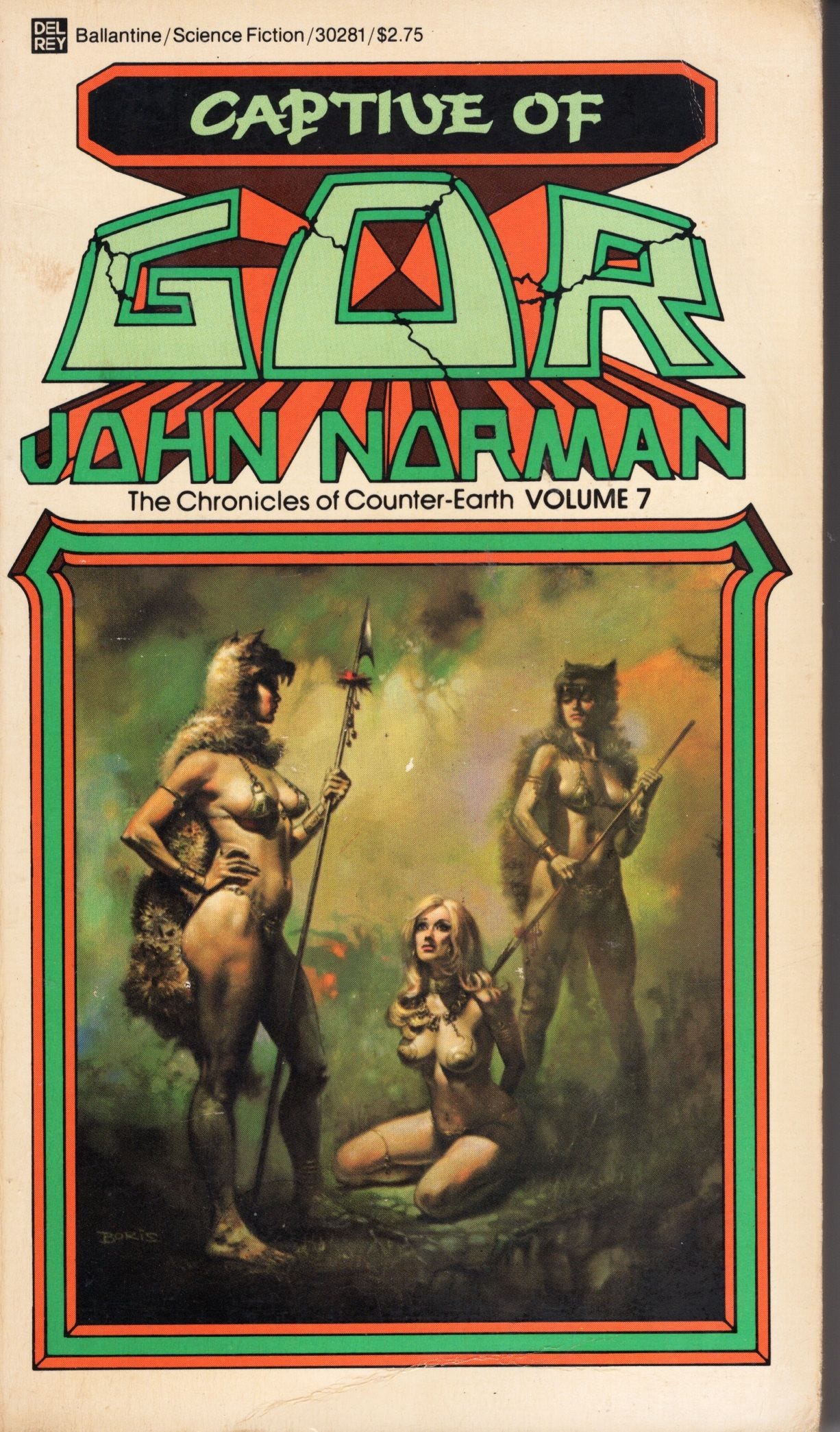
… the fiction books that are banned are usually fictionalized versions of those, works like Camp of the Saints, or The Turner Diaries, despite their ability to move people emotionally are not banned for their emotional content but for their political content (and in the case of The Turner Diaries its accurate instructions on bomb making)
HOWEVER! There is one series that was driven from bookstores, and by the late 90s was almost totally disappeared based purely on the … “feelings” … it generated in its readers. A fantasy series set entirely on another world with more or less nothing to say about politics back on earth, awakened … stirrings … in its readers so disturbing to the powers that be it had to be stopped.
The Chronicles of GOR by John Norman (Pen-name of Philosophy Professor John Lange)
Begun in 1966 and continuing to … today (he’s 92), the 38 book series is a Pulp Science Fantasy series in the vein of Edgar Rice Burroughs’ “Barsoom” series (shout out to John Carter of Postcards From Barsoom)
It has a lot of neat fantasy/historical/military hypotheticals to get the young male mind going “what if Vikings raided Japanese samurai cities with flying monsters?” but the thing that outraged the feminists and what they’d never admit enraged them, was its effect on female readers.
Norman has a lot of theories about sex … theories which his millions of books sold suggest are very true. Theories which recent DNA discoveries have confirmed.
At SEVERAL points in the genetic record you and nearly everyone on earth, have approximately 17 female ancestors for every 1 male ancestor.
This was of course the result of patriarchal warfare, polygamy, and sexual slavery … The kind familiar to any readers of the Iliad.
Indeed Norman cites Homer, Freud, and Nietzsche as the primary influences on his philosophy.
But whereas this produced the ancient and then modern warfighting man boys and young men idolize from the Iliad, through Rome, to the Mongols, to the adventures and conquests of early modern Europe. And whose feuds and daring consume half the plot of Norman’s stories …
The real controversy is what it produced of the women.
Women are natural slaves Norman tells and in the later books shows (the books greatly improved over time: don’t read them in order)
While these periods of slaving warfare between peoples and tribes produced modern technical, competent, highly coordinated and cooperative man … In women it produced natural slaves. Women who’d long for the chain, women who’d desire nothing so much as to be owned and to submit to a powerful violent man not of their choosing … women who’d never feel so “””empowered””” as when they obey, and surrender the spirits, bodies, and wombs which they cannot defend. Who’d never feel so loved and wanted as when they are abused and disdained.
This is the world and theory of mind Norman paints with a philosopher’s attention to completeness … 38 books deconstructing and undoing not only modern feminist ideas of equality, but Christian ideas of the equality of the soul and nobility of the feminine spirit. By any standard maybe the most sexist misogynistic books ever written, not out of ignorance or resentment but a philosopher’s indifference to any social or ethical preening that might impede the truth …
And women freaking loved it.
I encountered Captive of Gor at a mainstream book store in Mississauga in about 1975, and I was amazed that it was available for sale in still-pretty-conservative Ontario. I read several of the other books in the series, but I had no idea the author was still adding new volumes down to the present day. I can’t remember the last time I saw one for sale, but I guess the fans can still get their hands on them even if ordinary book stores no longer carry them.
Comments Off on Kulak on banned fantasy novels hated by Feminists
April 12, 2024
QotD: Prepper fantasy versus prepper reality
The thing is these stories are totally ahistorical — the best that solitary survivors have ever managed was to survive, none of them have rebuilt civilization. As Jane notes in her review of BAP, the sandal-clad barbarians have generally been subjected to a “tyranny of the cousins” even more intrusive and meticulous than the gynocratic safetyism that Bronze Age Lifestyle offers an imaginative escape from. And as for the pioneers, Tanner Greer notes that:
Many imagine the great American man of the past as a prototypical rugged individual, neither tamed nor tameable, bestriding the wilderness and dealing out justice in lonesome silence. But this is a false myth. It bears little resemblance to the actual behavior of the American pioneer, nor to the kinds of behaviors and norms that an agentic culture would need to cultivate today. Instead, the primary ideal enshrined and ritualized as the mark of manhood was “publick usefuleness”, similar, if not quite identical, to the classical concept of virtus. American civilization was built not by rugged individuals but by rugged communities. Manhood was understood as the leadership of and service to these communities.
It would be too easy to end the review here, with the implication that the prepper identity is a fantasy of radical individualism and like all such fantasies, kinda dumb. But the thing is, the prepper world has by and large absorbed this critique and incorporated it into its theorizing. In contrast to the libertarian fantasies of the 1970s, second-wave prepperism (reformed prepperism?) is constantly talking about community, the importance of having friends you can trust, of cultivating deep social bonds with your neighbors, etc.
What Yu Gun reminds us is that this is still totally ahistorical, but this time in a way that indicts not only the preppers, but also a much broader swathe of our society. A man without a community is unnatural, but so is a community without leadership, hierarchy, and order. The prepper version of community is a vision of freely contracting individuals respecting each others’ autonomy while cooperating because it’s in their best interests. This is also the folk version of community that motivates much of our economic and legal regime. Scratch an American “communitarian”, and underneath it’s just another individualist.
If you hang out on prepper forums, a recurrent mantra is to “practice your preps”, that is to start living on the margin as if the apocalypse had already occurred. The purpose of this is to gain experience in the skills you’ll need after the end, and to work out the kinks in your routine now, while it’s still easy to make adjustments. Originally this meant practicing getting lost in the woods, using and maintaining your weapon of choice, eating some of your food stockpile, or whatever. In second-wave prepperism it means all that, plus a bunch of new stuff like hanging out with your neighbors, attending community barbecues, and whatever else it is that freely contracting individuals like to autonomously do while temporarily occupying the same space.
But for we third-wave preppers, it has to take on a very different meaning. Greer’s essay that I quoted above is mainly about how leadership and service in local-scale organizations served as training for leadership and service in much larger groups aimed at problems with much higher stakes. In other words, they were practicing their preps. One of the great secrets of leadership is that following and leading are actually closely related skills, and that practice at one of them transfers well to the other. This is difficult for we Americans to see, because an aversion to hierarchy is built into our national character, and consequently we operate with impoverished models of what it means to be in a position of authority or of subordination.
Long ago I read an article contrasting Western and Korean massively-multiplayer online role-playing games (MMORPGs). Even if you know nothing about computer games, you probably know that in most of them you are the hero, the chosen one, the child of destiny. Talk about fantasies of agency! MMORPGs thus have a tricky needle to thread — somehow all the thousands and thousands of players need to simultaneously be the chosen one, the child of destiny, etc., etc. And they mostly accomplish this by just rolling with it and asking everybody to suspend disbelief. But this article claimed that Korean MMORPGs are different — when players join these games, they’re randomly assigned a role. A tiny fraction might become kings or generals or children of destiny, with the power to decide the fates of peoples and kingdoms, but most are given a role as ordinary soldiers or porters or blacksmiths, and toil away at their in-game mundane tasks, without much ability to affect anything at all.
We like to imagine that after the bombs fall and the smoke clears we will emerge as the new Yu Gun, apportioning merit and assigning tasks. And perhaps you will indeed be called upon to do that, so you should prepare yourself to step up and do it. That preparation will involve some practice commanding others and some practice obeying others’ commands, because the two are inextricably bound together. But in life as in Korean video games, there’s isn’t very much room at the top. Far more likely, when the stage of history is set, we will be cast in a supporting role, like the Korean gamer assigned to role-play as a peasant or like Yu’s followers standing in orderly ranks. Let us not turn our noses up at this vocation, the poorly-behaved seldom make history.
John Psmith, “REVIEW: Medieval Chinese Warfare, 300-900 by David A. Graff”, Mr. and Mrs. Psmith’s Bookshelf, 2023-06-05.
Comments Off on QotD: Prepper fantasy versus prepper reality
March 25, 2024
Vernor Vinge, RIP
Glenn Reynolds remember science fiction author Vernor Vinge, who died last week aged 79, reportedly from complications of Parkinson’s Disease:
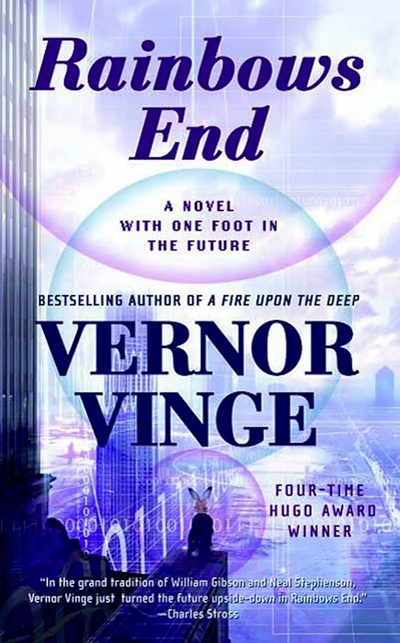
Vernor Vinge has died, but even in his absence, the rest of us are living in his world. In particular, we’re living in a world that looks increasingly like the 2025 of his 2007 novel Rainbows End. For better or for worse.
[…]
Vinge is best known for coining the now-commonplace term “the singularity” to describe the epochal technological change that we’re in the middle of now. The thing about a singularity is that it’s not just a change in degree, but a change in kind. As he explained it, if you traveled back in time to explain modern technology to, say, Mark Twain – a technophile of the late 19th Century – he would have been able to basically understand it. He might have doubted some of what you told him, and he might have had trouble grasping the significance of some of it, but basically, he would have understood the outlines.
But a post-singularity world would be as incomprehensible to us as our modern world is to a flatworm. When you have artificial intelligence (and/or augmented human intelligence, which at some point may merge) of sufficient power, it’s not just smarter than contemporary humans. It’s smart to a degree, and in ways, that contemporary humans simply can’t get their minds around.
I said that we’re living in Vinge’s world even without him, and Rainbows End is the illustration. Rainbows End is set in 2025, a time when technology is developing increasingly fast, and the first glimmers of artificial intelligence are beginning to appear – some not so obviously.
Well, that’s where we are. The book opens with the spread of a new epidemic being first noticed not by officials but by hobbyists who aggregate and analyze publicly available data. We, of course, have just come off a pandemic in which hobbyists and amateurs have in many respects outperformed public health officialdom (which sadly turns out to have been a genuinely low bar to clear). Likewise, today we see people using networks of iPhones (with their built in accelerometers) to predict and observe earthquakes.
But the most troubling passage in Rainbows End is this one:
Every year, the civilized world grew and the reach of lawlessness and poverty shrank. Many people thought that the world was becoming a safer place … Nowadays Grand Terror technology was so cheap that cults and criminal gangs could acquire it. … In all innocence, the marvelous creativity of humankind continued to generate unintended consequences. There were a dozen research trends that could ultimately put world-killer weapons in the hands of anyone having a bad hair day.
Modern gene-editing techniques make it increasingly easy to create deadly pathogens, and that’s just one of the places where distributed technology is moving us toward this prediction.
But the big item in the book is the appearance of artificial intelligence, and how that appearance is not as obvious or clear as you might have thought it would be in 2005. That’s kind of where we are now. Large Language Models can certainly seem intelligent, and are increasingly good enough to pass a Turing Test with naïve readers, though those who have read a lot of Chat GPT’s output learn to spot it pretty well. (Expect that to change soon, though).
Comments Off on Vernor Vinge, RIP
February 9, 2024
QotD: “Five, Four, Three, Two, One. Thunderbirds Are Go!”
Although there had been earlier offerings from the same stable, such as Supercar, Fireball XL5 and Stingray, and others which followed, it was Thunderbirds that gripped my generation and has never really let go. Set in the future, the genre devised by Gerry Anderson focused on the heroic exploits of secret but benevolent organisations operating from remote or hidden bases on land, in the sky or on the moon. Equipped with advanced technology, their missions were to protect civilisation from aggression, accident and sabotage, countering devious, often extra-terrestrial opponents. It was his brother’s service in the RAF that gave Anderson a life-long fascination with flying machines. Thunderbird Field at Glendale, Arizona, where his older brother learned to fly, provided a name for the series.
In his future worlds, planet Earth is generally united under a world president, in contrast to the traumas of the recently passed world war. Each programme featured life-like puppets, filmed in what Anderson dubbed “Supermarionation”. They were tributes to his brother. It was on 27 April 1944 that these future television series were really born. Flight Sergeant Lionel Anderson never got to pilot Stingray or Thunderbird One, or fly an Interceptor from Cloudbase, for during the early hours of that April Thursday, his twin-engined Mosquito was hit by flak on a night intruder raid and crashed near Deelen in Holland. Now he and his navigator, Sergeant Bert Hayward, lie in the corner of a cemetery in Arnhem, “Mourned by his devoted parents and brother Gerald”, as the Commonwealth War Grave headstone reads.
The war traumatised Gerry Anderson, whose Jewish grandparents had fled pogroms on the Polish–Russian frontier. He would complete his own national service in the RAF and experienced two more dramatic flying events. In 1948, he saw a Mosquito — his brother’s aircraft type — crash during an air display, killing many bystanders. Later a Spitfire came in to land without its undercarriage lowered. The helplessness he felt, and need for some divine intervention, such as that provided by the World Aquanaut Security Patrol (Stingray), International Rescue (Thunderbirds), Spectrum (Captain Scarlet) or Supreme Headquarters Alien Defence Organisation (UFO), provided more seeds for the future series, where the world was united and fought external foes. In German, the last was screened as Weltraumkommando SHADO, but the concept precisely echoed the UNIT organisation of Doctor Who.
Throughout the 1950s and 1960s we were promised robots, space travel, lunar colonies and travel to Mars. Films, television series, science fiction short stories and magazines guaranteed it to the point of entitlement. Airfix plastic model kits, cardboard cut-outs on cereal packets, Matchbox, Corgi and Dinky diecast toys reinforced this expectation, underwritten by the real, manned Mercury missions of 1961–63, Gemini space launches of 1965–66 and Apollo craft of 1968–72. Gerry Anderson’s vision (shared by the American script writers of Star Trek, which debuted exactly a year after Thunderbirds on 8 September 1966) of a world government did not seem absurd to the young minds of 1965. It is partly the innocence of those years which touches us today. I, for one, still feel short-changed.
Peter Caddick-Adams, “Broadcasting anniversaries”, The Critic, 2023-11-04.
Comments Off on QotD: “Five, Four, Three, Two, One. Thunderbirds Are Go!”
January 17, 2024
QotD: Did Hari Seldon live in vain?
Such complex causation defies general laws (even before we get into the fact that humans also observe history, which creates even more complexity) with such tremendous import from such unlikely events in an experiment which can only be run once without a control.
The other problem is evidence. Attempting to actually diagnose and model societies like this demands a lot of the data and not merely that you need a lot of it. You need consistent data which projects very far back in history which is accurate and fairly complete, so that it can be effectively compared. Trying, for instance, to compare ancient population estimates, which often have error bars of 100% or more, with modern, far more precise population estimates is bound to cause some real problems in teasing out clear correlations in data. The assumptions you make in tuning those ancient population figures can and will swallow any conclusions you might draw from the comparison with modern figures beyond the fairly obvious (there are more people now). But even the strongest administrative states now have tremendous difficulty getting good data on their own lower classes! Much of the “data” we think we have are themselves statistical estimates. The situation even in the very recent past is much worse and only degrades from there as one goes further back!
By way of example, I was stunned that Turchin figures he can identify “elite overproduction” and quantify wealth concentration into the deep past, including into the ancient world (Romans, late Bronze Age, etc). I study the Romans; their empire is only 2,000 years ago and moreover probably the single best-attested ancient society apart from perhaps Egypt or China (and even then I think Rome comes out quite solidly ahead). And even in that context, our estimates for the population of Roman Italy range from c. 5m to three to four times that much. Estimates for the size of the Roman budget under Augustus or Tiberius (again, by far the best attested period we have) range wildly (though within an order of magnitude, perhaps around 800 million sestertii). Even establishing a baseline for this society with the kind of precision that might let you measure important but modest increases in the size of the elite is functionally impossible with such limited data.
When it comes to elites, we have at best only one historical datapoint for the size of the top Roman census class (the ordo equester) and it’s in 225 BC, but as reported by Polybius in the 140s and also he may have done the math wrong and it also isn’t clear if he’s actually captured the size of the census class! We know in the imperial period what the minimum wealth requirement to be in the Senate was, but we don’t know what the average wealth of a senator was (we tend to hopefully assume that Pliny the Younger is broadly typically, but he might not have been!), nor do we know the size of the senatorial class itself (formed as a distinct class only in the empire), nor do we know how many households there were of senatorial wealth but which didn’t serve in the Senate because their members opted not to run for public office. One can, of course, make educated guesses for these things (it is often useful and important to do so), but they are estimates founded on guesses supported by suppositions; a castle of sand balanced atop other castles of sand. We can say with some confidence that the Late Roman Republic and the Early Roman Empire saw tremendous concentrations of wealth; can we quantity that with much accuracy? No, not really; we can make very rough estimates, but these are at the mercy of their simplifying assumptions.
And this is, to be clear, the very best attested ancient society and only about 2,000 years old at that. The data situation for other ancient societies can only be worse – unless, unless one begins by assuming elite overproduction is a general feature of complex, wealthy societies and then reads that conclusion backwards into what little data exists. But that isn’t historical research; it is merely elevating confirmation bias to a research methodology.
As noted, I have other nitpicks – particularly the tendency to present very old ideas as new discoveries, like secular cycles (Polybius, late 2nd century BC) or war as the foundation of complex societies (Heraclitus, d. c. 475 BC) without always seeming to appreciate just how old and how frequently recurring the idea is (such that it might, for instance, be the sort of intuitive idea many people might independently come up with, even if it was untrue or that it might be the kind of idea that historians had considered long ago and largely rejected for well established reasons) – but this will, I hope, suffice for a basic explanation of why I find the idea of this approach unsatisfying. This is, to be clear, not a rejection of the role of data or statistics in history, both of which can be tremendously important. Nor is it a rejection of the possible contributions of non-historians (who have important contributions to make), though I would ask that someone wading into the field familiarize themselves with it (perhaps by doing some traditional historical research), before declaring they had revolutionized the field. Rather it is an argument both that these things cannot replace more traditional historical methods and also that their employment, like the employment of any historical method, must come with a very strong dose of epistemic humility.
Psychohistory only works in science fiction where the author, as the god of his universe, can make it work. Today’s psychohistorians have no such power.
Bret Devereaux, “Fireside Friday: October 15, 2021”, A Collection of Unmitigated Pedantry, 2021-10-15.
1. For those confused by the causation, the Mongols are considered the most likely vector for the transmission of gunpowder from China, where it was invented, to Europe. Needless to say, having a single polity spanning the entire Eurasian Steppe at the precise historical moment for this to occur sure seems like a low probability event! In any event, European mastery of gunpowder led directly into European naval dominance in the world’s oceans (its impact on land warfare dominance is much more complex) which in turn led to European dominance at sea. At the same time, the English emphasis on gunnery over boarding actions early in this period (gunpowder again) provided a key advantage which contributed to subsequent British naval dominance among European powers (and also the British navy’s “cult of gunnery” in evidence to the World Wars at least), which in turn allowed for the wide diffusion of English as a business and trade language. In turn, American and British prominence in the post-WWII global order made English the natural language for NATO and thus the ICAO convention that English be used universally for all aircraft communication.
Comments Off on QotD: Did Hari Seldon live in vain?
December 31, 2023
QotD: Orwell as a “failed prophet”
Admittedly, if Orwell was aiming to prophesy, he misfired. Oceania is a world in which the ruling elite espouses no ideology except the brutal insistence that “might makes right”. Tyrannical regimes today still promote ideological orthodoxy — and punish public protest, organized dissidence, and conspicuous deviation. (Just ask broad swaths of the citizenry in places such as North Korea, Venezuela, Cuba, and mainland China.) Moreover, the Party in Oceania mostly ignores “the proles”. Barely able to subsist, they are regarded by the regime as harmless. The Party does not bother to monitor or indoctrinate them, which is not at all the case with the “Little Brothers” that have succeeded Hitler and Stalin on the world stage.
Rather than promulgate ideological doctrines and dogmas, the Party of Oceania exalts power, promotes leader worship, and builds cults of personality. In Room 101, O’Brien douses Winston’s vestigial hope to resist the brainwashing or at least to leave some scrap of a legacy that might give other rebels hope. “Imagine,” declares O’Brien, “a boot stamping on a human face — forever.” That is the future, he says, and nothing else. Hatred in Oceania is fomented by periodic “Hate Week” rallies where the Outer Party members bleat “Two Minutes Hate” chants, threatening death to the ever-changing enemy. (Critics of the Trump rallies during and since the presidential campaign compare the chants of his supporters — such as “Lock Her Up” about “Crooked Hillary” Clinton and her alleged crimes — to the Hate Week rallies in Nineteen Eighty-Four.)
Yet all of these complaints about the purported shortcomings of Nineteen Eighty-Four miss the central point. If Orwell “erred” in his predictions about the future, that was predictable — because he wasn’t aiming to “predict” or “forecast” the future. His book was not a prophecy; it was — and remains — a warning. Furthermore, the warning expressed by Orwell was so potent that this work of fiction helped prevent such a dire future from being realized. So effective were the sirens of the sentinel that the predictions of the “prophet” never were fulfilled.
Nineteen Eighty-Four voices Orwell’s still-relevant warning of what might have happened if certain global trends of the early postwar era had continued. And these trends — privacy invasion, corruption of language, cultural drivel and mental debris (prolefeed), bowdlerization (or “rectification”) of history, vanquishing of objective truth — persist in our own time. Orwell was right to warn his readers in the immediate aftermath of the defeat of Hitler and the still regnant Stalin in 1949. And his alarms still resound in the 21st century. Setting aside arguments about forecasting, it is indisputable that surveillance in certain locales, including in the “free” world of the West, resembles Big Brother’s “telescreens” everywhere in Oceania, which undermine all possibility of personal privacy. For instance, in 2013, it was estimated that England had 5.9 million CCTV cameras in operation. The case is comparable in many European and American places, especially in urban centers. (Ironically, it was revealed not long ago that the George Orwell Square in downtown Barcelona — christened to honor him for his fighting against the fascists in the Spanish Civil War — boasts several hidden security cameras.)
Cameras are just one, almost old-fashioned technology that violates our privacy, and our freedoms of speech and association. The power of Amazon, Google, Facebook, and other web systems to track our everyday activities is far beyond anything that Orwell imagined. What would he think of present-day mobile phones?
John Rodden and John Rossi, “George Orwell Warned Us, But Was Anyone Listening?”, The American Conservative, 2019-10-02.
Comments Off on QotD: Orwell as a “failed prophet”
December 3, 2023
Doctor What-are-your-pronouns
I don’t watch Doctor Who although I have fond childhood memories of watching William Hartnell and Patrick Troughton’s respective “Doctors” and I caught one or two episodes of Jon Pertwee and Tom Baker in the role. That the show is still running on British TV is a wonder … but it got headlines for a recent installment that had the Doctor being told off for “assuming” an alien creature’s pronouns:
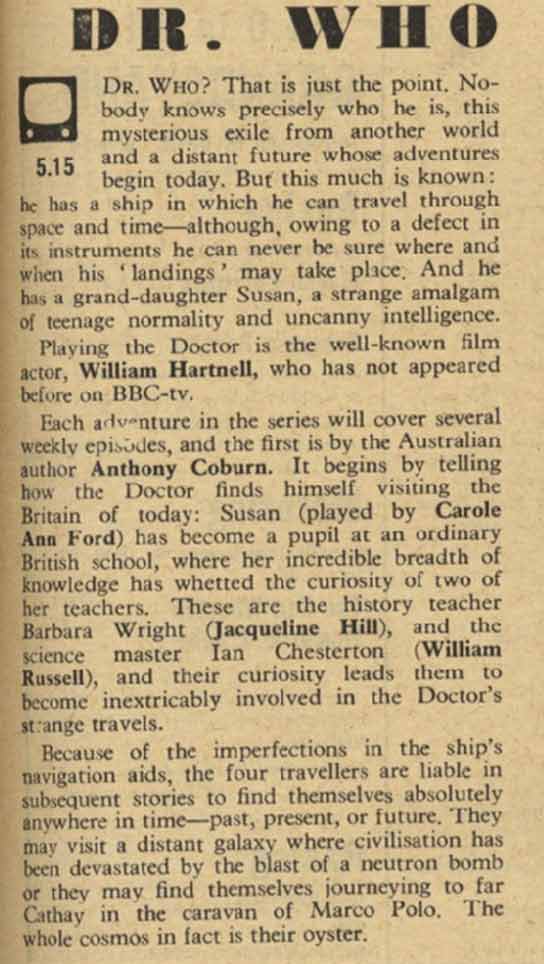
Remember when Doctor Who was fun? Watching it now is about as much fun as being publicly humiliated at work by some jumped-up nonbinary form-filler from HR who thinks he’s amazing because he’s painted one of his fingernails black.
A good example of this joylessness is a scene in the most recent special, “The Star Beast”, which has been treated by right-on broadsheet types as a moment of profound importance. Yet all that happened was a transwoman character – played by transwoman actor Yasmin Finney – lectured the Doctor about pronouns. In a moment of unforgivable Time Lord-cis privilege, the Doctor had assumed a diminutive alien called Beep the Meep used male pronouns. What was he thinking?
It is this sort of banal plot line that encapsulates the shrivelling ambition of science fiction. Once the genre dared to hold up a provocative mirror to contemporary society. From Mary Shelley’s Frankenstein to Octavia Butler’s Parable of the Sower, sci-fi challenged lazy assumptions. Now it revels in groupthink that feeds the collective self-righteousness of indolent teenagers and adults with teenage imaginations.
This matters, because at its best sci-fi can dazzle and even inspire us with the potential strangeness of the imagined future. A few years ago I made a series presented by William Shatner tracing the cultural and technological influence of Star Trek. In one episode, the inventor of the mobile phone, Martin Cooper, told director Julian Jones how he had been inspired by the example of Captain Kirk’s hand-held “communicator”. Will anyone invent something inspired by the new Doctor Who? A new set of guidelines for pronoun use, perhaps?
You can tell how out of touch Doctor Who has now become by the fact its enormously pompous showrunner, Russell T Davies, seemed to think that the new series would shock viewers with its “progressive” radicalism. The only shock was the alien pronoun scene’s patent stupidity.
I mean, why on Earth would the Doctor assume the gender of any alien? He has been encountering aliens with no fixed gender since the 1960s. The Doctor has effectively been asking aliens for their pronouns for nigh on 60 years.
Davies may think he’s blazing a trail with the new series of Doctor Who. But the truth is that gender-bending in science fiction is as old as the frozen hills of Gallifrey. In The War of the Worlds, published 125 years ago, HG Wells regaled us with Martian invaders who reproduced asexually. And hermaphrodites pepper sci-fi, from the work of Philip K Dick to that of Ursula K Le Guin.
Comments Off on Doctor What-are-your-pronouns
November 15, 2023
The big brains of Hollywood display “a special kind of stupid”
Ted Gioia met with a group of executives from movie distribution firms outside the North American market back in 2016. It was a good time, financially, but the overall tone of the meeting was anxious because the trend seemed unsustainable:
These were smart people, but they didn’t make the movies. They just ran theater chains. But they didn’t need to be specialists in creativity or storytelling to know that hit films were now built on tired formulas, the same plot lines played out over and over again.
Special effects added some sizzle to the steak, but it was still the same stale meal night after night. Sooner or later, even superheroes die.
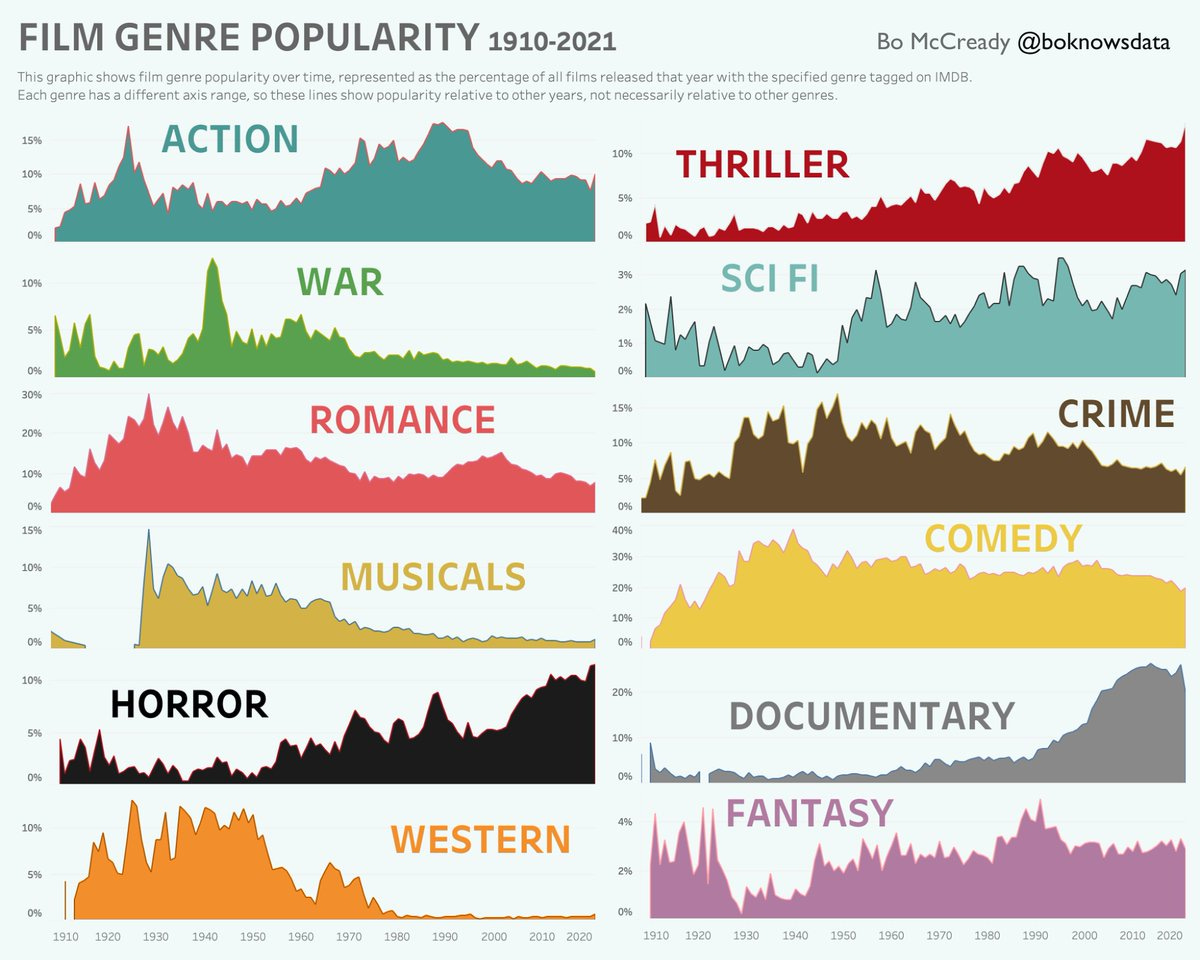
Other genres have come and gone — westerns and musicals and other box office draws of the past. Comic book franchises would eventually meet the same fate.
Source: Bo McReady
Back then, Disney was bragging to shareholders that another 20 Marvel films were already in the pipeline. And that was just a start. CEO Bob Iger explained that Disney owned the rights to 7,000 different Marvel characters — implying that brand franchises could propagate forever, like copulating Australian bunnies.
That was the party line in Burbank. But most of the people I spoke to that day privately expressed doubts about this formula-driven strategy. They hoped to enjoy a few more years of boom times, but worried about what would happen next.
“It takes a special kind of stupid to kill off Indiana Jones or Toy Story or a Marvel superhero, but that’s exactly what’s playing out right now in the Magic Kingdom.”
As it turned out, they were right to worry. But a virus, not a superhero, let them down. The first COVID case happened almost exactly three years after my December 2016 talk.
But it now looks like the pandemic merely delayed the creative collapse.
Hollywood has saturated the market with look-alike movies. Their pipeline of films is now exploding like the Nord Stream, but with this difference—studios are still sitting on a huge pile of future bombs.
And what does a studio do with a bomb on its hands?
They have four options—and they are four kinds of ugly
- You delay the film, hoping for a better market environment in the future.
- You send it back for rewriting and more filming
- You cancel it entirely, and write off the investment
- You release it — sinking another $50 million, more or less, into marketing — and then watch it collapse at the box office.
Disney is getting a sour taste of strategy number four this week.
Comments Off on The big brains of Hollywood display “a special kind of stupid”
November 8, 2023
Sampling the alternate history field
Jane Psmith confesses a weakness for a certain kind of speculative fiction and recommends some works in that field. The three here are also among my favourites, so I can comfortably agree with the choices:
As I’ve written before, I am an absolute sucker for alternate history. Unfortunately, though, most of it is not very good, even by the standards of genre fiction’s transparent prose. Its attraction is really the idea, with all its surprising facets, and means the best examples are typically the ones where the idea is so good — the unexpected ramifications so startling at the moment but so obvious in retrospect — that you can forgive the cardboard characters and lackluster prose.
But, what the heck, I’m feeling self-indulgent, so here are some of my favorites.
- Island in the Sea of Time et seq., by S.M. Stirling: This is my very favorite. The premise is quite simple: the island of Nantucket is inexplicably sent back in time to 1250 BC. Luckily, a Coast Guard sailing ship happens to be visiting, so they’re able to sail to Britain and trade for grain to survive the winter while they bootstrap industrial civilization on the thinly-inhabited coast of North America. Of course, it’s not that simple: the inhabitants of the Bronze Age have obvious and remarkably plausible reactions to the sudden appearance of strangers with superior technology, a renegade sailor steals one of the Nantucketers’ ships and sets off to carve his own empire from the past, and the Americans are thrust into Bronze Age geopolitics as they attempt to thwart him. The “good guys” are frankly pretty boring, in a late 90s multicultural neoliberal kind of way — the captain of the Coast Guard ship is a black lesbian and you can practically see Stirling clapping himself on the back for Representation — but the villainous Coast Guardsmen and (especially) the natives of 1250 BC get a far more complex and interesting portrayal.1 Two of them are particularly well-drawn: a fictional trader of the thinly attested Iberian city-state of Tartessos, and an Achaean nobleman named Odikweos, both of whom are thoroughly understandable and sympathetic while remaining distinctly unmodern. The Nantucketers, with their technological innovations and American values, provide plenty of contrast, but Stirling is really at his best in using them to highlight the alien past.
- Lest Darkness Fall, by L. Sprague de Camp: An absolute classic of the genre. I may not love what de Camp did with Conan, but the man could write! One of the great things about old books (this one is from 1939) is that they don’t waste time on technobabble to justify the silly parts: about two pages into the story, American archaeologist Martin Padway is struck by lightning while visiting Rome and transported back in time to 535 AD. How? Shut up, that’s how, and instead pay attention as Padway introduces distilled liquor, double-entry bookkeeping, yellow journalism, and the telegraph before taking advantage of his encyclopedic knowledge of Procopius’s De Bello Gothico to stabilize and defend the Italo-Gothic kingdom, wrest Belisarius’s loyalty away from Justinian, and entirely forestall the Dark Ages. If this sounds an awful lot like the imaginary book I described in my review of The Knowledge: yes. The combination of high agency history rerouting and total worldview disconnect — there’s a very funny barfight about Christology early on, and later some severe culture clash that interferes with a royal marriage — is charming. Also, this was the book that inspired Harry Turtledove not only to become an alt-history writer but to get a Ph.D. in Byzantine history.
[…]
- Ruled Britannia, by Harry Turtledove: Turtledove is by far the most famous and successful alternate history author out there, with lots of short pieces and novels ranging from “Byzantine intrigue in a world where Islam never existed” (Agent of Byzantium) to “time-travelling neo-Nazis bring AK-47s to the Confederacy” (The Guns of the South), but this is the only one of his books I’ve ever been tempted to re-read. The jumping-off point, “the Spanish Armada succeeded”, is fairly common for the genre2 — the pretty good Times Without Number and the lousy Pavane (hey, did you know the Church hates and fears technology?!) both start from there — but Turtledove fasts forward only a decade to show us William Shakespeare at the fulcrum of history. A loyalist faction (starring real life Elizabethan intriguers like Nicholas Skeres) wants him to write a play about Boudicca to inflame the population to free Queen Elizabeth from her imprisonment in the Tower of London, while the Spanish authorities (represented, hilariously, by playwright manqué Lope de Vega) want him to write one glorifying the late Philip II and the conquest of England. Turtledove does a surprisingly good job inventing new Shakespeare plays from snippets of real ones and from John Fletcher’s 1613 Bonduca, but of course I’m most taken by his rendition of the Tudor world. Maybe I should check out some of his straight historical fiction …
1. Well, except for the peaceful matriarchal Marija Gimbutas-y “Earth People” being displaced from Britain by the invading Proto-Celts; they’re also “good guys” and therefore, sadly, boring.
2. Not as common as “the Nazis won”, obviously.
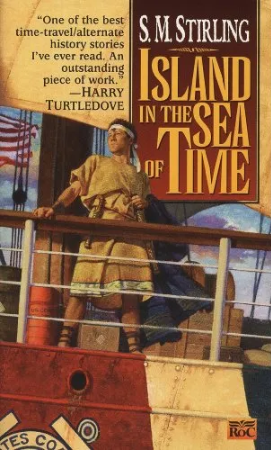
I agree with Jane about Island in the Sea of Time, but my son and daughter-in-law strongly preferred the other series Stirling wrote from the same start point: what happened to the world left behind when Nantucket Island got scooped out of our timeline and dumped back into the pre-collapse Bronze Age. Whereas ISOT has minimal supernatural elements to the story, the “Emberverse” series beginning with Dies the Fire went on for many, many more books and had much more witchy woo-woo stuff front-and-centre rather than marginal and de-emphasized.
While I quite enjoyed Ruled Britannia, it was the first Turtledove series I encountered that I’ve gone back to re-read: The Lost Legion … well, the first four books, anyway. He wrote several more books in that same world, but having wrapped up the storyline for the Legion’s main characters, I didn’t find the others as interesting.
Comments Off on Sampling the alternate history field
October 31, 2023
QotD: Orwell’s “hero” in Nineteen Eighty-Four
That is how it should be. What would you expect? In a world like this, it would be inconsistent, if not contradictory, to portray human beings who are not stunted and who live exciting lives with unexpected plot twists and turns.
Yet there is a hero in this anti-utopia, and Orwell’s magnificent portrait exemplifies its consummate artistry. The multidimensional, richly drawn “hero” is none other than the setting — that is, the empire of Oceania itself. Its history, its corrupt and tyrannical ruling Party, its oppressive and terrifying technology, its ingenious propagandistic language (“Newspeak”), its hatred of the body and sexuality (Julia belongs to — and pretends to support — the Junior Anti-Sex League): all this makes it a rounded, fascinating, creatively elaborated “character”. And there is no room for any other. Because Oceania is omnipotent and omniscient, it determines that its citizenry — whether prole or Party leader — is a cipher. The setting is, as it were, the (pseudo-Marxist) substructure; the superstructure of character and plot are determined by and beholden to it, utterly secondary and “superfluous” by comparison.
Orwell created an unforgettable, terrifying character — Oceania — and showed its “development” (in the spheres of technology, language, warfare, geopolitics, state torture, social relations, and family and sexuality) with astonishing inventive prowess. That development is manifested above all in Oceania’s range of technological gadgets, Newspeak neologisms, and Party slogans and catchwords.
And that is why Nineteen Eighty-Four is a gripping “novel”. That is, moreover, why it not only became a runaway bestseller in the early Cold War era, but also why it has exerted a cultural impact greater than any work of fiction in the 20th century.
John Rodden and John Rossi, “George Orwell Warned Us, But Was Anyone Listening?”, The American Conservative, 2019-10-02.
Comments Off on QotD: Orwell’s “hero” in Nineteen Eighty-Four
October 17, 2023
QotD: Representations of sex work in SF
Maybe it’s a relic from when SF was just another facet of Men’s Adventure magazines, or maybe it’s capitalizing on the stereotypical basement-dwelling Geek’s desire to have high quality women to command at the wave of a few credits or gold pieces. Or, more cynically, it’s the desire of Hollywood producers who actually DO have high quality women at their mercy, career-wise, to further normalize the idea that “Sex work is real work” to help smooth away the resistance to their hamfisted efforts on the casting couch.
TV Tropes has a number of entries about this, from “Unproblematic Prostitution” to “High Class Call Girl”. Writers like to call up the imagery of the Geisha, and make their Space Hookers come across as brilliant sexual artists, with additional talents that help the protagonists, such as advanced degrees or connections to corporate executives and high ranking government officials. (Funny how they are not corporate movers and shakers or government officials themselves …). They forget, of course, that Geisha were not actually prostitutes, and only rarely took lovers. There were still actual brothels in Japan for that sort of thing.
Science Fiction has gotten a lot more difficult to write as the frontiers of reality have pushed back against the flights of fantasy. We have had to accept that you can’t get to the moon inside a Victorian upholstered artillery shell, or set foot on the Jungles of Venus. And maybe that’s why a lot of SF in recent decades has turned towards the softer sciences where theories are more prominent than scientific facts, making it simpler to speculate.
However, even in our understanding of society, there are some realities that can’t be ignored. A few of them are listed in the aforementioned “Unproblematic Prostitution” entry. The primary social reality that undermines all of the tropes is that when you commodify sex, you are putting women on sale. Maybe it’s just fractionally, for a few hours out of her lifetime, but when your fantasy/SF hero comes along and waves a few C-notes to get a woman to do what he wants, it’s not the “Combination of Sex and Capitalism” (“… which are you against?” the excuse goes) but the sublimation of Sex TO Capitalism.
“Sex work is real work,” they like to say, but when you turn sex INTO work, it strips it of all of its better qualities. “Do what you love and you’ll never work another day in your life,” is another lie. I’ve known too many artists who go from having a fun hobby to chasing unsatisfying commissions, eventually burning out from endless requests by cretins for illustrations of their vilest fantasies. So the idea that our happy Space Hookers are having fun and getting paid, and what’s wrong with that, turns into burnout in pretty short order, because the kind of guys who go out looking for “That kind of girl” are not interested in the parts of sex that make it as enjoyable as it is for a compatible couple. They don’t have girlfriends for a reason. So the trope that Prostitution is just Sexy Fun Time falls by the wayside in the face of human nature.
SF also likes to postulate that science will make sex consequence free with perfect contraception and cures for all diseases. Writers and Producers fail to see the actual social costs and secondary effects, some of which we are finally running afoul of today, as women are aging out of their “Hookup culture” days and finding themselves alone and with few prospects for a lasting relationship, while at the same time human reproduction is falling below the replacement rate worldwide. And of course, nature being what it is, there will always be new diseases from new planets or new alien races or who knows WHAT our horny young space cadets have been sticking their dicks into. Human biology has less security in its OS than a Commodore 64.
Dr. Mauser, “Space Hookers Must Die!”, Shoplifting in the Marketplace of Ideas, 2023-07-16.
Comments Off on QotD: Representations of sex work in SF
August 24, 2023
There Will Be ⚡️Pain⚡️(A Book Update)
Jill Bearup
Published 15 May 2023I’m just saying, One Crisis at a Time is our motto as well as our title. Have a Fantasy Heroine book update for your delectation and delight.
#fantasyheroine #onecrisisatatime
Comments Off on There Will Be ⚡️Pain⚡️(A Book Update)


