Thersites the Historian
Published 4 Sep 2021In this video, I provide an analysis of the opening sections of Dionysius of Halicarnassus’ History of Rome, discussing where his place in the historiographical tradition and the goal of his work.
Patreon link: https://www.patreon.com/thersites
PayPal link: paypal.me/thersites
Discord: https://discord.gg/QCaXXFr
Brave Browser: https://brave.com/noa557
Twitter link: https://twitter.com/ThersitesAthens
Minds.com link: https://www.minds.com/ThersitestheHis…
Steemit/dtube link: https://steemit.com/@thersites/feed
BitChute: https://www.bitchute.com/channel/jbyg…
September 7, 2021
Early Rome, Part II: Dionysius of Halicarnassus and the Greek Tradition of Early Rome
September 6, 2021
Early Rome, Part I: The Historical Problem of Studying Early Rome
Thersites the Historian
Published 2 Sep 2021In this video, I discuss why early Rome is difficult to study and preview the upcoming episodes in this series.
Patreon link: https://www.patreon.com/thersites
PayPal link: paypal.me/thersites
Discord: https://discord.gg/QCaXXFr
Brave Browser: https://brave.com/noa557
Twitter link: https://twitter.com/ThersitesAthens
Minds.com link: https://www.minds.com/ThersitestheHis…
Steemit/dtube link: https://steemit.com/@thersites/feed
BitChute: https://www.bitchute.com/channel/jbyg…
August 17, 2021
QotD: The “Crisis of the Third Century”
You can find huge shelves of books analyzing this, attributing it to every conceivable thing, from the ol’ “lead in the water pipes” to massive structural defects stretching into remote antiquity. There’s probably something to all of them, but the biggest proximate cause is probably one the Romans themselves had identified, as early as Sallust, way back in the last century BC: lack of purpose. Having defeated Carthage and salted the earth where once she stood, the Roman “security state” — the largest and most comprehensive ever assembled to that point — simply ran out of reasons to exist.
If you’ve read much about (or especially by) them, you know that the Romans were, for lack of a better term, paranoid. It was simply incompatible with the Roman psyche to have any large, organized group of non-Romans anywhere near the Empire’s borders … so the Empire kept expanding, first reducing, then Romanizing, every conceivable threat. They kept doing this long past the point of negative returns, such that the Empire collapsed under the strain of trying to hold itself together.
Stop me if this sounds familiar: A “government” whose only claim to legitimacy is naked force. A large, increasingly rapacious, increasingly class-conscious military with no obvious enemies to fight, and no ability to subdue the ones it settles for. A large, increasingly rapacious, increasingly caste-conscious bureaucracy that views the whole “Imperial” project as one big tax farming operation. Massive, ever-increasing wealth disparities that can only be very temporarily alleviated by debasing the currency, because structural reform is culturally impossible from above, and physically impossible from below. And to top it all off, a weird, apocalyptic religious cult totally destroying the few pan-imperial cultural institutions, including the military.
The history of the Third Century is insanely complex, not well understood in many respects even by field specialists, but the gist of it is clear enough: Some general somewhere decides he’d like to have a crack at emperorizing, so he gets his troops to throw a purple toga on him and proceeds to take on the incumbent. Some other general thinks that’s a pretty nifty idea, so he does the same thing, taking on both the incumbent and the pretender. Not wanting to be left out of the fun, the incumbent’s main general murders the incumbent and takes the crown for himself, fighting whoever’s left, plus whichever of his subordinate commanders decide they want a shot at the big chair. The Senate rubber-stamps one of these clowns, or some other general who decides he’d like to throw his toga into the ring, and civil war follows civil war until one of them temporarily triumphs … only for the same thing to happen again once the shine is off the new guy (usually in less than a year or two).
They called ’em the “Barracks Emperors” for a reason, y’all. And it’s actually worse than that, since lots of times the rebel generals didn’t bother going for the big prize back in Italy. Lots of them decided they’d do just fine ruling, say, Britain, or parts of Gaul, or Asia Minor or Egypt or what have you, while the other guys slugged it out for the increasingly marginalized, if not totally meaningless, “official” title. Declare yourself the Emperor of ___, issue some slapped-together coins with your picture on them, and go nuts. The “Gallic Emperors” had a run of nearly half a century like that — not bad at all for Late Antiquity.
Severian, “The Crisis of the Third Decade”, Rotten Chestnuts, 2021-03-18.
June 21, 2021
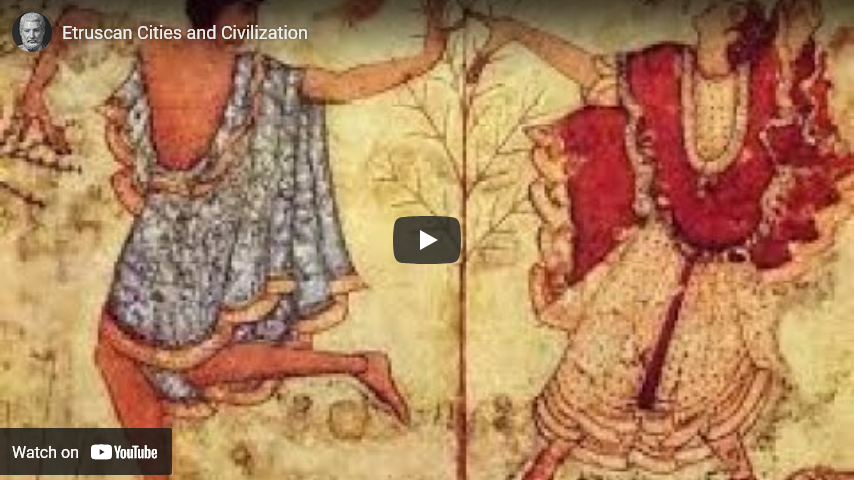
Etruscans: Italian Civilization Before Ancient Rome
Kings and Generals
Published 20 Feb 2020Our new animated historical documentary talks about the Etruscans. Their origins, culture, religion, lifestyle and how they influenced the Roman Republic and through it the world.
Support us on Patreon: http://www.patreon.com/KingsandGenerals or Paypal: http://paypal.me/kingsandgenerals
We are grateful to our patrons and sponsors, who made this video possible: https://docs.google.com/document/d/1_…
The video was made by our friend András Szente-Dzsida while the script was researched and written by Leo Stone
This video was narrated by Officially Devin (https://www.youtube.com/user/OfficiallyDevin)
✔ Merch store ► teespring.com/stores/kingsandgenerals
✔ Podcast ► Google Play: http://bit.ly/2QDF7y0 iTunes: https://apple.co/2QTuMNG
✔ Twitter ► https://twitter.com/KingsGenerals
✔ Instagram ► http://www.instagram.com/Kings_GeneralsProduction Music courtesy of Epidemic Sound: http://www.epidemicsound.com
#Documentary #Etruscans #KingsandGenerals
June 9, 2021
Charles Stross on Robert Heinlein’s Starship Troopers
In his first blog post in nearly a month, Charlie Stross opines on one of Heinlein’s most polarizing novels:
In the 1930s, Heinlein was a soft socialist — he was considered sufficiently left wing and “unreliable” that he was not recalled for active duty in the US Navy during the Second World War. After he married Virginia Gerstenfeld, his third and last wife, his views gradually shifted to the right — however he tended towards the libertarian right rather than the religious/paleoconservative right. (These distinctions do not mean in 2021 what they might have meant in 1971; today’s libertarian/neo-nazi nexus has mostly emerged in the 21st century, and Heinlein was a vehement opponent of Nazism.) So the surface picture is your stereotype of a socially liberal centrist/soft leftist who moved to the right as he grew older.
But to muddy the waters, Heinlein was always happy to pick up a bonkers ideological shibboleth and run with it in his fiction. He was sufficiently flexible to write from the first person viewpoint of unreliable/misguided narrators, to juxtapose their beliefs against a background that highlighted their weaknesses, and even to end the story with the narrator — but not the reader — unaware of this.
In Starship Troopers Heinlein was again playing unreliable narrator games. On the surface, ST appears to be a war novel loosely based on WW2 (“bugs” are Nazis; “skinnies” are either Italian or Japanese Axis forces), but each element of the subtext relates to the ideological awakening of his protagonist, everyman Johnny Rico (note: not many white American SF writers would have picked a Filipino hero for a novel in the 1950s). And the moral impetus is a discussion of how to exist in a universe populated by existential threats with which peaceful coexistence is impossible. The political framework Heinlein dreamed up for his human population — voting rights as a quid pro quo for military (or civilian public) service — isn’t that far from the early Roman Republic, although in Rico’s eyes it’s presented as something new, a post-war settlement. Heinlein, as opposed to his protagonist, is demonstrating it as a solution to how to run a polity in a state of total war without losing democratic accountability. (Even his presentation of corporal and capital punishment is consistent with the early Roman Republic as a model.) The totalizing nature of the war in ST isn’t at odds with the Roman interpretation: Carthago delenda est, anyone?
It seems to me that using the Roman Republic as a model is exactly the sort of cheat that Heinlein would employ. But then Starship Troopers became the type specimen for an entire subgenre of SF, namely Military-SF. It’s not that MilSF wasn’t written prior to Starship Troopers: merely that ST was compellingly written by the standards of SF circa 1959. And it was published against the creeping onset of the US involvement in the Vietnam War, and the early days of the New Wave in SF, so it was wildly influential beyond its author’s expectations.
The annoying right wing Heinlein Mil-SF stans that came along in later decades — mostly from the 1970s onwards — embraced Starship Troopers as an idealized fascist utopia with the permanent war of All against All that is fundamental to fascist thought. In doing so they missed the point completely. It’s no accident that fascist movements from Mussolini onwards appropriated Roman iconography (such as the Fasces): insecure imperialists often claim legitimacy by claiming they’re restoring an imagined golden age of empire. Indeed, this was the common design language of the British Empire’s architecture, and just about every other European imperialist program of the past millennium. By picking the Roman Republic as a model for a beleagured polity, Heinlein plugged into the underlying mythos of western imperialism. But by doing so he inadvertently obscured the moral lesson he was trying to deliver.
March 30, 2021
Caesar in Britain II: There and Back Again (54 B.C.E.)
Historia Civilis
Published 21 Mar 2017Patreon | http://historiacivilis.com/patreon
Donate | http://historiacivilis.com/donate
Merch | http://historiacivilis.com/merch
Mailing List | http://historiacivilis.com/mailinglist
Twitter | http://historiacivilis.com/twitter
Website | http://historiacivilis.comMusic is:
“Day Bird,” by Broke For Free
“Drums of the Deep,” by Kevin MacLeod
“Flood,” by Jahzzar
March 29, 2021
Caesar in Britain (55 B.C.E.)
Historia Civilis
Published 22 Feb 2017Patreon | http://historiacivilis.com/patreon
Donate | http://historiacivilis.com/donate
Merch | http://historiacivilis.com/merch
Mailing List | http://historiacivilis.com/mailinglist
Twitter | http://historiacivilis.com/twitter
Website | http://historiacivilis.comMusic is:
“Light Thought var 2,” by Kevin MacLeod
“Bird Day,” by Broke For Free
“Drums of the Deep,” by Kevin MacLeod
“Thinking Music,” by Kevin MacLeod
“Flood,” by Jahzzar
“Hallon,” by Christian Bjoerklund
March 24, 2021
How They Did It – Declaring War in Ancient Rome
Invicta
Published 24 Aug 2018The Romans were often at war but have you ever stopped to consider how exactly that was announced. Turns out the Romans had a complicated ritual associated with declarations of war aimed at making their casus belli apparent before the gods. I hope you enjoy this documentary on ancient government and religion!
Sources:
History of Rome Book I by Titus Livius
Handbook to Life in Ancient Rome by Lesley Adkins
The Rise of Rome by Anthony EverittMusic:
“Quirky Comedy” by 8th Mode Music#RomanHistory
#HowTheyDidIt
February 17, 2021
The Rise of Rome – How Italy Was Conquered
Invicta
Published 4 Aug 2018Let’s talk about the rise of the Roman Republic in its early years, specifically how the diverse communities across Italy were united! If you love this time period, I suggest you take a look at the “Rise of Rome” DLC coming out soon for Rome II Total War. I’ll be showing off gameplay on the 2nd channel.
Literary Sources:
“The Rise of Rome” by Anthony Everitt
“Early Roman Warrior” by Osprey Publishing
“The Roman Army” by Chris McNab
“Uniforms of the Roman World” by Kevin F. Kiley
“The Archaic Community of the Romans” by Robert E. Palmer#RomanHistory
#RiseofRome
February 14, 2021
History’s Best(?) Couples — Valentine’s Day Special
Overly Sarcastic Productions
Published 5 Feb 2021Celebrate Valentine’s Day with a look at some of the best couples in history. Well, “Best” is a stretch — definitely most entertaining — but the pairings on display today are FAR from healthy. Enjoy the slow descent into insanity that is “Me Discussing These Stories”.
SOURCES & Further Reading: Suetonius’ Twelve Caesars, Plutarch’s Parallel Lives: Julius Caesar, China: A History by John Keay, “Song of Everlasting Sorrow” by Bai Juyi, Smithsonian Magazine & Biography.com entries on Marie Antoinette & Louis XVI.
Our content is intended for teenage audiences and up.
TRACKLIST: “Scheming Weasel (faster version),” “Local Forecast – Elevator”, “Sneaky Snitch” Kevin MacLeod (incompetech.com)
Licensed under Creative Commons: By Attribution 4.0 License
http://creativecommons.org/licenses/b…PATREON: https://www.Patreon.com/OSP
PODCAST: https://overlysarcasticpodcast.transi…
DISCORD: https://discord.gg/osp
MERCH LINKS: http://rdbl.co/osp
OUR WEBSITE: https://www.OverlySarcasticProductions.com
Find us on Twitter https://www.Twitter.com/OSPYouTube
Find us on Reddit https://www.Reddit.com/r/OSP/
February 7, 2021
Roman legion vs Macedonian phalanx
Epimetheus
Published 13 Aug 2018Roman legion vs Macedonian phalanx (Macedonian wars)
Battle of Pydna 168 BC and battle of Cynoscephalae 197 BCSupport new videos from Epimetheus on Patreon! 😀
https://www.patreon.com/Epimetheus1776roman legion, roman legion tactics, macedonian phalanx, Macedonian phalanx tactics, Macedonian phalanx vs roman legion, ancient Macedonian army, ancient roman army, roman army, Roman legionary, rome vs Greece, Rome vs Macedon, roman army weapons, Roman army tactics, Macedonian wars, battle Cynoscephalae, battle of Pydna, republican Roman army, Roman maniple, Roman republic, documentary, ancient Rome documentary, ancient Greece documentary, rome documentary, battle of magnesia, rome selucid empire, Roman empire vs selucid empire, diadochi, ancient,
December 24, 2020
Saturnalia – Rome’s Awesome Pagan Christmas
Invicta
Published 23 Dec 2020Celebrate an awesome pagan Christmas with the Roman Saturnalia! The first 100 people to go to https://www.blinkist.com/invicta are going to get unlimited access for 1 week to try it out. You’ll also get 25% off if you want the full membership.
In this history documentary we cover a very special Roman Holiday, the Saturnalia. It was a hugely popular winter festival which dominated the ancient world and in many ways created the Christmas that we celebrate today!
We begin the episode with a discussion about the origins of Saturnalia as a harvest festival. In these early years it was celebrated whenever the last of the crops was brought with a special thanks being offered to the God of harvest, Saturn. The Romans did so at the temple of Saturn by offering a procession of bulls and hosting a grand feast. Over the years however the traditions would grow by importing Greek customs, pinning the date to December 17th and extending the holiday to a full week!
We then cover the history of Saturnalia at its full glory by recreating the experience. This begins with the traditional parade and feast on the first day after which all work was banned. The following days were filled with endless parties and feasts. These featured all kinds of familiar staples of Christmas like gift giving, hat wearing, and singing. However there were many more, wilder traditions as well. IO SATURNALIA!!!
We finally conclude with the rise of Christianity and the history of Christmas which coopted this popular pagan holiday. Stay tuned for more How They Did It episodes on the history of daily life in the past.
Bibliography and Suggested Reading:
Daily Life in the Roman City by Gregory Aldrete
Popular Culture in Ancient Rome by Jerry Toner
As the Romans Did by Jo-Ann Shelton
Festivals and Ceremonies of the Roman Republic by H. H. Scullard
The Roman Community at Table During the Principate by John Donahue#Saturnalia
#Rome
#History
November 24, 2020
Is the day of the orator over?
In The Critic, Nigel Jones considers some of the great orators of history:

Prime Minister Winston Churchill greets Canadian PM William Lyon Mackenzie King, 1941. Churchill was certainly one of the great orators of history … Mackenzie King, on the other hand, certainly was not.
Photo from Library and Archives Canada (reference number C-047565) via Wikimedia Commons.
On 19 November 1863, President Abraham Lincoln rose to speak at Gettysburg, Pennsylvania, the battlefield which four and a half months before had seen the decisive turning point of the American Civil War. Lincoln was not even the principal speaker at the ceremony to dedicate a cemetery for those who had fallen in the battle.
Before he spoke, the President had to sit through a two-hour address by a pompous official orator, a windbag called Edward Everett. But when he finally got to his feet Lincoln entered political immortality. He spoke for only two minutes, but the few words he uttered about “Government of the people, by the people, and for the people” have echoed down the years – even Mrs Thatcher made a recording of them – inspiring and rousing generations to value and defend democracy.
Winston Churchill’s iconic status as Britain’s greatest Prime Minister largely rests on the handful of radio speeches he growled out to the nation in the darkest days of World War Two: “… fight them on the beaches … so much owed by so many to so few … this was their finest hour …” and so on.
Ever since Roman statesmen such as Cato and Cicero delivered their speeches on the Capitol, oratory like that spoken by Lincoln and Churchill has been a mainstay of western civilisation and governance. A carefully constructed argument or a few ringing phrases having the power to change minds, stiffen sinews, and bring down leaders.
Churchill himself was brought to supreme political power in 1940 by the power of the spoken word. Those words were spoken by one politician – his friend and schoolmate Leo Amery – quoting another, when Amery repeated Oliver Cromwell’s words dismissing the Long Parliament in calling for the end of Neville Chamberlain’s feeble administration: “You have sat here too long for any good you have been doing. Depart, I say, and let us have done with you: in the name of God, go!” Chamberlain, albeit reluctantly, went.
November 3, 2020
How They DId It – Elections in Ancient Rome
Invicta
Published 14 Oct 2018We step back in time to join the Romans as they head to the polls! In this episode on ancient elections we look at the offices, the voters, and the process of the mid-Republic.
Bibliography:
— Yakobson, Alexander. “Secret Ballot and Its Effects in the Late Roman Republic.” Hermes, Vol. 123, No. 4 (1995) pp. 426-442.
— “Traditional Political Culture and the People’s Role in the Roman Republic.” Historia: Zeitschrift für Alte Geschichte, Bd. 59, H. 3 (2010) pp. 282-302.
— Elections and Electioneering in Rome: A Study in the Political System of the Late Republic. Franz Steiner Verlag Stuttgart, 1999.
— Lintott, Andrew. The Constitution of the Roman Republic. Oxford: Oxford University Press, 2002.
— Phillips, Daryll. “Voter Turnout in Consular Elections”, Ancient History Bulletin 18 (2004), 48–60.
— Morstein-Marx, Robert. Mass Oratory and Political Power in the Late Roman Republic. New York: Cambridge University Press, 2004.
— Taylor, Lily Ross. Jerszy Linderski, ed. The Voting Districts of the Roman Republic. University of Michigan Press, 2013.
— Roman voting assemblies from the Hannibalic War to the dictatorship of Caesar. Ann Arbor: University of Michigan Press, 1990.
— “The Centuriate Assembly Before and After the Reform.” The American Journal of Philology, Vol. 78, No. 4 (1957), pp. 337-354.
Hall, Ursula. “Voting Procedure in Roman Assemblies.” Historia: Zeitschrift für Alte Geschichte, Bd. 13, H3 (1964), pp. 267-306.
— “‘Species Libertatis‘ Voting Procedure in the Late Roman Republic.” Bulletin of the Institute of Classical Studies, Supplement No. 71 (1998), pp. 15-30.Research: James Conrad
Artwork: Anders Végh Blidlöv (https://www.behance.net/andersvb)Music:
“Strings and Drums Comedy” by 8th Mode Music#RomanHistory
#HowTheyDidIt
October 10, 2020
I AM Julius Caesar
The Study of Antiquity and the Middle Ages
Published 2 Jul 2020Politician, warrior, priest, lover.
My name is Gaius Julius Caesar and I led one of the most extraordinary lives in recorded history.
My victories over foes both foreign and domestic are still studied today. I upended the Roman Republic and became its first dictator.
I loved Cleopatra.
My brutal assassination has been synonymous with bitter betrayal for 2000 years.
New videos from The Study of Antiquity and the Middle Ages, the I AM series allows the great figures of history to introduce themselves in brief, compelling, historically-accurate episodes. Look for more I AM videos of your favorites!
I AM Julius Caesar! Welcome to the first episode of the I AM series where you live history itself through the mind, viewpoints and lives of a historical character!
See and experience the world they lived and celebrate their triumphs and feel their defeats.
This first episode is on Julius Caesar, the revolutionary who set into place the foundations of what would become the Roman Empire.
This was written, directed and created by the extraordinary professional DW Draffin! He is an audio book narrator, stage actor, and independent author.
AUDIOBOOK NARRATOR
https://www.audible.com/search?search…STAGE ACTOR
https://www.youtube.com/watch?v=xTept…INDEPENDENT AUTHOR
https://www.amazon.com/DW-Draffin/s?k…If you need a professional then contact him!
To support the channel, become a Patron and make history matter!
Patreon: https://www.patreon.com/The_Study_of_…
Donate directly to PayPal: https://paypal.me/NickBarksdale
Check out our newly opened store!
teespring.com/stores/antiquity-and-th…Get your SPQR Face Masks today!
https://spqr-emporium.com/collections…Enjoy history merchandise? Check out affiliate link to SPQR Emporium!
http://spqr-emporium.com?aff=3*Dislaimer, the link above is an affiliate link which means we will earn a generous commission from your magnificent purchase, just another way to help out the channel!
Join our community!