
Adrian Goldsworthy. Historian and Novelist
Published May 8, 2024The non citizen soldiers of the Roman Auxilia served alongside the Roman citizens of the legions. In the second and third centuries AD, there were at least as many auxiliaries as there were legionaries — probably more. Some were cavalry or archers, so served in roles that complemented the close order infantry of the legions. Yet the majority were infantrymen, wearing helmet and body armour. They looked different from the legionaries, but was their tactical role and style of fighting also different. Today we look at the tactical role of Roman auxiliaries.
Extra reading:
I mention M. Bishop & J. Coulston, Roman Military Equipment which is one of the best starting places. Mike Bishop’s Osprey books on specific types of Roman army equipment are also excellent. Peter Connolly’s books, notably Greece and Rome at War, also remain well worthwhile.
September 2, 2024
Roman auxiliaries – what was their role in the Imperial Roman army?
August 24, 2024
QotD: How did the Romans themselves view the change from Republic to Empire?
The Romans themselves had a lot of thoughts about the collapse of the republic. First, we should note that they were aware that something was going very wrong and we have a fair bit of evidence that at least some Romans were trying to figure out how to fix it. Sulla’s reforms (enforced at the point of a much-used sword) in 82-80 BC were an effort to fix what he saw as the progressive destabilization of the the republic going back to the tribunate of Tiberius Gracchus (133). Sulla’s solutions were hamfisted though – he assumed that if he annihilated the opposing faction, crippled the tribunate and strengthened the Senate that this would resolve all of the problems. Cicero likewise considered reforms during the 50s BCE which come out in his De re publica and De legibus. The 50s were a time of political tumult in Rome while at the same time the last years of the decade must have been loomed over by the knowledge of an impending crisis to come in 49. Cicero was never in a position to enact his idealized republic.
Overall the various Romans who contemplated reform were in a way hindered by the tendency of Roman elites to think in terms of the virtue of individuals rather than the tendency of systems. You can see this very clearly in the writings of Sallust – another Roman writing with considerable concern as the republic comes apart – who places the fault on the collapse of Roman morals rather than on any systemic problem.
We also get a sense of these feelings from the literature that emerges after Augustus takes power in 31, and here there is a lot of complexity. There is quite a lot of praise for Augustus of course – it would have been profoundly unwise to do otherwise – but also quite a lot of deep discomfort with the recent past, revealed in places like Livy’s deeply morally compromised legends of the founding of Rome or the sharp moral ambiguity in the final books of Vergil’s Aeneid. On the other hand, some of the praise for Augustus seems to have been genuine. There was clearly an awful lot of exhaustion after so many years of disruption and civil war and so a general openness to Augustus’ “restored republic”. Still, some Romans were clearly bothered by the collapse of the republic even much later; Lucan’s Pharsalia (65 AD) casts Pompey and Cato as heroes and views Caesar far more grimly.
We have less evidence for feeling in the provinces, but of course for many provincials, little would have changed. Few of Augustus’ changes would have done much to change much for people living in the provinces, whose taxes, laws and lives remained the same. They were clearly aware of what was going on and among the elite there was clearly a scramble to try to get on the right side of whoever was going to win; being on the wrong side of the eventual winner could be a very dangerous place to be. But for most regular provincials, the collapse of the Roman Republic only mattered if some rogue Roman general’s army happened to march through their part of the world.
Bret Devereaux, “Referenda ad Senatum: August 6, 2021: Feelings at the Fall of the Republic, Ancient and Medieval Living Standards, and Zombies!”, A Collection of Unmitigated Pedantry, 2021-08-06.
July 24, 2024
Tiberius Caesar, the second emperor
In The Critic, Jaspreet Singh Boparai reviews Iron Imperator: Roman Grand Strategy Under Tiberius by Iskander Rehman:
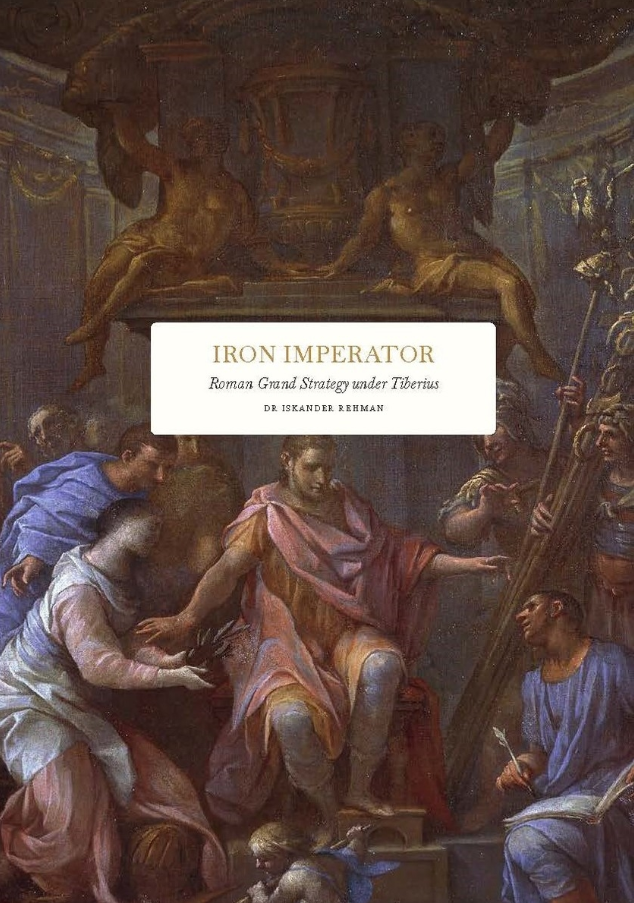
Tiberius was 55 years old when he became the second Roman emperor. He ruled from AD 14 to 37, spending most of the second half of his reign on the island of Capri, where he never lost his grip on power despite being over 130 miles from Rome.
Like most bureaucratic administrators, he was far from popular. Tacitus (AD 56–120), the greatest of all Roman historians, presents Tiberius as paranoid, ruthlessly cruel, and pathologically unable to say what he meant. The imperial biographer Suetonius (69–122) completes the Tacitean picture of a dour, charmless pervert, miserable even in his increasingly sordid pleasures.
Not all writers are quite so hostile to Tiberius: since the Enlightenment he has won qualified praise from thinkers including Montesquieu and Voltaire, who have often been willing to overlook at least some of his vices. The great Russian poet Alexander Pushkin wrote in 1825: “The more I read Tacitus, the more I come to like Tiberius. He was one of the greatest administrative minds of antiquity.”
Of course, Pushkin could take revisionism to contrarian extremes, as when he said of a notorious assassination: “If murder can be guiltless in an autocratic state when it is for reasons of political necessity, then Tiberius was justified”.
Iskander Rehman doesn’t go quite so far as Pushkin; yet he does want us to look past all the gossip and scandals, and see what we can learn in practical terms from this controversial emperor. Tiberius was not a conqueror; his main task was to consolidate his predecessor’s achievements and establish stability throughout the empire.
He was faced with the question of how you govern a massive, unwieldy state as an absolute monarch without the benefit of personal charisma, reliable subordinates or the momentum of conquest. Rehman focuses on foreign policy, military affairs and imperial management in general, and concludes that, whatever else might have been wrong with Tiberius, at least he understood grand strategy, international relations, and how to handle the Roman economy.
I must admit that my impression of Tiberius was largely informed by my childhood encounter with Robert Graves’ excellent novels I, Claudius and Claudius The God, which definitely drew the character details of Tiberius in the novels from Tacitus and Suetonius. But Graves also pointed out that whatever personal flaws were displayed in his private life, for the vast majority of the empire he was a competent successor to the great god Augustus.
July 18, 2024
QotD: Culture in the late western Roman Empire
The first thing to remember, as we’ve already discussed, is that the population of the Roman Empire itself was hardly uniform. Rather the Roman empire as it violently expanded, had absorbed numerous peoples – Celtiberians, Iberians, Greeks, Gauls, Syrians, Egyptians, and on and on. Centuries of subsequent Roman rule had led to a process of cultural fusion, whereby those people began to think of themselves as Romani – Romans – as they both adopted previously Roman cultural elements and their Roman counterparts adopted provincial culture elements (like trousers!).
In particular, by the fifth century, the majority of these self-described Romani, including the overwhelming majority of elites, had already adopted a provincial religion: Christianity, which had in turn become the Roman religion and a core marker of Roman identity by the fifth century. Indeed, the word paganus, increasingly used in this period to refer to the remaining non-Christian population, had a root-meaning of something like “country bumpkin”, reflecting the degree to which for Roman elites and indeed many non-elites, the last fading vestiges of the old Greek and Roman religions were seen as out of touch. Of course Christianity itself came from the fringes of the Empire – a strange mystery cult from the troubled frontier province of Judaea in the Levant which had slowly grown until it had become the dominant religion of the empire, receiving official imperial favor and preference.
The arrival of the “barbarians” didn’t wipe away that fusion culture. With the exception of the Angles, Saxons and Jutes who eventually ended up in England, the new-comers almost uniformly learned the language of the Roman west – Latin – such that their descendants living in those lands, in a sense still speak it, in its modern forms: Spanish, French, Italian, Portuguese, etc. alongside more than a dozen local regional dialects. All are derived from Latin (and not, one might note, from the Germanic languages that the Goths, Vandals, Franks and so on would have been speaking when they crossed the Roman frontier).
They also adopted the Roman religion, Christianity. I suspect sometimes the popular imagination – especially the one that comes with those extraordinarily dumb “Christian dark age” graphs – is that when the “barbarians invade” the Romans were still chilling in their Greco-Roman temples, which the “barbarians” burned down. But quite to the contrary – the Romans were the ones shutting down the old pagan temples at the behest of the now Christian Roman emperors, who busied themselves building beautiful and marvelous churches (a point The Bright Ages makes very well in its first chapter).
The “barbarians” didn’t tear down those churches – they built more of them. There was some conflict here – many of the Germanic peoples who moved into the Roman Empire had been converted to Christianity before they did so (again, the Angles and Saxons are the exception here, converting after arrival), but many of them had been converted through a bishop, Ulfilias, from Constantinople who held to a branch of Christian belief called “Arianism” which was regarded as heretical by the Roman authorities. The “barbarians” were thus, at least initially, the wrong sort of Christian and this did cause friction in the fifth century, but by the end of the sixth century nearly all of these new kingdoms created in the wake of the collapse of Roman authority were not only Christian, but had converted to the officially accepted Roman “Chalcedonian” Christianity. We’ll come back later to the idea of the Church as an institution, but for now as a cultural marker, it was adopted by the “barbarians” with aplomb.
Artwork also sees the clear impact of cultural fusion. Often this transition is, I think, misunderstood by students whose knowledge of artwork essentially “skips” Late Antiquity, instead jumping directly from the veristic Roman artwork of the late republic and the idealizing artwork of the early empire directly to the heavily stylized artwork of Carolingian period and leads some to conclude that the fall of Rome made the artists “bad”. There are two problems: the decline here isn’t in quality and moreover the change didn’t happen with the fall of the Roman Empire but quite a bit earlier. […]
Late Roman artwork shows a clear shift into stylization, the representation of objects in a simplified, conventional way. You are likely familiar with many modern, highly developed stylized art forms; the example I use with my students is anime. Anime makes no effort at direct realism – the lines and shading of characters are intentionally simplified, but also bodies are intentionally drawn at the wrong proportions, with oversized faces and eyes and sometimes exaggerated facial expressions. That doesn’t mean it is bad art – all of that stylization is purposeful and requires considerable skill – the large faces, simple lines and big expressions allow animated characters to convey more emotion (at a minimum of animation budget).
Late Roman artwork moves the same way, shifting from efforts to portray individuals as real-to-life as possible (to the point where one can recognize early emperors by their facial features in sculpture, a task I had to be able to perform in some of my art-and-archaeology graduate courses) to efforts to portray an idealized version of a figure. No longer a specific emperor – though some identifying features might remain – but the idea of an emperor. Imperial bearing rendered into a person. That trend towards stylization continues into religious art in the early Middle Ages for the same reason: the figures – Jesus, Mary, saints, and so on – represent ideas as much as they do actual people and so they are drawn in a stylized way to serve as the pure expressions of their idealized nature. Not a person, but holiness, sainthood, charity, and so on.
And it really only takes a casual glance at the artwork I’ve been sprinkling through this section to see how early medieval artwork, even out through the Carolingians (c. 800 AD) owes a lot to late Roman artwork, but also builds on that artwork, particularly by bringing in artistic themes that seem to come from the new arrivals – the decorative twisting patterns and scroll-work which often display the considerable technical skill of an artist (seriously, try drawing some of that free-hand and you suddenly realize that graceful flowing lines in clear symmetrical patterns are actually really hard to render well).
All of the cultural fusion was effectively unavoidable. While we can’t know their population with any certainty, the “barbarians” migrating into the faltering western Empire who would eventually make up the ruling class of the new kingdoms emerging from its collapse seem fairly clearly to have been minorities in the lands they settled into (with the notable exception, again, of the Angles, Saxons and Jutes – as we’re going to see this pattern again and again, Britain has an unusual and rather more traumatic path through this period than much of the rest of Roman Europe). They were, to a significant degree, as Guy Halsall (op. cit.) notes, melting into a sea of Gallo-Romans, or Italo-Romans, or Ibero-Romans.
Even Bryan Ward-Perkins, one of the most vociferous members of the decline-and-fall camp, in his explosively titled The Fall of Rome and the End of Civilization (2005) – this is a book whose arguments we will come back to in some detail – is forced to concede that “even in Britain the incomers [sic] had not dispossessed everyone” of their land, but rather “the invaders entered the empire in groups that were small enough to leave plenty to share with the locals” (66-7). No vast replacement wave this, instead the new and old ended up side by side. Indeed, Odoacer, seizing control of Italy in 476, we are told, redistributed a third of the land; it’s unclear if this meant the land itself or the tax revenue on it, but in either case clearly the majority of the land remained in the hands of the locals which, by this point in the development of the Roman countryside, will have mostly meant in the hands of the local aristocracy.
Instead, as Ralph Mathisen documents in Roman aristocrats in barbarian Gaul: strategies for survival in an age of transition (1993), most of the old Roman aristocracy seems to have adapted to their changing rulers. As we’ll discuss next week, the vibrant local government of the early Roman empire had already substantially atrophied before the “barbarians” had even arrived, so for local notables who were rich but nevertheless lived below the sort of mega-wealth that could make one a player on the imperial stage, little real voice in government was lost when they traded a distant, unaccountable imperial government for a close-by, unaccountable “barbarian” one. Instead, as Mathisen notes, some of the Gallo-Roman elite retreat into their books and estates, while more are co-opted into the administration of these new breakaway kingdoms, who after all need literate administrators beyond what the “barbarians” can provide. Mathisen notes that in other cases, Gallo-Roman aristocrats with ambitions simply transferred those ambitions from the older imperial hierarchy to the newer ecclesiastical one; we’ll talk more about the church as an institution next week. Distinct in the fifth century, by the end of the sixth century in Gaul, the two aristocracies: the barbarian warrior-aristocracy and the Gallo-Roman civic aristocracy had melded into one, intermarried and sharing the same religion, values and culture.
In this sense there really is a very strong argument to be made that the “Romans” and indeed Roman culture never left Rome’s lost western provinces – the collapse of the political order did not bring with it the collapse of the Roman linguistic or cultural sphere, even if it did fragment it.
Bret Devereaux, “Collections: Rome: Decline and Fall? Part I: Words”, A Collection of Unmitigated Pedantry, 2022-01-14.
June 30, 2024
QotD: The use of pictorial and archaeological evidence in studying the ancient world
Which brings us at last to the big dog, archaeological evidence (although all of the aforementioned also show up in the archaeological record). Archaeology is wonderful, easily the biggest contributor to the improvement in our knowledge of the ancient world over the last century; my own research relies heavily on archaeological evidence. And the best part of it is we are getting more and better archaeological evidence all the time. Some archaeological finds are truly spectacular, like the discovery of the remains of the wrecks from the Battle of the Aegates Islands (241), the decisive engagement that ended Rome’s first war with Carthage (underwater archaeology in general in a young part of archaeology, which is itself a young field so we may well expect more marvels to come).
But (you knew there would be a but), archaeological evidence is really only able to answer certain specific questions and most research topics are simply not archaeologically visible. If your research question is related to what objects were at a specific place at a given time (objects here being broad; “pots” or “houses” or “farms” or even “people” if you are OK with those people being dead), good news, archaeology can help you (probably). But if your research question does not touch on that, you are mostly out of luck. If your object of study doesn’t leave any archaeological evidence … then it doesn’t leave any evidence. Most plagues, wars, famines, rulers, laws simply do not have archaeologically visible impacts, while social values, opinions, beliefs don’t leave archaeological evidence in any case.
Take, for instance, our evidence for the Cult of Mithras in the Roman Empire. This religion leaves us archaeological evidence in the form of identifiable ritual sanctuaries (“mithraeums“). Archaeology can tell us a lot about the normal size and structure of these places, but it can’t tell us much about what people there believed, or what rituals they did, or who they were, with only a handful of exceptions, which is why so much of what we think we might know about Mithraism is still very speculative.
Moreover, archaeology only works for objects that leave archaeological remains! Different materials preserve at different rates. Ceramic and stone? Great! Metals? Less great; these tend to get melted down when they don’t rust. Wood or textiles? Worse, almost never survives. This is why we have so much data on loom weights (stone, ceramic) but less on looms (wood, textile), and so much data on spindle whorls (stone, ceramic) but less on spindle-sticks or distaffs (wood). Compounding this are preservation accidents, in that things that survive tend to be things thrown away or buried with bodies and those practices will impact your archaeological record.
But the best part about archaeology is that it has network effects, which is to say that the more archaeology we do, the more useful each find becomes. New discoveries help to date and understand old discoveries and with lots of archaeological evidence, you can do really neat things like charting trade networks or changing land-use patterns. The problem is that you really do need a lot to generate a representative sample so you know you aren’t wrongly extrapolating from exceptions, and for right now, only the best excavated regions (Italy, to a lesser extent Greece and Egypt) are at the point where we can talk about, for instance, changing patterns of land use and population with any detail. And even then, uncertainties are huge.
Finally, archaeology, like everything else, works best with literary evidence. Take, for example, pre-Roman Gaul. The Gauls, due to their deposition practices are very archaeologically visible. Rich burial assemblages, large ritual deposits and archaeologically visible hill-fort settlements mean that the archaeological record for pre-Roman Gaul is very robust (in some cases more robust that the equivalent Roman context; we can be far more confident about the shape and construction of Gallic weapons than contemporary Roman ones, for instance). But effectively no literary sources for Gaul until contact with the Romans and Greeks. Consequently, almost everything about their values, culture, social organization in the pre-Roman period is speculative, with enormous numbers of questions and few answers.
If you want to ask me, “When did the Gauls shift to using longer swords” I can tell you with remarkable precision, in some cases, region by region (but generally c. 250 BC, with the trend intensifying in the late second century). But if you want to ask, “what was it like to rule a Gallic polity in c. 250 BC?” The best we can do is reason from what we see Caesar describing in c. 50 BC and hope that was typical two hundred years earlier.
Bret Devereaux, “Fireside Friday: March 26, 2021 (On the Nature of Ancient Evidence”, A Collection of Unmitigated Pedantry, 2021-03-26.
June 24, 2024
History Summarized: Augustus Versus Antony
Overly Sarcastic Productions
Published Apr 6, 2018Now that Caesar’s assassins are out of the picture, which would-be dictator will defeat the other to become the sole-ruler of Rome? In today’s episode of “How Long Before There’s Another Civil War?”: Not a lot … honestly not a very long time … BUT THEN WE GET THE ROMAN EMPIRE WOOOOOOOOO~~~
June 22, 2024
Why and when did the Romans start wearing different clothing and armor?
Maiorianus
Published Mar 5, 2024
June 21, 2024
From “invention” to “tradition”
At Astral Codex Ten, Scott Alexander considers some “traditions” which were clearly invented much more recently than participants might believe:

Two NYC synagogues, one in Moorish Revival style and the other is some form of modernism (you can tell it’s not Brutalism because it’s not all decaying concrete). Like Scott, I vastly prefer the one on the left even if it isn’t totally faithful to the Moroccan original design.
A: I like Indian food.
B: Oh, so you like a few bites of flavorless rice daily? Because India is a very poor country, and that’s a more realistic depiction of what the average Indian person eats. And India has poor food safety laws – do you like eating in unsanitary restaurants full of rats? And are you condoning Narendra Modi’s fascist policies?
A: I just like paneer tikka.
This is how most arguments about being “trad” sound to me. Someone points out that they like some feature of the past. Then other people object that this feature is idealized, the past wasn’t universally like that, and the past had many other bad things.
But “of the past” is just meant to be a pointer! “Indian food” is a good pointer to paneer tikka even if it’s an idealized view of how Indians actually eat, even if India has lots of other problems!
In the same way, when people say they like Moorish Revival architecture or the 1950s family structure or whatever, I think of these as pointers. It’s fine if the Moors also had some bad buildings, or not all 1950s families were really like that. Everyone knows what they mean!
But there’s another anti-tradition argument which goes deeper than this. It’s something like “ah, but you’re a hypocrite, because the people of the past weren’t trying to return to some idealized history. They just did what made sense in their present environment.”
There were hints of this in Sam Kriss’ otherwise-excellent article about a fertility festival in Hastings, England. A celebrant dressed up as a green agricultural deity figure, paraded through the street, and then got ritually murdered. Then everyone drank and partied and had a good time.
Most of the people involved assumed it derived from the Druids or something. It was popular not just as a good party, but because it felt like a connection to primeval days of magic and mystery. But actually, the Hastings festival dates from 1983. If you really stretch things, it’s loosely based on similar rituals from the 1790s. There’s no connection to anything older than that.
Kriss wrote:
I don’t think the Jack in the Green is worse because it’s not really an ancient fertility rite, but I do think it’s a little worse because it pretends to be … tradition pretends to be a respect for the past, but it refuses to let the past inhabit its own particular time: it turns the past into eternity. The opposite of tradition is invention.
Tradition is fake, and invention is real. Most of the human activity of the past consists of people just doing stuff … they didn’t need a reason. It didn’t need to be part of anything ancient. They were having fun.
I’ve been thinking a lot about [a seagull float in the Hastings parade] … in the procession, the shape of the seagull became totemic. It had the intensity of a symbol, without needing to symbolise anything in particular. Another word for a symbol that burns through any referent is a god. I wasn’t kidding when I said I felt the faint urge to worship it. I don’t think it would be any more meaningful if someone had dug up some thousand-year-old seagull fetishes from a nearby field. It’s powerful simply because of what it is. Invention, just doing stuff, is the nebula that nurses newborn gods.
I’m nervous to ever disagree with Sam Kriss about ancient history, but this strikes me as totally false.
Modern traditionalists look back fondly on Victorian times. But the Victorians didn’t get their culture by just doing stuff without ever thinking of the past. They were writing pseudo-Arthurian poetry, building neo-Gothic palaces, and painting pre-Raphaelite art hearkening back to the early Renaissance. And the Renaissance itself was based on the idea of a re-naissance of Greco-Roman culture. And the Roman Empire at its peak spent half of its cultural energy obsessing over restoring the virtue of the ancient days of the Roman Republic:
Then none was for a party;
Then all were for the state;
Then the great man helped the poor,
And the poor man loved the great:
Then lands were fairly portioned;
Then spoils were fairly sold:
The Romans were like brothers
In the brave days of old.Now Roman is to Roman
More hateful than a foe,
And the Tribunes beard the high,
And the Fathers grind the low.
As we wax hot in faction,
In battle we wax cold:
Wherefore men fight not as they fought
In the brave days of old.(of course, this isn’t from a real Imperial Roman poem — it’s by a Victorian Brit pretending to be a later Roman yearning for the grand old days of Republican Rome. And it’s still better than any poem of the last fifty years, fight me.)
As for the ancient Roman Republic, they spoke fondly of a Golden Age when they were ruled by the god Saturn. As far as anyone knows, Saturn is a wholly mythical figure. But if he did exist, there are good odds he inspired his people (supposedly the fauns and nymphs) through stories of some even Goldener Age that came before.
May 23, 2024
The Roman Colosseum: What It Was Like to Attend the Games
Tasting History with Max Miller
Published Feb 13, 2024Like at sports events today, you could get snacks and souvenirs in and around the Colosseum in ancient Rome. There were sausages and pastries and small sweet snacks, like these dates. Not the same as modern hot dogs and soft serve, but kind of in the same spirit.
These dates are really, really good. You could grind the nuts into a fine paste, but I like the texture a lot when they’re left a little coarse. They’re very sweet from the dates and the honey, but the salt and pepper balance it so well (highly recommend the long pepper here). Definitely give these a try!
(more…)
May 13, 2024
Archaeological Publishing – the unpalatable truth
Classical and Ancient Civilization
Published May 11, 2024Some anecdotes about publishing archaeological sites
Roman Legions – Sometimes found all at sea!
Drachinifel
Published Feb 2, 2024Today we take a quick look at some of the maritime highlights of the new special exhibition at the British Museum about the Roman Legions:
https://www.britishmuseum.org/exhibit…
(more…)
May 2, 2024
Rome’s Biggest Construction Projects
toldinstone
Published Jan 26, 2024Chapters:
0:00 Introduction
3:06 Domitian’s Temple of Jupiter
4:45 Aura
5:48 The Forum of Trajan
7:16 Nero’s Golden HouseMy new book, Insane Emperors, Sunken Cities, and Earthquake Machines is now available! Check it out here: https://www.amazon.com/Insane-Emperor…
April 30, 2024
QotD: The ambitious Roman’s path to glory and riches
At no point, however, did the putative justification for war come into play. Picking a war with the Parthians wasn’t bad in itself. Nor was “picking a war with the Parthians because you gots to get paid”. Certainly picking a war with, say, the Gauls wasn’t bad in itself, and “picking a war with the Gauls because I need to capture and sell a few thousand slaves to cover my debts” was so far from being bad, guys like Caesar, if I recall my Gallic Wars correctly, openly declared it from jump street. And though Caesar surely would’ve been prosecuted if he’d lost, and Crassus if he’d lived, suggesting that anyone owed an apology to the Gauls or Parthians would’ve gotten you locked up as a dangerous lunatic.
A confident, manly power might lose a war or two. Hell, they might lose a bunch — the Romans got beat all the time, and so did the British. But no matter how bad the loss, or how embarrassing the peace treaty, they shrugged it off. You win some, you lose some, and when it’s clear you’re going to lose — or when it becomes clear that there’s no possible way “victory” will ever be worth the cost — you cut your losses and came home. HM forces, for instance, lost no less than three wars in Afghanistan. And so what? Great Britain was still the world’s preeminent power. They never even dreamed of apologizing — that’s the Great Game, old sock.
Severian, “Friday Mailbag / Grab Bag”, Rotten Chestnuts, 2021-07-23.
April 22, 2024
Roman Honor: The Fire in the Bones
From last week’s blog post, Bret Devereaux reviews a book by a former instructor from his undergraduate days, documenting Roman values and attitudes and how understanding their views of themselves helps put their actions into context:

I studied under Barton as an undergraduate at the University of Massachusetts at Amherst, but only looped back around to fully read her book on Roman honor during my Ph.D studies. This is a book about Roman culture and the Roman worldview – or more correctly the way the Romans view themselves and more crucially their innermost selves. This is an important exercise for the student of history, because, as L.P. Hartley famously put it, “The past is a foreign country; they do things differently there”. And so part of what the historian aims to do is not merely know what happened, but in order to understand why it happened, to be able to get into the minds of those people in the past, doing things differently. To put another way: we must also understand the vibes. This is a book about some serious Roman vibes.
The focus of Barton’s book, of course, is the Roman concept of honor and the whole constellation of ideas and concepts that circle around it (virtus, pudor and so on). For Barton, the Roman lived for the discrimen or certamen – that moment of testing and decision for which we have so many well-worn phrases (“sorting the wheat from the chaff”, “separating the men and the boys” and so on).1 It is in that moment that the Roman is, in a sense, most alive, propelled forward by virtus, guided by the other virtues, to pass the test and thereby win honor.
Two things, I think, distinguish Barton’s approach. The first is a focus on how these ideas make Romans feel and act; the man of honor shines, he is fiery, he glows. He stands tall, while others defer to him. The man filled with shame is the opposite. Understanding how real these ideas could be in Roman culture is in turn important for understanding how the Roman state – republic and empire – works, because it is predicated on those values, on the assumption that those not yet tested defer to those with honos who have been so tested and have shown their virtus. Second, the way Barton engages with the sources leaves a strong impression: the reader is bombarded with quotations (translated in the text, original in the footnotes) where the Romans can speak themselves about their values. And goodness do the Romans ever speak for themselves – almost never one example but half a dozen or more.
That strength can also be a weakness: to get that many references, Barton has to cast a wide net, especially chronologically and it isn’t unusual to see different examples for a point covering centuries, for instance from Plautus (late 3rd cent. BC) to Seneca (mid-late 1st cent. AD) in the same paragraph. That somewhat weakens the book’s ability to address chronological change, though Barton does work a bit of that chronology back in some of the later chapters. That said, Barton’s conception remains rooted with the bulk of her sources in the Late Republic (c. 133-31 BC) and while she stretches beyond this and notes some changes, this is fundamentally not a chronologically focused work. On the upside, the book is printed with footnotes (often taking up half a page or more!) with both original text for the translations and other useful notes, so for the student a trip from Barton’s prose to the original sources is quick and often quite fruitful.
Barton’s prose is very readable. As someone who sat in her classes, I can hear her lecture voice in the pages – she is well-known among the students as a passionate lecturer (now retired) who would shout and gesture, jump up and down and even get a bit misty-eyed at the fall of the Gracchi. The passion, I think, comes through in the book as well, to its benefit and that’s important, because this is fundamentally about things the Romans themselves were passionate about. I will also note, I think this book combines well with J.E. Lendon’s Empire of Honor (somewhat harder to obtain) to give a the fullest picture of honor in Roman affairs. But for someone looking to understand how the Romans thought about their own inner-lives and emotions, Roman Honor is, I think, the place to start.
1. One thing that’s striking: whereas the Greek equivalent, the agon is a contest against another, the Roman discrimen is a test against any sort of challenge or hardship. Greek arete (“excellence”) tends to be comparative in nature: the best, the strongest, the fastest and so on, whereas the Roman equivalents are less inherently comparative. Virtus is not zero-sum. That doesn’t mean the Romans aren’t competitive, but it is, I think, a subtle but real difference in ethos (especially aristocratic ethos).
April 18, 2024
What to do if Romans Sack your City
toldinstone
Published Jan 12, 2024Chapters:
0:00 Introduction
0:34 Progress of a siege
1:55 Looting and violence
3:42 Recorded atrocities
4:45 Captives
5:27 BetterHelp
6:36 Surviving a Roman sack
7:13 Where to hide
8:27 What to do if you’re captured
9:20 Advice for women
10:09 The fate of captives
(more…)


