Quotulatiousness

January 9, 2025

Hollywood’s favourite creation … the “hero forgives” scene

Filed under: History, Media, Politics, USA — Tags: , , , , , — Nicholas @ 04:00

I’ve never been much of a moviegoer or TV-watcher, so I hadn’t consciously noticed what kulak is discussing here:

“El Cid” (Charlton Heston) releases enemy raiders who’ve just burnt down a village … for no reason.

All that it takes for evil to triumph is for good men to do nothing.”
-Edmund Burke

The reason the boomers are the way they are, and the reason no one in the west fights back against their dispossession and replacement is an 80 year long program to indoctrinate an Ideology I call “Hollywood Anti-justice”.

In almost every piece of media to do with violence, crime, justice, and individual heroism of the past 80 years there is a scene: The “Hero Forgives” scene.

Upon violently defeating, disarming, and capturing the villain, the hero, in spite of his every instinct, in spite of friends screaming at him and reasoning with him with arguments he can’t counter, in spite of the villains mocking unrepentance, dead to rights evidence, gleeful confessions, and even vows to reoffend.

Even if the villain is guilty of hundreds of murders, rapes, and treason, even if the hero himself has killed hundreds of henchmen to capture the villain …

The hero will refuse to kill or punish him.

Sometimes the hero will insist that he must go through the courts … Sometimes the villain will openly mock him that the courts are corrupt and will never convict him, and the hero still will refuse to take matters into his own hands …

Sometimes the hero himself IS the lawful authority. Sometimes the hero is a Military officer, post apocalyptic militia captain, Medieval Knight, Greek Hero, Roman Centurion … etc. And in fact his private judgement IS the official lawful means of passing judgement and executing obviously guilty villains … And he STILL refuses to punish or kill them.

I recently saw El Cid, where the hero, a Knight, refused to hang brigands who had pillaged, raped, burnt a town, confessed and were themselves quite resigned to dying, and even as his fellow knights berated him that the law itself demands he hang them, that it is his sacred duty to hang them, and that it would be treason for him not to…

And the Hero simply cuts their bindings and lets them go … Choosing to be forsworn as a traitor rather than hang the confessed and red-handed guilty. Now this may be a historical, but as far as I’ve been able to find such an event never occurred, it’s been made up for the film, doubly egregious because the historical El Cid almost certainly executed many criminals and brigands, committing and ordering justice … Which is NOT depicted in the film.

Even if the hero has been in this exact position before and spared the villain only for more to die, sometimes even his own family and friends, demonstrating the failure of this unspoken philosophy, the hero will STILL let them go … AGAIN.

Ussually there is some Deus Ex Machina that makes this all workout some ironic or divine punishment will find the Villain through their own folly … but not always. Indeed entire franchises have been perpetuated on THE SAME serial killer villain being forgiven, released, allowed to escape, etc. over and over again.

And audiences consistently hate this, this is always the most cliched, poorly written, out of character, film breaking scene in the entire work … Supposedly great kings, ruthless bounty-hunters, outlaws, veteran knights, military officers, grey and black market criminal anti-heroes, smugglers … All of them transformed into the most inconsistent pacifists for exactly this scene. I’ve seen audiences groan and scream at the TV “Just kill him” and yet the hero, often entirely contrary to their character, will not.

This is not an old literary trope, this is a Hollywood trope.

You can read the original Greek legends, the tales of King Arthur and his Knights, early modern nationalist heroes’ stories, the adventure stories of the Napoleonic officer, the Boys’ Own adventures of empire, and well into contemporary fiction westerns, crime stories, military science fiction, historical fiction, etc.

And in all of them you will see heroes kill their enemies in cold blood, order executions of the guilty, demand deserters, spies, and traitors be shot, seek revenge, order mass hangings … Etc.

Nor is this some uniquely American madness … As late as the 1950s the vigilantes/terrorists of the original reconstruction era (1864-1877) Ku Klux Klan were treated as folk heroes… Birth of a Nation was played at the White House when it was released. The idea of vengeance, wild justice, and vigilante killings being some unconscionable moral horror was simply not the case in the first half of the 20th century … It was celebrated, much as it had been for the previous 3000 years of the west.

In 1915 the legitimacy of Vigilantism, Vengeance, and Private Justice was so accepted that even arch-progressive, Princeton University Professor, and US President Woodrow Wilson screened Birth of a Nation, a celebration of the Ku Klux Klan’s vigilante-terror campaign, at the White House.

Why did Hollywood invent this trope?

Where Hollywood producers just so attached to an idea of Christian forgiveness and pacifism that they just HAD to include it over the groans and often shouting of their audiences?

Were any of these writers, directors and producers even Christian to begin with!?

Why would the communists, atheists, Jews, and pedophiles that comprise the core of Hollywood writing include such an unusual Christian theme so insistently and often story breakingly?

Well. why do they insist on bullshit girl-bossery, race mixing, and woke theming today over the protests and disinterest of their audience?

Because it benefits them to brainwash the masses that way.

The Hollywood writers never identified with the hero refusing to kill an enemy … they identified with the villain and quite liked for him to get away (indeed many Hollywood writers will openly say as much, that they identify with the villains and much prefer writing them).

Trump plays fast and loose with numbers over US/Canadian trade

Filed under: Cancon, Economics, Media, Politics, USA — Tags: , , , , — Nicholas @ 03:00

On her Substack, Tasha Kheiriddin refutes some of the big numbers US President-elect Donald Trump has been using in his “make Canada the 51st state” campaign:

US President-elect Donald Trump successfully trolled Justin Trudeau about Canada becoming the 51st state of the union.

“We don’t need their cars. … We don’t need their lumber”, Trump said. “We have massive fields of lumber … We don’t need their dairy products. We have more than they have.”

This is, of course, a giant lie. Canada has plenty of things America needs, including raw materials like oil and food that it refines and transforms. That transformation generates millions of well-paying US industrial and manufacturing jobs. The US also imports nearly $5 billion in fertilizer to boost agricultural production.

And if we don’t have anything America needs, why would Trump want to annex us? Because, he claims, the US trade deficit with Canada is a “subsidy.” Trump asks, “Why are we losing $200 billion dollars a year and more to protect Canada?”

This is a second lie. First of all, trade deficits are not subsidies. A trade deficit represents the difference in the value of imports and exports. Second, the US trade deficit with Canada isn’t $200 billion, or even the $100 billion figure Trump has previously used. In 2023, according to the US Bureau of Economic Analysis, it was $USD 41 billion. And if you remove energy exports, the US actually runs a surplus with us, not a deficit. Energy exports accounted for over $177 billion of Canada’s exports south of the border. Twenty-eight per cent of what we export is energy, namely, over four million barrels per day of oil, the largest amount from any country in the world.

Trump is correct that Canada has benefitted from the American military’s umbrella. We benefit by proximity, because we happen to be next to the US – just like Americans benefit from buying our discounted crude oil, because they happen to be next to us. The US would maintain their military whether we were neighbours or not. They wouldn’t have a smaller military if they annexed Canada; if anything, they’d spend more, because they would be actively engaged across our entire landmass, directly defending our borders. We have also been a steadfast ally in times of war, a fact Trump handily omits.

So Trump’s argument is a lie, but a clever lie. It’s something that will resonate with his voters, with the average American struggling to pay their bills. It’s purportedly about fairness, doing what’s right. Not taking over a sovereign nation, but returning to Americans what’s rightfully theirs.

It’s like Putin saying that the Donbas is full of Russians, so it really should be part of Russia. Or Xi Jinping saying that Taiwan is really part of China, so the two countries should be “reunified”.

It’s also cover for the real reason Trump would like to take over Canada: because we do have a lot of what the US needs, namely oil, water, and critical minerals. He would love to take control of the Arctic, ostensibly for security reasons, but really for the resources that lie beneath. Drill, baby, drill. But Trump can’t say that part out loud, because then he sounds like a communist dictator, not the leader of the free world.

Trump wants to use tariffs to break Canada. Our GDP could drop by two to four per cent and put us in an official recession. Two and half million jobs would be at risk. People would get poorer at a time when two million of us are already using food banks. Throw in a simultaneous diet of pro-annexation propaganda pumped out by Trump’s friends on social media, and the blathering of front groups funded by vested interests, and the 13% of Canadians who favour joining the US could swell to the point where they put political pressure on Ottawa to cave to Trump’s demands.

And then, all bets are off. Trump figures Canadians will beg to join the US, and he may not be wrong. Manifest destiny, achieved — and a YUGE legacy for him.

In the National Post, Carson Jerema wishes the Canadian media would calm the hell down and recognize that Trump is still trolling the heck out of them:

So it turns out Donald Trump doesn’t really want to annex Canada. Seriously. Anyone who watched his news conference Tuesday, and not just the short clip shared on social media, should come away assured, as much as one can be with Trump anyway, that his comments about this country becoming the 51st state really are little more than trolling. Certainly, the U.S. president-elect repeatedly musing about absorbing Canada has never been funny, and the words themselves undermine Canadian sovereignty, but nothing Trump said Tuesday was much different than what he’s been saying for weeks.

Yes, I’m aware that we are supposed to be in crisis mode at Trump’s latest musings, which the Toronto Star called “explosive”, and the Globe and Mail referred to as an “escalation”. Even the National Post’s Wednesday front page played up the president-elect’s comments. A similar response came from Prime Minister Justin Trudeau, who posted on social media that “There isn’t a snowball’s chance in hell” that Canada would merge with the U.S., and Conservative Leader Pierre Poilievre, who posted that “Canada will never be the 51st state. Period”.

As is so often the case, what Trump actually said is less exciting than the reaction it generated.

When asked by a reporter if he was “considering military force to annex and acquire Canada?” Trump responded, “No. Economic force because Canada and the United States, that would really be something. You get rid of that artificially drawn line and you take a look at what that looks like and it would also be much better for national security.”

That response is the sum total of the so-called “escalation”.

It is, at a brief glance, easy to see why so many felt compelled to react the way they did to the president-elect’s comments, but it was the reporter, not Trump, who used the word “force” first, and getting “rid” of the border could mean any number of arrangements, short of a merger. Beyond that, however, there isn’t much in the way of a new development in the supposed annexation crisis of 2025.

December 23, 2024

“I am trying hard to think of a major national story in the MSM over the last few years that wasn’t a lie”

Filed under: Media, Politics, USA — Tags: , , , — Nicholas @ 04:00

Chris Bray with a link-filled post about the modern malaise of western society:

We’re getting there. We can all see it, especially as it gets ready to die.

But a more and more widely shared diagnosis is still producing explanations that don’t quite fit together. Take some time over the holidays, or just over this weekend, to read two remarkable new essays that offer different explanations for the same sickness:

At Tablet, David Samuels describes the creation of a messaging system designed to advance untruth and herd people into compliance — and he discusses “Obama’s role in directing the entire system from above”. In this telling, the system of social manipulation is a party instrument. Democrats did it.

At the same time, on his Substack page, Lorenzo Warby has just posted a deeply argued essay concluding that “we in the West do not live in Party-States. We increasingly live in activist-network states.” In this formulation, our descent into a societal atmosphere of enforced untruth is distributed, not centralized — through “networks and (interactive) signalling”.

What you’ll find striking about these two essays is how much they overlap in description while offering different explanations. We live in an atmosphere of dishonesty and manipulation — an age of psychic warfare — but we’re not quite sure who to blame for it.

However it works, whatever force or system or personality is driving, the social illness caused by the cultural compliance exercise has been obvious for years. Samuels: “The effect of the permission structure machine is to instill and maintain obedience to voices coming from outside yourself, regardless of the obvious gaps in logic and functioning that they create. The clinical term for this state is schizophrenia.”

An argument against Obama did it is that the “it” is global, and more obviously horrible in Australia, New Zealand, Canada, and the UK, and nearing its grotesque apogee in Germany. The pandemic-era narrative enforcement efforts of people like Daniel Andrews, Jacinda Ardern, and Canadian Prime Minister Derek Zoolander surely make American commissars swoon with jealousy. Another argument against the claim that Obama created a new compliance system is the behavior of Václav Havel’s greengrocer, which suggests the use of new media tools for an old job.

An argument against socially guided networks that aren’t top-down party-state systems is the astonishing degree to which the US government is now known to have weaponized the corporate-state coordination of narrative control.

December 18, 2024

QotD: Western shaming – the grass is always greener overseas

Filed under: China, Economics, History, Japan, Media, Quotations, Russia, USA — Tags: , , , — Nicholas @ 01:00

In the late 1950s, many elites in the United States bought the Soviet Union line that the march of global communism would “bury” the West. Then, as Soviet power eroded in the 1980s, Japan Inc. and its ascendant model of state-sponsored industry became the preferred alternative to Western-style democratic capitalism.

Once Japan’s economy ossified, the new utopia of the 1990s was supposedly the emerging European Union. Americans were supposed to be awed that the euro gained ground on the dollar. Europe’s borderless democratic socialism and its “soft power” were declared preferable to the reactionary U.S.

By 2015, the EU was a mess, so China was preordained as the inevitable global superpower. American intellectuals pointed to its high-speed rail transportation, solar industries and gleaming airports, in contrast to the hollowed-out and grubby American heartland.

Now the curtain has been pulled back on the interior rot of the Chinese Communist Party, its gulag-like re-education camps, its systematic mercantile cheating, its Orwellian surveillance apparatus, its serial public health crises and its primitive hinterland infrastructure.

After the calcification of the Soviet Union, Japan Inc., the EU and the Chinese superpower, no one quite knows which alternative will next supposedly bury America.

Victor Davis Hanson, “The Cult of Western Shaming”, Townhall.com, 2020-01-29.

December 8, 2024

President Hindenburg dissolves the Reichstag – Rise of Hitler 07, July 1930

World War Two
Published 7 Dec 2024

July 1930 sees the Weimar Republic facing unprecedented turmoil. From Brüning’s budget crisis and the Reichstag‘s dissolution to Nazi and Communist clashes with state governments, Germany braces for a pivotal election in September. This episode unpacks the month’s chaos, political maneuvers, and the rising tensions tearing the Republic apart.
(more…)

December 1, 2024

“Fellow Canadians, forget your dire financial plight … it’s only a ‘vibecession'”

Tristin Hopper imagines what Chrystia Freeland might be confiding to her diary after she blithely assured struggling Canadians that no, really, everything’s just fine and dandy and you’re being deceived by “bad vibes”:


Screencap from a CPAC video of Chrystia Freeland speaking.

Monday

As a former journalist, I am fully aware of the awesome power of the press to distort and pervert reality. Here we all are in 2024 Canada. There is food. There is shelter. There is breathable air. The vast majority of us will go through the rest of the fiscal year without being stabbed on public transit.

And yet, to hear the misinformation and disinformation trafficked by the media, you would think we live in some kind of violent, economically depressed hellscape.

Well, this kind of mendacity has consequences: A nationwide hysteria of bad feelings and negative energy. A fanatical devotion to bad vibes in the face of all evidence to the contrary. I don’t purport to know how to cure such irrational malaise, but I will be very surprised if $250 each and some tax-free liquor and Christmas shopping doesn’t do it.

Tuesday

Donald Trump’s threat of 25 per cent tariffs is easily the most serious challenge I have faced as Canadian finance minister. The United States is our largest trading partner, and the suspension of free trade across our shared border would invite economic ruin the likes of which we’ve never seen.

Worse, Trump is immune to our usual strategies. We suggested sending his tariff threat to committee, or having it reviewed by a Crown inquiry, but neither offer was accepted. Rather, they want us to stem the tide of illegal migrants using Canada as a base to enter the United States. They are under the impression — let’s call it “bad vibes” — that this is a problem.

But let nobody say that the integrity of our trade flows are not my department’s top priority. As such, we are immediately introducing a one-time bursary of between $150 and $240 paid to any resident of Canada who can prove they have not attempted illegal entry of the United States within the past 12 months.

November 24, 2024

How Allied and Nazi Generals Created the Clean Wehrmacht Myth

Filed under: Germany, History, Military, Russia, USA, WW2 — Tags: , , , , , , , , — Nicholas @ 04:00

World War Two
Published 23 Nov 2024

After the fall of the Third Reich, many of Hitler’s generals are convicted as war criminals by the Allies and condemned to prison and disgrace. Yet, within a few years, the Western Powers embrace them Cold War partners against the Soviet Union. In this new alliance, they rewrite history and create the enduring myth of the “clean Wehrmacht“.
(more…)

November 19, 2024

“Sometimes, a bouncy castle is just a bouncy castle”

Filed under: Cancon, Liberty, Media, Politics — Tags: , , , , — Nicholas @ 03:00

From Donna Laframboise at Thank You, Truckers!, part of the story of the bouncy castles during the Freedom Convoy protests in Ottawa in 2022:

A t-shirt shows some of Bianca’s post-Convoy branding.

More than two years after the trucker protest ended, Bianca says the COVID era was clarifying. “It opened my mind to what we need to do — and what we don’t need to do.” In her view, childhoods are precious and fleeting. Society should have gone to greater lengths, she feels, to insulate children from pandemic panic and fear. “The kids don’t need that. They just need to be kids.”

[…]

Other than a brief conversation with TVA — a Quebec French-language television station — Bianca says no one from the media spoke to her.

How do we explain this profound lack of curiosity? A young mother inflated bouncy castles that were wholly impossible to miss. Mere steps from the National Press Building. Two weekends in a row. (Smaller inflatables sometimes put in an appearance mid-week.)

Several journalists commented on the bouncy castles. But no one reported Bianca’s story. No one tried to understand.

[…]

Many people instantly grasped the outsized, symbolic significance of the inflatables. “I will never get tired of seeing videos with the bouncy castles in them,” one person tweeted. “It just crumbles the false narrative …”

But “the mainstream media told us the trucker rally was all hate and violence,” someone else pointed out facetiously, while another chimed in: “Those fringe extremists ruining Canada with their happiness and joy.”

If the flag of Canada is ever changed, still another added, the maple leaf should be replaced with a red bouncy castle.

“I absolutely love the tactic” (italics here and below by me), someone else tweeted. “It’s peaceful, family oriented, and gives the Politicians the finger at the same time. Mayor Watson was near tears on CTV today.”

Many people — both sympathetic and hostile to the protest — talked about the bouncy castles as if they were part of a pre-determined plan, dreamt up by a mastermind. According to one individual, the “bouncy castle is probably one of the greatest strategic moves against any government lusting for violence in the history of war strategies“.

Another described the inflatables as “one of the finest information warfare tactics I’ve seen to date”. In the opinion of someone else, “The bouncy castles are the unsung heroes of the protest. The government doesn’t dare send in the tanks or snipers while children are playing in bouncy castles. The optics would be horrific.”

Thomas Juneau, a University of Ottawa professor who specializes in Middle Eastern politics, confidently told the world: “Just to be clear, the bouncy castle was an info op, and more than a few gullible commentators fell for it”. In the universe inhabited by our pompous professor, no evidence is actually required. According to someone else, the presence of bouncy castles pointed to “a sophistication of terrorists”.

On the Monday following the first bouncy castle weekend, someone said the inflatables had disappeared because the “bouncy castle guy” had to report to work. Ten days later, someone else claimed the bouncy castle (singular) had exited the stage because those responsible “are hoping to get their deposit back on it so they can afford the bus fare back to Alberta”.

But the facts in this matter are straightforward. The Freedom Convoy story is about ordinary people who did extraordinary things. Bianca of the Bouncy Castles was one of those people. A mom who cared about the kids. A resident of Quebec who lived three hours distant. An event planner who knows how to make things happen.

There’s nothing covert or complicated here. Sometimes, a bouncy castle is just a bouncy castle.

November 18, 2024

“The Great Canadian Lie is the claim that we’ve ‘always been multicultural'”

Filed under: Books, Britain, Cancon, Government, History — Tags: , , , , , — Nicholas @ 04:00

Fortissax thinks that the rest of Canada has lessons to be learned from Quebec:

If you are a Canadian born at any point in the Post-WWII era, you have been subjected to varying degrees of liberal “Cultural Mosaic” propaganda. This narrative exploits the historic presence of three British Isles ethnic groups (which had already been intermixing for millennia) and the predominantly Norman French settlers to justify the unprecedented mass migration of people from the Third World into Canada. This process only began in earnest in the 1990s before accelerating rapidly in the 2010s.

The Great Canadian Lie is the claim that we’ve “always been multicultural”, as though the extremely small and inconsequential presence of “Black Loyalists” or the historically hostile Indigenous groups (making up only 1% of the population at Canada’s founding in 1867) played any serious role in shaping the Canadian nation, its identity, institutions, or culture. Inspired by Dr. Ricardo Duchesne’s book Canada in Decay: Mass Immigration, Diversity, and the Ethnocide of Euro-Canadians (2017), which chronicled the emergence of two ethnic groups uniquely born of the New World, I delved into the 2021 Census data collected by the Canadian government to explore the ethnic breakdown of White Canadians in greater detail

The evidence is clear. In 2021, just four years ago, 72.7% of the entire Canadian population was not just White, but Anglo-Canadian and French-Canadian, representing an overwhelming presence compared to visible minorities and other White ethnic groups, such as the small populations of Germans and Ukrainians.

In the space last night, I highlighted this historical fact and explained to the audience the ethnogenesis of the Anglo-Canadian and its significance. While we all recognize that the Québécois are a homogeneous group descended predominantly from Norman French settlers — such as the Filles du Roi and Samuel de Champlain’s 1608 expedition, which established Quebec City with a single-minded purpose — the Anglo-Canadian story also deserves similar recognition for its role in shaping Canada’s identity.

But what is less known is that Anglo-Canadians are just as ethnically homogeneous as the Québécois, from Nova Scotia to British Columbia. Anglo-Canadian identity emerged from Loyalist Americans in the 1750s, beginning with the New England Planters in Nova Scotia — “continentals” with a culture distinct from both England and the emergent Americans. After the American Revolutionary War, they marched north with indomitable purpose, like Aeneas and the Trojans, to rebuild their Dominion. Author Carl Berger, in his influential work The Sense of Power: Studies in the Ideas of Canadian Imperialism, demonstrates that the descendants of Loyalists were the one ethnic group that nurtured “an indigenous British Canadian feeling.” The following passage from Berger’s work is worth citing:

    The centennial arrival of the loyalists in Ontario coincided with the fiftieth anniversary of the incorporation of the City of Toronto and, during a week filled with various exhibitions, July 3 was set aside as “Loyalist Day”. On the morning of that day the platform erected at the Horticultural Pavilion was crowded with civic and ecclesiastical dignitaries and on one wall hung the old flag presented in 1813 to the York Militia by the ladies of the county. Between stirring orations on the significance of the loyalist legacy, injunctions to remain faithful to their principles, and tirades against the ancient foe, patriotic anthems were sung and nationalist poetry recited. “Rule Britannia” and “If England to Herself Be True” were rendered “in splendid style” and evoked “great enthusiasm”. “A Loyalist Song”, “Loyalist Days”, and “The Maple Leaf Forever”, were all beautifully sung

The 60,000 Loyalist Americans, who arrived in two significant waves, were soon bolstered by mass settlement from the British Isles. However, British settlers assimilated into the Loyalist American culture rather than imposing a British identity on the new Canadians. The first major wave of British settlers after the Loyalists primarily consisted of the Irish. Before Confederation in 1867, approximately 850,000 Irish immigrants settled in Canada. Between 1790 and 1815, an estimated 6,000 to 10,000 settlers, mainly from the Scottish Highlands and Ireland, also made their way to Canada.

Another large-scale migration occurred between 1815 and 1867, bringing approximately 1 million settlers from Britain to Canada, specifically to Ontario, Nova Scotia, and New Brunswick. New Brunswick was carved out from the larger province of Nova Scotia to make room for the influx of Loyalists. During this time, settlers from England, Scotland, and Ireland intermingled and assimilated into the growing Anglo-Canadian culture. Scottish immigrants, who constituted 10–15% of this wave, primarily spoke Gaelic upon arrival but adopted English as they integrated.

All settlers from the British Isles spoke English (small numbers spoke Gaelic in case of Scots), were ethnically and culturally similar, and had much more in common with each other than with their continental European counterparts.

Settlement would slow down in the years immediately preceding Confederation in 1867 but surged again during the period between 1896 and 1914, with an estimated 1.25 million settlers yet again from Britain moving to Canada as part of internal migration within the British Empire. These settlers predominantly also [went] to Ontario and the Maritimes, further forging the Anglo-Canadian identity.

A common misconception among Canadians is that Canada “was a colony” of Britain, subordinate to, or a “vassal state”. This is wrong. Canadians were the British, in North America. There were no restrictions on what Canadians could or could not do in their own Dominion. From the first wave of Loyalists onward, Canadians were regularly involved in politics and governance, actively participating in shaping the nation.

Like the ethnogenesis of the English, which saw Angles, Saxons, Jutes, and Frisians converge into a new people and ethnicity (the Anglo-Saxons), Anglo-Canadians are a combination of 1.9 million English, 850,000 Irish (from both Northern and Southern Ireland), and 200,000 Scots, converging with 60,000 Loyalist Americans from the 13 Colonies. These distinct yet similar ethnic groups no longer exist as separate peoples in Canada. Anglo-Canadians are the fusion of the entire British Isles. The Arms of Canada, the favourite symbol of Canadian nationalists today, represents this new ethnic group with the inclusion of the French:

Arms of England, Scotland, Ireland and France in that order.

It’s no coincidence that, once rediscovered, the Arms of Canada exploded in popularity as the emblem of Canadian nationalists. Unlike more controversial symbols that appeal to pan-White racial unity, such as the Sonnenrad or Celtic cross, the Arms of Canada resonate as a distinctly Canadian icon, deeply rooted in the nation’s true heritage and history — a heritage that cannot be bought, sold, or traded away. This is an immutable bloodline stretching into the ancient past. If culture is downstream from race, and deeper still, ethnicity, then Canadian culture, values, and identity are fundamentally tied not just its race, but its ethnic composition. The ethnos defines the ethos. Canadians are not as receptive to the abstract idea of White nationalism for the same reason Europeans aren’t — because they possess a cohesive ethnic identity, unlike most White Americans.

November 16, 2024

QotD: Mao Zedong’s strategy of “protracted war” is a “strategy of the weak”

Filed under: History, Military, Quotations — Tags: , , , — Nicholas @ 01:00

… the strategy of protracted war [Wiki] has to be adapted for local circumstances and new communications technologies and the ways in which it can be so adapted. But before we talk about how the framework might apply to the current conflict in Ukraine (the one which resulted from Russia’s unprovoked, lawless invasion), I want to summarize the basic features that connect these different kinds of protracted war.

First, the party trying to win a protracted war accepts that they are unable to win a “war of quick decision” – because protracted war tends to be so destructive, if you have a decent shot at winning a war of quick decision, you take it. I do want to stress this – no power resorts to insurgency or protracted war by choice; they do it out of necessity. This is a strategy of the weak. Next, the goal of protracted war is to change the center of gravity of the conflict from a question of industrial and military might to a question of will – to make it about mobilizing people rather than industry or firepower. The longer the war can be protracted, the more opportunities will be provided to degrade enemy will and to reinforce friendly will (through propaganda, recruitment, etc.).

Those concerns produce the “phase” pattern where the war proceeds – ideally – in stages, precisely because the weaker party cannot try for a direct victory at the outset. In the first phase, it is assumes the stronger party will try to use their strength to force that war of quick decision (that they win). In response, the defender has to find ways to avoid the superior firepower of the stronger party, often by trading space for time or by using the supportive population as covering terrain or both. The goal of this phase is not to win but to stall out the attacker’s advance so that the war can be protracted; not losing counts as success early in a protracted war.

That success produces a period of strategic stalemate which enables the weaker party to continue to degrade the will of their enemy, all while building their own strength through recruitment and through equipment supplied by outside powers (which often requires a political effort directed at securing that outside support). Finally, once enemy will is sufficiently degraded and their foreign partners have been made to withdraw (through that same erosion of will), the originally weaker side can shift to conventional “positional” warfare, achieving its aims.

This is the basic pattern that ties together different sorts of protracted war: protraction, the focus on will, the consequent importance of the political effort alongside the military effort, and the succession of phases.

(For those who want more detail on this and also more of a sense of how protracted war, insurgency and terrorism interrelate as strategies of the weak, when I cover this topic in the military history survey, the textbook I use is W. Lee, Waging War: Conflict, Culture and Innovation in World History (2016). Chapter 14 covers these approaches and the responses to them and includes a more expensive bibliography of further reading. Mao’s On Protracted War can be found translated online. Many of Giáp’s writings on military theory are translated and gathered together in R. Stetler (ed.), The Military Art of People’s War: Selected Writings of General Vo Nguyen Giáp (1970).)

Bret Devereaux, “Collections: How the Weak Can Win – A Primer on Protracted War”, A Collection of Unmitigated Pedantry, 2022-03-03.

November 11, 2024

QotD: Military glamour

Filed under: History, Media, Military, Quotations, WW1 — Tags: — Nicholas @ 01:00

From Achilles, David, and Alexander through knights, samurai, admirals, and airmen, warriors have been icons of masculine glamour, exemplifying courage, prowess, and patriotic significance. Military glamour endures to this day in the iconography of recruiting ads, with their depictions of swift, decisive action, enduring camaraderie, perfect coordination, and meaningful exertion.

In the 19th century, warfare was one of the first contexts in which English speakers used the term glamour in its modern metaphorical sense. (The word originally meant a literal magic spell that made people see things that weren’t there.) “Military heroes who give up their lives in the flush and excitement and glamour of battle”, opined a U.S. congressman in 1885, “are sustained in the discharge of duty by the rush and conflict of physical forces, the hope of earthly glory and renown”.

Even people who hated military life could feel the attraction. Writing after the briefest of conscriptions (a single night in the barracks), D.H. Lawrence in 1916 lamented “this terrible glamour of camaraderie, which is the glamour of Homer and of all militarism”.

The slaughter and apparent futility of the Great War changed all that. Peace activists and bitter veterans now saw the “glamour of battle” as a dangerous delusion rather than a valuable inspiration. “Are you going to tell your children the truth about what you endured,” an American challenged fellow veterans in 1921, “or gild your reminiscences with glamour that will make them want to have a merry war experience of their own?” In 1919, the British painter Paul Nash wrote that the purpose of The Menin Road, his bleak portrait of a desolate and blasted landscape, was “to rob war of the last shred of glory, the last shine of glamour.”

Virginia Postrel, “Casualty of War”, Virginia’s Newsletter, 2023-08-10.

November 3, 2024

Unholy Alliance topples Saxony – Rise of Hitler 05, May 1930

World War Two
Published 2 Nov 2024

May 1930 brings political upheaval to the Weimar Republic, with the French deciding to leave the Rhineland, violent clashes between Communists and Nazis, and a surprising alliance that dissolves Saxony’s government. See how these events unfold and shape Germany’s current political landscape.
(more…)

October 24, 2024

Did the Media Lose the Vietnam War?

Filed under: Asia, History, Media, Military, USA — Tags: , , , , , , , , , , , — Nicholas @ 02:00

Real Time History
Published Jun 21, 2024

In late April 1975, dramatic images from Saigon are beamed across the world. North Vietnamese troops proclaimed final victory. Just how did the US lose the Vietnam War?
(more…)

October 23, 2024

Canadian history through the propagandist lens

Filed under: Britain, Cancon, History, Media, Politics — Tags: , , , , , — Nicholas @ 03:00

Fortissax casually tosses a few bricks into the glass house of Canadian history as it has been taught to schoolchildren over the last 30-40 years:

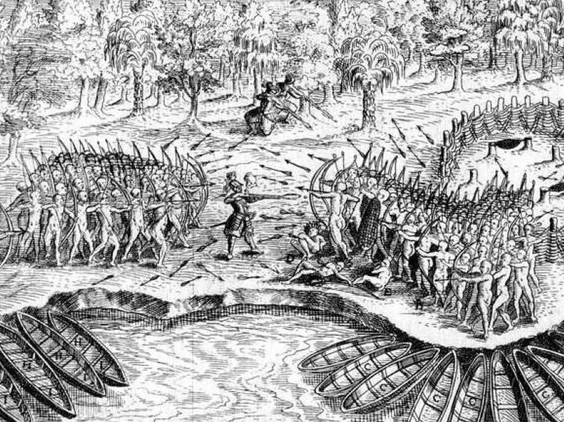
During our annual Not One Body Found season, I thought I’d discuss the truth about the brutal violence and savagery of North America’s most early, prominent and influential indigenous tribes, and popular narratives surrounding them.

If you’re an ethnic Canadian, born in the 1990s, you’re no doubt familiar with the education system’s attempts to subject you to a program of Maoist-style struggle sessions over the alleged genocide of the indigenous peoples in Canada. These struggle sessions in classrooms and collective humiliation rituals serve multiple purposes. One is to de-legitimize the history of, and perpetuate the ongoing deconstruction of Canada. The other is to de-legitimize the existence of the Canadian people as a nation (defined as a group sharing ethnic, cultural, and historical ties), in preparation for demographic replacement via mass migration.

The average Canadian’s school experience is filled with a turbo-charged version of liberal Noble Savage mythology, which is still propagated by leftists and indigenous activists. This has given the impression to many of the indigenous tribes as a singular race, continent-wide, uniformly peace-loving, non-binary, nature-appreciating matriarchal egalitarians until the evil, white, patriarchal Christian man arrived.

This resembles equally revisionist history about the Indo-European invasions into Europe around 4000 B.C. against the Pre-Indo-Europeans. You know that story: patriarchal brutes from the Eurasian steppes, with their advanced bronze weaponry and horse-powered chariots, wiped out the longhouse-dwelling, peace-loving, egalitarian agricultural Early European Farmers, who were feminist. This theory, conceived by Maria Gimbutas, a feminist intellectual, was debunked and discarded years ago. In reality, the Early-European-Farmers were extraordinarily warlike, violent, engaged in child murder or sacrifice and were apparently innovative as they built monuments like Stonehenge. This is much the same for indigenous in North America. All of this is framed in a Marxist oppressor-oppressed paradigm.

Tales of cruel treatment, deliberate biological warfare via smallpox blankets (of which there is only one known reference, with attempts to implement unknown), or extermination by colonial death squads haunts the minds of Canadians, planting the seeds of self-doubt and masochism. If you listen carefully to the rhetoric of leftists and indigenous activists, you’d be led to believe there was an industrial mass-slaughter of tribes, with conveyor belts funneling indigenous people into machines that spit out moccasins and dream catchers. The depopulation of indigenous tribes was not the result of deliberate action but rather Europeans being far more numerous and carrying diseases to which they had no immunity. The second cause was perpetual, brutal warfare by the survivors against each other. The mass depopulation from epidemic disease in North America occurred in the mid-1600s, after epidemic breakouts in the filthy, cramped conditions of Europe. Not almost a hundred years later in 1763, where smallpox blankets are merely discussed by General Jeffrey Amherst and Colonel Henry Bouquet.

Indigenous activists believe they were subject to a holocaust-style genocide. It is not a coincidence that the amplifying of the National Day for Truth and Reconciliation occurs at the same time as the Managerial Regime in Canada has declared itself a “post-national state” (which the indigenous also live in and suffer consequences from). They believe Canada is a country without a people. Ironically this lines up with activists’ own definition of “cultural genocide”, because in 1867 during Confederation Year, according to census data, Canada was 92% Anglo-French, 7% miscellaneous Europeans, and the remaining 1% indigenous. Canada is unquestionably, unmistakably, a European construct of Anglo-French extraction.

In 2021, seemingly out of nowhere, the public was subjected to the establishment of this astroturfed federal holiday, which was made statutory—still only for employees of the federal government (what a coincidence!)—as of March 2023. Participation in this public humiliation ritual involves the coerced wearing of orange, and sometimes red, shirts. Canadians across the political spectrum knowingly or unknowingly participate in this ritual, with many rough, cowboy-hat-wearing, lifted-big-black-truck-driving conservatives, as well as tattooed, soy-eating, vegan ketamine enthusiast quartz-worshiping leftists also enthusiastically partaking.

It’s called being a decent human being, Chud! Schools, the monopolized legacy media, corporations, and brands all recognize and partake in the humiliation ritual, directed exclusively at ethnic Canadians. Football games have their players sing the national anthem, and every clinically obese, corn-syrup-slurping sportsball fan claps as the announcer humiliates and shames him or her with a land acknowledgement to prove to the crowd and community that they “don’t see race”. Medical professionals and university faculty across the country also include land acknowledgements in professional email signatures. Even law enforcement gleefully participate in the the ritual, dancing like circus monkeys to the tune of people who despise them.

October 7, 2024

A grim anniversary

Filed under: Media, Middle East, Military — Tags: , , , , , — Nicholas @ 04:00

In the National Post, Barbara Kay notes the anniversary of the Hamas attacks along the Gaza-Israeli border that killed many Israeli civilians and led to the still-ongoing captivity for hundreds more:

One year on, Jews in the West have had time to process the primary shock of Hamas’s pogrom in southern Israel and the secondary shock of hateful blowback against Israel and Jews worldwide. We learned in a span of hours that where lethal antisemitism is concerned, “never again” was for us a mere objective, not a guarantee against those consumed by a mission of “again and again and again”.

But should we have been so surprised? Gaza was riddled with tunnels, their sole purpose to prepare for a war of extermination against Jews. The West’s intellectual “tunnels” have been operating in plain sight for many years. Under the aegis of “Israel Apartheid Week” and the Boycott, Divestment, Sanctions (BDS) movement, vicious anti-Zionism has been a campus fixture since 2001, when the World Conference against Racism in Durban, South Africa erupted into a “festival of hate” against Jews. After decades of aggressive Israel-bashing, Palestinians have been elevated throughout western educational systems to the summit of intersectional victimhood. Those indoctrinated in this hierarchy over the last 25 years consider it a duty and a virtue to demonize Zionism as an original historical sin. October 7 popped the cork on that long-seething volcano.

Throughout the past year, we’ve seen hostage posters vandalized, Jewish schoolchildren bullied, Jewish-owned businesses attacked, Jewish neighbourhoods tormented, Jewish institutions burned and shot at. Downtowns are routinely plagued by foul-mouthed protesters shrieking mantras that call for Israel’s elimination. University campuses have tolerated long-term encampments, Judenrein except for Jews who earn their laissez-passer with a denunciation of Israel.

It’s getting worse. On Saturday in Toronto, a demonstration featured Hezbollah flags, banners extolling violence against Israel and portraits of the (recently eliminated) Hezbollah leader and arch-terrorist Hassan Nasrallah. Last Sunday in Montreal, a band of black-garbed protesters attacked Concordia University and smashed several downtown store windows. During a foot chase, one even threw Molotov cocktails in the direction of police, an ominous escalation.

More ominous in my opinion: Post-October 7, we saw the emergence at rallies and on western social media of the image of a Jewish star being dumped into a trash can accompanied by the words “Keep the world clean” — for years a meme favoured by Hamas, inspired by the Nazis.

The Nazis used the image and words in their propaganda to normalize the idea that Jews, like vermin, were a hygiene threat requiring drastic action to preserve the nation’s health. That such messages are tolerated in the public forum points to a growing acceptance of outright eradicationist antisemitism as a “respectable” opinion to hold, even among supposedly enlightened people in fields such as mental health, as evidenced by anti-Zionist blacklists targeting Jewish members of the profession.

« Newer PostsOlder Posts »

Powered by WordPress