
Being a correspondent in Moscow, I found, was, in itself, easy enough. The Soviet press was the only source of news; nothing happened or was said until it was reported in the newspapers. So all I had to do was go through the papers, pick out any item that might be interesting to readers of the Guardian, dish it up in a suitable form, get it passed by the censor at the Press Department, and hand it in at the telegraph office for dispatch. One might, if in a conscientious mood, embellish the item a little … sow in a little local colour, blow it up a little, or render it down a little according to the exigencies of the new situation. The original item itself was almost certainly untrue or grotesquely distorted. One’s own deviations, therefore, seemed to matter little, only amounting to further falsifying what was already false.
This bizarre fantasy was very costly and elaborate and earnestly promoted. Something gets published in Pravda; say, that the Soviet Union has a bumper wheat harvest – so many poods per hectare. There is no means of checking; the Press Department men don’t know, and anyone who does is far, far removed from the attentions of foreign journalists. Soviet statistics have always been almost entirely fanciful, though not the less seriously regarded fro that. When the Germans occupied Kiev in the 1939-45 war they got hold of a master Five Year Plan, showing what had really been produced and where. Needless to say, it was quite different from the published figures. This in no way affected credulity about such figures subsequently, as put out in Russia, or even in China.
Malcolm Muggeridge, Chronicles of Wasted Time, 2006.
April 13, 2017
QotD: Soviet statistics
March 28, 2017
QotD: The rise of political correctness in the UK
The philosophy of political correctness is now firmly entrenched over here, too, and at its core is a refusal to look the truth squarely in the face, unpalatable as it may be.
Political correctness is about denial, usually in the weasel circumlocutory jargon which distorts and evades and seldom stands up to honest analysis.
It comes in many guises, some of them so effective that the PC can be difficult to detect. The silly euphemisms, apparently harmless, but forever dripping to wear away common sense — the naivete of the phrase “a caring force for the future” on Remembrance poppy trays, which suggests that the army is some kind of peace corps, when in fact its true function is killing.
The continual attempt to soften and sanitise the harsh realities of life in the name of liberalism, in an effort to suppress truths unwelcome to the PC mind; the social engineering which plays down Christianity, demanding equal status for alien religions.
The selective distortions of history, so beloved by New Labour, denigrating Britain’s past with such propaganda as hopelessly unbalanced accounts of the slave trade, laying all the blame on the white races, but carefully censoring the truth that not a slave could have come out of Africa without the active assistance of black slavers, and that the trade was only finally suppressed by the Royal Navy virtually single-handed.
In schools, the waging of war against examinations as “elitist” exercises which will undermine the confidence of those who fail — what an intelligent way to prepare children for real life in which competition and failure are inevitable, since both are what life, if not liberal lunacy, is about.
PC also demands that “stress”, which used to be coped with by less sensitive generations, should now be compensated by huge cash payments lavished on griping incompetents who can’t do their jobs, and on policemen and firemen “traumatised” by the normal hazards of work which their predecessors took for granted.
Furthermore, it makes grieving part of the national culture, as it was on such a nauseating scale when large areas were carpeted in rotting vegetation in “mourning” for the Princess of Wales; and it insists that anyone suffering ordinary hardship should be regarded as a “victim” — and, of course, be paid for it.
That PC should have become acceptable in Britain is a glaring symptom of the country’s decline.
George MacDonald Fraser, “The last testament of Flashman’s creator: How Britain has destroyed itself”, Daily Mail, 2008-01-05.
March 26, 2017
QotD: Muggeridge on queues in the Soviet Union
We used to run a little contest among ourselves to see who could produce the most striking example of credulity among this fine flower of our western intelligentsia. Persuading church dignitaries to feel at home in an anti-God museum was too easy to count. So was taking lawyers into the people´s courts. I got an honourable mention by persuading Lord Marley that the queueing at food shops was permitted by the authorities because it provided a means of inducing the workers to take a rest when otherwise their zeal for completing the five-year plan in record time was such that they would keep at it all the time, but no marks for floating a story that Soviet citizens were being asked to send in human hair – any sort – for making of felt boots. It seemed that this had actually happened.
Malcolm Muggeridge, Chronicles of Wasted Time, 2006.
March 19, 2017
Crucified Soldier – RMS Olympic – Somme Cavalry I OUT OF THE TRENCHES
Published on 18 Mar 2017
Chair of Wisdom Time! This week we talk about the propaganda story of the crucified soldier and the RMS Olympic.
March 6, 2017
“What could possibly account for that growth? Statistical fakery so fake that a Vegas bookie would weep”
Daniel Greenfield on how to hoax the media into reporting on a burgeoning anti-Muslim movement in the United States:
“Huge Growth in Anti-Muslim Hate Groups During 2016: SPLC Report,” wails NBC News. “Watchdog: Number of anti-Muslim hate groups tripled since 2015,” FOX News bleats. ABC News vomits up this word salad. “Trump cited in report finding increase in US hate groups for 2nd year in a row.”
The SPLC stands for the Southern Poverty Law Center: an organization with slightly less credibility than Ringling Bros and Barnum & Bailey Clown College, and without the academic degree in greasepaint.
And you won’t believe the shameless way the SPLC faked its latest Islamophobia crisis.
The Southern Poverty Law Center’s latest “hate group” sightings claims that the “number of anti-Muslim hate groups increased almost three-fold in 2016.”
That’s a lot of folds.
And there is both bad news and good news from its “Year in Hate and Extremism.”
First the good news.
Casa D’Ice Signs, the sign outside a bar in K-Mart Plaza in Allegheny County, Pennsylvania, is no longer listed as a hate group. The sign outside the bar had been listed as a hate group by the SPLC for years. The owner of Casa D’Ice had been known for putting politically incorrect signs outside his bar. So the SPLC listed the “signs” as a hate group. (Even though there was only one sign.) Not the bar. That would have made too much sense.
Since then Casa D’Ice was sold and the SPLC has celebrated the defeat of another hate group. Even if the hate group was just a plastic sign outside a bar.
But the bad news, according to the Southern Poverty Law Center, is that anti-Muslim hate groups shot up from only 34 in 2015 to 101 in 2016.
What could possibly account for that growth? Statistical fakery so fake that a Vegas bookie would weep.
March 1, 2017
The different “flavours” of propaganda
Cory Doctorow on the various types of propaganda in use around the world:
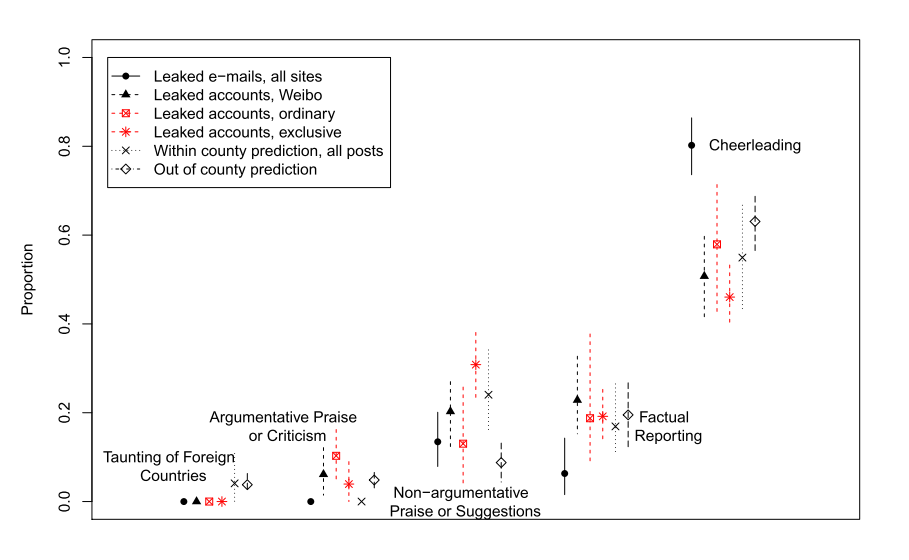
Jonathan Stray summarizes three different strains of propaganda, analyzing why they work, and suggesting counter-tactics: in Russia, it’s about flooding the channel with a mix of lies and truth, crowding out other stories; in China, it’s about suffocating arguments with happy-talk distractions, and for trolls like Milo Yiannopoulos, it’s weaponizing hate, outraging people so they spread your message to the small, diffused minority of broken people who welcome your message and would otherwise be uneconomical to reach.
Stray cites some of the same sources I’ve written about here: Tucker Max’s analysis of Yiannopoulos’s weaponized hate and The Harvard Institute for Quantitative Science team’s first-of-its kind analysis of leaked messages directing the activities of the “50-cent army, which overwhelms online Chinese conversation with upbeat cheerleading (think of Animal Farm‘s sheep-bleating, or Nineteen Eighty-Four‘s quackspeak).
But I’d never encountered the work he references on Russian propaganda, by RAND scholar Christopher Paul, who calls Russian disinformation a “firehose of falsehood.” This tactic involves having huge numbers of channels at your disposal: fake and real social media accounts, tactical leaks to journalists, state media channels like RT, which are able to convey narrative at higher volume than the counternarrative, which becomes compelling just by dint of being everywhere (“quantity does indeed have a quality all its own”).
Mixing outright lies with a large dollop of truth is key to this tactic, as it surrounds the lies with a penumbra of truthfulness. This is a time-honored tactic, of course: think of the Christian Science Monitor‘s history of outstanding international coverage, accompanied by editorials about God’s ability to heal through prayer; or Voice of America‘s mixture of excellent reporting on (again) international politics and glaring silence on US crises (see also: Al Jazeera as a reliable source on everything except corruption in the UAE; the BBC World Service‘s top-notch journalism on everything except UK complicity in disasters like the Gulf War, etc).
In addition to this excellent taxonomy of propaganda, Stray proposes countermeasures for each strain: for Russia-style “firehoses of falsehood,” you have to reach the audience first with an alternative narrative; once the firehose is on, it’s too late. For Chinese quackspeak floods, you need “organized, visible resistance” in the streets. For pathetic attention-whores like Yiannopoulos, Stray says Tucker Max is right: you have to ignore him.
February 26, 2017
British History’s Biggest Fibs with Lucy Worsley Episode 3: The Jewel in the Crown
Published on 10 Feb 2017
In the final episode, Lucy debunks the fibs that surround the ‘jewel in the crown’ of the British Empire – India. Travelling to Kolkata, she investigates how the Raj was created following a British government coup in 1858. After snatching control from the discredited East India Company, the new regime presented itself as a new kind of caring, sharing imperialism with Queen Victoria as its maternal Empress.
Tyranny, greed and exploitation were to be things of the past. From the ‘black hole of Calcutta’ to the Indian ‘mutiny’, from East India Company governance to crown rule, and from Queen Victoria to Empress of India, Lucy reveals how this chapter of British history is another carefully edited narrative that’s full of fibs.
February 24, 2017
Mechanised War In Mesopotamia – Toplica Uprising I THE GREAT WAR Week 135
Published on 23 Feb 2017
After the humiliating defeat at Kut last year, the British upped their game in Mesopotamia and this week 100 years ago the British Indian Army starts making gains towards Baghdad. In the occupied territories of Serbia the local population is rising up against the Bulgarian and Austro-Hungarian occupants and on the Western Front, the British make surprisingly easy progress against the German Army.
February 8, 2017
British History’s Biggest Fibs with Lucy Worsley Episode 1 War of the Roses [HD]
Published on 27 Jan 2017
Lucy debunks the foundation myth of one of our favourite royal dynasties, the Tudors. According to the history books, after 30 years of bloody battles between the white-rosed Yorkists and the red-rosed Lancastrians, Henry Tudor rid us of civil war and the evil king Richard III. But Lucy reveals how the Tudors invented the story of the ‘Wars of the Roses’ after they came to power to justify their rule. She shows how Henry and his historians fabricated the scale of the conflict, forged Richard’s monstrous persona and even conjured up the image of competing roses. When our greatest storyteller William Shakespeare got in on the act and added his own spin, Tudor fiction was cemented as historical fact. Taking the story right up to date, with the discovery of Richard III’s bones in a Leicester car park, Lucy discovers how 15th-century fibs remain as compelling as they were over 500 years ago. As one colleague tells Lucy: ‘Never believe an historian!
December 1, 2016
Rolling Stone calls out the Washington Post for shoddy journalism
Pot, I’d like to introduce you to Kettle. Kettle, please meet Pot.
However, that’s not to say that Rolling Stone is wrong about this:
Last week, a technology reporter for the Washington Post named Craig Timberg ran an incredible story. It has no analog that I can think of in modern times. Headlined “Russian propaganda effort helped spread ‘fake news’ during election, experts say,” the piece promotes the work of a shadowy group that smears some 200 alternative news outlets as either knowing or unwitting agents of a foreign power, including popular sites like Truthdig and Naked Capitalism.
The thrust of Timberg’s astonishingly lazy report is that a Russian intelligence operation of some kind was behind the publication of a “hurricane” of false news reports during the election season, in particular stories harmful to Hillary Clinton. The piece referenced those 200 websites as “routine peddlers of Russian propaganda.”
The piece relied on what it claimed were “two teams of independent researchers,” but the citing of a report by the longtime anticommunist Foreign Policy Research Institute was really window dressing.
The meat of the story relied on a report by unnamed analysts from a single mysterious “organization” called PropOrNot – we don’t know if it’s one person or, as it claims, over 30 – a “group” that seems to have been in existence for just a few months.
It was PropOrNot’s report that identified what it calls “the list” of 200 offending sites. Outlets as diverse as AntiWar.com, LewRockwell.com and the Ron Paul Institute were described as either knowingly directed by Russian intelligence, or “useful idiots” who unwittingly did the bidding of foreign masters.
Forget that the Post offered no information about the “PropOrNot” group beyond that they were “a collection of researchers with foreign policy, military and technology backgrounds.”
Forget also that the group offered zero concrete evidence of coordination with Russian intelligence agencies, even offering this remarkable disclaimer about its analytic methods:
“Please note that our criteria are behavioral. … For purposes of this definition it does not matter … whether they even knew they were echoing Russian propaganda at any particular point: If they meet these criteria, they are at the very least acting as bona-fide ‘useful idiots’ of the Russian intelligence services, and are worthy of further scrutiny.”
What this apparently means is that if you published material that meets their definition of being “useful” to the Russian state, you could be put on the “list,” and “warrant further scrutiny.”
November 11, 2016
QotD: The amazing long-term success of Soviet subversion in the West
The Soviets consciously followed the Gramscian prescription; they pursued a war of position, subverting the “leading elements” of society through their agents of influence. (See, for example, Stephen Koch’s Double Lives: Stalin, Willi Munzenberg and the Seduction of the Intellectuals; summary by Koch here) This worked exactly as expected; their memes seeped into Western popular culture and are repeated endlessly in (for example) the products of Hollywood.
Indeed, the index of Soviet success is that most of us no longer think of these memes as Communist propaganda. It takes a significant amount of digging and rethinking and remembering, even for a lifelong anti-Communist like myself, to realize that there was a time (within the lifetime of my parents) when all of these ideas would have seemed alien, absurd, and repulsive to most people — at best, the beliefs of a nutty left-wing fringe, and at worst instruments of deliberate subversion intended to destroy the American way of life.
Koch shows us that the worst-case scenario was, as it turns out now, the correct one; these ideas, like the “race bomb” rumor, really were instruments deliberately designed to destroy the American way of life. Another index of their success is that most members of the bicoastal elite can no longer speak of “the American way of life” without deprecation, irony, or an automatic and half-conscious genuflection towards the altar of political correctness. In this and other ways, the corrosive effects of Stalin’s meme war have come to utterly pervade our culture.
The most paranoid and xenophobic conservatives of the Cold War were, painful though this is to admit, the closest to the truth in estimating the magnitude and subtlety of Soviet subversion. Liberal anticommunists (like myself in the 1970s) thought we were being judicious and fair-minded when we dismissed half of the Right’s complaint as crude blather. We were wrong; the Rosenbergs and Alger Hiss really were guilty, the Hollywood Ten really were Stalinist tools, and all of Joseph McCarthy’s rants about “Communists in the State Department” were essentially true. The Venona transcripts and other new material leave no room for reasonable doubt on this score.
While the espionage apparatus of the Soviet Union didn’t outlast it, their memetic weapons did. These memes are now coming near to crippling our culture’s response to Islamic terrorism.
Eric S. Raymond, “Gramscian damage”, Armed and Dangerous, 2006-02-11.
November 7, 2016
October 30, 2016
Bomber Pilot Fame – Delville Wood – WW1 Remembrance I OUT OF THE TRENCHES
Published on 29 Oct 2016
It’s time for another exciting episode of Out Of The Trenches. This week we talk about the fame of bomber pilots, the Battle of Delville Wood and the importance of remembering World War 1.
October 12, 2016
QotD: The fine art of self-deception
… we are all capable of believing things which we know to be untrue, and then, when we are finally proved wrong, impudently twisting the facts so as to show that we were right. Intellectually, it is possible to carry on this process for an indefinite time: the only check on it is that sooner or later a false belief bumps up against solid reality, usually on a battlefield.
When one looks at the all-prevailing schizophrenia of democratic societies, the lies that have to be told for vote-catching purposes, the silence about major issues, the distortions of the press, it is tempting to believe that in totalitarian countries there is less humbug, more facing of the facts. There, at least, the ruling groups are not dependent on popular favour and can utter the truth crudely and brutally. Goering could say ‘Guns before butter’, while his democratic opposite numbers had to wrap the same sentiment up in hundreds of hypocritical words.
Actually, however, the avoidance of reality is much the same everywhere, and has much the same consequences. The Russian people were taught for years that they were better off than everybody else, and propaganda posters showed Russian families sitting down to abundant meal while the proletariat of other countries starved in the gutter. Meanwhile the workers in the western countries were so much better off than those of the U.S.S.R. that non-contact between Soviet citizens and outsiders had to be a guiding principle of policy. Then, as a result of the war, millions of ordinary Russians penetrated far into Europe, and when they return home the original avoidance of reality will inevitably be paid for in frictions of various kinds. The Germans and the Japanese lost the war quite largely because their rulers were unable to see facts which were plain to any dispassionate eye.
To see what is in front of one’s nose needs a constant struggle. One thing that helps toward it is to keep a diary, or, at any rate, to keep some kind of record of one’s opinions about important events. Otherwise, when some particularly absurd belief is exploded by events, one may simply forget that one ever held it. Political predictions are usually wrong. But even when one makes a correct one, to discover why one was right can be very illuminating. In general, one is only right when either wish or fear coincides with reality. If one recognizes this, one cannot, of course, get rid of one’s subjective feelings, but one can to some extent insulate them from one’s thinking and make predictions cold-bloodedly, by the book of arithmetic. In private life most people are fairly realistic. When one is making out one’s weekly budget, two and two invariably make four. Politics, on the other hand, is a sort of sub-atomic or non-Euclidean word where it is quite easy for the part to be greater than the whole or for two objects to be in the same place simultaneously. Hence the contradictions and absurdities I have chronicled above, all finally traceable to a secret belief that one’s political opinions, unlike the weekly budget, will not have to be tested against solid reality.
George Orwell, “In Front of Your Nose”, Tribune, 1946-03-22.
September 20, 2016
Reaching the Masses – Propaganda Film During World War 1 I THE GREAT WAR Special
Published on 19 Sep 2016
Cinemas were already pretty popular when World War 1 broke out in 1914. After initial hesitation all warring nations started to embrace the new mass medium for their propaganda. Since it was technically difficult deliver the authentic material the audiences wanted, the films were mostly staged. Film scripts opened the opportunity to transport any message about the war to a mass audience.


