
World War Two
Published 19 Sep 2024In the summer of 1940, Hitler was at the peak of his popularity as he conquered Germany’s enemies seemingly at will. But just how quickly did this approval decline as the war turned further and further against Germany? What did the Germans think of him by the end of the war? Is there any love left for Hitler in postwar Germany? Today Spartacus answers these questions.
(more…)
September 20, 2024
How Popular Was Hitler?
Comments Off on How Popular Was Hitler?
September 16, 2024
Anger sells – “Words like ‘wrong’, ‘bad’, ‘awful’, ‘hate’, ‘sick’, ‘fight’, and ‘scary’ each predict a 2.3% increase in click-through rates”
Rob Henderson explains the incentives that lead to provoking as much anger as possible among readers (and especially voters):

It seems like people are angrier than ever. According to a poll by CBS News, 84 percent of Americans believe we are angrier than previous generations. Another survey recently found that nine in ten Americans can name either a recent news event or something about American politics that made them angry, while only half could identify a recent news event or something about American politics that made them proud.
What explains this feeling of rage? One noteworthy reason is that exploiting anger is politically convenient.
The strategic use of anger in politics has transformed it from a natural human emotion into a weapon of division, with far-reaching consequences for our social cohesion and democratic governance.
According to Steven Webster, author of “American Rage: How Anger Shapes Our Politics” and assistant professor of political science at Indiana University, “Anger provides ample benefits to those politicians who are able to use it most skillfully”.
Indeed, across political settings, angry people are more likely to vote than those who are not angry. In other words, politicians who can stoke anger can use it to motivate their base. The angrier voters are at the opposing party, the more likely they are to show up to the polls to support their own party. As Webster puts it, “angry voters are loyal voters”.
Political anger has consequences that extend beyond how Americans view their governing institutions or the opposing political party. When American voters are angry about politics, they are inclined to avoid social interactions or social events where they are likely to come into contact with those whose political leanings differ from their own.
In a chapter titled “Emotions in Politics” published last year, the psychologists Florian van Leeuwen and Michael Bang Peterson suggest that along with other emotions, anger “seems to be a distinct strategy for increasing what one is entitled to in the minds of others”.
Provoking rage against selected groups is an effective way to promote unity in politics. Today, many Americans across the political spectrum are encouraged to feel they are being victimized. It’s no coincidence that one of Donald Trump’s go-to lines on the campaign trail is “They’re laughing at us”. Being laughed at induces humiliation, which often quickly transforms into rage.
In a notable historical illustration of a political movement using anger as a limitless source of ideological fuel, consider the case of the “Recalling Bitterness” campaign in Maoist China. In the 1960s, the communist dictator Mao Zedong grew worried that ordinary Chinese citizens were developing lukewarm attitudes about the socialist revolution. In response, the regime forced people into rituals in which they publicly announced how bad life was before they had been liberated. Mao ordered writers and artists to rewrite history through the lens of class struggle to suit the needs of his political agenda. Regime officials held meetings encouraging peasants to describe how much better life was now compared to pre-liberation, hoping to convince them that the revolution’s successes outnumbered its failures. The “devils” here were reactionaries, landlords, rich farmers, and counterrevolutionaries. Documenting the rituals of the Recalling Bitterness campaign, the historian Guo Wu has written, “Only poor peasants were allowed to speak; former landlords and rich peasants were silenced”.
Comments Off on Anger sells – “Words like ‘wrong’, ‘bad’, ‘awful’, ‘hate’, ‘sick’, ‘fight’, and ‘scary’ each predict a 2.3% increase in click-through rates”
September 8, 2024
Hitler’s Victory in Thüringen – Rise of Hitler 01
World War Two
Published 7 Sep 2024In this issue of the Weimar Wire, we dive deep into the critical events of January 1930. Political violence in the streets, uncertainty over the nation’s very character and Nazis entering a governing coalition provide a veritable treasure trove of political intrigue, hidden aspirations, and grand schemes.
(more…)
Comments Off on Hitler’s Victory in Thüringen – Rise of Hitler 01
August 21, 2024
The pro-Kamala coup
At UnHerd, Edward Luttwak walks through the steps behind the scenes that led to Kamala Harris becoming the Democratic Party’s Presidential candidate for the 2024 election:
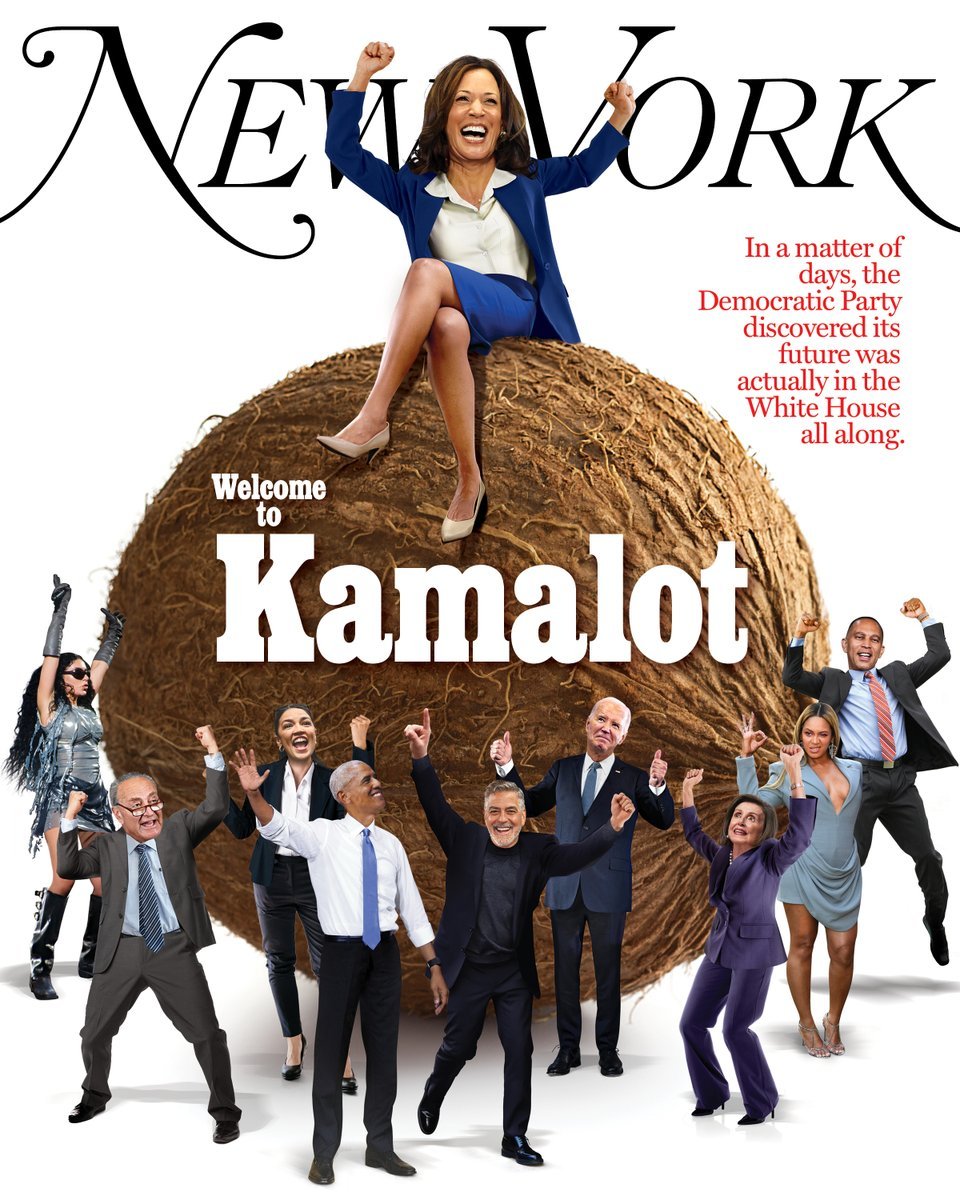
We are stuck with the French phrase coup d’état because nothing else describes so well the sudden removal of an old ruler by secret manoeuvrings — and their replacement with a chosen successor who happens to be endowed with every possible virtue. Of course, Kamala Harris is not a dictator because she must still face a nationwide election. But secret manoeuvrings did make her the presidential candidate of her Democratic Party, a position that is also intended to be filled by primary elections up and down the country before delegates agree on the victor at the Party Convention.
Nor was her vice-presidency enough to secure her candidacy. Far from it, given the unpromising electoral record of that most peculiar office, not inaccurately described as “not worth a bucket of warm spit” by John Nance Garner, Franklin D. Roosevelt’s vice president. In fact, in all of American history, only seven vice presidents were elected to the presidency (eight replaced a dead president). This reflects the habitual role of vice presidents: emphatically not presidents-in-waiting but rather politicos serving as symbolic figures who are selected to attract voters that the president cannot attract with his policies.
[…]
What happened next could not possibly have occurred if there were not a single directing hand behind the scenes. Suddenly, the very same voices from Nancy Pelosi down, who had just told the American people that Biden was fit and ready to win in the upcoming elections and rule for four more years, said the very opposite: that Biden should immediately announce his withdrawal from the elections. Nor is it any mystery who pulled the switch: Barack Obama, the only American President of recent times who has continued to live in Washington DC after leaving the White House — and it is not for the Potomac river-fishing that he has stayed there.
[…]
Obama had definitely not wanted Harris in that position, fearing that she would come under attack for her San Francisco career launched by an older mayor who was also her romantic partner. After Biden had locked himself into his vice-presidential choice of a black woman, Obama proposed his former National Security Advisor, Susan Rice. But even the faithful Biden could not accept that: in his own eight vice-presidential years, Biden often tried to influence foreign policy only to be overruled by Obama’s appointees, who knew very much less than he did after his decades of attentive service on the Senate Foreign Relations Committee. And none was more arrogant with him than Rice. And so, even faithful Biden would not accept her, which meant that Obama could ensure Biden’s withdrawal, but not his replacement with his own candidate.
So, what is the party left with? Because Kamala Harris did not win even one primary, and her vice-presidential role was more unremarkable than most, it is possible, just possible, that this week’s gathering will not unfold as a Chinese Communist Party Congress, and one or more delegates will call for a choice. And because there are in fact candidates ready and waiting among the Democratic governors, eight of them women, an open convention need not devolve into chaos or coup — but rather into a democratic election.
Comments Off on The pro-Kamala coup
August 20, 2024
QotD: The printing press was to the Reformation what social media is in the Current Year
Consider the Reformation. I’m in no way qualified to walk you through all the various doctrinal issues, but in this case a superficial analysis is not only sufficient, it’s actually better. Instead of getting lost in the theological weeds, I want to focus on the process. So let’s stipulate for the sake of argument that nothing Luther said was all that original, theologically — you can find pretty much any tenet of “Lutherism” (as it then was) somewhere in the past, often among the Church Fathers (the “double predestination” that drove Calvinists insane is straight out of St. Augustine, for example). Wyclif, Hus, Nicholas of Cusa, Marsilius of Padua, all those guys were proto-Luthers, at least in part.
The thing about Luther, then, wasn’t what he said, so much as how he said it.
Martin Luther was the world’s first spin doctor. Though he insisted for a long time that his famous 95 Theses were, and were always intended to be, a scholastic debate between clergymen, Luther mastered the use of printed propaganda. His opponents soon followed, or tried to, in an ever-increasing spiral of printed viciousness. Mutatis mutandis, the exchanges between Luther, Erasmus, Thomas More (to say nothing of a thousand lesser lights) and their opponents all sound shockingly Current Year. They’re snarky and waspish at best, grotesque ad hominem at worst. Modern flame wars have nothing on the way Thomas More and William Tyndale tore into each other, for instance, and More and Tyndale were rank amateurs compared to Luther.
As with the Current Year, where being first on social media is the only criterion that matters, so the printing press injected something very like “hot takes” into the late-Medieval intellectual atmosphere. If you tried to respond to your opponents the old-fashioned way — with closely reasoned, heavily cited arguments, on parchment, hand-copied by monks — you might win the intellectual battle … 500 years later, among historians who thank you for providing such a useful glimpse into late-Medieval mentalités, but in your own time you’d get fired at best, get burned at the stake at worst, if you didn’t respond instantly, in kind.
The printing press, in other words, represented a quantum leap in the velocity of information. Those who grasped its fundamentals prospered, while those who fell behind perished. King Henry VIII, for instance, fatally damaged his cherished intellectual reputation when he deigned to attack to Luther in person. Luther hit back with a tirade that wouldn’t be out of place on Twitter1, and Henry responded in kind, and now the king, who was hip-deep in self-inflicted shit by that point, had to drop the fight. Having been publicly abused by a mere ex-monk, he had to quit the field with his tail between his legs.
Severian, “Velocity of Information”, Rotten Chestnuts, 2021-08-10.
1. Again, mutatis mutandis. Though this sounds to modern ears like an abject apology on Luther’s part (“especially as I am the offscouring of the world, a mere worm who ought only to live in contemptuous neglect”, etc.), in context it’s a vicious attack. For one thing, what’s a great king like Henry doing responding to a “mere worm”? And Henry had to know, since Wolsey did nothing without his master’s orders … except everyone had heard the rumors that Henry was just a dimwitted playboy, and Cardinal Wolsey was really the king in all but name, so maybe he didn’t know. Either way Henry, who prided himself on being an intellectual, was a fool. That’s the kind of thing that would get you executed in the 16th century, and here’s this “mere worm” publishing it, for all the world to see, with no possibility of reprisal from a supposedly puissant monarch.
Comments Off on QotD: The printing press was to the Reformation what social media is in the Current Year
August 13, 2024
Feelings … nothing more than (climate) feelings …
Have you been metaphorically beaten over the head about your climate sins? Your carbon buttprint? You know your very existence is a threat to Mother Gaia, right? Well, Katharina van Bronswijk is worried that you’ll stop listening to the neverending lectures about you and your evil externalities:
Climatism is a political programme bound to a broad social movement. Most of its momentum comes not from The Science or The Experts, but from diffuse cultural forces that we should probably try to understand, if only because they are driving our entire civilisation straight into the ground. Against all advice, I will therefore steer the plague chronicle into this ridiculous quagmire of leftoid green babble, with a look at our first lesson in Unlearnings, namely “Unlearn Repression”.
This superficial and disorganised essay is the work of an infuriating young woman named Katharina van Bronswijk. She’s a psychotherapist best known for her 2022 book, Climate in Our Heads. Fear, Anger, Hope: What the Ecological Crisis is Doing to Us. It belongs to that genre of inevitably unreadable monographs, in which the author herself appears on the cover, looking windswept, pioneering and undaunted:
“Climate feelings” are van Bronswijk’s niche in the extremely crowded enterprise of CO2-bothering. In “Unlearn Repression”, she argues that we should not suppress our negative feelings about climate change, but rather embrace them in constructive ways on behalf of the planet.
Now, van Bronswijk is the kind of deeply unoriginal person who just says the same things over and over. Everything she writes in “Unlearn Repression” flows directly from Climate in our Heads; she’s been digesting, reheating and reworking this same overboiled intellectual artichoke for almost two years now, through various media interviews and even in this English-language TEDx Talk. Throughout this woman’s work is the vague anxiety that the climatists have perhaps overdone it with doom and gloom, and that a lot of people have had enough of hearing about a climate apocalypse that never quite happens.
Van Bronswijk is naturally very dumb, but more than that she is painfully condescending, oblivious, verbose and just awash in litres of estrogen. I defy anyone to read her work and not come away from it a raging misogynist. This odious overpromoted schoolmarm belongs out of sight in a childcare centre teaching young children the alphabet. Perhaps she should also be in a choir, or part of a local environmental club dedicated to collecting litter in parks. That our society has denied van Bronswijk and so many others like her these proper outlets for their instincts and instead pushed them into public activism and intellectual production itself explains a great deal of what is wrong with the world.
“Unlearn Repression” opens with some autobiographical details, because of course everything van Bronswijk talks about is all about van Bronswijk. Like so many Germans of her generation, she was radicalised by school climate propaganda – specifically, by her teacher’s fateful screening of that classic propaganda film, An Inconvenient Truth:
Back then … I was happy for the welcome distraction of watching a film instead of doing normal lessons. But afterwards I was shocked and asked my mum for answers to all the questions and challenges. She didn’t have any solutions for me, how could she? I was alarmed and started to think about the impending consequences of climate change and what could be done about it. I found approaches in newsletters from NGOs and by reading up on animal and environmental protection … That was when my dream bubble burst and I realised: the world is unfair and, unlike all the Disney stories of my childhood, there will be no single hero*ine who saves the world. And there is no magical or technical miracle solution either.
Al Gore’s film so terrified the young van Bronswijk, that for a while she retreated into conspiratorial theories about why climate change is not happening, which qualifies our crayon psychotherapist to pronounce upon the psychology of those who deny the climate. This deeply evil and irrational movement is driven primarily by “white men”, because they “still enjoy most of the privileges in our society, and therefore have the most to lose”.

Comments Off on Feelings … nothing more than (climate) feelings …
August 2, 2024
QotD: The essential target of ideological propaganda
The Third Reich didn’t last long enough to figure it out, but in their 70-odd years the Soviets learned that “the masses” can be more or less ignored. They’re no threat to the regime. Your average Soviet “citizen” — Ivan Sixpack — would follow pretty much any rule, so long as he had a steady and predictable life course. That’s no slander on Ivan; it’s just the way people are. If you want proof, go look around — if I’d told you, back in the summer of 2019, about all the masks and the social distancing and the lockdowns and everything else, you’d have laughed at me. “There will be blood in the streets! No one will stand for it!”
The reaction of “the masses” (a term I hate; it’s patronizing, but it’ll have to do) to COVID was instructive: They either did as they were told, with nary a peep of complaint, or they simply ignored it … with nary a peep of complaint. From the rulers’ perspective, either one was fine, because they’re functionally the same thing. We all know that whatever the ruling class thought they were going to get out of the Kung Flu panic — and it’s not at all clear; we’ll get there — “public health”, as in the actual health of real members of the public, was nowhere on the list. As with “climate change” and all their other “crises”, their highly visible behavior showed how seriously they took it — which was, of course, not at all.
Indeed, from the rulers’ perspective, it was actually better that some large fraction of the underclass didn’t comply — that way, the mental energy of the Karens was channeled down, not up. Karen could start complaining about Whitmer, Newsom, and the rest not living by their own rules, and had she done so, that might’ve posed a problem for the rulers. But thanks to the maskless proles (and, of course, asshole class traitors like me), Karen always had a bunch of much softer targets to hector.
That’s the function of “propaganda” in my sense. It’s designed to create a narrative, the purpose of which is to channel dissatisfaction down the social scale.
What the Soviets learned, and their SJWs successors have internalized, is that you really only need a small cadre of “middle class” (for lack of a better term) producers to keep things running. Those are the targets of narrative-reinforcing propaganda.
Indeed, it’s only a subset of that already small fraction that needs to be propagandized. As the Soviets quickly learned, true technical experts are more or less ideology-proof. That’s because their technical expertise takes up all their time; they’ve oriented their personalities around it. You could read a novel like Red Plenty to get the sense of it (Z Man has a review somewhere if you want it), but I suggest a much easier path: Watch the fun old movie Boiler Room, with Giovanni Ribisi, Vin Diesel, and in a brief but memorable scene, Ben Affleck. I’m sure that seems odd — it’s a movie about sell-at-all-costs stockbrokers, based loosely on Jordan Belfort’s Stratton Oakmont scam; what could be more explicitly capitalist?
But note how they live: They own ludicrous cars and live in huge mansions, but the cars hardly get driven, and the mansions are unfurnished. There’s a scene where they all get together in Vin Diesel’s living room to watch a movie (Wall Street, natch). There’s a huge tv and a couch, but everything else is boxed up, and they’re eating takeout pizza. Giovanni Ribisi says something like “did you just move in this weekend?” and the other guys say no, he’s been living here for years, he just never got around to unpacking his stuff. That’s the mindset of the true technical intelligentsia. Those stockbrokers think they’re doing it for the money, and so they have the outward trappings of rich people, but they’re really doing it because that’s who they are — they’d be just as deliriously happy competing for subway tokens or scraps of confetti, so long as they had one more scrap than the guy on the next phone.
Given that, the only group that really needs to be propagandized is — you guessed it — Karen. The entire narrative of COVID was very obviously designed by hormonal cat ladies, for hormonal cat ladies. Cards on the table: Though I thought Kung Flu was overblown and ridiculous from the beginning, since I know a little history, I didn’t base my conclusions on my reading in the medical journals. I didn’t read medical journals, and unless you’re a doctor I bet you didn’t, either. My opposition to the Kung Flu panic was entirely visceral: THIS IS MEAN GIRL SHIT.
Severian, “Narrative Collapse III: Magic Masks”, Rotten Chestnuts, 2021-07-07.
Comments Off on QotD: The essential target of ideological propaganda
July 31, 2024
“You really can’t hate them enough”
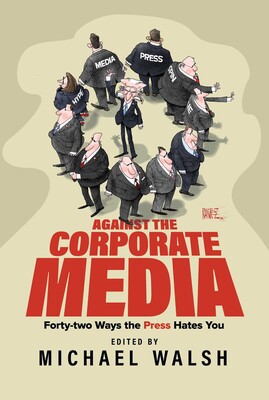
Elizabeth Nickson links to a short excerpt from Michael Walsh’s introduction to his upcoming Against the Corporate Media:
Today’s journalists now openly celebrate the death of objectivity, arguing that reporters have biases like everybody else, so why pretend that they don’t? In clear violation of their own — and now very much outmoded — Society of Professional Journalists’ Code of Ethics, they happily ignore such tenets as:
- Identify sources clearly.
- Consider sources’ motives before promising anonymity.
- Avoid conflicts of interest, real or perceived.
- Expose unethical conduct in journalism, including within their organizations.
Thus, after nearly a century’s consensus about journalistic best practices, we have come full circle to the days of naked partisanship that marked the earliest American newspapers. Gossip has become news, journalistic crusades are fabricated out of whole cloth and attributed to anonymous sources as justification. It’s noteworthy that the word “objectivity” nowhere appears in the current SPJ code, which was revised in 2014. Why would it? Objectivity has become the mortal enemy of the current vogue for “explanatory” or “advocacy” journalism — otherwise generally known as propaganda.
The transformation of journalism from rank advocacy to lukewarm “objectivity” and back to even ranker political propaganda (nearly all news stories today are couched in political terms, including those about pop music and sports) is one of the principal subjects of this book. Accordingly we have assembled a corps of forty-two journalists — some grizzled veterans, some newcomers, some of whose primary occupations lie in the wider fields of book publishing, fiction, non-fiction, television, and even Hollywood — to analyze the startling changes that have come over the profession in our lifetimes.
You really can’t hate them enough.
Even greater than the abandonment of “objectivity” as a pernicious influence on journalism is the internet, the great destroyer of printed periodicals, which has laid waste to the newspaper and magazine industry and has fallen under the control of the social-media giants, such as X (formerly Twitter) and Facebook, and is now subject to favoritism and even censorship by near-monopolies like Google, a search engine that also now controls visual media via its ownership of YouTube. Whether the patrician Walter Lippmann would have admired his wishful handiwork now that it is a reality is open to question, but surely he would celebrate the intrusion of the American federal government, along with governments around the world, into both de facto and de jure informational control of cyberspace. In many countries around the world, the press and attendant broadcast media are now directly and unabashedly controlled by government entities which, in many cases, openly fund and censor them.
Even in a work of this length, it is of course impossible to touch upon every aspect of the current state of the media. From the point of view of one who has labored in it, off and on, for more than half a century, it is parlous and getting worse. Ask someone with less than ten years’ experience in the field and you may well — very likely will — get a different answer: that it’s liberated, responsive, unfettered. Still, my work as a historian has convinced me of the truth of Jean-Baptiste Alphonse Karr’s famous axiom, plus ça change, plus c’est la même chose. (The Paris-born Karr, who lived from 1808 to 1890, was, of course, a journalist himself, in addition to being a critic, novelist, and flora-culturalist. But that was back in the day when “journalists” were men of accomplishment in other fields.) That is to say, the fundamental things apply in all walks of human endeavor, and among these things is mankind’s innate desire to convince others of the rightness of his position on any given subject. The question always has been: What’s the best way to go about it?
Comments Off on “You really can’t hate them enough”
July 27, 2024
More Kamalamentum
At Spiked, Fraser Myers examines what he calls “Kamala’s Ministry of Truth”:

“Kamala Harris” by Gage Skidmore is licensed under CC BY-SA 2.0 

 .
.
Did I just fall out of a coconut tree? How else to explain the dizziness so many of us are feeling at the speed of Kamala Harris’s coronation – and at the contortions now being performed to present her as the saviour of the beleaguered Democrats, if not of American democracy itself.
Within 48 hours of Joe Biden’s withdrawal from the US presidential race on Sunday, Vice-President Harris had clinched enough delegates, donors and Democratic power-brokers to ensure her an unchallenged, uncontested path to becoming the Democratic nominee to face Donald Trump this autumn. The last dominos to fall, Barack and Michelle Obama, today offered a full-throated endorsement of Harris, claiming she has the “vision, the character, and the strength that this critical moment demands”.
Since Harris emerged as the frontrunner, the Democrats’ media cheerleaders appear to have been gripped by a nasty bout of Kamalamania. “Kamala Harris will be the 47th President of the United States. Democracy will survive”, declared one Hollywood celeb. She brings the “political power of joy” and “effervescent vibes” to US politics, according to a New York Times columnist. CNN reporters have been gushing over her choice of hoodie and sneakers. As Jenny Holland wrote on spiked earlier this week, the media are eager to present Harris as “Martin Luther King, Ruth Bader Ginsburg, Taylor Swift and Beyoncé, all rolled into one”.
We need to remember who we’re talking about here. The newly anointed Democratic nominee was someone few believed could win the presidency, only a few weeks ago. Indeed, this is widely understood to be behind the Obamas’ hesitancy to back her – and Biden’s own reluctance to hand over the baton to his veep.
It’s not hard to see why. Harris is a politician who exudes negative charisma. She speaks like a cross between a Calfornian self-help guru – her favoured aphorism is “What can be, unburdened by what has been” – and a primary-school teacher who enjoys a few too many glasses of wine at lunchtime. She laughs and cackles at inopportune moments, often to herself. At times, her speech is as incoherent as the mentally frail Joe Biden’s. Who could forget her nonsensical remarks last year at a White House function in which she asked: “You think you just fell out of a coconut tree? You exist in the context of all in which you live and what came before you.” Good luck translating that into English for swing voters in Pennsylvania.
We know that Harris is unpopular with the public, because she has been tested before. Her campaign for the Democratic nomination in 2020 had to be suspended two months before the first primary vote in order to avoid total humiliation at the ballot box. Nationally, Harris was polling at just three per cent. Even in her home state of California, she could only muster eight per cent. Yet now she is about to become the Democratic contender for the White House, with zero input from the public or the party grassroots.
At Founding Questions, Severian responds to a few questions from readers about the Kamala Harris candidacy and what it might indicate about what is happening behind the scenes among the Democratic movers and shakers:

My read is that 2024 is going to be Fortified to hell and back — that’s a certainty — but the extent of the Fortification, and probably its eventual outcome, is tied to the Robber Barons. I agree with William Briggs or whoever it is who suggests a “Thermidorian faction” (I prefer “competent fraction”) of Juggs within the Apparat who are trying desperately to slam on the brakes. IF they can do it — and I’m honestly not sure they can, not at this late date — it’ll be because the Robber Barons put the resources behind it.
I get a sense that there are more than a few Robber Barons making their peace with the BOM. There are, of course, a lot more Robber Barons who hate him and will never reconcile themselves to him … but that doesn’t mean they want Kamala Harris as President. As I wrote in the comments yesterday, if they’d wanted Harris as President, she’d be President by now. Pretty much all the Uniparty’s current problems go away if Biden resigns the Presidency, and if they can force him to drop his reelection bid, they can certainly force his resignation — he’s out in five months no matter what, so why not pass the reins to Harris? She’d be in a far, far stronger position going into 2024 as the incumbent.
No, really. I know that sounds badly wrong to people in contact with Reality, but look at it from the dumbass perspective. The Media has been telling us for four years that the Biden Administration is the greatest ever. Despite your lying eyes, there’s no inflation, no border crisis, no crime problem, and so forth. Harris is going to try to take credit for that on the campaign trail, of course, but it rings a weensy bit hollow coming from a Vice-President. From Madam President xzyrzelf, though? Different story. At least, that’s how the dumbfucks out there in Normie-land would see it, and those are the stupid bastards who will be voting in the fall.
As Vice-President, she gets no credit for the Biden Administration’s accomplishments (I know, I know, stop laughing) … but she gets tarred with all their failures, plus her fuckups as “border czar” (that’s gonna be fun), plus her role in the very obvious and ongoing coverup of Dementia Joe’s galloping dementia.
Make her President, and all that shit goes away. For her first official act, she appoints someone, anyone, as the new “border czar”, and tells that persyn to fall on xzheyr sword. Or, better yet, just never mention the border again. Tell the Media to blast nothing but Historic First Female President!! shit from now until Fortification Day. They will be happy to comply, and it’ll drive most of the bad news off the front page.
This is such a no-brainer that there are only two possible explanations for why they haven’t done it: Either they’re even more terrifyingly stupid than they seem, and so it never occurred to them; or it did occur to them, but Kamala Harris is such a repulsive retard that they can’t risk it — despite it all, Chomo Joe and his galloping dementia are still, somehow, the safer bet.
My guess is that, as Pickle Rick posited the other day, they all give her a pro-forma endorsement, then quietly pull the funding plug. They all pretty much have to endorse her at this point, if for no other reason than the Spiteful Mutants are already going to go apeshit in Chicago; an actual primary fight might burn the city to the ground.
But who knows? These are Juggs. Plus, as I’ve written, this is their moment — every grievance group in AINO will be going for it, as the Uniparty in general, and Harris in particular, will have to promise them the earth and stars to keep them onside. Consider that she has to get both the Bagels and their shekels, and the Pali-bros, in order to make the whole thing go. That would test the political skill of a Metternich, to say nothing of a woman who literally slept her way to the top. She can’t blow ’em all, so she’s going to have to deliver the goods in some other way.
It’ll be a hoot, that’s for sure. Keeping an eye on the funding is probably the best indicator we have.
And in an answer to a different reader:
Welcome to Late Soviet America. Expect a lot more of this, as obvious, ham-handed repression is SOP for flailing, collapsing regimes. We’ve entered the Andropov / Chernenko phase of the festivities, when the phrase “decrepit old man” refers to both the “leader” and his nation. And yeah, I realize that makes Kamala Harris the fake and gay Gorbachev, but that’s actually pretty close — Gorby, too, destroyed what was left of his country because he really believed in all that “openness” and “democracy” bullshit they taught him at the Higher Party Academies. Harris is a far worse moonbat race-baiter than even Bathhouse Barry ever dreamed of being; we’ll get the whole Gorby-Yeltsin-we’re fucked decade in about six weeks once she’s Fortified into office.
And on the power politics uncertainties for both America’s allies and adversaries when it’s not clear exactly who is in charge in Washington DC, the temptation to press a temporary advantage may become overwhelming:
Had Brandon resigned, it wouldn’t be ideal for the Juggs — Harris is still largely holding the bag for Chomo’s failures — but it’d be a hell of a lot better than this, because at least there is someone nominally in charge. Putin or Xi or whoever can pick up the phone and demand to speak to President Harris, and at the very least, he can be assured that President Harris will remember their discussion a few hours later. She might decide to do some incredibly stupid shit, of course — in fact that’s almost guaranteed — but at least Xi, Putin, whoever will know that it’s a bad decision …
… and not just some random drooling lunacy by a guy who thinks it’s 1971 and he’s sticking it to Corn Pop. If anything, the problem just got worse, because they’ve all but openly admitted what everybody already knew: We’re under the Do Long Bridge. There ain’t no fuckin’ CO. But now, instead of just ignoring Harris as per usual when decisions have to be made by … well, by whomever, now they pretty much have to loop her stupid ass in, even though she has no official power to make anything happen. They’ve added yet another layer of retarded dysfunction to an already FUBAR process.
And at The Free Press, Suzy Weiss explains a few Kamalamemes that her campaign has decided to “lean into” (note that the rest is behind a paywall):
→ Kamala is brat, Biden is boots, please God send the asteroid today: I’ve learned the hard way — and by that I mean my parents once asked me what “WAP” meant — that certain things should never be explained with words. It’s not that it’s impossible, it’s just that it embarrasses everyone.
That’s how I feel about the whole Kamala-is-brat thing. Brat is a good album about partying and getting older and having anxiety that was released earlier this summer by Charli XCX. But it’s since been adopted by too-online and very young people as a personality, and by Kamala Harris’s campaign as a mode to relate to those very young people. Her campaign is leaning into the whole green look of the album to try and win over Gen Z, and generally recasting her many viral moments—”You think you just fell out of a coconut tree?” “I love Venn diagrams” “What can be, unburdened by what has been” — as calling cards. It’s like when Hillary went on Broad City, only this time more cringe.
And now we have Jake Tapper and Greg Gutfeld grappling with the “essence” and the “aesthetic” and overall vibe of brat girl summer. We used to be a serious country. We used to make things.
Here’s the thing about Kamla: she is hilarious and campy, but unintentionally so. Any goodwill that her goofy dances or weird turns of phrase garner should be considered bonus points, not game play. Was there ever any doubt that Fire Island would go blue? We’ve been debating whether Kamala’s meme campaign is a good move for her prospects in the Free Press Slack, and here I’ll borrow from my older and wiser colleague Peter Savodnik: “There is nothing more pathetic than an older person who cares what a younger person thinks is cool”.
→ Boomer behavior: While Kamala’s campaign is being run by a 24-year-old twink with an Adderall prescription, J.D. Vance’s speechwriter seems to be a drunk boomer who just got kicked out of a 7-Eleven. Vance, appearing this week at a rally in Middletown, Ohio, riffed, “Democrats say that it is racist to believe … well, they say it’s racist to do anything. I had a Diet Mountain Dew yesterday and one today, and I’m sure they’re going to call that racist too.” Crickets. Horror. Major “Thanks, Obama” energy. There was also a bit on fried bologna sandwiches and a lot of “lemme tell you another story”. The guy is 39 but sounds older than Biden.
Fresher, 35-to-60-year-old blood is exactly what we’ve been begging for. Let the boomers boom, let the Zoomers zoom. Kamala and J.D.: act your age.
Comments Off on More Kamalamentum
July 9, 2024
QotD: “No official Propaganda Department has ever been half as effective as Twitter and Facebook”
Our overlords figured that out, give credit where it’s due. No official Propaganda Department has ever been half as effective as Twitter and Facebook. But that’s a problem, too, as we’re starting to see. The problem with freelance propaganda is the free market problem of marginal utility.
Facebook and Twitter are SJW cesspools. Everyone knows this. Even your sweet old granny, who is only on Facebook to exchange pie recipes and knitting ideas, knows this, because the #WokeStapo came for knitting years back. When the “trust and safety council” goes so far as to ban the sitting President of the United States, even hermits living in remote Himalayan caves got the message — toe the Party line on social media, or else.
This reduces the value of ALL information on social media to, effectively, zero. Sure, it might be true — and propaganda, as we know, works better the closer to the truth it steers — but given that they’ve even gone after knitting, for pete’s sake, means that any even halfway sorta quasi rational person assumes everything on social media is nothing but propaganda.
Severian, “If They Were Clever”, Rotten Chestnuts, 2021-06-08.
Comments Off on QotD: “No official Propaganda Department has ever been half as effective as Twitter and Facebook”
July 6, 2024
“Western media resembles … the consumer landscape of the Soviet bloc. We find the same product on offer everywhere in all leading publications”
eugyppius invites us to contemplate the “awesome, terrifying power of the press”, and not for its useful role in keeping us proles informed about the goings-on of our governments and the doings of the great and the good, but its utterly cynical co-ordinated manipulation of “the narrative”:
Take a moment to contemplate the awesome and terrifying power of the press.
Since 2020, the United States have had a geriatric president who suffers from serious mental deficits. The media discounted this awkward state of affairs as a conspiracy theory or as Trumpist propaganda for years, substantially blunting the political impact of Biden’s dementia. Then, after the president’s terrible debate performance on 27 June, the press made Biden’s incapacity the centre of their coverage, finally welcoming this fact into official regime-sanctioned reality and bringing Biden’s candidacy into crisis. All of this happened within just hours. As I write this, Biden has no more than even odds of securing his party’s nomination, and the press are working overtime to rehabilitate Kamala Harris. Journalists who spent years quietly mocking the vice president for her abrasive personality and her bizarre speaking gaffes are now making the latter a cornerstone of her candidacy. Are you coconutpilled, dear reader?
The Biden Affair is nothing new. So overwhelming is the influence of the press over our politics, that many have described liberal democracies as media-steered regimes, wherein politicians adopt positions and enact policies calculated above all to secure favourable coverage from journalists.
As I mentioned the other day, a healthy media would provide a range of opinions wider than our current spectrum of centre-left/left/hard-left/totally woke. That they do not, despite that spectrum not covering the majority of beliefs among the general public, shows just how monolithic and partisan the surviving mainstream media outlets have become.
Imagine, for a moment, that you wanted to found your own periodical. Maybe you hope to run a weekly magazine or a daily newspaper, maybe you have ambitions of amassing an enormous audience of millions, or maybe you’re content to collect primarily regional readers. Whatever the details, you want to cover national politics in some way. The most rational approach – before you even rent office space or begin to hire staff – would be to study what existing publications are saying and what they’re reporting on, and plan to offer something different. Unless you provide content that your readers can’t get anywhere else, after all, you’ll have trouble convincing anyone to read you.
You’d think, therefore, that the media landscape would be a richly differentiated thing – especially when it comes to big, national stories. Variation like this is present everywhere else in the consumer economy. There are a near-infinite variety of headphones, energy drinks, shoes and coffee makers. Newspapers should be just as varied in their coverage, focus and analysis as all of these other things.
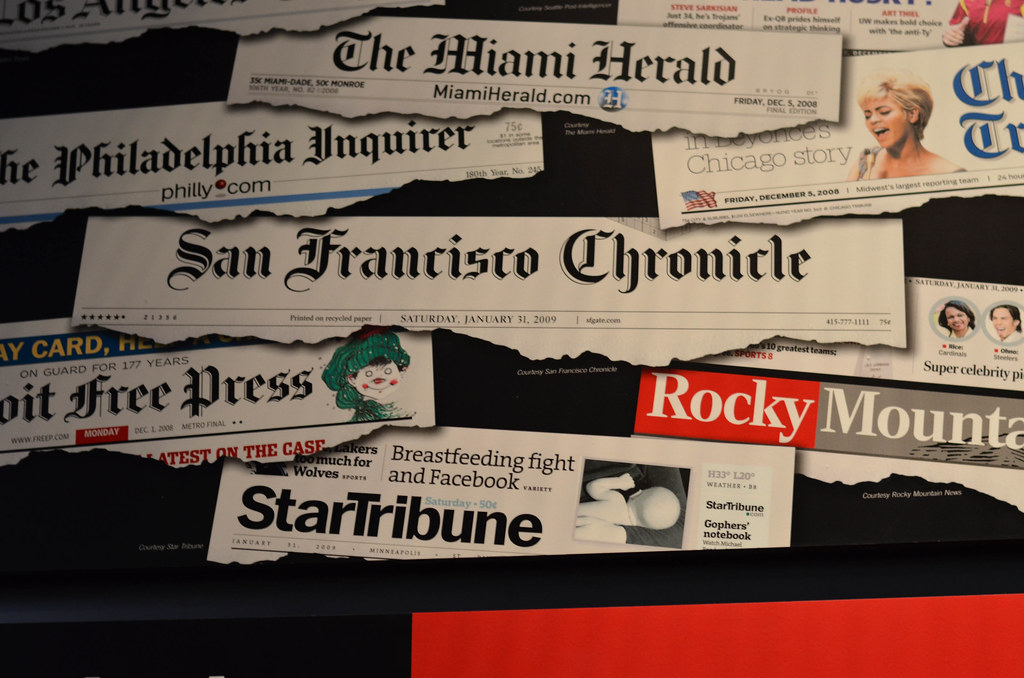
But of course, it is the opposite. Western media resembles much more the consumer landscape of the Soviet bloc. We find the same product on offer everywhere in all leading publications. As in the communist East, variety is confined to a kind of black market – that is to say an array of blogs, social media accounts and alternative (mostly online) publications that you’re not supposed to read and that the official discourse wholly ignores. This anomaly is easy enough to see if you spend multiple hours every day reading news stories. The average consumer of political reporting, however, has a much more casual and sporadic relationship to press discourse, and he’s apt to think that the convergence is entirely natural. The New York Times, the Süddeutsche Zeitung, and Le Monde report the very same things in the very same way at the very same time, often under extremely similar headlines, because they’re just reporting on the way the world is.
In hard authoritarian regimes, like National Socialist Germany, regime propaganda was an open, blunt instrument. Everybody who read the Völkischer Beobachter knew very well that the paper propagated the official Nazi Party line. The soft authoritarianism of the liberal West, in contrast, manages the information and opinions available to the public in a much more effective manner, namely by pretending not to. Millions of people open their newspapers every day in the belief that they contain accurate accounts of the goings-on in the world, and they form their beliefs and political preferences within this highly convincing illusion.
The distributed propaganda network maintained by our establishment press is very expensive. Especially the opportunity costs are very high. In a healthy, uncoordinated media environment, it would be impossible for somebody like me to make a living blogging about the insanity of German politics. I’d have very stiff competition from a multitude of professional, well-funded journalists who would be fighting at every moment to take my readers away from me by writing the kinds of things I do, only more effectively, more frequently and with fewer typographical errors. Of course I am a very small player in the broader ecosystem of alternative media; the audience for this content is hundreds of millions strong. It consists of all those people who have been written off by the establishment press, as the necessary price of exercising narrative control.
Among the forces that conspire to keep legacy media on-message is their aforementioned collaboration with the political establishment. This collaboration includes a tacit understanding that leading politicians and bureaucrats will only provide interviews and information to regime-adjacent journalists, granting them an effective monopoly on political news.
Comments Off on “Western media resembles … the consumer landscape of the Soviet bloc. We find the same product on offer everywhere in all leading publications”
July 4, 2024
“Over twenty years ago now, we declared war on terror; a generation later, we are ruled by terror”
At Postcards From Barsoom, John Carter discusses the prevalence of fear in modern western culture:
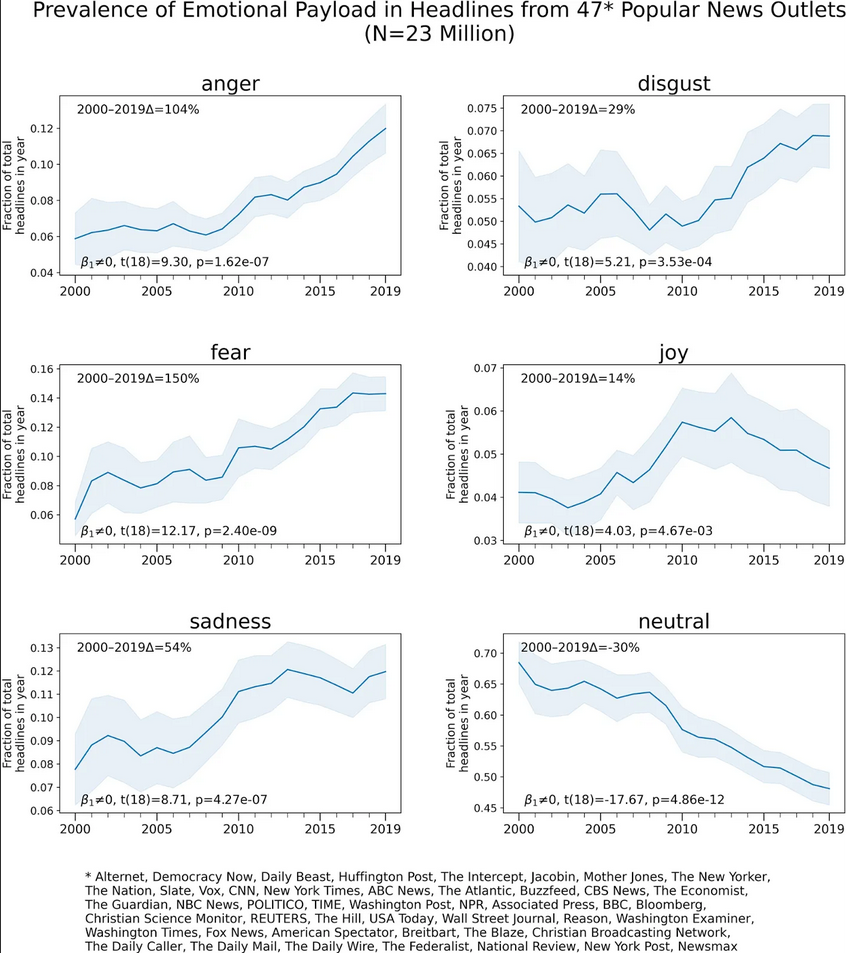
Over twenty years ago now, we declared war on terror; a generation later, we are ruled by terror. The public discourse revolves around peoples’ fears, most of them imagined. Many spend their lives petrified at the prospect of normal social interaction. Women are scared that men will rape them, and men are scared that women will rape them in the courts. Both leftists and rightists are terrified that the other, if given free rein, will drag the world into a dark age, though only one of them is right. All of our great public efforts are either to mitigate this future catastrophe or that dire present threat, or they are about furiously not acknowledging some insoluble and therefore inevitable future disaster, while studiously ignoring some entirely soluble ongoing emergency which those who could solve delude themselves they can profit from.
It shouldn’t be surprising that the war on terror ended up making us chronically terrified. That’s the track record for these things. Even back in the 1990s we knew that. The war on poverty generated an obscenely inflated welfare underclass while systematically slowing economic growth, thereby generating poverty twice over. The war on drugs led to a society of drug addicts, in which every fifth person is on at least one kind of pill, and most of the rest are self-medicating in other ways. Instead of weed (legal now, in any case), we have fentanyl and meth. Victory!
When Washington declares war on something, it invariably produces more of it. This seems perverse until you realize that wars on abstractions are simply how managerial bureaucracies extend their bases of power. A war that can never be won is a war with job security. A war that gets worse the longer and harder you fight it is even better, because this generates growth.
Washington’s current wars seem to be on racism, baseline human sexual normalcy, men, and multipolarity; the latter is really just a fancy word for the growing tendency for other countries to not do what Washington tells them to because, in general, they prefer being racist to being erased, they think the butt stuff is weird, they don’t want to be castrated, and since they are not castrated, they are still capable of not liking to be told what to do. Sure enough, all of these wars, whether cultural or geopolitical, are steadily generating the very things that they’re trying to stamp out. Racism stocks have reached prices they haven’t seen in generations, thanks to sustained decade of all-out full sector push by the media, corporate, educational, and public sectors, all doing their part to push that line up, up, up. Meanwhile, the war on multipolarity seems in general to be doing a fantastic job of generating more multipolarity.
The longer Washington wages its cowardly war against Russia, China, Iran, and I guess now North Korea, the more Washington’s standing in the world is reduced. I say “cowardly” of course because the war is not waged openly: formally, no war has been declared by Washington or any of its core NATO allies against any of the obvious belligerents. It’s all done through proxies which Washington pays to train and arm and die on its behalf, funding it all with a money printer whose brrrring has gotten defeaning. Or it’s done through sabotage; let’s not forget Nordstream, which kicked the legs out from under Germany’s, and therefore Europe’s economy, in perhaps the most breathtakingly cynical act of strategic sabotage against a supposed ally that one might imagine. Washington doomed Europe in order to ensure that Europe would stay attached to Washington. The whole world sees what Washington is doing of course, and is frightened lest it happen to them, but also disgusted that it happens at all; the latter emotion is becoming increasingly dominant, however, because Washington is becoming less frightening every day.
Washington could not even coordinate an orderly retreat from Afghanistan; its wunderwaffen have made little impact on the Ukrainian battlefront; even combined with its vassals, it cannot match levels of armament production that come effortlessly to its adversaries; its pier in Gaza fell apart uselessly; its mighty navy has so far been utterly powerless to stop a blockade imposed by some obscure tribe of desert Arabs. Then there’s the big fail, Washington’s attempt to nuke the Russian economy by locking it out of the SWIFT system. The Russian economy is doing fine, in fact better than fine, but SWIFT on the other hand is swiftly becoming irrelevant. The dollar’s global reserve status is on borrowed time, and everyone knows it.
I don’t think anyone’s more terrified right now than Western elites. They know they’ve fumbled the ball, that they’ve lost their footing, and they’re flailing around weightlessly as they try to catch it without faceplanting. None of their plans are really working. None of their usual levers of control are as effective as they used to be; some, such as the media, have almost stopped responding altogether. Their people are turning against them for a dozen different reasons, all of them excellent. Their great economic machine is sluggish, its components grinding together and seizing up. Their enemies abroad are on the march, or mobilizing. It’s all coming for them at once, and they don’t appear to have any idea what to do. You’re seeing that deer in the headlights look a lot now from prime ministers and presidents, and it isn’t always because of dementia. They’re in over their heads. Children, playing a game that became all too real when they weren’t paying attention.
Comments Off on “Over twenty years ago now, we declared war on terror; a generation later, we are ruled by terror”
July 3, 2024
The profound, utter, inescapable uselessness of the legacy media
As an early and enthusiastic blog reader and eventually a blog creator, I’ve always sought interesting aspects of stories in the news — even when I disagreed with the source or the presentation, it’s always a good thing to approach any topic “in the round” whenever possible. Getting all your information from one viewpoint or even one source is a good way to gaslight yourself. Once upon a time, while the TV networks tended to be as bland as they could (because going too far toward sensationalism would be a good way to get in bad with the regulators who control your broadcasting privileges), newspapers were not under such strong moderation. You could find very progressive, mildly progressive, centrist, and even mildly conservative voices with relative ease. At least, that’s what a rosy view of media history suggests — I think you have to go back before World War II to find really vigorous debates among the major newspapers.
Here in Canada, the mass media were already overly deferential to the government of the day — unless it was a Conservative government, of course — and after the internet and social media ate all the profit out of their business, they turned as one to the government to bail them out. In return, they became even more deferential to official story lines unless the foreign press forced their collective hand to present a more complete story. Over the last few years, as the surviving mainstream media shed jobs, many journalists have “crossed the lines” and become much more like their distant predecessors in the media: diggers of dirt, tellers of uncomfortable truths, and impartial mockers of government incompetence (Canada’s The Line is an excellent example of this … even when I don’t link to them, I almost always find their articles interesting and informative.)
All that throat-clearing out of the way, here’s Chris Bray asking what you have learned from the mainstream media lately:
When was the last time you read something in the mainstream news media — an op-ed piece, a major revelation that some clever and persistent investigative reporter dug up, a sharp bit of news analysis — that surprised you? When was the last time you read something in the news that changed your understanding of a major issue? When was the last time something in the “news” reframed an issue in your head with an argument you hadn’t anticipated, or with new evidence that you hadn’t heard before? “Man, I’d never thought of it that way,” you say, tossing the New York Times down on the coffee table.
Related, when was the last time a report or a panel discussion on television news surprised you and made you see something differently?
My impression is that the public sphere is now made up almost entirely of people saying things that we already know they’re going to say. “Jennifer Rubin will now analyze the presidential debate.” You don’t need to hear that. There’s no need to listen to any of it, ever. Andrea Mitchell is for [current thing]. Of course she is. If you know what [current thing] is, what’s the point of an Andrea Mitchell?
It’s all so dull.
There are at least a couple hundred prominent media and academic figures in the United States who could die tonight without anyone noticing, as long as there was a tape or a computer program of some kind to go on posting the received wisdom of the day under their names.
Comments Off on The profound, utter, inescapable uselessness of the legacy media
June 29, 2024
“So, as the pundits say, everywhere is warming faster than everywhere else”
Terry Etam on the totalitarian controls being imposed on citizens in Canada where under yet another censorship bill being pushed out to ensure that nobody says anything that contravenes some yet-to-be-determined “internationally recognized methodology”:

And then, as a final but impressive gasp of inept state control, witness Canada’s frantic flailing to control the situation by …
Send in the goons: Canada cracks down on any speech it doesn’t like, with sweeping rules measured against undefined regulations, and enters the historical pantheon of legendarily badly run states
We’ve all heard about bill C-59 by now, the government of Canada’s crackdown on any comments related to emissions reduction mitigation efforts that do not adhere to “internationally recognized methodology”. It’s a Soviet-style attempt to crack down on any talk about what companies are doing to reduce emissions, or anything they do that is an attempt to reduce “the environmental, social and ecological causes or effects of climate change”.
The apes in charge, and their sycophants, say hey, it’s not censorship at all, you can talk about emissions reduction all day long, so long as it meets some undefined international standard, and the onus of proof is on anyone making the statement to show that they are not violating some “internationally recognized methodology” that does not exist.
This whole fiasco is of course a one way street; the freedom to say anything that cements the climate emergency narrative remains gloriously unchecked. For example, energy commentator David Blackmon recently catalogued on LinkedIn the number of countries/regions that claim to be warming faster than the global average: Canada, Mexico, Latin America and Caribbean, Arctic, Asia, Africa, the US, Europe, Russia, Australia, China, and Finland all claim to be warming faster than the global average. The high priest of modern politicized science, Scientific American, says that oceans are also warming 40 percent faster than expected, and that oceans absorb up to 90 percent of the warming caused by human carbon emissions, and SA also notes that the South Pole is warming “three times faster than the global average”. So, as the pundits say, everywhere is warming faster than everywhere else.
Extrapolating from this, in keeping with necessary mathematical precedents such as how averages work, then the few remaining regions not mentioned must be plummeting in temperature, because that’s how averages work. And I mean plummeting, if it alone is offsetting the above-average gains in the rest of the world. Strange indeed how not a single headline can be found to that effect.
The speech police have no problem with such math crimes, because the asinine claims are put forth under the banner of “science”. It must be concluded then that math is not one of the “internationally recognized methodologies”.
No matter. The point is, as always, to silence discussions and ram through whatever ideological junk they can while still clinging to power like a bee holding onto an accelerating windshield.
Welcome to Canada, where if global embarrassment were an Olympic sport we’d be wearing perma-gold. Joke’s on us though; we elected these people. We should now clearly understand why Canada’s status as an investment haven is plummeting like a shot duck. (Do not point me towards legendary genius Warren Buffett who says he is comfortable investing in Canada; Buffett buys existing businesses, with moats, and the government of Canada is working to build those moats as fast as it can. Remember this investing rule for the foreseeable future: existing infrastructure is getting more valuable, because building anything gets harder by the day.)
It is probably unfair to single out Canada for such withering criticism when other western countries are on similar energy suicide missions. Australia, England, Germany … all under the spell of radicals that will accept nothing other than total nihilistic energy “victory”, a crown that seems to mean de-industrialization and subjugation of citizens in autos they don’t want, doing things they don’t want to, and not being permitted to say what they want to. (New Zealand was in that club as well, but has recently repealed a ban on oil & gas exploration when it dawned on them that fields decline, and do not produce at flat levels in perpetuity without investment. Yes, western governments really have enacted such legislation while simultaneously holding an astonishing ignorance about how energy really works.)
As far as Canada’s hydrocarbon sector goes, the most important thing to do at this stage is to keep our heads [down] and carry on providing the energy the world desperately needs. And that means every single person, right down to Guilbeault’s Greenpeace and the soup throwing fools of Just Stop Oil. If the feds are going to outlaw emissions talk, let them … the rotten foundations of their world can’t stand for much longer.
No one should stand taller than one that provides reliable and affordable energy for the globe’s citizens. Go back to work, and patiently wait until the inevitable happens, the day when governments are no longer able to pretend they can’t see reality. It’s going to be epic.
Comments Off on “So, as the pundits say, everywhere is warming faster than everywhere else”
June 27, 2024
The Toronto Star wants Ontario to adopt Scottish booze regulation (but ignore the failure)
The Toronto Star always loves a good moral crusade, and if it also happens to fly in the face of whatever Premier Ford wants to do, then so much the better:
The Toronto Star is looking to Scotland to teach it how to reduce alcohol-related deaths. In an article titled “How Scotland started to kick its alcohol problem — and what Ontario could learn from it“, it pushes back on plans to liberalise Ontario’s state monopoly on alcohol retail, saying:
Ontario officials say they are fulfilling a 2018 election promise to increase “choice and convenience for shoppers and support Ontario retailers, domestic producers and workers in the alcohol industry”.
But Scotland has cut alcohol-related hospital admissions by 40 per cent and deaths by almost half. While in Ontario, alcohol-related admissions have risen by a third and deaths by almost half, according to the Canadian Centre on Substance Use and Addiction.
How did Scotland supposedly achieve this public health miracle?
The key part of Scotland’s landmark policy was aimed at reducing drinking by introducing minimum unit prices to make drinking more expensive.,/p>
Ontario already has minimum pricing and Scotland doesn’t have a state alcohol monopoly, so it is not obvious what lessons Ontarians are supposed to be learning, but put that to one side for a moment and consider the main claim.
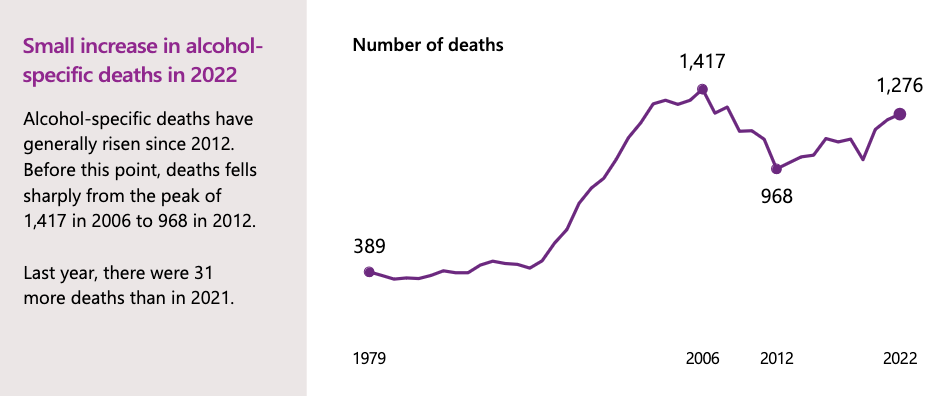
Anyone who has been following events in Scotland knows that alcohol-specific deaths have risen since minimum pricing was introduced in 2018 and have generally risen since 2012 following a significant downturn in the years prior.
It is that drop between 2006 and 2012 that the Toronto Star must be referring to when it claims that deaths fell by “almost half” (actually a third). But the Scottish government didn’t pass any anti-alcohol legislation in those six years and it certainly didn’t have minimum pricing. The newspaper mentions that the drink-drive limit was cut, but that didn’t happen until 2014 and the evidence is clear that it had no effect on road accidents.
Since the Toronto Star doesn’t mention when the decline in alcohol-specific deaths took place, it is leading its readers to believe that it coincided with the introduction of minimum pricing and the lowering of the drink-drive limit. I call that lying.
It is strangely fitting that Canadians are being lied to about the “success” of Scotland’s alcohol strategy since the Scottish public were conned into accepting minimum pricing, in part, on the basis of lies told about the “success” of minimum pricing in Canada. The neo-temperance academic Tim Stockwell, who is quoted in the Star article, published a series of studies in the 2010s making some absurd claims about minimum pricing that were parroted by campaigners in the UK.
Comments Off on The Toronto Star wants Ontario to adopt Scottish booze regulation (but ignore the failure)


