Quotulatiousness

February 13, 2023

Reising M55 Submachine Gun

Filed under: History, Military, USA, Weapons, WW2 — Tags: , , , , , — Nicholas @ 02:00

Forgotten Weapons
Published 28 Sept 2015

When the US entered WWII, submachine guns were in short supply and high demand. Much of the production of Thompson guns was being purchased by the UK, and what guns were available to the US military went first to the Army. In accordance with long tradition, the Marine Corps were secondary to the Army in receiving new weapons. However, the formation of a Marine paratroop unit in particular necessitated the Corps finding some sort of suitable submachine gun.

What was available at the time were Eugene Reising’s M50 and M55 guns, being manufactured by Harrington & Richardson. The guns were chambered for the standard .45ACP cartridge and used a delayed blowback action which allowed them to be significantly lighter than the Thompson. The M50 had a full-length traditional stock, while the M55 used a pistol grip and wire folding stock. Mechanically, the two variants were identical. The M55, which is what we have today, wound up being specifically issued to tank crews and paratroops, where its compactness was a significant advantage.

The Reising developed a quite bad reputation in the Pacific for a couple of reasons. Its parts were not always interchangeable between guns (a deliberate choice to speed up manufacture, which troops were not necessarily aware of), its mechanism was more susceptible to fouling than other military small arms, and its disassembly procedure was far too complex for military service. However, these issues did not prevent it from being quite successful and well-liked as a law enforcement weapon in civilian police use after the war. Thanks to that negative wartime reputation, Reisings are some of the least expensive military machine guns available on the market today in the US.
(more…)

February 5, 2023

“[E]very story now assumes ‘white supremacy’ as the core truth of the world”

Filed under: Media, Politics, USA — Tags: , , , , , , — Nicholas @ 05:00

Andrew Sullivan on the state of the American legacy media in an age of young, woke reporters driving the narrative forward at the expense of any hint of objectivity:

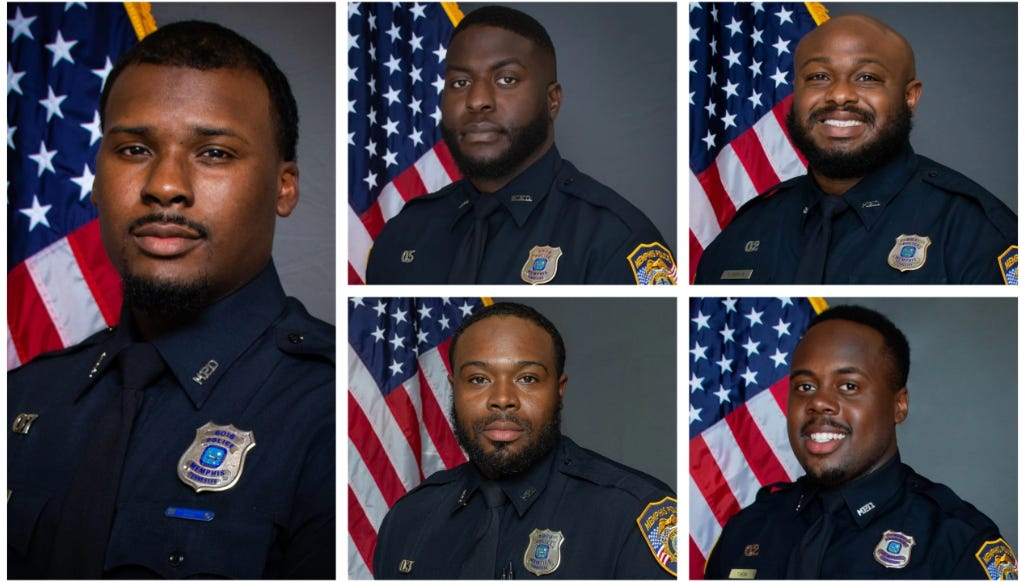
Memphis police officers charged in the beating death of Tyre Nichols.

There are times when I actually feel some pity for the editors in mainstream media. In the last few years, pressured relentlessly by young, super-leftist staffers, they have slowly and then precipitously dropped the goal of objectivity and news in favor of subjectivity and narratives. The struggle against white supremacy has become too urgent for news that may not advance “social justice”. Here’s a glimpse of what the old guard is dealing with, in a leaked transcript of a NYT staff meeting in 2019. An early question from a NYT reporter was:

    I’m wondering to what extent you think that the fact of racism and white supremacy being sort of the foundation of this country should play into our reporting. Just because it feels to me like it should be a starting point, you know? … I just feel like racism is in everything. It should be considered in our science reporting, in our culture reporting, in our national reporting. And so, to me, it’s less about the individual instances of racism, and sort of how we’re thinking about racism and white supremacy as the foundation of all of the systems in the country.

And, as you can see every day, this is what the NYT subsequently did. Distilled that year with The 1619 Project (now airing on Hulu!), everything was and is parsed through the lens of critical race/gender/queer theory — from birdwatching to knitting to “literally abolishing the police”. It’s their foundation.

The same ideological fervor swept over the WaPo, of course — right down to the racist birds! And this week, the former executive editor, Len Downie, a near-icon of the old school, published a report on journalism and found a broad consensus among his colleagues that, in the words of one editor-in-chief, “Objectivity has got to go!” So every story now assumes “white supremacy” as the core truth of the world.

So what happens when stories arrive which, on the face of it, seem to refute that entirely? Take three recent events: two mass killings of Asian-Americans within two days in California by an Asian-American (in Monterey Park) and a Chinese national (in Half Moon Bay); five black police officers in a majority-black police force with a black police chief all but lynched and murdered an innocent black man; and a trans woman was convicted of the rape of two other women with the use of her penis.

How on earth do these fit into the pre-arranged “white supremacy” template?

They can’t of course. They reflect a reality far more complex than the crude racial hierarchies beloved of actual white supremacists and woke activists alike. They show individual actors, with a range of possible motives, in unique moments that will always escape predictable narratives. Maybe racial prejudice is present; maybe not; or maybe mixed into a range of other possible factors. You work empirically from the ground up.

But if the facts don’t fit the narrative, you move on quickly to a story that will. So with the Asian-American massacres, after some initial excitement, the MSM lost interest as soon as a white man could not be blamed. (Contrast that with the days-long feeding frenzy over the Atlanta spa massacre, despite zero evidence of any anti-Asian motive from the white killer.) Or they try to force it into their narrative anyway.

January 22, 2023

One year later

Last year, the Freedom Convoy 2022 from all parts of Canada began to assemble and move toward Mordor, er, I mean Ottawa. Patrick Carroll remembers:

It’s hard to believe, but the one-year anniversary of the Canadian Freedom Convoy is upon us. It was January 22, 2022 when the convoy began to form across the country. Over the following week, thousands of trucks made their way to Ottawa, and on January 29 they arrived in the nation’s capital, loud and determined as ever.

The following month was one of the most tumultuous times in modern Canadian history. Downtown Ottawa was completely gridlocked, bridges were blocked, and politicians along with the media took every opportunity to smear the protesters.

Four weeks later, it ended quite a bit faster than most people expected. Armed with special powers from the never-before-invoked Emergencies Act, the government successfully dismantled the protest in a matter of days.

In hindsight, the practical effect of the protest on legislation is difficult to detect. Some Covid policies were probably relaxed a few months earlier than they otherwise would have been, but for the Convoy organizers, this was far from a decisive victory.

A debate has been raging in Canada ever since: were the protestors within their rights to do what they did? Those who support the convoy argue that they were, since the Canadian Charter of Rights and Freedoms guarantees the right to freedom of expression and freedom of peaceful assembly. Those who oppose the convoy largely agree with these freedoms, but argue that such freedoms should be subject to certain reasonable restrictions. Major obstructions to traffic, and especially obstructions to critical infrastructure such as bridges, are simply going too far in their view. Is the government supposed to stand by and let a group of hooligans bring the country to its knees?

That’s certainly the line the governments (city, provincial, and federal) generally chose to take and the media were almost chanting the governments’ line in unison. Of course, the governments were not all that well synchronized, which led to some blatant examples of deliberate misinformation/disinformation/gaslighting from one or another level, as Donna Laframboise points out:

During the inquiry into the use of the Emergencies Act, witnesses talked about misinformation as if it were a problem confined to contrarians on social media. But the Closing Submission of former Ottawa police chief Peter Sloly shows that government officials are, themselves, a fertile source of misinformation.

If someone in our federal government had demonstrated genuine leadership by going out and talking to the truckers, the protesters would likely have dispersed after the first weekend. Instead, a government that meets with professional lobbyists on 24,000 occasions a year refused to have a single meeting with working people who’d driven thousands of miles to the nation’s capital. Rather than being a grownup, the Prime Minister called them names. Rather than negotiating with the protesters, he told police to get rid of them.

According to Chief Sloly, the Ottawa force was understaffed at the best of times. Even after cancelling vacations and days off, there still weren’t enough personnel to deal with a significant, extended protest on top of normal duties.

From the beginning, the media failed to behave responsibly. It whipped up hysteria. It smeared and sneered. It sowed suspicion and fear of small town Canada, of those who see the world differently, of people who’d reached their breaking point. Big surprise a portion of the public did, in fact, become hysterical. As the protest dragged on, the pressure became intense. In lieu of pursuing a political resolution to what were clearly political grievances, slimy politicians pointed fingers at the Ottawa police. While simultaneously hamstringing them behind the scenes.

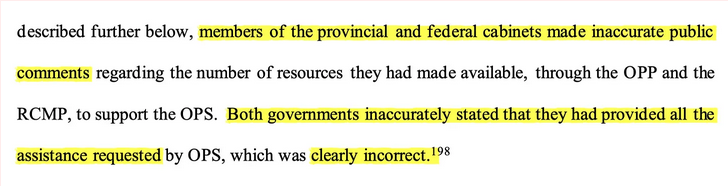
Page 43 of Chief Sloly’s Closing Submission says federal Public Safety Minister Marco Mendicino falsely told the world — on February 3rd — that the Royal Canadian Mounted Police (RCMP) had provided all the resources the Ottawa police had asked for. Four days later — on February 7th — he insisted 250 RCMP officers had been dispatched to Ottawa.

But the reality was quite different. Until mid-February, say his lawyers, the maximum number of RCMP officers available to the Ottawa force on any given day was 60 — far less than the number required.

It was the same story with the Ontario Provincial Police (OPP). On February 6th, Ontario’s Solicitor General Sylvia Jones falsely stated in an official document that “more than 1,500” OPP personnel had already been sent to Ottawa. In the words of Chief Sloly’s lawyers, this was “grossly inaccurate” (pages 80, 107).

Government ministers at both the provincial and federal level, they insist, made misleading statements about the degree of assistance Ottawa police had received. Statements that were “clearly incorrect” (page 53).

Which means Cabinet ministers were spreading misinformation. Misinformation that just happened to deflect blame away from themselves. That just happened to make the Ottawa Police Service look incompetent while turning the chief into a scapegoat. Ottawa’s first black police chief, a Jamaican immigrant, got thrown under the bus.

January 9, 2023

QotD: Property is theft

Filed under: Law, Liberty, Quotations, USA — Tags: , , , — Nicholas @ 01:00

The French socialist philosopher who was much ridiculed by Marx as a sentimental petit-bourgeois moralist, Pierre-Joseph Proudhon, is now remembered mainly for his aphorism, so good that he repeated it many times, “Property is theft”. But in the wake of Hurricane Katrina, the reverse of this celebrated but preposterous dictum has actually become true: Theft is property.

Pictures of the looting that followed the devastation in New Orleans have been flashed around the world. Everyone is, or at least pretends to be, shocked and horrified, as if the breakdown of law and order couldn’t happen here, wherever here happens to be. Smugness is, after all, one of the most pleasant of feelings; but for myself, I have very little doubt that it could, and would, happen where I live, in Britain, under the same or similar conditions. New Orleans shows us in the starkest possible way the reality of the thin blue line that protects us from barbarism and mob rule.

Of course, an unknown proportion of the looting must have arisen from genuine need and desperation. Who among us would not help himself to food and water if he and his family were hungry and thirsty, and there were no other source of such essentials to hand?

But the pictures that have been printed in the world’s newspapers are not those of people maddened by hunger and thirst, but those of people wading through water clutching boxes of goods that are clearly not for immediate consumption. There are pictures of people standing outside stores, apparently discussing what to take and how to transport it, and of men loading the trunks of cars with a dozen cartons of nonessentials. They are thinking ahead, to when the normal economy reestablishes itself, and the goods that they have stolen will have a monetary value once more.

Theodore Dalrymple, “The Veneer of Civilization”, Manhattan Institute, 2005-09-26.

December 28, 2022

The Myth of the Nazi Police State – WW2 Documentary Special

World War Two
Published 27 Dec 2022

The popular image of the Gestapo is as black leather-jacketed fiends whose spies keep the nation under constant surveillance. They are so powerful that the terrified population has no choice but to sell out its family and friends. But how true is this? Are all Germans living in fear of the Gestapo all the time?
(more…)

December 15, 2022

The hot new thing for municipal politicians is the “15-minute city”

Filed under: Bureaucracy, Government, Liberty — Tags: , , , , , — Nicholas @ 05:00

Elizabeth Nickson on how some of the building blocks of a global police state are being laid at the local level in pretty much every municipality in the western world:

Every single ministry or government department has been writing police-power regulation into their revised policy statements for the last 20 years. It is incremental and surreptitious. I mean come on, if you were going to abrogate democracy, cheat in every election, remove property rights from every citizen, bank that property in multinational/UN hands, you would need a police state, amIright?

That said, the province where I live, which is so crazy, it’s where California gets most of its bonkers ideas, has turned, locally-speaking. The socialists and greens were so confident of sweeping their elections that they didn’t bother to cheat, and as a result most every town and city was taken back by people saying, nope, you’re done. We are going back to basics. Like no more outdoor drug bazaars, silly wasteful green projects, and here’s an idea: let’s respond to our voters and not try to steal everything they have.

This would happen in every single state and county if we managed to stop them cheating. Because trust me, in every election in every jurisdiction, they are cheating.

The catastrophe even reached Davos. When one of their extra-special places is under threat time to roll out the big guns.

Hence 15-minute cities. Get this damn thing done before the slow learners, i.e. city people, wake up.

Therefore Oxford City Council this past week instituted their trial of 15 Minute Cities. This is a UN/WEF project meant to continue the lockdowns by scaring us to death using the nonexistent climate crisis. And if you think this is local to the UK, it’s not. This is being trialed in Brisbane, Portland, Barcelona, Paris and Buenos Aires.

Here are the basic rules. You are allowed out of your neighborhood for fifteen minutes a day and out of your region, 100 days a year. Fifteen minutes is enough to shop, take your kids to school and pick them up. Trespass that and you’re fined. Oxford has approved the installation of electronic traffic filters, placed strategically, which will be able to track your car, wherever it goes. That will cost citizens around $15,000,000. We get to build our own prisons!

The trial lockdown goes into effect January 1, 2024

People voted for this. Or rather they didn’t, but did.

Seems preposterous doesn’t it? Yet those who still read and watch legacy media know about it. They have been selling it hard. When I mean “they”, I mean the massive PR firms paid by WEF and the UN, strategized no doubt by McKinsey.

To refresh, this is what they want: drive people out of rural areas, and place them in 15 minute cities. Take all the resources, and divide them up among multi-nationals who will then tax our use of water, air, minerals, etc. Creating a world of renters, of serfs. You will have a lovely category: Amazon serf, Tesla serf. Bill Gates’ serf.

Pretty much every city council in every city in the world has had 15 Minute Cities pitched to them. Without doubt, every single city council in the world, has some committee and elected officer assigned to the 15 Minute city project. They are “researching” it with your money, which means they are trying to find a way to convince people to sign onto it.

They only got here because we stopped paying attention. No one went to meetings, no one followed what they were doing in committee. We trusted them. As someone pointed out, WEF and the UN during COP26 hold meetings and lectures that show precisely what they are planning to do, that are videotaped and available to anyone who wants to know what they are planning. Views of each? 26 people. 50 tops.

I’d like to advise you to get involved with your local government, because they have undoubtedly gone rogue and are amassing power and attaching funding requirements to each project. Many of them, if green-based, and locally everything is green-based, will be ill-founded, the science can be exploded. At our last virtual meeting here, a man from the real world, with real skills made a presentation showing that our local government was selling a fraudulent idea, and had put itself at risk legally. They had used a flawed study checked by no adult, sloppily researched and written by a university student to create the climate policy. Instead of being an ideal carbon sink, as was claimed, it turned out the islands were much less effective in that regard than other parts of the province.

Our local government had used this study for the past year, to harangue citizens and senior governments to push for more restrictive regulation on islanders.

The New World Order is built on sand, it is feather-weight, it can be blown over by a single honest consultant who can read legislation and do math. Become one. It is super satisfying. And the friends you will make will last beyond the grave.

December 13, 2022

Well, the modern Weimarites were getting overdue for another putsch

Filed under: Germany, Government, Politics, Weapons — Tags: , , , — Nicholas @ 05:00

Apparently, we just missed having a new German Reich last week, due to the lack of a few key ingredients, including mass support, weapons, good planning, and competent coup leaders … or maybe the German government just over-reacted to a non-existential threat:

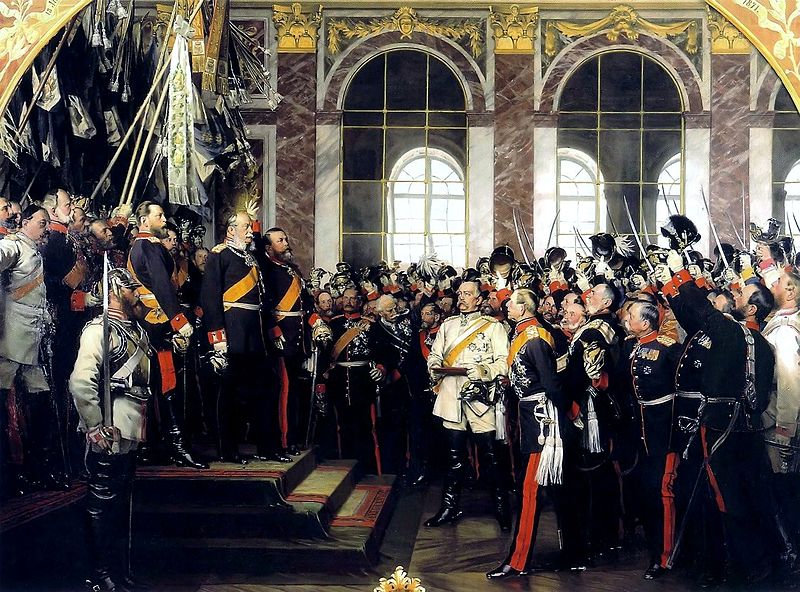
The proclamation of Prussian king Wilhelm I as German Emperor at Versailles, by Anton von Werner. The first two versions were destroyed in the Second World War. This version was commissioned by the Prussian royal family for chancellor Bismarck’s 70th birthday.

The German state oversaw one of its largest anti-terror operations in its modern history last week. Approximately 3,000 police officers arrested 54 suspects in raids carried out on Wednesday morning. Those arrested were members of the Reichsbürger – one of the oddest and most obnoxious movements to have emerged in Germany in recent years. It is alleged that those arrested were conspiring to overthrow the state and install a shadow government headed by an obscure German nobleman.

German chancellor Olaf Scholz was clearly pleased with himself after the raid. He hailed it as an example of Germany’s “defensive democracy” (wehrhafte Demokratie) in action. This refers to the modern German state’s willingness to curtail certain democratic freedoms to protect itself from the far right.

The Reichsbürger are deeply reactionary, anti-democratic and conspiratorial. They claim that the old German Reich, which collapsed at the end of the First World War, was never legally abolished and that modern-day Germany is therefore an illegal construct. They believe Germany’s democracy is a sham, which conceals a secret deep state pulling the strings behind the scenes. In its place, the Reichsbürger want to recreate the Germany of the late 19th century, which includes reinstalling a Kaiser as ruler.

The fact that such a bizarre movement has been growing in size – from around 19,000 supporters in 2019 to an alleged 23,000 in 2022, according to the police – shows us that something is clearly going wrong in Germany. The Reichsbürger have not been growing in a political vacuum. Indeed, they have grown partly as a response to the German government’s authoritarian handling of the Covid pandemic. The Reichsbürger’s black, white and red flags (the colour of the flag of the old pre-1918 German Reich) could often be seen at anti-lockdown demonstrations. This made it all too easy for the pro-lockdown lobby to present any opposition to Covid restrictions as the product of far-right conspiracy theorists.

The Reichsbürger have also been violent at times. During a raid on a Reichsbürger building in 2016, three police officers were injured and one was killed. Earlier this year, one member ran over and seriously injured a policeman with his car. They also have members with military skills. Some of those arrested last week were former German soldiers, including a member of an elite military unit (the KSK).

Yet it is important not to exaggerate the threat the Reichsbürger pose to the German state. Which is what the government deliberately seems to be doing. Interior minister Nancy Faeser spoke of the alleged plotters as a “terrorist threat”, despite the fact those arrested looked more like confused pensioners than hardened insurgents. Indeed, the alleged head of the conspiracy, a 71-year-old member of a largely unknown former noble family, is called “Prince Reuss” (or Prince Henry XIII). A relative of the prince told reporters that, while the “prince” does have nutty ideas and is bitter about his loss of social status, it is hard to imagine him as the ringleader of a conspiracy. At the time of writing, there is also no trace of the huge cache of military hardware that was alleged to be somewhere on the prince’s estate – although some swords, rifles and crossbows have been found.

November 24, 2022

Viewing the Public Order Emergency Commission spectacle from abroad

Filed under: Cancon, Government, Law, Liberty, Media, Politics — Tags: , , , , , — Nicholas @ 03:00

Chris Bray on how the Public Order Emergency Commission inquiry in Ottawa has utterly failed to show up on the radar of the US legacy media:

I conducted a dignified survey of a number of politically savvy people this evening, by which I mean I staggered around a bar and slurred questions at friends, and I was surprised to discover that no one has noticed the POEC. At all. Similarly, the US news media appears to have taken a nearly complete pass on covering the thing. The New York Times offered a single story, more than a month ago, describing the fact that it would be happening, and then lapsed into silence. I left some blank space at the bottom of this image so you can see all the nothing down there:

But the spectacle has been extraordinary, and it opens the curtains on the world of high-status malevolence, elite mediocrity, and news media cravenness. For background, remember that the Canadian government led by Prime Minister Derek Zoolander responded to the peaceful truckers’ “Freedom Convoy” in Ottawa and anti-Covid-measure blockades at several border crossing areas this February — the infamous bouncy castle protests — by invoking Canada’s Emergencies Act, for the first time since that law was created in 1988. That declaration of a national emergency allowed the government to exercise extraordinary power, most infamously in the form of an order to Canadian banks to completely freeze the bank accounts of protest participants. Zoolander lost his state of emergency as the Canadian Senate signaled its growing alarm at the decision, after a shameful vote in the House of Commons to affirm the declaration. The state of emergency was declared on February 14, and revoked on February 23.

Now comes the second act. The invocation of the Emergencies Act triggers a legal duty to review that decision after the fact. Here’s the directive calling the Public Order Emergency Commission into being.

So the commission is meeting, with testimony from government officials, and — this is the important part — with cross-examination from lawyers representing the targets of the declaration of emergency. In effect, the truckers are in the room; their representatives can ask questions of the government officials who did things like ordering banks to take their money because they disagreed with the government.

If you read the mainstream Canadian press, which pisses me off every time I try to do it, this means that the moronic lawyers for a bunch of idiotic terrorists are being pointlessly mean to senior government officials. Conspiracy theories! Debunked claims! I mean, truck drivers versus respectable figures, amirite? All the usual deployment of marking language is in effect, telling readers what to think about what’s happening while carefully limiting their description of what’s actually happening.

[…]

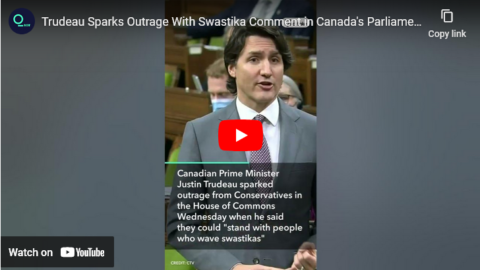
And finally, most remarkably, if you followed the Emergencies Act debate in the House of Commons back in February, you’ll recall that Prime Minister Zoolander and his ministers responded to every criticism and question regarding their handling of the convoy by saying that Canadians won’t stand with people who carry Confederate flags, and with “those who fly swastikas”.

That’s how they framed the entire event, full stop: the truckers, the swastika people. The anti-vaccine-mandate Nazis!

The news media picked up that framing and ran with it, non-stop, pounding the message that the truckers were flying Nazi symbols and Confederate flags:

Now: Miller said, before the commission, that he knows the identity of the people who carried those Nazi and Confederate flags in Ottawa — and that they’re employees of a public relations firm that was working on behalf of officials in the Canadian government.

November 15, 2022

New Zealand’s “splintered reality”

Filed under: Media, Politics — Tags: , , , — Nicholas @ 03:00

Earlier in 2022, when most of us were distracted by the Freedom Convoy in Ottawa, New Zealand was having its own populist protest moment, as Chris Bray recounts:

Back in February, protesters gathered outside New Zealand’s parliament began warning that police were using LRAD sound cannons to disrupt their protest. To the news media, it was evidence of how stupid and crazy the protesters had become, and still more proof of the obvious silliness of the anti-vaccine mandate protests in general.

Here are the first three paragraphs of that news story, laying it on thick with baseless claims and tinfoil hats:

    Wellington anti-mandate protesters have been seen wearing tin foil hats, as some baselessly claim they are being targeted by “tech weapons” directed at them.

    A video posted on Facebook on Thursday under the name Carlene Louise has attracted attention on social media.

    In the video, the protester said people at the occupation site in Wellington are getting ill and claims without any evidence that the cause is “EMF machines”, “radiation machines” and “technological weapons” being directed at the occupation.

Four months later, police confirmed that they had used LRAD cannons against the protesters, though they claimed they didn’t use them until March. See, so it totally was a baseless conspiracy theory. Tinfoil hatted morons! Falsely claiming that the police did … what they … did. Hold on a second.

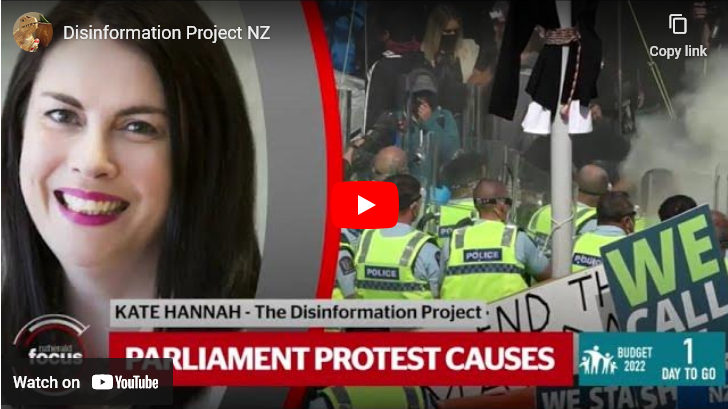
This nice bookending of claims and facts, and many other extraordinarily insightful juxtapositions, comes from a short documentary that, unfortunately, appears to only be available on YouTube:

In just half an hour, this is the whole thing, a perfect depiction of the “disinformation” project as it works everywhere. Note the moment when a news anchor and New Zealand’s bizarre prime minister are having an exchange about the viciousness and terrifying blood thirst of the far-right anti-government protesters, and the camera cuts away to show the protest, undercutting the description in real time. Note the moment when the disinformation expert tells an interviewer that she has determined that the protests are violent and dangerous, and then explains that people inside the protest believe that they’re engaged in a project of peace and love — a frightening example, she explains, of the splintered reality these people occupy inside their echo chamber. Note the moment when a member of parliament warns that anti-mandate protests are “fascist”.

And note, above all, how confused the news media figures are as they discuss the way their accurate and factual reporting from the perimeter of the protest, responsibly informed by experts and authorities, is being irresponsibly contradicted by livestreaming from inside the protest.

October 23, 2022

“It’s starting to be noteworthy how often people in government record their important conversations”

Filed under: Cancon, Government, Liberty, Media, Politics — Tags: , , , , , — Nicholas @ 03:00

From the kindness of his heart, Paul Wells decided to make this column available to cheapskate non-paying subscribers like me because he feels it needs to be seen by a wider audience. The topic is the ongoing inquiry into the Trudeau government’s invocation of the Emergencies Act and it’s certainly promising to stay entertaining for a while (unlike the vast majority of such inquiries):

A screenshot from a YouTube video showing the protest in front of Parliament in Ottawa on 30 January, 2022.
Photo via Wikimedia Commons.

The goal of it all is to permit Rouleau to decide whether the Emergencies Act was used properly when it was invoked, for the first time in its 34-year existence, by the Trudeau government to end the mess in Ottawa’s Centretown. But it’s also a deep dive into conflicting ideas of police doctrine, the best look we’ve had at the stressed and dysfunctional city administration in Ottawa. And while we haven’t yet heard much about the Trudeau government’s processes, that’s coming. The prime minister and seven of his senior cabinet ministers, with their deputies, will testify soon.

Nobody can keep up with it. For Ottawa reporters it’s as though we’ve dragged ourselves for a decade through a desert of talking points and euphemisms into an oasis of unbelievable information bounty. The temptation is to gorge. I took Wednesday off, only to learn that Diane Deans, the city councillor who was heading the Ottawa Police Service Board when the mess began, secretly recorded the call in which she informed Mayor Jim Watson that she’d gone ahead and negotiated the hiring of an interim police chief Watson had never heard of. […]

Aaron Sorkin couldn’t have written it better. Deans tells Watson she’s found a new police chief for him in the middle of the worst public-security crises of their lives. He tells her it’s a terrible plan. She asks whether he’ll vote to remove her from her post and he won’t say, which of course is the same as saying. They talk about what to do next, in a way that leaves room for each to have an understanding of what they agreed that’s incompatible with the other’s. It’s gold. The consensus on Thursday among Parliament Hill people I talked to who’d heard the tape was that conversations like this happen all the time in workplaces across the capital, as of course they happen around the world. It’s just that usually in governments, as in most large organizations, any sign of their existence is buried under lakes of Novocaine.

It’s starting to be noteworthy how often people in government record their important conversations. Almost as though people were increasingly worried they might be lied about. When Jody Wilson-Raybould did such a thing three years ago, it was possible for her ex-colleagues to clutch their pearls and protest that such a thing just isn’t done. But after months of claims and assertions about what RCMP commissioner Brenda Lucki told the RCMP detachment in Nova Scotia, nine days after the worst mass murder in Canadian history, it’s handy to have a recording, isn’t it.

By this emerging standard, Patricia Ferguson is old-fashioned. As far as we know she didn’t record her meetings. But she did break open a notebook methodically, like clockwork, to write detailed longhand notes after her conversations. Those notes are hard to reconcile with the portrait Deans painted in her testimony a day earlier, of Peter Sloly as a lone good man, standing up for proper policing in the face of heckling and even racism from the city’s old guard.

In Ferguson’s version, it sounds like Ottawa’s cops were all reasonably good but they were cracking and colliding under immense pressure.

Ferguson described an Ottawa Police Service already worn down by the beginning of this year. There had been retirements, resignations, a high-level suspension and a suicide before and during the COVID lockdowns, followed by Black Lives Matter protests with the attendant internal soul-searching and external scrutiny every North American police corps faced.

And then the convoy hit. And then it stayed. This last was more of a surprise than it should have been.

The late stories out of Wednesday’s testimony were from Pat Morris, an Ontario Provincial Police superintendent in charge of intelligence-gathering. He dumped a bunch of old OPP “Project Hendon” reports, a term of art for the force’s intelligence-gathering operations, onto the commission server. Those reports were sent regularly to the Ottawa police as the various truck convoys approached the capital. Ferguson testified that she didn’t become aware of them until just before the trucks arrived. Which is too bad. What the OPP had found was a very large group of protesters from all over. They did not pose an organized threat of violence, though the Hendon reports acknowledged that confrontation can always escalate and that “lone wolf” extremists could well be tempted to join the crowd. But all the trucks represented a huge problem anyway, because they had rapidly growing funding — and no plans to go home at any point.

October 5, 2022

Are the protests in Iran about to tip over into actual revolution?

Filed under: Middle East, Politics, Religion — Tags: , , , , , — Nicholas @ 05:00

In The Line, Kaveh Shahrooz reports on the still-ongoing public protests after the death of a young woman at the hands of the morality police:

Aftermath of anti-government protests in Bojnord, North Khorasan Province, Iran, 22 September, 2022.
Photo from Tasnim News Agency Bojnord Desk via Wikimedia Commons.

Revolutions are funny things. They sometimes appear impossible until, in one single moment, they become inevitable. In Iran, that moment came on September 13th with the murder of a young woman.

Mahsa Amini, a 22-year-old who was also known by her Kurdish name “Gina”, had come from Iran’s Kurdistan region to visit her brother in Tehran. It was during that trip that she faced a particular humiliation that has become a fact of life for tens of millions of women in that country: a run-in with the country’s gasht-e ershad (“Guidance Patrol”). The role of this roving gang, seemingly imported from Atwood’s Gilead and called Iran’s “morality police”, is to monitor the streets to find and punish violations of the regime’s seventh-century moral and dress codes.

Having determined that Mahsa’s hijab exposed a little too much hair — a few strands of a woman’s hair and men will simply be incapable of controlling their sexual urges, the logic goes — they detained and beat her severely. The story for most women who deal with the morality police typically ends there, after which they are released to seethe at having endured another round of state-imposed gender apartheid. For Mahsa, the story ended differently: with a skull fracture that caused her to be brought, brain dead, to a local clinic. She died there on September 16th.

The murder of Mahsa Amini was the spark that set off a revolution. The killing reminded women of their daily misery at the hands of a regime that, both de facto and de jure, treats them as second-class citizens. And it reminded everyone of the million other senseless cruelties, large and small, that they must endure daily at the hands of a barbaric theocracy. Outraged by the death of an innocent young woman, the people took to the streets in protests that continue to this day.

There have been mass protests in Iran before. In 2009, in response to a widespread belief that Mahmoud Ahmadinejad had illegally stolen the presidential election — to the extent the word “election” means anything in a country where candidates must first be approved by a clerical body loyal to the regime — citizens protested by the millions. Their slogan, “Where’s my vote?” rested on the premise that a fair, albeit controlled, election was something that could change the system for the better. The protesters typically avoided confrontation with security forces. Even when they happened to corner a regime thug periodically, they ensured that no harm was done to him.

September 19, 2022

QotD: Representative government

Filed under: Government, Law, Quotations, USA — Tags: , , , , , — Nicholas @ 01:00

If it’s to work at all, representative government has to be representative. That is, it must be consented to by the governed. But not only did we not consent to be ruled this way, we couldn’t. Just to take the most obvious problem: We have no idea who our rulers actually are.

Hawaiian judges are our kakistocracy‘s public face, but all the decisions that matter are made long before the hacks in black get involved. As we know, we Americans commit, on average, three felonies a day. If, when, and how these come to the State’s attention are almost completely random. This is true for any law, actually, and because it is, it’s not really an exaggeration to say that your livelihood, and often your actual freedom, depends on what side of the bed the cop got up on this morning.

If The Authorities notice you when they’re in a good mood, you skate. If The Authorities are in a bad mood, though — tired, hung over, had a fight with the spouse, whatever — you’re screwed. What actually happens to you depends on the lawyers, a.k.a the most incestuous little fraternity on the planet. Whether they choose to prosecute or not, and for what, and what deals they make over a drink or seven determine what happens to you once you get in front of hizzoner … who, of course, is also butt-buddies with all the lawyers who appear in his chambers, since he was one of them not too long ago and they remain his entire social circle.

Who in his right mind could possibly agree to this? No, forget “right mind” — it’s simply not possible for anyone, not even someone as far out on reality’s fringes as the SJWs, to consent to this. Those “people” (in the strict biological sense) think houseplants have human rights, but not even they would agree to have their life’s course determined by two dimbulbs with great hair and ugly neckties cutting deals with each other in a dive bar.

But so long as we fetishize the form of “representative government,” it can’t be otherwise. As folks in Our Thing never tire of pointing out, had The People ever been consulted about our preferences, at any time after 1963, we’d still be living in a White Christian nation with a solid manufacturing base and a minuscule military footprint. If it were possible to throw the bums out, we would’ve thrown out every bum on every ballot since at least Calvin Coolidge. But we can’t throw the bums out, because the process is rigged.

Severian, “Form > Process > Outcome”, Rotten Chestnuts, 2019-09-06.

September 17, 2022

A royal assault on free speech | The spiked podcast

Filed under: Britain, Law, Liberty, Media, Politics, Russia — Tags: , , , , , — Nicholas @ 04:00

spiked
Published 16 Sep 2022

Tom, Fraser and Ella discuss the clampdown on republican protesters. Plus: the Ukrainian counteroffensive and the madness of Mermaids.
(more…)

September 5, 2022

QotD: Why bureaucracies are inherently slow

Filed under: Bureaucracy, Government, Quotations, USA — Tags: , , — Nicholas @ 01:00

It is important to remember that all government law enforcement agencies are bureaucracies. And all bureaucracies have certain behavioral tendencies owing to their institutional structure and the incentives that structure generates.

The great economist Ludwig von Mises analyzed these tendencies and incentives in his 1944 book Bureaucracy.

In that book, Mises identified “slowness and slackness” as among the inherent features of government bureaucracy that no reform can remove.

We have all experienced the “slowness and slackness” of government bureaucracy: with the post office, the DMV, the public school system, etc. That’s why the animated movie Zootopia had sloths working at the DMV and everyone got the joke. And police bureaucracies are no exception to this reputation.

Why is this so? In part, it is due to another indelible feature of bureaucracy: that it is, as Mises wrote, “bound to comply with detailed rules and regulations fixed by the authority of a superior body. The task of the bureaucrat is to perform what these rules and regulations order him to do. His discretion to act according to his own best conviction is seriously restricted by them.”

Sometimes a delay is simply due to the fact that the government employee is too tied up in red tape to respond in a timely manner. The timely response may be outright prohibited by the rules. Or the delay may be owing to Kafkaesque procedural mazes that first must be navigated or chains of command that must be climbed for permission.

[…]

Again, Mises considered such features of bureaucracy to be unreformable. Why? He argued that it is the only way that a government bureaucracy can be made at all accountable to the public. A bureaucrat with a free hand is even more dangerous than a bureaucrat with his hands tied.

“If one assigns to the authorities the power to imprison or even to kill people,” Mises wrote, “one must restrict and clearly circumscribe this power. Otherwise the officeholder or judge would turn into an irresponsible despot.”

Dan Sanchez, “How Bureaucracy May Have Cost Lives in Uvalde”, Foundation for Economic Education, 2022-05-31.

September 1, 2022

Rotherham Borough Council proudly announces they will be the first “Children’s Capital of Culture”

Honest to God, you can’t parody the real world harder than it parodies itself:

The news that the South Yorkshire market town of Rotherham would be the world’s first “Children’s Capital of Culture” in 2025 has been greeted by many as some kind of sick joke.

Rotherham is at the heart of England’s group-based child sexual exploitation crisis. In 2012, The Times revealed that a confidential 2010 police report had warned that vast numbers of underaged girls were being sexually exploited in South Yorkshire each year by organised networks of men “largely of Pakistani heritage”. South Yorkshire Police and local child-protection agencies were shown to have knowledge of widespread, organised child sexual abuse — but failed to act on this on-the-ground intelligence.

Rotherham borough council, South Yorkshire Police and other public agencies responded by setting up a team of specialists to investigate the reports. In 2013, an independent inquiry spearheaded by Professor Alexis Jay was launched. Her subsequent report into child sexual exploitation in Rotherham, published in 2014, made for awfully grim reading. It found that at least 1,400 children had been subjected to appalling forms of group-based sexual exploitation between 1997 and 2013. The report detailed how girls as young as eleven years of age — either in Year 6 or Year 7 of school — had been intimidated, trafficked, abducted, beaten and raped by men predominantly of Pakistani heritage.

Jay was also deeply critical of the institutional failures that had allowed organised child sexual abuse to flourish in Rotherham. The report concluded that there had been “blatant” collective failures on the part, firstly, of the local council, which consistently downplayed the scale of the problem; and secondly, on the part of South Yorkshire Police, which failed to prioritise investigating the abuse allegations. Indeed, the Jay Report found that the police had “regarded many child victims with contempt”. The inquiry discovered cases involving “children who had been doused in petrol and threatened with being set alight, threatened with guns, made to witness brutally violent rapes and threatened they would be next if they told anyone”. One young person told the inquiry that gang rape was a normal part of growing up in Rotherham. Just let that sink in — groups of adult-male rapists preying on vulnerable girls was normalised in an English minster town.

The Jay Report also took the local authorities to task for elevating concerns about racial sensitivities over the protection of the children in their care — an all-too-familiar element of the nationwide grooming-gangs scandal in England. As the Jay Report put it: “Several [council] staff described their nervousness about identifying the ethnic origins of perpetrators for fear of being thought as racist; others remembered clear direction from their managers not to do so”.

The safety and protection of the most vulnerable girls in society was sacrificed on the altar of state-backed multiculturalism and diversity politics. A recent report published after a series of investigations carried out by the Independent Office for Police Conduct (IOPC) under “Operation Linden”, found there were “systemic problems” within South Yorkshire Police that meant “like other agencies in Rotherham … it was simply not equipped to deal with the abuse and organised grooming of young girls on the scale we encountered”. South Yorkshire Police recently landed itself in further hot water after it was revealed by The Times that the police force was failing to routinely record the ethnic background of suspected child sexual abusers. For Rotherham, suspect ethnicity was missing for two in three cases.

« Newer PostsOlder Posts »

Powered by WordPress