Forgotten Weapons
Published Jan 22, 2024The revolver we are looking at today is a 9mm pinfire revolver adopted for the Papal Gendarmerie in 1868. At that time, the Papal States controlled roughly the same amount of territory as Switzerland today, and had its own armed forced for internal security — the Papal Gendarmerie. The Papal States had previously adopted a 12mm Lefaucheux revolver for its army, but this was deemed too bulky for the Gendarmes. So in 1867, they went looking for a smaller new pistol. The Mazzocchi brothers in Rome had been official armorers to the Vatican for three generations (their shop was actually located in Castel St Angelo until 1850!), and they won the contract for the Gendarmerie with this revolver model. A total of 2500 were made in 1868 and 1869, at 50 Papal Lira each.
(more…)
April 26, 2024
Guns for the Pope’s Police: Mazzocchi Pinfire Revolver
April 24, 2024
“What is to be done?” – N.S. Lyons at the National Conservatism Conference in Brussels
I suspect the recent National Conservatism Conference in Brussels would have been a mere blip in the media if it hadn’t been for the dedicated and persistent efforts of local Belgian politicians and activists to prevent it from happening at all, using almost every tool at their disposal. By chasing the event from venue to venue, intimidating the businesses who had contracted to provide services to the event and then finally sending in a massive police presence to physically prevent the conference from going forward, it became a nine-day wonder. One of the people invited to speak at the event was N.S. Lyons:
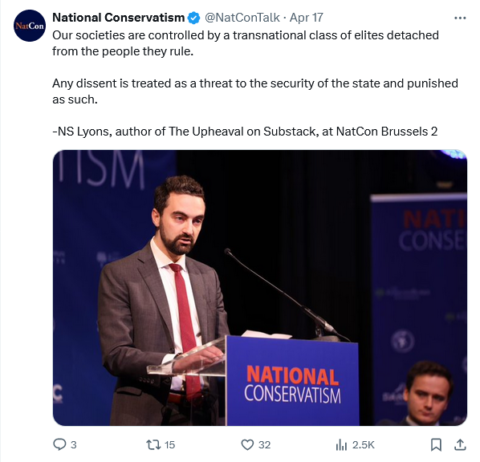
“What is to be done?” That seems to be the question on everyone’s lips these days. Answering it is I think in fact the real purpose of this conference on National Conservatism here in Brussels.
By now most of us are well aware of the scope of the problems we face. Our societies are controlled by a transnational class of managerial elites increasingly isolated from the people they rule, and from reality. These elites, and the many institutions they control, have been captured by a revolutionary ideology that seeks to remake the world, and everyone in it, from the top down.
The vast machinery of modern managerial technocracy has been turned against us, its bulging bureaucracies seeking to impose on us a totalizing project of internal colonization. Our systems of self-governance, the cultural fabric of our national ways of life, even our very human nature are being intentionally suppressed and replaced with the stifling conformity of a rigid system of ideological and technological control. All remaining semblances of democratic accountability are today being cast aside in favor of governance via mass manipulation and open coercion. Increasingly, any dissent is treated as a threat to the security of the state – and is punished as such.
As has been so amply demonstrated by the police outside our very doors, dispatched to shut down this conference, for conservatives and other dissidents this state of affairs means escalating exclusion and persecution. The reality is that any “liberal neutrality” or “rule of law” once maintained by the state no longer exists – such restraint was an artifact of the old order.
Meanwhile, managerialism’s progressive project has produced a deliberate inversion of moral values, a degradation of competence, and an implosion of social trust. This has begun to induce collapse in the basic systems upholding civilization. The result is a proliferation of crime, addiction, social atomization, and general despair, dysfunction, disorder, and decay. So now we suffer under a state of simultaneous anarcho-tyranny.
What is to be done? First of all, it should be clear by now that old guard conservatism will be of no use to us whatsoever. For decades, such a conservatism has failed to conserve much of anything at all. Even when successfully elected to political office with a strong mandate, conservatives of this mode are soon either coopted by the oligarchic establishment or find themselves isolated and helpless before the vast unelected managerial “deep state”.
They have proven themselves unable to combat either the relentless march of progressive cultural hegemony, or the growing technocratic tyranny that openly advertises its intent to ultimately destroy them. Over and over again, they are fast reduced to blustering uselessly at Congressional hearings, whining on talk shows, or settling in to merely grift whatever they can, while they can. So, unfortunately, just “voting harder” will not be enough to get us out of our present mess.
April 23, 2024
The 1950 Marketing Contest to Name the S&W Chiefs Special
Forgotten Weapons
Published Jan 19, 2024Today we’re taking a look at a Smith & Wesson Chiefs Special, but not just any Chiefs Special. This is serial number 29, factory engraved and gifted to Chief Edward Boyko of Passaic New Jersey in 1950. When S&W introduced the new revolver to compete with Colt’s Detective Special, they simply called it the “Model J” (it was the first of the J-frame S&W revolvers). They released it at the 1950 annual conference of the International Association of Chiefs of Police, and ran a contest among to attendees to name the new gun.
Chief Edward Boyko’s suggestion of “Chiefs Special” was (perhaps unsurprisingly, given the audience) voted winner, and S&W gave him a personally engraved example as a prize. He would carry that gun for another 10 years as Passaic Chief of Police before retiring in 1960.
The Chiefs Special was essentially a slightly scaled-up I-frame revolver, strengthened to handle the .38 Special cartridge instead of the previous .38 S&W option. This extremely early example has a number of features not present on standard production guns, including the small trigger guard, large cylinder release latch, and semi-circular front sight.
(more…)
April 8, 2024
“At the time of writing, the Scottish first minister Humza Yousaf edges J. K. Rowling in the battle for the inaugural title of Scotland’s Most Hateful Person”
At Oxford Sour, Christopher Gage updates us on the mental gymnastics required to navigate Scotland’s new hate crime law:

To the surprise of many terminally online folks, J.K. Rowling is not the top offender under Scotland’s new hate crime law. That “honour” goes to Scotland’s current first minister, Humza Yousaf for a speech delivered several years ago.
One-third of the Scottish police are yet to receive any training on this sweeping new law. Amongst the rank-and-file, the spectre of threatening and abusive material seeping out of public performances such as plays creeps like sarin gas. Such forbidden filth threatens to mutate ordinary Scots into far-right zombies, parroting Andrew Tate’s pitiful jock philosophy.
Police have absorbed over 4,000 reports of hate crimes in the first 48 hours. Mercifully, many Scots are still evidently well-versed in the timeless Scottish art of taking the piss. At the time of writing, the Scottish first minister Humza Yousaf edges J. K. Rowling in the battle for the inaugural title of Scotland’s Most Hateful Person. Second prize, I believe, is a set of steak knives.
Not to worry, those coppers recently announced a new “proportional response strategy”. Police will no longer investigate crimes such as smashed windows, or run-of-the-mill thefts. This “new approach” to policing, which contravenes the very definition of policing, saves the rozzers 24,000 fewer investigations and 130,000 man-hours per year. That leaves plenty of time to investigate those unenlightened beings poxed with the false belief that women don’t have cocks.
Nobody has any idea what is going on. On the first day of the Scottish Unenlightenment, a Scottish National Party minister said J. K. Rowling’s gender-critical tweets could bring the coppers to her door.
On Twitter, J. K. Rowling had reeled off a string of photographs of trans people. She then called those biological men “men”.
Siobhian Brown, the SNP’s community safety minister, had claimed referring to a trans woman as a “he” would not break the new law. Later on, she said the police would decide whether such misgendering would count as a hate crime.
“It could be reported, and it could be investigated. Whether or not the police would think it was criminal is up to Police Scotland for that”, said Brown.
You could taste the acrid, small-town glee steaming from the repressive and literal minded. Rajan Barot, a former fraud prosecutor for the Crown Prosecution Service, warned Rowling that her Twitter posts, many of which state that biological men are not and cannot become women, would most likely contravene the new law and advised her to delete them.
Police later confirmed the very rich and very visible author would not face prosecution for her stubborn grasp of biological reality — at least whilst the universe watched on in a state of unadulterated fremdschämen.
March 29, 2024
“TamponGate” at Vanderbilt
Suzy Weiss at The Free Press relates a story that’s just too weird not to share:

No one is ever going to let me guest-host this digest again, so I might as well tell you about some Vanderbilt girl’s tampon. This all started yesterday morning, when a wave of undergrad students rushed Kirkland Hall, where Vanderbilt’s chancellor’s office is located. Thus began their sit-in — a response to the college administration shutting down a student government vote over whether the school should divest funds from Israel.
The protesters remained there for nearly 21.5 hours — blowing Harvard’s 12-hour “hunger strike“, also known as a good night’s sleep — out of the water, before police began removing and arresting students, some of whom have since been suspended.
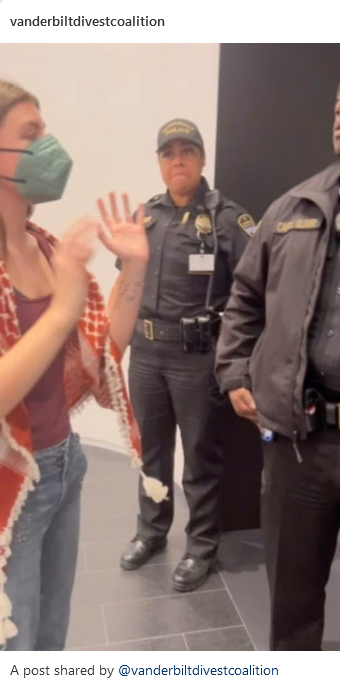
There are many dumbfounding moments from this latest campus frenzy — for example, when the students, arms linked, called the black police officers protecting the chancellor “puppets”. When food was brought in from Panera Bread by the administration for the officers but not the students, it was treated like a human-rights abuse.
But the tampon takes the cake. (Major props to Steve McGuire for compiling the best episode of the internet since yesterday.)
Here’s what went down: during one of those 21.5 hours of the protest, probably at an ungodly one, a few of the student demonstrators decided to call 911. That’s because their friend, who was part of the sit-in, had to change her tampon.
Specifically, she was “being denied the right to change her tampon that has been in for multiple hours, which leads to an increased risk of toxic shock syndrome.”
The frankly Zen-like 911 operator, who deserves a raise, was understandably confused. “Ma’am, do you have an emergency?”
Um, yes?! The student on the phone requests urgent medical assistance.
“You’re telling me your friend in Kirkland needs an ambulance. Is that what you’re telling me?”
Then in another video, one of the protesters—in a keffiyeh and a mask—approaches the police and an administrator, who was indeed in a sweater vest, demanding to know WHAT. WILL. HAPPEN. to her friend, should she leave the sit-in to change the tampon in question. The adults calmly explain that she won’t be arrested if she leaves the building. But can they confirm that she will never be arrested, ever?!
“She does not feel safe,” someone says off-screen, punctuating it with claps.
This whole thing makes the Nick Christakis Halloween costume struggle session look like a teachable moment. It must be seen to be believed. Watch all the videos in Steve’s thread here.
For starters, if having a tampon in for “multiple hours” is grounds to call for an ambulance, I should have been dead years ago. Second, this student was being denied no such right. All she had to do was get up, leave the protest, and find one of the hundreds of bathrooms that she had access to elsewhere on campus. Pro tip: wear a pad to the all-night protest. The First Amendment doesn’t come with a heating pad.
It’s all very Karen, to borrow a trope from 2020, especially when a protester demands the administrator find someone who can get them some answers. Just like middle-aged women who think dressing down the manager will somehow earn them a full refund, these students have convinced themselves that by linking arms and screaming “shame” at their college’s chancellor, they are stopping a war in the Middle East.
Don’t these authority figures realize they are standing in the way of a global intifada, which is also — obviously — a totally good thing?
We find out in a subsequent video that indeed the tampon was removed, though not in any bathroom. Reader, it came out at the sit-in, like so much urine in so many plastic water bottles. A woman on the microphone calls it “the most depraved shit I’ve seen in my entire life”.
Hard agree.
March 23, 2024
“At least they didn’t arrest the dog”
Andrew Doyle revisits the Nazi pug story as new Scottish blasphemy hate speech laws are about to come into force at the beginning of April:
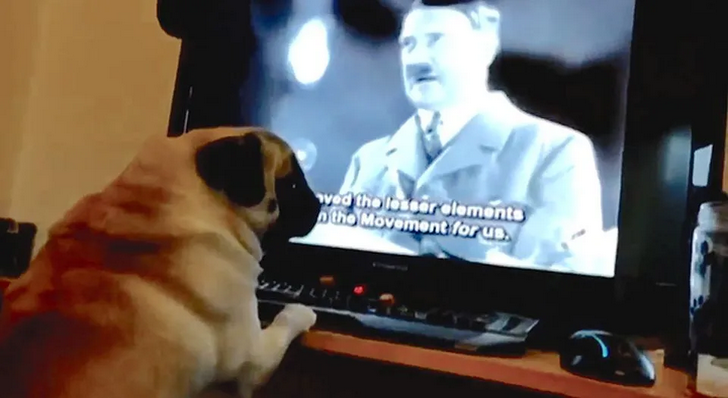
If you’re deluded enough to suppose that human history works in a progressive linear fashion, the example of Scotland should swiftly change your mind. Once the home of the Enlightenment, the country has now veered into authoritarianism under the control of the SNP. The party’s new hate crime law will come into force on April Fools’ Day, and no-one in government is seemingly able to give examples of “crimes” that would be covered by this legislation that aren’t already criminal. When specifically asked on the BBC’s Newsnight whether “misgendering” would result in prosecution, SNP backbench Fulton MacGregor could only mutter: “Well, it depends on the circumstances”. How reassuring.
For all MacGregor’s “faith” that the law would be “properly” implemented, nonbelievers are right to be cautious. Vaguely worded legislation is bound to be exploited, and has been many times in the past. This is particularly the case when it comes to “hate speech”, a concept for which no adequate definition has ever been achieved. The best the Irish government could muster for their forthcoming hate crime bill is that hatred “means hatred”. In these times of slippery authoritarian wordplay, that’s about as specific as we can expect.
The Scottish police have claimed that they will not “target” comedians and actors under the new legislation, and yet at the same time have sworn to investigate every complaint. Thankfully, activists never make spurious complaints against their ideological opponents in the hope of seeing them silenced. Oh wait. They do. All the time.
[…]
So for all of the claims that our concerns about the new hate crime law are unfounded, and that the police would never prosecute anyone for a gag, we should remember that they already have. This legislation will simply make it easier for activists within and without the police force to weaponise the law against those deemed to be subversive. On the day of Meechan’s arrest, one police officer affirmed that he must be “an actual Nazi trying to inspire people to become Nazis”. The judge eventually agreed, in spite of the fact that after two years of investigation the police had uncovered no evidence of far-right sympathies.
Of course those who wish to criminalise dissent will not stop at comedians. They’ll also be keen to crack down on anyone who knows the difference between men and women and is willing to declare this esoteric knowledge out loud. Although it has become a cliché to cite George Orwell’s Nineteen Eighty-Four in such circumstances, that is only because it is so apposite: “The Party told you to reject the evidence of your eyes and ears. It was their final, most essential command”.
I do not sincerely believe that the police will turn up at our Comedy Unleashed show next Monday. It seems unfathomable that we might see a kind of re-enactment of the closing scenes of The Blues Brothers, with police officers standing in the shadows of the club to monitor the show for heterodox content. But then, I would never have anticipated that in a free country someone who made a video mocking Nazis would end up with a criminal record. Of course our show will be offensive to those who choose to be offended. Such is the nature of comedy. The only way to avoid such a situation would be for the acts to stand on stage in total silence. And even then, someone might find this offensive to mutes.
March 15, 2024
Toronto’s blue-uniformed surrender monkeys say … just make it easier for criminals and maybe they won’t hurt you
Crime has been increasing lately, and Toronto’s boys, girls, and all 57 other genderbeings in blue have their very best advice for you: surrender now.

… Toronto Police have reflected on the problem. They’ve mulled it over. Thought long and hard. And they’re advising people just give up. To stay safe.
This advice came out at a community safety meeting between Toronto Police officials and concerned citizens last month. (The meeting was covered by City News Toronto, but didn’t get widespread coverage until this week, when clips went viral online. Tell me that isn’t a microcosm of the 21 century.) In remarks to the citizens at the meeting, a Toronto police constable said this: “To prevent the possibility of being attacked in your home, leave your fobs by your front door. Because they’re breaking into your homes to steal your car. They don’t want anything else. A lot of them that [the police] are arresting have guns on them. And they’re not toy guns. They’re real guns. They’re loaded.”
Oh. Okay.
Look, it’s not bad advice, in any individual circumstance. There probably are a lot of people out there who’d be relieved if someone kicked in their door, grabbed the fob and took off. And it’s certainly not novel advice from a police service. We’ve all heard variations of this before, right? “Just give up your wallet” when you’re mugged. “Just get out of the car” during a carjacking. You can always replace things. Right?
The problem is that, in the other scenarios above, you’re out and about in public. There’s no guarantee of safety in public, as much as we all wish otherwise. The advice now being given by Toronto police isn’t what to do when someone jabs a gun into your ribs in a seedy back alley, but how to avoid being harmed by bad guys in your own home. And the police advice is “Make it so easy on them that they have no reason to hurt you”.
There’s no charitable read on this, and in this case, truth isn’t a defence. I accept that the police are giving their real, best, true advice. I accept that they are being sincere. That’s the problem: the police are sincerely surrendering. They’ve given up, and they think it would be best if you gave up, too. These violent robberies are just going to continue, and it’s on us — the public — to minimize the bloodshed and risk to ourselves by … submitting.
I try to avoid hyperbole in columns, with the odd exception for comic effect. But this isn’t funny at all, so I won’t make a joke of it. Let’s be extremely serious for a moment. If this is where the Toronto Police Service has landed in terms of their best advice for the public, as a member of that public and Toronto resident, I’d like to ask this: why stop with leaving my fob by the front door? I have a laptop computer. It’s a few years old now, but still in workable condition. It’s worth a few hundred bucks. Maybe I should leave that by the door, too? I don’t keep a lot of cash on hand — who the hell does, in 2024? — but there’s usually a few bucks in my wallet, or my wife’s. Should part of our nightly routine now just be emptying our wallets into a little bowl that we can leave on the radiator by the front door, and come morning, if the door hasn’t been kicked down and the cash grabbed, we can just put the money right back into our wallets as we get the day started? I’m not really a jewelry guy, but my wedding band is worth something, I guess. Pop that into the bowl with the cash?
After all, the bad guys have guns. Real guns. Loaded guns. And there is apparently nothing to be done about this except submit and co-operate. So say the police.
<sarc>No, that can’t be right. Justin Trudeau made guns illegal, so the bad guys just can’t have guns. It would be against the law, and they might get in trouble.</sarc> Oh, and should the propitiatory offerings be placed inside or outside the door? I guess outside, to make it even easier for them, but make sure everything is protected from rain or snow … it’d be risky if they had to pick everything up soaking wet and they might take it out on you and your family.
That’s Matt Gurney from The Line, so you really should read the whole thing.
March 1, 2024
Women behaving badly on [police bodycam] video
Janice Fiamengo suggests that demands to the use of police bodycam footage involving young women being arrested for criminal behaviour is a weird bit of official white-knighting on the part of the authorities:

Moments of public outrage can be opportunities to consider deep-rooted cultural assumptions.
There’s been moral outrage lately over a popular YouTube channel called Drive Thru Tours. Launched in 2020, the channel started out by posting videos of tours through parts of New Jersey and New York. It hit paydirt last year when it began showing videos of police arrests, with titles such as “Rude 19-year-old Girl Arrested for DUI in Pullman, WA” (recommended if you want to get a flavor of the site) and “Belligerent Woman Arrested for DWI after Police Pursuit and Taken to Jail” (not recommended — very disturbing). The channel owner obtained the content — which until recently has focused exclusively on female offenders — from police bodycam recordings, now publicly available through freedom of information requests.
Bodycam footage was originally made accessible to the public so that American citizens can hold police accountable for their actions. Scrutiny of police behavior is widely considered a public good. Scrutiny of female behavior, however, is quite a different story — as responses to the channel demonstrate.
According to a small flurry of recent news reports, New Jersey police are warning that Drive Thru Tours is harming “vulnerable” young women by posting the evidence of their arrests. The bodycam footage was never intended, they protest, for such a purpose. In consequence, the Association of Chiefs of Police of New Jersey is calling for legislation against what they are describing as “online sexual predators“, and lawmakers in that state are considering a bill that would prohibit publishing the footage except within narrow parameters, including with the written consent of the subject.
Quite apart from whether such a bill is a good idea or not (I favor public access but have not given the matter serious thought), the language used in the articles is remarkable for its gynocentric sentimentality and misplaced sympathy.
One of the most vocal on the subject is Montville, New Jersey Police Chief Andrew Caggiano, who is quoted as stating that “It was never the intent of OPRA [the Open Public Records Act] to create such a platform that preys on young women and takes advantage of them at a time when they are vulnerable”. He also expressed a personal repugnance: “As a law enforcement professional and the father of three daughters, I am sickened by the fact that people are abusing OPRA to post these types of videos on social media sites”.
Given that it is not (yet) illegal to use bodycam material in the manner described, Chief Caggiano’s dramatic reaction seems overstated. One wonders in what sense the reckless and self-absorbed young people shown in these videos are “vulnerable”. Wouldn’t such language be better suited to their victims? Perhaps Caggiano knows something about his daughters that we don’t know (there is a video in which a “Cop’s Daughter Gets Arrested for DWI after Fleeing Accident Scene”): one would not normally expect a chief of police to so quickly substitute in imagination his own daughters for the inebriated and flagrantly dishonest women shown on Drive Thru Tours.
Caggiano’s bluster is, of course, all too familiar in a culture that cannot bear to hold women fully responsible for their bad actions — no matter how anti-social or potentially lethal — and must habitually frame them as innocent victims. It’s impossible to imagine such outraged sympathy being expressed for any male offenders in similar situations.
January 14, 2024
Tristin Hopper imagines the thoughts of the Toronto Police Service
Every week, Tristin Hopper helps us understand an element of the week’s news by “imagining” the diary entries of the people or organizations involved. This week, it’s the turn of Toronto’s police department:
The Toronto police have not had a good week. After receiving widespread criticism for refusing to disperse an anti-Israel blockade targeting a north Toronto Jewish neighbourhood, video emerged this week of officers delivering coffee and donuts to the blockaders.
And so, only after a cross-section of local politicians and Jewish leaders had expressed bafflement at police inaction, did Toronto police announce plans on Thursday to actually put a stop to protests at the Avenue Road bridge. They even charged one protester with incitement of hatred for allegedly carrying a hate group’s flag at a protest in downtown Toronto.
Monday
I’m sorry — is that the sound of people wanting us to enforce the law? As in, “hey there, sworn peace officer, get in your car, go identify some criminality and use force to stop it?”Are you sure about that, Toronto? You sure you don’t want us to instead try fixing this with a solidarity flag raising? Or maybe this is something that could be diffused with one of those equity roundtables you keep forcing us to attend.
After all, enforcing the law is a messy business. People could get hurt. This isn’t like handing out a traffic ticket or a jaywalking citation: You’re asking us to confront people who may not care that their actions are illegal, and may employ additional illegal methods to dispute that.
Tuesday
I’m still trying to get my head around this new paradigm. So to refresh: when people break laws, you want us to stop that? The Criminal Code. The Highway Traffic Act. The Controlled Substances Act. You want our officers to read up on contemporary legislation, seek out violators of said legislation, and then apply appropriate sanctions?This is a minefield, frankly. We’re talking raised voices. Mean tweets. People in handcuffs. Unflattering videos. Outraged Toronto Star columns. This is how we board an escalator that may soon make us pine for the days when our only problems were an easily ignored minority demographic having their overpass shut down.
Wednesday
When we’re enforcing these laws, are you absolutely sure you want us to do this without first checking if they’re politically acceptable? I mean, it would obviously streamline everything if roadways were only ever blockaded by white supremacist cannibal pedophiles, but that’s rarely the case.And what if they’re doing an illegal thing that is tangentially related to something you like? I had our legal guy look into it and he said that any laws broken as a result of a public protest are still illegal – the right to protest only covers legal things, it turns out. So bear with me; this could result in a city in which graffiti, blockades and vandalism OF ANY KIND could end up banned. It’s a slippery slope.
January 9, 2024
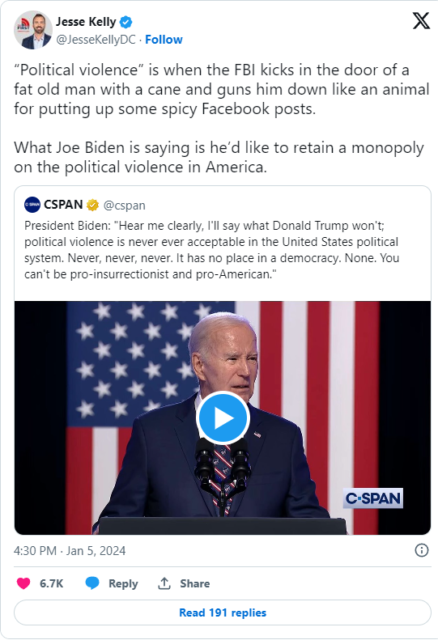
“[P]olitical violence is never ever acceptable in the United States political system”
Mark Steyn gets the message:
~I’m glad to see I wasn’t the only one who got a mordant laugh out of this line in Joe Biden’s Feast of the Insurrection sermon:
So “political violence is never ever acceptable in the United States political system. Never, never, never. It has no place in a democracy. None.”
An odd thing to say about a “political system” in which Lieutenant Michael Byrd was able to kill Ashli Babbitt in cold blood as his Capitol Police colleagues were able to do likewise to another defenceless woman, Mariam Carey. I would hope to be wrong, but I would be surprised if America gets through this year without more “political violence” — because one side seems to be fomenting it as a pretext for intensifying what Mr Kelly calls their “monopoly” on it.
That monopoly is part of a broader problem in the United States: the abolition of equality before the law. If you can avoid getting dispatched as swiftly as Ms Babbitt, you will nevertheless have what remains of your life ruined by detention without trial, solitary confinement, double-digit years of prison with no possibility of parole … Americans have gotten the message. Do you recall, after the Canadian truckers’ heroic Covid protests inspired the world, there was talk of a similar American Freedom Convoy?
Oh, you don’t remember? Me neither. That’s because it all fizzled out, as its proponents figured that the dirty stinkin’ rotten corrupt US Department of Justice would just treat it as January 6th on wheels.
~Of course, it didn’t work out too great for the Canadian truckers, either: Frozen bank accounts, protracted prosecution … Small potatoes by US DOJ standards, and Lieutenant Byrd wasn’t around to shoot them dead, but it has certainly been fierce and targeted by Canadian standards. Why? Because in Ottawa the “traffic disruption impacted residents’ lives in many ways”.
On the other hand, “pro-Palestinian” groups are currently disrupting traffic in Toronto. For over a week they’ve shut down the Avenue Road bridge over the 401. Why?
Well, it’s a key artery into Toronto’s and Canada’s most Jewish neighbourhood. But, relax: they’re not anti-Jew, they’re just anti-Zionist. After all, many of these Jews in Armour Heights and Bathurst Manor are out every night bombing Gaza daycare centres. It’s part of the same expansive definition of “pro-Palestinian” that has seen International Delicatessen Foods attacked because it has the same acronym as the Israeli Defence Force. But don’t worry, they’re not anti-Semites, just acro-Semites. If I were the famous Japanese tea master Takeno Jōō, I would hire additional security. But fortunately he died in 1555 …
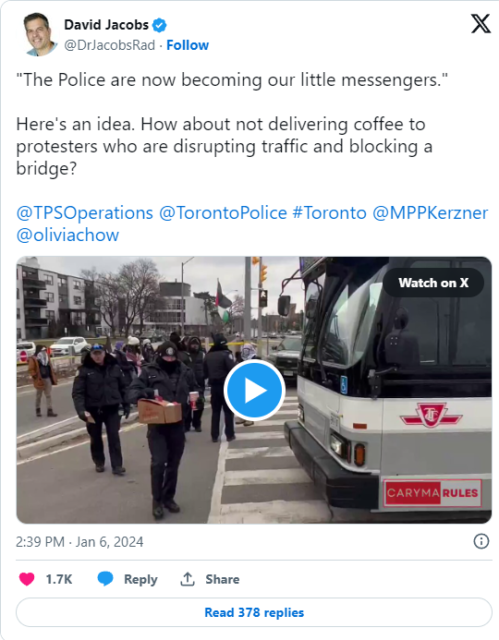
Yet, as I said, it all comes down to equality before the law. The Canadian truckers handed out coffee and doughnuts to locals and are still in the dock two years on. Whereas on the blockaded Avenue Road overpass the Toronto Police deliver coffee and doughnuts to the pro-Hamas lads:
Roll up the Jews to win! In the old days, the German coppers pleaded that they were just obeying orders, but, as Kate MacMillan points out, the Toronto constables are just taking orders. Did you hear the way that fellow put it? “The police are now becoming our little messengers.”
November 23, 2023
A .22LR Berthier for the French National Police (CRS)
Forgotten Weapons
Published 15 Jun 2022In 1954, the Unique company (MAPF) in Hendaye France rebuilt a batch of 800 Berthier carbines into .22LR caliber for use by the Sûreté Nationale (later renamed the Police Nationale). These were to be used for training and also issued to prison guards. Both 1892 and 1916 pattern carbines were used, and so the CRS .22s can be found both with and without upper handguards. They were fitted with 5-round magazines from one of Unique’s pistol models. The change of the firing system from centerfire to rimfire was rather cleverly done, with the new barrels bored at a slight angle to obviate the need to change the firing pin geometry. This did require shaving down the cocking piece and changing the sights, however.
(more…)
October 1, 2023
MGD PM9 Rotary-Action Submachine Gun
Forgotten Weapons
Published 23 May 2017The PM9 was an interesting an unique submachine gun designed by Louis Debuit for the French firm Merlin and Gerin (hence the MGD name – Merlin, Gerin, Debuit) in the late 1940s and early 50s. The design was intended to provide a very compact package, which it did with a very short action, folding stock, and folding magazine.
The PM9 uses a delayed blowback action, and the delaying is done by a rotating flywheel-type block and clock spring. The bolt and flywheel act somewhat like the piston and crank in an engine. As the bolt (piston) moved rearward in a straight line, it forces the flywheel (crank) to rotate because the two are connected. In the case of the PM9, the connection is a nub on the flywheel that rides in a vertical slot in the bolt. The flywheel is pushing against the clock spring to rotate, and the combination of the its inertia and spring pressure keep the bolt closed long enough for pressure to drop to a safe level. The rotary action allows this to be done in a much smaller package than typical submachine guns.
The PM9 was initially chambered for 7.65 French Long, but quickly changed to standard 9mm Parabellum for the production models. It used the same magazine as the German MP38/MP40, giving it a 32-round capacity. In addition to the model with a skeletonized folding stock, the PM9 was also available with a fixed wooden stock and either short barrel of long carbine barrel. A relatively small number of guns were produced in France in 1954 and 1955, but they failed to find commercial success. In 1956 the German Erma company acquired a license to build the PM9, but abandoned the idea after making a few prototypes.
(more…)
July 18, 2023
Manville Gas Gun
Forgotten Weapons
Published 29 Oct 2012Charles Manville developed this weapon in the 1930s as a riot control tool, and they were built in 12ga, 25mm, and 37mm. We should point out that the 12ga version was for tear gas rounds only (like today’s 12ga flare launchers) and not safe to use with high-pressure ammunition. Anyway, it was intended for use by prison guards and riot police, offering a much greater ammunition capacity than any other contemporary launcher.
During World War II, Manville tried to sell the military on a high-pressure version to fire 37mm explosive rounds, but was unsuccessful. Instead, the Manville company spent the was making parts for the Oerlikon 20mm AA guns, and the tooling for the gas launcher was all destroyed.
(more…)
July 15, 2023
The French Intifada
Ed West on the origins of the rising violence in French towns and cities:
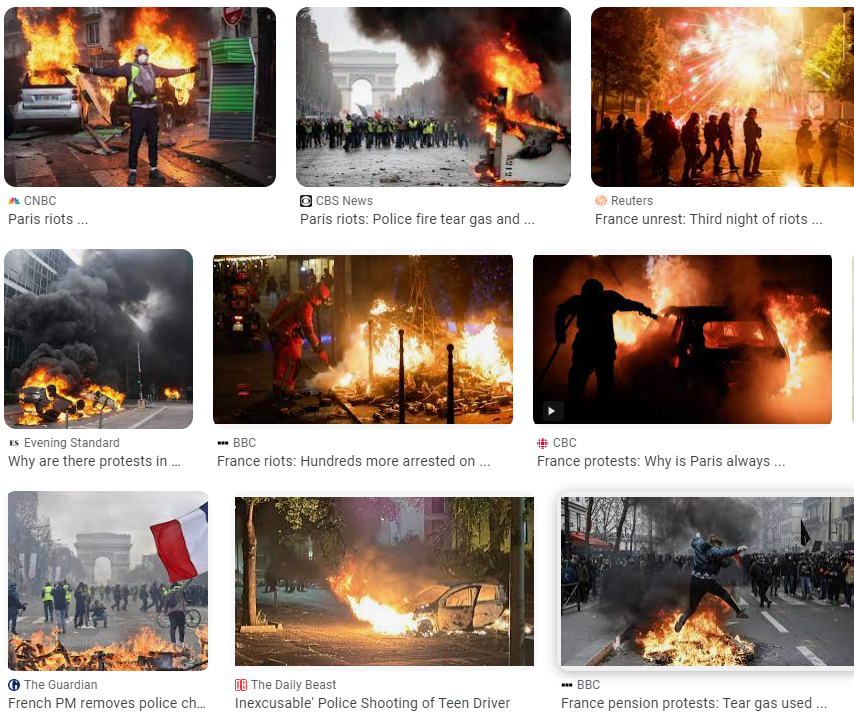
I ran an image search for “Paris rioting” and there was a plentiful supply of fiery, eye-catching photos. Not all of these are from the most recent outbreak of violence, but they are certainly representative of how the legacy media is covering the situation.
The recent violence in Paris and elsewhere, which saw attempts to ram the home of a mayor, once again highlighted the trouble the country has with integration. But the French police union describing themselves as being “at war with vermin” illustrated the different mindset to the English-speaking world, and the far more belligerent approach to the problems of diversity.
Like Britain, the Netherlands, Germany and Sweden, France has had difficulties assimilating the children of immigrants from beyond Europe, yet its recent history has proved especially violent and troubled. Britain has jihadi terrorism – 2017 was especially grim – but it has never reached such intensity. Today, as over 130,000 police officers stand guard to protect the Republic on the day of its celebration, it is worth considering the journey that brought it to such a state.
Analysts have often compared Britain’s state multiculturalism with France’s system of laïcité, which tends to downplay the existence of “communities” even to the point of not taking demographic statistics. Although neither country’s approach has entirely been a success, France’s refusal to recognise immigrants as anything but French has often been blamed for the widespread sense of alienation.
Others point to the housing system, which tends towards concentrations of North and West Africans in suburban banlieues, or the less laissez-faire economic policy which results in higher unemployment (in exchange for better social security).
While they no doubt play a part, the biggest single difference is history, as Andrew Hussey recounted back in 2014 in The French Intifada, in particular France’s history with North Africa. To put it in British terms, imagine that Britain’s rule in Pakistan had involved not a small number of administrators and soldiers but instead hundreds of thousands of British settlers arriving in the country, many with the intention of making it a “new America” (i.e. driving the natives out).
That Britain had declared Pakistan an integral part of the country, and that, rather than scarpering in indecent haste when the empire began to disintegrate, Britain had dug in to preserve its rule in a sadistic war of independence, one in which natives and white settlers committed countless atrocities against each other.
And that this violence had spilled into Britain with assassination attempts and terrorism, by both sides, destabilising the country to the point where there was talk of a coup. And that this was happening just as large-scale immigration to the colonial power was taking place.
Britain experienced nothing like as much violence in the dying days of empire, and indeed the only real comparison with our history was the moment when there was almost all-out conflict between Britain’s Protestant and Irish Catholic populations before the First World War.
If French politicians so casually talk of “civil war” between its right wing and the Algerian-descended population, it is because it has already played out this conflict before – one that was never healed, and so invites a sequel.
June 5, 2023
The poster child for truly antisocial behaviour
Not following the news closely, I don’t think I’d heard of “Mizzy” until perhaps a week or two back, but if he’d tried pulling this kind of behaviour in the US, his career would likely have been a lot shorter and much more violent:

Screen capture from a YouTube video
What’s the big deal about Mizzy? Surely one idiot 18 year old doesn’t merit the full glare of the British media, you may be thinking (at least if you haven’t been paying attention). Certainly the Guardian didn’t seem to think so — lagging two days behind reporting of the story in the Daily Mail, Telegraph, Independent and BBC. We at the Critic were kind enough to point this out and the Guardian have since seen fit to lower themselves to the story — an unhelpful distraction no doubt from more serious stories their exhaustive coverage of Philip Schofield’s departure from British breakfast TV.
One reason to care, is that despite claims to be a mere prankster, Mizzy’s actions are profoundly serious, terrifying to his victims, and suggest an escalating pattern of behaviour that could very plausibly lead to greater crimes. In a series of videos clearly intended to menace his targets, he decided to steal a dog from an old lady, burst into the home of a young family, and, in one truly shocking incident, comes up to a woman alone at night and asks her if she wants to die. It’s obvious, taken together, that these incidents are not pranks taken too far, but deliberate and calculated attempts to terrify and intimidate innocent people, often women, children or the elderly.
Anyone who has been subject to what we often euphemistically call “anti-social behaviour” and middle class columnists like to frame as teenagers with “too little to do” (blame the closed youth centre or something), knows all too well what Mizzy is up to. It’s the local drug addict who always follows you late at night, leering. It’s the teenagers who let their pitbull bark and snarl at you, smirking all the while. It’s the men who sit outside your house drinking, and stare at you as you walk down the road. Men and boys who take pleasure in the fear of others, often to compensate for absences in their own life — a job, a father, a girlfriend, a future. And sometimes the absence has no obvious explanation — there’s just something missing inside, a hole that demands to be filled, an appetite for brutality and cruelty muzzled but not tamed by modern society.
So what’s so special about Mizzy? He’s got a TikTok channel, on which he proudly posts these petty acts of barbarity for the pleasure of his thousands of followers. And this fact tells a story, an important story, about both the present and future of British society.
In the present, it’s a tale of an unpoliced and anti-social public realm; an increasingly familiar and despairing story of police and judicial passivity in the face of open criminality. Under Blair we reclassified petty crime as “anti-social behaviour” and instead of prison, or a suspended sentence and an ankle monitor, judges handed down things along the lines of “you must not be in the East Shield shopping centre after 10pm”. ASBO recipients, having been briefly hauled up, generally swiftly resume their trajectory towards criminality, creating more victims in the process.
Mizzy, having spent months openly terrorising people, was, amidst national attention and outrage, given the successor to the ASBO — a CBO (Criminal Behaviour Order). Shortly after appearing on national TV and complaining that he was the victim of racism, and only two days after receiving his CBO, Mizzy had already breached its terms, having posted yet more videos.
So much for the present — but what does the tiresome tale of narcissism and cruelty tell us about our future? Nothing good. Mizzy has blended street thuggery with online harassment, creating entertainment out of fear and pain. He’s part of a new flamboyant and triumphalist form of bullying and criminality, which finds an enthusiastic audience online.
Joe Baron instantly recognized Mizzy’s type from his own experiences as a teacher:
Piers Morgan is right. Mizzy is a moron. For those of you unfamiliar with the story, “Mizzy” is 18-year-old Bacari-Bronze O’Garro, who attracts followers on TikTok by filming himself engaged in criminal activity. He terrifies families by invading their homes, steals the dogs of elderly women, physically assaults unsuspecting commuters, and threateningly asks random people if they’d like to die.
[…]
As a teacher I recognised him immediately. So many youngsters betray the same peculiarities: entitled, self-satisfied and utterly irresponsible.
Why are these traits so commonplace among our young people? There are several reasons, bad parenting being the most notable. Either through fear or convenience, parents no longer discipline their children. If a teacher attempts to do so, the parents often complain, presumably in a bid to appease their volatile offspring and maintain a quiet life at home.
This month, I had a furious encounter with a parent who could only be described as deranged. My crime: issuing her daughter with a 30-minute detention for forgetting her exercise book. In an earlier incident, another parent physically assaulted a colleague, attempting to strangle him for disciplining his daughter. She had slapped a book out of his hand during classroom changeover. Anxious and stressed, my colleague left the school soon after, and several weeks later, his attacker’s daughter viciously assaulted another pupil, who then needed hospital treatment.
Parents also have to take responsibility for the devastating effects of divorce on their children. Nearly half of all marriages end in failure. That’s a huge number of broken homes and broken children. And it often leads to poor behaviour. Fecklessness begets fecklessness. When will we wake up to this reality and encourage prospective parents to take their vows more seriously? That’s if there is a marriage in the first place. Or even a father present in the home.
Furthermore, adults have surrendered their authority to children. For example, recalcitrant pupils are not effectively disciplined because, contrary to the Christian doctrine of Original Sin, children are now seen as pure, infallible and morally unimpeachable, and adults as iniquitous and corrupting influences. Consequently, a child’s misbehaviour must be the fault of the adult or teacher. In addition, if a child should make a statement concerning an incident, and the statement contradicts his or her teacher’s version of events, the child’s claims must take precedence, even if they’re completely bogus.