Quotulatiousness

November 21, 2020

About that “Canadian content crisis” the feds are trying to “fix” with Bill C-10

Filed under: Cancon, Government, Law, Media — Tags: , , , , , — Nicholas @ 03:00

Michael Geist begins a series of posts on the ongoing blunder that is the federal government’s “get money from the web giants” proposed legislation:

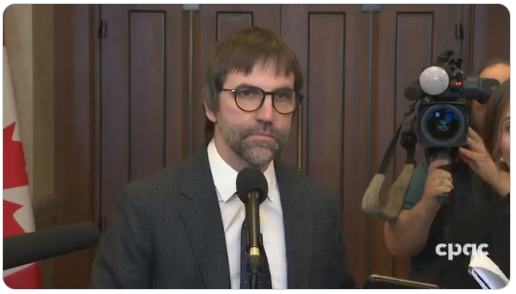
Canadian Heritage Minister Steven Guilbeault, 3 February 2020.
Screencapure from CPAC video.

Canadian Heritage Minister Steven Guilbeault rose in the House of Commons yesterday for the second reading of Bill C-10, his Internet regulation bill that reforms the Broadcasting Act. Guilbeault told the House that the bill would level the playing field, that it would establish a high revenue threshold before applying to Internet streamers, would not impact consumer choice, or raise consumer costs. He argued that even if you don’t believe in cultural sovereignty, you should still support his bill for the economic benefits it will bring, warning that Canadian producers will miss out on a billion dollars by 2023 if the legislation isn’t enacted. He painted a picture of Internet companies (invariably called “web giants”) that have millions of Canadian subscribers but do not contribute to the Canadian economy.

Guilbeault is wrong. He is wrong in his description of the bill (it does not contain thresholds), wrong about its impact on consumers (it is virtually certain to both decrease choice and increase costs), wrong about the contributions of Internet streamers (who have been described as the biggest contributor to Canadian production), wrong about level playing field claims (incumbent broadcasters enjoy a host of regulatory benefits not enjoyed by streamers), wrong about the economic impact of the bill (it is likely to decrease investment in the short term), and wrong about cultural sovereignty (it surrenders cultural sovereignty rather than protect it).

With the bill starting its Parliamentary review, this is the first in a new series of posts on why a careful examination of the data and the bill itself reveals multiple blunders. There are good arguments for addressing the sector, including tax reform, privacy upgrades, and competition law enforcement. There are also benefits to updating the Broadcasting Act, but in an effort to cater to a handful of vocal lobby groups over the interests of the broader Canadian public, Guilbeault’s bill will cause more harm than good. The series will run each weekday for the next month, first addressing the weak policy foundation that underlies Bill C-10, then a series a posts on the uncertainty the bill creates, a review of the trade threats it invites, and an assessment of its likely impact on consumers and the broader public.

The series begins with a post on the fictional Canadian content “crisis.” Canadians can be forgiven for thinking that the shift to digital and Internet streaming services has created a crisis on creating Canadian content. Canadian cultural lobby groups regularly claim that there is one (Artisti, CDCE) and Guilbeault tells the House of Commons that billions of dollars for the sector is at risk. Yet the reality is that spending on film and television production in Canada is at record highs. This includes both certified Canadian content and so-called foreign location and service production in which the production takes place in Canada (thereby facilitating significant economic benefits) but does not meet the narrow criteria to qualify as “Canadian.” I have written before about the need to revisit the Canadian content qualification rules which enable productions with little connection to Canada to receive certification and some that directly meet the goal of “telling Canadian stories” that fail to do so.

November 19, 2020

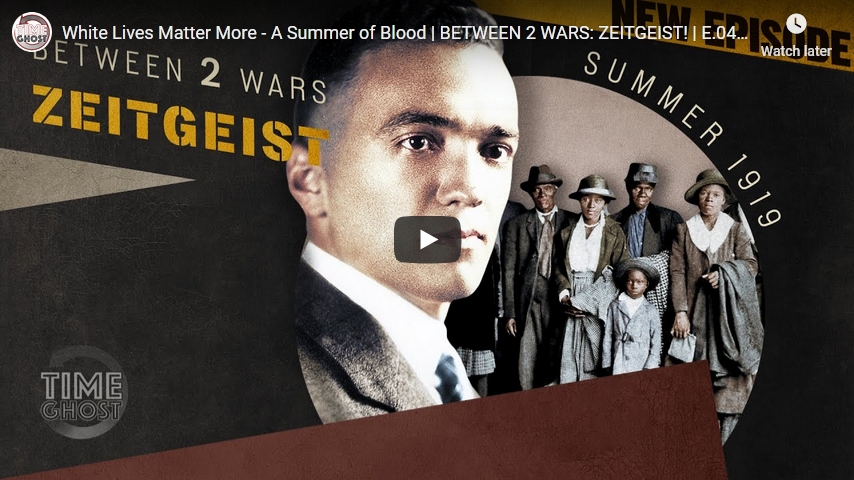
White Lives Matter More – A Summer of Blood | BETWEEN 2 WARS: ZEITGEIST! | E.04 – Summer 1919

TimeGhost History
Published 18 Nov 2020

Technology promises a better and more connected world in the summer of 1919. But battles still rage everywhere over who will inherit it.

Join us on Patreon: https://www.patreon.com/TimeGhostHistory

Subscribe to our World War Two series: https://www.youtube.com/c/worldwartwo…
Like TimeGhost on Facebook: https://www.facebook.com/TimeGhost-16…

Hosted by: Indy Neidell
Written by: Indy Neidell and Francis van Berkel
Director: Astrid Deinhard
Producers: Astrid Deinhard and Spartacus Olsson
Executive Producers: Astrid Deinhard, Indy Neidell, Spartacus Olsson, Bodo Rittenauer
Creative Producer: Maria Kyhle
Post-Production Director: Wieke Kapteijns
Research by: Indy Neidell and Francis van Berkel
Image Research by: Miki Cackowski and Michał Zbojna
Edited by: Michał Zbojna
Sound design: Marek Kamiński

Colorizations:
Mikołaj Uchman
Spartacus Olsson

Sources:
From the Noun Project: bridge by Adrien Coquet, Delete by Kevin Eichhorn, Fire by Sweet Farm, Model T by Alex Valdivia, people by Anastasia Latysheva, peoples by Musmellow, revolt by Symbolon, Smoke by Krish, people by Nithinan Tatah, explosion by Aldric Rodríguez

Archive by Screenocean/Reuters https://www.screenocean.com.

A TimeGhost chronological documentary produced by OnLion Entertainment GmbH.

From the comments:

TimeGhost History
21 hours ago
Four episodes into this new series and we think it’s going pretty well. Behind-the-scenes we have been getting ahead with our planning to make make things as laser-focused as possible and we have some pretty fascinating pieces of history we want to talk about.

But we know that there is always a learning curve with a new series and we care what our community thinks. It’s the TimeGhost Army who make our content possible so we’d like to hear from you what you think about Season Two of Between 2 Wars. What are you enjoying about it? Is there anything you think we should work on? How do you feel about Indy’s outrageous suits and ties?

November 12, 2020

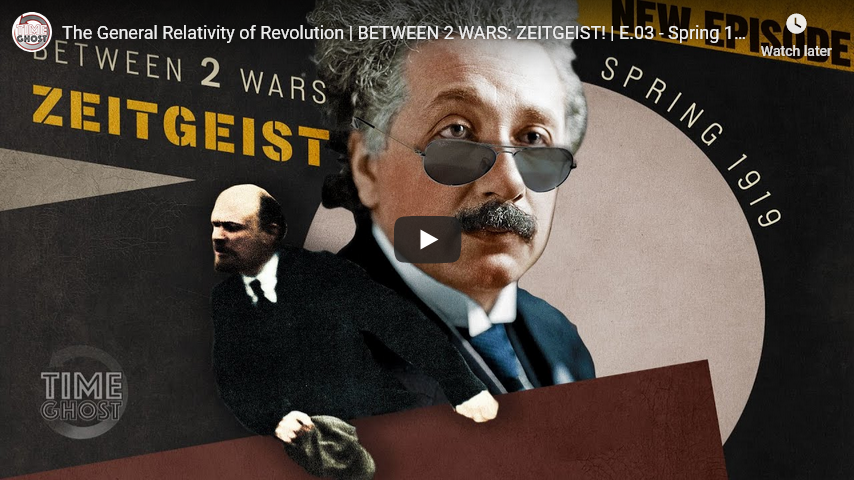
The General Relativity of Revolution | BETWEEN 2 WARS: ZEITGEIST! | E.03 – Spring 1919

Filed under: Architecture, Germany, History, Media, Russia, Technology, USA — Tags: , , , , — Nicholas @ 04:00

TimeGhost History
Published 11 Nov 2020

It is a springtime of revolution throughout the world in 1919 and not just the political kind. Era-defining advances in science and technology and iconic cinematography are made this season.

Join us on Patreon: https://www.patreon.com/TimeGhostHistory

Hosted by: Indy Neidell
Written by: Indy Neidell and Francis van Berkel
Director: Astrid Deinhard
Producers: Astrid Deinhard and Spartacus Olsson
Executive Producers: Astrid Deinhard, Indy Neidell, Spartacus Olsson, Bodo Rittenauer
Creative Producer: Maria Kyhle
Post-Production Director: Wieke Kapteijns
Research by: Indy Neidell and Francis van Berkel
Edited by: Michał Zbojna
Sound design: Marek Kamiński

Colorizations:
Klimbim
Mikołaj Uchman
Wayne Degan
metacolor.org

Sources:
Library of Congress
Bundesarchiv
Icons from The Noun Project:
– retro computer By Tinashe Mugayi, MY
– audio sound recorder By Vectors Point, PK
– Radio by Bill Denk
– Old TV By Pascal Heß, DE
– Radio Tower by Iris Sun

Soundtracks from Epidemic Sound:
– “British Royalty” – Trailer Worx
– “Flight Path” – Cobby Costa
– “Deflection” – Reynard Seidel
– “Flight Path” – Cobby Costa
– “A Single Grain Of Rice” – Yi Nantiro
– “Trapped in a Maze” – Philip Ayers
– “Symphony of the Cold-Blooded” – Christian Andersen
– “Rainy Landscapes” – Farrell Wooten
– “Ancient Saga” – Max Anson

Archive by Screenocean/Reuters https://www.screenocean.com.

A TimeGhost chronological documentary produced by OnLion Entertainment GmbH.

From the comments:

TimeGhost History
1 day ago
J’accuse is one of the many iconic films we’ll explore in this series. The interwar period is when European cinema really starts to hit its stride again after some serious setbacks during the Great War. In those years, American cinema rocketed to the mainstream both at home and abroad, with revolutionary filmmaking techniques being developed that we still see today such as close-ups, huge cast lists, and realistic set design.

The post-Great War is set to be a great era in the history of cinema and not just because of the films themselves, J’accuse and other films are important as historical movers in their own right! They shape public perceptions, influence political change, and inspire whole social movements, so make sure you stay tuned to find out.

And in the meantime, are there any iconic interwar films you think deserve to be in this series?

November 5, 2020

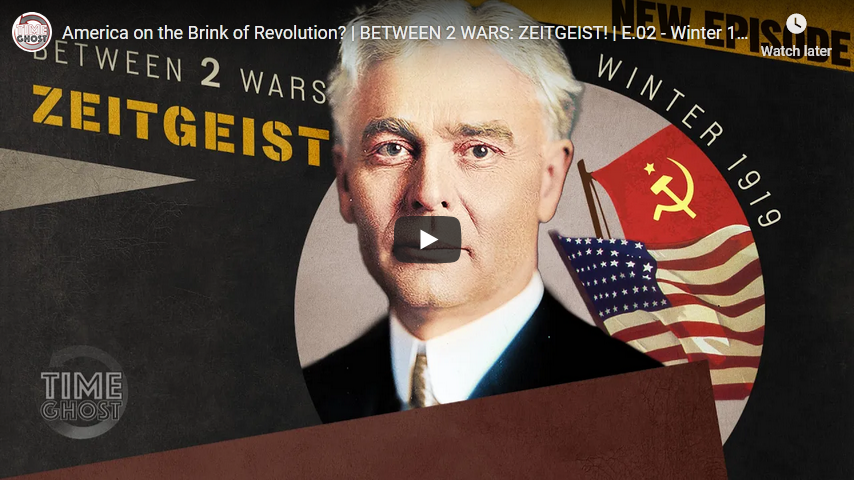
America on the Brink of Revolution? | BETWEEN 2 WARS: ZEITGEIST! | E.02 – Winter 1919

Filed under: Britain, Business, France, History, Media, USA — Tags: , , , , , , , — Nicholas @ 04:00

TimeGhost History
Published 4 Nov 2020

There is revolution and fear of revolution throughout the world in the winter of 1919. But cultural and technological revolutions are also bringing hope to many. A new age of Jazz and Cinema is about to reach America and Europe.

Join us on Patreon: https://www.patreon.com/TimeGhostHistory

Hosted by: Indy Neidell
Written by: Indy Neidell, Francis van Berkel, and Spartacus Olsson.
Director: Astrid Deinhard
Producers: Astrid Deinhard and Spartacus Olsson
Executive Producers: Astrid Deinhard, Indy Neidell, Spartacus Olsson, Bodo Rittenauer
Creative Producer: Maria Kyhle
Post-Production Director: Wieke Kapteijns
Research by: Indy Neidell, Francis van Berkel, and Spartacus Olsson.
Archive Research: Daniel Weiss
Edited by: Daniel Weiss
Sound design: Marek Kamiński

Colorizations:
Daniel Weiss – https://www.facebook.com/TheYankeeCol…
Mikołaj Uchman
Norman Stewart – https://oldtimesincolor.blogspot.com/

Sources:

From the Noun Project:
– Money by Gilberto
– lightbulb By Maxim Kulikov

Soundtracks from Epidemic Sound and ODJB:
– “One More for the Road” – Golden Age Radio
– “The Last Journey” – Line Neesgaard
– “Tiger_Rag” – ODJB
– “Not Safe Yet” – Gunnar Johnsen
– “Please Hear Me Out” – Philip Ayers
– “Dark Shadow” – Etienne Roussel
– “The Inspector 4” – Johannes Bornlöf
– “I Won’t Give You Up” – Almost Here
– “The Charleston” – Macy’s Voice
– “Defeated” – Wendel Scherer

Archive by Screenocean/Reuters https://www.screenocean.com.

A TimeGhost chronological documentary produced by OnLion Entertainment GmbH.

From the comments:

TimeGhost History
2 days ago (edited)
As in life, this series will always be a curious balance of light and dark. In the winter of 1919, one Parisian might have tickets to see the Original Dixieland Jass Band while their neighbour lies destitute after the war, and a well-to do man in Glasgow might be at the cinema while tanks rolls into his city to quell industrial unrest.

Troubled and fascinating times then and troubled fascinating times now here in 2020. All of us here at TimeGhost hope that all of you are healthy and staying safe. And hey, if you need some entertainment to pass the time, you can find plenty of Between 2 Wars episodes alongside WW2 In Real Time and BIO Specials!

November 4, 2020

QotD: The dangers of breaking the “fourth wall”

Filed under: Media, Quotations — Tags: , , , — Nicholas @ 01:00

Those are the givens. It doesn’t matter how ludicrous they are, so long as you don’t break your own rules.

Note that the rules can be broken from either side, the spectacle’s or the audience’s. Movies these days are most often guilty of the former, while rasslin’ bankrupted itself doing the latter. The last Star Wars movie I saw, for instance, was the first one with Girl Luke. It broke its own in-universe rules by having Girl Luke do everything Luke did, minus the training and effort and self doubt. She was just instantly awesome at everything, because grrrl power, and now that franchise is in the process of bankrupting (oh God, let it be so, and soon!) the entire Disney empire. Rasslin’ first tried to fool the “smart marks,” then went the nudge-nudge wink-wink route — both fatal to the suspension of disbelief for the majority of fans, who were still operating under the old contract.

Under the old contract, “wrestling fan,” like “Star Wars fan” or “Schwarzenegger movie fan” or what have you was a temporary identity. You went to the spectacle to put your real self aside for a few hours. You buy the ticket, and cease being Joe Schmoe the mechanic or the plumber or the customer service rep or the shmuck who still lives at home because he just can’t catch a break. Instead you’re transported to a galaxy far, far away, where bodybuilders are time-traveling robots and men in spandex come back from the dead to body slam their rivals.

For that kind of person, breaking the fourth wall, as the lit-crit types call it, is a slap in the face. Ha ha, fuck you, you loser! You don’t get to enjoy a few hours in a galaxy far, far away from your normal life, because we’ll be constantly reminding you that all of this is fake fake fake fake fake! You can watch the body slams and light saber fights, but every time you’re just starting to get into it and forgetting yourself, we’re gonna pop back up with an in-your-face aside! You’re a loser, and the very fact that you’re here watching this proves you’re a waste of oxygen! Take that!

In other words, loser is the fixed identity on which Postmodern entertainment is parasitic. This is just aces for the dorks-with-big-microphones who write the Tweets, since nudge-nudge wink-winking each other about what losers those other fans are is what keeps them, the Postmodern ironists, from feeling like losers themselves. But see above, with wrestling. Or Star Wars, or now sportsball, or pretty much anything else. The Postmodern ironists don’t buy tickets. They don’t go to the show in person, because they know that bringing their Postmodern ironic act into the theater would likely end with them getting their asses kicked.

Severian, “Rasslin'”, Rotten Chestnuts, 2020-07-26.

November 1, 2020

QotD: Trumbo

Over the past weekend I watched Trumbo, the story of the Marxist screenwriter blacklisted by Hollywood during the Red Scare back in the 1950s. To say that I watched it with a jaundiced eye would be a very big understatement, because I suspected (just from the trailer) that the movie would just be one big blowjob for both Dalton Trumbo and his merry little band of Commiesymps who infested Hollywood back then.

And it was. Needless to say, the movie made villains of the conservatives who opposed the Marxist infiltration: people like John Wayne and Hedda Hopper in particular, Wayne because Wayne, and Hopper because she had a son serving in the U.S. Navy during the Korean War. Of course Wayne was made out to be a bully and Hopper a vindictive bitch — and the Senators and Congressmen who haled the Commies in front of the Senate and House Un-American Committee (HUAC) were depicted as ideological purists who saw Communists behind every bush — even though, in the case of Hollywood, there were Commies behind every bush at the time.

Of course, much was made of the fact that being a Communist wasn’t actually illegal (then, and now), and Trumbo made a great show of this being a First Amendment issue — which it was — and how these Commies all wanted to improve America, but of course there were evil right-wingers like Wayne, Joe McCarthy and HUAC harassing them at every turn.

The execution of the traitors Julius and Ethel Rosenberg got a little puff piece in the movie, which didn’t — couldn’t — actually say they weren’t guilty of treason espionage, so it was brushed over with the throwaway that it was the first execution for espionage in peacetime, as though peacetime should give espionage a pass. And if that wasn’t enough, the Rosenberg children were paraded around as sympathy magnets — as they still are — because Communists have no problem using children to serve their own purposes.

Kim du Toit, “Blacklists Matter”, Splendid Isolation, 2020-07-28.

October 31, 2020

Atun-Shei’s Dracula

Filed under: Books, Britain, Europe, History, Media — Tags: , , , , , — Nicholas @ 06:00

Atun-Shei Films
Published 30 Oct 2020

🎃 Get 50% OFF 👉🏻 your first 6 months of Babbel 🕰 limited time only! HERE: http://bit.ly/AtunSheiFilms

An in-depth analysis of Dracula, the original 1897 book by Bram Stoker, possibly the most influential horror novel ever written. Why has the Count enjoyed such longevity in popular culture? What made Dracula so scary for Victorian readers? And what – pray tell – makes vampires so attractive?

Support Atun-Shei Films on Patreon ► https://www.patreon.com/atunsheifilms

Leave a Tip via Paypal ► https://www.paypal.me/atunsheifilms

Buy Merch ► teespring.com/stores/atun-shei-films

#BramStoker #Dracula #Analysis

Reddit ► https://www.reddit.com/r/atunsheifilms
Twitter ► https://twitter.com/atun_shei

~REFERENCES~

[1] “Dracula Movies” (2016). IMDB https://www.imdb.com/list/ls058255047/

[2] Leslie S. Klinger. The New Annotated Dracula (2008). W.W. Norton & Company, Page xvi

[3] Klinger, Page xxi

[4] Dr. Andrzej Diniejko. “Slums and Slumming in Late-Victorian London.” The Victorian Web http://www.victorianweb.org/history/s…

[5] Gill Davies. “London in Dracula; Dracula in London” (2004). Literary London: Interdisciplinary Studies in the Representation of London, Volume 2 Number 1 http://www.literarylondon.org/london-…

[6] Klinger, xxxii-xli

[7] “An 1897 Review of Bram Stoker’s Dracula” (2019). Literary Hub https://bookmarks.reviews/an-1897-rev…

[8] “The Spectator‘s Review of Dracula, 1897″ (2012). The Spectator https://www.spectator.co.uk/article/t…

[9] olly Furneaux. “Victorian Se•ualities” (2014). British Library https://www.bl.uk/romantics-and-victo…

[10] Klinger, Page xvii-xviii

[11] Greg Buzwell. “Daughters of Decadence: The New Woman in the Victorian Fin De Siécle” (2014). British Library https://www.bl.uk/romantics-and-victo…

October 29, 2020

War, Cinema, and Cheese! | BETWEEN 2 WARS: ZEITGEIST! | E.01 – Harvest 1918

TimeGhost History
Published 28 Oct 2020

War, poverty, and disease continue to pummel the word in the wake of the Great War. But still, humanity carries on, not only surviving but creating a host of futuristic opportunities in the arts, the economy, and … cheese.

Join us on Patreon: https://www.patreon.com/TimeGhostHistory

Hosted by: Indy Neidell
Written by: Indy Neidell, Francis van Berkel, and Spartacus Olsson.
Director: Astrid Deinhard
Producers: Astrid Deinhard and Spartacus Olsson
Executive Producers: Astrid Deinhard, Indy Neidell, Spartacus Olsson, Bodo Rittenauer
Creative Producer: Maria Kyhle
Post-Production Director: Wieke Kapteijns
Research by: Indy Neidell, Francis van Berkel, and Spartacus Olsson.
Archive Research: Daniel Weiss
Edited by: Daniel Weiss
Sound design: Marek Kamiński

Colorizations:
Daniel Weiss – https://www.facebook.com/TheYankeeCol…
(BlauColorizations) – https://www.instagram.com/blaucolorizations
Dememorabilia – https://www.instagram.com/dememorabilia/

Sources:

From the Noun Project:
iron cross By Souvik Maity, IN
poverty By Phạm Thanh Lộc, VN
Skull_51748

Soundtracks from Epidemic Sound:
– “One More for the Road” – Golden Age Radio
– “Dark Shadow” – Etienne Roussel
– “Not Safe Yet” – Gunnar Johnsen
– “Rememberance” – Fabien Tell
– “Last Point of Safe Return” – Fabien Tell
– “Steps in Time” – Golden Age Radio
– “What Now” – Golden Age Radio
– “Sunday Worship” – Radio Night
– “Astray” – Alec Slayne
– “Break Free” – Fabien Tell

Archive by Screenocean/Reuters https://www.screenocean.com.

A TimeGhost chronological documentary produced by OnLion Entertainment GmbH.

From the comments:

TimeGhost History
1 day ago
Welcome back to Between Two Wars! Strap in for what is going to be an exciting ride through the massive cultural, social, economic, and technological shifts that take place after the Great War. We can’t guarantee this will always be a positive tale. These changes entail plenty of fear and suffering, and even ‘fun’ things like the Jazz Age have their darker sides.

But that doesn’t alter the fact that the interwar era is a time of promise where people envision modern futures to replace old pasts. There is everything to play for in this brave new world and a vision of progress all around in politics, culture, food, and more.

October 1, 2020

Historical Breakdown of A Bridge Too Far – Planning and Failure of Market Garden I RHINELAND 45

The Great War
Published 30 Sep 2020

Support our brand new World War 2 documentary about The Battle of the Rhineland (not to be released on YouTube): https://realtimehistory.net/rhineland45

After last year’s Downfall video (with over 1 million views!) we thought we look at another classic WW2 movie and give you a breakdown about the historical figures and background. Our pick this time: A Bridge Too Far.

» SUPPORT THE CHANNEL
Patreon: https://www.patreon.com/thegreatwar

» OUR PODCAST
https://realtimehistory.net/podcast – interviews with World War 1 historians and background info for the show.

» BUY OUR SOURCES IN OUR AMAZON STORES
https://realtimehistory.net/amazon *
*Buying via this link supports The Great War (Affiliate-Link)

» SOURCES
A. Beevor, Arnhem: The Battle for the Bridges (2018)
B. Horrocks, Escape to Action (1960)
R. Neillands, The Battle for the Rhine 1944 (2005)
Builder, Bankes, Nordin, Command Concepts (1999)
www.pegasusarchive.org
www.nam.ac.uk/explore/market-garden
www.iwm.org.uk/history/the-story-of-operation-market-garden-in-photos

» MORE THE GREAT WAR
Website: https://realtimehistory.net
Instagram: https://instagram.com/the_great_war
Twitter: https://twitter.com/WW1_Series
Reddit: https://reddit.com/r/TheGreatWarChannel

»CREDITS
Presented by: Jesse Alexander
Written by: Jesse Alexander
Director: Toni Steller & Florian Wittig
Director of Photography: Toni Steller
Sound: Toni Steller
Editing: Toni Steller
Motion Design: Philipp Appelt
Mixing, Mastering & Sound Design: http://above-zero.com
Maps: Daniel Kogosov (https://www.patreon.com/Zalezsky)
Research by: Matthew Moss
Fact checking: Florian Wittig

Channel Design: Alexander Clark
Original Logo: David van Stephold

Contains licensed material by getty images
All rights reserved – Real Time History GmbH 2020

From the comments:

The Great War
6 hours ago
Support our brand new World War 2 documentary about The Battle of the Rhineland (not to be released on YouTube): https://realtimehistory.net/rhineland45 *

*We know that some of you don’t like the fact that we upload non-Great War content once in a while. But here are a few fun facts: Last year’s video about THAT scene from Downfall has been one of our most successful videos ever produced. It helped us spreading the word about our crowdfunding campaign last year and it also brought new subscribers to The Great War that hadn’t heard about it. And in the cut-throat world of the YouTube attention economy this is really important for our continued existence. Another “fun” fact: Both this video and the Downfall video were both claimed for copyright violation even though they clearly fall under fair use. We disputed and lost and now there is nothing we can do about the fact that someone else is earning money through our work. Just one of the reasons why it’s increasingly frustrating working with YouTube and why we are exploring other avenues for The Great War and our other projects.

Far from being in trouble, Canadian film and TV investment has nearly doubled in the last 10 years

Filed under: Business, Cancon, Government, Media — Tags: , , , , , , , — Nicholas @ 03:00

The Canadian government — particularly Canadian Heritage minister Steven Guilbeault — is eager to pass legislation to “get money from the web giants” and their primary justification is the claim that Canadian TV and movie funding has been shrinking. As Michael Geist explains, that’s a pants-on-fire lie:

CMPA Profile – Financing, Sources: CMPA Profile 2019, 2016, 2013

Canadian Heritage Minister Steven Guilbeault has said that his top legislative priority is to “get money from web giants.” While much of the attention has focused on his ill-advised plan to require Facebook to obtain licences for linking to news articles, his first legislative step is likely to target Internet streamers such as Netflix, Amazon and Disney with new requirements to fund Canadian content and to increase its “discoverability” by making it more prominent for subscribers. Based on his comments at several town halls, Guilbeault is likely to also create new incentives for supporting indigenous and persons of colour in the sector with a bonus for those investments (potentially treating $1 of investment as $1.50 for the purposes of meeting Cancon spending requirements). Much of the actual implementation will fall to the CRTC, which will be granted significant new regulatory powers and targeted with a policy direction.

Guilbeault’s case for establishing new mandated payments is premised on the claim that support for the film and television sector is declining due to the emergence of Internet streaming services, which have resulted in decreased revenues for the conventional broadcast sector and therefore lower contributions to Cancon creation. In fact, Guilbeault recently told Le Devoir that without taking action there would be a billion dollar deficit in support in the next three years. He says that his objective is to actually generate a few hundred million more per year in local production by the Internet streamers. In other words, he’s expecting roughly $2 billion in new investment over three years in Cancon from U.S. entities due to his planned regulations (moving from a billion dollar deficit to a billion dollars in extra spending).

While Guilbeault frames these regulatory requirements as a matter of fairness and “rebalancing”, industry data over the past decade tell a much different story. Indeed, there has been record setting film and television production in recent years, much of it supported by companies such as Netflix. CRTC chair Ian Scott last year said that Netflix is “probably the biggest single contributor to the [Canadian] production sector today.” While that is not entirely true – the data suggests that Canadian taxpayers are the biggest contributor with federal and provincial tax credits consistently the largest source of financing – the claim that there is a billion dollar deficit coming or that foreign streamers do not contribute to film and television production in Canada without a regulatory requirement is simply false.

September 29, 2020

Modern Classics Summarized: 1984

Overly Sarcastic Productions
Published 24 Feb 2017

It’s the mother of all dystopias! Long before YA dystopia rose to power, before the age of Young Attractive Heroes who Rebel Against The State and Also Find Love, there was just Winston Smith — a middle-aged man in poor health who Rebelled Against The State and Also Found Love. It just ended much less prettily for him.

1984 codified most of the modern dystopia tropes — absolute control of the media, black-bagging people who spoke out, and a lot of popular terms like “doublethink”, “big brother”, and “thought police”. Unfortunately, a lot of those terms got stripped of context and thrown around for the sake of Extra Edge, and as a result they get used a little haphazardly. And there’s nothing Red hates more than misused terminology, so here’s the video outlining the ORIGINAL meaning of 1984!

PATREON: www.patreon.com/user?u=4664797

MERCH LINKS:
Shirts – https://overlysarcasticproducts.threa…
All the other stuff – http://www.cafepress.com/OverlySarcas…

Find us on Twitter @OSPYouTube!

August 30, 2020

Why Gods and Generals is Neo-Confederate Propaganda (and Objectively Sucks)

Filed under: History, Humour, Media, Military, USA — Tags: , , , , , — Nicholas @ 02:00

Atun-Shei Films
Published 12 Aug 2019

Like if Ken Burns and Mr. Plinkett had a baby.

Gods and Generals (2003) is a four and a half hour long epic from the director of Gettysburg (1993), chronicling the first two years of the American Civil War in the Eastern Theater from the point of view of General Stonewall Jackson. In this video essay / review, I examine how the film is an insidious piece of pro-Confederate propaganda, echoing the inaccuracies and misconceptions of the notorious Lost Cause myth.

Support Atun-Shei Films on Patreon ► https://www.patreon.com/atunsheifilms
#GodsAndGenerals #CivilWar #VideoEssay

Watch our film ALIEN, BABY! free with Prime ► http://a.co/d/3QjqOWv
Reddit ► https://www.reddit.com/r/atunsheifilms
Twitter ► https://twitter.com/alienbabymovie
Instagram ► https://www.instagram.com/atunsheifilms
Merch ► https://atun-sheifilms.bandcamp.com

August 24, 2020

MATERA – James Bond and the City of Beige

Filed under: Architecture, Books, Europe, History, Italy — Tags: , , , — Nicholas @ 04:00

Lindybeige
Published 23 Aug 2020

Get your first audiobook and a monthly selection of Audible Originals for free when you try Audible for 30 days visit https://www.audible.com/lindybeige or text lindybeige to 500 500.

Matera is an city in Italy which has suddenly become famous. It is rather special and here I describe why.

Support me on Patreon: https://www.patreon.com/Lindybeige

Buy the music – the music played at the end of my videos is now available here: https://lindybeige.bandcamp.com/track…

Buy tat (merch):
https://outloudmerch.com/collections/…

Lindybeige: a channel of archaeology, ancient and medieval warfare, rants, swing dance, travelogues, evolution, and whatever else occurs to me to make.

▼ Follow me…

Twitter: https://twitter.com/Lindybeige I may have some drivel to contribute to the Twittersphere, plus you get notice of uploads.

My website:
http://www.LloydianAspects.co.uk

August 21, 2020

Virtuesplaining Blazing Saddles

Filed under: History, Humour, Media, Politics, USA — Tags: , , , , , , — Nicholas @ 03:00

Paul du Quenoy says that Mel Brooks is cancelled after all:

It seems like only yesterday that HBO Max, the financially troubled American cable television network’s new film streaming service, signalled its virtue by removing Gone With The Wind from viewing so that the classic film could be properly “contextualised” as what presenter and University of Chicago film professor Jacqueline Stewart calls “a prime text for examining expressions of white supremacy in popular culture”. She believes this is useful for the “re-education” of audiences who might otherwise stray into thoughtcrime.

Mel Brooks’s smash hit 1974 comedy Blazing Saddles, which seems to have been added to HBO Max since the Gone With The Wind dust up and is known for its liberal use of the feared and loathed “n-word”, arrived with a similarly patronising disclaimer already installed. In a three-minute introduction that apparently cannot be skipped over, Stewart is there again, this time to inform viewers that “racist language and attitudes pervade the film”, while instructing them that “those attitudes are espoused by characters who are portrayed here as explicitly small-minded, ignorant bigots … The real, and much more enlightened, perspective is provided by the main characters played by Cleavon Little and Gene Wilder”.

Thanks, Aunt Jacqueline. If you have not seen Blazing Saddles – and if you are under the age of forty there is an excellent chance some prudish authority figure sanitised it out of your cosseted millennial existence – it stands as one of the greatest, and the certainly the funniest, anti-racist films of all time. Based on a story by Andrew Bergman, Brooks conceived it as a scathing send-up of racism and the hypocrisy that still enabled it after the great civil rights victories of the 1960s. Brooks’s idiom was a parody of the classic Western, by then an exhausted genre that had, among other flaws, become inanely predictable and was much criticised for leaving out minorities. A landmark of American film, Blazing Saddles was selected in 2006 for inclusion in the US National Film Registry, which recognises “culturally, historically, or aesthetically significant films” worthy of preservation.

Drenched in hilarity – and by my count using the “n-word” 17 times in its 93-minute run – the plot involves a conspiracy by an avaricious U.S. state attorney general who wants to drive white settlers off land he needs to complete a profitable railroad project. After having outlaws wreak mayhem on the townspeople, he recommends that the governor appoint a black sheriff to restore law and order, cynically assuming that their racism will cause them to reject the new lawman and give up. Despite a rough initial reception, the sheriff outwits attempts to get rid of him and, with the help of a washed up but sympathetic alcoholic gunslinger, leads the townspeople to victory, winning their love and respect before moving on to other brave deeds.

While HBO no longer wants to risk having its paying customers think for themselves (and what stale corporate outfit uneasily transitioning to a crowded new market wouldn’t?), it could rightly be said that anyone dumb enough to miss the film’s message might be a recent product of Anglo-American higher education. I do not mean this at all facetiously. Decaying and run by a self-important clerisy whose demands to be taken seriously only become shriller as it declines in reach and vitality – and from which any participant can be dismissed for even the slightest speech or behavioural infraction – academia naturally discourages humour. Jokes, which can almost always cause some kind of offence, are simply too risky to be told or laughed at, even in private. Finding the wrong thing funny can invite career-hobbling accusations that one has demeaned a student or colleague and thereby made them feel unacceptably “uncomfortable” or even physically “unsafe”. Perceived flippancy bruises sanctified “professional seriousness” in a way tantamount to sacrilege. The only tolerated exceptions are a kind of solemn irony that offers comfort in coping with academia’s increasing irrelevance and a resigned gallows humor about its ever more limited prospects.

August 13, 2020

Hitler’s screen idol – Leni Riefenstahl – WW2 Biography Special

World War Two
Published 12 Aug 2020

Leni Riefenstal’s film techniques were groundbreaking and are still influential today. She did, though, create her most famous works in the service of Adolf Hitler.

Join us on Patreon: https://www.patreon.com/TimeGhostHistory
Or join The TimeGhost Army directly at: https://timeghost.tv

Follow WW2 day by day on Instagram @World_war_two_realtime https://www.instagram.com/world_war_two_realtime
Between 2 Wars: https://www.youtube.com/playlist?list…
Source list: http://bit.ly/WW2sources

Written and Hosted by: Indy Neidell
Director: Astrid Deinhard
Producers: Astrid Deinhard and Spartacus Olsson
Executive Producers: Astrid Deinhard, Indy Neidell, Spartacus Olsson, Bodo Rittenauer
Creative Producer: Joram Appel
Post-Production Director: Wieke Kapteijns
Research by: Madeline Johnson
Edited by: Monika Worona
Sound design: Marek Kamiński
Map animations: Eastory (https://www.youtube.com/c/eastory)

Colorizations by:
– Norman Stewart – https://oldtimesincolor.blogspot.com/
– Olga Shirnina, a.k.a. Klimbim – https://klimbim2014.wordpress.com/

Sources:
– Bundesarchiv

Archive by Screenocean/Reuters https://www.screenocean.com.

A TimeGhost chronological documentary produced by OnLion Entertainment GmbH.

From the comments:

World War Two
4 hours ago
Thanks to Madeline Johnson for the research for this episode. In many ways it’s our community who keep TimeGhost going. If you want to be part of this then join the TimeGhost Army on www.patreon.com/timeghosthistory or https://timeghost.tv.

Please let us know what other Bios you’d like to see. And if you have a question about the war you’re dying to have answered, submit it for our Q&A series, Out of the Foxholes at: https://community.timeghost.tv/c/Out-of-the-Foxholes-Qs.

« Newer PostsOlder Posts »

Powered by WordPress