The worship of Napoleon has always been a French mystery. Is it spontaneous, reflecting nostalgia for empire, or something organized by the state, which has inherited from that period a matchless taste for authority? French schoolchildren are taught only the benefits of the emperor’s reign. According to our textbooks, Napoleon is supposed to have endowed France with a perfect legal system that still governs us today and to have caused the winds of freedom to blow across Europe. Each year, a dozen more books are published in France touting Napoleon’s glory. He has been represented more often than Christ on film, always as a positive hero.
Other Europeans see him very differently. While French historians amplify the myth that Napoleon himself created by dictating his idealized Memoires on St. Helena, English, German, Russian and Spanish authors count up the massacres and the destruction of their cities and their civilization.
Napoleon began shaping his reputation while he was still alive. He commonly wrote reports of his victories before the battles had even begun, which makes him the founding father of fake news. Certain disasters, such as the Battle of Eylau (now in Poland) against the Russians and Prussians, for example, are still inscribed in the walls of the Arc de Triomphe in Paris as if they were victories, since that is how they were first announced.
Since France is now part of Europe — rather than Europe becoming part of France, as Napoleon wished — what should we commemorate? French victories, such as Austerlitz, were defeats for the Russians and Austrians. Waterloo, a day of mourning for the French, is a symbol of liberation for the British, Germans, and Dutch. In any case, since the return of Napoleon’s ashes, our view of history has changed; the fate of people concerns us more than the fate of armies. Napoleon’s stature does not benefit from this change of perspective. To finance his wars, he ruined Europe, banning international commerce (only smugglers got rich), conscripting peasants, ravaging harvests, and confiscating horses. How should we commemorate the Russian and German campaigns of 1812 and 1813, when the Grand Army left in its wake not the liberation of peoples, but famine and epidemic? Worst still, how should we commemorate the restoration of slavery in the French Antilles, Guadeloupe, and Santo Domingo (Haiti), where the deputies of France’s Revolutionary Convention had abolished it in 1794?
Guy Sorman, “Which Napoleon?”, City Journal, 2021-05-14.
September 15, 2021
QotD: The cult of Napoleon
September 13, 2021
Early Rome, Part IV: Plutarch’s Life of Numa Pompilius
Thersites the Historian
Published 5 Sep 2021In this video, we look at how the philosopher Plutarch dealt with early Rome when he covered the life and times of Numa Pompilius, the most significant of Rome’s cultural heroes.
Patreon link: https://www.patreon.com/thersites
PayPal link: paypal.me/thersites
Discord: https://discord.gg/QCaXXFr
Brave Browser: https://brave.com/noa557
Twitter link: https://twitter.com/ThersitesAthens
Minds.com link: https://www.minds.com/ThersitestheHis…
Steemit/dtube link: https://steemit.com/@thersites/feed
BitChute: https://www.bitchute.com/channel/jbyg…
September 12, 2021
Early Rome, Part III: Livy and the Roman Tradition of Early Rome
Thersites the Historian
Published 5 Sep 2021Here, I examine Livy’s Book I with an emphasis on the tradition that he worked in and his agenda for undertaking such a massive and ambitious project.
Patreon link: https://www.patreon.com/thersites
PayPal link: paypal.me/thersites
Discord: https://discord.gg/QCaXXFr
Brave Browser: https://brave.com/noa557
Twitter link: https://twitter.com/ThersitesAthens
Minds.com link: https://www.minds.com/ThersitestheHis…
Steemit/dtube link: https://steemit.com/@thersites/feed
BitChute: https://www.bitchute.com/channel/jbyg…
September 6, 2021
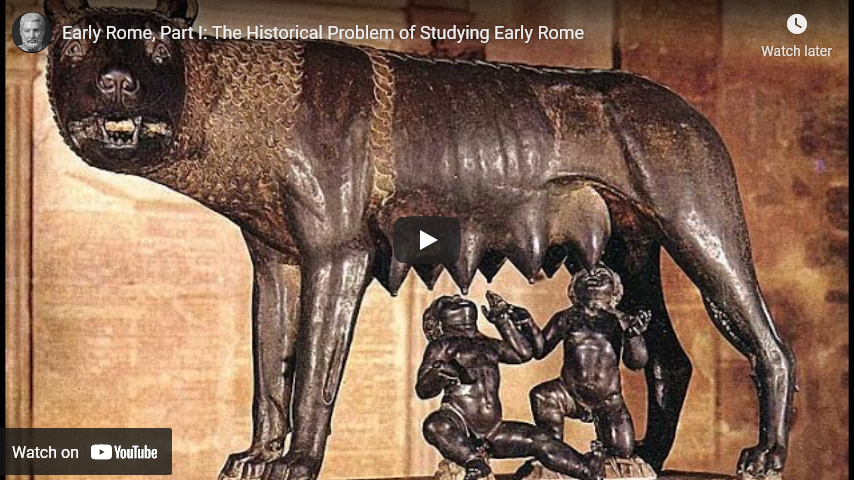
Early Rome, Part I: The Historical Problem of Studying Early Rome
Thersites the Historian
Published 2 Sep 2021In this video, I discuss why early Rome is difficult to study and preview the upcoming episodes in this series.
Patreon link: https://www.patreon.com/thersites
PayPal link: paypal.me/thersites
Discord: https://discord.gg/QCaXXFr
Brave Browser: https://brave.com/noa557
Twitter link: https://twitter.com/ThersitesAthens
Minds.com link: https://www.minds.com/ThersitestheHis…
Steemit/dtube link: https://steemit.com/@thersites/feed
BitChute: https://www.bitchute.com/channel/jbyg…
August 18, 2021
QotD: Napoleon Bonaparte
The French Republic still uses Napoleonic touches in its mythmaking, as do its politicians. Sweden’s crown is still worn by descendants of Bernadotte, a general who was of humble birth but proved the ultimate champion of the emperor’s bizarre game of thrones. Napoleon said of his army that every man in it carried a marshal’s baton in his knapsack. By the same token, every ambitious colonel who ever plotted to pull together a squadron of tanks and overthrow a president carries a little portrait of Napoleon I next to his bosom. It may not be fair to say that Napoleon bears part of the responsibility for Hitler, but if there had been no Napoleon there could not possibly have been a Hitler. It is probably one of those “necessary cause” vs. “sufficient cause” things that give people so much trouble.
The bicentenary of Napoleon’s lonely death in custody on a windblown South Atlantic island has given the English an excuse to refresh some of their most precious and whimsical tokens of victory. At Apsley House, the home of the 1st Duke of Wellington, art restorers have been giving special attention to a bronze copy of Napoleon’s death mask, which was taken in plaster after the emperor expired. It’s a mesmerizing totem: to our eyes, the face emphasizes the Italian character that the ci-devant Buonaparte struggled to elude and conceal on the way to becoming master of France. Death masks seem creepy to us today, but they speak in ways a portrait cannot.
Colby Cosh, “Will There Be Cake?”, NP Platformed, 2021-05-05.
August 5, 2021
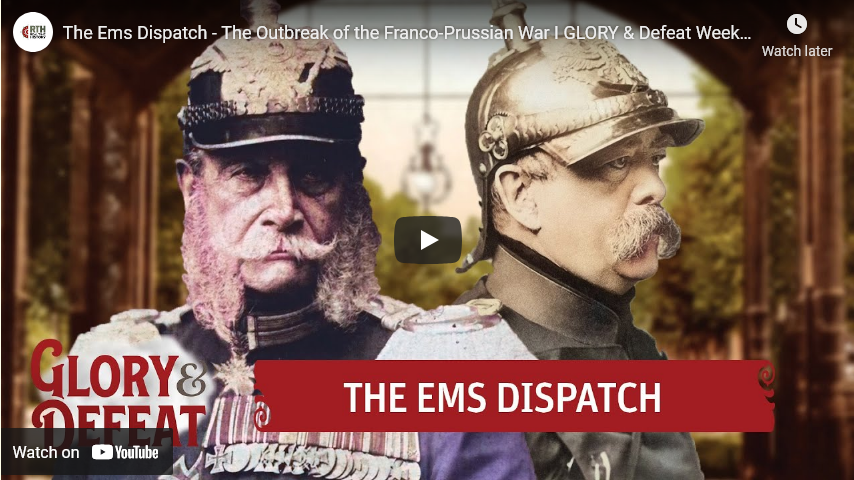
The Ems Dispatch – The Outbreak of the Franco-Prussian War I GLORY & Defeat Week 1
realtimehistory
Published 13 Jul 2021Support Glory & Defeat: https://realtimehistory.net/gloryandd…
French and Prussian animosity have been swelling in the background since the German Wars of Unification started in the 1860s. The French Duc de Gramont hopes that a victory over Prussia could restore French prestige while Prussian Chancellor Bismarck needs a reason to fulfill his dream of German unification from above. When the crisis about the Spanish throne escalates with the Ems Dispatch, the die is cast and the Franco-Prussian War begins.
» OUR PODCAST
https://realtimehistory.net/podcast – interviews with historians and background info for the show.» LITERATURE
Arand, Tobias: 1870/71 – Die Geschichte des Deutsch-Französischen Krieges erzählt in Einzelschicksalen. Hamburg 2018Böhme, Helmut: (Hrsg.): Die Reichs-gründung. dtv-Dokumente. München 1967
Gall, Lothar (Hrsg: Deutschland Archiv). Kaiserreich Bd. I. o.O. 2007
Girard Louis: Napoléon III. Paris 1986
Mährle, Wolfgang (Hrsg.): Nation im Siegesrausch. Württemberg und die Gründung des Deutschen Reiches 1870/71. Stuttgart 2020
Milza, Pierre: L’année terrible. La guerre franco-prussienne septembre 1870 – mars 1871. Paris 2009
» SOURCES
Fontane, Theodor: Der Krieg gegen Frankreich Bd. I. Berlin 1873Louis L. Snyder, ed., Documents of German History. New Brunswick, N.J.: Rutgers University Press, 1958
» OUR STORE
Website: https://realtimehistory.net»CREDITS
Presented by: Jesse Alexander
Written by: Cathérine Pfauth, Dr. Tobias Arand, Jesse Alexander
Director: Toni Steller & Florian Wittig
Director of Photography: Toni Steller
Sound: Above Zero
Editing: Toni Steller
Motion Design: Philipp Appelt
Mixing, Mastering & Sound Design: http://above-zero.com
Maps: Battlefield Design
Research by: Cathérine Pfauth, Prof. Dr. Tobias Arand
Fact checking: Cathérine Pfauth, Prof. Dr. Tobias ArandChannel Design: Battlefield Design
Contains licensed material by getty images
All rights reserved – Real Time History GmbH 2021
August 3, 2021
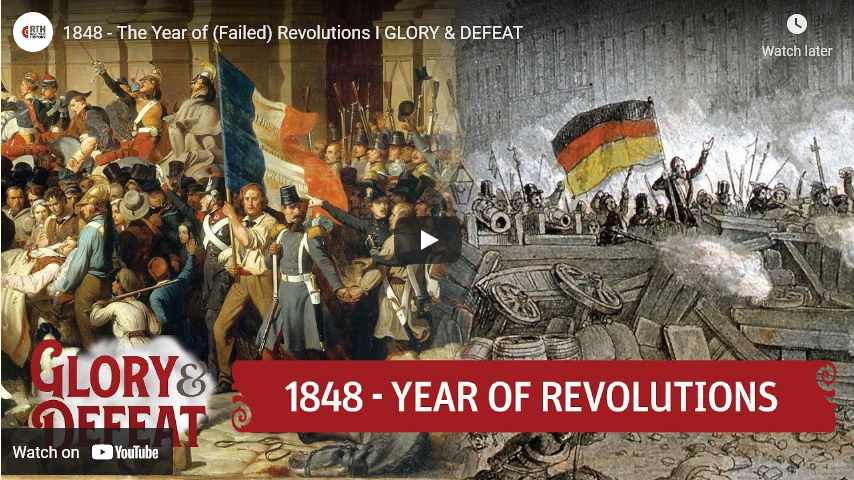
1848 – The Year of (Failed) Revolutions I GLORY & DEFEAT
realtimehistory
Published 7 Jul 2021Support Glory & Defeat: https://realtimehistory.net/gloryandd…
The year 1848 was pivotal in European history. All across the continent revolutionary movements erupted and demanded a new order. This would be no different in France and in the German states.
» OUR PODCAST
https://realtimehistory.net/podcast – interviews with historians and background info for the show.» LITERATURE
Engehausen, Frank: Die Revolution von 1848/49. Paderborn, München 2007Gall, Lothar (Hrsg.): 1848 – Aufbruch zur Freiheit: Ausstellungskatalog zum 150-jährigen Jubiläum der Revolution von 1848/49. Berlin 1998
Gouttman, Alain. La grande défaite de 1870-1871. Paris 2015
Siemann, Wolfram: Die deutsche Revolution von 1848/49. Suhrkamp, Frankfurt am Main 1985
Wollstein, Günter: “Scheitern eines Traumes”. In: Informationen zur politischen Bildung, Heft 265 (2010) o.S.
» SOURCES
Carrey, Émile: Recueil complet des actes du Gouvernement provisoire. Première partie n° 281. Paris 1884Haupt, Hermann (Hrsg.): Quellen und Darstellungen zur Geschichte der Burschenschaft und der deutschen Einheitsbewegung, Band 1, Heidelberg 1910
N.N.: Die Staats-Verträge des Königsreichs Bayern von 1806 – 1858. Regensburg 1860
» OUR STORE
Website: https://realtimehistory.net»CREDITS
Presented by: Jesse Alexander
Written by: Cathérine Pfauth, Prof. Dr. Tobias Arand, Jesse Alexander
Director: Toni Steller & Florian Wittig
Director of Photography: Toni Steller
Sound: Above Zero
Editing: Toni Steller
Motion Design: Philipp Appelt
Mixing, Mastering & Sound Design: http://above-zero.com
Maps: Battlefield Design https://www.battlefield-design.co.uk/
Research by: Cathérine Pfauth, Prof. Dr. Tobias Arand
Fact checking: Cathérine Pfauth, Prof. Dr. Tobias ArandChannel Design: Battlefield Design
Contains licensed material by getty images
All rights reserved – Real Time History GmbH 2021
July 29, 2021
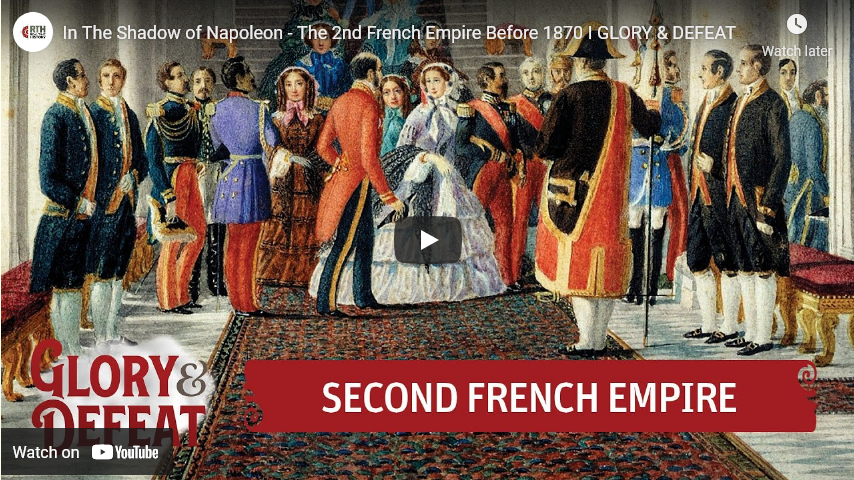
In The Shadow of Napoleon – The 2nd French Empire Before 1870 I GLORY & DEFEAT
realtimehistory
Published 12 Jul 2021Support Glory & Defeat: https://realtimehistory.net/gloryandd…
After Napoleon I had conquered and then lost Europe, France went through multiple revolutions. In 1851, Napoleon’s nephew and French president Louis-Napoléon Bonaparte took control and in 1852 crowned himself Emperor Napoleon III. The new French Empire wanted to regain the glory of Napoleon’s uncle and together with his wife Empress Eugenie he ruled a state known for lavish balls and spending.
» OUR PODCAST
https://realtimehistory.net/podcast – interviews with historians and background info for the show.» LITERATURE
Arand, Tobias: 1870/71. Die Geschichte des Deutsch-Französischen Kriegs erzählt in Einzelschicksalen. Hamburg 2018Arand, Tobias/Bunnenberg, Christian (Hrsg.): Karl Klein. Fröschweiler Chronik. Kriegs- und Friedensbilder aus dem Krieg 1870. Kommentierte Edition. Hamburg 2021
Gouttman, Alain. La grande défaite de 1870-1871. Paris 2015
Herre, Franz: Eugénie. Kaiserin der Franzosen. Stuttgart, München 2000
Rieder, Heinz: Napoleon III. Abenteurer und Imperator. München 1998
» SOURCES
Bonaparte, Prince Napoléon-Louis: Des Idées Napoléoniennes. London 1839Marx, Karl: Der achtzehnte Brumaire des Louis Napoleon. Hamburg 1869
Maupassant, Guy de: Bel-Ami. Paris 1901
N.N. (Hrsg): Fontane, Theodor. Aus den Tagen der Okkupation. Eine Osterreise durch Nordfrankreich und Elsaß-Lothingen 1871. Berlin (Ost) 1984
» OUR STORE
Website: https://realtimehistory.net»CREDITS
Presented by: Jesse Alexander
Written by: Cathérine Pfauth, Dr. Tobias Arand, Jesse Alexander
Director: Toni Steller & Florian Wittig
Director of Photography: Toni Steller
Sound: Above Zero
Editing: Toni Steller
Motion Design: Philipp Appelt
Mixing, Mastering & Sound Design: http://above-zero.com
Maps: Battlefield Design
Research by: Cathérine Pfauth, Prof. Dr. Tobias Arand
Fact checking: Cathérine Pfauth, Prof. Dr. Tobias ArandChannel Design: Battlefield Design
Contains licensed material by getty images
All rights reserved – Real Time History GmbH 2021
July 24, 2021
History Hijinks: Rome’s Crisis of the Third Century
Overly Sarcastic Productions
Published 23 Jul 2021Local Empire Too Stubborn To Die — Field Historian Blue is here at the scene of Ancient Rome with more on the Crisis of the Third Century.
SOURCES & Further Reading
https://www.britannica.com/place/anci… + Aurelian, Postumus, Zenobia
The Great Courses The Roman Empire: From Augustus to The Fall of Rome lectures 13 14 and 15, “From Commodus to Caracalla”, “The Crisis of the Third Century” and “Diocletian and Late Third-Century Reforms”, by Gregory Aldrete
The Enemies of Rome Chapter 20 “Parthia, Persia, Palmyra” by Stephen KershawPartial Tracklist: “Scheming Weasel”, Sneaky Snitch”, “Marty Gots A Plan” Kevin MacLeod (incompetech.com)Licensed under Creative Commons: By Attribution 4.0 License
http://creativecommons.org/licenses/b…Content is intended for teenage audiences and up.
PATREON: https://www.Patreon.com/OSP
PODCAST: https://overlysarcasticpodcast.transi…
DISCORD: https://discord.gg/osp
MERCH LINKS: http://rdbl.co/osp
OUR WEBSITE: https://www.OverlySarcasticProductions.com
Find us on Twitter https://www.Twitter.com/OSPYouTube
Find us on Reddit https://www.Reddit.com/r/OSP/
From the comments:
Facundo Cadaa
2 hours ago
Thumbnail: “Rome’s big crisis”Do you have any idea how little that narrows it down?
July 20, 2021
An unlikely survivor in India, His Highness the Prince of Arcot
Ned Donovan explains why there is still a Prince of Arcot, despite the Indian government having abolished all the titles and privileges of the nearly 600 “Maharajas, Maharanas, Rajas, Nawabs, Khans and so on” of the Princely states that were incorporated into modern India after Partition in 1947:
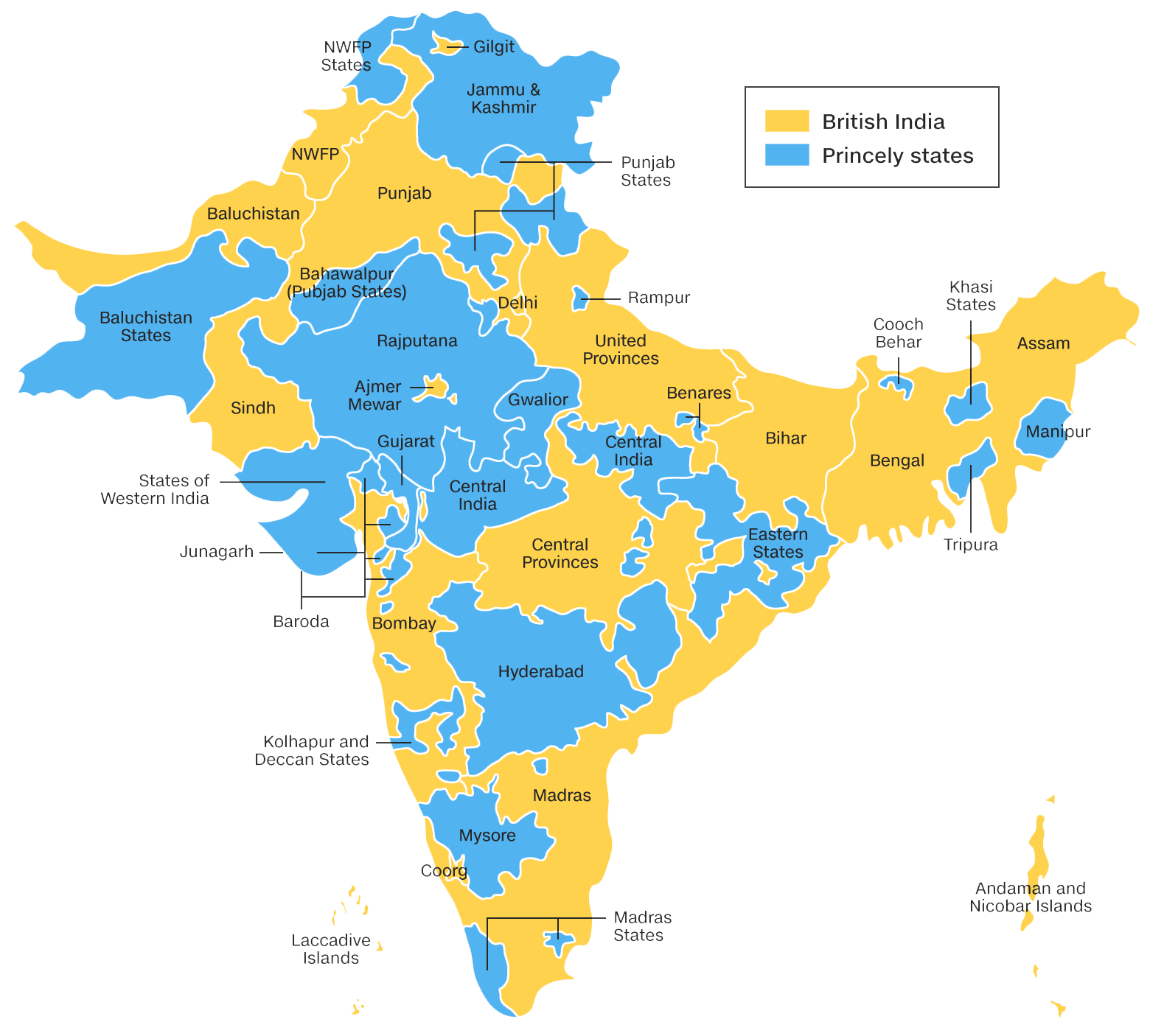
A significant amount of effort was taken during the process of independence to integrate these princely states into the newly independent countries. Almost all of the rulers acceded quickly and peacefully in return for recognition of their symbolic status and titles by the new republics who also promised perpetual large annual payments to sweeten the deal. A handful of princely states were stubborn and were integrated by force, with issues as a result to this day, such as Jammu and Kashmir.
As a result, for the first few decades of independent India, there existed a class of royals recognised within the republic, with privileges and financial support not that different to what they received during the period of British rule. But in 1971 this came tumbling down.
The then-Prime Minister Indira Gandhi amended the Indian Constitution to abolish all privileges and titles, along with any financial subsidies. She believed the whole system to be at odds with the secular socialist republic she was attempting to perfect. The move also had financial benefits: the large princely subsidies stopped being a drain on the Indian treasury while much of the royals’ gold and property were seized by the Government in the process. In 1972, Pakistan followed suit and similarly abolished its remaining princes’ titles.
But the title “Prince of Arcot” somehow escaped to carry on to the modern day … thanks to an unusual historical situation and the presentation of letters patent from Queen Victoria:
In 1855, the 13th Nawab of Arcot died without children. The British, influenced by the East India Company, declared the kingdom had lapsed as a result and annexed it entirely. As a token compensation, Queen Victoria in 1870 gave the last Nawab’s uncle a pension and the title of “His Highness the Prince of Arcot” for him and his descendants in perpetuity. This was granted in a type of royal charter, known as letters patent.
As there was no land still to rule, the Princes of Arcot existed in a strange realm of being kings without a kingdom but with significant influence and prestige. The title continued to pass down through the original holder’s family and they built a large palace, Amir Mahal, in Madras that became a centre of culture instead of one of government.
H/T to Colby Cosh for the link.
July 18, 2021
QotD: Rules of wars in the Eighteenth Century
This Treaty was a Good Thing and laid down the Rules for fighting the wars; these were:
(1) that there should be a mutual restitution of conquests except that England should keep Gibraltar, Malta, Minorca, Canada, India, etc.;
(2) that France should hand over to England the West Indian islands of San Flamingo, Tapioca, Sago, Dago, Bezique and Contango, while the Dutch were always to have Lumbago and the Laxative Islands;
(3) that everyone, however Infantile or even insane, should renounce all claim to the Spanish throne;
(4) that the King (or Queen) of France should admit that the King (or Queen) of England was King (or Queen) of England and should not harbour the Young Pretender, but that the fortifications of Dunkirk should be disgruntled and raised to the ground.
Thus, as soon as the fortifications of Dunkirk had been gruntled again, or the Young Pretender was found in a harbour in France, or it was discovered that the Dutch had not got Lumbago, etc., the countries knew that it was time for the treaty to be signed again, so that the War could continue in an orderly manner.
W.C. Sellar & R.J. Yeatman, 1066 And All That, 1930.
July 11, 2021
QotD: William and Mary
A Darien Scheme
The Scots were now in a skirling uproar because James II was the last of the Scottish Kings and England was under the rule of the Dutch Orange; it was therefore decided to put them in charge of a very fat man called Cortez and transport them to a Peak in Darien, where it was hoped they would be more silent.
Massacre of Glascoe
The Scots, however, continued to squirl and hoot at the Orange, and a rebellion was raised by the memorable Viscount Slaughterhouse (the Bonnie Dundee) and his Gallivanting Army. Finally Slaughterhouse was defeated at the Pass of Ghilliekrankie and the Scots were all massacred at Glascoe, near Edinburgh (in Scotland, where the Scots were living at that time); after which they were forbidden to curl or hoot or even to wear the Kilt. (This was a Good Thing, as the Kilt was one of the causes of their being so uproarious and Scotch.)
Blood-Orangemen
Meanwhile the Orange increased its popularity and showed themselves to be a very strong King by its ingenious answer to the Irish Question; this consisted in the Battle of the Boyne and a very strong treaty which followed it, stating (a) that all the Irish Roman Catholics who liked could be transported to France, (b) that all the rest who liked could be put to the sword, (c) that Northern Ireland should be planted with Blood Orangemen.
These Blood-Orangemen are still there; they are, of course, all descendants of Nell Glyn and are extremely fierce and industrial and so loyal that they are always ready to start a loyal rebellion to the Glory of God and the Orange. All of which shows that the Orange was a Good Thing, as well as being a good King. After the Treaty the Irish who remained were made to go and live in a bog and think of a New Question.
The Bank of England
It was Williamanmary who first discovered the National Debt and had the memorable idea of building the Bank of England to put it in. The National Debt is a very Good Thing and it would be dangerous to pay it off, for fear of Political Economy.
Finally the Orange was killed by a mole while out riding and was succeeded by the memorable dead queen, Anne.
W.C. Sellar & R.J. Yeatman, 1066 And All That, 1930.
July 4, 2021
QotD: It’s not your money … it’s the GOVERNMENT’S money
The left seems to be going off the same book when they say things like “How will you pay for the tax cuts?” as if the government is OF COURSE entitled to all your money, and if you’re getting some back, that part must be compensated for.
Sarah Hoyt, “The Tragedy of the Squid Farms on Mars”, Libertarian Enterprise, 2018-12-05.
June 30, 2021
QotD: The Yorkist pretenders
Two Pretenders who now arose were Lambert Simnel and Perkin Warbeck, and they succeeded in confusing the issue absolutely by being so similar that some historians suggest they were really the same person (i.e. the Earl of Warbeck).
Lambert Simnel (the Young Pretender) was really (probably) himself, but cleverly pretended to be the Earl of Warbeck. Henry VII therefore ordered him to be led through the streets of London to prove that he really was.
Perkin Warbeck (the Older and more confusing Pretender) insisted that he was himself, thus causing complete dissension till Henry VII had him led through the streets of London to prove that he was really Lambert Simnel.
The punishment of these memorable Pretenders was justly similar, since Perkin Warmnel was compelled to become a blot on the King’s skitchen, while Perbeck was made an escullion. Wimneck, however, subsequently began pretending again. This time he pretended that he had been smothered in early youth and buried under a stair-rod while pretending to be one of the Little Princes in the Tower. In order to prove that he had not been murdered before, Henry was reluctantly compelled to have him really executed.
Even after his execution many people believed that he was only pretending to have been beheaded, while others declared that it was not Warmneck at all but Lamkin, and that Permnel had been dead all the time really, like Queen Anne.
W.C. Sellar & R.J. Yeatman, 1066 And All That, 1930.
June 28, 2021
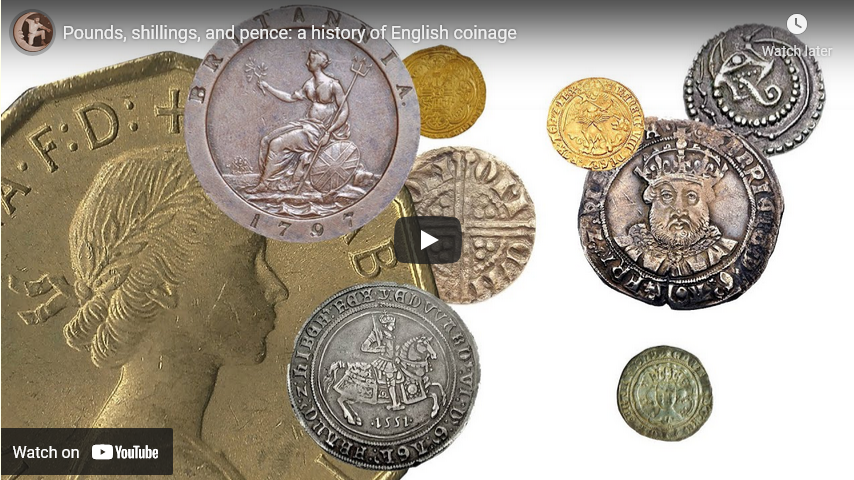
Pounds, shillings, and pence: a history of English coinage
Lindybeige
Published 18 Dec 2020I talk for a bit the history of English coinage, and the problems of maintaining a good currency. Once or twice I might stray off topic, but I end with an explanation of why the system worked so well.
Picture credits:
40 librae weight
Martinvl, CC BY-SA 3.0 https://creativecommons.org/licenses/…, via Wikimedia CommonsSceat K series, and others
By Classical Numismatic Group, Inc. http://www.cngcoins.com, CC BY-SA 3.0, https://commons.wikimedia.org/w/index…William I penny, and Charles II crown
The Portable Antiquities Scheme/ The Trustees of the British Museum, CC BY-SA 2.0 https://creativecommons.org/licenses/…, via Wikimedia CommonsBust of Charlemagne
By Beckstet – Own work, CC BY-SA 3.0, https://commons.wikimedia.org/w/index…Edward VI crown
By CNG – http://www.cngcoins.com/Coin.aspx?Coi…, CC BY-SA 3.0, https://commons.wikimedia.org/w/index…Charles II guinea
Gregory Edmund, CC BY-SA 4.0 https://creativecommons.org/licenses/…, via Wikimedia CommonsSupport me on Patreon: https://www.patreon.com/Lindybeige
Buy the music – the music played at the end of my videos is now available here: https://lindybeige.bandcamp.com/track…
Buy tat (merch):
https://outloudmerch.com/collections/…Lindybeige: a channel of archaeology, ancient and medieval warfare, rants, swing dance, travelogues, evolution, and whatever else occurs to me to make.
▼ Follow me…
Twitter: https://twitter.com/Lindybeige I may have some drivel to contribute to the Twittersphere, plus you get notice of uploads.
My website:
http://www.LloydianAspects.co.uk