As you may have heard, at the same time that Canadian politicians of all parties were thumping the tub about buying Canadian, British Columbia’s provincially owned ferry corporation decided to buy new ships from China … and the federal government not only gave the deal their blessing, they added in a billion dollar underwriting guarantee to boot:

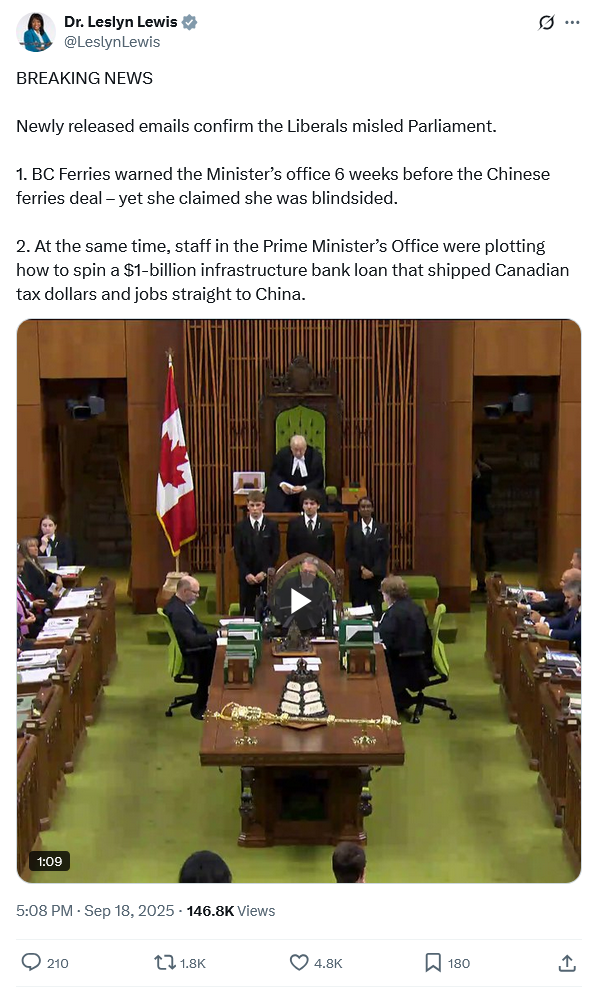
In Ottawa they call it “arm’s-length”. Out in the real world, people call it duck-and-cover. At Meeting No. 6 of the House of Commons transport committee, MPs confronted a simple, damning timeline: Transport Canada’s top non-partisan official was warned six weeks before the public announcement that BC Ferries would award a four-ship contract to a Chinese state-owned yard. Yet the former transport minister, Chrystia Freeland, told Parliament she was “shocked”. Those two facts do not coexist in nature. One is true, or the other is.
There’s an even bigger betrayal hiding in plain sight. In the last election, this Liberal government campaigned on a Canada-first message — jobs here, supply chains here, steel here. And then, when it actually mattered, they watched a billion-dollar ferry order sail to a PRC state yard with no Canadian-content requirement attached to the federal financing. So much for “Canada first”. Turns out it was “Canada … eventually”, after the press release.
Conservatives put the revelation on the record and asked the only question that matters in a democracy: what did the minister know and when did she know it? The documents they cite don’t suggest confusion; they suggest choreography — ministerial staff emailing the Prime Minister’s Office on how to manage the announcement rather than stop the deal that offshored Canadian work to a Chinese state firm.
Follow the money and it gets worse. A federal Crown lender — the Canada Infrastructure Bank — underwrote $1 billion for BC Ferries and attached no Canadian-content requirement to the financing. In plain English: taxpayers took the risk, Beijing got the jobs. The paper trail presented to MPs is smothered in black ink — hundreds of pages of redactions — with one stray breadcrumb: a partially visible BC Hydro analysis suggesting roughly half a billion dollars in B.C. terminal upgrades to make the “green” ferry plan work. You’re not supposed to see that. You almost didn’t.
How did the government side respond? With a jurisdictional shrug. We’re told, over and over, that BC Ferries is a provincial, arm’s-length corporation; the feds didn’t pick the yard, don’t run the procurement, and therefore shouldn’t be blamed. That line is convenient, and in a technical sense it’s tidy. But it wilts under heat. The federal lender is still federal. The money is still public. If “arm’s-length” means “no accountability”, it’s not a governance model — it’s a get-out-of-jail-free card.
The fallback argument is economic fatalism: no Canadian shipyards bid, we’re told; building here would have taken longer and cost “billions” more. Maybe that’s true, maybe it isn’t — but it’s the sort of claim that demands evidence, not condescension. Because the last time Canadians heard this script, the same political class promised that global supply chains were efficient, cheap and safe. Then reality happened. If domestic capacity is too weak to compete, that’s not an argument for outsourcing permanently; it’s an indictment of the people who let that capacity atrophy. And if you swear “Canada first” on the campaign trail, you don’t bankroll “China first” from the Treasury bench.