
Quotulatiousness

July 3, 2014

Jeremy Bentham’s “secret” writings

Filed under: Britain, History, Liberty, Media, Quotations — Tags: , , , — Nicholas @ 10:43

In the Guardian, Faramerz Dabhoiwala reviews a recent “discovery” that Jeremy Bentham, far from being an innocent about sexual matters (as portrayed by his disciple John Stuart Mill among others), had thought deeply on the topic and had written much. After his death, these writings were ignored for fear that they would discredit his wider body of work.

Bodily passion was not just a part of Bentham’s life: it was fundamental to his thought. After all, the maximisation of pleasure was the central aim of utilitarian ethics. In place of the traditional Christian stress on bodily restraint and discipline, Bentham sought, like many other 18th-century philosophers, to promote the benefits of economic consumption, the enjoyment of worldly appetites and the liberty of natural passions. This modern, enlightened view of the purpose of life spawned a revolution in sexual attitudes, and no European scholar of the time pursued its implications as thoroughly as Bentham. To think about sex, he noted in 1785, was to consider “the greatest, and perhaps the only real pleasures of mankind”: it must therefore be “the subject of greatest interest to mortal men”. Throughout his adult life, from the 1770s to the 1820s, he returned again and again to the topic. Over many hundreds of pages of private notes and treatises, he tried to strip away all the irrational and religious prohibitions that surrounded sexual activity.

Of all enjoyments, Bentham reasoned, sex was the most universal, the most easily accessible, the most intense, and the most copious — nothing was more conducive to happiness. An “all-comprehensive liberty for all modes of sexual gratification” would therefore be a huge, permanent benefit to humankind: if consenting adults were freed to do whatever they liked with their own bodies, “what calculation shall compute the aggregate mass of pleasure that may be brought into existence?”

The main impetus for Bentham’s obsession with sexual freedom was his society’s harsh persecution of homosexual men. Since about 1700, the increasing permissiveness towards what was seen as “natural” sex had led to a sharpened abhorrence across the western world of supposedly “unnatural” acts. Throughout Bentham’s lifetime, homosexuals were regularly executed in England, or had their lives ruined by the pillory, exile or public disgrace. He was appalled at this horrible prejudice. Sodomy, he argued, was not just harmless but evidently pleasurable to its participants. The mere fact that the custom was abhorrent to the majority of the community no more justified the persecution of sodomites than it did the killing of Jews, heretics, smokers, or people who ate oysters — “to destroy a man there should certainly be some better reason than mere dislike to his Taste, let that dislike be ever so strong”.

Though ultimately he never published his detailed arguments for sexual liberty for fear of the odium they would bring on his general philosophy, Bentham felt compelled to think them through in detail, to write about them repeatedly and to discuss them with his acquaintances. In one surviving letter to a friend, he joked that his rereading of the Bible had finally revealed that the sin for which God had punished the inhabitants of Sodom and Gomorrah was not in fact buggery, but the taking of snuff. He and his secretary had consequently taken a solemn oath to hide their snuff-pouches and nevermore to indulge “that anti-Christian and really unnatural practice” in front of one another. Meanwhile, they were now both happily free to enjoy “the liberty of taking in the churchyard or in the market place, or in any more or less public or retired spot with Man, Woman or Beast, the amusement till now supposed to be so unrighteous, but now discovered to be a matter of indifference”. Among those with whom Bentham discussed his arguments for sexual toleration were such influential thinkers and activists as William Godwin, Francis Place and James Mill (John Stuart Mill’s father). Bentham’s ultimate hope, “for the sake of the interests of humanity”, was that his private elaboration and advocacy of these views might contribute to their eventual free discussion and general acceptance. “At any rate,” he once explained, even if his writings could not be published in his own lifetime, “when I am dead mankind will be the better for it”.
LGBT? LGBTQQI? LGBTQQIAP? Or even LGBTTIQQ2SA?

Filed under: Cancon, Liberty, Politics — Tags: , , , , , — Nicholas @ 07:32

The coalition of lesbians, gays, bisexuals, and trans* people has a problem: the big tent approach requires that they acknowledge the members of their coalition more directly, leading to a situation where they’ve “had to start using Sanskrit because we’ve run out of letters.”

“We have absolutely nothing in common with gay men,” says Eda, a young lesbian, “so I have no idea why we are lumped in together.”

Not everyone agrees. Since the late 1980s, lesbians and gay men have been treated almost as one generic group. In recent years, other sexual minorities and preferences have joined them.

The term LGBT, representing lesbian, gay, bisexual and transgender, has been in widespread use since the early 1990s. Recent additions — queer, “questioning” and intersex — have seen the term expand to LGBTQQI in many places. But do lesbians and gay men, let alone the others on the list, share the same issues, values and goals?

Anthony Lorenzo, a young gay journalist, says the list has become so long, “We’ve had to start using Sanskrit because we’ve run out of letters.”

Bisexuals have argued that they are disliked and mistrusted by both straight and gay people. Trans people say they should be included because they experience hatred and discrimination, and thereby are campaigning along similar lines as the gay community for equality.

But what about those who wish to add asexual to the pot? Are asexual people facing the same category of discrimination. And “polyamorous”? Would it end at LGBTQQIAP?

There is scepticism from some activists. Paul Burston, long-time gay rights campaigner, suggests that one could even take a longer formulation and add NQBHTHOWTB (Not Queer But Happy To Help Out When They’re Busy). Or it could be shortened to GLW (Gay, Lesbian or Whatever).

An event in Canada is currently advertising itself as an “annual festival of LGBTTIQQ2SA culture and human rights”, with LGBTTIQQ2SA representing “a broad array of identities such as, but not limited to, lesbian, gay, bisexual, transsexual, transgender, intersex, queer, questioning, two-spirited, and allies”. Two-spirited is a term used by Native Americans to describe more than one gender identity.

Note that once you go down the rabbit hole of ever-expanding naming practices for ever-more-finely-divided groups you end up with the 58 gender choices of Facebook and instant demands to add a 59th, 60th, and 61st choice or else you’re being offensively exclusive to those who can’t identify with the first 58 choices. I’d bet that one of the criticisms Julie Bindel will face for this article is that she uses the hateful, out-dated, and offensive terms “transsexual” and “transgender” when everyone knows the “correct” term is now “Trans*” (perhaps deliberately chosen to ensure that you can’t successfully Google it).

June 29, 2014

Gay journalist decries same-sex marriage

Filed under: Law, Liberty, USA — Tags: , , — Nicholas @ 11:19

Okay, I over-state in the headline (does that make it “clickbait”?). But in the Guardian, Hugh Ryan recognizes that the fight for same sex marriage has not gone quite the way many activists thought it would:

We didn’t queer the institution of marriage. It straightened us

Wisconsin. Indiana. Utah. Hardly a week goes by that the courts don’t rule same-sex marriage street legal in another state in America (the last twenty-two consecutive cases have all come down on the side of marriage equality), making what once seemed impossible now seems unstoppable. Wedding white is the new black — and all the gays are wearing it.

So on this anniversary weekend of the Stonewall Riots, let me be the shrill voice in the back of the church, speaking now instead of forever holding my peace. I think we’re losing something. I have no desire to turn back the clock on marriage equality: it provides both real and symbolic benefits to queer communities, families and our country as a whole. But I cannot ignore the coercive (and corrosive) power that marriage holds. In this country, it is not just an option: it is the option. It is the relationship against which all others are defined, both an institution and an expectation — and you cannot have one without the other.

Before marriage was an option of first resort, queer people had been making our own ceremonies and families for (at least) a century. This will never stop, but the new expectations of marriage will curtail this kind of life-building (just ask any single straight woman over thirty how people treat her relationship choices). We will have to justify our reasons for not marrying, and any relationship that survives past a certain sell-by date will be looked at as pre-marriage.

[…]

Somewhere along the line, the gay rights movement — and maybe the gay community writ large — separated its short-term goals and some people’s immediate needs from the larger ideals of justice and societal change that initially stirred our community to action. This diminution happened by degrees, making it almost impossible to locate the moment when we could have turned around. But I suspect we will one day look back on the contentious 1999 Millennium March on Washington as the point of no return.

Maybe the same-sex marriage wave will begin a broader reconsideration of why our government is in the business of giving benefits to sexual relationships at all — gay or straight. Perhaps we will some day expand these privileges, for which we have fought so hard, to any group of people in a long-lasting relationship of care that keeps them safe, happy, and less dependent on government services — the way France tried (and largely failed) to do with their pacte civil de solidarité. Maybe we can queer the institution.

June 24, 2014

Stereotypes, “gaydar”, and sexual orientation

Filed under: Randomness, Science — Tags: , , — Nicholas @ 08:38

In (of all places) the Toronto Star, Brian Platt says that “gaydar” is a real thing and that it works better for conservatives than for liberals:

In less than the blink of an eye, your subconscious “gaydar” makes a judgment about someone’s sexual orientation based entirely on facial traits — and it’s usually right.

So says the research of Nicholas Rule, a University of Toronto psychologist giving a talk on the subject this week as part of WorldPride. “The gist of it is that people can accurately judge someone’s sexual orientation from very minimal information about them,” Rule said in an interview.

“You only need to see a face for less than 40 milliseconds to judge sexual orientation with the same level of accuracy that you get if you take all the time in the world.

“To put that in perspective, it takes 400 milliseconds to blink your eye.”

Facial “gaydar” is 65-per-cent accurate on average, according to Rule and his co-researchers at U of T’s Social Perception & Cognition Laboratory. These judgments can be reliably made based on the eyes alone, though facial shape and texture are also big factors.

“Conservatives are more accurate than liberals in making these judgments when they study a face, because conservatives are more likely to use stereotypes,” Rule said. “Of course, stereotypes are often wrong, but they do have what we call kernels of truth. Liberals tend to not want to use stereotypes in making judgments, and it impairs their accuracy.”

June 21, 2014

Shock, horror! An “offensive game” is actually offensive!

Filed under: Gaming, Humour, Media — Tags: , , — Nicholas @ 06:43

Charles C.W. Cooke on an outbreak of offensensitivity on the part of players of Cards Against Humanity, a game that only exists to be politically incorrect and offensive:

“Offended” has become such a fluid and subjective term these days that I can’t possibly keep up — and, frankly, I don’t especially care to. Either way, that the outrage brigade would go after this game is nothing short of extraordinary. Whatever case there is for polite society, universities, or television networks attempting to keep their language within the malleable and brittle bounds that our arbiters of taste have contrived this week to establish, there is no reason whatsoever for it to be applied to a party lark. Make no mistake: The entire purpose — quite literally the only point — of Cards Against Humanity is to be shocking and objectionable. Pretty much every single card in the pack is shocking and objectionable. The game is “offensive”? Gosh, what gave it away? Was it, perhaps, the words Cards Against Humanity emblazoned on the box? Or, perhaps, the description, “A party game for horrible people”? Maybe it was that the stated aim is to be as “despicable” as possible? A card “wasn’t okay”? Well, obviously.

Perhaps I just read too much of the Left’s output, but I’m starting to wonder whether “trans” people are engaged in some sort of concerted effort to be the most vocally boring and self-indulgent members of the perpetually aggrieved. Among the other topics at which Cards Against Humanity routinely pokes fun are incest, abortion, genocide, race, homosexuality, death, the disabled, those with crippling diseases, and the religious. A typical combination: “What will always get you laid? Date rape.” Another: “In 1,000 years, when paper money is but a distant memory, black people will be our currency.” Within the pack there are ready made Holocaust jokes, jokes about the massacre of American Indians, jokes about the molestation of altar boys, jokes that make light of black people and of slavery, jokes about fatal drug addiction, and an endless supply of gross, semi-pornographic nonsense. Oh, and more Holocaust jokes. (Oh, and even more Holocaust jokes.) Nick Summers, of Bloomberg Businessweek, described the offering as being built around “punch lines that include Auschwitz, slavery, ‘Stephen Hawking talking dirty,’ white privilege, ethnic cleansing, terrorists, the Trail of Tears, assless chaps, nuclear bombs, ‘a mime having a stroke,’ and more depravity.” You get the picture.

Is this funny? That depends on your taste. I think it is, yes, and I enjoy playing the game. Not only do I have a high tolerance for these things, but, as a rule, I think that humor is by far and away the most effective way of conquering tragedy. Clearly, the guy who took such offense at the one card enjoyed the game too. He bought into the premise. He was happy enough to play. He sat there through the rest of the rounds, which inevitably contained other “offensive jokes,” likely laughing at hideous things. He just didn’t like it when the joke was on him.

June 1, 2014

Kevin Williamson provokes a reaction to his Laverne Cox hit piece

Filed under: Media, Politics, USA — Tags: , , , — Nicholas @ 10:02

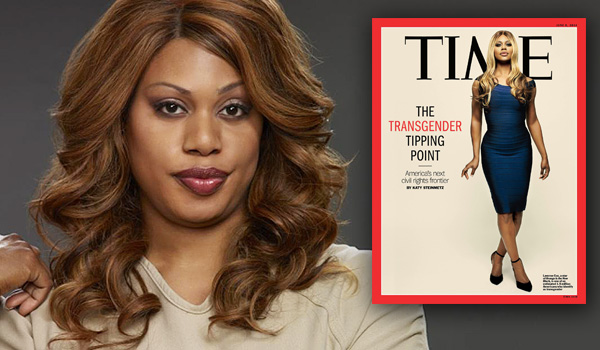
The National Review‘s Kevin Williamson went out of his way to be provocative in his article about transgendered actress Laverne Cox:

NRO - Laverne Cox Is Not a WomanThe world is abuzz with news that actor Laverne Cox has become the first transgender person to appear on the cover of Time magazine. If I understand the current state of the ever-shifting ethic and rhetoric of transgenderism, that is not quite true: Bradley Manning, whom we are expected now to call Chelsea, beat Cox to the punch by some time. Manning’s announcement of his intention to begin living his life as a woman and to undergo so-called sex-reassignment surgery came after Time’s story, but, given that we are expected to defer to all subjective experience in the matter of gender identity, it could not possibly be the case that Manning is a transgendered person today but was not at the time of the Time cover simply because Time was unaware of the fact, unless the issuance of a press release is now a critical step in the evolutionary process.

As I wrote at the time of the Manning announcement, Bradley Manning is not a woman. Neither is Laverne Cox.

Cox, a fine actor, has become a spokesman — no doubt he would object to the term — for trans people, whose characteristics may include a wide variety of self-conceptions and physical traits. Katie Couric famously asked him about whether he had undergone surgical alteration, and he rejected the question as invasive, though what counts as invasive when you are being interviewed by Katie Couric about features of your sexual identity is open to interpretation. Couric was roundly denounced for the question and for using “transgenders” as a noun, and God help her if she had misdeployed a pronoun, which is now considered practically a hate crime.

On cue, Tom Chivers responds:

For Williamson, the term “trans woman” is, of course, meaningless. He refers to Cox as “he” throughout his piece (despite a Clarksonesque but-you-can’t-say-that-these-days line about how “misdeploying” pronouns “is now considered practically a hate crime”) and says that our modern sensibilities of referring to trans people as their preferred gender is “sympathetic magic”, “treating delusion as fact”, “policing language on the theory that language mystically shapes reality”, like a “voodoo doll”. “Regardless of the question of whether he has had his genitals amputated, Cox is not a woman, but an effigy of a woman,” he says.

This, Williamson would no doubt claim, is the-emperor-has-no-clothes telling-it-like-it-is. “Sex is a biological reality,” he points out, unarguably. Indeed it is. No amount of surgery or hormone therapy will allow Cox to become pregnant, no terms of address will turn that stubborn Y chromosome into a second X. That is, indeed, a simple fact of human biology.

But who disagrees with that? No one. Williamson’s fearless truthsaying is, in fact, a fatuous statement of the obvious, dressed up as iconoclasm. Nobody in the world believes that calling Cox and other trans women “women”, using the pronouns “she” and “her”, will change anything biological; they know that she will not be able to have children, no matter what words we use. They do it out of respect, and sensitivity – what we used, in fact, to call politeness. If someone wishes to be addressed as X, then it is polite, usually, to do so. There may be times when other considerations apply: if someone insists on being referred to as “Doctor” and using that to give them unearned authority, say. But if someone wants to change their name, then we are happy to let them do so, and to address them by their chosen name, because it’s their business. I see no reason why changing one’s chosen pronouns should be any different.

Update. On the non-confrontational side, Elio Iannacci reports on Laverne Cox for Maclean’s:

The standout figure in all this flurry of activity, of course, is advocate/actress Laverne Cox, who graces the cover of this week’s issue of Time magazine. Cox is the breakout star of Netflix’s popular prison drama, Orange Is The New Black, which begins airing its second season next week.

Cox, an academic, writer and film producer as well as performer, has been fighting for Trans rights well before she had her first major guest spot on Law & Order and appeared in the reality show I Want To Work For Diddy in 2008. She says trans issues weren’t broached so intelligently five years ago. “I’m not naming names because I’m a working actress …  but let’s get real,” she says via phone from New York City. “We’ve had such a wave of trans-ploitation films and TV — but that’s changing.” She is aggressively seeking to be a part of that change; she’s producing a documentary on transgender teens as well as one on Ce Ce MacDonald, an African-American trans woman who served a 41-month prison sentence in a men’s prison in Minnesota. “We are in the midst of a revolutionary moment,” she says.

Even a few years ago, the current profusion of trans characters and would have been unimaginable. A trans character was more likely an afterthought in a script, treated as a cliché or a freak. Most had more in common with Jared Leto’s trans character in Dallas Buyers Club, an Oscar-winning role that some critics have protested, saying it mirrors the offensive Mammy caricature in Gone With The Wind. On the fourth season of the popular reality series Project Runway, in 2008, fashion designer Christian Seriano used disparaging phrases such as “hot tranny mess” to describe inelegant or unstylish people. The word seeped into mainstream vernacular.

“We’ve had years of being at the end of the bad jokes and getting our bodies sensationalized,” says Cox, “but we have since learned to speak up. Transgender people in social media began standing up and saying, ‘This is not me and this is not acceptable.’ ”

May 20, 2014

The “Pentagon News Channel” turns on its master

Filed under: Media, Military, USA — Tags: , , , — Nicholas @ 08:06

J. Neil Schulman talks about a recent Fox News commentary by Liz Trotta, which excoriated the Secretary of Defense:

I’ve been aware for a long time that commentators on the Fox News Channel get away with the most extremely jingoistic, the most atavistic, the most bigoted opinions in weekend commentaries that would make even the average weekday Fox viewer cringe.

But the commentary quoted above from FNC‘s Liz Trotta managed to surprise even me.

My friend, Brad Linaweaver, calls Fox News the Pentagon Channel because of all the 24-hour news channels Fox is the one that tends to support the agenda of those who find the Pentagon’s ungodly budget always too small, no projection of military force anywhere in the world too unattractive, and no invasion of privacy or restriction of liberty unnecessary. After seeing lively debates on Fox on all these subjects — often dragging in quasi-libertarians like Senator Rand Paul or in-house personalities like Bob Beckel or Kennedy to take the opposition — I’d have to say that Brad is being only slightly sardonic.

But unquestionably Fox, like much of the degraded talk-radio right today, has adopted the worst propaganda techniques that used to be the patented reserve of party-line Communists and World War II era Nazis. It’s a perfect storm of spinning half truths or facts presented in a misleading context, tunnel-vision ideology, and ad hominem slurs replacing reasoned discourse.

This was the technique perfected by Hitler’s propaganda minister, Joseph Goebbels, but for those not a student of history like Mr. Linaweaver, one needs go no further than the average anonymous Internet troll to find this level of vile attack.

In the above commentary Ms. Trotta manages to conflate the Veterans Administration — which does not treat active military — with the Army’s healthcare policies for active-duty military, and conflates both with the Affordable Care Act that addresses only civilian medical care.

Ms. Trotta manages to forget that homosexuals now serve openly in the U.S. military forces so a “feckless” Defense Secretary (who as an Army volunteer serving in combat earned two Purple Hearts) considering extending this policy to transgenders isn’t that much of a stretch.

But Ms. Trotta — in both managing to dismiss “gender dysphoria” as a treatable medical condition while simultaneously dismissing transgendering as a passing fashion — also does not know or chooses to ignore that as late as 1973 the American Psychiatric Association listed homosexuality in its official diagnostic manual as a mental illness.

May 13, 2014

The NFL’s first openly gay player

Filed under: Football, Media — Tags: , , , , , — Nicholas @ 09:03

Michael Sam was drafted this weekend by the St. Louis Rams. He’s the first openly gay player to be drafted by an NFL team. Back in February, I wrote:

In addition to the questions about whether Sam’s collegiate talents will be enough to allow him to flourish in the NFL, and whether a given team would welcome an openly gay team-mate in the locker room, there’s also the “Tim Tebow” problem … the team that drafts Sam will be in the unrelenting focus of the media’s publicity floodlights. Just drafting Sam would only be the start of the media’s attention. Everything to do with Sam will draw TV cameras, paparazzi, and the team’s beat writers for local media outlets.

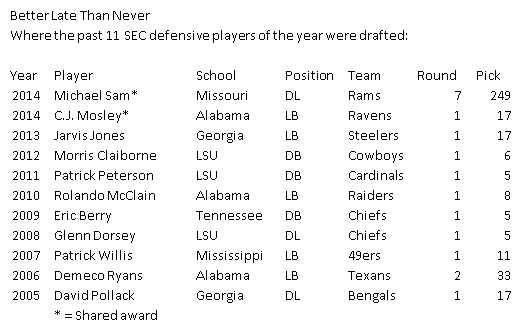
Perhaps I misjudged the degree of ongoing interest by media outlets, as after the initial flurry of coverage, I heard very little about Michael Sam until he was actually drafted, as a photo of him kissing his boyfriend hit Twitter (and the knuckle-dragging idiots came out in droves). In February, I didn’t think Sam would be drafted, but I was wrong. However, as David Boaz points out, he was drafted far later than he would likely have been if he wasn’t “out”:

… this past weekend has reminded us that we haven’t quite achieved “opportunity to the talented.” Michael Sam was the Co-Defensive Player of the Year in the country’s strongest football conference, yet many people wondered if any NFL team would draft the league’s first openly gay player. Turns out they were right to wonder. Here’s a revealing chart published in yesterday’s Washington Post (based on data from pro-football-reference.com and published alongside this article in the print edition but apparently not online).

2014 NFL draft and Michael Sam

Every other SEC Defensive Player of the Year in the past decade, including the athlete who shared the award this year with Michael Sam, was among the top 33 picks in the draft, and only one was below number 17. Does that mean that being gay cost Michael Sam 232 places in the draft, compared to his Co-Defensive Player of the Year? Maybe not. There are doubts about Sam’s abilities at the professional level. But there are doubts about many of the players who were drafted ahead of him, in the first 248 picks this year. Looking at this chart, I think it’s hard to escape the conclusion that Sam paid a price for being openly gay. That’s why classical liberals – which in this broad sense should encompass most American libertarians, liberals, and conservatives – should continue to press for a society in which the careers are truly open to the talents. That doesn’t mean we need laws, regulations, or mandates. It means that we want to live in a society that is open to talent wherever it appears. As Scott Shackford writes at Reason, Sam’s drafting is “a significant cultural development toward a country that actually doesn’t care about individual sexual orientation. The apathetic should celebrate this development, as it is a harbinger of a future where such revelations become less and less of a big deal.” Let’s continue to look forward to a society in which it’s not news that a Jewish, Catholic, African-American, Mormon, redneck, or gay person achieves a personal goal.

Update: Draw Play Dave gets it exactly right.

April 15, 2014

Finland to issue “Tom of Finland” erotic postage stamps

Filed under: Europe — Tags: , , , , — Nicholas @ 11:02

Unlike other Scandinavian countries, Finland isn’t noted as a trend-setter in LGBT issues: still not allowing same-sex marriage even though homosexuality was legalized in 1971. Finland also classified transvestism as an illness until 2011. Knowing that, it’s hard to credit that Itella Posti, the Finnish postal service, will be selling these stamps beginning in September.

From their English-language website:

Finland issues Tom of Finland stampsIn September-October 2014, Itella Posti will release seven new sets of stamps, containing a total of 33 new designs. It is a great collection to choose from; the subjects of the new stamps include male drawings by Tom of Finland, autumnal yard and garden scenes painted by Urpo Martikainen, and Jaakko Tähti’s photos of Finnish bridges. Other subjects for the end-of-the-year stamps include signs of sky and the change in everyday Finland — and, of course, Christmas.


The autumn’s stamp series begins September 8 with Tom of Finland, who is considered one of the most well-known Finnish artists around the world. His emphatically masculine homoerotic drawings have attained iconic status in their genre and had an influence on, for instance, pop culture and fashion. In his works, Tom of Finland utilized the self-irony and humor typical of subcultures.

During his career, Tom of Finland produced more than 3,500 drawings. The two drawings on the stamp sheet were selected by graphic artist Timo Berry, who designed the stamp, and Susanna Luoto, the Finnish representative of the foundation named after Tom of Finland operating in Los Angeles.

The drawings on the stamp sheet represent strong and confident male figures typical of their designer. “The sheet portrays a sensual life force and being proud of oneself. There is never too much of that in this northern country,” says Timo Berry. The miniature sheet contains three 1st class self-adhesive stamps.

The artist behind Tom of Finland was Touko Laaksonen (1920-1991), whose profile is extended in the exhibition Sealed with a Secret – Correspondence of Tom of Finland opening in the Postal Museum September 6. The exhibition will display the busy correspondence of Laaksonen from the early 1940s to his dying year, 1991. The exhibition will be displayed until March 29, 2015, in Museum Centre Vapriikki in the new Postal Museum to be opened in Tampere in September.

April 8, 2014

QotD: Making certain arguments “beyond the pale”

Filed under: Liberty, Politics, Quotations — Tags: , , , — Nicholas @ 00:01

The right to free speech may begin and end with the First Amendment, but there is a vast middle where our freedom of speech is protected by us — by our capacity to listen and accept that people disagree, often strongly, that there are fools, some of them columnists and elected officials and, yes, even reality-show patriarchs, that there are people who believe stupid, irrational, hateful things about other people and it’s okay to let those words in our ears sometimes without rolling out the guillotines.

[…]

The trouble, I think, is when ostracizing a viewpoint as “beyond the pale” becomes not an end but a means to an end; that by declaring something unsayable, we make it so. It makes me uncomfortable, even as I see the value of it. I for one would love homophobia to fully make it on that list, to get to the point where being against gay marriage is as vulgar and shameful as being against interracial marriage. But it isn’t. Maybe it will be. But it isn’t. And kicking a reality-show star off his reality show doesn’t make that less true. Win the argument; don’t declare the argument too offensive to be won. And that’s true whether it’s GLAAD making demands of A&E or the head of the Republican National Committee making demands of MSNBC.

The bottom line is, you don’t beat an idea by beating a person. You beat an idea by beating an idea. Not only is it counter-productive — nobody likes the kid who complains to the teacher even when the kid is right — it replaces a competition of arguments with a competition to delegitimize arguments. And what’s left is the pressure to sand down the corners of your speech while looking for the rough edges in the speech of your adversaries. Everyone is offended. Everyone is offensive. Nothing is close to the line because close to the line is over the line because over the line is better for clicks and retweets and fundraising and ad revenue.

Jon Lovett, “The Culture of Shut Up: Too many debates about important issues degenerate into manufactured and misplaced outrage — and it’s chilling free speech”, The Atlantic, 2014-04-07

April 4, 2014

“Why do these bigots still have jobs? Let’s go get them”

Filed under: Business, Media, Politics, USA — Tags: , , , — Nicholas @ 08:45

In Slate, Will Saletan digs through the data to find the next set of targets:

Some of my colleagues are celebrating. They call Eich a bigot who got what he deserved. I agree. But let’s not stop here. If we’re serious about enforcing the new standard, thousands of other employees who donated to the same anti-gay ballot measure must be punished.

More than 35,000 people gave money to the campaign for Proposition 8, the 2008 ballot measure that declared, “Only marriage between a man and a woman is valid or recognized in California.” You can download the entire list, via the Los Angeles Times, as a compressed spreadsheet. (Click the link that says, “Download CSV.”) Each row lists the donor’s employer. If you organize the data by company, you can add up the total number of donors and dollars that came from people associated with that company.

The first thing you’ll notice, if you search for Eich, is that he’s the only Mozilla employee who gave to the campaign for Prop 8. His $1,000 was more than canceled out by three Mozilla employees who donated to the other side.

The next thing you’ll notice is that other companies, including other tech firms, substantially outscored Mozilla in pro-Prop 8 contributions attributed to their employees. That includes Adobe, Apple, Google, Microsoft, Oracle, Sun Microsystems, and Yahoo, as well as Disney, DreamWorks, Gap, and Warner Bros.

Thirty-seven companies in the database are linked to more than 1,300 employees who gave nearly $1 million in combined contributions to the campaign for Prop 8. Twenty-five tech companies are linked to 435 employees who gave more than $300,000. Many of these employees gave $1,000 apiece, if not more. Some, like Eich, are probably senior executives.

Why do these bigots still have jobs? Let’s go get them.

Welcome to the church of SSM militant

Filed under: Law, Liberty, Politics, USA — Tags: , , , , — Nicholas @ 07:20

A National Review editorial on the Mozilla CEO’s short tenure after being outed as a supporter of a Californian anti-SSM ballot initiative:

In 2008, Barack Obama and Brendan Eich both were against gay marriage. Senator Obama averred his support for the one-man/one-woman view of marriage, while Mr. Eich, a cofounder of the Mozilla web-browser company, donated $1,000 to support Proposition 8 — a California ballot initiative that had the effect of making Senator Obama’s avowed marriage policy the law in California, at least until a federal court overturned it on the theory that California’s constitution is unconstitutional. Barack Obama inexplicably remains, as of this writing, president of the United States of America, but Mr. Eich has just been forced out as CEO of Mozilla because of his political views.

The various tendencies that operate under the general heading of “gay rights” have had an extraordinary run of it in the past several years, in both the political and the cultural theaters. We now have a constitutional right to commit homosexual acts (Lawrence v. Texas), while Facebook offers at last count 56 different gender options to its users (trans with or without asterisk, genderqueer, neutrois, and two-spirit among them). Having won the battle in California, the sore winners are roaming the battlefield with bayonets and taking no prisoners. Mr. Eich’s donation had been a matter of public record for some years, but Eros is a jealous god, and he will have blood from time to time. Mr. Eich’s elevation to the chief executive’s position provided occasion for critics within his firm and without to make an example of him.

[…]

Again, it is in this case a matter of culture. The nation’s full-time gay-rights professionals simply will not rest until a homogeneous and stultifying monoculture is settled upon the land, and if that means deploying a ridiculous lynch mob to pronounce anathema upon a California technology executive for private views acted on in his private life, then so be it. The gay agenda of the moment is, ironically enough, to force nonconformists into the metaphorical closet. If through the miracle of modern medicine you end up with five sets of mixed genitals, you’ll get your own section in the California civil-rights statutes; cling to nearly universal views about marriage for a few months after it’s become unfashionable, and you’re an untouchable.

Unless, that is, you’re the anti-gay-marriage candidate that all the pro-gay-marriage people voted for in 2008, in which case you get a pass, apparently on the theory that everybody assumed you were being willfully dishonest for political reasons. (That assumption provides a relatively rare point of agreement between homosexual activists and the editors of this magazine.) There simply is to be no disagreement, no dissent, and no tolerance for other points of view.

Update: In Time, Nick Gillespie says there’s both good and bad aspects of this event.

Welcome to the brave new world of socially conscious… web-browsing. In the past, consumers might patronize certain businesses (Whole Foods, say, or Ben & Jerry’s) whose stated missions extended beyond increasing shareholder value and avoided others that might have politically objectionable CEOs or reputations for being anti-abortion (Domino’s Pizza, say) or public positions opposed to certain forms of birth control (Hobby Lobby, for instance). Now we’re boycotting free products such as Firefox and demanding companies dance to the tune called by customers. I think that’s a good thing overall — but it may end up being just as difficult for consumers to live with as it will be for corporations.

Whether you care about gay marriage or politically correct web experiences, Eich’s resignation shows how businesses respond to market signals. “Mozilla believes both in equality and freedom of speech. Equality is necessary for meaningful speech,” writes Mitchell Baker, the organization’s executive chairwoman, in announcing Eich’s stepping down. “And you need free speech to fight for equality. Figuring out how to stand for both at the same time can be hard.”

Just as the Internet has empowered consumers to find cheaper prices, more-extensive reviews, and a wider variety of goods than ever before, it’s also made it easier for them to call out companies for all sorts of dastardly actions, screw-ups, and problems. I like that OKCupid’s intervention wasn’t a call for government action to limit people’s choices or ban something. Indeed, OKCupid didn’t even block Firefox users from its site — rather, it politely asked them to consider getting to the site via a different browser.

March 25, 2014

Understatement of the day: “dumb things happen when you’ve been drinking”

Filed under: Cancon, Law — Tags: , , , , — Nicholas @ 10:10

It’s hard to guess just which parts of his little violent criminal spree might be downgraded to mere “dumb things”:

Cpl. Jonathan Laporte shot up his own home and two of his neighbours’ cars before arming himself with a shotgun and handgun and blasting his way through the showroom of a high-end car dealership on Feb. 9, 2011.

The rampage came less than an hour after he was charged and released by police for physically assaulting three men at a Hunt Club Road hotel.

The 25-year-old soldier had met a man at the Days Inn after replying to an online ad for consensual, “no strings attached” gay sex. But the encounter turned violent after Laporte became heavily intoxicated and grabbed his partner by the neck and started squeezing after warning the man not to tell anyone about their hook-up.

The man eventually escaped wearing nothing more than his underwear and a T-shirt, but returned to the room to recover his wallet and cellphone. Once inside, Laporte closed the door and resumed the attack, punching the man repeatedly in the face as he screamed for help.

March 24, 2014

QotD: On Women’s Power

Filed under: Books, Media, Quotations — Tags: , , , , — Nicholas @ 08:05

If you have never been sexually attracted to women, you will never quite understand the monumental power of female sexuality, except by proxy or in theory, nor will you quite know the immense advantage it gives us over men. Dating women as a man was a lesson in female power, and it made me, of all things, into a momentary misogynist, which I suppose was the best indicator that my experiment had worked. I saw my own sex from the other side, and I disliked women irrationally for a while because of it. I disliked their superiority, their accusatory smiles, their entitlement to choose or dash me with a fingertip, an execution so lazy, so effortless, it made the defeats and even the successes unbearably humiliating. Typical male power feels by comparison like a blunt instrument, its salvos and field strategies laughably remedial next to the damage a woman can do with a single cutting word: no.

Sex is most powerful in the mind, and to men, in the mind, women have a lot of power, not only to arouse, but to give worth, self-worth, meaning, initiation, sustenance, everything. Seeing this more clearly through my experience, I began to wonder whether the most extreme men resort to violence with women because they think that’s all they have, their one pathetic advantage over all she seems to hold above them. I make no excuses for this. There are none. But as a man I felt vaguely attuned to this mind-set or its possibility. I did not inhabit it, but I thought I saw how rejection might get twisted beyond recognition in the mind of a discarded male where misogyny and ultimately rape may be a vicious attempt to take what cannot be taken because it has not been bestowed.

There were other surprising discoveries. With all the anger I felt flowing in my direction — anger directed at the abstraction called men — I was not expecting to find, nestled within the confines of female heterosexuality, a deep love and genuine attraction for real men. Not for women in men’s bodies, as the prejudicial me had thought. Not even just for the metrosexual, though he has his audience, but for brawny, hairy, smelly, stalwart, manly men; bald men, men with bellies, men who can fix things and, yes, men who like sports and pound away in the bedroom. Men whom women loved for being men with all the qualities that testosterone and the patriarchy had given them, and whom I have come to appreciate for those very same qualities, however infuriating I still find them at times.

Dating women was the hardest thing I had to do as Ned, even when the women liked me and I liked them. I have never felt more vulnerable to total strangers, never more socially defenceless than in my clanking suit of borrowed armour. But then, I guess maybe that’s one of the secrets of manhood that no man tells if he can help it. Every man’s armour is borrowed and 10 sizes too big, and beneath it he’s naked and insecure and hoping you won’t see.

That, maybe, was the last twist of my adventure. I passed in a man’s world not because my mask was so real, but because the world of men was a masked ball. Eventually I realised that my disguise was the one thing I had in common with every guy in the room. It was hard being a guy.

Rather than choosing to become a woman again, it is probably truer to say that I reverted to form. I stopped faking it. I came back to myself, proud, free and glad in every way to be a woman.

Norah Vincent, “Double agent” (an edited extract from Self-Made Man: My Year Disguised As A Man), Guardian, 2006-03-18.

March 19, 2014

Alex Marwood: “Fred Phelps might finally be teaching us a lesson”

Filed under: Media, Politics, Religion, USA — Tags: , , , — Nicholas @ 08:45

Alex Marwood contemplates the actual lessons to be drawn from the impending death of the head (former head?) of the flamboyantly repellant Westboro Baptist Church:

But here’s the thing that might indeed deserve celebrating: I think that, in his final hours, Fred Phelps might finally be teaching us a lesson. And it’s not the lesson that his spittle-bowed ranting, his family’s laughable adaptations of pop songs and psychotic banner-waving have been intended to teach us. For years now, I’ve looked at Westboro and wanted to ask them about their take on the Seven Deadly Sins. The old man and his numerous offspring seemed, you see, to base their style upon them. Wrath he had, in plenty — but Phelps also seem to be driven as much by envy (of the “fags” who were getting preferential enabling), a prideful self-belief only challenged by that of L Ron Hubbard, greed, as demonstrated in all those juicy court settlements from local councils who sought to limit his ‘freedom of speech’ and, well, frankly, quite a bit of sloth, sitting about in his compound sending the grandkids out to demonstrate. As to gluttony and lust — well, no one really knows what went on behind the walls of that compound when Louis Theroux wasn’t filming, but the guy has 13 kids and a bit of a paunch, which suggests a degree of busyness, to say the least. And here he is, at the end of his life, alone, unmourned and, as many people believe, anyway, probably going to hell.

So thank you, Fred. You’ve taught us how not to live our lives. Actually, I would hazard that, if anything, Fred’s career has done gay rights a favour. For every sad-act who got themselves sucked in by them, there will be thousands upon thousands who will have thought “well, if that’s the face of the moral Right, I’m out,” and gone and shaken hands with their local homosexuals. In a land where the values of Christianity often seem to have been warped by the twin evils of psychopathically Right-wing Right-wingers and greed-fuelled fraudsters, Phelps picked up the ball, glued spikes on it and kicked it into the faces of small children and then sued them for getting in the way. He will have done more to turn people away from his brand of God than even Morris Cerullo. So thanks, Fred! If any of the kids are looking for an example of a Christian life, we now have a perfect example to show them, and say “the opposite of that, basically”. Well played, and flights of something sing thee to thy rest!

« Newer Posts — Older Posts »

Powered by WordPress
