
Forgotten Weapons
Published 8 Jan 2025The Falkland Islands Defense Force is a small organization independent of the British military, run directly by the Falkland Islands government. When it decided to update its small arms form the L1A1 SLR (aka British FAL) in the early 1990s, the British assumed they would purchase the new L85A1 rifles. However, by that time the flaws in the L85 were pretty well known, and the Islanders exercised their independence and chose to adopt something different. After investigating a number of different options they chose to use the Steyr AUG. At this time the AUG was in service with a number of other nations including the Australians and New Zealanders, and Steyr offered good terms and good support for the FIDF.
The FIDF purchased about 160 AUG rifles in total, including a small number of carbines and heavy-barreled LMGs. The carbines were particularly useful in a maritime role, which was part of the FIDF mission at the time (fisheries patrol). The LMG version, fitted with an Elcan C79 4x optic, was intended to supplant the FN MAG as a support weapon, but was found unfit for that role. Instead, most of the LMGs were converted to standard rifles via simple barrel swap. In addition, the Elcan optics proved prone to breakage, and were eventually replaced with British SUSATs. Indeed, some of the standard AUGs had their factory scopes replaced with SUSATs as well.
The AUG remained the standard rifle for the FIDF until recently, when the service received L85A3 rifles from the British. The AUG was not configured to use the bullet-trap blank adapters that the British used, and the L85s were intended to allow better integrated training between the two forces. A formal replacement for the AUG has not yet been determined, as it remains a bit unclear what the British military will decide to do to replace the L85 in the coming years.
Many thanks to the FIDF for giving me access to their armory to dig out these rifles to film for you! They remain today a small but quite well-equipped all-volunteer force dedicated to maintaining the security of the Falkland Islands.
(more…)
May 9, 2025
Steyr AUGs of the Falkland Islands Defense Force
May 6, 2025
Gilboa Snake: Is the Double-AR Really so Dumb? (Re-Cut for YouTube)
Forgotten Weapons
Published 7 Jan 2025YouTube removed this video, so I re-cut it to meet their requirements (I think … for now). If you want to get off YouTube and support historical & education gun channels, please consider subscribing to History of Weapons & War: weaponsandwar.tv
The Gilboa Snake is an Israeli rifle (from the same designer behind the Cornershot) that essentially combines two standard ARs into a single unit. In its civilian configuration it has two of every part — barrels, bolts (mirrored, so one ejects left and the other right), triggers, buffers, etc. In its military setup, the triggers and recoil system are combined into single units, and this makes the gun arguably practical. With a single trigger, a person fires two rounds simultaneously, resulting in either two simultaneous hits at close range, or the potential for one hit at longer range instead of what might be a miss with a regular rifle. This is a concept that has been experimented with by pretty much all major militaries over the past decades; the Russians, French, and Americans all had rifles like this. Other approaches to the end result included duplex and triplex ammunition (multiple bullets in one case) and hyper-burst firing mechanisms (like the Russian AN-94 and German G11). Ultimately all of the different systems were deemed poor compromises compared to normal rifles, but it’s not as bizarre of an idea as it might first appear.
Unfortunately, the civilian Snake has to have two separate triggers to avoid machine gun classification in the US. It’s difficult to fire both triggers simultaneously, and this limits the practical military applications of the gun.
Oh, and don’t miss the unique elements in the Snake to allow for the barrels to be zeroed before mounting sights!
(more…)
May 3, 2025
Development of the Uzi Family: Standard, Mini, and Micro
Forgotten Weapons
Published 4 Jan 2025The Uzi was originally designed in the 1950s, and it was on the technological cutting edge at the time. The stamped receiver, telescoping bolt, and compact magazine-in-grip layout made it an inexpensive and effective weapon. Its sedate 600 round/minute rate of fire helped as well, making it easy to shoot effectively. Uziel Gal experimented with a compact version at that time, but dropped the idea when he proved unable to make a smaller version with the same low rate of fire as the standard pattern.
Fast forward to the late 1970s, and the designers at IMI revisited the idea of a compact Uzi. They were willing to accept the increased rate of fire of a shorter receiver and lighter bolt, and their first prototypes were ready in 1978. full export sales began in 1980. The gun was advertised as having a 900 rpm rate of fire, but the reality was much higher.
The final step of classic Uzi development was the Micro Uzi, introduced in 1986. This was actually developed form the semiautomatic, closed-bolt Uzi Pistol made for American commercial sales. That pistol was given a select-fire trigger group and a folding stock, and it became a micro-compact submachine gun for only the most tactical of operators. It was advertised as having a 1200 rpm rate of fire, but this was again underestimated to improve sales.
In reality, the standard Uzi does fire at about 600 rpm. The Mini (in closed-bolt form) ran at 1300+ in my testing at S&B, and the Micro was over 1400 rpm. Where the original Uzi is best kept in fully automatic mode and can easily fire single shots when desired, the Mini and Micro Uzis are definitely best suited to semiautomatic use. Firing them in fully automatic is a much more difficult proposition if one wants to maintain any level of accuracy and situational awareness.
Thanks to Sellier & Bellot for giving me access to this set of Uzis to film for you!
(more…)
April 30, 2025
April 24, 2025
Modernizing Le Clairon: the FAMAS Valorisé
Forgotten Weapons
Published 25 Dec 2024The FAMAS was the best bullpup rifle of its era, but it was a difficult platform to modernize with optics. In 1995, the “FELIN” (Fantassin à Équipement et Liaisons INtégrés; Integrated Infantry Equipment and Communications) was commissioned to create a next-generation weapons platform for the French soldier. This used a computerized multi-function optic mounted to a lowered rails system and a control keypad on a new front grip on the rifle. Like the American Objective Force Warrior and other similar programs, FELIN was not successful — but the base rifle did have a future. By dropping the new keypad-integrated lower assembly for the original FAMAS F1 lower but keeping the lowered upper assembly with its Picatinny rail, the FAMAS Valorisé was created, allowing much improved optics mounting.
These new rifles still used the FAMAS 25-round magazine, but now had Beretta-made barrels with 1:9 rifling, suitable for M855 and other heavy 5.56mm loadings. The Valorisé also included a small piece of rail specifically for an IR laser and added pivot to the bipod (which remained free-floated from the barrel). A total of 18,500 rifles were converted, and in 2015 they were used to equip 17 French regiments — and they saw some combat use in Afghanistan. Had the FAMAS platform been retained, this would have been the basis for its further modernization — but with adoption of the H&K 416F instead, the Valorisé rifles are being decommissioned.
(more…)
April 23, 2025
Germany’s extremely extreme extreme right AfD now the most popular party
Friedrich Merz, the leader of the “main” right-wing party in the Bundesrat seems to have a problem with math, as he keeps promising to cut the AfD support in half, yet ends up doubling it:
Many years ago – in 2018, to be precise – a man named Friedrich Merz was in the running to succeed Merkel as chairman of the CDU.
Merz said many interesting things back then. On 14 November 2018, for example, he gave an interview to BILD, in which he denounced Alternative für Deutschland as a party “that does not distance itself from the right” and said that “this makes them unsuitable for any coalition”. Merz pledged to win back all the CDU voters who had defected to the AfD over the years. “In the short term,” he said, “it will probably be impossible to get rid of the AfD,” but if he were chosen to succeed Merkel, he pledged that he could “cut their support in half“.
The very next day he tweeted the exact same thing – promising to lead the CDU back to 40% in the polls and to “halve the AfD“.
At a regional CDU conference around this time, Merz yet again promised to “cut the AfD in half,” adding that “this really is possible”. If I looked harder, I could probably find even more examples of Merz repeating this exact same promise. He made it such a core component of his campaign for the party chairmanship that the Frankfurter Allgemeine Zeitung observed in retrospect: “The whole idea of Merz as party chairman was based on the notion that he would win back votes that Angela Merkel had lost“.
[…]
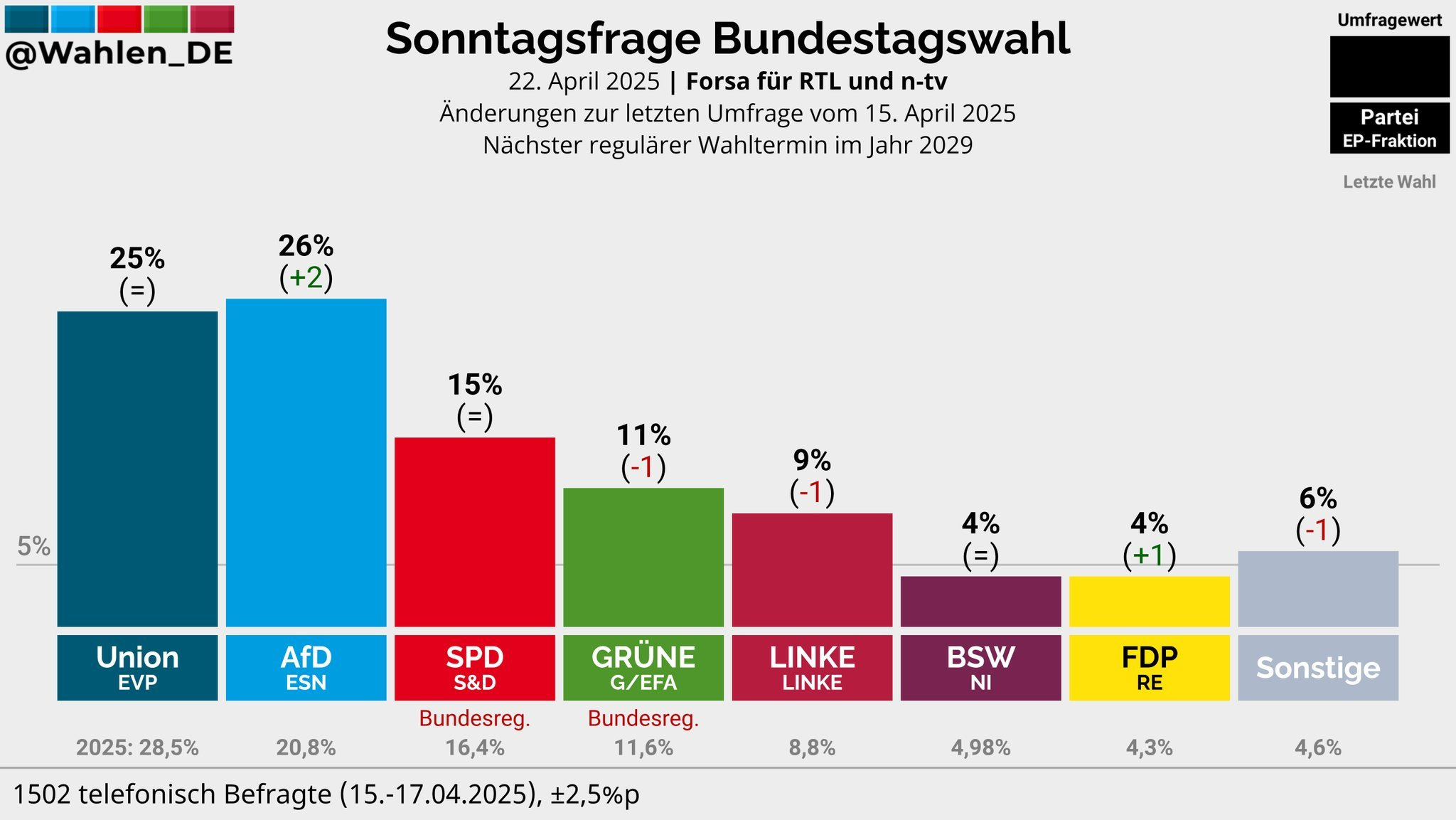
The latest Forsa poll (conducted for RTL and ntv) has Alternative für Deutschland at a cool 26%. That is their best result in history, and it makes them the strongest party in the Federal Republic. This is the second such poll that places AfD in first place, following an Ipsos survey from 9 April that pegged them at 25%.
Merz has indeed done something to AfD support involving the operand of 2. It’s just not exactly what he imagined.
Now all of that rhetoric we one once heard from the cartel parties – about the importance of dealing with the AfD on the issues and of making convincing appeals to the “democratically inclined” among AfD voters – have become yesteryear’s pablum. They are going to try to ban the AfD now. Because they can’t beat them in any other way, and because they believe Germans shouldn’t be allowed to cast their votes beyond the narrow confines of the political cartel that runs the Federal Republic, they’re going to try to remove the AfD from the board via legal trickery.

Of course, if the AfD is now the most popular party in Germany, it must be suppressed ASAP, and the individual members of the party must be punished “to save democracy”:

In Germany, owning guns is a privilege that can be taken away — not for breaking the law, but for holding the wrong political opinion.
Members and supporters of the right-leaning Alternative für Deutschland (AfD) party are now facing mass gun license revocations. The reason? The German government has labeled the AfD a “right-wing extremist” group — a political designation that suddenly makes its members “unreliable” under the country’s gun laws. And just like that, firearms must be surrendered or destroyed.
If that sounds outrageous, it should. But it’s not surprising.
[…]
In 2021, Germany’s domestic intelligence agency, the Bundesamt für Verfassungsschutz (BfV), designated the entire AfD as a “suspected threat to democracy”. That move allowed the government to surveil, wiretap, and investigate the party and its members.
It didn’t stop there.
Courts have now upheld revoking gun licenses from AfD members, based solely on their political affiliation. In one case, a couple in North Rhine-Westphalia lost legal ownership of over 200 firearms. They weren’t criminals. They weren’t accused of wrongdoing. They were just AfD members.
Another court in Thuringia blocked a blanket gun ban for all AfD members — but left the door wide open for revocations on a case-by-case basis.
In Saxony-Anhalt, officials are reviewing the gun licenses of 109 AfD members. As of last fall, 72 had already been targeted for revocation, with the rest under active review. The justification? Supporting a party the state now claims is “working against the constitutional order”.
And the courts are backing it up. According to a March 2024 ruling, former or current AfD supporters “lack the reliability” required to legally own firearms.
April 21, 2025
ZB47: A Truly Weird Czech SMG
Forgotten Weapons
Published 23 Dec 2024The ZB47 was developed at Brno as a contender for Czech military submachine gun adoption in the late 1940s. The Czech Army had technically adopted a submachine gun prior to World War Two (the vz.38; video on that is coming a bit later) but production did not begin before the arrival of German troops. After the war, the army was eager to add a submachine gun to its arsenal, and the vz.38 was no longer a practical option as it was chambered for the 9x17mm cartridge.
The ZB-47 is chambered for 9x19mm Parabellum, fired from an open bolt, uses a simple blowback action, and does not have a semiautomatic setting — just full auto. In its infantry configuration, it has a fixed wooden stock with a thumbhole design and a 72-round (!) magazine fitted almost horizontally under the stock and barrel. A unique feed system pushes cartridges vertically up out of the magazine feed lips into a pair of feed ramps that pitch the round 90 degrees forward and into the chamber. The system is closest to that of the FN P90, although the cartridge rotating element on the ZB is built into the gun, not the magazine. The paratrooper variant of the gun has a collapsing metal stock, which shortened the overall length and also restricts its capacity to a 30-round magazine when the stock is closed. Rate of fire was reportedly a blistering 1200 rpm.
One challenge of this very long straight magazine was the slight taper of the standard 9x19mm cartridge case. In 30-round magazines this is not really an issue, but by 72 rounds the taper adds up to enough to cause problems stacking cartridges. Brno attempted to solve this by making a truly cylindrical version of 9×19, but the Czech military was (rightly) not convinced of its benefits and rejected it.
In the 1947 field trials, eight Czech units were given examples of the ZB47 and other competitors. Five of those units actually reported favorably on the ZB; it looks like a very awkward gun to handle but actually isn’t in practice. However, the Army deemed it to have too many drawbacks, including the magazine reliability, poor accuracy, and bring judged too fragile. One more set of trials would take place the next year and ultimately the CZ model 23 was adopted. In total, just 62 examples of the ZB-47 were produced.
Many thanks to the VHU — the Czech Military History Institute – for giving me access to these two fantastic prototypes to film for you. The Army Museum Žižkov is a part of the Institute, and they have a three-story museum full of cool exhibits open to the public in Prague. If you have a chance to visit, it’s definitely worth the time! You can find all of their details (including their aviation and armor museums) here:
April 18, 2025
SIG P320 Flux Legion / Flux Raider: The Best Pistol-PDW System Yet
Forgotten Weapons
Published 18 Dec 2024The Flux Raider is a chassis system designed to turn the SIG P320 into a very compact PDW. The design concept began as a desire to improve the practical accuracy of a handgun by adding a collapsing stock while keeping the weapon holsterable. Flux’ first product, circa 2019, was a spring-loaded stock that could be attached to the back of a Glock pistol. This had some clear shortcomings, and it led to development of the MP17 in 2020. This was a SIG chassis, something made feasible by the use of a serialized fire control group in the P320 pistol. The MP17 used the same basic stock design as the original Flux brace, but added an optics mount and a space to store a space magazine.
Less than 400 MP17s were built before the design was refined into the Flux Raider, and the manufacturing changed from printing to molded polymer. Of particular significance was the choice of polymer compounds to use, as the typical glass-reinforced nylon is not rigid enough to keep a good optics zero. By opting for a much more rigid material (albeit a much more expensive one), Flux was able to remove the metal reinforcing in the chassis, lightening the system while still retaining an optics mount stable enough to hold zero under adverse conditions. The spare magazine system was also significantly improved in the Raider, and an ambidextrous manual safety added.
Today, Flux has partnered with SIG to produce the P320 Flux Legion. I am excited to see where Flux and SIG take the design from here!
[Published a day later, here’s Ian’s range trip with the P320 Flux Legion Raider.]
(more…)
April 15, 2025
Daniel Defense H9: The Hudson Reborn and Completely Reengineered
Forgotten Weapons
Published 16 Dec 2024In 2017, Hudson released a new pistol that was the darling of the firearms industry. It purported to offer a radically low bore axis and 1911-style trigger in a striker-fired system that would be fast and simple to use.
In 2019, Hudson went bankrupt, out of money and having started to scavenge parts off returned pistols to fix other customers’ broken guns. It was an ignominious end to a product with such potential.
About that same time, Daniel Defense was looking for a way to expand their catalog into the pistol market. They saw Hudson, and it looked like the perfect opportunity to pick up a good design that seemed to have been the victim of management and cash flow problems. So DD bought up the patents and other aspects of the H9 pistol … but when they got a close look at the gun they realized, belatedly, that the whole thing needed to be redesigned.
In the years since, Daniel Defense has been fixing the H9. The fire control system remains fundamentally the same, but with no interchangeable parts — and now actually drop-safe. The exotic forward-mounted unlocking cams on the barrel are gone now, and the accessory rail is moved up enough to allow reasonable use of lights and lasers. The frame is aluminum and shortened for better concealment. The recoil spring system is much stronger, and the slide stop redesigned to prevent the breakages that plagued the original Hudson. Every part of the magazine has been changed, to fit the same 15 rounds into a shorter body and prevent over insertion. The slide is now cut for optics, with four different adapter plates to fit all the common footprints.
Shooting the new H9 side by side with the original Hudson, I think Daniel Defense has kept all the qualities of the design while fixing a lot of the problems it had. The gun does indeed have a lot less muzzle rise than more conventional designs, and the trigger feels quite nice. This is not a Grand Master’s IPSC gun and it is not a subcompact pocket gun. It is a jack of all trades piece that can be carried as well as any service pistol (better than most, thanks to its quite narrow construction) and can hold its own in a variety of competition venues as well.
(more…)
April 12, 2025
Carney’s Liberals promise to do something that’s been part of the legal code for decades
Among the Conservative and Liberal mis-steps of the election campaign this week, the promise by Liberal leader Mark Carney to pass legislation to boldly and courageously do something that has been part of the firearms laws for over 40 years deserves calling out:

Your Line editors knew that guns were going to come into the campaign eventually. It’s one of the eternal issues for the Red Team, and while they seemed to have shied away from it a bit after some pretty brutal fumbling in Justin Trudeau’s later years, we figured it would be back eventually. And so it was on Thursday, when Liberal leader Mark Carney announced, as part of a package of crime policy proposals, that a re-elected Liberal government would make sure that guns were automatically taken from anyone convicted of a violent crime, including intimate partner violence.
*pulls hard on chain, activating bullshit klaxon*
See, here’s the thing, friends. First of all, to take Carney at his word here would require us accepting, even just for a moment, that this didn’t already happen. That up until Thursday of this week, the Liberals were hunky dory with people convicted of violent crimes, including intimate partner violence, keeping whatever guns they may own or wish to acquire.
That is, we suspect readers know, utter bullshit. Removing guns is already required in those circumstances, and it doesn’t even require a conviction. Police officers can seize any weapon of any type if it isn’t in the safety interest of any person, even without a warrant, and revoke any license they hold immediately.
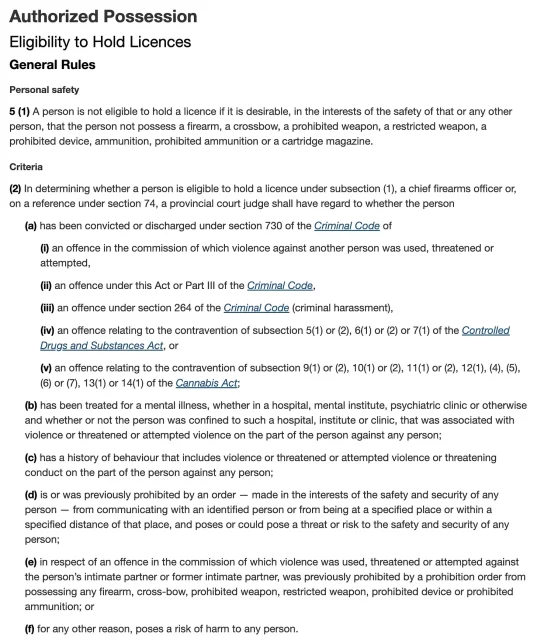
Nobody is eligible to hold a license if it isn’t in the safety interest of a person — that’s literally the first eligibility criterion in the Firearms Act. Issuing a license requires the issuer to consider all past convictions, mental illnesses, history of violent behaviour, previous prohibitions, any potential intimate partner violence, and any potential harm to any person before they issue it. That is checked through a process called Continuous Eligibility Screening, where license holders are checked for “hits” against police systems every single day to determine whether they are still able to hold a license.
This is something almost no one outside Canada’s firearms-owning community understands, and The Line wants to underline this point — anyone with a firearms licence is automatically checked for any new legal issues that might render them unable to own firearms every single day. If you happen to find yourself hanging out with someone with a firearms licence, they were checked out by law enforcement within the last 24 hours. This includes your friends at The Line. The day you’re reading this is a day they passed another screening.
A conviction for a violent crime, it hardly need be said — well, actually, check that, apparently it does need saying — would render one rather ineligible! Not only is this already the law, but there are so many overlapping laws to deal with that exact scenario that it takes real effort to be ignorant of them. Weapon prohibition orders on conviction for violent offences? Already a thing at the federal and provincial levels. Prohibitions while on bail? Already a thing. Firearm seizures during divorces? Not automatic, but common, sometimes even where there is no history of violence or reasonable belief that violence is likely.
The Liberals know all this, especially since it was the Liberals who last changed these laws — though not to add the removal provisions, which largely already existed, but to remove any discretion or ability for rehabilitation.
Every party is fine with keeping guns away from domestic violence perpetrators. Carney making this an issue is bullshit. He’s counting on the public to not know enough to call him out on it.
It’ll probably work.
Oh, and by the way. If you don’t want to take our word for any of the above, you can just read the Firearms Act yourself. Relevant section, below.
April 11, 2025
Beretta 93R: The Best Machine Pistol?
Forgotten Weapons
Published 13 Dec 2024The Beretta 93R (“Raffica”) was developed in the 1970s by Beretta engineer Paolo Parola at the request of Italian military special forces. It took the basic Beretta 92 pistol design and added a well-thought-out burst mechanism under the right-side grip panel. It does not have a plain full-auto setting, but only semiauto and 3-round burst. To help keep the gun controllable, it has a heavier slide to reduce cyclic rate, a detachable shoulder stock, and a folding front grip to help control the muzzle. It uses extended 20-round magazines and is actually remarkably controllable (or so I am told; I have not had a chance to shoot one myself).
(more…)
April 7, 2025
Best of American and Europe: the Webley No5 Express New Army
Forgotten Weapons
Published 6 Dec 2024Webley introduced their No5 Express New Army model revolver in 1878. This was essentially a ruggedized and scaled up variation on the No5 RIC revolvers that was very popular with police forces. The RIC was chambered for just the .450 Adams cartridge, and its ejection system in particular was not suitable to serious military campaigning. Hoping for a military contract, Webley took that No5 double-action clockwork and put it into a much bigger frame, capable of handling all patterns of British service cartridge as well as the American .45 Colt powerhouse. It then proceeded to lose the military adoption to the Enfield MkI, a frankly not very good design.
However, British officers had their own choice of sidearms, and many opted for the No5 Army Express, as evidenced by significant sales through the Army & Navy CSL catalog. The model was well liked and popular, but only for a fairly brief span. In 1887 the British adopted the top-break Webley MkI, and the development of new technology like smokeless powder and tip-out cylinders quickly rendered the No5 obsolete. But for about a decade, this was a very compelling choice, offering a reliably double action system with a powerful cartridge.
(more…)
April 4, 2025
SVD Dragunov: The First Purpose-Built DMR
Forgotten Weapons
Published 3 Dec 2024The development of the Dragunov designated marksman’s rifle was spurred by the NATO adoption of the 7.62x51mm cartridge. The Red Army had standardized on a new suite of infantry weapons using the intermediate-sized 7.62x39mm round, and feared being out-ranged in open terrain by NATO units. The Soviet squad needed some way to reach out and engage a NATO machine gun or antitank weapon that might be beyond the range of their RPD light machine gun. And so in 1957, specifications were issued for a new 7.62x54Rmm precision rifle.
Three designers responded with proposals; Dragunov, Konstatinov, and Simonov. The Simonov was not really suitable (it was a scaled-up SKS in essence), and the Konstantinov was not as accurate as the Dragunov. And so, Evgeniy Dragunov’s rifle was adopted in 1963 as the SVD. Dragunov himself was a talented competitive marksman, and this experience undoubtedly contributed to the quality of his design. The SVD is a rotating bolt rifle with a lightweight short-stroke gas piston and a light-be-accurate barrel. It was issued to ever squad in mechanized infantry units, and was an important part of infantry armament, still in service today.
(more…)
March 31, 2025
Berettas With Bayonets: The Very Early Model 38A SMG
Forgotten Weapons
Published 29 Nov 2024The initial model of the Beretta 38A had a number of features that were dropped rather quickly once wartime production became a priority. Specifically, they included a lockout safety switch for just the rear full-auto trigger. This was in place primarily for police use, in which the guns were intended for semiautomatic use except on dire emergency (and the first batches of 38As in Italy went to the police and the Polizia dell’Africa Italiana). The first version of the 38A also included a bayonet lug to use a version of the folding bayonet also used on the Carcano rifles. This was a folding-blade bayonet, and the model for the 38A replaced the rifle muzzle ring with a special T-lug to attach to the muzzle brake of the SMG. These bayonets are extremely scarce today, as they were only used for a very limited time.
(more…)
March 28, 2025
The First Sturmgewehr: The MKb42(H)
Forgotten Weapons
Published 27 Nov 2024The first iteration of the iconic German Sturmgewehr was developed by Haenel starting in 1938. It was a select-fire rifle chambered for the short 8x33mm cartridge, developed by the Polte company. It used a long-stroke gas piston and a tilting bolt patterned after the Czech ZB-26 light machine gun. What makes the MKb42(H) stand out from the later Sturmgewehr models is that it was an open-bolt design. The original design spec was concerned about preventing cook-offs, and so it required firing from an open bolt. This means a very simple fire control system, but it also made the rifle difficult to shoot accurately in semiautomatic.
The first MKb42(H) prototype was finished in 1941, with 50 sample guns produced by late March 1942. A major trial was held in April 1942, in which Hitler rejected the design (mostly, he disliked the smaller cartridge). Development was continued anyway, with a move to a closed-bolt system that would become the MP43/1 which was ready for its first testing in November 1942. The open-bolt 42(H) was put into production anyway, as a stopgap measure to provide some much-needed individual firepower to troops on the Eastern front. Serial production began in January 1943, and continued until September 1943. In total, 11,813 of the rifles were manufactured. They saw use in Russia until replaced by newer MP43 models, and represent the first combat use of the assault rifle concept.
(more…)


