
Forgotten Weapons
Published 23 Nov 2024When the French took over control of the Mauser factory complex in May 1945, the plant had some 85 tons of pistol parts on hand — 7.3 million individual components in various stages of production. This was enough to make a whole lot of guns, even if many of them were not completed parts. So alongside K98k rifles, HST and Luger pistols, the French restarted P38 pistol production at Mauser.
German military production ended at about serial number 3000f in April 1945, and the French chose to start back up at 1g. They would make a total of 38,780 P38s by the early summer of 1946, completing the G, H, and I serial number blocks and getting mostly through K as well. A final batch of 500 were numbered in the L series after being assembled back in France at the Chatellerault arsenal.
French production P38s are generally recognized by the French 5-pointed star acceptance marks on the slides. They will have slide codes of
svw45andsvw46(the French updated the code to match the year in 1946). Many of the parts used were completed prior to occupation, and various German proof marks can be found on some parts.
(more…)
March 25, 2025
“Grey Ghost” – The French Occupation Production P38 Pistol
March 24, 2025
Canada could learn from the Finnish example
US President Donald Trump tossed several grenades into the still waters of Canadian defence platitudes and forcefully called attention to the clear fact that Canada has been a world-leader in defence freeloading since the late 1960s. In The Line, Tim Thurley suggests that Canada should look more closely at how Finland has maintained its sovereignty with a larger, militarily dominant, and unpredictable neighbour for more than a century:
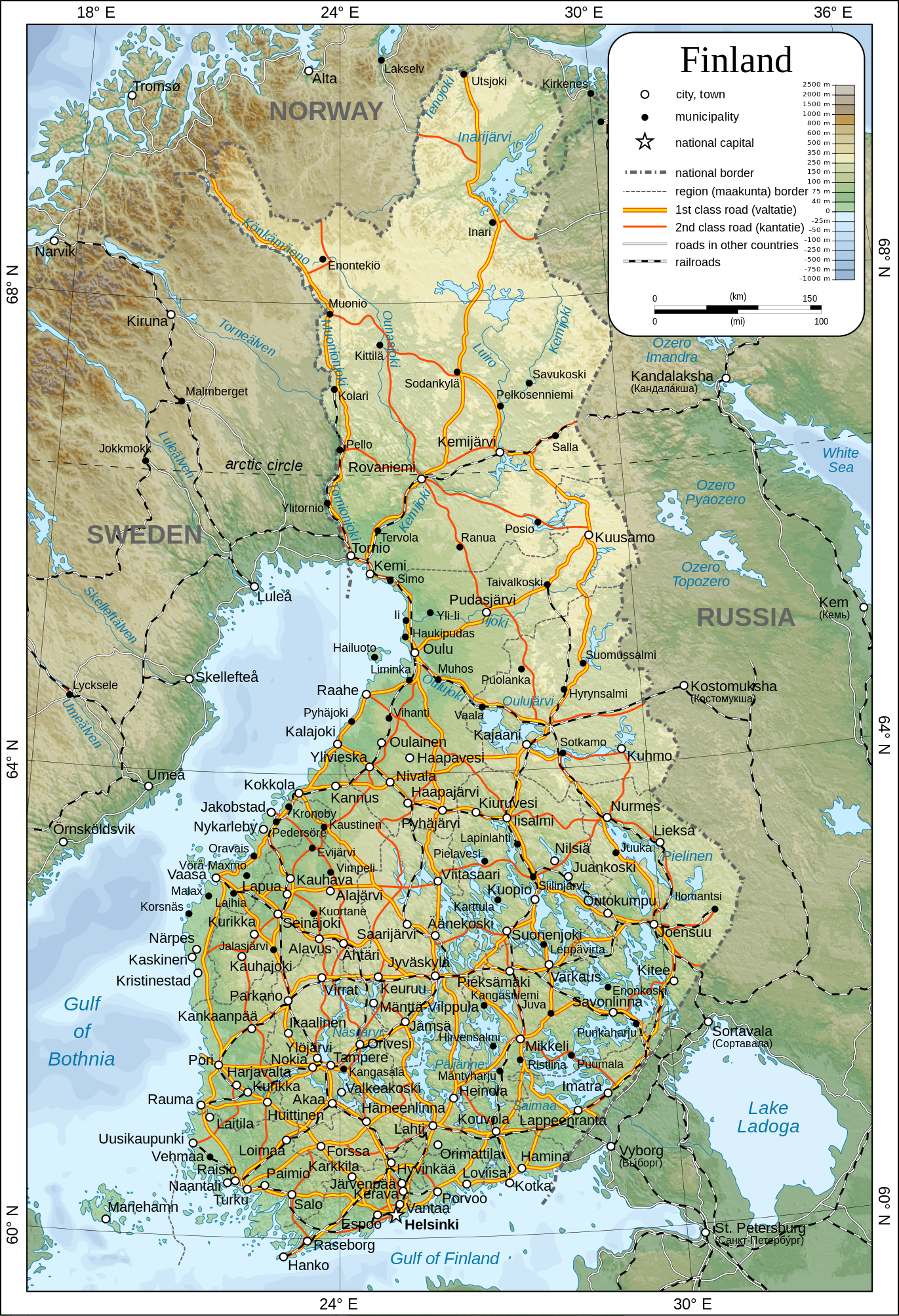
Map of Finland (Suomen kartta) by Oona Räisänen. Boundaries, rivers, roads, and railroads are based on a 1996 CIA map, with revisions. (via Wikimedia – https://en.wikipedia.org/wiki/File:Map_of_Finland-en.svg)
Canadians pretended we didn’t need to take defence seriously. We justified it with fantasies — the world wasn’t that dangerous, threats were distant, and America would rescue us if needed. That delusion is dead. U.S. Republicans and some Democrats don’t trust us to defend our own territory. Trump openly floated annexation and made clear that military protection now comes at a price — potentially statehood. Canadian military leaders now describe our closest ally as “unpredictable and potentially unreliable”. And even when America was a sure bet, our overreliance was reckless. Sovereignty requires self-defence; outsourcing it means surrendering power.
We should take cues from nations in similar situations, like Finland. Both of us border stronger powers, control vast, harsh landscapes, and hold valuable strategic resources. We’re internally stable, democratic, and potential targets.
We also share a key strength — one that could expand our military recruitment, onshore defence production, rebuild social trust, and bolster deterrence: a strong civilian firearms tradition.
We should be doing everything we can to make that tradition a bigger part of Canadian defence, and a larger part of our economy, too.
That may sound absurd to some Canadians. It shouldn’t. Finland is taking full advantage by attempting to expand shooting and military training for civilians both through private and public ranges and the voluntary National Defence Training Association. Finland is seeking to massively upgrade civilian range capacity by building 300 new ones and upgrading others to encourage civilian interest in firearms and national defence, and is doing so in partnership with civilian firearm owners and existing non-government institutions.
Multiple other states near Finland are investing in similar programs. Poland is even involving the education system. Firearm safety training and target practice for school children are part of a new defence education curriculum component, which includes conflict zone survival, cybersecurity, and first aid training. Poland’s aim is to help civilians manage conflict zones, but also to bolster military recruitment.
Lithuania and Estonia encourage civilian marksmanship as part of a society-wide comprehensive defence strategy. The Lithuanian Riflemen’s Union, one of the small nation’s most recognizable institutions, is a voluntary government-sponsored organization intended to prepare civilians for resistance to an occupying power. It has 15,000 members in a population of 2.8 million. The Estonian Defence League trains mostly-unpaid civilian volunteers in guerrilla warfare. It has an 80 per cent approval rating in Estonia, where over one in every 100 men and women with ordinary jobs have joined to learn defence techniques, including mastering standard-issue military service rifles that they may keep at home, ready to fight on a moment’s notice.
These strategies are modern. These countries are no strangers to cutting-edge modern warfare, necessitated by a common border with an aggressive Russia. But technologies like drones are not a replacement for a trained and motivated citizenry, as the Ukraine conflict illustrates. Against a stronger and more aggressive neighbour, these societies deter and respond to aggression through organized, determined, and trained populations prepared to resist attackers in-depth — by putting a potential rifle behind every blade of grass.
Canada, meanwhile, is spending money to hurt our own capacity. It’s coming back to bite us. The Trudeau government misused civilian firearm ownership as a partisan political wedge and ignored the grave flaws of that strategy when they were pointed out, hundreds of times, by good-faith critics. Thousands of firearm models have been banned at massive and increasing expense since 2020 despite no evident public safety benefit. In the recently concluded party leadership race, Mark Carney pledged to spend billions of dollars confiscating them. Government policies eliminating significant portions of business revenue have maimed a firearm industry that historically contributed to our defence infrastructure. Civilian range numbers, which often do double-duty with police and even military use, plunged from roughly 1,400 to 891 in five years. Without civilians to maintain ranges for necessary exercises and qualification shoots, governments must assume the operating expenses, construct new ranges, or fly participants elsewhere to train.
March 22, 2025
Allen & Wheelock Lipfire Navy Revolver
Forgotten Weapons
Published 12 Apr 2015Not all companies responded in the same way to the development of cartridge revolvers and the Rollin White patent. Allen & Wheelock, for example, decided to simply ignore the patent and make revolvers for their proprietary lipfire cartridges (fairly similar to rimfire) while relying on their lawyers to delay the anticipated patent infringement suit for as long as possible. Ultimately it took 4 years for Rollin White and S&W to gain a legal injunction against them, and when that did happen they were ready and converted their production to percussion revolvers of the same basic type. This particular piece is a .36 caliber (“Navy”) version for the lipfire round, which have been since converted to use either lipfire or more common rimfire ammunition.
March 19, 2025
Moore Teatfire Revolver
Forgotten Weapons
Published 21 Jun 2015The Moore patent “teatfire” revolver was one of the more (no pun intended) successful workarounds to the Rollin White patent. Designed by Daniel Moore and David Williamson, the gun was a six-shot .32 caliber pocket revolver which used a proprietary type of cartridge. It was loaded from the front, and the rear of the case had a nipple in its center full of priming compound. This allowed the rear of the cylinder to only have a small hole through which the hammer could reach to hit the nipple and fire the round, as opposed to a rimfire design in which the whole rear of the cartridge had to be exposed at the back of the cylinder. Some examples, including this one, included a unique type of extractor for pushing out spent cases.
March 16, 2025
George Hyde’s First Submachine Gun: The Hyde Model 33
Forgotten Weapons
Published 11 Mar 2018George Hyde was a gun designer who is due substantial credit, but whose name is rarely heard, because he did not end up with his name on an iconic firearm. Hyde was a German immigrant to the United States in 1927 who formed the Hyde Arms Company and started designing submachine guns. His first was the Model 33, which we have here today. This quickly evolved into the Model 35, which was tested by Aberdeen Proving Grounds in the summer of 1939. It was found to have a number of significant advantages over the Thompson, but also some durability problems. The problems could probably have been addressed, but Hyde (who had gone from working as shop foreman at Griffin & Howe to later becoming chief designer for GM’s Inland division during WWII) had already moved on to a better iteration. His next design was actually adopted as the M2 to replace the Thompson, but production problems caused it to be cancelled. The M3 Grease Gun was chosen instead, and Hyde had designed that as well. He was also responsible for the design of the clandestine .45 caliber Liberator pistol.
The Hyde Model 33 is a blowback submachine gun which obviously took significant influence from the Thompson — just look at the front grip, barrel ribs, controls, magazine well, and stock design. However, it was simpler, lighter, and less expensive than the Thompson. It fared better than the Thompson in military mud and dust tests, probably in part because of its unusual charging handle, a long rod mounted in the rear cap of the receiver. This was pulled rearward to cycle the bolt, a bit like the AR15 charging handle. Like the AR15, this setup eliminated the need for an open slot in the receiver. Apparently, however, the handle had a disconcerting habit of bouncing back into the face of the shooter when firing.
Cool Forgotten Weapons merch! http://shop.bbtv.com/collections/forg…
March 12, 2025
Colt Sidehammer “Root” Dragoon Prototype
Forgotten Weapons
Published 17 Nov 2016During the development of the 1860 Army revolver, Colt did consider mechanical options other than simply scaling up the 1851 Navy pattern. One of these, as evidenced by this Colt prototype, was an enlarged version of the 1855 Pocket, aka “Root”, revolver. That 1855 design used a solid frame and had been the basis for Colt’s revolving rifles and shotguns, and so it would be natural to consider it for use in a .44-caliber Army revolver. How extensive the experimentation was is not known, and I believe this is the only known surviving prototype of a Dragoon-size 1855 pistol. It survives in excellent shape, and is a really neat glimpse at what might have been …
March 8, 2025
Joslyn M1862 and M1864 Carbines
Forgotten Weapons
Published 15 Jun 2015While US infantry forces during the Civil War had only limited access to the newest rifle technology, cavalry units adopted a wide variety of new carbines in significant numbers. Among these were a design by Benjamin Joslyn. It first appeared in 1855 designed to use paper cartridges, but by the time the US Army showed an interest Joslyn had updated the weapon to use brass rimfire ammunition. The first version purchased by the government was the 1862 pattern carbine, of which about a thousand were obtained. Many more were ordered, but it took Joslyn a couple years to really get his manufacturing facility and processes worked out. By the time he had this all straightened out, the design had been updated again to the 1864 pattern, addressing several minor problems with the earlier version. Ultimately more than 11,000 of the 1864 pattern carbines were purchased by the Union, chambered for the same .56-.52 cartridge as the Spencer carbines also in service.
March 5, 2025
Colt Boa: Rarest of the Snake Revolvers
Forgotten Weapons
Published 13 Nov 2024Of the seven revolvers Colt named after snakes, the rarest is the Colt Boa. Only a single production run of these were made totaling just 1,200 guns. They were made in 1985 as a custom order for the Lew Horton distribution company, which wanted something unique to offer its buyers. The Boa was an intermediary between the standard Colt MkV and the high-end Python. It was a 6-shot .357 Magnum with a full underlay and ventilated shroud. The only variation was in barrel length, as half were made with 4” barrels and half with 6” barrels. The serial numbers were “BOAxxxx”, with the 4” guns having odd numbers and the 6” ones getting even numbers. Five hundred of each were sold individually, but the first 100 of each length were packaged together into sequentially-numbered pairs in fancy cases.
The Boas all sold in 1985, and they are now the hardest to find for the Colt Snake collector. This particular pair is a gorgeous example of an original cased set, numbers 43 and 44.
(more…)
March 1, 2025
Spoils of War: French Occupation-Production Mauser K98k svwMB
Forgotten Weapons
Published 11 Nov 2024Allied troops occupied the Mauser factory complex in Oberndorf in April of 1945, right at the end of the war. The factory was put under French administration and by May that same year production lines were restarted to supply French forces (who needed as many arms as they could get). In total, just under 52,000 new K98k rifles were made for the French between May 1945 and June 1946, when the factory shut back down (and much of it was dynamited by the departing French forces).
The rifles made under French control were all marked with the receiver code svwMB. German production had switched to this code early in 1945 after producing an “a” block of svw45 rifles and about 5,500 guns in the svw45 “b” block. The factory shutdown came midway through svwMB “c” block, and the first French-property rifles had been assembled under German control and were waiting for final inspection when the factory was occupied. Mauser production was non-linear, and some “c” block receivers had been finished and shipped to German forces before the shutdown, while others remained at the factory. There is no specific transition point between French and German rifles because of this. Production of the “c” block ran into the 29,000 range, and was followed by three suffixes of entirely French-production guns; “d”, “h”, and “k”.
The K98k being produced by this point — and what was continued under the French — was the Kriegsmodell, the last-ditch simplified model of the K98k. It had many stamped and welded parts, no barrel band springs (screws were used instead) and no bayonet lug. The French produced the guns in exactly the same configuration as the Germans had, simply substituting a five-pointed star as a final inspection stamp in front of the receiver serial number. At some point later, the French rebuilt many of these rifles and added two distinctive features that are often thought to have been original factory production elements. These are the hexagonal stacking rod under the muzzle and the left-side sling bar on the stock. When these rebuilds were done, the bolts were also scrubbed and renumbered with just the last 3 digits of the receiver serial number.
(more…)
February 27, 2025
Reining in the ATF
J.D. Tuccille on the ATF’s immediate future with FBI director Kash Patel as the newly appointed acting head of the bureau:

Kash Patel, 9th Director of the Federal Bureau of Investigation.
… it’s impossible to credibly argue that the ATF doesn’t need a shakeup. After all, this is a federal agency that ran guns to criminal gangs in Mexico as part of a bizarre and failed “investigation”, manipulated mentally disabled people into participating in sting operations — and then arrested them, lost thousands of guns and gun parts, killed people over paperwork violations, and unilaterally reinterpreted laws to create new felonies out of thin air (which means more cause for sketchy investigations and stings). The federal police agency obsessively focused on firearms has long seemed determined to guarantee itself work by finding ever more things to police.
But what about putting the same person in charge of both the ATF and the FBI? How does that make sense?
Well, there’s a lot of overlap in the responsibilities of federal agencies. During the ATF’s “Operation Fast and Furious” gunrunning escapade in Mexico, it coordinated — badly — with the FBI, the Drug Enforcement Administration (DEA), and Immigration and Customs Enforcement (ICE). During its 2012 investigation of that fiasco, the Justice Department Inspector General “conducted interviews with more than 130 persons currently or previously employed by the Department, ATF, the DEA, the FBI, and the Department of Homeland Security (DHS)” on its way to identifying “a series of misguided strategies, tactics, errors in judgment, and management failures that permeated ATF Headquarters and the Phoenix Field Division”.
[…]
Done right, you wouldn’t need as many agents for the combined agency, and you would have lower overhead. But — and this is a big concern — done wrong, you’d end up with a supercharged federal enforcement agency with all the hostility to civil liberties its old components embodied when separate, but now with lots more clout.
When he took charge of the FBI, Patel became the leader of an agency that has long served as a sort of political police. Its abuses date back decades and never seem to go away, just to morph into new ways of targeting anybody who criticizes whoever is currently in power.
“The FBI entraps hapless people all the time, arrests them, charges them with domestic terrorism offenses or other serious felonies, claims victory in the ‘war on domestic terrorism’, and then asks Congress for more money to entrap more people,” John Kiriakou, a former CIA officer and whistleblower, wrote in 2021.
That means there’s already a problem that needs to be addressed, or it could infect a combined agency rather than taking the sharp edges off the ATF.
Also troubling is that before his nomination to head the FBI, Patel made comments suggesting he wants to target his own political enemies. He’s backed off those threats, telling the Senate Judiciary Committee he’s committed to “a de-weaponized, de-politicized system of law enforcement completely devoted to rigorous obedience to the Constitution and a singular standard of justice”. But it’s worth watching what he does with his roles at the separate FBI and ATF before combining the two agencies into something more dangerous.
Or maybe the Trump administration won’t take the next step of formally integrating the ATF and the FBI. Self defense advocates have long called for ATF leadership that isn’t actively hostile to gun owners. If all Patel does is rein in the ATF so that Americans get a few years of relief from that agency’s abuses, that’s a victory itself. But eliminating a much-loathed federal agency would be even better.
February 26, 2025
G33/40: Special Carbine for the Gebirgsjager
Forgotten Weapons
Published 8 Nov 2024When the Germans took over control of the Czechoslovakian arms industry, they took some time to work out what out to mass produce at the Brno factory. In the interim, they decided to restart production of the Czech vz33 Mauser carbine as the Gewehr 33/40 for German mountain troops. This was a truly short carbine with a 19.4 inch (490mm) barrel, which the Czechs had used for mostly police applications. German had used a short carbine back before World War One, but with Spitzer ammunition it was deemed too harsh shooting (both blast and recoil) to be worth the reduced length. Well, that calculation was different for mountain troops.
The G33/40 also had a distinctive added metal plate on the left side of the stock to help protect it in mountain use. The G33/40 would remain in production for three years, from 1940 until 1942 (after which the rifle production changed to standard K98ks). About 130,000 were made, with 945 receiver codes in 1940 and dot codes thereafter.
(more…)
February 23, 2025
Portuguese Navy Lugers: Model m/910 from DWM and Mauser
Forgotten Weapons
Published 2 Nov 2024Following Portuguese Army adoption in 1908, the Portuguese Navy adopted the Luger in 1909 as the m/910. The pattern they chose was a “new model” Luger in 9x19mm, with a 100mm / 4″ barrel. A total of 650 were ordered in late 1909 and delivered between 1910 and 1912. The guns had Portuguese-language safety and extractor markings (“Seguranca” and “Carregada“) and included grip safeties. They were in a dedicated serial number range of 1 to 650. The first 350 were delivered under the reign of Portuguese King Manuel II and had crown-over-anchor chamber crests. With the establishment of a Republic in Portugal, that marking was changed to “R.P.” over an anchor, which was used on the remaining guns (351-650).
In the mid 1930s, the Navy ordered another 156 m/910 Luger pistols, this time from the Mauser company. These had the same Portuguese markings, but without any special crest — just blank chambers. They were numbered in Mauser’s export/commercial serial number range, and are in the “v” block of numbers. A few more very small orders were placed in 1941 and 1942, but these were filled with basically straight German P08 pistols.
(more…)
February 20, 2025
Enfield MkII: Better Than the MkI, I Guess
Forgotten Weapons
Published 1 Nov 2024The Enfield MkI had only been in service for two years when the MkII was adopted in March 1882 to resolve some of its problems (and reduce its cost). At the same time, a new cartridge was adopted (the MkIII) with a heeled .477” bullet — also in hopes of resolving some of the problems with the Enfield revolver.
The Enfield used a selective ejection system that was intended to dump empty cases but retain unfired live cartridges. It was a bit finicky, with the live rounds often moving during the ejection process and jamming the system up. The larger heeled bullets were hoped to help stop that — and they were also thought to provide better accuracy in the gun’s Henry type rifling.
Simplifications to reduce cost of the gun included:
Unchecked grips
Smooth holster guides
Simplified geometry on the lower frame and top strap
Semicircular front sightFinally, a number of mechanical changes were made. Small elements were added to the clockwork to prevent cylinder rotation when not firing, and to lock the trigger and hammer when the loading gate was open. A second side plate screw was added to ease disassembly, and the grip attachment redesigned to use the lanyard ring as a screw to hold them in place. A fatal accident with an Enfield led to design of a hammer block safety that was intended to be universally retrofitted to guns in service, but many of the guns already sent out to far corners of the planet were never returned for this work.
In total, 13,102 MkII Enfield revolvers were made between 1882 and 1885, plus one gun each in 1886 and 1887. In 1887, the Webley MkI revolver was adopted to replace it, presumably much to the relief of Ordnance officers across the Empire.
(more…)
February 8, 2025
Hungarian WWII Rifles (35M, 43M, G98/40)
Forgotten Weapons
Published 11 Jun 2015After the breakup of the Austro-Hungarian Empire, the Hungarian army was armed primarily with Steyr M95 straight-pull rifles and carbines, chambered for the 8x56mm rimmed cartridge. In 1935 they adopted a new Mannlicher turnbolt rifle, the 35M, which used the same 8x56R ammunition and en bloc clips. The rifle was modified in 1940 for production to German specifications as the Gewehr 98/40 (including conversion to 8×57 rimless ammunition and a stripper-clip-fed box magazine). The resulting rifle was good enough that it was adopted by Hungary as well in 1943 as the 43M.
QotD: American gun rights
I was asked last night why, when I talk about politics, I focus on gun rights so much. Surely, said querent, there are lots of other important things for a libertarian like you to weigh in on. Censorship. DEI. AGW hysteria. The list goes on …
Fair question. It’s because many years ago L. Neil Smith, a libertarian SF writer sadly no longer with us, persuaded me of something important.
A politician’s attitude about firearms rights is a very reliable index for his actual attitude about individual freedom and agency.
Never mind what they say about other issues. A politician standing up for the right of ordinary citizens to be armed is sending a very reliable signal that he values their ability to assert their freedom, and trusts them to generally make correct choices about the use of violence even it might be directed against himself.
Conversely, a politician who is against gun rights is telling on himself. He fears the wrath of the people and wants them disempowered. He does not trust them to employ violence only when necessary.
And that’s actually the best case. In far too many cases, anti-gun politicians clearly dream of being the jackboot that stomps on human faces forever, and view the disarmament of the general population as a step towards that end.
If I must have politicians meddling in my affairs, I demand at the very least that they respect my freedom and my agency. That’s why I demand that they respect my right to keep and bear arms.
Gun rights may look like a narrow single issue. It isn’t. It’s an even better index of a politician’s attitude about liberty than questions about free speech and censorship, because it pushes the stakes higher. Because words can’t kill you, but arms wielded by enraged citizens can.
No matter what soothing words drop from his lips, no matter what promises he makes, the politician who tries to disarm you is always, always, always your enemy. Never forget that.
ESR, Twitter, 2024-11-06.


