
On Target Canada
Published 20 Jan 2020Time to get a closer look at a rifle I have spent a lot of time with in the past. The FN C1A1, used by the Canadian Army from the mid 1950s to the late 1980s.
Enjoy!
(more…)
February 4, 2025
The FN C1A1 – Workhorse of the Cold War Canadian Army
Comments Off on The FN C1A1 – Workhorse of the Cold War Canadian Army
February 1, 2025
A century of war: The cartridge that remains deadly on today’s battleground
BFBS Forces News
Published 19 Oct 2024Say “7.62mm” when talking about rifle and machine gun rounds, and most people will think of the Nato cartridge that was introduced in 1954, but there’s a far older one that’s still in use – the 7.62x54mmR.
While the 7.62x51mm Nato cartridge was brought into service in 1954, the 7.62x54mmR dates back to 1891 in Imperial Russia.
Although this cartridge was developed in Russia, the “R” actually stands for “Rimmed” and this is what makes these two 7.62mm cartridges so different.
(more…)
Comments Off on A century of war: The cartridge that remains deadly on today’s battleground
January 30, 2025
QotD: Michael Moore
Bowling for Columbine is the latest documentary from Michael Moore, the leftwing multi-millionaire provocateur in his usual cunning disguise as an all-American lardbutt loser — baseball cap, unkempt hair, untucked shirt. This time, the nominal subject is American violence, but, by now, connoisseurs of Roger and Me and Moore’s TV work know that, whatever the subject, the routine never varies: he turns up at company headquarters unannounced and demands to see the chairman. The receptionist says he’s not available, and Moore merrily films the stand-off before moving on to some other target. If he showed up to see me without making an appointment, I’d tell him to piss off and then fire a warning shot. If I showed up to see him unannounced and accompanied by a camera crew, his people would do the same to me.
But most folks are nicer than that.
And so you can’t help noticing that, for a champion of the little guy, he goes to an awful lot of time and effort to make the little guy look like a chump. Moore has no interest in digging deep into his subjects when all the fun’s to be had on the surface of American life — the squeaky receptionists, the bored security guards, the bland PR women, the squaresville company guy in the suit, the State Police trooper with the infelicitous phrasing, the bozo in the pool hall … His vision of America as a wasteland of gun kooks, conspiracy theorists and perky brain-fried mall clerks will doubtless have them rolling in the aisles in Paris this weekend. In my corner of New Hampshire, there were only four other moviegoers in the theater. But Moore, a great favorite with the BBC, now does his shtick with an eye to the non-American market.
Mark Steyn, “Bowling for Columbine”, Steyn Online, 2002-11-30.
Comments Off on QotD: Michael Moore
January 29, 2025
Gewehr 98: The German WWI Standard Rifle
Forgotten Weapons
Published 11 Jun 2016The Gewehr 1898 was the product of a decade of bolt action repeating rifle improvements by the Mauser company, and would be the standard German infantry rifle through both World Wars. Today we are looking at a pre-WWI example (1905 production) that shows all the features of what a German soldier would have taken to war in 1914.
Comments Off on Gewehr 98: The German WWI Standard Rifle
January 26, 2025
The FAL in Cuba: Left Arm of the Communist World?
Forgotten Weapons
Published 7 Oct 2024The full version of this video, including the fully automatic fire not permitted on YouTube, is available on History of Weapons & War here:
https://forgottenweapons.vhx.tv/video…
In 1958, Cuban dictator Fulgencio Batista ordered some 35,000 FAL rifles from FN, including both regular infantry rifles have heavy-barreled FALO light machine guns. Before any of them could arrive, however, Batista fled the country and his guns were delivered to Fidel Castro beginning in July 1959.At this time, the FAL was still a fairly new rifle, having been first adopted by Venezuela in 1954 and Belgium in 1954/55. A few changes had been made by the time of the Cuban contract (like the slightly taller sights requested by the Germans), but these were still Type 1 receivers with early features.
The first consignment of rifles arrived from Belgium to Havana July 9, 1959 and this consisted of 8,000 rifles and ten LMGs. A second shipment of 2,000 rifles arrived October 15th, and a third of 2,500 rifles and 500 LMGs on December 1st. The final ship bringing FALs to Cuba (the French freighter La Courbe) docked in Havana March 4th 1960, and suffered a pair of explosions while bring unloaded. Several hundred people were killed or injured, and Castro blamed the CIA for the event. In total, the Cubans received 12,500 FAL rifles and 510 FALO light machine guns.
The FALs were used, but many ended up being exported to other parties, as Cuba generally moved to Soviet bloc small arms starting in 1960 (when they began receiving weapons from the USSR and Czechoslovakia). These were often scrubbed of their Cuban markings before shipment, and can be found with a round hole milled in the magazine well where the Cuban crest originally was, similar to how some South African FALs were scrubbed before being sent to Rhodesia.
Thanks to Sellier & Bellot for giving me access to this pair of very scarce Cuban FALs to film for you!
(more…)
Comments Off on The FAL in Cuba: Left Arm of the Communist World?
January 23, 2025
Guycot 40-shot Chain Pistol
Forgotten Weapons
Published 19 Dec 2016The Guycot chain pistol was the development of two Frenchmen, Henri Guenot and Paulin Gay in 1879. It is chambered for a unique 6.5mm caseless rocket ball type cartridge in which the base of the projectile is hollowed out and contains the propellant powder and a primer. Upon firing, the entirely of the projectile exits, leaving nothing to be extracted or ejected from the chamber. Unfortunately for the Guycot’s military aspirations, this cartridge was far too small and underpowered to attract and serious interest and only a few hundred at most were made. These were divided between several models, including a 25-shot pistol, a 40-shot pistol like this one, and an 80-shot carbine.
January 20, 2025
Campo-Giro M1913 – Spain’s First Domestic Selfloader
Forgotten Weapons
Published 31 May 2015The Campo-Giro was Spain’s first indigenous self-loading military pistol, adopted in 1912 to replace the Belgian 1908 Bergmann-Mars. Only a small number were made of the original M1913 variety, with the vast majority being the later and slightly more refined M1913/16. This particular example is an early one, and particularly interesting to look at for that reason. The gun is a straight blowback design in 9mm Largo, and only lasted as Spain’s standard pistol until its descendent, the Astra 400, was adopted in 1921.
Comments Off on Campo-Giro M1913 – Spain’s First Domestic Selfloader
January 17, 2025
Schwarzlose 1898 Semiauto Pistol
Forgotten Weapons
Published 4 May 2015The model 1898 Schwarzlose was a self loading pistol definitely ahead of its time. It was simple, powerful (for the period; it was chambered for 7.63mm Mauser), and remarkably ergonomic. It used a short recoil, rotating bolt mechanism to operate, and very cleverly had one single spring which did the duties of primary recoil spring, striker spring, trigger spring, and extractor spring. Why it failed to become a commercial success is a question I have not been able to definitively answer — I suspect it must have been due to cost. Edward Ezell theorizes that it was unable to compete with the Borchardt/Luger and Mauser pistols because those were able to be made with much more economy of scale. It is really a shame, because the Schwarzlose 1898 is the best of all the pre-1900 handguns I have encountered.
Comments Off on Schwarzlose 1898 Semiauto Pistol
January 6, 2025
QotD: The right to bear arms
And that is where ethics and psychology bring us back to the bearing of arms. For causality runs both ways here; the dignity of a free man is what makes one ethically competent to bear arms, and the act of bearing arms promotes (by teaching its hard and subtle lessons) the inner qualities that compose the dignity of a free man.
It is not always so, of course. There is a 3% or so of psychotics, drug addicts, and criminal deviants who are incapable of the dignity of free men. Arms in the hands of such as these do not promote virtue, but are merely instruments of tragedy and destruction. But so, too, are cars. And kitchen knives. And bricks. The ethically incompetent readily (and effectively) find other means to destroy and terrorize when denied arms. And when civilian arms are banned, they more readily find helpless victims.
But for the other 97%, the bearing of arms functions not merely as an assertion of power but as a fierce and redemptive discipline. When sudden death hangs inches from your right hand, you become much more careful, more mindful, and much more peaceful in your heart — because you know that if you are thoughtless or sloppy in your actions or succumb to bad temper, people will die.
Too many of us have come to believe ourselves incapable of this discipline. We fall prey to the sick belief that we are all psychopaths or incompetents under the skin. We have been taught to imagine ourselves armed only as villains, doomed to succumb to our own worst nature and kill a loved one in a moment of carelessness or rage. Or to end our days holed up in a mall listening to police bullhorns as some SWAT sniper draws a bead …
But it’s not so. To believe this is to ignore the actual statistics and generative patterns of weapons crimes. “Virtually never”, writes criminologist Don B. Kates, “are murderers the ordinary, law-abiding people against whom gun bans are aimed. Almost without exception, murderers are extreme aberrants with lifelong histories of crime, substance abuse, psychopathology, mental retardation and/or irrational violence against those around them, as well as other hazardous behavior, e.g., automobile and gun accidents.”
To believe one is incompetent to bear arms is, therefore, to live in corroding and almost always needless fear of the self — in fact, to affirm oneself a moral coward. A state further from “the dignity of a free man” would be rather hard to imagine. It is as a way of exorcising this demon, of reclaiming for ourselves the dignity and courage and ethical self-confidence of free (wo)men that the bearing of personal arms, is, ultimately, most important.
This is the final ethical lesson of bearing arms: that right choices are possible, and the ordinary judgement of ordinary (wo)men is sufficient to make them.
We can, truly, embrace our power and our responsibility to make life-or-death decisions, rather than fearing both. We can accept our ultimate responsibility for our own actions. We can know (not just intellectually, but in the sinew of experience) that we are fit to choose.
Eric S. Raymond, “Ethics from the Barrel of a Gun”.
Comments Off on QotD: The right to bear arms
December 29, 2024
wz.35: Poland’s Remarkably Misunderstood Antitank Rifle
Forgotten Weapons
Published Aug 26, 2024In the 1930s, Poland decided to develop an anti-tank rifle, and the young designer Józef Maroszek came up with the winning system by scaling up a bolt-action service rifle he had already drawn up. The project was kept very secret, out of concern that Germany or Russia would up-armor their tanks if the Polish rifle’s existence and capabilities became known. This secrecy has led to a lot of misconceptions about the rifle today …
Interestingly, the ammunition for the wz.35 used a plain lead core. Polish engineers found that at its incredible 4200 fps (1280 m/s) muzzle velocity, the lead core had excellent armor penetrating capacity. When the German Army later captured and reused the rifles, they didn’t trust this, and reloaded captured Polish ammunition with German tungsten-cored projectiles made for the PzB-39.
Rather than explain the full story of the wz.35 in detail here, I will refer you to http://www.forgottenweapons.com/wz-35/, where I have posted a full monograph on the rifle written by Leszek Erenfeicht.
(more…)
Comments Off on wz.35: Poland’s Remarkably Misunderstood Antitank Rifle
December 28, 2024
How the H1B visa argument follows an earlier political struggle
On the social media platform formerly known as Twitter, ESR points out that the arguments over US work permits for foreigners might well have been prefigured by the now-receding tide of attempts to gut the second amendment:
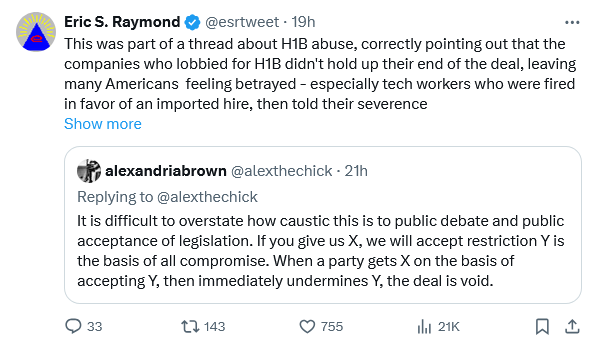
alexandriabrown @alexthechick
It is difficult to overstate how caustic this is to public debate and public acceptance of legislation. If you give us X, we will accept restriction Y is the basis of all compromise. When a party gets X on the basis of accepting Y, then immediately undermines Y, the deal is void.This was part of a thread about H1B abuse, correctly pointing out that the companies who lobbied for H1B didn’t hold up their end of the deal, leaving many Americans feeling betrayed — especially tech workers who were fired in favor of an imported hire, then told their severance pay would be denied if they didn’t train their replacements.
I am, however, irresistibly reminded of another betrayal. One I’ve written about before — but maybe at least part of this story needs to be told again.
Today in the 21st century most of the American gun culture is bitterly, even fanatically opposed to more “gun control” laws, and howling for all of them clear back to the National Firearms Act of 1934 to be repealed. Donald Trump earned huge support with his promise to get national concealed-carry reciprocity pushed through Congress.
We weren’t always like that. Long ago, before 1990, many of us were less resistant to new gun control measures. Sometimes major gun-rights organizations would even help lawmakers draft legislative language.
(Yes, I was a gun owner then. So I’m not going by legends, but by lived experience.)
What changed?
The quid-quo-pros we were offered were many variations of “If you will accept this specific restriction X, we will stop pushing. We will stop trying to undermine your Second Amendment rights in general. Help us save the chilllldren!”
That promise was never kept. Gradually, we noticed this. It always turned out that the minority of angry suspicious people who said “This won’t be enough, they’ll come back for another bite!” were right.
Eventually, some documents leaked out of one of the major graboid organizations that revealed a conscious strategy of salami-slicing — instead of challenging gun rights directly, they intended to gradually make owning personal weapons less useful and more onerous until the culture around them collapsed.
So nowadays we’re pretty much all angry and suspicious. Even restrictions that do little harm and might be objectively reasonable (bump stocks, anyone?) touch off tsunamis of protest.
People offering us more “deals” (just give up this one little thing, mmmkay?) now have negative credibility.
Are you paying attention, Big Tech? (Particularly you, @elonmusk, and you, @VivekGRamaswamy.) Because you’re almost there, now. Too many people see that H1B has become an indentured-servitude fraud that victimizes both the workers it imports and the Americans it displaces.
You credibility isn’t as shot as the gun-banners’ yet. You still have some room for recovery on “high-skilled immigation” in general, but it’s decreasing.
Your smart move would be to sacrifice H1B so you can keep the O-1 “genius” visas. I advise you to take it, because if you dig in your heels I think you are likely to lose both.
And on the reason so many Americans have become angry about blatant and exploitive H1B visa abuse:
Today’s big beef is between tech-success maximizers like @elonmusk and MAGA nationalists who think the US job market is being flooded by low-skill immigrants because employers don’t want to pay competitive wages to Americans.
To be honest, I think both sides are making some sound points. But I’d rather focus on a different aspect of the problem.
When I entered the job market as a fledgling programmer back in the early 1980s, I didn’t have to worry that some purple-haired harpy in HR was going to throw my resume in the circular file because I’m a straight white male.
I also didn’t have to worry that a hiring manager from a subcontinent that shall not be named would laugh at my qualifications because in-group loyalty tells him to hire his fourth cousin from a city where they still shit on the streets.
It’s a bit much to complain that today’s American students won’t grind as hard as East Asians when we abandoned meritocracy more than 30 years ago. Nothing disincentivizes working your ass off to excel more than a justified belief that it’s futile.
Right now we’re in and everybody-loses situation. Employers aren’t getting the talent they desperately need, and talent is being wasted. That mismatch is the first problem that needs solving.
You want excellence? Fire the goddamn HR drones and the nepotists. Scrap DEI. Find all the underemployed white male STEM majors out there who gave up on what they really wanted to do because the hiring system repeatedly punched them in the face, and bring them in.
Don’t forget the part about paying competitive wages. This whole H-1B indentured-servitude thing? It stinks, and the stench pollutes your entire case for “high-skill” immigration. You might actually have a case, but until you clean up that mess Americans will be justified in dismissing it.
These measures should get you through the next five years or so, while the signal that straight white men are allowed to be in the game again propagates.
I’m not going to overclaim here. This will probably solve your need for top 10% coders and engineers, but not your need for the top 0.1%. For those you probably do have to recruit worldwide.
But if you stop overtly discriminating against the Americans who could fill your top 10% jobs, your talent problem will greatly ease. And you’ll no longer get huge political pushback from aggrieved MAGA types against measures that could solve the rest of it.
Doesn’t that seem like it’s worth a try?
Comments Off on How the H1B visa argument follows an earlier political struggle
November 25, 2024
The Experimental SOE Welrod MkI Prototype
Forgotten Weapons
Published Aug 12, 2024The Welrod was a program to develop a silent assassination pistol for British SOE (Special Operations Executive) late in 1942. It needed to be chambered in the .32 ACP cartridge, be effective to a range of 15m, and have its firing not recognizable as a firearm at 50m distance. The project was led by Major Hugh Quentin Reeves, who developed much of SOE’s inventory of gadgets.
The Welrod concept was ready in January 1943, and it was not quite the Welrod that we recognize today. This initial MkI design used a fixed internal 5-round magazine and a thumb trigger, along with a rifle style bolt action mechanism. Samples were produced in April 1943, and testing showed that it was rather awkward to use. A MkII version was quickly developed in June 1943 with a more traditional style of grip and magazine, and formal trials led to the adoption of that MkII design. Incidentally, this is why the first Welrod produced was the MkII, and the later production version in 9mm was designated the MkI (it was the first mark of 9mm Welrod).
Eventually many thousands of Welrod pistols were manufactured, and they almost certainly remain in limited use to this day. This example we have today is the only surviving MkI example, however.
(more…)
Comments Off on The Experimental SOE Welrod MkI Prototype
November 22, 2024
Kalthoff 30-Shot Flintlock: The First Repeating Firearm Used in War (1659)
Forgotten Weapons
Published Aug 7, 2024The first repeating rifle used in combat by a military force was a flintlock system developed by the Kalthoff brothers. It was adopted in the 1640s by the Danish Royal Guard, who purchased a bit more than 100 of the guns, and used them successfully in the Siege of Copenhagen in 1659. The Kalthoff is a .54 caliber flintlock rifle with a magazine of 30 balls under the barrel and a powder storage compartment in the buttstock. A lever under the action is rotated forward 180 degrees and then back to completely reload the rifle — this action loads a ball into the chamber, seats it fully in place, loads powder behind it, primes the pan, cocks the hammer, and closes the frizzen. This was an amazing amount of firepower in the mid-1600s, and the mechanism in the gun is brilliant.
The Kalthoff brothers (Peter, Mathias, Caspar, Henrik, and William) spread out across Europe working for many royal courts although it was in Denmark where their gun saw the most substantial military use. The system would lead to other repeating flintlock designs like the Lorenzoni, but these did not really meet the quality of the original Kalthoffs (in my opinion). However, the system was very expensive to make and rather fragile to use. By 1696 the Danes had taken them out of service in favor of simpler and more durable designs. Kalthoffs today are very, very rare, and it was an incredible privilege to be able to take this one apart to show to you. Many thanks to Jan, its owner, for letting me do that!
(more…)
Comments Off on Kalthoff 30-Shot Flintlock: The First Repeating Firearm Used in War (1659)
November 19, 2024
WF-51: A Swiss Intermediate-Cartridge Copy of the FG-42
Forgotten Weapons
Published Aug 5, 2024After World War Two the Swiss needed a new self-loading military rifle to replace their K-31 bolt actions. Two major design tracks followed; one being a roller-delayed system based on the G3 at SIG and the other being a derivative of the German FG-42 at Waffenfabrik Bern. Bern, under the direction of Adolph Furrer, had been experimenting with intermediate cartridges since the 1920s, and they used this as a basis to develop an improved FG-42 using an intermediate cartridge (7.5x38mm). The program began in 1951 and went through about a half dozen major iterations until it ultimately lost to the SIG program (which produced the Stgw-57).
Today we are looking at one of the first steps in the Bern program, the WF-51. The most substantial change form the FG42 design here is the use of a tilting bolt instead of a rotating bolt like the Germans used. It is a beautifully manufactured firearm, and a real pleasure to take a look at …
Many thanks to the Royal Armouries for allowing me to film and disassemble this rifle! The NFC collection there — perhaps the best military small arms collection in Western Europe — is available by appointment to researchers:
https://royalarmouries.org/research/n…You can browse the various Armouries collections online here:
https://royalarmouries.org/collection/
(more…)
Comments Off on WF-51: A Swiss Intermediate-Cartridge Copy of the FG-42
November 16, 2024
RT20: Croatia’s Insane Kludged 20mm Anti-Materiel Rifle
Forgotten Weapons
Published Jul 31, 2024During its Homeland War, Croatia manufactured a wide variety of ad-hoc firearms including a number of anti-materiel rifles. The RT-20 was the largest of these, and its development began with the discovery of a stash of Yugoslav M55 anti-aircraft cannon barrels chambered for 20mm Hispano in a warehouse. These barrels were cut down, fitted with single-shot bolt actions, bipods, and bullpup stock assemblies and became the RT-20s. The most unusual element of the design is the use of gas vents about halfway down the barrel which open into a hollow tube which vents over the shooter’s shoulder. This creates a gas exhaust jet upon firing to help counteract recoil (and also reducing the muzzle velocity by about 25%). The recoil from firing is still pretty brutal, but the guns can be used — and were during the war for Croatia’s independence. A few remain in Croatian police inventory today …
A big thanks to the Croatian Police Museum (Muzej Policije) in Zagreb for giving me access to film this rare piece for you! Check them out at: https://muzej-policije.gov.hr
(more…)
Comments Off on RT20: Croatia’s Insane Kludged 20mm Anti-Materiel Rifle


