
Feral Historian
Published 24 Jan 2025Harry Turtledove’s The Guns of the South gives us a look at a victorious Confederate States as they grapple with the consequences of slavery, war, and the challenges of building a new nation. It also skewers a favorite activity of alt-history readers, the nitpicking of plausibility in the points of divergence, by dropping South African time travelers with AKs into the middle of the Civil War.
00:00 Intro
02:08 America Will Break
04:49 Right and Left
05:36 CSA at odds with AWB
08:08 Forrest
10:16 Technology
13:16 “Why then …”
June 19, 2025
The Guns of the South: Checkmate, Alt-Hist Plausibility Sticklers
Comments Off on The Guns of the South: Checkmate, Alt-Hist Plausibility Sticklers
June 18, 2025
AG42 Ljungman: Sweden Adopts a Battle Rifle in WWII
Forgotten Weapons
Published 29 Jan 2025
All the best firearms history channels streaming to all major devices:
weaponsandwar.tvSweden developed, adopted, and produced a new self-loading rifle during World War Two. The process began in 1938, with an attempt by the state rifle factory to convert Swedish Mauser bolt actions into semiautomatic; that did not go well. Trials for a ground-up semiauto followed shortly thereafter, with the two finalists being the Pelo rifle from Finland and a design by Erik Eklund of the C.J. Ljungmans Verkstäder, a company that made gas pumps and had no prior small arms experience. Eklund focused on making his rifle as simple as possible, and created a direct gas impingement system with a tilting bolt and a rather unique method of operation. It was chambered for the 6.5x55mm cartridge, with a detachable 10-round magazine (which was intended to be reloaded with stripper clips).
The rifle went into production in 1942, and by 1944 rifles were being delivered to the military. They were never a complete replacement for the various patterns of Swedish Mauser, instead being used to supplement squad firepower. In 1953 a major refit program was put in place, making a number of changes and creating the Ag m/42B pattern. Those rifles remained in use until eventually replaced by the AK4, the Swedish model of the G3 rifle from Heckler & Koch.
(more…)
Comments Off on AG42 Ljungman: Sweden Adopts a Battle Rifle in WWII
June 15, 2025
America’s Forgotten SMG: The Hyde/Marlin M2
Forgotten Weapons
Published 4 Oct 2019 #36270The United States went into World War Two with the Thompson submachine gun — a weapon far too heavy and too expensive for its role. The British went to the other extreme with the Sten and while the US did not want a gun quite that crude, the Sten did spur a desire for something cheaper than the Thompson. George Hyde (then working for the Inland Division of GM) had worked on submachine gun designs in the 1930s, and he put together a weapon that would fit US needs. It was much cheaper than the Thompson and weighed in a full 2 pounds lighter. At tests in the spring of 1942, it also proved to be much more accurate in automatic firing, as it had a much more ergonomic stock design than the Thompson. The weapon was approved as the M2 submachine gun in 1942, and a contract went to Marlin to produce it (Inland had no extra production capacity at the time).
The receiver of the M2 was made through a metal sintering process, and Marlin had trouble getting this properly tooled up. The first gun delivery didn’t actually happen until May of 1943, and by that time Hyde had finished designing the M3 “Grease Gun”, which was cheaper still, and more attractive to the military. The contract for the M2 was cancelled in June of 1943, with only 400 guns delivered. There are only six known surviving examples today, split between private collections, museums, and military institutions.
(more…)
Comments Off on America’s Forgotten SMG: The Hyde/Marlin M2
June 12, 2025
Type 30 Arisaka
Forgotten Weapons
Published 22 Jun 2015Most people are familiar with the Type 38 Arisaka, which was one of the two very distinctive Japanese rifles of World War II (along with the Type 99). The Type 38 was an outstanding rifle in large part because it was the result of several years of experience and development which began in 1897 with the Type 30 “Hook Safety” Arisaka. This first Japanese smallbore military rifle was designed by a committee (led by Col. Arisaka) from the best elements of other rifles being made at the time. It used a bolt which was significantly more complex than the elegant Type 38 bolt which would follow later.
Comments Off on Type 30 Arisaka
June 11, 2025
QotD: “Pike and Shot” in the early gunpowder era
… this is why the pike[-armed infantry] fought in squares: it was assumed the cavalry was mobile enough to strike a group of pikemen from any direction and to whirl around in the empty spaces between pike formations, so a given pike square had to be able to face its weapons out in any direction or, indeed, all directions at once.
Instead, pike and shot were combined into a single unit. The “standard” form of this was the tercio, the Spanish organizational form of pike and shot and one which was imitated by many others. In the early 16th century, the standard organization of a tercio – at least notionally, as these units were almost never at full strength – was 2,400 pikemen and 600 arquebusiers. In battle, the tercio itself was the maneuver unit, moving as a single formation (albeit with changing shape); they were often deployed in threes (thus the name “tercio” meaning “a third”) with two positioned forward and the third behind and between, allowing them to support each other. The normal arrangement for a tercio was a “bastioned square” with a “sleeve of shot”: the pikes formed a square at the center, which was surrounded by a thin “sleeve” of muskets, then at each corner of the sleeve there was an additional, smaller square of shot. Placing those secondary squares (the “bastions” – named after the fortification element) on the corner allowed each one a wide potential range of fire and would mean that any enemy approaching the square would be under fire at minimum from one side of the sleeve and two of the bastions.
That said, if drilled properly, the formation could respond dynamically to changing conditions. Shot might be thrown forward to provide volley-fire if there was no imminent threat of an enemy advance, or it might be moved back to shelter behind the square if there was. If cavalry approached, the square might be hollowed and the shot brought inside to protect it from being overrun by cavalry. In the 1600s, against other pike-and-shot formations, it became more common to arrange the formation linearly, with the pike square in the center with a thin sleeve of shot while most of the shot was deployed in two large blocks to its right and left, firing in “countermarch” (each man firing and moving to the rear to reload) in order to bring the full potential firepower of the formation to bear.
Indeed it is worth expanding on that point: volley fire. The great limitation for firearms (and to a lesser extent crossbows) was the combination of frontage and reloading time: the limited frontage of a unit restricted how many men could shoot at once (but too wide a unit was vulnerable and hard to control) and long reload times meant long gaps between shots. The solution was synchronized volley fire allowing part of a unit to be reloading while another part fired. In China, this seems to have been first used with crossbows, but in Europe it really only catches on with muskets – we see early experiments with volley fire in the late 1500s, with the version that “catches on” being proposed by William Louis of Nassau-Dillenburg (1560-1620) to Maurice of Nassau (1567-1625) in 1594; the “countermarch” as it came to be known ends up associated with Maurice. Initially, the formation was six ranks deep but as reloading speed and drill improved, it could be made thinner without a break in firing, eventually leading to 18th century fire-by-rank drills with three ranks (though by this time these were opposed by drills where the first three ranks – the front kneeling, the back slightly offset – would all fire at once but with different sections of the line firing at different times (“fire-by-platoon”)).
Coming back to Total War, the irony is that while the basic components of pike-and-shot warfare exist in both Empire: Total War and for the Empire faction in Total War: Warhammer, in both games it isn’t really possible to actually do pike-and-shot warfare. Even if an army combines pikes and muskets, the unit sizes make the kind of fine maneuvers required of a pike-and-shot formation impossible and while it is possible to have missile units automatically retreat from contact, it is not possible to have them pointedly retreat into a pike unit (even though in Empire, it was possible to form hollow squares, a formation developed for this very purpose).
Indeed if anything the Total War series has been moving away from the gameplay elements which would be necessary to make representing this kind of synchronized discipline and careful formation fighting possible. While earlier Total War games experimented with synchronized discipline in the form of volley-fire drills (e.g. fire by rank), that feature was essentially abandoned after Total War: Shogun 2‘s Fall of the Samurai DLC in 2012. Instead of firing by rank, musket units in Total War: Warhammer are just permitted to fire through other members of their unit to allow all of the soldiers in a formation – regardless of depth or width – to fire (they cannot fire through other friendly units, however). That’s actually a striking and frustrating simplification: volley fire drills and indeed everything about subsequent linear firearm warfare was focused on efficient ways to allow more men to be actively firing at once; that complexity is simply abandoned in the current generation of Total War games.
Bret Devereaux, “Collection: Total War‘s Missing Infantry-Type”, A Collection of Unmitigated Pedantry, 2022-04-01.
Comments Off on QotD: “Pike and Shot” in the early gunpowder era
June 9, 2025
The federal Minister of Public Safety admits he knows literally nothing about Canadian gun laws
Prime Minister Mark Carney’s cabinet may actually be worse than any line-up of ministers under Justin Trudeau, with the Minister of Public Safety as a poster child for ignorance and apathy:
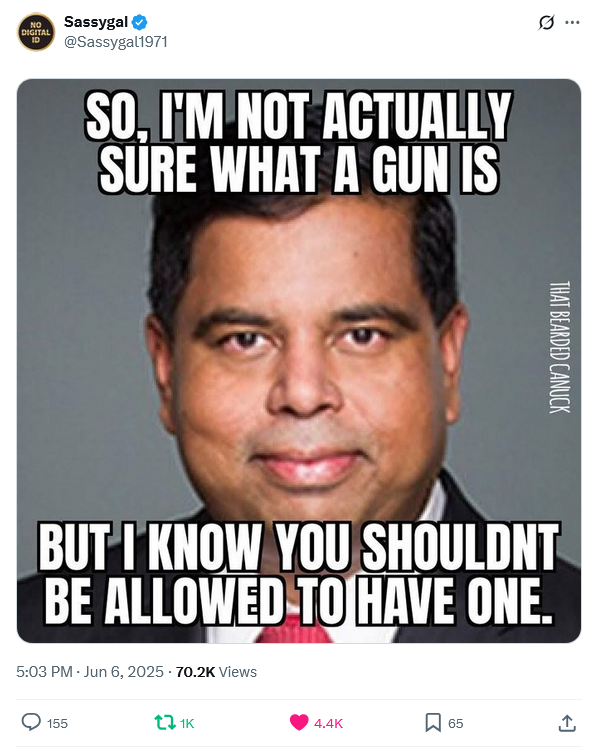
[…] Then we have the Minister of Public Safety, Gary Anandasangaree — a Trudeau–Carney loyalist freshly installed under the new Liberal minority regime — who made headlines not for bold leadership, but for a shocking display of ignorance on the very file he’s been assigned to oversee: firearms policy.
During a session of debate on the current spending bill, Conservative MP Andrew Lawton posed a basic question:
“Do you know what an RPAL is?”
An RPAL, or Restricted Possession and Acquisition Licence, is a standard certification required by law for any Canadian who wants to own restricted firearms, such as handguns or certain rifles. It’s a core element of Canada’s legal firearms framework.
The Minister’s response?
“I do not.”
Lawton followed up with another foundational question:
“Do you know what the CFSC is?”
The CFSC, or Canadian Firearms Safety Course, is a mandatory course required for all individuals seeking to obtain a firearms license in Canada — including the RPAL. It’s the very first step every legal gun owner in the country must complete. This is basic civics for anyone involved in firearms policy.
Anandasangaree replied again:
“I do not know.”
This wasn’t a “gotcha” moment. It was a revealing moment. The Minister of Public Safety, the individual charged with implementing gun bans, overseeing buyback programs, and crafting firearms legislation, has no familiarity with the fundamental licensing and safety processes every Canadian gun owner must follow.
In any other profession, this level of unpreparedness would be disqualifying. If a surgeon couldn’t name a scalpel, he’d be pulled from the operating room. But in Ottawa? It qualifies you to oversee a multi-hundred-million-dollar national gun seizure operation.
And that brings us to the next moment of absurdity.
Lawton asked the minister how much money had already been spent on the federal firearms buyback program, the centerpiece of the Liberal government’s Bill C-21, which targets legally acquired firearms now deemed prohibited.
Anandasangaree’s answer?
“About $20 million.”
But that doesn’t match the government’s own published data. In a report tabled by Public Safety Canada in September 2023, it was disclosed that $67.2 million had already been spent on the buyback as of that date. The majority of that spending was attributed to “program design and administration” — before a single firearm had even been collected.
So what happened? Did the government refund tens of millions of dollars? Were contracts cancelled? Of course not.
They just reframed the accounting — separating so-called “preparatory costs” and implying they don’t count as part of the buyback, even though they exist entirely to implement it.
It’s not transparency. It’s political bookkeeping — a deliberate attempt to make a costly, unpopular program appear manageable.
And it didn’t end there. When Lawton asked for the number of firearms that had actually been collected under the buyback, the response was yet another dodge. The Minister and his department couldn’t provide a number.
That’s right: after spending over $67 million, the federal government can’t even say how many guns have been retrieved. Yet they’re moving full steam ahead, with the support of a minister who doesn’t understand the system he’s responsible for.
This isn’t policymaking. It’s blind ideology strapped to a blank cheque. And the people paying the price are law-abiding citizens — not criminals, not gangs, and not smugglers.
At this rate, I can’t imagine how he’ll still be in cabinet by the end of summer.
Comments Off on The federal Minister of Public Safety admits he knows literally nothing about Canadian gun laws
Q&A: British Small Arms of World War Two
Forgotten Weapons
Published 24 Jan 2025Today’s Q&A is brought to you by the fine folks at Patreon, and by Penguin Brutality: https://www.varusteleka.com/en/search…
01:11 – Was the Vickers .50 any good, and why did the British use four different heavy cartridges instead of consolidating?
07:35 – The Sten and its single-feed magazine design
10:27 – Owen versus Sten, and German use of the Owen.
14:38 – British wartime work on an “assault rifle” sort of weapon?
15:44 – Why no British semiauto rifle during WW2? – Jonathan Ferguson on British semiauto rifle trials: Q&A 43 (feat. Jonathan Ferguson): Mil…
18:04 – EM2’s automatic bolt closure system
20:46 – Did the British use other allied weapons besides American ones?
23:15 – Is the PIAT a Destrucitve Device under US law and why?
26:07 – Bren vs Degtyarev
27:50 – Why not make the Sten in .45 to use Thompson ammo?
29:37 – Did the British get M3 Grease Guns?
31:01 – British SMG in .455?
32:03 – Sten vs Lanchester
33:26 – Was there an LSW version of the EM1/EM2 planned? EM1 Korsac: The Korsac EM1 – a British/Polish Bul…
34:25 – Why wasn’t the BESA in .303?
36:34 – Biggest British missed opportunity during the interwar period?
38:40 – British naval service small arms
41:45 – Did .280 cartridge development begin during the war?
43:24 – Impact of MP44 on British post-war small arms development?
44:25 – Gallilean sights on the Enfield
46:25 – Why is there a semiauto selector on the Sten?
49:17 – Did American soldiers use British small arms?
50:29 – Why did the British choose the Lee action over the Mauser action?
51:16 – Which was better, Sten or Grease Gun?
52:34 – Why did the whole Commonwealth not switch to the No4 Enfield?
(more…)
Comments Off on Q&A: British Small Arms of World War Two
June 5, 2025
Rate of Fire: What Determines it and How to Change It
Forgotten Weapons
Published 17 Jan 2025What determines the rate of fire of a machine gun, and how can that rate of fire be determined or changed from a design perspective? Let’s talk about pressure, mass, and distance …
(more…)
Comments Off on Rate of Fire: What Determines it and How to Change It
June 3, 2025
QotD: Heinlein’s opinions on the right to bear arms
Between 1942 and 1966 Heinlein’s politics evolved from New Deal left-liberalism towards what after 1971 would come to be called libertarianism. But that way of putting it is actually misleading, because Heinlein did not merely approach libertarianism, he played a significant part in defining it. His 1966 novel The Moon Is A Harsh Mistress was formative of the movement, with the “rational anarchist” Bernardo de la Paz becoming a role model for later libertarians. By 1978, we have direct evidence (from an interview in Samuel Edward Konkin’s New Libertarian magazine, among other sources) that Heinlein self-identified as a libertarian and regretted his earlier statism.
But if Heinlein’s overall politics changed considerably and wandered down some odd byways during his lifetime, his uncompromising support of civilian firearms rights was a constant on display throughout his life. Brin observes that was already true in 1942, but attempts to attribute this position to John W. Campbell. Multiple lines of evidence refute this claim.
[…]
Heinlein, on the other hand, was a vocal and consistent advocate of civilian weapons ownership both during and after his association with Campbell. This is perhaps clearest in his 1949 novel Red Planet, written after their parting of the ways. In that novel, the bearing of personal weapons is explicitly connected to the assumption of adult responsibilities.
Red Planet is also interesting because, although we might consider the views of Heinlein’s characters an unreliable guide to Heinlein’s own, Heinlein’s letters about the novel reveal much more. His editor at Scribner attempted to delete the section of argument in which weapons-bearing is connected to adult responsibility; Heinlein rejected this, objecting that it eviscerated the book’s ethical core and making very clear that the views of the pro-gun mentor figures in the novel were his own.
Heinlein was to reiterate similar views not only in his later fiction but in the posthumous nonfiction collection Grumbles From The Grave – by which time they were no surprise to any Heinlein fan. And it would be difficult to overstate the influence they had on firearms-rights activists during the dark years between the Gun Control Act of 1968 and our vindication in the 2008 District of Columbia v. Heller ruling.
Heinlein’s gift to firearms-rights activism during that bleak four decades was to be able to draw on the principled case for civilian firearms going back to the framers of the U.S. Constitution and English Republican sources and restate it in language appealing to the brightest children of post-WWII America. But he did more than that, because in Red Planet and elsewhere firearms rights were presented as an inextricable part of a philosophical whole, with the personal firearm both as instrument and defining symbol of personal liberty and responsibility.
Eric S. Raymond, “Brin on Heinlein on guns is dead wrong”, Armed and Dangerous, 2011-07-18.
June 1, 2025
Praga I: A Blow-Forward Bullpup Semi-Auto-Selectable Vickers Gun
Forgotten Weapons
Published 15 Jan 2025The Praga I was the first machine gun design from noted Czech arms designed Vaclav Holek. Three examples were made for Czech military testing in 1922, but they were not acceptable. Instead, this design served as the first stepping stone to the eventual development of the ZB-26, perhaps the best of the interwar light machine guns.
Mechanically, the Praga I is largely based on the Vickers/Maxim system except with a locking wedge instead of a toggle joint. It also uses a forward-moving gas trap sort of action instead of recoil operation like the Maxim/Vickers. The fire control mechanism is essentially a Vickers lock, just built into the receiver of the gun instead of in a moving bolt or lock. It is a truly fascinating system!
Many thanks to the VHU — the Czech Military History Institute — for giving me access to this fantastic prototype to film for you. The Army Museum Žižkov is a part of the Institute, and they have a three-story museum full of cool exhibits open to the public in Prague. If you have a chance to visit, it’s definitely worth the time! You can find all of their details (including their aviation and armor museums) here:
Comments Off on Praga I: A Blow-Forward Bullpup Semi-Auto-Selectable Vickers Gun
May 25, 2025
BD-44: The New Semiauto Sturmgewehr from D-K Productions
Forgotten Weapons
Published 13 Jan 2025D-K Productions is a collaboration between the German company Sport System Dittrich (SSD) and an American partner. SSD has been making reproductions of German World War Two small arms for something like 20 years — including Sturmgewehrs. Their guns are really good recreations of the 1940s originals, but there have long been issues importing them into the US. This was solved at last by forming a US company and doing the receiver manufacturing here in the States. While the company has plans to offer a whole bunch of different models, the one currently available is the BD-44, a copy of the standard production model of MP-44/StG-44.
I was really impressed by the use of not-finish-machined forgings for parts like the stacking rod and gas block, correctly duplicating the original German production. The stampings look good, and the handling matches the original guns (don’t expect it to be AR-level ergonomic!). The gut “feel” of the gun is an excellent match for an original MP-44. The 8×33 chambering and use of original magazines (alongside new-production magazines made by D-K) is the correct choice, of course.
I did not like the mismatch between the magazine well and magazine stops, and I did have a couple malfunctions in the two magazines I ran through it so far. Note that the gun I have at the range is my second one; the first one (which is what you see on the table) had consistent feed problems and D-K replaced it when I sent it back to them.
Whether the gun is worth the steep asking price is a personal decision, naturally. Hopefully this video gives you the information necessary to make your decision if you were considering getting one!
(more…)
Comments Off on BD-44: The New Semiauto Sturmgewehr from D-K Productions
May 22, 2025
Landstad 1900: A True Semiautomatic Revolver
Forgotten Weapons
Published 3 Jul 2024The Landstad Model 1900 is a magazine-fed, semiautomatic revolver designed by Norwegian Halvard Folkestad Landstad, who lived in Kristiana (now called Oslo). He designed the gun on his own dime, and presented it to military trials in 1901, which it failed miserably. The gun has a six-round detachable box magazine of 7.5mm Nagant cartridges, a two-chamber cylinder, and a simple blowback action. Its firing cycle is to chamber a round from the magazine into the bottom cylinder chamber by manually cycling the action. The trigger is a long double-action type which rotates the cylinder 180 degrees so the cartridge is in line with the barrel and releases the striker to fire the round. Upon firing, the bolt cycles open, extracting and ejecting the empty case, rechecking the striker, and chambering a new round from the magazine into the bottom of the cylinder.
The purpose of this overly complex system was to provide a semiauto action which did not ever leave a live cartridge under the striker, in the name of safety. Only one example was made, and its bolt broke after just 5 or 6 rounds fired. It was repaired almost immediately, but the Norwegian military had was not interested in further development, and nothing more came of the program. A few years later in 1908 Norway would institute a more serious semiauto pistol trials program which led to adoption of the Kongsberg 1914 (a slightly modified Colt 1911).
Thanks to Jan for allowing me to disassemble and film this one-of-a-kind piece for you!
(more…)
Comments Off on Landstad 1900: A True Semiautomatic Revolver
May 18, 2025
The FAL for British Troop Trials in 1954: X8E1 & X8E2
Forgotten Weapons
Published 21 Feb 2020The NATO rifle trials of the early 1950s eventually chose the 7.62mm x 51mm cartridge, and the British and Belgians agreed on the FAL rifle to shoot it (and they thought the US would as well, but that’s another story). The British government formally accepted the FAL for troop trials, and in 1954 an order for 4,000 X8E1 rifles (with iron sights) and 1,000 X8E2 rifles (with SUIT 1x optical sights) was placed. These rifles were mechanically the same as what would be finalized as the L1A1 rifle, but they include a number of differing features. Both models had 3-position selector switches allowing automatic fire, and they also had manual forward assists on the bolt handles. The iron sights had top covers with integrated stripper clip guides, as there was concern that troops would have to manually reload their magazines, and stripper clips would speed this process up.
(more…)
Comments Off on The FAL for British Troop Trials in 1954: X8E1 & X8E2
May 15, 2025
Remington Model 81 Special Police
Forgotten Weapons
Published 30 Sept 2016The Remington Model 8 was one of the first successful self-loading rifles introduced to the commercial market, and it was designed by none other than John Browning. It was an expensive rifle, but popular for its power and reliability. In the 1920s, an entrepreneur founded the Peace Officer Equipment Company to sell police gear in St Joseph, Missouri. He would design a conversion to the Remington Model 8 to replace its fixed 5-round magazine with larger detachable magazines (5-, 10-, and 15-round, with 15-round being the most common by far).
POEC made and sold the conversion until about 1936, when Remington replaced the Model 8 with the slightly improved Model 81. At that point, Remington licensed the magazine conversion themselves, and offered it as a factory option, under the Special Police name. Remington had big hopes for the rifle, but only a few hundred were sold, with the LA County Sheriff being the single largest customer, ordering 200 of them. This rifle is one of the LA guns, number 40 of their order.
Cool Forgotten Weapons Merch! http://shop.bbtv.com/collections/forg…
Comments Off on Remington Model 81 Special Police
May 12, 2025
(A Few of) The Many Faces of the Dutch M95 Carbine
Forgotten Weapons
Published 16 Jun 2015When the Dutch military adopted the M95 Mannlicher rifle, they made a rifle for standard infantry, and a variety of carbines for specialist troops. These included artillery, cavalry, bicycle, engineers, and colonial service carbines. During World War I they attempted to standardize these and reduce the number of different designs, but met with only limited success. By the time World War II began, there were at least 13 different variants of M95 carbine in service with the Dutch military.
Comments Off on (A Few of) The Many Faces of the Dutch M95 Carbine


