Quotulatiousness

September 25, 2023

Ted Gioia explains why he loves writing for Substack

Filed under: Media, Technology — Tags: , , , , — Nicholas @ 03:00

It’s much easier to reach the audience he wants to share with using his Substack than either Twit-er, er, I mean “X”, or Facebook:

Below I look at some surprising ways Substack has changed the media (and social media) landscape.

This gives me a good excuse to recommend the new Substack app. It’s now my go-to source for informed writing — providing access to a smarter and more diverse group of authors, thinkers, and creators than I’ve found anywhere else.

I’ve now been on Substack for 30 months, and the improvements in the platform during that time have far exceeded my expectations. I didn’t know any music writers on Substack back when I launched, but it now boasts a better roster of critics than any newspaper or magazine. By the way, I’m also subscribing to writers in a dozen or so other fields (culinary arts, economics, literature, finance, technology, psychology, etc.).

I’m a heavy user. I must have signed up for almost a hundred Substacks.

Substack has also added a lot of new features during those 30 months. I especially like Notes, which is similar to Twitter but with extra IQ points. And I’ve also benefited from cross-posting, recommendations, and many other new features. I also applaud options I don’t currently use (like chat and podcasts), because they empower writers and readers.

The reality is that Substack is innovating faster than I can keep up with. But I like it that way. It’s creating an interconnected and independent media ecosystem here.

Best of all are the core values behind all this:

  • Substack supports writers — who receive almost 90% of subscription revenues. This is the exact opposite of the traditional publishing model, where royalty rates of around 10% are typical.
  • I don’t need to attract advertisers, and this frees me from the conflicts-of-interest advertising brings to other platforms.
  • There’s no surveillance or selling of users’ private information here.
  • I share my articles directly with readers, and no algorithm or gatekeeper intervenes to prevent our direct connection.

For these and other reasons, I’ve been an advocate for the platform. And that’s a good introduction to my subject today.

September 22, 2023

“The Online News Act … has been an utter disaster”

Filed under: Cancon, Government, Law, Media, Politics — Tags: , , , , — Nicholas @ 03:00

Michael Geist on the ongoing disaster the federal government created with the Online News Act:

Prime Minister Justin Trudeau was asked this week about concerns with the implementation of Bill C-18, to which he responded that other countries are quietly backing Canada in its battle against tech companies. I posted a reality check tweet noting that Meta is not returning to news in Canada, the law’s regulation stipulating a 4% fee on revenues is not found anywhere else, and that Bill C-18 has emerged as a model for what not to do. With the House of Commons back in session, it is worth providing a more fulsome reality check on where things stand with the Online News Act. While the government is still talking tough, the law has been an utter disaster, leading to millions in lost revenues with cancelled deals, reduced traffic for Canadian media sites, declining investment in media in Canada, and few options to salvage this mess.

For those that took the summer off, Bill C-18 received royal assent in late June. Over the past three months:

1. Meta has blocked all news links in Canada and cancelled existing deals with Canadian news outlets. The blocked links covers both Canadian and foreign news in light of the broad scope of the law. While the Australian experience lasted a few days, the blocking in Canada has now gone on for weeks and there is little reason to believe that the company will reverse its position to comply with the law by simply not linking to news.

2. The government responded to the blocked news links by stopping to advertise on Facebook and Instagram and encouraging others to do the same. The boycott has had little effect as the Liberal party is still advertising on the platforms with a new round of ads this week, the Prime Minister is still posting on the platforms, and reports indicate that Facebook has not experienced a reduction in user activity. In fact, reports suggest that the experience on Facebook without news has improved. Further, a Competition Act complaint has not sparked any action.

3. Google responded to Bill C-18 by advising it too would remove news links from its services before the law takes effect in December. That position enabled it to wait for the government to release draft regulations that provide further detail on the application of the law and the standards for obtaining an exemption from the mandatory bargaining process that can lead to final offer arbitration overseen by the CRTC.

Several more items of concern at the link.

September 2, 2023

The 4% non-solution

Filed under: Business, Cancon, Law, Media — Tags: , , , , , — Nicholas @ 03:00

Michael Geist updates us on the Canadian government’s latest blunder in the Online News Act saga:

The government is releasing its draft regulations for Bill C-18 today and the chances that both Google and Meta will stop linking to news in Canada just increased significantly. In fact, with the government setting an astonishing floor of 4% of revenues for linking to news, the global implications could run into the billions for Google alone. No country in the world has come close to setting this standard and the question the Internet companies will face is whether they are comfortable with the global liability that would see many other countries making similar demands. The implications are therefore pretty clear: there is little likelihood that Meta will restore news links in Canada and Google is more likely to follow the same path as the Canadian government establishes what amounts to 4% link tax from Bill C-18 on top of a 3% digital services tax and millions in Bill C-11 payments.

The estimated revenues from Bill C-18 or the Online News Act have always been the subject of some debate. The Parliamentary Budget Officer set the number at $329 million, using a metric of 30% of news costs for all news outlets in Canada. Under that approach, over 75% of the revenues would go to broadcasters such as Bell, Rogers, and the CBC. The Canadian Heritage estimates were considerably lower, with officials telling a House of Commons committee last December that they expected about $150 million in revenue:

    I won’t speak to the PBO report which is the source of the numbers that you cited. That was not a department-led initiative. The internal modelling that we did when we tabled the bill and mentioned in our technical briefings was more around $150 million impact. That was based again in terms of how this played out in Australia and making some assumptions about how it might play out here. With respect to the PBO report, any questions about that particular number would have to be directed towards them.

By the time the bill reached the Senate several months after that, the number had grown to $215 million.

With the release of the draft regulations, the government has established a formula with an even bigger estimate. The creation of a formula is presumably designed to provide some cost certainty to the companies and represents a change in approach in Bill C-18, given that the government had previously said it would not get involved private sector deals but it is now setting a minimum value of the agreements. Officials told the media this morning that it believes Google’s contribution would be $172 million and Meta’s would be $62 million, for a total of $234 million. However, that may understate the revenues by focusing on search revenues alone. If based on total revenues, with a 4% minimum floor, the requirement would exceed C$300 million for Google. Either way, the number is more than 50% higher than the $150 million estimate the department gave the Heritage committee just eight months ago.

The draft regulations will also provide some additional clarity on several issues. The standard for a digital news intermediary has been fleshed out to include $1 billion in global revenues and 20 million Canadian users. As for the process, those companies subject to the rules are required to conduct a 60 day open call for negotiations. To meet a fairness standard, the resulting deals must be within 20% of the average and cover a wide range of news outlets. Contributions can include non-monetary items but it seems unlikely the resulting deals would grant links significant value. The CRTC would then pass judgment on the deals and determine whether the companies are exempt from a final offer arbitration process. The timing on this includes a 30 day consultation process on the regulations, before they are finalized prior to the December deadline. But with the CRTC not having established a bargaining framework before 2025, the liability issues start arising well before any deals are concluded or approved.

August 24, 2023

“Facebook has made a calculated business decision about the value of its fucks. These fucks are expensive. So they won’t give any.”

In The Line, Jen Gerson fought the good fight as long as she could, but finally had to load up the old shotgun and share both barrels with the participants in the ongoing clusterfarce over the Online News Act (the artist formerly known as Bill C-18):

Look, I’ve largely said my piece on the Online News Act: it’s poorly conceived legislation that risked terrible outcomes. It’s pointless, now, with those terrible outcomes unfolding, to say “I told you so”.

But the response to the news that Meta has decided to continue blocking news — even in the face of devastating wildfires in B.C. and the Northwest Territories — has been such disingenuous dumbfuckery from every corner that I have failed to bestill my cursed fingertips.

Let’s start with this quote from Prime Minister Justin Trudeau, who at a recent press conference, said: “Right now in an emergency situation where up-to-date local information is more important than ever, Facebook’s putting corporate profits ahead of people’s safety, ahead of supporting quality local journalism … This is not the time for that”.

Wait, a major global corporation that has been labelled as actually literally evil by both progressives and conservatives in recent years is putting its own profits and self-interest ahead of the priorities and values of politicians and pundits?

Sir, surely thou art in jest.

Is this government only now figuring out that major global corporations exist to extract profits; that whatever social corporate responsibility roles they may choose to enact, they aren’t a public service? Is Trudeau shocked — shocked, I say! — to just this very moment discover that Meta isn’t actually some combination of the Red Cross and Reuters?

I mean … welcome to the adult world, I guess, and please leave your copy of Adbusters near the coat check at the door.

But if Meta is as evil as all that, why did so few politicos or pundits anticipate that the company would follow through on its explicit threat to block news if C-18 were passed? This is like watching an Allied general who says: “I think these Nazi fellows are the baddies!” and then gets flustered when the guys with skulls on their caps pull out their guns and start shooting in the midst of afternoon trench tea. “Well, I never. That’s hardly sporting!” This is some Black Adder comedy, friends, and we may be on the side of the angels, but our angels also happen to be a little slow in the head.

Oh, but surely Meta wouldn’t block news to put their own self interest “ahead of people’s safety”, hmmmm?

With advance apologies, but is our antipathy toward Meta so intense that we’re going to straight-face pretend that AM radio, FM radio, emergency text alerts and broadcasts, municipal and provincial emergency websites, formal and informal social media networks and chat groups, and local news broadcasts with websites that can be accessed directly through web browsers all just ceased to exist, simultaneously, the very moment that CBC stopped being able to post news links to Instagram?

If Facebook is actually putting lives in danger, that’s an admission of impotence and incompetence from our entire communications infrastructure, including government, private and public media. It is an incredible and embarrassing self-own.

August 22, 2023

With Bill C-18 about to come into effect, there is zero sense for the “tech giants” to start negotiating

Filed under: Business, Cancon, Government, Law, Media, Politics — Tags: , , , , , — Nicholas @ 05:00

Michael Geist explains why there are no incentives for Google and Meta to begin any kind of negotiations with the Canadian government over the ruthlessly self-destructive Online News Act:

The rhetoric around Bill C-18 has escalated in recent days in light of the awful wildfires in NWT and British Columbia. In my view, the issues associated with these tragic events have little to do with Meta blocking news links and the attempt to bring it into the conversation is a transparent attempt to score political points (the connectivity issues with some NWT communities completely taken offline for days is somehow never mentioned). The reality is that Meta was asked about just this scenario at committee and it made it clear that it would not block any non-news outlet links. That is precisely what has been happening and the government’s legislative choices should be the starting point for understanding why compliance with the law involves blocking a very broad range of news links that extend beyond even those sources that are defined as “eligible news outlets”.

The government and supporters of Bill C-18 talking points now emphasize two things in relation to Meta blocking news links: the law has yet to take effect and there is room to address their concerns in the regulation-making process. Both of these claims are incredibly deceptive, relying on the assumption that most won’t bother to read the actual legislation. If they did, they would see that (1) the law has received royal assent and can take effect anytime and (2) the regulation making process addresses only a small subset of Bill C-18 issues with most of the core issues finalized. In other words, the time to shape the law and address many of the key concerns was before the government repeatedly cut off debate in order to ensure it that received royal assent before the summer break.

Start with when the law takes effect. As noted above, the law has been passed and received royal assent. It is the law of the land and there is no scope for changes or amendments without a new bill that must be passed by Parliament. Section 93 establishes when the provisions come into force. The law initially envisioned a staged approach whereby certain sections would be proclaimed in effect by the government in stage one, followed by four additional stages, some of which were contingent on certain regulations coming into force. Yet at the last minute the government approved a Senate amendment that basically discarded the entire approach. Section 93(6) states:

    (6) Despite subsections (1) to (5), any provision of this Act that does not come into force by order before the 180th day following the day on which this Act receives royal assent comes into force 180 days after the day on which this Act receives royal assent.

The entire law therefore takes effect no later than 180 days after royal assent, which is December 19, 2023. This change was included at the urging of the Canadian media sector (specifically Quebecor) which lobbied to have it take effect as soon as possible. Under this approach, the law can take effect at any time as the government need only issue the relevant Orders-in-Council. There is now little wiggle room. As of today’s post, the latest the law will take effect is in 120 days but it could happen well before that.

Once the law takes effect, the clock on negotiations and potential mediation and arbitration begins. The timelines are fixed in Section 19(1) of the law: 90 days to negotiate and 120 days for mediation. If there is no agreement and no request to the CRTC to extend the deadlines, the issue can go to final offer arbitration. To be clear, none of these timelines are subject to the regulation making process. They are fixed and they create obvious urgency for anyone facing compliance requirements.

The government threatened Meta and Google with mandated payment to Canadian news sources if their online services merely linked to articles or videos from those news sources. Meta and Google rationally decided that the tiny little Canadian market wasn’t worth the cost of paying CBC and other Canadian news outlets for the privilege of sending them readers and are in the process of obeying the letter of the new law and blocking such links on their respective platforms. They told the Canadian government that this is what they’d do if the law was passed in its current form, yet the government is pretending to be shocked and surprised that Meta and Google are going to obey the law.

After all, there’s no real risk that lives might be endangered because so many Canadians are used to getting their news by way of Facebook or Google, is there?

August 13, 2023

Don’t worry about losing all your news links, citizen! The Liberal government’s Ministry of Propaganda will tell you everything you need to know!

Filed under: Business, Cancon, Government, Law, Media, Politics — Tags: , , , , — Nicholas @ 05:00

The federal government still seems shocked and a little bit hurt that the “tech giants” are carefully obeying the letter of their new Online News Act instead of pumping millions of dollars into government-favoured media outlets. How dare Alphabet and Meta obey the law we wrote? We wanted to soak them for bribes subsidies to give to legacy corporations who can be depended upon to cheerlead our agenda!

Blocking of news links on Facebook and Instagram in Canada has becomes increasingly widespread in recent days, leading to a growing number of public comments from media outlets and reporters expressing surprise or shock about the scope of the link blocking. Indeed, outlets with blocked links include university student newspapers, radio stations, and foreign news outlets. While there may have been some errors (Facebook has a page to seek review of any blocked link decision), the inclusion of a very wide range of Canadian and foreign news outlets is no accident. Rather, it reflects the government’s Bill C-18 approach, which effectively covers all news outlets worldwide whose links are accessed in Canada. The Canadian government could have adopted a more targeted approach – for example, limiting the scope to news links from those news outlets eligible to negotiate agreements with Internet platforms under the law – but it instead went for the broadest possible approach that includes foreign news outlets with little or no connection to Canada.

Understanding why Bill C-18 covers news links from outlets who are not “eligible news businesses” under the law requires unpacking several provisions. First, start with the definition of a “digital news intermediary”, which states:

    digital news intermediary means an online communications platform, including a search engine or social media service, that is subject to the legislative authority of Parliament and that makes news content produced by news outlets available to persons in Canada. It does not include an online communications platform that is a messaging service the primary purpose of which is to allow persons to communicate with each other privately.‍ 

This definition is critical since the only companies that are subject to Bill C-18’s requirement to negotiate agreements with news outlets are (1) those that qualify as DNIs under this definition and (2) meet the requirements found in Section 6 on a significant bargaining power imbalance. The absence of significant bargaining power imbalance is why companies such as Twitter, Microsoft or Apple are not subject to the law. That leaves Google and Meta, provided that they qualify as DNIs. The key phrase in the qualification requirement is that the companies “make news content produced by news outlets available to persons in Canada”. If the companies do not make news content produced by news outlets available to persons in Canada they are not DNIs and are not subject to the law.

[…]

… the government’s choice was to try to bring Meta and Google into the scope of the law by virtue of any news links to any news outlet anywhere in the world, even if those outlets have nothing to do with Canada or with the Bill C-18 system. Given Meta’s stated goal of complying with Bill C-18 by removing links to news content that would render it a DNI, the government’s legislative choice of covering all news links from all news outlets therefore effectively requires it to block all of those news links.

It takes a lot to make Google, of all companies, a sympathetic victim … yet Canada’s awesomely awful Liberal government aced it. Bananada strikes again!

“It makes [Canada] look like some cheap, politically petty little kleptocracy run by a collection of self-serving narcissists”

Filed under: Bureaucracy, Cancon, Government, Media — Tags: , , , , — Nicholas @ 03:00

Canada became a parody of itself so slowly that the legacy media barely even noticed:

There was a time when politicians steered very carefully around saying anything that could be construed as an attempt to influence a decision by one of Canada’s independent agencies.

Honest, there was.

There was also a time when, should a politician so much as nod or wink publicly to indicate a preferred outcome by, say, the office of the Commissioner for Competition, the nation’s leading media organizations would see this as a big story. Sixteen dollar orange juice big. Heads would roll.

Seriously, there was.

The reasons people like Francois-Phillipe Champagne, Minister of Innovation, Science and Economic Development are supposed to keep their yaps shut are pretty straightforward. Businesses, citizens, consumers, and investors need to know the processes at law enforcement agencies and regulators — such as the Competition Bureau and the CRTC respectively — are independent of the sordid manipulations of partisanship. They need to be able to trust that the rules are clear, their application is consistent and that they can have faith that the institution involved views matters before it in an objective fashion.

It’s Rule of Law 101 stuff and messing with it makes Canada look like something less than a first world country. It makes us look like some cheap, politically petty little kleptocracy run by a collection of self-serving narcissists.

Shortly after the CBC, the Canadian Association of Broadcasters and News Media Canada filed a complaint with the Competition Bureau over Meta’s decision to no longer carry news in Canada, Champagne seized the opportunity to show Big Tech who their daddy is.

“I am determined to use every tool at our disposal to ensure that Canadians can have access to reliable news — across all platforms,” Champagne posted on X (the platform formerly known as Twitter). “I fully support the complaint made to the Competition Bureau by Cnd media groups against Meta in their effort to promote a free & independent press.”

I don’t expect that many readers have hung around with cabinet appointees. But I have, and I’ve been one. And I can tell you that most of them — particularly the ones whose conditions of appointment mean they serve “at pleasure” as Competition Commissioner Matthew Boswell does — pay attention when the minister through whom their agency reports to Parliament, says anything, let alone things like that.

August 6, 2023

What’s in a (tech) name?

Filed under: Business, Media, Technology, USA — Tags: , , , , , — Nicholas @ 03:00

Ted Gioia isn’t a fan of all the recent rebrandings of social media platforms, and tries to explain “why web platforms keep changing their names like criminals in the Witness Protection Program”:

“Automotive Social Media Marketing” by socialautomotive is licensed under CC BY 2.0

When I first heard that Twitter was renaming itself as X, I thought it was a joke.

Not a funny joke, just a goofy one. Elon Musk has a taste for schoolboy humor — and on many occasions has posted something undignified for a laugh. I assumed X was another example of this.

Who could take that name seriously?

Just consider the significations of X:

  • The crossbones you put in front of a skull on a bottle of poison;
  • A mistake on a test, marked by the teacher in red;
  • How you sign your name if you can’t read or write;
  • Something you haven’t figured out in algebra;
  • A movie that’s dirty, raunchy, or offensive in some manner;
  • A mark on a map where stolen wealth has been buried by pirates or criminals;
  • The street name for an illegal drug (MDMA) with various adverse long-term effects — including depression, anxiety, and impairments of cognition, memory, and learning;
  • A symbol of betrayal (i.e., a double cross);
  • In marketing language, an inferior product, as in “Brand X”;
  • A radioactive ray so dangerous that it killed the people who invented and developed it.

Given these associations, nobody in their right mind would replace a familiar, proven brand name with X. Mr. Musk must be joking again. Or so I thought.

But I thought wrong.

If this were an isolated event, I would dismiss it as just one more quirk on the part of an eccentric CEO. But these horrible rebrands are now standard practice in Silicon Valley, especially among dominant Internet platforms.

Why did Google change its corporate name to Alphabet? Why did Facebook change its corporate name to Meta? These were two of the best known brand names in the history of capitalism. Why get rid of them?

And consider this bizarre coincidence. The very same month that Twitter became X, Instagram launched its own text posting option. But it refused to use the familiar Instagram name, instead calling this new feature Threads.

Threads is another word that has all sorts of negative connotations. It refers to something old and torn. It’s associated with poverty and an embarrassing appearance.

What gives?

Do you remember the carefree early days of the web? Brand names were innocent and playful — they sounded like something from a nursery rhyme: Yahoo, Google, Tumblr. Twitter was one of those cutesy names.

Its symbol was a chirping bird. So sweet. So innocent.

But nowadays, web platforms take on names straight out of an H.P. Lovecraft horror story — Threads, X, Ghost, Twitch, Discord, etc.

Today’s writing prompt: Use all of those words in the opening lines of a story. Then send it off to an editor at Weird Tales.

Current day techno bro vibe

August 3, 2023

“Tech giants” obey the law and block access to Canadian news sites to Canadian users

Filed under: Cancon, Government, Law, Media, Technology — Tags: , , , , , , — Nicholas @ 03:00

For some reason — despite a clamour of warnings from sensible observers — the Canadian government still seems shocked and surprised that the much-reviled “tech giants” have chosen to obey the new Online News Act and are actively blocking links to Canadian media outlets just as the law requires:

For months, supporters of Bill C-18, the Online News Act, assured the government that Meta and Google were bluffing when they warned that a bill based on mandated payments for links was unworkable and they would comply with it by removing links to news from their platforms. However, what has been readily apparent for months became reality yesterday: Meta is now actively blocking news links and sharing on its Facebook and Instagram platforms. The announcement does not reference Threads, but it would not surprise if news links are ultimately blocked on that platform as well. The company says that the blocking will take several weeks to fully roll out to all users, suggesting that it has learned from the over-blocking mistakes made in Australia and is proceeding more cautiously in Canada. By the end of the month, the world’s largest social media platform will become a news desert in Canada, with links to all news – both Canadian and foreign – blocked on the platform.

It is worth revisiting that it was only a couple of months ago that some industry leaders, lobbyists, and academics were assuring the Senate that the Meta threat was just a bluff. Kevin Desjardins of the Canadian Association of Broadcasters, referenced the Australian experience, and told the Senate committee studying the bill that “when legislated to do so, they will come to the table”. Sylvain Poisson of Hebdos Quebec confidently said “they made those threats in Australia and elsewhere and every time they back down”. Chris Pedigo of the U.S.-based Digital Context Next assured the committee “it’s important to understand what happens when these bills become law. In Australia, they moved quickly to secure deals. They have done similar work in Europe, and I expect it would happen quickly in Canada as well.” And Carleton professor Dwayne Winseck said “I am not worried. The threats they are making, they are doing this all around the world.”

Despite the assurances, the company was true to its word and blocking news links is now here. If this is a negotiation tactic, it’s a pretty strange one given that reports indicate the company is not talking to the government about potential changes to a law that has already received royal assent. Indeed, while the new Heritage Minister Pascale St-Onge urged the company to participate in the regulatory process, there is nothing in the regulations that could alter the fundamental principle in the bill of mandated payments for links. At best, the government could toss aside its commitment to stay out of negotiations by using the regulations to dictate to the supposedly independent CRTC how much needs to be spent in order to avoid Bill C-18’s final offer arbitration provisions. Government negotiating total payment value and eviscerating the CRTC’s independence does not inspire confidence and Meta reasonably wants no part of it, since the time to fix Bill C-18 was before it received royal assent, not after.

Bolded section mine: I didn’t realize that it wasn’t just Canadian media links that were being blocked … it’s all news sites in the world being hidden from Canadian users. That’s an escalation from what I’d originally understood. I don’t blame the “tech giants” at all, but it will be tough on older Canadians who’ve been depending on social media to keep them up-to-date on domestic and foreign news.

July 7, 2023

Justin Trudeau says that Canada is merely defending itself from the “attack” by Facebook

Filed under: Business, Cancon, Government, Law, Media, Politics — Tags: , , , , — Nicholas @ 03:00

Prime Minister Justin Trudeau has never faced a situation he couldn’t get histrionic about:

The government escalated the battle over Bill C-18 yesterday, announcing that it was suspending advertising on Meta’s Facebook and Instagram platforms due the company’s decision to comply with the bill by blocking news sharing and its reluctance to engage in further negotiations on the issue. While the ad ban applies to federal government advertising, Liberal party officials confirmed they plan to continue political advertising on the social networks, suggesting that principled opposition ends when there might be a political cost involved. At issue is roughly $11 million in annual advertising by the federal government, a sum that pales in comparison to the Parliamentary Budget Officer’s estimate of at least $100 million in payments in Canada for news links from Meta alone.

In addition to raising the economic cost to Meta for stopping news sharing, Prime Minister Justin Trudeau increased the rhetoric, describing Canada as having been “attacked” by Meta and likening the government’s fight over the bill to defending democracy in Ukraine or during the Second World War [at 13:30]:

    Facebook decided that Canada was a small country, small enough that they could reject our asks. They made the wrong choice by deciding to attack Canada. We want to defend democracy. This is what we’re doing across the world, such as supporting Ukraine. This is what we did during the Second World War. This is what we’re doing every single day in the United Nations.

There are strongly held views on both sides of the Bill C-18 debate, but the suggestion that stopping sharing news links on a social network is in any way comparable to World War 2 is embarrassingly hyperbolic and gives the sense of a government that has lost perspective on the issue. Canadian Heritage Minister Pablo Rodriguez has repeatedly described the manner of compliance with Bill C-18 as a business choice for the Internet companies, yet the Prime Minister now calls that choice an attack on the country.

If it were truly comparable to a world war, then surely the Liberal Party (joined by the NDP) would not continue to advertise on the platform. Yet since the 2021 election call, the party alone has run approximately 11,000 ads on Facebook and Instagram. That is separate from individual MPs, who have also run hundreds of ads. The Meta Ad Library provides ample evidence of how reliant the party has been on social media. For example, since the start of the year, Anna Gainey ran over 500 ads as part of her by-election campaign in Quebec. David Hilderley, who was a candidate in the Oxford by-election, ran approximately 180 ads on Facebook during the same timeframe.

July 4, 2023

It’s not “bullying” for corporations to act in their own (and their shareholders’) best interests

Filed under: Business, Cancon, Government, Media, Technology — Tags: , , , — Nicholas @ 03:00

The weekly round-up from The Line editors wasn’t happy reading for fans of the Canadian mainstream media:

The Canadian government approached this as if it was “Big Tech” who were reaping all the rewards … when in fact it was the Canadian media companies getting most of the benefit from the arrangement. No wonder “Big Tech” chose to take their bat and ball and go home.

There are two major items up for consideration, and we’ll deal with each in turn. The first is a proposed merger between Postmedia and the Torstar/Metroland newspapers. The second, and most significant, news item, is that following on Meta/Facebook’s decision to stop featuring news on its feeds, Google is promising to drop the Google News Showcase feature, and to stop surfacing Canadian news links on its search feeds. All of this is in response to C-18, the Online News Act.

This law is trying to force Facebook and Google to compensate news organizations for the links that appear on their platforms; so the companies reacted in an entirely predictable way after the bill received Royal Assent last week — they announced they are going to absent themselves from the scope of the bill by no longer providing those links.

The government, its supporters, and many in the media itself reacted to this announcement with the same inane bluster that has come to dominate the conversation around this byzantine and poorly conceived bill. The Liberals promised to stand up to “Big Tech”; and the media organizations that pinned their survival on milking this new revenue stream are now accusing Google et al. of “bullying”. We at The Line don’t consider this rhetoric to be rational or in good faith. We are annoyed — we are horrified — by these companies’ decisions, but we understand them.

Both Facebook and Google made it clear that C-18 was untenable from a business point of view; they both warned that they would consider pulling news links in response. From Big Tech’s perspective, the decision-making tree is real simple here: does the revenue generated by news outweigh the potential uncapped financial liability that C-18 would present? Further, would complying with C-18 in Canada present a greater risk to the company globally if the bill were replicated in larger media markets? Or are the companies better off to withdraw from a low-priority market pour encourager les autres. We can scream about the evils of Big Tech all we want, but ultimately, these are just math conversations.

No one ought to be surprised that the math didn’t go our way. But almost everyone was. Because — and there’s no nice way to say this — this country’s media industry is both painfully parochial and embarrassingly self-important. For people whose job it is to understand and explain the world to Canadians, it often astonishes us at how incompetent we are at understanding and explaining that world to ourselves. Canadian journalists have an unshakeable faith in our vocation; we genuinely believe that our work is a vital service to democracy. Therefore the fruits of that labour — the news content — must be valuable to the digital platforms that we now depend upon to distribute it. This is why many in the industry were so unshakeably convinced that Facebook and Google were bluffing during the course of C-18. Incredibly, many seem to remain convinced that Big Tech will capitulate to their demands for capital, even now. To quote this old gem: “It is difficult to get a man to understand something, when his salary depends on his not understanding it”.

The flaw in this reasoning ought to be apparent, yet the industry lacks the digital savvy to understand the risk it is courting. “What about Bing, amiright?” Denial and self-importance are now sucking Canadian journalism straight into the maw of an existential crisis. To lose Facebook is a major set back; to lose Google is death.

The thing our colleagues and peers need to come to terms with is that Canadian journalism just isn’t that important in the global scheme of things. Facebook and Google aren’t out to get us — they are indifferent to us. Canadian news comprises a small and un-lucrative segment of even Canadian traffic flows. And Canada is a mid-tier market, at best. Optics aside, global tech oligopolies simply don’t lose very much by cutting us off. Facebook and Google are in the business of advertising, not journalism. They share neither our self regard, nor our democratic mandate; as a result, there is no internally coherent reason for them to take losses in order to save our industry. We just don’t matter to them.

On her Substack, Tasha Kheiriddin doesn’t blame Google for the impending destruction of what’s left of mainstream Canadian media:

The funeral has begun. The pyres are lit; the mourners are weeping. RIP, Canadian media industry, we hardly knew ye. Between mergers, acquisitions, closures, and layoffs, you didn’t stand a chance. And then came Bill C-18.

The legislation, passed last week, compels internet behemoths Meta and Google to compensate Canadian news outlets in exchange for featuring links to their content. Bill C-18 is modeled on an Australian law that saw the two tech giants enter into financial arrangements with media outlets in that country. Here in Canada, the Parliamentary Budget Office estimates similar deals could produce annual revenues of $329 million, a juicy sum for the cash-strapped news business.

Instead, Meta and Google announced that they would no longer include Canadian news links. Rather than reap a profit, Canadian media companies now face the prospect of far fewer eyeballs on screens – and the decimation of their ad revenue. Meta also cut its funding to CN2i, the Coopérative nationale de l’information indépendante, which supports six print publications, including La Presse, further damaging media companies’ bottom line.

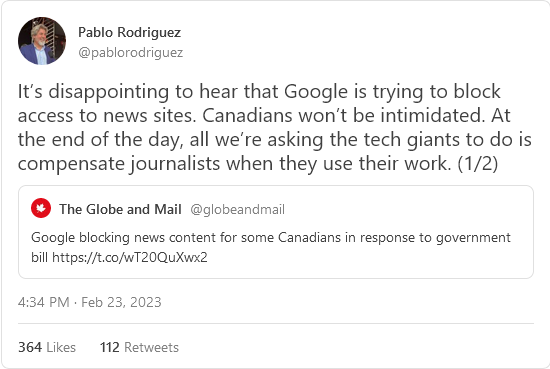
Cue the sound of “Taps” and political outrage. Heritage Minister Pablo Rodriguez had this to say:

    Big tech would rather spend money to change their platforms to block Canadians from accessing good quality and local news instead of paying their fair share to news organizations … This shows how deeply irresponsible and out of touch they are, especially when they make billions of dollars off of Canadian users.

No, this shows how deeply out of touch the government is with the business model of these companies – and with internet technology in general.

July 1, 2023

The Trudeau plan to eliminate Canada from the internet is going great!

Wait, you mean that wasn’t the plan? It must have been, if you judge the plan by the amazing results:

The damage caused by the government’s Bill C-18 continues to grow as Meta has started to cancel its existing agreements with Canadian publishers. The move should not as a surprise since any deals that involve facilitating access to news content would bring the company into the legislative framework and mandate payments for links. Indeed, Meta said earlier this week that its 18 existing deals “did not have much of a future“. When this is coupled with a reported “impasse” between the government and Google over its approach to Bill C-18, the risks to the Canadian media sector look increasingly dire.

This was entirely foreseeable, yet Canadian Heritage Minister Pablo Rodriguez never seemed to take the risks seriously. It raises the question of whether the government developed estimates of the cost of its legislation if Meta and Google chose to comply by stopping news sharing or linking. While there were estimates for the benefits of new deals that ran into the hundreds of millions of dollars, did it conduct a risk assessment of the economic costs that would come from Internet companies exiting the news market in Canada?

There are obviously costs that extend far beyond the economics that include reduced access to news, increased prominence of low quality news sources, harm to the Canadian Internet, and the reputational damage to a government that handled this about as incompetently as possible. But from a pure economic perspective, the risks were always understated as they extended beyond just the value of increased traffic to publishers from the links they were themselves posting. Both Google and Meta have deals with Canadian publishers reportedly worth millions of dollars. As Meta’s step to begin cancelling deals suggests, those agreements are unlikely to survive the decision to exit news in Canada.

And of course, Google doesn’t want to set any kind of precedent by accepting a shakedown from any two-bit hoodlum country like Canada:

The worst case scenario for Canadian Heritage Minister Pablo Rodriguez, the Canadian news sector, and the Canadian public has come to pass: Google has announced that it will block news links in Canada in response to the mandated payment for links approach established in Bill C-18. The decision, which the company says will be implemented before the law takes effect, will cover search, Google News, and Google Discover. The decision – which government seemingly tried to avoid with last minute discussions with Google executives after it became apparent that the risks of exit were real – will have lasting and enormously damaging consequences for Canadians and represents a remarkable own-goal by Rodriguez who has managed to take millions away from the news sector and left everyone in a far worse position than if he had done nothing at all.

If you’re in any way interested in Canadian government … machinations … when it comes to digital policy, you really should be following Michael Geist‘s reporting. He’s been doing a great job and deserves the support.

June 24, 2023

Canada’s Online News Act already impacting news delivery for smaller outlets

Filed under: Business, Cancon, Law, Media — Tags: , , , — Nicholas @ 04:00

A local site I use regularly has already begun to feel the negative effects of the federal government’s Online News Act (aka Bill C-18):

Durham Radio News (DRN) doesn’t normally post editorial content, but when local news is being attacked we refuse to stay silent.

Bill C-18 is now law and will have a very negative impact on local independent newsrooms such as DRN.

The bill forces major tech companies such as Google and Meta to pay news outlets for content.

The vast majority of referrals to our DRN site come from Facebook and Google.

Both platforms have been instrumental in growing our audience.

Despite multiple warnings from Meta and Google that they would block news, the Liberal government proceeded with Bill C-18.

It’s now law and in a statement Meta says news will no longer be available on Facebook and Instagram.

Google is expected to follow suit.

Both tech giants have publicly said they don’t make much money off links to news stories so it doesn’t make financial sense for them to pay news providers.

Prime Minister Justin Trudeau called their threats to remove news a bullying tactic and said it will not work with his government.

It really appears the Liberals thought they were bluffing, we now know they were not.

DRN has been trying to get our voices heard for months on the negative impact this bill would have on our business.

We were drowned out by larger media outlets who would stand to benefit from this bill.

We will not be naming other outlets and we don’t begrudge the financial help they are already receiving.

Meta provides funding through fellowships with some media partners, and it is these outlets that became greedy and were asking for more.

For them it doesn’t matter if they get kicked off social media platforms.

For us it will make a huge impact.

March 20, 2023

“It amounts to nothing less than a declaration of all-out war between the government and the Big Tech companies”

Filed under: Business, Cancon, Government, Liberty, Media, Politics, Technology — Tags: , , , — Nicholas @ 05:00

The editors of The Line have strong opinions on the federal government’s decision to batter Google, Facebook, and other online “giants” over their opposition to the proposed internet legislation in bills C-11 and C-18:

As a result of C-18, both Google and Meta have considered dropping news distribution from their platforms, or have outright promised to do so. To which we have responded: “Well, no shit, Sherlocks.” We have, in fact, warned all of the parties involved with this misguided bill that that’s exactly what was going to happen.

Nonetheless, the dim-witted government officials and corporate media barons who have pinned their hopes of survival to the apparent money spigot of Big Tech didn’t believe us. So when Meta came right out and said it would drop news last week, the ashen-faced Minister of Heritage accused them of using “intimidation and subversion” tactics. And, thus, these demands for private correspondence appear to have been drafted.

It amounts to nothing less than a declaration of all-out war between the government and the Big Tech companies — and, by extension, the many independent media creators like ourselves.

Well. Okey Dokey then.

*cracks knuckles*

Let’s start with two very obvious points: firstly, we at The Line don’t object to forcing these tech companies to disclose funding to third parties for the purpose of opposing C-18 et al. That is perfectly reasonable, in our minds. Further, if these companies are being accused of anything illegal, by all means, investigate away — after you get a warrant.

The rest of these demands are nothing short of banana crackers; it’s an extraordinary interpretation of the committee’s mandate. It’s the kind of overbroad dragnet that will necessarily create privacy breaches for the unknown numbers of ordinary citizens, dissidents and journalists who have corresponded with these companies about these bills.

We will remind the government that private citizens and private companies do not owe the government a full accounting of their private business or communications. The government is subject to this kind of transparency and disclosure because the government works for us. Not the other way around.

We will also point out the irony. The government is demanding years worth of correspondence from private entities within a very short time frame: this is a level of transparency that no government department would subject itself to. Don’t believe us? Just try to draft a similar ATIP request to any ministry; it would take years to get such a request fulfilled, and half if it would come back redacted.

March 19, 2023

Disagree with the Canadian government’s attempt to take over significant parts of the internet? Get ready for administrative punishment, citizens!

Michael Geist, who often seems like the only person paying close attention to the Canadian government’s growing authoritarian attitudes to Canadians’ internet usage, shows the utter hypocrisy of the feds demanding access to a vast array of private and corporate information on a two-week deadline, when it can take literally years for them to respond to a request for access to government information:

Senator Joe McCarthy would be in awe of the Canadian government’s audacious power grab.
Library of Congress photo via Wikimedia Commons.

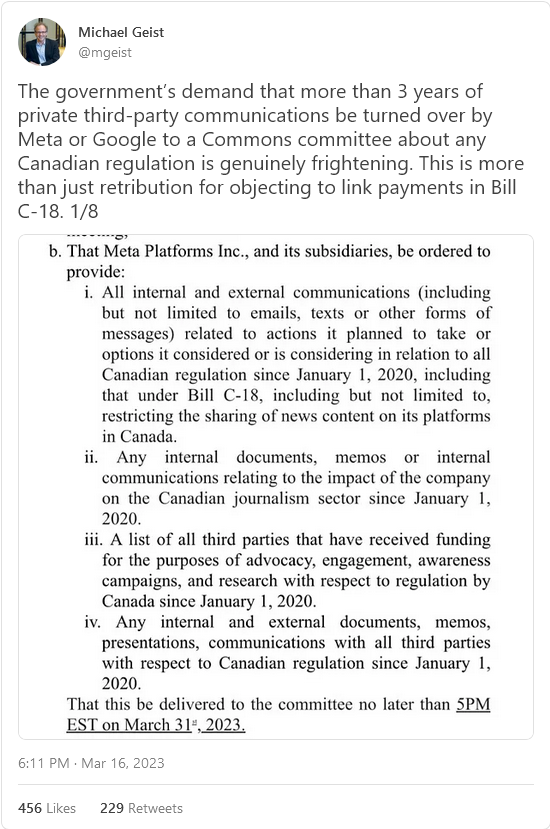
The government plans to introduce a motion next week requiring Google and Facebook to turn over years of private third-party communication involving any Canadian regulation. The move represents more than just a remarkable escalation of its battle against the two tech companies for opposing Bill C-18 and considering blocking news sharing or linking in light of demands for hundreds of millions in payments. The motion – to be introduced by the Parliamentary Secretary to the Minister of Canadian Heritage (yes, that guy) – calls for a series of hearings on what it describes as “current and ongoing use of intimidation and subversion tactics to avoid regulation in Canada”. In the context of Bill C-18, those tactics amount to little more than making the business choice that Heritage Minister Pablo Rodriguez made clear was a function of his bill: if you link to content, you fall within the scope of the law and must pay. If you don’t link, you are out of scope.

While the same committee initially blocked Facebook from even appearing on Bill C-18 (Liberal MP Anthony Housefather said he was ready for clause-by-clause review after just four hearings and no Facebook invitation), bringing the companies to committee to investigate the implications of their plans is a reasonable approach. But the motion isn’t just about calling executives before committee to answer questions from what will no doubt be a hostile group of MPs. The same motion sweeps in the private communications of thousands of Canadians, which is a stunning disregard for privacy and which could have a dangerous chilling effect on public participation. Indeed, the intent seems fairly clear: guilt by association for anyone who dares to communicate with these companies with an attempt to undermine critics by casting doubt on their motivations. Note that this approach is only aimed at those that criticize government legislation. There has been a painfully obvious lobbying campaign in support of the bill within some Canadian media outlets, but there are no efforts to uncover potential bias or funding for those that speak out in favour of Bill C-18, Bill C-11, or other digital policy initiatives.

It is hard to overstate the broad scope of the disclosure demands. Canadian digital creators concerned with Bill C-11 who wrote to Youtube would find their correspondence disclosed to the committee. So would researchers who sought access to data from Google or Facebook on issues such as police access to social media records or anti-hate groups who contacted Facebook regarding the government’s online harms proposal for automated reports to law enforcement. Privacy advocates focused on how Google administers the right to be forgotten in Canada would ironically find their correspondence disclosed as would independent media sites that wrote to Facebook about the implications of Bill C-18.

« Newer PostsOlder Posts »

Powered by WordPress