The world’s least efficient machine:
More information about this modern day wonder here.

The world’s least efficient machine:
More information about this modern day wonder here.
I have to admit it’s doubly amusing finding articles like Mars ate my spacecraft!, once for the content and once for the amusing title:
The investigation board made the not-terribly-earth-shaking observation that tired people make mistakes. The contractor used excessive overtime to meet an ambitious schedule. Mars is tough on schedules. Slip by just one day past the end of the launch window and the mission must idle for two years. In some businesses we can dicker with the boss over the due date, but you just can’t negotiate with planetary geometries.
[. . .]
NASA’s mantra is to test like you fly, fly what you tested. Yet no impact test of a running, powered, DS2 system ever occurred. Though planned, these were deleted midway through the project due to schedule considerations. Two possible reasons were found for Deep Space 2’s twin flops: electronics failure in the high-g impact, and ionization around the antenna after the impacts. Strangely, the antenna was never tested in a simulation of Mar’s 6 torr atmosphere.
While the DS2 probes were slamming into the Red Planet things weren’t going much better on MPL. The investigation board believes the landing legs deployed when the spacecraft was 1,500 meters high, as designed. Three sensors, one per leg, signal a successful touchdown, causing the code to turn the descent engine off. Engineers knew that when the legs deployed these sensors could experience a transient, giving a false “down” reading… but somehow forgot to inform the firmware people. The glitch was latched; at 40 meters altitude the code started looking at the data, saw the false readings, and faithfully switched off the engine.
A pre-launch system test failed to detect the problem because the sensors were miswired. After correcting the wiring error the test was never repeated.
H/T to Paula Lieberman for the link.
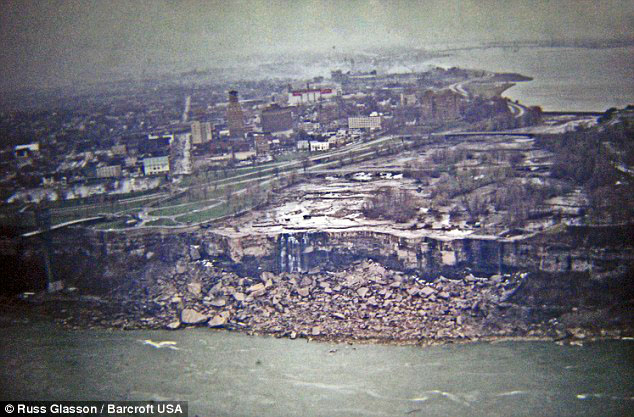
The day Niagara Falls ran dry:
“In June 1969, U.S. engineers diverted the flow of the Niagara River away from the American side of the falls for several months.
“Their plan was to remove the large amount of loose rock from the base of the waterfall, an idea which they eventually abandoned due to expense in November of that year.
[. . .]
To achieve this the army had to build a 600ft dam across the Niagara River, which meant that 60,000 gallons of water that flowed ever second was diverted over the larger Horseshoe Falls which flow entirely on the Canadian side of the border.
“The dam itself consisted of 27,800 tons of rock, and on June 12, 1969, after flowing continuously for over 12,000 years, the American Falls stopped. Over the course of the next six months thousands of visitors flocked to the falls to witness the historic occasion.
I remember seeing this, although as I was nine at the time, I can’t say with certainty that it was in person . . . I might be mistakenly remembering seeing it on TV, although my family visited Niagara Falls frequently during the late 1960s and early 1970s.
Thought experiment: imagine an Internet in which email and web addresses were centrally issued by government agencies, with heavy procedural requirements and no mobility — even, at a plausible extreme, political patronage footballs. What kind of society do you suppose eventually issues from that?
I was there in 1983 when a tiny group called the IETF prevented this from happening. I had a personal hand in preventing it and yes, I knew what the stakes were. Even then. So did everyone else in the room.
Thought experiment: imagine a future in which everybody takes for granted that all software outside a few toy projects in academia will be closed source controlled by managerial elites, computers are unhackable sealed boxes, communications protocols are opaque and locked down, and any use of computer-assisted technology requires layers of permissions that (in effect) mean digital information flow is utterly controlled by those with political and legal master keys. What kind of society do you suppose eventually issues from that?
Remember Trusted Computing and Palladium and crypto-export restrictions? RMS and Linus Torvalds and John Gilmore and I and a few score other hackers aborted that future before it was born, by using our leverage as engineers and mentors of engineers to change the ground of debate.
[. . .]
Did we bend the trajectory of society? Yes. Yes, I think we did. It wasn’t a given that we’d get a future in which any random person could have a website and a blog, you know. It wasn’t even given that we’d have an Internet that anyone could hook up to without permission. And I’m pretty sure that if the political class had understood the implications of what we were actually doing, they’d have insisted on more centralized control. ~For the public good and the children, don’t you know.~
So, yes, sometimes very tiny groups can change society in visibly large ways on a short timescale. I’ve been there when it was done; once or twice I’ve been the instrument of change myself.
Eric S. Raymond, “Engineering history”, Armed and Dangerous, 2010-09-12
As anyone who’s been paying attention knows, most engineering work is unexceptional and we depend on it working without fuss or bother. Engineers learn what is and isn’t possible with the materials and techniques available, but one of the most important teachers is failure:
The sinking of the Titanic, the meltdown of the Chernobyl reactor in 1986, the collapse of the World Trade Center — all forced engineers to address what came to be seen as deadly flaws.
“Any engineering failure has a lot of lessons,” said Gary Halada, a professor at the State University of New York at Stony Brook who teaches a course called “Learning from Disaster.”
Design engineers say that, too frequently, the nature of their profession is to fly blind.
Eric H. Brown, a British engineer who developed aircraft during World War II and afterward taught at Imperial College London, candidly described the predicament. In a 1967 book, he called structural engineering “the art of molding materials we do not really understand into shapes we cannot really analyze, so as to withstand forces we cannot really assess, in such a way that the public does not really suspect.”



Powered by WordPress