
Drachinifel
Published 25 May 2024HMS Canada / Almirante Latorre, a single dreadnought battleship of the British Royal Navy and Chilean Navy, is today’s subject.
(more…)
July 18, 2025
HMS Canada / Almirante Latorre – Guide 389
Comments Off on HMS Canada / Almirante Latorre – Guide 389
July 16, 2025
German Sten Copy: MP-3008, aka Gerät Neumünster
Forgotten Weapons
Published 4 Feb 2016The MP 3008, aka Gerät Neumünster, was one of two German efforts to copy the British Sten gun. The first was the Gerät Potsdam (“gerät” meaning device or project; basically project code name), which was a direct copy of the Sten distinguishable only by a marking details and a few differences in manufacturing processes. While 10,000 of those were being manufactured by Mauser, R&D engineer Ludwig Vorgrimmler was simplifying the Sten design even farther, resulting in the MP-3008.
This simplified design did away with the Sten’s barrel shroud, and used a vertical magazine well instead of the Sten’s distinctive horizontal mounting. These were the significant changes, although there was also a sling loop placed on the front of the magazine well and a few minor simplifications to the fire control parts. Unlike the Potsdam, significant variation can be found in the MP-3008 in the details of stock and grip design.
In a masterpiece of insane optimism, German official placed an order for literally a million MP-3008 submachine guns, which of course was completely insane. Manufacture was undertaken at a wide scattering of small shops, with guns being assembled by larger manufacturers from supplied parts. The total made is not known, but is probably in the range of 3000-5000. Some are marked with manufacturing codes from recognized factories, some with codes unknown, and some have no marking at all. This particular example is dewat made by “TJK” — an unknown factory.
Comments Off on German Sten Copy: MP-3008, aka Gerät Neumünster
July 13, 2025
Tiger II: What was the point?
The folks at the Tank Museum at Bovington put together a video comparing the Tiger II to the earlier Tiger I and the typical allied tanks they faced on the battlefield. On the social media site formerly known as Twitter, historian Jonathan Ware posted a long thread about both the topics the Tank Museum’s video raised and where he feels they should have added more context:
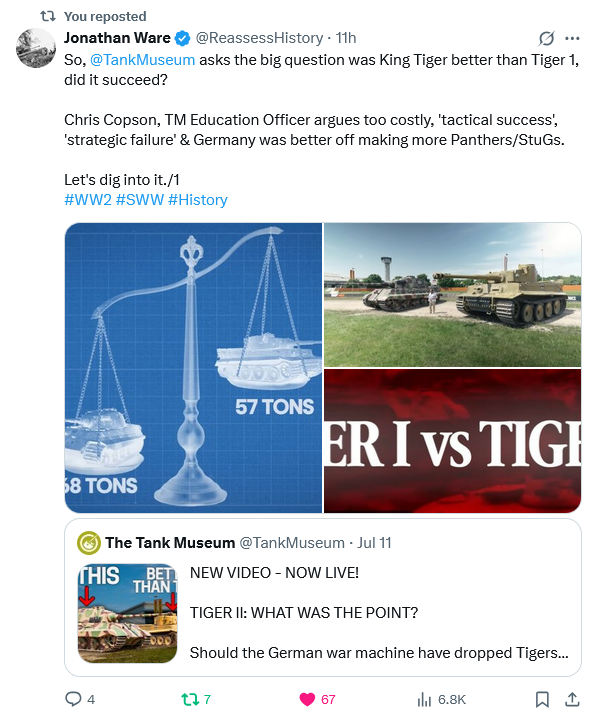
And here’s the Tank Museum’s video itself:
FEATURING FOOTAGE OF TIGER I AND TIGER II RUNNING TOGETHER AT TANKFEST 2025 – with thanks to Musée des Blindés and World of Tanks.
It’s absurdly large, heavy, expensive, and difficult to build. So, you have to ask; what is the point of Tiger II when you already have the biggest, toughest and meanest beast on the block – Tiger I.
Whilst the Tiger I has maintained a legendary status since its appearance on the battlefield, there were many aspects of this tank’s design that were pretty much dead ends. The turret couldn’t be resized to fit a more powerful gun. And adding extra weight in the form of armour would put a huge amount of strain on the internal mechanics. So, a new tank was needed to ensure the German’s could maintain their edge against Allied armour.
Enter the Tiger II, otherwise known as the King Tiger. Heavily armed, the Tiger II could take on any Allied tanks that it faced, with its KwK 43 able to penetrate the frontal armour of a Sherman at 1,800m. Its thick sloped armour was incredibly dependable, and no Allied tank commander would willingly engage a Tiger II in a head-to-head fight.
The Tiger II’s battlefield presence came at a significant cost. A single Tiger II could take up to 400,000 hours to build at a price of RM 321,500 – up to 100,000 more hours than a Tiger I, and over twice the cost of a Panther. A while the Allies were churning out tanks that were “good enough”, the Germans were committed to quality and ensuring their tanks would always have the edge against enemy armour.
The Tiger II has often been described as a tactical success for its battlefield prowess, but a strategic failure for being so resource-hungry, expensive and relatively low in number. Given their cost, it forces us to question whether the German war machine should have dropped Tigers altogether in favour producing tanks that were cheaper and easier to build
00:00 | Introduction
00:55 | Durchbruchswagen
06:15 | Tiger I vs Tiger II
12:52 | The Numbers Game
17:34 | Was Tiger II a Success?This video features archive footage courtesy of British Pathé.
In this film, Chris Copson breaks down the differences between two legendary tanks – the Tiger I and Tiger II. Whilst Tiger I was an impressive tank, certain areas of its design were an evolutionary dead-end. Its boxy turret couldn’t be enlarged to fit a bigger gun, and the hull couldn’t be up armoured without adding stress to the drive train. So, Tiger II ordered in 1943, including even thicker, sloped armour and a much more destructive gun. With mixed success on the battlefield, difficulties in maintaining its complex mechanics and reliance on dwindling supply lines, the Tiger II ended up being a tactic success, but a strategic failure.
Want to learn more about the Tiger I and Tiger II? Here are some of the sources we used to make this film:
Panzer Tracts No.23 – Panzer Production from 1933 to 1945 by Thomas Jentz and Hilary Doyle, 2011
Germany’s Tiger Tanks, DW to Tiger I: Design, Production and Modifications by Thomas Jentz and Hilary Doyle, 2000
Germany’s Tiger Tanks, VK45.02 to Tiger II: Design, Production and Modifications by Thomas Jentz and Hilary Doyle, 1997
Encyclopedia of German Tanks of World War Two, Revised Edition by Peter Chamberlain and Hilary Doyle, 1993
Tigerfibel. English translation by The Tank Museum, 2022
Panther and its Variants by Walter Spielberger, 1978
Armored Champion: The Top Tanks of World War II by Steven Zaloga, 2015
www.tankarchives.com
www.forum.axishistory.com
www.achtungpanzer.com
www.feldgrau.net
Comments Off on Tiger II: What was the point?
July 10, 2025
Was Matilda II the BEST Tank of WWII?
The Tank Museum
Published 21 Feb 2025Forget the Sherman, forget the Panther, forget the T-34 … Should Matilda II be considered the best tank of WWII?
Emerging from the request for a new and improved infantry tank, Matilda II debuted on the battlefield in France. The heroic actions of Matilda crews at Arras stopped Blitzkrieg in its tracks and allowed the British army to be evacuated from the beaches of Dunkirk.
The Matilda’s fighting peak was during the North Africa campaign, where the 2pdr gun was more than a match for any of the Italian armour it came up against. Despite some mechanical issues, the performance of Matilda II at this time would earn her the title “Queen of the Desert”. Once the Germans arrived in North Africa, Matilda started to become obsolete but remained useful as a testbed for experimental equipment that would eventually be used on D-Day.
Matilda II saw service in all theatres of the Second World War. Around 900 tanks were deployed by the Soviets in 1942, filling the gap as the Red Army increased its roster of T-34s. Matilda made great contributions to campaigns in the Pacific – its small and solid profile making it ideal for jungle bashing. The Australians made effective use of the Matilda, creating variants including a mortar launcher and a flamethrower.
Some say that if it wasn’t for Matilda II we would be speaking German right now. Watch this video to find out why …
00:00 | Introduction
00:36 | Heroics at Arras
03:29 | It Takes Two
06:00 | Matilda II – Inside and Out
13:03 | Queen of the Desert
18:14 | Soviet Service on The Eastern Front
19:49 | The Pacific – Welcome to the Jungle…
(more…)
Comments Off on Was Matilda II the BEST Tank of WWII?
July 9, 2025
WF-54: The Swiss FG-42 Scaled up to 7.5×55
Forgotten Weapons
Published 19 Aug 2024After World War Two the Swiss needed a new self-loading military rifle to replace their K-31 bolt actions. Two major design tracks followed; one being a roller-delayed system based on the G3 at SIG and the other being a derivative of the German FG-42 at Waffenfabrik Bern. Bern, under the direction of Adolph Furrer, had been experimenting with intermediate cartridges since the 1920s, and they used this as a basis to develop an improved FG-42 using an intermediate cartridge (7.5x38mm). The program began in 1951 and went through about a half dozen major iterations until it ultimately lost to the SIG program (which produced the Stgw-57).
Today we are looking at one of the later steps in the Bern program, the WF-54. By this point the intermediate cartridge had been discarded in favor of using the standard Swiss GP11 (7.5x55mm). The overall design was a bit simplified as well. The Bern program would continue for two more years after this rifle before ultimately losing out to the SIG 510 for Swiss military adoption.
(more…)
Comments Off on WF-54: The Swiss FG-42 Scaled up to 7.5×55
July 6, 2025
Steyr-Solothurn S2-200: the Austrian MG30 and Hungarian 31M
Forgotten Weapons
Published 23 Sept 2024The S2-200 was developed by Louis Stange at the Rheinmetall company in Germany in the late 1920s. Because Germany was not allowed to be doing this sort of arms development at the time, Rheinmetall bought a controlling stake in the Swiss firm Solothurn AG, to make the product deniably Swiss. The gun itself is recoil operated, with a rotating locking collar connecting the bolt and barrel, rather like the Hotchkiss Portative. It was a design that had some early influence on the German MG34, although the German military declined to adopt it. Instead, it was taken into service in 8x56mm by both Austria (as the MG30) and Hungary (as the 31M). A third purchaser was El Salvador, which purchased 47 examples in 7x57mm caliber.
After the anschluss in 1938, the Austrian guns were integrated into the Wehrmacht, where they were primarily used by mountain troops. Hungary did later make a version in 7.92x57mm, designated the 43M.
(more…)
Comments Off on Steyr-Solothurn S2-200: the Austrian MG30 and Hungarian 31M
June 24, 2025
Praga I-23: Prototype Belt-Fed Predecessor of the ZB26
Forgotten Weapons
Published 3 Feb 2025Vaclav Holek’s first machine gun design for the Czech military was the Praga I, built in 1922 and based heavily on the Vickers/Maxim system. However, it became clear that the military wanted something lighter and more portable, and so the next year he heavily updated the design to this, the Praga I-23 (for 1923). It remains a belt-fed weapon chambered for the 8mm Mauser cartridge, but the locking system has been much simplified into a tilting bolt arrangement. The recoil operation from the earlier model is also gone, now replaced by a long stroke gas piston. Some elements of the Maxim remain in the belt feeding elements, but the overall gun is much more a light machine gun than the mounted heavy machine gun that was his first design.
A total of 40 of the Praga I-23 were ordered by the Czechoslovak military, and they were tested in 1924 (only 20 examples were actually delivered of the 40). The I-23 performed well, but it was again clear that it wasn’t quite what the military really wanted. Holek revised the design again to the model 1924, using a box magazine instead of a belt feed — and that is the gun that continued the path to the ZB-26.
Video on the Praga I machine gun that came immediately before this model: Praga I: A Blow-Forward Bullpup Semi-…
Many thanks to the VHU — the Czech Military History Institute — for giving me access to this fantastic prototype to film for you. The Army Museum Žižkov is a part of the Institute, and they have a three-story museum full of cool exhibits open to the public in Prague. If you have a chance to visit, it’s definitely worth the time! You can find all of their details (including their aviation and armor museums) here:
Comments Off on Praga I-23: Prototype Belt-Fed Predecessor of the ZB26
June 18, 2025
AG42 Ljungman: Sweden Adopts a Battle Rifle in WWII
Forgotten Weapons
Published 29 Jan 2025
All the best firearms history channels streaming to all major devices:
weaponsandwar.tvSweden developed, adopted, and produced a new self-loading rifle during World War Two. The process began in 1938, with an attempt by the state rifle factory to convert Swedish Mauser bolt actions into semiautomatic; that did not go well. Trials for a ground-up semiauto followed shortly thereafter, with the two finalists being the Pelo rifle from Finland and a design by Erik Eklund of the C.J. Ljungmans Verkstäder, a company that made gas pumps and had no prior small arms experience. Eklund focused on making his rifle as simple as possible, and created a direct gas impingement system with a tilting bolt and a rather unique method of operation. It was chambered for the 6.5x55mm cartridge, with a detachable 10-round magazine (which was intended to be reloaded with stripper clips).
The rifle went into production in 1942, and by 1944 rifles were being delivered to the military. They were never a complete replacement for the various patterns of Swedish Mauser, instead being used to supplement squad firepower. In 1953 a major refit program was put in place, making a number of changes and creating the Ag m/42B pattern. Those rifles remained in use until eventually replaced by the AK4, the Swedish model of the G3 rifle from Heckler & Koch.
(more…)
Comments Off on AG42 Ljungman: Sweden Adopts a Battle Rifle in WWII
June 17, 2025
The Crewless Tank Experiment | Project Crazy Horse
The Tank Museum
Published 31 Jan 2025This might just be one of the greatest missed opportunities in the history of tank development. Project Crazy Horse: a full-sized, crewless, remote-control tank – developed 35 years ago.
Being shot at is as unpleasant as it is dangerous. But in the 1980s, the Ministry of Defence needed to trial the cutting-edge TRIGAT missile system with a mobile target. The MOD approached the Royal Armament Research and Development Establishment (RARDE) with a unique challenge – design us a tank that can operate by remote control.
With a limited budget, the project team selected an old Mark I Chieftain as the test bed for their vehicle. Stripping out any unnecessary components and piecing together the needed parts from a range of tech, Crazy Horse was successfully trialed in 1988.
But despite the innovations of both the team and the technology, the project was shut down due to budget cuts and issues of unreliability. The team was reassigned, and Crazy Horse was sent to The Tank Museum. There is currently no such thing as an unmanned, remote controlled main battle tank. But 35 years ago, we came tantalisingly close.
00:00 | Introduction
00:39 | A Moving Target
03:00 | Less Than A Million Dollars?
04:40 | Previous Attempts
07:47 | Creating Crazy Horse
10:16 | A Stormer!
13:47 | Slow Death of Crazy Horse
18:23 | A Missed Opportunity?In this film Chris Copson and Paul Famojuro explore the extraordinary story of Project Crazy Horse. This unique Chieftain target tank was developed in the 1980s, by an enthusiastic team that used their expertise to create the biggest remote-controlled tank in the world. Sadly, despite several glimmers of a resurrection, Crazy Horse would never see its full potential. Both Crazy Horse and its Stormer control vehicle were saved from scrap, and are now on display at The Tank Museum, where visitors can discover more about this revolutionary design.
(more…)
Comments Off on The Crewless Tank Experiment | Project Crazy Horse
QotD: What is a “tank”?
… the tank was a direct response to the battlefield conditions of WWI, in particular the trench stalemate on the Western front. The idea of some kind of armored “land cruiser” (potentially armed with machine guns) had been floated before WWI but never seriously considered and developed on, but serious development only began in 1915 with the formation of the Landship Committee early that year. Famously, they needed a code-name for their planned vehicle and opted first for “water carrier” and then for “tank”, thus giving the tank its peculiar English name.
And we should stop to note that as with any question of definition, this one too is language-sensitive. The exact confines of a term vary from one language to another; kampfpanzer, for instance is not necessarily an exact synonym for “tank”.
In any event, the basic demands of early tanks were dictated by the realities of the Western Front: a tank needed to be able to resist small arms fire (particularly machine guns), deliver direct supporting fire itself, it needed to be able to move on the muddy, artillery-flattened ground and it needed to be able to cross a trench. This last requirement – the need to be able to both climb a parapet (usually c. 4ft) and then cross over an 8ft wide trench – was significant in the design of early tanks.
Those factors in turn dictated a lot of the design of early tanks. The armor demands of resisting small arms fire meant that the vehicle would be heavy (and indeed, as soon as tanks appeared amongst Allied troops, their German opponents began introducing more powerful bullets, like the K bullet and later the 13.2mm anti-tank round fired from the Mauser 1918 T-Gewehr). And here is the first advantage of tracks. The weight of a vehicle is distributed along all of the area of contact it has with the ground; with tires that area is limited to the bottom of the tire so the total area of ground contact is fairly low, which is fine for most vehicles.
But tanks are heavy. Really heavy. Even something like the Renault FT could mass around 7 tons and by later standards that would be classified as a tankette (a “mini-tank” as it were); by WWII, medium tanks often clocked in around 30 tons. If you put a vehicle like that on tires, you are going to create a LOT of pressure on those small points of contact. That might still be OK if you are just going to drive on roads and other firm surfaces which can take the pressure. But remember: tanks were designed for the Western Front, which looks like this.
Fortunately for the landship committee, this wasn’t a new problem: farming tractors were also heavy and also had to operate in churned up (in this case, plowed) soft soil; the heaviest of these vehicles had much the same problem and the solution was continuous tracks or “treads”. When kept properly tensioned – tune in, by the by, to Nicholas “The Chieftain” Moran’s YouTube for more than you ever want to know about track tension – the track distributes the weight of the tank across the entire section of the track touching the ground, which reduces the ground pressure at any given point, allowing a big heavy tank to roll over terrain where even a much lighter wheeled vehicle would get stuck.
This is one of those points where the functionality of a tank (what a tank does) has such a strong influence on design that the design implications of the functionality become part of the definition: a tank has to be heavily armored and has to be able to move off-road and as a result has to be tracked, not wheeled. One might be able to imagine some sort of exotic technology that might make it possible to do all of the things a tank does without tracks, but we don’t have that yet.
The other factor was fire. I’ve mentioned this before, but one of the significant background factors of WWI is that a lot of the belligerents misjudged the kind of artillery they’d need for a general European war. Not to get too deep into the weeds here, but most of the belligerents expected a relatively rapid war of maneuver and so thought that light, direct-fire artillery like the famed French ’75 (the Matériel de 75mm Mle 1897) would be the most useful. Those guns could be moved quickly and could deliver a lot of quick firepower on static or moving formations of enemy infantry in support of friendly infantry.
The problem is that in the conditions of trench warfare, those guns – as they were configured, at least – were far less useful. They were, first off, much shorter in range which meant they had to be brought dangerously far forward to do their direct fire role – often so far forward they could be engaged by enemy rifles and machine guns. This was compounded by the fact that direct fire at range was ineffective against trench works (which are dug down into the earth). But at the same time, the value of rapid firing (because these lighter guns could fire a lot faster than the heavy, indirect fire artillery) direct fire artillery remained high, if only you could get it to the fight.
This was also a problem a tank could solve: as a mobile, armored platform it could move a rapid-firing direct fire gun forward without immediately being knocked out by enemy small arms to support the infantry. There is, I should note, early complexity on this point, with both “male” (heavy direct fire cannon focused) and “female” (machine gun focused) tanks in WWI though in the end “hermaphrodite” designs with both capabilities (but much more focus on the main cannon) triumph, so that’s what we’ll focus on.
And that gets us the fundamental role structure for tanks: enough armor to resist enemy small arms (but with the understanding that some weapons will always be effective against the tank), enough mobility to cross the churned up battlefield and some direct fire capability to support the infantry crossing it at the same time.
Bret Devereaux, “Collections: When is a ‘Tank’ Not a Tank?”, A Collection of Unmitigated Pedantry, 2022-05-06.
Comments Off on QotD: What is a “tank”?
June 15, 2025
America’s Forgotten SMG: The Hyde/Marlin M2
Forgotten Weapons
Published 4 Oct 2019 #36270The United States went into World War Two with the Thompson submachine gun — a weapon far too heavy and too expensive for its role. The British went to the other extreme with the Sten and while the US did not want a gun quite that crude, the Sten did spur a desire for something cheaper than the Thompson. George Hyde (then working for the Inland Division of GM) had worked on submachine gun designs in the 1930s, and he put together a weapon that would fit US needs. It was much cheaper than the Thompson and weighed in a full 2 pounds lighter. At tests in the spring of 1942, it also proved to be much more accurate in automatic firing, as it had a much more ergonomic stock design than the Thompson. The weapon was approved as the M2 submachine gun in 1942, and a contract went to Marlin to produce it (Inland had no extra production capacity at the time).
The receiver of the M2 was made through a metal sintering process, and Marlin had trouble getting this properly tooled up. The first gun delivery didn’t actually happen until May of 1943, and by that time Hyde had finished designing the M3 “Grease Gun”, which was cheaper still, and more attractive to the military. The contract for the M2 was cancelled in June of 1943, with only 400 guns delivered. There are only six known surviving examples today, split between private collections, museums, and military institutions.
(more…)
Comments Off on America’s Forgotten SMG: The Hyde/Marlin M2
June 12, 2025
Type 30 Arisaka
Forgotten Weapons
Published 22 Jun 2015Most people are familiar with the Type 38 Arisaka, which was one of the two very distinctive Japanese rifles of World War II (along with the Type 99). The Type 38 was an outstanding rifle in large part because it was the result of several years of experience and development which began in 1897 with the Type 30 “Hook Safety” Arisaka. This first Japanese smallbore military rifle was designed by a committee (led by Col. Arisaka) from the best elements of other rifles being made at the time. It used a bolt which was significantly more complex than the elegant Type 38 bolt which would follow later.
Comments Off on Type 30 Arisaka
June 9, 2025
The Mighty Meteor – The World’s First Operational Jet Fighter
HardThrasher
Published 8 Jun 2025References
1. https://tinyurl.com/yc74kmed
2. Britain’s Jet Age, Guy Ellis, 2016, Amberley Publishing
3. Genius Of The Jet | The Invention Of The J… – Frank Whittle and Powerjets documentary, originally aired on the BBC
4. Meteor, Gloster’s First Jet Fighter, Steven Bond, Midland, 1985, Chpt 1
5. The British Aircraft Specifications File, Meekcombs and Morgan, 1994, p.298
6. https://en.wikipedia.org/wiki/Klimov_…
7. Most Secret Place, Johnson & Hefferman, Janes, 1983
8. https://mikesresearch.com/2020/12/25/…
9. Bond, op cit. p18
10. Bond, op cit.p34
11. QUEEN OF THE SKY: Meteor Night Fighters, U…
12. https://hushkit.net/2020/05/12/my-fav…
13. https://asn.flightsafety.org/wikibase… and https://asn.flightsafety.org/wikibase…
(more…)
Comments Off on The Mighty Meteor – The World’s First Operational Jet Fighter
Q&A: British Small Arms of World War Two
Forgotten Weapons
Published 24 Jan 2025Today’s Q&A is brought to you by the fine folks at Patreon, and by Penguin Brutality: https://www.varusteleka.com/en/search…
01:11 – Was the Vickers .50 any good, and why did the British use four different heavy cartridges instead of consolidating?
07:35 – The Sten and its single-feed magazine design
10:27 – Owen versus Sten, and German use of the Owen.
14:38 – British wartime work on an “assault rifle” sort of weapon?
15:44 – Why no British semiauto rifle during WW2? – Jonathan Ferguson on British semiauto rifle trials: Q&A 43 (feat. Jonathan Ferguson): Mil…
18:04 – EM2’s automatic bolt closure system
20:46 – Did the British use other allied weapons besides American ones?
23:15 – Is the PIAT a Destrucitve Device under US law and why?
26:07 – Bren vs Degtyarev
27:50 – Why not make the Sten in .45 to use Thompson ammo?
29:37 – Did the British get M3 Grease Guns?
31:01 – British SMG in .455?
32:03 – Sten vs Lanchester
33:26 – Was there an LSW version of the EM1/EM2 planned? EM1 Korsac: The Korsac EM1 – a British/Polish Bul…
34:25 – Why wasn’t the BESA in .303?
36:34 – Biggest British missed opportunity during the interwar period?
38:40 – British naval service small arms
41:45 – Did .280 cartridge development begin during the war?
43:24 – Impact of MP44 on British post-war small arms development?
44:25 – Gallilean sights on the Enfield
46:25 – Why is there a semiauto selector on the Sten?
49:17 – Did American soldiers use British small arms?
50:29 – Why did the British choose the Lee action over the Mauser action?
51:16 – Which was better, Sten or Grease Gun?
52:34 – Why did the whole Commonwealth not switch to the No4 Enfield?
(more…)
Comments Off on Q&A: British Small Arms of World War Two
June 5, 2025
Rate of Fire: What Determines it and How to Change It
Forgotten Weapons
Published 17 Jan 2025What determines the rate of fire of a machine gun, and how can that rate of fire be determined or changed from a design perspective? Let’s talk about pressure, mass, and distance …
(more…)
Comments Off on Rate of Fire: What Determines it and How to Change It


