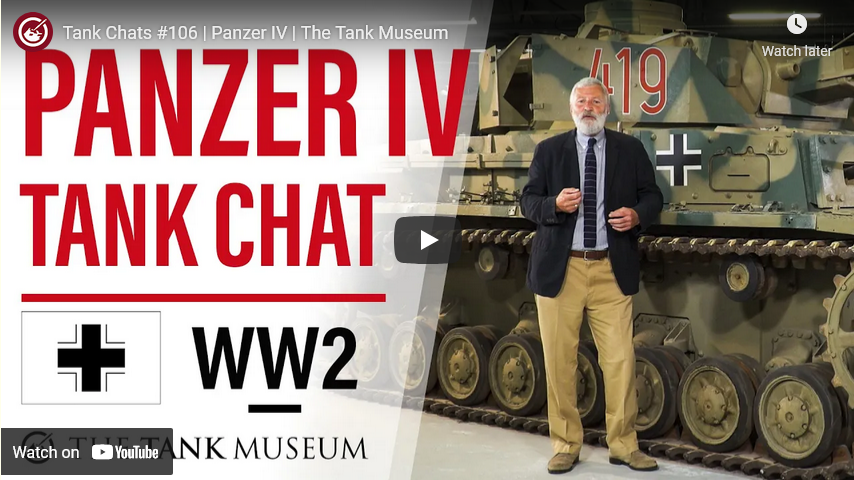
Join The Tank Museum’s Curator David Willey as he discusses the Sd.Kfz 161, better known as Panzer IV: the most numerously produced tank by Germany during the Second World War.
Support the work of The Tank Museum on Patreon: ► https://www.patreon.com/tankmuseum
Visit The Tank Museum SHOP & become a Friend: ► tankmuseumshop.org
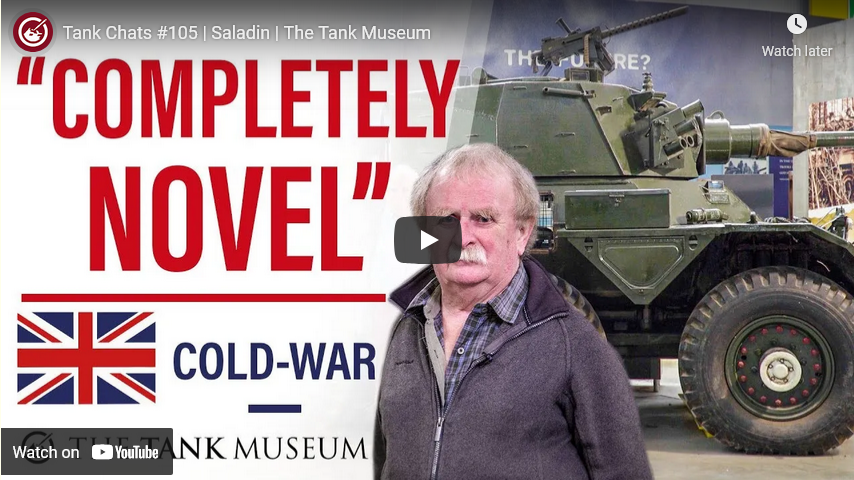
David Fletcher is back! Join him as he discusses the FV601 Saladin — a six wheeled armoured car developed by Crossley Motors and later produced by Alvis. The Saladin has had a long service life and despite its dated design, is still in service with some countries.
Support the work of The Tank Museum on Patreon: ► https://www.patreon.com/tankmuseum
Visit The Tank Museum SHOP & become a Friend: ► tankmuseumshop.org
Correction: Browning invented the pistol slide, but not the overall short recoil system. Maxim was the first to successfully create a short recoil firearm.
Short recoil is the most common system used today in self-loading handguns, and it also used to be fairly popular in machine gun designs. The basic principle is that the bolt and barrel (in a handgun, slide and barrel) are locked together for an initial travel substantially less than the overall length of the cartridge. After typically a few millimeters of travel, the barrel stops and the bolt or slide is able to continue rearward to extract and eject the empty case. Short recoil can be paired with virtually any locking system, but today the Browning tilting barrel system is most common.
Short recoil has never been popular in shoulder rifle, as the reduction in mechanical accuracy from the moving barrel can be undesirable. In handguns and machine guns, this accuracy reduction is generally below the threshold of relevance.
Contact:
Forgotten Weapons
6281 N. Oracle #36270
Tucson, AZ 85740
Comments Off on How Does it Work: Short Recoil Operation
Here Curator David Willey discusses the T-54, and its successor the T-55, tanks which can source their roots back to the Second World War and are probably the most produced tanks of all time.
Support the work of The Tank Museum on Patreon: ► https://www.patreon.com/tankmuseum
Visit The Tank Museum SHOP & become a Friend: ► tankmuseumshop.org
There are at least five advantages to having two separate islands on the Royal Navy’s Queen Elizabeth-class aircraft carriers. But the main reason for such a design can only be found below the deck. Enjoy!
David Fletcher looks at this curiosity from the 1970’s, a Land Rover with tracks. Currently housed in The Tank Museum’s Vehicle Conservation Centre.
Support the work of The Tank Museum on Patreon: ► https://www.patreon.com/tankmuseum
Visit The Tank Museum SHOP & become a Friend: ► tankmuseumshop.org
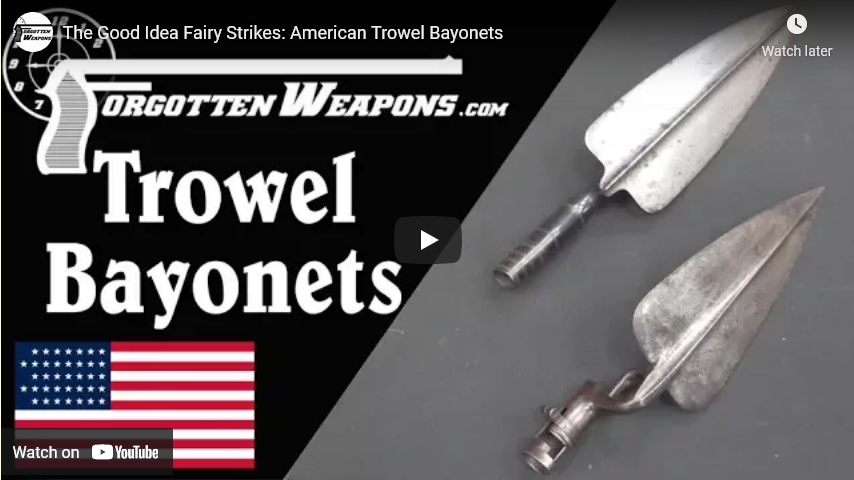
The United States first experimented with a combination trowel and bayonet in 1868, producing 200 experimental examples made from standard socket bayonets. This was immediately followed by an additional 500 Model 1869 trowel bayonets made new. These were distributed to a few companies of the infantry to test in the field. Remarkably, the trials reports were overwhelmingly positive.
The US infantryman at that time did not carry any sort of entrenching tool, and so even an awkward combination tool was an improvement over a canteen cup or other ad hoc tool for digging. The bayonet was seen by some officers as becoming obsolete with the introduction of breechloading rifles, so the reduced effectiveness of the new item as a bayonet was not a substantial concern. The intended use of these tools was not to dig elaborate trenches, but rather to hastily construct a shallow ditch and embankment which would provide just enough cover to shelter a prone soldier.
With the trials reports in, the government purchased 10,000 of the improved 1873 pattern trowel bayonet, which featured a stronger blade and a much more comfortable handle for digging. These were issued and used in the field (and in several combat engagements), but the developmental direction turned towards combination knife trowels instead of bayonets, and there would be no further development or issue of these tools after the 1870s.
Armament Research Services (ARES) is a specialist technical intelligence consultancy, offering expertise and analysis to a range of government and non-government entities in the arms and munitions field. For detailed photos of the guns in this video, don’t miss the ARES companion blog post:
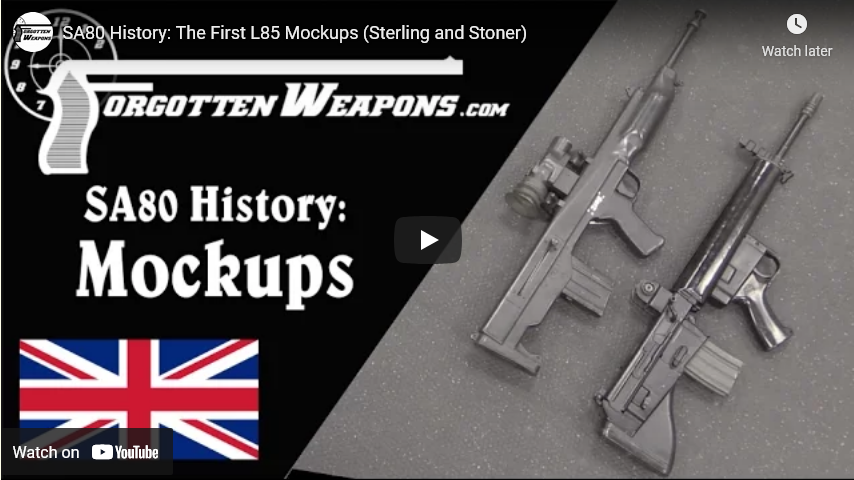
The British military had been working towards a reduced-power cartridge since the end of World War 2, and the ultimate adoption of the FAL/SLR in 7.62x51mm NATO did not end their interest in the concept. It would not be long before the roots of SA80 would take hold, and today we are looking at the very first mockups of the concept that would become the L85A1 and L86A1.
As part of a preliminary study to decide the basic layout and capabilities of a future new individual weapon and light support weapon, five wooden and metal mockups were produced in conventional and bullpup layouts, and also with/without “dropped” stocks to facilitate sighting. The favored mockup was the bullpup seen here, which gave rise to the whole Enfield Weapon System/SA80 family. It is relevant to note that the concept included a universal standard optical sight from the very outset, as this was a cutting edge concept at the time. In addition, note the small features like safety, sling swivels, and magazine catch, as these would vary back and forth through the development program.
After the wooden guns, two functional (or mostly functional) guns were produced. These were standard off-the-shelf rifles converted into bullpup configuration – one Stoner 63 and one Sterling AR18. Neither company was contacted for licensing or technical assistance.
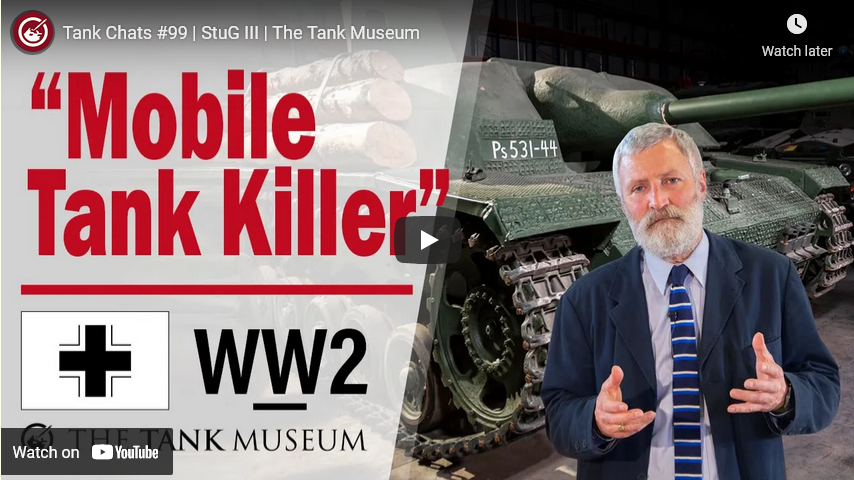
Here David Willey discusses the Sturmgeschütz III Self-Propelled Assault Gun, better known as the StuG III, Germany’s most numerously produced fully tracked Armoured Fighting Vehicle of the Second World War.
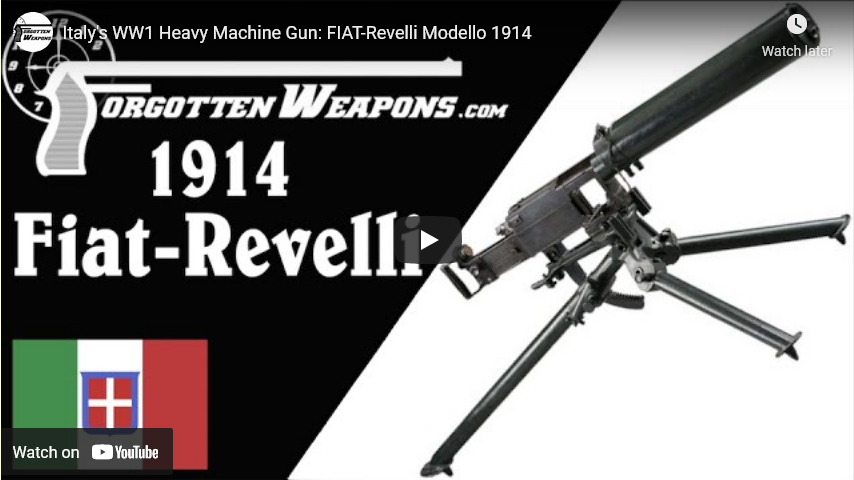
Italy was the first major adopter of the Maxim heavy machine gun and had several hundred by 1914 — but wanted to have a domestic design in production as well. The Italian government and military put a lot of resources into the Perino machine gun, but kept it so secret that it was never properly tested and development was very slow. By the time war broke out, the Perino was clearly not ready for field use — and Maxims (along with other foreign designs) were no longer available for commercial sale as production was being taken up by warring nations. This led Italy to adopt a private design of Bethel Revelli in partnership with the FIAT company.
Adopted as the Modello 1914, Revelli’s machine gun was a delayed blowback system with a wedge under mechanical disadvantage holding the bolt closed long enough to safely cycle. Its most unique element was the 50-round mousetrap-type box magazine that used 10 independent stacks of 5 rounds each (a 100-round version was also made). This was a very complex magazine to produce, and much more delicate than the other machine gun feed systems in use at the time. The Revelli is also notable for being the only major machine gun of the period to have a circulating water jacket, operated by a small hand-cranked pump on the condensing tank.
The FIAT-Revelli would see service as both and aircraft and ground gun through World War 1, and was updated in 1935 to an air cooled pattern that would serve through World War 2. These guns are very scarce in the United States today, and I am grateful to the collector who owns this one for providing access to it!
Contact:
Forgotten Weapons
6281 N. Oracle #36270
Tucson, AZ 85740
Comments Off on Italy’s WW1 Heavy Machine Gun: FIAT-Revelli Modello 1914
Combat experience with the bazooka rocket launcher in World War Two and its larger versions in the Korean War convinced the US military that a better weapon was needed to give front-line troops a direct-fire way to attack enemy strong points. The bazooka was bulky, not particularly accurate, and created a lot of backblast signature when fired. This led to a multi-part development effort involving design of a small grenade body, reliable but cheap fusing system, and a cartridge design that could launch it.
The result was the 40x46mm grenade. It uses a “high-low” system (originally developed by Rheinmetall during World War Two) in which a powder charge is fired in a small compartment within the cartridge case. The initial pressure in this compartment is some 35,000 psi, which is plenty high to ensure complete and repeatable powder burn. At peak pressure, the internal compartment ruptures, allowing the propellant gasses to expand into the full case volume, which lowers the pressure to about 3,000 psi. This lower pressure is safe to use with an aluminum barrel, and propels the grenade at about 250 fps, giving it a range of about 400 yards without generating excessive recoil.
The M79 proved to be very accurate and reliable. Its downside was the need for the grenadier to carry a backup sidearm, as the M79 could not be used at close range. Almost as soon as it was introduced, work began on developing a launcher which could be attached to the M16 service rifle. This would first be the XM-148, and then ultimately the M203 that would replace the M79 in service. M79 launchers can still be found all over the world, however, as they are robust and reliable.
Contact:
Forgotten Weapons
6281 N. Oracle #36270
Tucson, AZ 85740
Comments Off on M79: The Iconic “Bloop Tube” 40mm Grenade Launcher
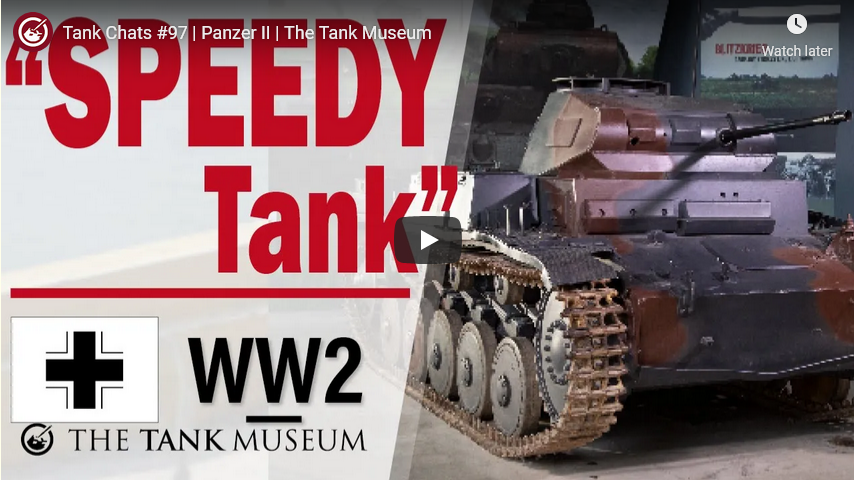
Here David Willey discusses the Panzer II, a German tank which was instrumental in the early days of the Second World War, especially during the Blitzkrieg.
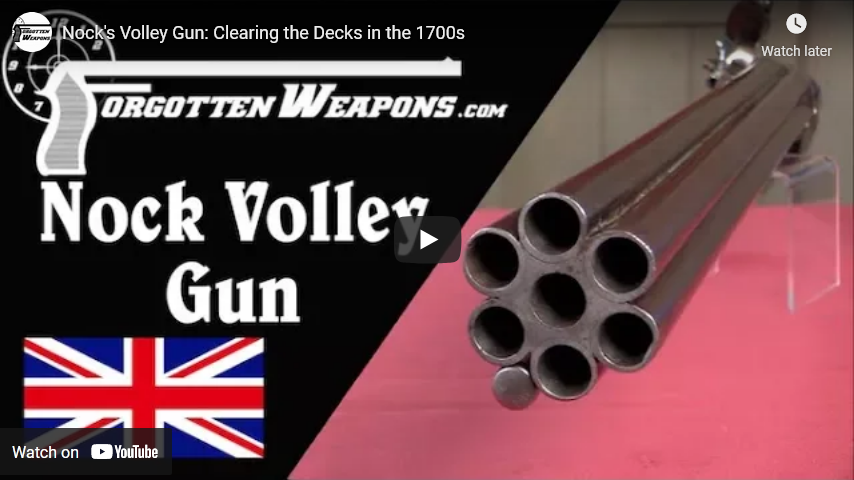
The Nock Volley Gun was actually invented by an Englishman named James Wilson in 1789, and presented to the British military as a potential infantry weapons. This was declined as impractical, but the Royal Navy found the concept interesting for shipboard use. In 1790 the Navy ordered two prototypes made by the British gunsmith Henry Nock, and finding them suitable, proceeded to oder a total of 500 of the guns (thus forever associating Nock’s name with the gun instead of Wilson’s). A further 100 or so were ordered in 1797, and the guns were in fact issued out to various ships — although accounts of their use in combat are difficult to find.
Unfortunately for Nock, the guns presented a couple of substantial problems in use. One was simply the recoil of firing. A single 32-bore (approximately .55 caliber) round ball over 40 grains of black powder is not a very impressive load, but seven of them firing simultaneously add up to a recoil comparable to 4- or 6-bore rifles, and in a volley gun weighing just 13 pounds (5.9kg). In addition, the guns did not always reliably fire all barrels, especially when dirty. This produced a conundrum: how to determine which barrels had fired and which had not? The practical result was double-loaded barrels, which could be liable to bulge or burst. For these reasons, the weapon was declared obsolete in 1805, and never appeared to play any significant military role.
The gun did receive a new wave of popular awareness in 1960, when the character of Jim Bowie was outfitted with one in the movie The Alamo (against all historical evidence). His easy handling of the weapon and the waves of men he was able to mow down with it brought the gun back into the popular consciousness.
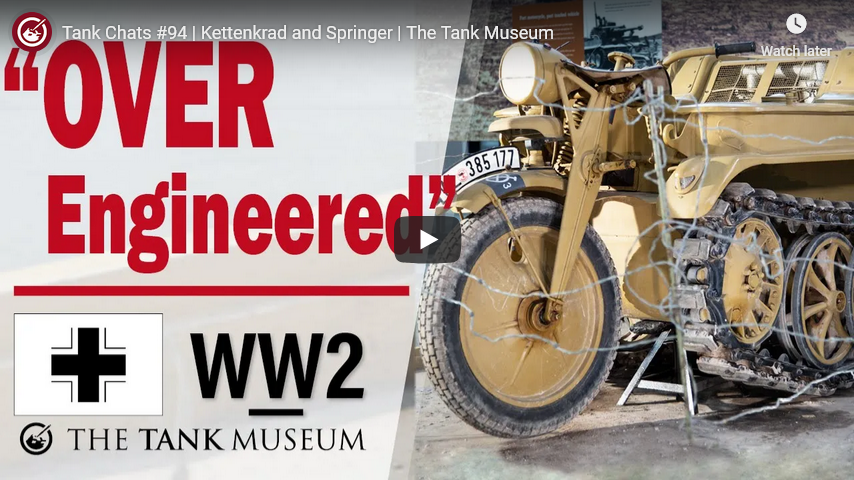
Here David Willey examines two WW2 German tracked vehicles. The first is the Sd.Kfz. 2, better known as the Kettenkrad, a light tractor. The second, the Springer, a demolition vehicle which was fundamentally a mobile bomb, which shared the Kettenkrad’s running gear and engine.
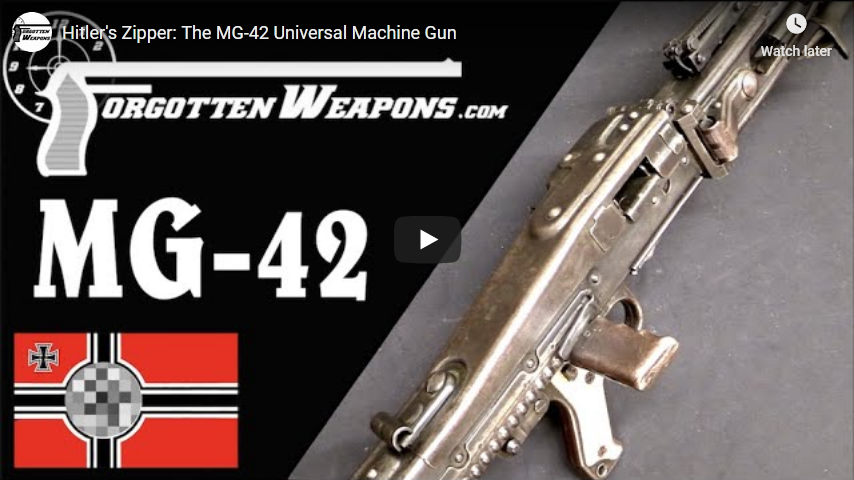
The MG42 was developed to be a more reliable and easier to manufacture replacement for the MG34, although both would serve side by side until the end of World War Two. Designed by Grossfuss company engineer Werner Gruner with no previous military or small arms design experience, the MG42 used heavy stampings for its main assemblies, thus reducing German need for expensive and difficult to obtain alloyed steels.
As a practical matter, the MG42 had a much higher rate of fire than the MG34, at 1500-1600 rounds per minute (more than 50% faster than the MG34). This was deemed desirable to improve the effectiveness of suppressing fire and the density of the cone of fire, but naturally resulted in much higher ammunition consumption than other machine gun models.
This example is a very early production Gustloff example, with the early horizontal charging handle, unreinforced wooden stock, and adjustable front sight. It was most likely captured in North Africa from Rommel’s forces, as they were a primarily user of the very early MG42s.
Contact:
Forgotten Weapons
6281 N. Oracle #36270
Tucson, AZ 85740
Comments Off on Hitler’s Zipper: The MG-42 Universal Machine Gun