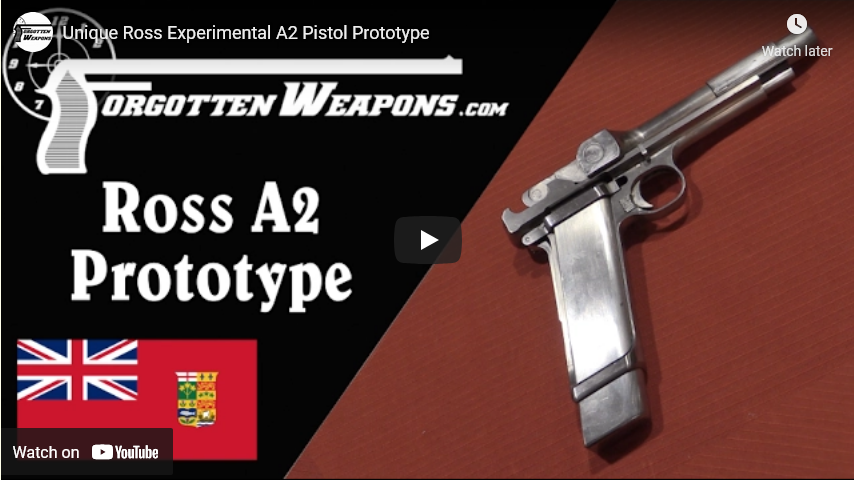
This is a very rare Ross automatic pistol, patented in 1903 by Charles Ross, of the Ross Rifle Company in Quebec. It is a short recoil, toggle locked design, made for the .45 Ross proprietary cartridge (although efforts were made, unsuccessfully, to make a .45 ACP version for the US 1907 pistol trials).
Tank Museum Historian David Fletcher discusses the British Second World War Churchill Mark I, the very first Churchill, as well as its successor, the Mark II. This chat also covers the development of the A20 prototype and how this became the production Mark I variant. The Churchill displayed is actually a Mark II made to look like a Mark I, and is the oldest surviving Churchill in the UK. (more…)
Comments Off on Tank Chats #112 | Churchill Mk I and II | The Tank Museum
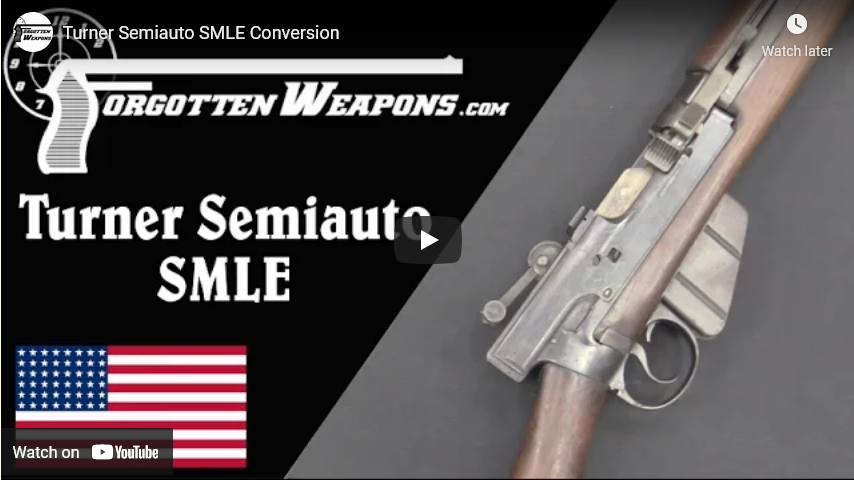
Russell Turner was a Pennsylvania gunsmith and inventor who developed this semiautomatic conversion of an SMLE bolt action rifle circa 1940. It was intended for trial and potential sale to the Canadian military, as it would allow them to retrofit existing rifles into semiautomatic configuration and still use existing supplies of .303 British ammunition. Rather than try to devise a reliable system to rotate the original Enfield bolt, Turner replaced the bolt entirely, using instead a side-tilting design much like what he used in his M1 Carbine trials rifle for the US military. This was coupled with a long stroke gas piston and a hammer firing trigger mechanism.
Reportedly the rifle was tested by Canadian authorities, and performed quite well, with the adjustable gas system allowing it to function reliably even in temperatures of 25 below zero (where the Garand, tested alongside, experienced problems). However, Turner’s rifle was deemed too complex for military adoption.
That decision against the rifle was probably the right one for Canada, although Turner’s conversion is one of the better semi auto bolt acton conversions I have handled. It was remarkably non-awkward — that may not sound like much to crow about, but it sets a pretty high standard for this type of rifle.
Designing some armour for ladies? Female torso armour specifically? Welcome. Get a year of streaming some of your favourite creators and HQ documentaries for under $15 at http://curiositystream.com/jillbearup
Boob armour, or boob plate, or lady armour. Or fantasy lady armour, come to that: how does it work then? Let’s have a look at Wonder Woman, The Mandalorian, Warhammer 40K and various examples of historical armour, as well as costume considerations, which will make designing a look for your female fighters that is practical and looks awesome a breeze.
TIMESTAMPS!
00:00 So you need some lady armour?
00:37 1. You don’t need boob plate
02:23 Alternate options
03:14 2. Divots are a disadvantage
03:56 Muscle cuirasses
04:35 Boob shelf designs
05:11 Cleavage divots
05:39 Wasp waist armor
06:44 Sticky weapons
08:02 Codpieces
08:40 3. Consider mobility (including experiments)
09:35 Two handed weapons and giant swords
10:29 Underlayers and materials used in experiments
11:03 Low guards and power generation in boob plate
11:46 Not painting a ‘look, a lady!’ target on yourself with your armor
12:17 4. Breathing is important
13:44 Corsets are not like armor, and scifi armor with flex
15:44 Fencing chest protectors are not armor, extra content on Nebula, this video is sponsored by Curiosity Stream
16:49 Lightning round
#boobplate #femalearmor #armor
Music by epidemicsound.com
“Meet Me in the Hills” – Howard Harper-Barnes
“To Begin” – Raymond Grouse
“Honorable Salute” – Sage Orsler
“Plains of Illeyneth” – Dragon Tamer
“Sparkle and Swirl” – Raymond Grouse
“Sergeant Wise” – Stationary Sign
“Optimist At Heart” – Jerry Lacey
“Fluz de la Riviere” – Howard Harper-Barnes
“Sailing for Gold” – Howard Harper-Barnes
“Endless Flirtation” – Jerry Lacey
Comments Off on Boob Armor: 4 Things You Need to Know
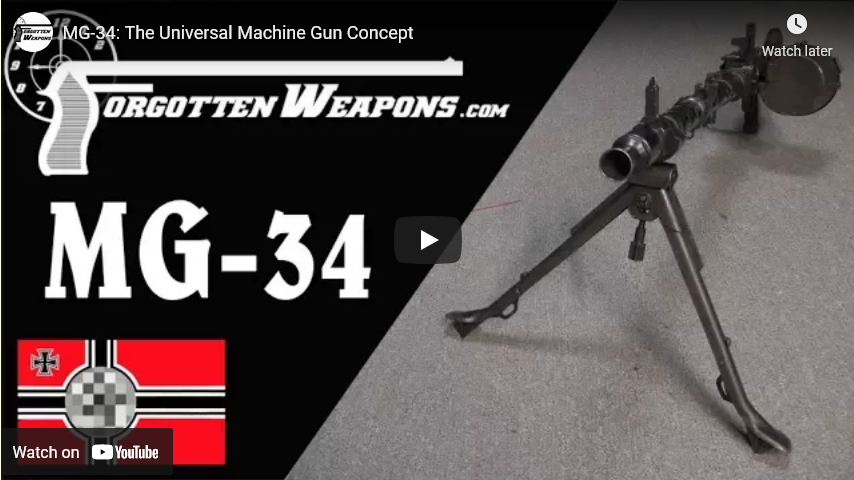
The MG34 was the first German implementation of the universal machine gun concept — and really the first such fielded by any army. The idea was to have a single weapon which could be used as a light machine gun, heavy machine gun, vehicle gun, fortification gun, and antiaircraft gun. The MG34 was designed to be light enough for use as an LMG, to have a high enough rate of fire to serve as an antiaircraft gun, to be compact and flexible enough for use in vehicles and fortifications, and to be mounted on a complex and advanced tripod for use as a heavy machine gun.
Mechanically, the MG34 is a recoil operated gun using a rotating bolt for locking. It is chambered for 8mm Mauser, and feeds from 50-round belt segments with a clever and unique quick-change barrel mechanism. The early versions were fitted with adjustable rate reducers in the grips allowing firing from 400 to 900 rounds per minute, and also had an option for a top cover which would fit a 75-round double drum magazine. Both of these features were rather quickly discarded, however, in the interest of more efficient production. However, the gun fulfilled its universal role remarkably well.
The MG34 was considered a state secret when first developed, and despite entering production in 1936 it would not be formally adopted until 1939 — by which time 50,000 or so had already been manufactured. It would comprise about 47% of the machine guns in German service when the Wehrmacht invaded Poland, but would be fully standardized by March of 1941. It was replaced by the MG42 later in the war, as that weapon was both faster and cheaper to produce and also required substantially less of the high-grade steel alloys that Germany had limited supplies of. However, it would continue to be produced through the war, particularly for vehicle mounts.
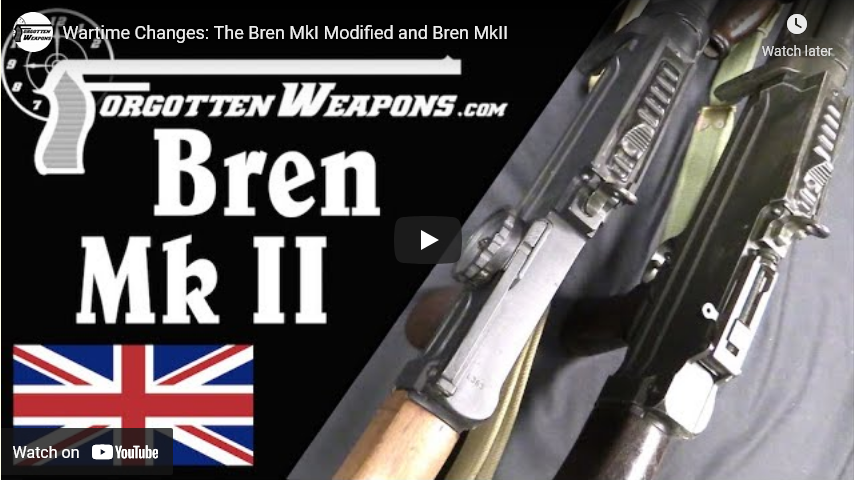
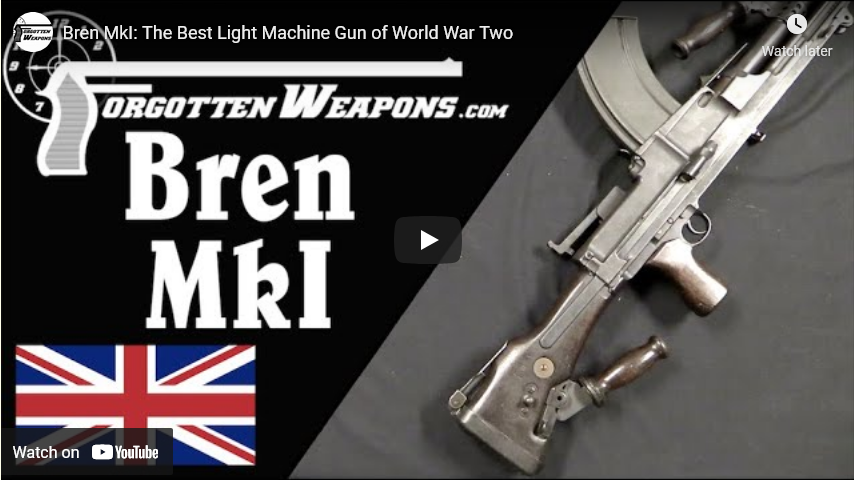
The British lost some 90% of their stock of Bren light machine guns in the disastrous Dunkirk evacuation, and in the following months rushed to rearm. Part of this program was a two-tiered simplification of the Bren design. First was a MkI Modified Bren (which was not marked any differently than the original MkI), and this was followed by a MkII design. These patterns simplified many of the machining operation required to produce the Bren, significantly reducing the number of required machining operations. The most visually distinctive elements of the MkII pattern were the omission of the stainless steel flash hider assembly and the replacement of the original dial rear sight with a simple ladder sight. In addition, changes were made to the buttstock, buttplate, receiver profile, gas block, and bipod. Both Enfield and Inglis would produce the simpler MkII Brens by the middle of the war. Despite the many changes made, the core operating components (bolt, bolt carrier, etc) were left unchanged, so they could still interchange between all patterns of the gun in service.
Contact:
Forgotten Weapons
6281 N. Oracle #36270
Tucson, AZ 85740
Comments Off on Wartime Changes: The Bren MkI Modified and Bren MkII
I have recently collected quite a number of articles online and in the press in favor of brutalism. I did so without having made any special effort, and without finding anything like the same number of countervailing articles against it, albeit that the great mass of the population, in my view rightly, detests brutalism. The penultimate paragraph of one of the recent articles that I have seen in favor of brutalism — the employment of great slabs of concrete in the construction of buildings — goes as follows:
The newly-gained attractivity [of architectural brutalism] is growing by the day. In troubled times where societal divides are stronger than ever around the globe and in a world where instantaneous rhymes with tenuous, brutalism offers a grounded style. It’s a simple, massive and timeless base upon which one can feel safe, it’s reassuring.
It is rather difficult to argue with, let alone refute, the vague propositions of such a paragraph, which nevertheless intends (I imagine) to connote approval and judgment based upon sophisticated, wide, and deep intellectual considerations. But what exactly is a “grounded style” in contrast to a “world where instantaneous rhymes with tenuous”? This is verbiage, if not outright verbigeration, though it might serve to intimidate those with little confidence in their own judgment. The idea that brute concrete could create any kind of security rather than unease or fear is laughable.
When defenders of or apologists for brutalism illustrate their articles with supposed masterpieces of the genre, it is hardly a coincidence that they do so with pictures of buildings utterly devoid of human beings. A human being would be about as out of place in such a picture, and a fortiori in such a building, as he would be in a textbook of Euclidean geometry, and would be as welcome as a termite in a wooden floor or a policeman in a thieves’ kitchen. For such defenders and apologists of brutalism, architecture is a matter of the application of an abstract principle alone, and they see the results through the lenses of their abstraction, which they cherish as others cherish their pet.
Join David Willey as he discusses the T-72, a Soviet era main battle tank which first entered production in 1971. The T-72’s service life has proven to be extremely successful. With about 20,000 produced, it has seen service with over 40 countries, and thanks to refurbishment, is still in service to this very day.
In the years after World War One, the British military wanted a new machine gun, and they wanted it to replace both the Lewis and the Vickers. Through the 1920s the British would tinker with most of the light machine guns that became available, but it was not until the early 1930s that a serious formal trial was conducted. The initial trials found three particularly encouraging guns; the ZB-26, Madsen, and Vickers-Berthier. Over a series of followup testing, the Madsen and Vickers-Berthier were both eliminated, leaving the Czechoslovakian ZB as the final choice.
The British were extremely enthusiastic about the qualities of the ZB, and it is understandable why. The final .303 British version, the Bren, is widely regarded as the best magazine-fed light machine gun ever made. In its final preproduction trial, one of the prototype guns endured a 150,000-round trial without any real problems.
The design was licensed for British production as well as in the Dominions, and would be put into production at both Enfield in England and the John Inglis company in Canada. About 30,000 were produced before the Dunkirk disaster, which would lead to simplification of the design. But those changes are a subject for another video later…
Contact:
Forgotten Weapons
6281 N. Oracle #36270
Tucson, AZ 85740
From the comments:
Jeffrey Holdeman
5 hours ago
Ian- “this video is getting a little long already”
Everyone else- “so what!”
Notable Discomfort
2 hours ago
Ian: “This video is a little long already.”
Everyone: “Baby doll, you take all the time you need, I’m in love with every second you take. Every minute you take to explain this rifle is a minute I get to spend with you and your comforting voice. Don’t never apologize. There’s nothing to be sorry about.
FLIBFLAGGAFLUP
2 hours ago
The sheer amount of Victoria Cross citations that start with “he picked up a Bren gun” is stupendous, like a WW2 cheat code.
Comments Off on Bren MkI: The Best Light Machine Gun of World War Two
Join The Tank Museum’s Historian David Fletcher as he discusses the TV15000, the unique prototype of the FV101 Scorpion armoured reconnaissance vehicle. David examines its development and how it came to be the production Scorpion we know today. (more…)
Comments Off on Tank Chats #109 | Scorpion & TV15000 | The Tank Museum
The fact is, contemporary architecture gives most regular humans the heebie-jeebies. Try telling that to architects and their acolytes, though, and you’ll get an earful about why your feeling is misguided, the product of some embarrassing misconception about architectural principles. One defense, typically, is that these eyesores are, in reality, incredible feats of engineering. After all, “blobitecture” — which, we regret to say, is a real school of contemporary architecture — is created using complicated computer-driven algorithms! You may think the ensuing blob-structure looks like a tentacled turd, or a crumpled kleenex, but that’s because you don’t have an architect’s trained eye.
Another thing you will often hear from design-school types is that contemporary architecture is honest. It doesn’t rely on the forms and usages of the past, and it is not interested in coddling you and your dumb feelings. Wake up, sheeple! Your boss hates you, and your bloodsucking landlord too, and your government fully intends to grind you between its gears. That’s the world we live in! Get used to it! Fans of Brutalism — the blocky-industrial-concrete school of architecture — are quick to emphasize that these buildings tell it like it is, as if this somehow excused the fact that they look, at best, dreary, and, at worst, like the headquarters of some kind of post-apocalyptic totalitarian dictatorship.
Tank Museum Historian David Fletcher discusses the M48 “Patton”, an American first generation Main Battle Tank introduced in 1952. Throughout its service life, the M48 has been very successful and has seen service with many countries including the Americans in Vietnam and the Israel Defense Forces.
Support the work of The Tank Museum on Patreon: ► https://www.patreon.com/tankmuseum
Visit The Tank Museum SHOP & become a Friend: ► tankmuseumshop.org
The British author Douglas Adams had this to say about airports: “Airports are ugly. Some are very ugly. Some attain a degree of ugliness that can only be the result of special effort.” Sadly, this truth is not applicable merely to airports: it can also be said of most contemporary architecture.
Take the Tour Montparnasse, a black, slickly glass-panelled skyscraper, looming over the beautiful Paris cityscape like a giant domino waiting to fall. Parisians hated it so much that the city was subsequently forced to enact an ordinance forbidding any further skyscrapers higher than 36 meters.
Or take Boston’s City Hall Plaza. Downtown Boston is generally an attractive place, with old buildings and a waterfront and a beautiful public garden. But Boston’s City Hall is a hideous concrete edifice of mind-bogglingly inscrutable shape, like an ominous component found left over after you’ve painstakingly assembled a complicated household appliance. In the 1960s, before the first batch of concrete had even dried in the mold, people were already begging preemptively for the damn thing to be torn down. There’s a whole additional complex of equally unpleasant federal buildings attached to the same plaza, designed by Walter Gropius, an architect whose chuckle-inducing surname belies the utter cheerlessness of his designs. The John F. Kennedy Building, for example — featurelessly grim on the outside, infuriatingly unnavigable on the inside — is where, among other things, terrified immigrants attend their deportation hearings, and where traumatized veterans come to apply for benefits. Such an inhospitable building sends a very clear message, which is: the government wants its lowly supplicants to feel confused, alienated, and afraid.
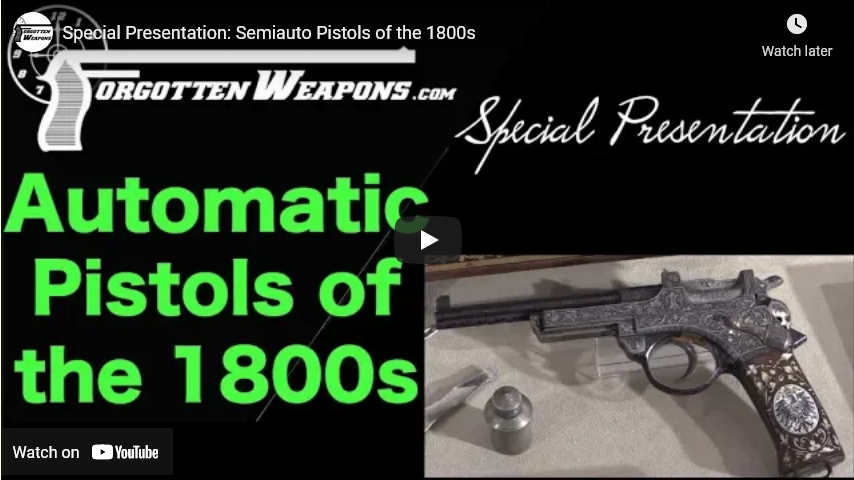
Today’s Special Presentation is an overview of all the semiautomatic pistols that were actually put into serial production before the year 1900. We have looked at these individually before, but I think it is worthwhile to examine them together in context, to gain a better understanding of what the automatic pistol scene was really like in the last years of the 19th century.
If you enjoy Forgotten Weapons, check out its sister channel, InRangeTV! http://www.youtube.com/InRangeTVShow
Contact:
Forgotten Weapons
6281 N Oracle #36270
Tucson, AZ 85704
From the comments:
Joseph Heschmeyer
2 years ago (edited)
“Hi guys, thanks for tuning in for another video on ForgottenWeapons.com. Today we’ll be looking at the science fair project that got me kicked out of middle school.”
Comments Off on Special Presentation: Semiauto Pistols of the 1800s