
The Tank Museum
Published 20 Aug 2021David Fletcher is back with another Tank Chat on one of the most successful post-war tank designs, Centurion. It was the primary British Army main battle tank of the post-World War II period.
(more…)
December 1, 2021
Tank Chats #134 | Centurion | The Tank Museum
Comments Off on Tank Chats #134 | Centurion | The Tank Museum
November 27, 2021
Armored Vehicles of Operation Torch Pt. 2: America and Britain (and France) – by the Chieftain
World War Two
Published 26 Nov 2021Part two of Chieftain’s return to the North African campaign. Here he looks at the armored fighting vehicles of the British and Americans with a small bit on the French as well. We see the introduction of the iconic Sherman and the varied fortunes of British designs.
(more…)
Comments Off on Armored Vehicles of Operation Torch Pt. 2: America and Britain (and France) – by the Chieftain
November 21, 2021
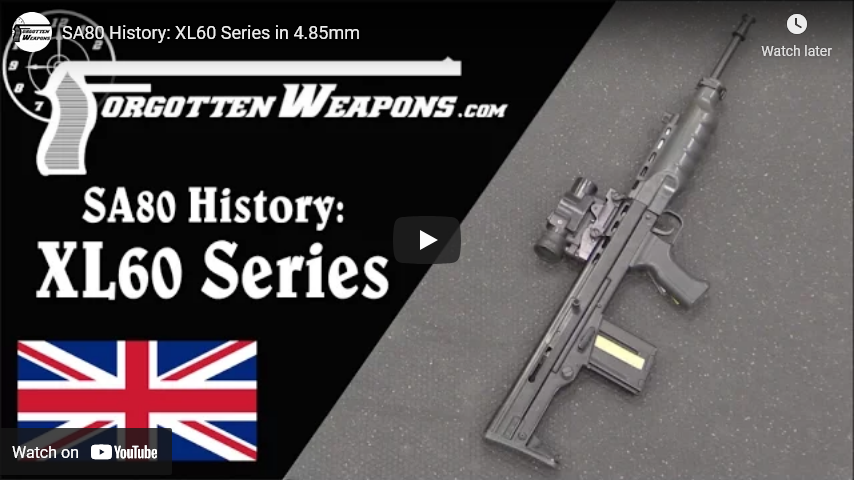
SA80 History: XL60 Series in 4.85mm
Forgotten Weapons
Published 10 May 2017Armament Research Services (ARES) is a specialist technical intelligence consultancy, offering expertise and analysis to a range of government and non-government entities in the arms and munitions field. For detailed photos of the guns in this video, don’t miss the ARES companion blog post:
http://armamentresearch.com/british-e…
Once the basic configuration of the new British rifle was determined, the next step was to build a series of prototypes. The design that took form was basically a bullpup copy of the Armalite AR-18. The design team at Enfield were mostly senior draftsmen, with virtually no firearms experience among them. To make things worse, most of the design team was regularly rotated onto other projects, preventing them from developing any project experience on the rifle.
Several prototype batches were made (typically of a dozen guns each, both IWs and LSWs), all in the unique British 4.85x49mm cartridge, with a variety of different feature sets. Through the different patterns, configurations would change on the safety (push button vs lever) fire selector (push button vs lever), and magazine catch (straight-in side lever vs rock-in side lever vs rock-in rear paddle). At this time, plans still existed to make both left- and right-handed versions of the final gun, so prototypes of both were manufactured.
Because cost-cutting measures had not yet been forced on the project, these XL-60 series guns were generally reliable, at least in normal conditions. They are quite comfortable to fire, with a cartridge very similar to the 5.56mm NATO in practical terms. There is nothing particularly wrong with that cartridge, but it would be dropped when it lost NATO trials to the Belgian SS109 … but we will address that in the next episode of the SA80 history.
http://www.patreon.com/ForgottenWeapons
Cool Forgotten Weapons merch! http://shop.bbtv.com/collections/forg…
If you enjoy Forgotten Weapons, check out its sister channel, InRangeTV! http://www.youtube.com/InRangeTVShow
Comments Off on SA80 History: XL60 Series in 4.85mm
November 18, 2021
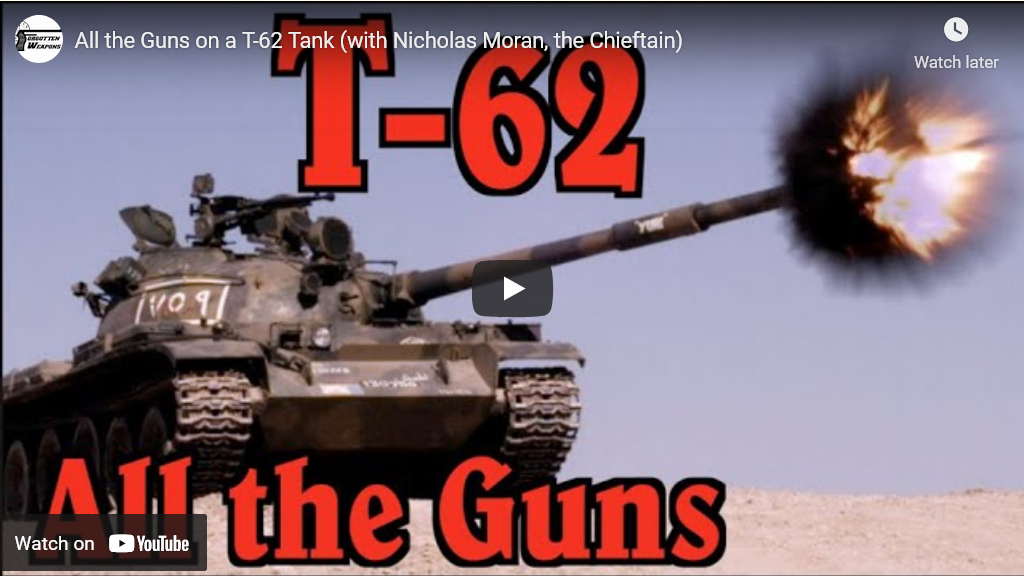
All the Guns on a T-62 Tank (with Nicholas Moran, the Chieftain)
Forgotten Weapons
Published 5 Aug 2021Try out World of Tanks with a special bonus tank using this link!
Today Nicholas Moran (the Chieftain) and I are at Battlefield Vegas courtesy of Wargaming.net, to show you around a Soviet T-62 and all its various armaments. This particular T-62 was built in 1971 or 1972 and initially sold to Syria. It saw combat in the Valley of Tears in 1973, but survived as was eventually transferred to Lebanese ownership. From there is was captured by Israel and eventually imported into the United States via the UK. The T-62 was the last of the “simple” WW2-style Soviet tanks, and equipped with an extremely effective 115mm smoothbore main gun. In addition to that cannon, we will discuss and shoot the coaxial PKT machine gun and the loader’s antiaircraft DShKM heavy machine gun.
If you enjoy this video, check out World of Tanks – and maybe they will send Nicholas and I back again to do the same thing yet again on a third tank!
For videos on the detail of tanks like this one, check out The Chieftain:
https://www.youtube.com/user/WorldOfT…
https://www.youtube.com/channel/UCp4j…0:00:00 – Introduction
0:06:02 – Coaxial PKT
0:13:12 – Antiaircraft DShKM
0:20:25 – 115mm Main Gun
0:28:43 – Firing the main gunContact:
Forgotten Weapons
6281 N. Oracle 36270
Tucson, AZ 85740
Comments Off on All the Guns on a T-62 Tank (with Nicholas Moran, the Chieftain)
November 12, 2021
Britain’s Highly Unusual Crescent-Wing Victor Bomber
Dark Skies
Published 2 Nov 2021The V force was a legendary team of bombers built to serve during the post-war crisis. However, they would not carry ordinary bombs, but nuclear weapons.
As World War II ended, the division between the West and the East became a significant threat to world peace, and shortly before the Cold War began, Britain started working on a modern jet bomber force that could rival any other on the planet.
The Handley Page Victor featured a one-of-kind wing, making it the largest aircraft to break the sound barrier up to that point.
As the British mastered the atomic bomb by the mid-1950s with the exceptional V force and the Victor to deliver it, Britain’s stature among the world’s superpowers significantly solidified.
—
Join Dark Skies as we explore the world of aviation with cinematic short documentaries featuring the biggest and fastest airplanes ever built, top-secret military projects, and classified missions with hidden untold true stories. Including US, German, and Soviet warplanes, along with aircraft developments that took place during World War I, World War 2, the Korean War, the Vietnam War, the Cold War, the Gulf War, and special operations missions in between.
As images and footage of actual events are not always available, Dark Skies sometimes utilizes similar historical images and footage for dramatic effect and soundtracks for emotional impact. We do our best to keep it as visually accurate as possible.
All content on Dark Skies is researched, produced, and presented in historical context for educational purposes. We are history enthusiasts and are not always experts in some areas, so please don’t hesitate to reach out to us with corrections, additional information, or new ideas.

Comments Off on Britain’s Highly Unusual Crescent-Wing Victor Bomber
November 9, 2021
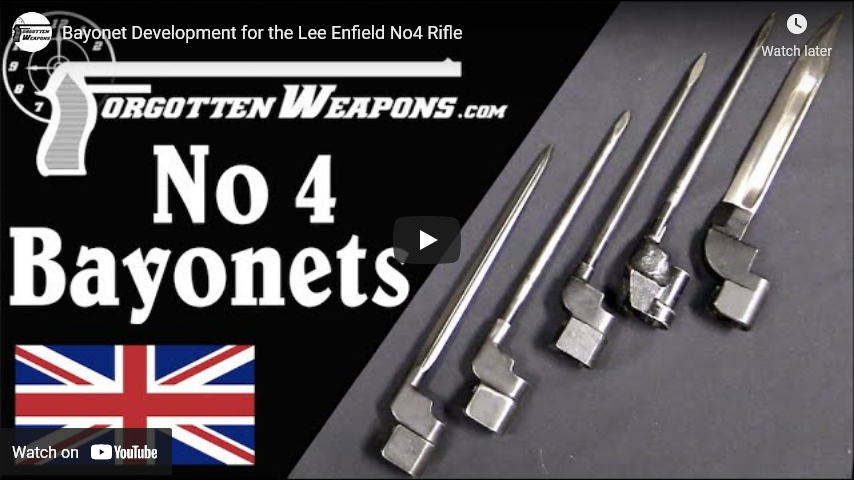
Bayonet Development for the Lee Enfield No4 Rifle
Forgotten Weapons
Published 22 Jul 2021http://www.patreon.com/ForgottenWeapons
https://www.floatplane.com/channel/Fo…
Cool Forgotten Weapons merch! http://shop.forgottenweapons.com
Having wrapped up our series on the major development of the Lee Enfield rifle in British service, I figured it would be a nice addendum to talk about the bayonets developed for the No4 rifle. These went through a substantial evolution, and are an interesting field for collectors all by themselves.
During World War One, the British used the Pattern 1907 bayonet, a long blade type essentially copied from the Japanese Type 30. By the 1920s, this was being reconsidered – the long blades were expensive, fragile, and perhaps not really necessary. When the No1 Mk VI rifle was put into trials, it was given a new bayonet style. This was inspired by the Swiss cyclists’ bayonet, with a cruciform spike instead of a true blade. It was only 8 inches long; this was determined to be long enough for virtually all use cases and being short minimized weight and bulk.
As World War Two progressed, the spike bayonet was simplified several times. Before the initial production of the first standard model (No4 MkI) was completed, the cruciform pattens had already been abandoned for a much simpler (and faster and cheaper) round body spike with a screwdriver-like point at the end. This was in turn simplified by separating the socket and spike into two parts for easier production, and then further simplified by casting the socket instead of forging it. After the war, the spike was replaced by a short blade-type socket bayonet (the No9), although this was rather short-lived because of the adoption of the SLR (FN FAL).
Contact:
Forgotten Weapons
6281 N. Oracle 36270
Tucson, AZ 85740
Comments Off on Bayonet Development for the Lee Enfield No4 Rifle
October 28, 2021
Tank Chats #130 | Ikv 91 | The Tank Museum
The Tank Museum
Published 18 Jun 2021Curator David Willey discusses the Cold War era Swedish Ikv 91. Short for Infanterikanonvagn 91, this tank destroyer was developed to meet the operational requirements of the Swedish Army post-WW2.
(more…)
Comments Off on Tank Chats #130 | Ikv 91 | The Tank Museum
October 25, 2021
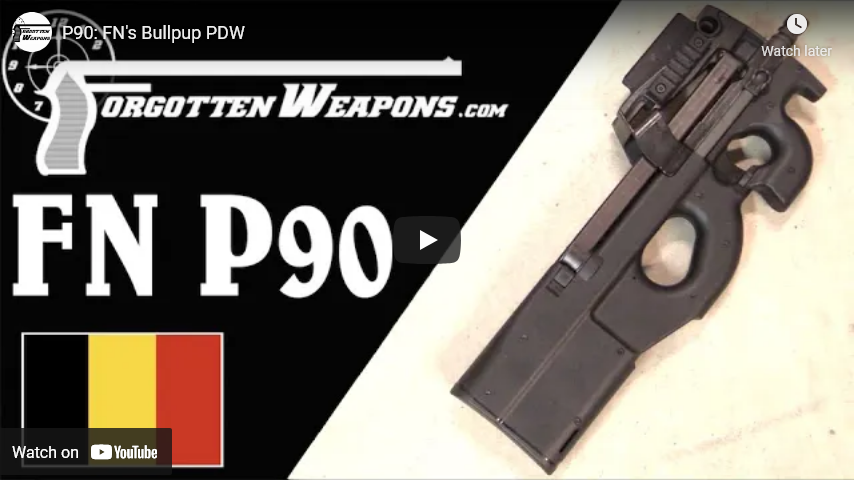
P90: FN’s Bullpup PDW
Forgotten Weapons
Published 2 Jul 2021http://www.patreon.com/ForgottenWeapons
https://www.floatplane.com/channel/Fo…
Cool Forgotten Weapons merch! http://shop.forgottenweapons.com
FN began developing the P90 in the late 1980s, actually preceding the NATO requirement that it would eventually compete for. The idea of the P90 was to develop a weapon for secondary troops to replace 9mm pistols and SMGs. There was an anticipated threat of Russian paratroops wearing armor that could defeat 9mm ball. The P90 was intended to be a light and handy weapon that was easily controllable without a tremendous about of training, and could defeat that sort of body armor.
The result was the 5.7x28mm cartridge, firing a 31 grain armor-piercing bullet at 2350 fps. This was combined with a simple blowback action and a Hall-style 50-round magazine in a fully ambidextrous, bullpup layout. The gun was introduced onto the market in 1990, and has been widely purchased by security and special operations organizations. In its original intended role for support troops, it has only been adopted by Belgium.
Contact:
Forgotten Weapons
6281 N. Oracle 36270
Tucson, AZ 85740
October 22, 2021
The Vehicle That Will Win World War Two – WW2 Special
World War Two
Published 21 Oct 2021The Higgins Landing Craft, Higgins Boat, Landing Craft, or whatever you would like to call it, is one of the most important vehicles of the Second World War — perhaps just as much as tanks, planes, and warships. In a war full of amphibious invasions, landing on beaches in a safer and more efficient way is crucial to victory. So let’s find out the history of this war machine and its use by the World War Two allies.
(more…)
Comments Off on The Vehicle That Will Win World War Two – WW2 Special
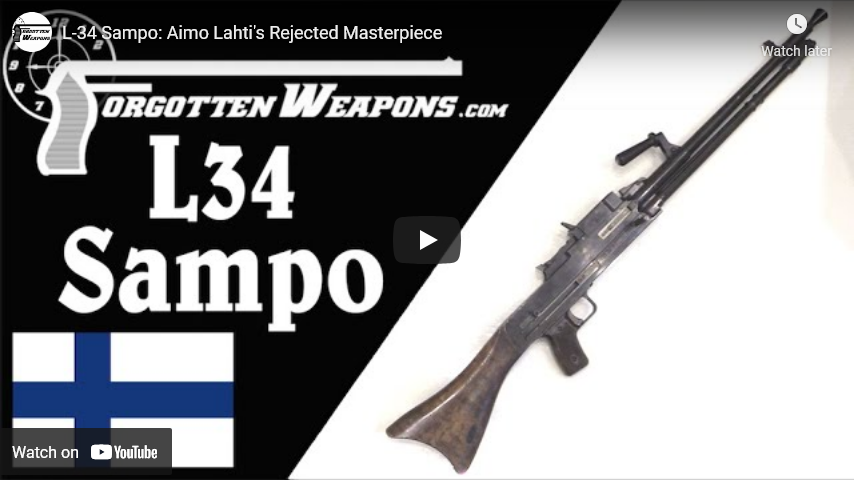
L-34 Sampo: Aimo Lahti’s Rejected Masterpiece
Forgotten Weapons
Published 30 Jun 2021http://www.patreon.com/ForgottenWeapons
https://www.floatplane.com/channel/Fo…
Cool Forgotten Weapons merch! http://shop.forgottenweapons.com
Finland’s standard light machine gun going into the Winter War was the LS-26, a gun which did not succeed in field use. It was complex and cumbersome, and Finnish troops quickly replaced it with captured Russian DP-27 LMGs. Part of the problem of the LS-26 was its recoil-operated design. Finnish military authorities specified a recoil-operated mechanism for their LMG in light of the success of the recoil-operated heavy Maxim guns in Finnish service. Gas operation was quickly recognized as a superior system for light machine guns, but too late to stop adoption of the LS-26.
In the early 1930s, Aimo Lahti did design a gas-operated LMG, heavily influenced by the Czech ZB-26 system. A handful of prototypes were made by VKT, looking for both Finnish military acceptance and international sales. The gun was made in several calibers, most notably 7.62x54R for Finland and 7.92x57mm Mauser for export. However, bureaucratic issues prevented its consideration by the Finnish Army, and the timing was too late for exports. The L-34 was significantly lighter and simpler than the LS-26, and it was performed quite well in Finnish trials — which did not happen until the 1950s. By that time, the Finnish military was looking for an intermediate-caliber belt-fed gun, and the L-34 was not suitable regardless of its performance.
Many thanks to Sako for providing me access to film this L-34 from their reference collection!
Contact:
Forgotten Weapons
6281 N. Oracle 36270
Tucson, AZ 85740
Comments Off on L-34 Sampo: Aimo Lahti’s Rejected Masterpiece
October 19, 2021
Places – Lost in Time: The Crystal Palace
Ruairidh MacVeigh
Published 1 Jun 2020This is a reupload of my original Crystal Palace video, which I had to take down and do some amendments to in order to fix some technical issues.
Hello! 😀
Not to change the format so early in it’s conception, but here I present an idea I’ve had for several years now, but am proud to finally bring to fruition.
For as long as I can remember I have been fascinated by places that have either been abandoned or destroyed, not so much out of interest for how they were lost, but more the microcosm of society that revolved around them — how people interacted with them and made them more human. Specifically, places which existed in living memory or photographic record are the ones that have captured my imagination the most, as you can see how people did interact with these wondrous locations and almost put yourself in their shoes.
Therefore, without further ado, I present Episode 1 of Places — Lost in Time, with my first feature being the lavish and opulent Crystal Palace in London. This video follows the history of the two structures to share this iconic name, and how both were created through Victorian engineering feats, how they became icons of British culture, and how they eventually met their end.
All video content and images in this production have been provided with permission wherever possible. While I endeavour to ensure that all accreditations properly name the original creator, some of my sources do not list them as they are usually provided by other, unrelated YouTubers. Therefore, if I have mistakenly put the accreditation of “Unknown”, and you are aware of the original creator, please send me a personal message at my Gmail (this is more effective than comments as I am often unable to read all of them): rorymacveigh@gmail.com
The views and opinions expressed in this video are my personal appraisal and are not the views and opinions of any of these individuals or bodies who have kindly supplied me with footage and images.
If you enjoyed this video, why not leave a like, and consider subscribing for more great content coming soon.
Thanks again, everyone, and enjoy! 😀
References:
– British Library (and their respective references)
– Victoria and Albert Museum (and their respective references)
– Wikipedia (and its respective references)Music – YouTube Audio Library

Comments Off on Places – Lost in Time: The Crystal Palace
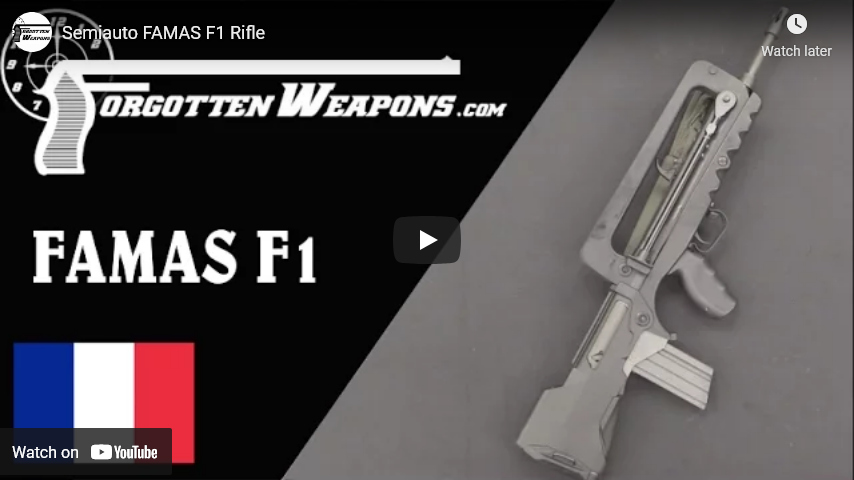
Semiauto FAMAS F1 Rifle
Forgotten Weapons
Published 9 Aug 2016http://www.patreon.com/ForgottenWeapons
The French FAMAS was one of the first bullpup rifles to be adopted and built in large numbers by a military power. It was adopted by France in 1978 at right about the same time as the Steyr AUG was being adopted by the Austrian military. Bullpup rifles offered a short overall length without sacrificing barrel length, an advantage that seemed quite valuable for troops who were to spend significant amounts of time in vehicles, where space is at a premium. In French service, the FAMAS was also made the formal replacement for both the MAS-49/56 rifle and the MAT-49 submachine gun, thanks to its compact nature.
The FAMAS is interesting mechanically, as it is one of very few production delayed-blowback rifle designs (the other common one being the CETME/HK series). The FAMAS uses a lever-delaying system, which allows a very simple bolt and action mechanism. The F1 model (adopted by the French Army and still in use today, making up the bulk of FAMAS production) has a 1:12″ twist to its rifling, effectively limiting it to 55 grain projectiles — and it also requires steel-cased ammunition to run reliably. The G2 variant (adopted in 1995 by the French Navy) changed to a 1:9″ twist, introduced a full-hand trigger guard, and also uses NATO standard AR15 magazines instead of the proprietary 25-round magazine of the F1.
In the late 1980s a small number of semiauto FAMAS rifles were made by St Etienne and imported into the US by Century. Most people say 100-125 rifles, although serial number suggest this may have actually been 225-250 rifles. Regardless, they are quite scarce and expensive today.
Comments Off on Semiauto FAMAS F1 Rifle
October 14, 2021
Tank Chats #128 | Panzer 61 | The Tank Museum
The Tank Museum
Published 4 Jun 2021Curator David Willey examines one of Switzerland’s first indigenously designed and produced tanks, the Panzer 61, put into service during the Cold War.
(more…)
Comments Off on Tank Chats #128 | Panzer 61 | The Tank Museum
October 10, 2021
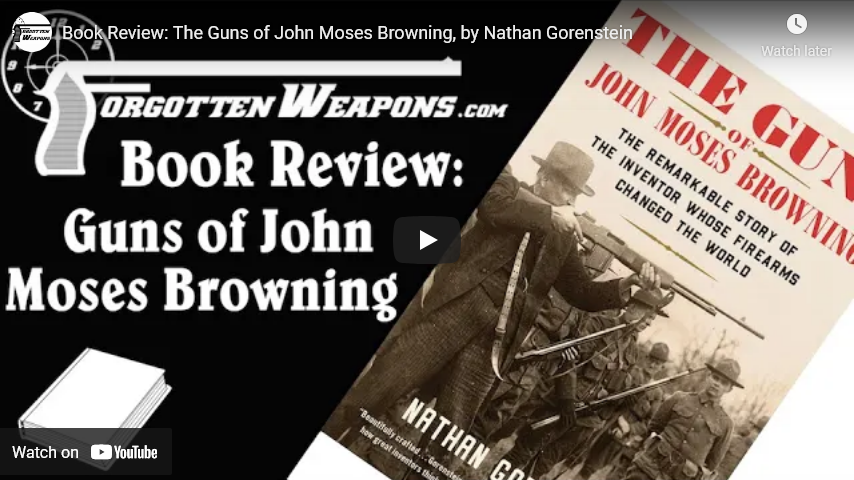
Book Review: The Guns of John Moses Browning, by Nathan Gorenstein
Forgotten Weapons
Published 24 Jun 2021http://www.patreon.com/ForgottenWeapons
https://www.floatplane.com/channel/Fo…
Cool Forgotten Weapons merch! http://shop.forgottenweapons.com
John Moses Browning is, without argument, the greatest firearms designer in history. While we have had many brilliant designers who had their names forever connected to guns (Maxim, Luger, Kalashnikov, …), Browning invented whole *categories* of firearms. Gorenstein’s new book The Guns of John Moses Browning is a welcome biography of the man, giving great insight into Browning’s life and work. The book is well researched, well written, and thoroughly engaging. It is also worth noting that Gorenstein is himself a competitive shooter, and understands the world that Browning operated in.
I think my back-cover blurb for the book (for which I received no compensation; full disclosure) sums it up well:
Following Browning from his birth in rural Utah to his death in urban Belgium, we see how a changing world shaped his inventions and how, in turn, his inventions shaped a changing world.
Browning began in the last years of the Wild West inventing lever action rifles, then became a major part of the blossoming of the automatic pistol, then invented the semiauto shotgun before designing the modern machine guns that become iconic to the United States’ involvement in two world wars. It is a tremendous story, and Gorenstein’s book lays it all out for the reader.
Available from Amazon here:
https://amzn.to/355eMxeContact:
Forgotten Weapons
6281 N. Oracle 36270
Tucson, AZ 85740
Comments Off on Book Review: The Guns of John Moses Browning, by Nathan Gorenstein
October 7, 2021
Tank Chats #127 | Thornycroft Bison Concrete Armoured Lorry | The Tank Museum
The Tank Museum
Published 28 May 2021David Fletcher looks at the eccentric Thornycroft Bison, a concrete armoured lorry, created by the British to defend airfields in the early years of the Second World War.
(more…)
Comments Off on Tank Chats #127 | Thornycroft Bison Concrete Armoured Lorry | The Tank Museum


