Quotulatiousness

October 26, 2009

An alternative spending plan for Britain’s MoD

Filed under: Britain, Economics, Military — Tags: , , , , — Nicholas @ 12:16

Lewis Page looks at the Ministry of Defence and comes up with innovative ways to both save money and increase military capabilities:

Under the plan as laid out in the Times, the Ministry of Defence would still buy the two planned new carriers, to be dubbed HMS Queen Elizabeth and Prince of Wales. However the Prince of Wales would not be operated as a strike carrier with a force of jets; instead she would be a “commando carrier”, a floating forward-mounting airbase full of marines, helicopters and drones. This would mean no need to replace HMS Ocean, the navy’s current helicopters’n’marines ship — which would, according to the Thunderer, cost £600m in the 20-teens. (That seems pretty steep as Ocean herself only cost £150m in the mid ’90s).

This is the same story I linked to yesterday, although I said I suspected that the MoD had probably decided that their best plan was to scrap the carriers altogether. Part of the problem is that the Royal Navy can’t depend on the Royal Air Force to join with them in the larger purchase of aircraft:

It has long been known that the RAF doesn’t want to replace its own Harrier force — it would rather spend that money upgrading as many of its Eurofighter Typhoons as it can. The horrifyingly expensive Typhoon was designed as a pure air-to-air fighter, and at the moment it mostly still is — though a few RAF ones have been given an “austere” bombing capability.

The RAF would like to rebuild and re-equip as many of its largely irrelevant Typhoons as possible, giving them such things as trendy electronically-scanned radars and air-launched cruise missiles of various sorts. This would, perhaps, enable the Typhoon force to tackle tough enemy air-defence networks of the sort possessed by nations such as Iran and Russia.

There’s another over-priced item on the MoD budget that could be cut without seriously impacting military capabilities:

But there are many better ways to cut money from the MoD than crippling our new carrier force. To give just one example, our new fleet of refurbished De Havilland Comet subhunters (sorry, “Nimrod MRA4s”) will cost at least £700m a year to operate. If we put the whole Nimrod force on the scrapheap for which they are so long overdue right now, by the year 2019 we will have saved the £7bn needed to buy the missing eighty-odd JSFs for our second carrier — and the Prince of Wales isn’t actually going to be afloat much before then, so that’s not a problem.

[. . .]

There are many, many other such stories. We could buy cheap Sky Warrior auto-drones off the shelf rather than expensive Watchkeepers. We could equip the carriers properly and so buy cheaper F-35 C tailhook planes rather than pricey B-model jumpjets — this would save money straight off, and save a fortune on the vital carrier radar planes. Indeed, we could buy much cheaper Super Hornets to begin with, if we wanted to save a lot of cash. We could bin the expensive, feeble A400M transport and buy nice cheap C-17s instead. Rather than upgrading squadrons of Eurofighters into superbombers at a cost of billions we could buy a force of vastly more cost-effective turboprop strike planes to back our troops in Afghanistan. The list goes on.

I rather agree about the A400M . . . although Britain isn’t paying as much as South Africa for their planes.

Related: Strategy Page looks at the costs involved in refitting current USN aircraft carriers, and in designing and building the next generation of CVNs.

October 25, 2009

Royal Navy carrier plans: going, going . . .

Filed under: Britain, Military — Tags: , , — Nicholas @ 20:34

A report in The Guardian walks a bit further down the road to the increasingly likely end of aircraft carrier operations in the Royal Navy:

Defence chiefs are considering scrapping plans to have two large aircraft carriers equipped with fast jets, a move that could save billions of pounds, Whitehall officials said today.

The idea would be to have just one carrier holding US-made joint strike fighters, with the second, more basic, ship, being used only as a platform for helicopters and possibly unmanned drones equipped with missiles and cameras.

The two proposed carriers, the Queen Elizabeth, due to go into service in 2016, and the Prince of Wales, to follow in 2018, are already running £1bn over budget. The original estimated cost was £3.9bn.

Consideration is being given to cutting the number of joint strike fighters to be flown from the carriers, from 138 to about 50, saving more than £7bn.

The head of the Royal Navy last month conceded that the decision to build two large aircraft carriers could be overturned. Admiral Sir Mark Stanhope said that though contracts had been signed to build the carriers, next year’s defence review could cause those plans to change.

Personally, I suspect that the final decision to cancel the carriers has already been taken, the government is just waiting for an opportune moment to make the announcement. Given that the rest of the fleet has been shrinking for years, eliminating the two carriers would allow the government to “save” an even-more-reduced Royal Navy from further cuts . . . until next budget period.

August 6, 2009

More threats to Royal Navy’s carrier plans

Filed under: Britain, Military — Tags: , , , , — Nicholas @ 12:03

An interesting report in The Register discussing the possibility of abandoning the planned STOVL variant of the F-35 and switching to the more traditional catapult-launch and tailhook-landing variant being developed for the US Navy:

The UK Ministry of Defence (MoD) is set to make a major change to the design of the new aircraft carriers for the Royal Navy, according to a newspaper report. It’s suggested that the ships will now be equipped with catapults and arrester wires, allowing them to operate normal carrier aircraft rather than the complex, expensive jump-jets which had been planned.

According to the Daily Telegraph today “the MoD has indicated that it will drop the jump-jet… The Daily Telegraph has learnt from senior defence officials that an announcement is due this autumn.”

There would definitely be advantages to going with a more traditional aircraft: less mechanical complexity, greater weapons-carrying capability, and (probably most important in the MoD) lower per-aircraft costs. It’s not a slam-dunk decision, however:

Catapults and arrester gear aren’t a significant expense in themselves, but current catapults are powered by steam from the ship’s engines. The planned new Royal Navy ships will be propelled by gas turbines, however, and so have no steam (US and French carriers use nuclear propulsion, which can easily furnish steam from their associated turbines).

Adding powerful auxiliary steam boilers for catapults or upgrading the ships to nuclear propulsion would significantly increase their cost. There is an alternative option, the use of electrically-powered catapults, but these don’t yet exist. They are being developed in the States for the next US carrier, but as a new technology there is naturally some risk that they won’t pan out, or may be subject to delays and cost increases.

Of course, there’s always the risk that the MoD, under pressure from the government of the day would cancel the ships altogether, as a cost-saving measure (see this post from last year for further grim speculation on that topic).

July 29, 2009

Another lost WW2 combat aircraft discovered

Filed under: History, Military — Tags: , , , — Nicholas @ 20:28

This time it’s a US Navy carrier plane:

On May 28, 1945, the SB2C-4 Helldiver was on a practice bombing run from a nearby aircraft carrier. The crew members survived the emergency landing.

At the time, the Navy opted not to recover the plane.

Yesterday, Raia said she couldn’t comment on how long it will take Navy officials to decide whether to salvage the plane. Typically, the Naval Aviation Museum in Pensacola, Fla., plays a major role in the evaluation process.

One of the pilots is believed to be 90 years old and living in Michigan, but the Navy hasn’t provided his name.

“Wouldn’t that be something to fly him out here and have him standing on the shoreline when they lift the plane out?” Manville said.

That’d be cool . . . as long as they don’t make him pay for the recovery of the plane.

July 24, 2009

Photo tour of the USS Hornet

Filed under: History, Military — Tags: , , , , — Nicholas @ 10:06

I’ve been onboard several retired battleships, but so far I’ve not managed to get onto an aircraft carrier. This will have to do for the time being:

The USS Hornet was on hand 40 years ago to pick up the Apollo 11 astronauts after their Columbia Command Module splashed down in the Pacific Ocean on July 24, 1969.

Today, the aircraft carrier is preserved as a museum in Alameda, California. Its main deck is littered with historic warplanes and space artifacts including an Apollo command module and Mobile Quarantine Facility from subsequent missions, pictured below. The first footsteps the Apollo 11 crew took on Earth after walking on the moon are traced on the deck.

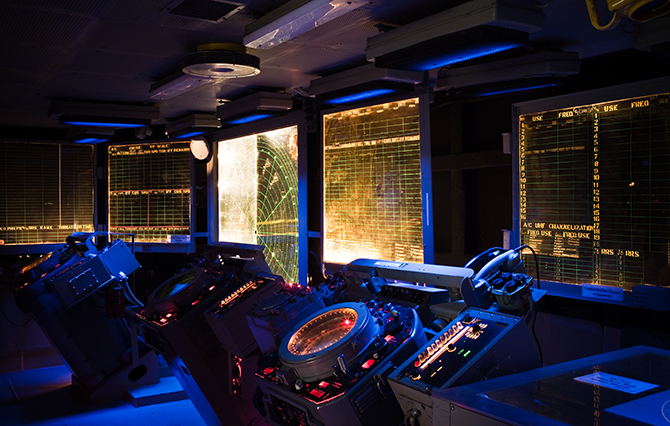
USS Hornet CIC

USS Hornet CIC

Above: The USS Hornet’s Crisis Information Center is pictured. While engaged in active warfare, crewmembers would stand behind transparent, hanging boards and write information backwards to keep from getting in the way of the officers who needed to read it.

I think it was actually the “Combat” Information Center, but I could be mistaken. Lots of cool images, but I’d like to see more . . .

« Newer Posts

Powered by WordPress