
Longtime readers will remember that we’ve actually already talked about “realism” as a school of international relations study before, in the context of our discussion of Europa Universalis. But let’s briefly start out with what we mean when we say IR realism (properly “neo-realism” in its modern form): this is not simply being “realistic” about international politics. “Realism” is amazing branding, but “realists” are not simply claiming that they are observing reality – they have a broader claim about how reality works.
Instead realism is the view that international politics is fundamentally structured by the fact that states seek to maximize their power, act more or less rationally to do so, and are unrestrained by customs or international law. Thus the classic Thucydidean formulation in its most simple terms, “the strong do what they will, the weak suffer what they must”,1 with the additional proviso that, this being the case, all states seek to be as strong as possible.
If you accept those premises, you can chart a fairly consistent analytical vision of interstate activity basically from first principles, describing all sorts of behavior – balancing, coercion, hegemony and so on – that ought to occur in such systems and which does occur in the real world. Naturally, theory being what it is, neo-realist theory (which is what we call the modern post-1979 version of this thinking) is split into its own sub-schools based on exactly how they imagine this all works out, with defensive realism (“states aim to survive”) and offensive realism (“states aim to maximize power”), but we needn’t get into the details.
So when someone says they are a “foreign policy realist”, assuming they know what they’re talking about, they’re not saying they have a realistic vision of international politics, but that they instead believe that the actions of states are governed mostly by the pursuit of power and security, which they pursue mostly rationally, without moral, customary or legal constraint. This is, I must stress, not the only theory of the case (and we’ll get into some limits in a second).
The first problem with IR Realists is that they run into a contradiction between realism as an analytical tool and realism as a set of normative behaviors. Put another way, IR realism runs the risk of conflating “states generally act this way”, with “states should generally act this way”. You can see that specific contradiction manifested grotesquely in John Mearsheimer’s career as of late, where his principle argument is that because a realist perspective suggests that Russia would attack Ukraine that Russia was right to do so and therefore, somehow, the United States should not contest this (despite it being in the United States’ power-maximizing interest to do so). Note the jump from the analytical statement (“Russia was always likely to do this”) to the normative statement (“Russia carries no guilt, this is NATO’s fault, we should not stop this”). The former, of course, can always be true without the latter being necessary.
I should note, this sort of “normative smuggling” in realism is not remotely new: it is exactly how the very first instances of realist political thought are framed. The first expressions of IR realism are in Thucydides, where the Athenians – first at Corinth and then at Melos – make realist arguments expressly to get other states to do something, namely to acquiesce to Athenian Empire. The arguments in both cases are explicitly normative, that Athens did not act “contrary to the common practice of mankind” (expressed in realist dog-eat-dog terms) and so in the first case shouldn’t be punished with war by Sparta and in the latter case, that the Melians should submit to Athenian rule. In both cases, the Athenians are smuggling in a normative statement about what a state should do (in the former case, seemingly against interest!) into a description of what states supposedly always do.
I should note that one of my persistent complaints against international relations study in political science in general is that political scientists often read Thucydides very shallowly, dipping in for the theory and out for the rest. But Thucydides’ reader would not have missed that it is always the Athenians who make the realist arguments and they lost both the arguments [AND] the war. When Thucydides has the Melians caution that the Athenians’ “realist” ruthlessness would mean “your fall would be a signal for the heaviest vengeance and an example for the world to meditate upon”2 the ancient Greek reader knows they are right, in a way that it often seems to me political science students seem to miss.
And there’s a logical contradiction inherent in this sort of normative smuggling, which is that the smuggling is even necessary at all. After all, if states are mostly rational and largely pursue their own interests, loudly insisting that they should do so seems a bit pointless, doesn’t it? Using realism as a way to describe the world or to predict the actions of other states is consistent with the logical system, but using it to persuade other states – or your own state – seems to defeat the purpose. If you believe realism is true, your state and every other is going to act to maximize its power, regardless of what you do or say. If they can do otherwise than there must be some significant space for institutions, customs, morals, norms or simple mistakes and suddenly the air-tight logical framework of realism begins to break down.
That latter vision gives rise to constructivism (“international relations are shaped by ideology and culture”) and IR liberalism (“international relations are also shaped by institutions, which can bend the system away from the endless conflict realism anticipates”). The great irony of realism is that to think that having more realists in power would cause a country to behave in a more realist way is inconsistent with neo-Realism which would suggest countries ought to behave in realist ways even in the absence of realist theory or thinkers.
In practice – and this is the punchline – in my experience most “realists”, intentionally or not, use realism as a cover for strong ideological convictions, typically convictions which are uncomfortable to utter in the highly educated spaces that foreign policy chatter tends to happen. Sometimes those convictions are fairly benign – it is not an accident that there’s a vocal subset of IR-realists with ties to the CATO Institute, for instance. They’re libertarians who think the foreign policy adventures that often flew under the banner of constructivist or liberal internationalist label – that’s where you’d find “spreading democracy will make the world more peaceful” – were really expensive and they really dislike taxes. But “we should just spend a lot less on foreign policy” is a tough sell in the foreign policy space; realism can provide a more intellectually sophisticated gloss to the idea. Sometimes those convictions are less benign; one can’t help but notice the realist pretensions of some figures in the orbit of the current administration have a whiff of authoritarianism or ethnocentrism in them, since a realist framework can be used to drain imperial exploitation and butchery of its moral component, rendering it “just states maximizing their power – and better to be exploiter than exploited”.
One question I find useful to ask of any foreign policy framework, but especially of self-claimed realist frameworks is, “what compromise, what tradeoff does this demand of you?” Strategy, after all, is the art of priorities and that means accepting some things you want are lower priority; in the case of realism which holds that states seek to maximize power, it may mean assigning a high priority to things you do not want the state to do at all but which maximize its power. A realism deserving of the name, in applied practice would be endlessly caveated: “I hate, this but …” “I don’t like this, but …” “I would want to do this, but …” If a neo-realist analysis leads only to comfortable conclusions that someone and their priorities were right everywhere all along, it is simply ideology, wearing realism as a mask. And that is, to be frank, the most common form, as far as I can tell.
That isn’t to say there is nothing to neo-realism or foreign policy realists. I think as an analytical and predict tool, realism is quite valuable. States very often do behave in the way realist theory would suggest they ought, they just don’t always do so and it turns out norms and expectations matter a lot. Not the least of which because, as we’ve noted before, the economic model on which realist and neo-realist thinking was predicted basically no longer exists. To return to the current Ukraine War: is Putin really behaving rationally in a power-maximizing mode by putting his army to the torch capturing burned out Ukrainian farmland one centimeter at a time and no faster? It sure seems like Russian power has been reduced rather than enhanced by this move, even though realists will insist that Russia’s effort to dominate states near it is rational power-maximizing under offensive realism.
Bret Devereaux, “Fireside Friday, June 27, 2025 (On the Limits of Realism)”, A Collection of Unmitigated Pedantry, 2025-06-27.
- Thuc. 5.89.
- Thuc. 5.90.
January 11, 2026
QotD: The limits of foreign policy realism
January 5, 2026
QotD: Nitpicking the opening battle in Gladiator (2000)
The iconic opening battle, set in the Marcomannic Wars (166-180) during the reign of Marcus Aurelius (r. 161-180) dominates the pop-cultural reference points for the Roman army in battle and you can see its heavy influence in things like how the Total War series presents Roman armies (particularly in trailers and other promotional material). Students and enthusiasts alike will often cite this sequence as the thing which sparked their interest in the Roman army. It is hard to overstate how pervasive its influence is in the public imagination of what the Roman army, particularly of the imperial period, was like, especially as its style is imitated by later pop culture works.
Which is why it is so unfortunate that it is such a deceptive historical mess. This sequence in particular is a banner example of what I’ve termed elsewhere the “perils of historical verisimilitude“, the habit of historically based popular-culture works including what we might think of as fake signifiers of research, things that seem historically grounded rather than being historically grounded, as a way to cheaply cash in on the cachet that an actually grounded representation gets.
Gladiator actually provides a perfect metaphor for this: its main character’s name. Russell Crowe proudly informs us he is, “Maximus Decimus Meridius”, a name that certainly sounds suitably Roman, picking up the three-part name with that standard second declension -us ending. It sounds like it could be a real name – if you didn’t know Latin you would probably assume that it could be a real Roman name. But, as we’ve noted, it isn’t a Roman name and in fact gets nearly all of the Roman naming conventions wrong: Roman names are ordered as praenomen, nomen and cognomen, with the nomen indicating one’s gens (“clan” more or less) and the praenomen selected from just a couple dozen common personal names. Decimus is one of those two-dozen common praenomina (which also means it is never going to show up as the name of a gens), so it ought to go first as it is actually his personal name. Meanwhile Maximus (“the greatest”) is very much not one of those roughly two-dozen praenomina, instead being always cognomen (essentially a nickname). Finally Meridius isn’t a Latin word at all (so it can’t be a praenomen personal name nor a cognomen nickname),2 meaning it has to be the nomen (referencing a fictive gens Meridia). Every part of his name is wrong and it should read Decimus Meridius Maximus.
It sounds just right enough to fool your average viewer, while being entirely wrong. It is “truthy” rather than true – verisimilitudinous (like truth), rather than veristic (realistic, true).
In the case of Gladiator‘s opening battle scene, the attention is on creating verisimilitude (without fidelity, as we’ll see) in the visual elements of the sequence and only the visual elements. The visual representation of a Roman army – the equipment in particular – is heavily based on the Column of Trajan (including replicating the Column’s own deceptions) and since that is the one thing a viewer can easily check, that verisimilitude leads a lot of viewers to conclude that the entire sequence is much more historically grounded than it is. They take their cues from the one thing they can judge – “do these fellows wear that strange armor I saw on that picture of a Roman column?” – and assume everything is about as well researched, when in fact none of it is.
Instead, apart from the equipment – which has its own deep flaws – this is a sequence that bears almost no resemblance to the way Roman armies fought and expected to win their battles. The Roman army in this sequence has the wrong composition, is deployed incorrectly, uses the wrong tactics, has the wrong theory of victory and employs the wrong weapons and then employs them incorrectly. Perhaps most importantly the sequence suggests an oddly cavalry-and-archer focused Roman army which is simply not how the Romans in this period expected to win their battles.
Now I want to be clear here that this isn’t a review of the film Gladiator (2000) or my opinion in general on the film. To be honest, unlike the recent sequel, I enjoy Gladiator even though it is historical gibberish. So I am not telling you that you aren’t “allowed” to like Gladiator, but rather simply that, despite appearances, it is historical gibberish, particularly this opening scene, which I often find folks who are aware the rest of the film is historical gibberish nevertheless assume this opening scene is at least somewhat grounded. It is not.
Bret Devereaux, “Collections: Nitpicking Gladiator’s Iconic Opening Battle, Part I”, A Collection of Unmitigated Pedantry, 2025-06-06.
- I’d think its only real rival for prominence would be Spartacus (1960).
- If you are wondering, “but then were does our word “meridian” come from, the answer is from Latin meridies, meaning “midday”.
December 31, 2025
QotD: The cloth trade in the ancient and medieval world
Fabric is not like that. While the lower classes will often have had to make do with whatever sorts of cloth is produced cheaply and locally, for people who could afford to have some choices the very nature of textile production produces lots of regional differences which incentivized trade. Almost everything about textile production is subject to regional variations:
- What fibers are being used. Major wool and linen producing regions tended to be separate, with wool (and sheep) in colder climates and uplands while (as noted) flax tended to be grown in warmer river-valleys with rich alluvial soil. Meanwhile, the cotton-and-silk producing regions generally (with some notable exceptions, mind) did not overlap with the wool and linen producing regions.
- The nature of the local fibers. We’ll get to some specific examples in a moment but ancient and medieval writers were well aware that different growing conditions, breeds of sheep or flax, climate and so on produced fibers of subtly different qualities. Consequently, even with the exact same processes, cloth produced in one region might be different from cloth produced in another region. But the processes were almost never the same because …
- Local variation in production processes. Again, we’ll have some examples in a moment, but the variance here could be considerable. As we’ve seen, the various tasks in cloth production are all pretty involved and give a lot of room for skill and thus for location variations in methods and patterns. One might see different weaving patterns, different spinning techniques, different chemical treatments, different growing or shearing methods and so on producing fabrics of different qualities which might thus be ideal for different purposes.
- Dye methods and availability. And as we discussed last time, available dyestuffs (and the craft knowledge about how to use them) was also often very local, leading to certain colors or patterns of color being associated with different regions and creating a demand for those. While it was often possible to ship dyestuffs (although not all dyestuffs responded well to long-distance shipping), it was often more economical to shift dyed fabric.
Added on top of this, fabric is a great trade-good. It is relatively low bulk when wrapped around in a roll (a bolt of fabric might hold fabric anywhere from 35-91m long and 100-150cm wide. Standard English broadcloth was 24 yards x 1.75 yards; that’s a lot of fabric in both cases!) and could be very high value, especially for high quality or foreign fabrics (or fabrics dyed in rare or difficult colors). Moreover, fabric isn’t perishable, temperature sensitive (short of an actual fire) or particularly fragile, meaning that as long as it is kept reasonably dry it will keep over long distances and adverse conditions. And everyone needs it; fabrics are almost perfect stock trade goods.
Consequently, we have ample evidence to the trade of both raw fibers (that is, wool or flax rovings) and finished fabrics from some of the earliest periods of written records (spotting textile trade earlier than that is hard, since fabric is so rarely preserved in the archaeological record). Records from Presargonic Mesopotamia (c. 2400-2300) record wool trading both between Mesopotamian cities but wool being used as a trade good for merchants heading through the Persian Gulf, to Elam and appears to have been one of, if not the primary export good for Sumerian cities (W. Sallaberger in Breniquet and Michel, op. cit.). More evidence comes later, for instance, palace letters and records from the Old Babylonian Empire (1894-1595) reporting the commercialization of wool produced under the auspices of the palace or the temple (Mesopotamian economies being centralized in this way in what is sometimes termed a “redistribution economy” though this term and the model it implies is increasingly contested as it becomes clearer from our evidence that economic activity outside of the “palace economy” also existed) and being traded with other cities like Sippar (on this, note K. De Graef and C. Michel’s chapters in Breniquet and Michel, op. cit.).
Pliny the Elder, in detailing wool and linen producing regions provides some clues for the outline of the cloth trade in the Roman world. Pliny notes that the region between the Po and Ticino river (in Northern Italy) produced linen that was never bleached while linen from Faventia (modern Faenza) was always bleached and renowned for its whiteness (Pliny, NH 19.9). Linen from Spain around Tarragona was thought by Pliny to be exceptionally fine while linens from Zeola (modern Oiartzun, Spain) was particularly durable and good for making nets (Pliny, NH 19.10). Meanwhile Egyptian flax he notes is the least strong but the most fine and thus the most expensive (Pliny NH 19.14). Meanwhile on wool, Pliny notes that natural wool color varied by region; the best white wool he thought came from the Po River valley, the best black wool from the Alps, the best red wool from Asia Minor, the best brown wool from Canusium (in Apulia) and so on (Pliny, Natural History 8.188-191). He also notes different local manufacture processes producing different results, noting Gallic embroidery and felting (NH 8.192). And of course, being Pliny, he must rank them all, with wool from Tarentum and Canusium (Taranto and Canosa di Puglia) being the best, followed more generally by Italian wools and in third place wools from Miletus in Asia Minor (Pliny NH 8.190). Agreement was not quite universal, Columella gives the best wools as those from Miletus, Calabria, and Apulia, with Tarantine wool being the best, but demoting the rest of the Italian wools out of the list entirely (Col. De Re Rust. 7.2).
In medieval Europe, wool merchants were a common feature of economic activity in towns, with the Low Countries and Northern Italy in particular being hubs of trade in wool and other fabrics (Italian ports also being one of the major routes by which cottons and silks from India and China might find their way, via the Mediterranean, to European aristocrats). Wool produced in Britain (which was a major production center) would be shipped either as rovings or as undyed “broadcloths” (called “whites”) to the Low Countries for dyeing and sale abroad (though there was also quite a lot of cloth dyeing happening in Britain as well).
Bret Devereaux, “Collections: Clothing, How Did They Make It? Part IVb: Cloth Money”, A Collection of Unmitigated Pedantry, 2021-04-09.
December 16, 2025
QotD: Arms and the (pre-modern) man (at arms)
Here we do have some significant price data, but of course its tricky to be able to correlate a given value for arms and armor with something concrete like wages in every period, because of course prices are not stable. But here are some of the data points I’ve encountered:
We don’t have good Roman price data from the Republic or early/high Empire, unfortunately (and indeed, the reason I have been collecting late antique and medieval comparanda is to use it to understand the structure of earlier Roman costs). Hugh Elton1 notes that a law of Valens (r. 364-378) assessed the cost of clothing, equipment and such for a new infantry recruit to be 6 solidi and for a cavalryman, 13 solidi (the extra 7 being for the horse). The solidus was a 4.5g gold coin at the time (roughly equal to the earlier aureus) so that is a substantial expense to kit out an individual soldier. For comparison, the annual rations for soldiers in the same period seem to have been 4-5 solidi, so we might suggest a Roman soldier is wearing something like a year’s worth of living expenses.2
We don’t see a huge change in the Early Middle Ages either. The seventh century Lex Ripuaria,3 quotes the following prices for military equipment: 12 solidi for a coat of mail, 6 solidi for a metal helmet, 7 for a sword with its scabbard, 6 for mail leggings, 2 solidi for a lance and shield for a rider (wood is cheap!); a warhorse was 12 solidi, whereas a whole damn cow was just 3 solidi. On the one hand, the armor for this rider has gotten somewhat more extensive – mail leggings (chausses) were a new thing (the Romans didn’t have them) – but clearly the price of metal equipment here is higher: equipping a mailed infantryman would have some to something like 25ish solidi compared to 12 for the warhorse (so 2x the cost of the horse) compared to the near 1-to-1 armor-to-horse price from Valens. I should note, however, warhorses even compared to other goods, show high volatility in the medieval price data.
As we get further one, we get more and more price data. Verbruggen (op. cit. 170-1) also notes prices for the equipment of the heavy infantry militia of Bruges in 1304; the average price of the heavy infantry equipment was a staggering £21, with the priciest item by far being the required body armor (still a coat of mail) coming in between £10 and £15. Now you will recall the continental livre by this point is hardly the Carolingian unit (or the English one), but the £21 here would have represented something around two-thirds of a year’s wages for a skilled artisan.
Almost contemporary in English, we have some data from Yorkshire.4 Villages had to supply a certain number of infantrymen for military service and around 1300, the cost to equip them was 5 shillings per man, as unarmored light infantry. When Edward II (r. 1307-1327) demanded quite minimally armored men (a metal helmet and a textile padded jack or gambeson), the cost jumped four-fold to £1, which ended up causing the experiment in recruiting heavier infantry this way to fail. And I should note, a gambeson and a helmet is hardly very heavy infantry!
For comparison, in the same period an English longbowman out on campaign was paid just 2d per day, so that £1 of kit would have represented 120 days wages. By contrast, the average cost of a good quality longbow in the same period was just 1s, 6d, which the longbowman could earn back in just over a week.5 Once again: wood is cheap, metal is expensive.
Finally, we have the prices from our ever-handy Medieval Price List and its sources. We see quite a range in this price data, both in that we see truly elite pieces of armor (gilt armor for a prince at £340, a full set of Milanese 15th century plate at more than £8, etc) and its tricky to use these figures too without taking careful note of the year and checking the source citation to figure out which region’s currency we’re using. One other thing to note here that comes out clearly: plate cuirasses are often quite a bit cheaper than the mail armor (or mail voiders) they’re worn over, though hardly cheap. Still, full sets of armor ranging from single to low-double digit livres and pounds seem standard and we already know from last week’s exercise that a single livre or pound is likely reflecting a pretty big chunk of money, potentially close to a year’s wage for a regular worker.
So while your heavily armored knight or man-at-arms or Roman legionary was, of course, not walking around with the Great Pyramid’s worth of labor-value on his back, even the “standard” equipment for a heavy infantryman or heavy cavalryman – not counting the horse! – might represent a year or even years of a regular workers’ wages. On the flipside, for societies that could afford it, heavy infantry was worth it: putting heavy, armored infantry in contact with light infantry in pre-gunpowder warfare generally produces horrific one-sided slaughters. But relatively few societies could afford it: the Romans are very unusual for either ancient or medieval European societies in that they deploy large numbers of armored heavy infantry (predominately in mail in any period, although in the empire we also see scale and the famed lorica segmentata), a topic that forms a pretty substantial part of my upcoming book, Of Arms and Men, which I will miss no opportunity to plug over the next however long it takes to come out.6 Obviously armored heavy cavalry is even harder to get and generally restricted to simply putting a society’s aristocracy on the battlefield, since the Big Men can afford both the horses and the armor.
But the other thing I want to note here is the social gap this sort of difference in value creates. As noted above with the bowman’s wages, it would take a year or even years of wages for a regular light soldier (or civilian laborers of his class) to put together enough money to purchase the sort of equipment required to serve as a soldier of higher status (who also gets higher pay). Of course it isn’t as simple as, “work as a bowman for a year and then buy some armor”, because nearly all of that pay the longbowman is getting is being absorbed by food and living expenses. The result is that the high cost of equipment means that for many of these men, the social gap between them and either an unmounted man-at-arms or the mounted knight is economically unbridgeable.7
Bret Devereaux, “Fireside Friday, January 10, 2025”, A Collection of Unmitigated Pedantry, 2025-01-10.
- Warfare in Roman Europe AD 350-425 (1996), 122.
- If you are wondering why I’m not comparing to wages, the answer is that by this point, Roman military wages are super irregular, consisting mostly of donatives – special disbursements at the accession of a new emperor or a successful military campaign – rather than regular pay, making it really hard to do a direct comparison.
- Here my citation is not from the text directly, but Verbruggen, The Art of War in Western Europe during the Middle Ages (1997), 23.
- From Prestwich, Armies and Warfare in the Middle Ages (1996).
- These prices via Hardy, Longbow: A Social and Military History (1992).
- Expect it no earlier than late this year; as I write this, the core text is actually done (but needs revising), but that’s hardly the end of the publication process.
- Man-at-arms is one of those annoyingly plastic terms which is used to mean “a man of non-knightly status, equipped in the sort of kit a knight would have”, which sometimes implies heavy armored non-noble infantry and sometimes implies non-knightly heavy cavalry retainers of knights and other nobles.
December 9, 2025
QotD: The development of army discipline and drill in pre-modern armies
The reason we cannot just call this “drill” is because while drill is the most common way agrarian societies produce this result, it is not the only way to this end. For instance as we’ve discussed before, steppe nomads could achieve a very high degree of coordination and synchronization without the same formal systems of drill because the training that produced that coordination was embedded in their culture (particularly in hunting methods) and so young steppe nomad males were acculturated into the synchronicity that way. That said for the rest of this we’re going to place those systems aside and mostly focus on synchronized discipline as a result of drill because for most armies that developed a great deal of synchronized discipline, that’s how they did it.
Fundamentally the principle behind using drill to build synchronized discipline is that the way to get a whole lot of humans to act effectively in concert together is to force them to practice doing exactly the things they’ll be asked to do on the battlefield a lot until the motions are practically second nature. Indeed, the ideal in developing this kind of drill was often to ingrain the actions the soldiers were to perform so deeply that in the midst of the terror of battle when they couldn’t even really think straight those soldiers would fall back on simply mechanically performing the actions they were trained to perform. That in turn creates an important element of predictability: an individual soldier does not need to be checking their action or position against the others around them as much because they’ve done this very maneuver with these very fellows and so already know where everyone is going to be.
The context that drill tends to emerge in (this is an idea invented more than once) tends to give it a highly regimented, fairly brutal character. For instance in early modern Europe, the structure of drill for gunpowder armies was conditioned by elite snobbery: European officer-aristocrats (in many cases the direct continuation of the medieval aristocracy) had an extremely poor view of their common soldiers (drawn from the peasantry). Assuming they lacked any natural valor, harsh drill was settled upon as a solution to make the actions of battle merely mechanical, to reduce the man to a machine. Roman commanders seemed to have thought somewhat better of their soldiers’ bravery, but assumed that harsh discipline was necessary to control, restrain and direct the native fiery virtus (“strength/bravery/valor”) of the common soldier who, unlike the aristocrat, could not be expected to control himself (again, in the snobbish view of the aristocrats).
In short, drill tends to appear in highly stratified agrarian societies, the very nature of which tends to mean that drill is instituted by a class of aristocrats who have at best a dim view of their common soldiers. Consequently, while the core of drill is to simply practice the actions of battle over and over again until they become natural, drill tends to also be encrusted with lots of corporal punishments and intense regulation as a product of those elite attitudes. And though it falls outside of our topic today it seems worth noting that our systems of drill to produce synchronized discipline have the same roots (deriving from early modern musket drill).
Bret Devereaux, “Collections: Total Generalship: Commanding Pre-Modern Armies, Part IIIa”, A Collection of Unmitigated Pedantry, 2022-06-17.
December 3, 2025
QotD: Origins of the Mediterranean “omni-spear”
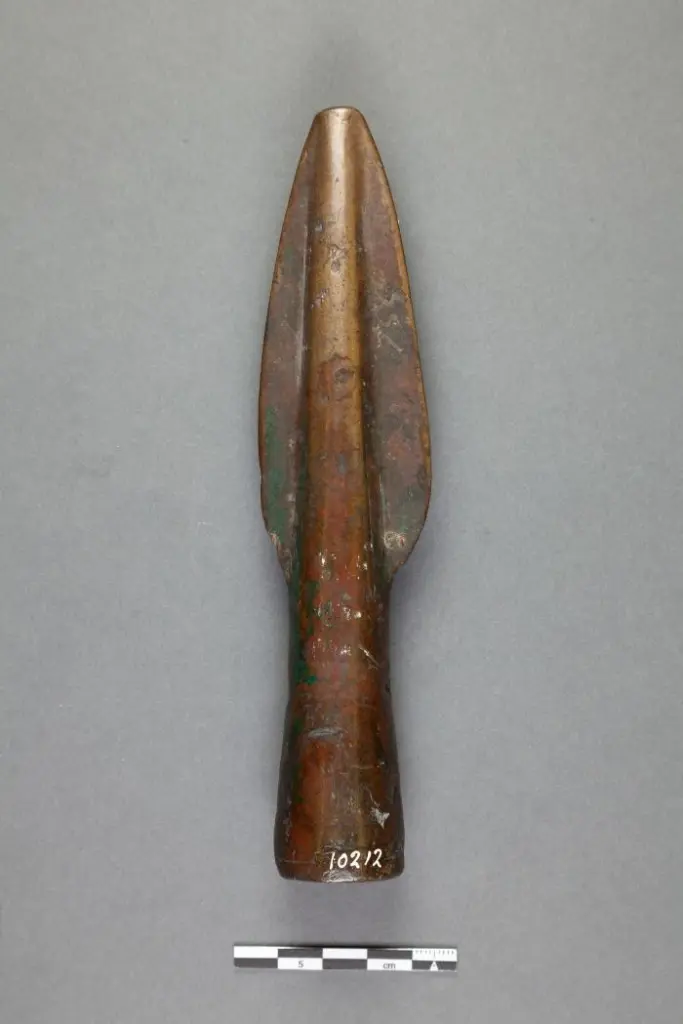
From the Museo Arqueológico Nacional in Madrid, a bronze spearhead (inv. 10212) from Italy, c. 1300-900 BC, identified as Villanovan or proto-Villanovan.
Why are so many early iron spearheads shaped this way? Well, the easy answer to the question is that it is because even earlier bronze spearheads were shaped this way. In every culture I’ve studied with the omni-spear, you can find bronze spearheads with the same basic shape – the strong mid-ridge, leaf-shaped blades and circular socket – proceeding them. There are differences; the bronze spearheads of this type tend to be shorter and as a result somewhat “stubbier” (that is, they’re just as wide, but not as long) compared to the later iron spearheads which borrow their shape. That seems like it is probably a concession to metallurgy and possibly production. On the production side, bronze artifacts were generally cast to shape and depending on the temperature of the cast and type of casting method, that can place upper-limits on the size of the final artifact. Certainly ancient bronze-smiths were capable of managing very large casts with high quality metals – the heaviest recovered naval ram (the Athlit ram, as far as I know) is absolutely massive at 465kg, cast in a single piece.
That said, I suspect the real issue that limits the size of bronze spearheads is the metal itself. Weapons generally tend to push their materials to the outer edges of what they are capable of, because of the demand to keep weight low: the smith is looking to hit the absolute minimum amount of metal which will handle the strains of impact. And the strains of impact here are considerable! Bronze under stress tends to undergo plastic deformation, which is to say that it bends and doesn’t bend back, it isn’t “springy”. As a result bronze weapons – swords, spearheads, arrow-heads, etc. – tend to be quite a bit shorter than later iron weapons, so that they can withstand the rigors of combat without permanently deforming in a way that would render them useless. But iron when put under mild stress deforms elastically, which is to say it is “springy” and when the force of stress is removed it bends back to its original shape (adding carbon to make a high-carbon “spring steel” can improve this quality), so even while iron isn’t any harder than bronze (though steel most certainly is), an iron weapon can take a bigger hit and not end up hopelessly bent. And that is even more true once you begin adding really any amount of carbon to make even very mild steels.
Consequently, you can push an iron sword to be longer for the same weight because you can count on it withstanding a hit, bending a bit to absorb the force and bending back when the force is removed, better than bronze. I suspect the same thing is happening as bronze spearhead designs shift to iron: smiths are realizing they can get a somewhat longer point, with a longer more deadly taper, without an unacceptable increase in weight.
But then why keep the shape? Because a lot of bronze age sword shapes drop or are extensively modified fairly quickly in the shift to iron in places where the omni-spearhead remains the standard shape, albeit somewhat larger than its bronze variant.
Well, the answer, to me, seems to be that its a pretty useful shape, at least in a particular combat environment.
The round socket, of course, is to fit the round haft of the spear. These sockets are, as noted, generally round, which suggests that these spears are almost entirely being used to thrust. You probably could cut with the edges of these blades, but if that was how you expected to use the spear, you’d want a different haft shape so that you could feel the alignment of the edges of the blades. Interestingly, octagonal or rhombic sockets are a minority type that appears in a lot of places (both Gaul and Spain, for instance), but they remain really rare, as opposed to, say, medieval polearms, where non-circular hafts become common over time so that the wielder can feel that edge-alignment.
Extending the socket to make the mid-ridge also makes a lot of sense, as it provides a nice, thick, stout element of the spear to resist the forces of impact, which is going to be a mix of compression and bending. In an ideal, perfect impact, it’d be all compression, but in the real world, your target isn’t standing still and your hit probably isn’t dead-on, so you want some part of the spearhead that can resist that impact and hold its shape, transmitting the force instead into the shaft. The mid-ridge, being nice and thick (and generally not hollow past the socket) accomplishes this neatly.
Meanwhile, those wide, thin blades ensure a wide wound that is going to slice through a lot of the target. You want that too, because the fellow striking with the weapon wants a wound which will disable their opponent as quickly as possible. After all, all of the time between the delivery of a wound and it becoming disabling is, definitionally, a period where you are in range of their counter-attack and they are not disabled and so able to give it. If you ever wondered why a lot of really narrow, quick effective piercing weapons like rapiers were less common on the battlefield, this is a big part of it: those penetrating wounds are really lethal but often not very quickly and in a battlefield (where you may not be able to quickly back off after having delivered a fatal wound) you want a wound that, fatal or not, is going to disable fast.
Wide slicing wounds do that for you, because they cut across blood vessels, muscles and tendons. The former leads to rapid blood-loss, which can be disabling (and of course, fatal, but again, you care about disabling; fatal or not is a problem to consider once you are out of danger), while the later can instantly render limbs useless. It doesn’t matter how much adrenaline or willpower an enemy has, if a blow has sliced the muscles they would use to move their limbs, they cannot physically move those limbs.
The shape of the blades also seems intentional. While we do see neatly “oval” shaped blades, the most common shapes are “teardrop” or “leaf” shapes, which are widest close to the base. That probably helps in preventing over-penetration, because you need to be able to pull the spear back after delivering a strike; you do not want it stuck in the target. Likewise, I think that’s why truly “arrow” shaped spearheads tend to be both early and relatively rare. Instead the base curves back into the socket rather than having barbs, to make it easier to get that spear back out of an opponent after you strike them.
At the same time, spears are by no means immune to weight considerations. Ideally a combatant wants the longest spear they can manage easily in a single hand. That in turn is going to place a hard limit on the weight of the spearhead; every gram in the spearhead shifts the center of balance forward, making the weapon harder to handle. Shifting that center of balance back means adding a gram to the spear butt. Spearheads are pretty much always heavier than spear butts (often several times over), but the basic interaction is there where adding mass to the tip of the spear imposes weight costs which limit length. The trade-off is actually quite clear in medieval spears, where winged and “hewing” spears with larger spear-tips do, in fact, tend to be shorter and may have often been intended for use in two hands.
And because the humans in these systems don’t differ all that much, everyone more or less hits the same set of tradeoffs at basically the same point and so ends up developing spears with very similar weight and length characteristics. This should, I hope, help to dispel any myths that this or that group of ancient agrarian people were super-strong supermen; Greek, Roman, Spanish, Gallic, and Persian spears are all of the same basic length and weight and modern enthusiasts, reenactors and experimental archaeologists can wield those spears just fine. The basic limits of an average warrior haven’t changed all that much.
What you are left with is a spear with a 2-2.5m haft (probably just under 1kg), with spear-tips ranging from 150-450g, mostly clustered in the center of that range around 200g, and spear-butts typically very light, less than 100g and very simple in design (with an exception here for the elaborate Greek saurotar). A simple, no-frills design that would have been very effective on foot or on horseback.1
But as a basic design, the typical omni-spear provides a very effective balance of capabilities: the longest infantry spear that is easy enough to handle with a tip that is suitably deadly against lightly armored or unarmored targets and typically a spear-butt which both encloses the base of the spear (preventing it from delaminating) and provides a point which can be used to both brace the weapon and as an emergency back-up weapon, without adding unacceptable amounts of weight. Note, of course, that I’ve said unarmored or lightly armored: the wide blade on that spearhead is going to cause a strike to have to move aside quite a bit of armor if your opponent is wearing some, greatly limiting the depth of a strike if you have to move the weapon through, say, thick textile armor or mail. But assuming you only expect to strike unarmored targets, or the unarmored portions of armored targets, the shape is very effective.
Bret Devereaux, “Collections: The Mediterranean Iron Omni-Spear”, A Collection of Unmitigated Pedantry,
- Though the Greek cavalry spear of the late-Classical and Hellenistic, the xyston – pronounced ksuston, not zystin – is differently structured than this.
November 27, 2025
QotD: Honor, homage, and fealty in Game of Thrones
To refer to a distinction introduced in Wayne Lee’s talk [here] – Tywin cannot rely on force (do it because I will kill you if you don’t), he has to use power (do it because you think you ought). Because the apparatus of the state here is very limited, that power is largely generated through personal relationships – you ought to fight for your liege because you have a personal relationship with him. You see him fairly often, you swore loyalty to him (in person!!), he (or his ancestors) have helped resolve your problems in the past and most importantly, because he has kept faith with you in the past.
Which is a way of saying that this system runs on trust and reputation, and that runs both ways. Even as Tywin watches his vassals for signs of disloyalty, his vassals are watching him. Is he true to his word? Can I trust him? Because if the answer is no – I best start hedging my bets. And that bet-hedging is going to come in ways Tywin does not want – I might refuse to come out and fight, or redirect my efforts to fortifying my own holdings, or even switch over to another liege. And in the very early seasons, key characters – most notably Tywin and Tyrion – know this and act accordingly. Tywin talks a good game about lions and sheep, but when it comes down to it, he knows his reputation matters – what the sheep say about the lion matters a great deal, it turns out. Robb Stark’s failure to handle the Karstarks, Tullys and Freys is his eventual undoing. Tyrion berates Cersei on returning to King’s Landing for her actions which might call the Lannister reputation into question (“that bit of theatre will haunt our family for a generation”.)
What is unusual here is how frequently key characters deviate from the norms these societies need to function – Westerosi nobles are stunningly treacherous for people who rely on systems based in trust for survival. In a system which runs on trust and reputation, elites tend to value trust and reputation. They produce literature extolling it (as, indeed, do most “mirrors for princes” – guidebooks on how to be a good ruler – from the Middle Ages do; see, for instance, Book 3 of Dhouda’s Liber Manualis (9th cent.), which goes on and on about trustworthiness) and refine its practice. The sort of eye-popping treachery so common in Game of Thrones was far rarer in the actual historical Middle Ages for exactly the reason Game of Thrones would lead you to believe: it is almost always self-defeating.
The problem here comes in the later seasons and how they re-contextualize all of this concern. That problem has a name, and it is Cersei. Cersei breaks all of these rules. Even early on, she has her soldiers (who recall – are not paid mercenaries, but likely vassals of her house who can very much take their skills elsewhere if they don’t like their current employer) demonstrate her own capricious untrustworthiness on Lord Baelish (she has also, I will note, mistaken violence for power). She humiliates Barriston Selmy in court, a spectacle her own future vassals might have remembered. She incinerated her own family – by blood and marriage – along with her erstwhile allies. Cersei is endlessly treacherous, often foolishly and obviously so, and yet …
And yet it doesn’t matter. The Lannister bannermen in the penultimate episode mount the walls to fight a doomed battle for her anyway. Not only is that behavior inexplicable, it hardly seems possible. Who, after all, is raising and leading these men? Who is coordinating supplies and grain shipments to the capital? Remember, the reason for this distributed system of political leadership is that the central state does not have the administrative apparatus to raise armies or feed cities on its own – it has to outsource that to vassals. Vassals that Cersei has murdered or alienated, almost to a man. Cersei is defeated because dragons are unstoppable monsters, but she should have been defeated because she would have simply been incapable of raising an army at all.
Bret Devereaux, “New Acquisitions: How It Wasn’t: Game of Thrones and the Middle Ages, Part III”, A Collection of Unmitigated Pedantry, 2019-06-12.
November 21, 2025
QotD: Why did the (western) Roman Empire collapse?
Let’s start with the foederati.
After the Constitutio Antoniniana, there was no longer much need for the auxilia, as all persons in the empire were citizens, and so the structure distinction between the legions and other formations fades away (part of this is also the tendency of the legions in this period to be progressively split up into smaller units called vexillationes, meaning that the unit-sizes wouldn’t have been so different). But during the fourth century, with frontier pressures building, the Romans again looked for ways to utilize the manpower and fighting skill of non-Romans. What is striking here is that whereas in some ways […] the auxilia had represented almost a revival of the attitudes which had informed the system for the socii, the new system that emerged for using foreign troops, called foederati (“treaty men”) did not draw on the previously successful auxilia-system (which, to be clear, by this point had been effectively gone for more than a century). Instead, the Romans signed treaties with Germanic-speaking kings, exchanging chunks of (often depopulated, war-torn frontier) land in exchange for military service. Since these troops were bound by treaty (foedus) they were called foederati. They served in their own units, under their own leaders, up to their kings. Consequently, all of the mechanisms that encouraged the auxilia to adopt Roman practices and identify with the Roman Empire were lost; these men might view Rome as a friendly ally (at times) but they were never encouraged to think of themselves as Roman.
The reason for this different system of recruitment seem to be rooted in financial realities. The Roman army had already been expanded during the Crisis of the Third Century and only grew more under Diocletian and Constantine, probably by this point being between 400,000 and 500,000 men (compared to 300,000-350,000 earlier in the empire). Moreover, Diocletian had opted to reform the empire’s administration with a much more intensive, top-down, bureaucratic approach, which imposed further costs. Taxes had become heavy (although elites were increasingly allowed to dodge them), the economy was weak and revenues were short. The value of the foederati was that the empire didn’t have to pay them; they were handed land (again, in war-torn frontier zones) and expected to use that to pay for their military support. At the time, it must have seemed a brilliant work-around to get more military power out of a dwindling tax-base.
(I feel the need to note that I increasingly regard Diocletian (r. 284-305) as a ruinous emperor, even though he lacked the normal moralizing character flaws of “bad emperors”. While he was active, dedicated and focused, almost all of his reforms turned out to be quite bad ideas in the long run even before one gets to the Great Persecution. His currency reforms were catastrophic, his administrative reforms were top-heavy, his tax plan depended on a regular census which was never regular and the tetrarchy was doomed from its inception. Diocletian was pretty much a living, “Well, You Tried” meme. That said, to be clear, Diocletian wasn’t responsible for the foederati; it’s not quite clear who the first foederati were – they may have been the Franks in 358, which would make Julian (as a “Caesar” or junior-emperor under Constantius) the culprit for this bad idea – he had a surplus of those too.)
The problem, of course, is right there: the status of the foederati made it impossible for them to ever fully integrate into the empire. They had, after all, their own kings, their own local laws and served in their own military formations. While, interestingly, they would eventually adopt Latin from the local population which had already done so (leading to French, Spanish and Italian) they could never become Roman. That wasn’t always their choice, either! As O’Donnell (op. cit.) notes, many of these foederati wanted to be “in” in the Roman Empire; it was more frequently the Romans who were busy saying “no”. It is striking that this occurs in a period where social class in the Roman world was generally calcifying. Whereas citizenship had been an expanding category, after the Constitutio Antoniniana, the legal categories of honestiores and humiliores (lit. “respectable” and “humble” people, but in practice, “wealthy” and “commoners”) largely replaced citizenship as the legal dividing lines of Roman society. These were far less flexible categories, as economic social mobility in the ancient world was never very high. Even there, the tax reforms of Diocletian (with some “patches” under Constantine) began, for tax purposes, to tie tenant farmers (“coloni“) to their land, essentially barring both physical and economic mobility in the name of more efficient tax collection in a system that strongly resembled later medieval serfdom.
Nevertheless, the consequence of this system of organization was that as often as the foederati provided crucial soldiers to Roman armies, they were just as frequently the problem Roman armies were being sent to address. Never fully incorporated into the Roman army and under the command of their own kings, they proved deeply unreliable allies. Pitting one set of foederati against the next could work in the short-term, but in the long term, without any plan to permanently incorporate the foederati into Roman society, fragmentation was inevitable. The Roman abandonment of the successful older systems for managing diverse armies (on account that they were too expensive) turned the foederati from a potential source of vital manpower into the central cause of imperial collapse in the West.
Bret Devereaux, “Collections: The Queen’s Latin or Who Were the Romans, Part V: Saving and Losing and Empire”, A Collection of Unmitigated Pedantry, 2021-07-30.
November 15, 2025
QotD: The innovation of infiltration tactics in trench warfare
The mature form of this tactical framework is often called “Hutier” tactics, after German general Oskar Emil von Hutier, though he was hardly the sole or even chief inventor of the method. In its mature form, the technique went thusly: instead of attacking with large waves of infantry which cleared each objective in sequential order, attacks ought to be proceeded by smaller units, carefully trained with the layout of the enemy positions. Those units, rather than having a very rigid plan of attack, would be given those general objectives and left to figure for themselves how to accomplish them (“mission tactics” or Auftragstaktik)1, giving them more freedom to make decisions based on local conditions and the ground.
These elite spearhead units, called Stoßtruppen or “Stormtroopers” were well equipped (in particular with a higher amount of automatic firearms and hand grenades, along with flamethrowers). Importantly, they were directed to bypass enemy strong-points and keep moving forward to meet their objectives. The idea here was that the follow-up waves of normal infantry could do the slow work of clearing out points where enemy resistance was strong, but the stormtroopers should aim to push as deeply as possible as rapidly as possible to disorient the defenders and rapidly envelop what defenses remained.2
These sets of infantry tactics were in turn combined with the hurricane barrage, a style of artillery use which focused on much shorter but more intense artillery barrages, particularly associated with Colonel Georg “Breakthrough” Bruchmüller. Rather than attempting to pulverize defenses out of existence, the hurricane barrage was designed merely to force enemies into their dugouts and disorient the defenders; much of the fire was directed at longer ranges to disrupt roads and artillery in the enemy rear. The short barrage left the ground relatively more intact. Meanwhile, those elite infiltration units could be trained to follow the creeping barrage very closely (being instructed, for instance, to run into the shell explosions, since as the barrage advantages, no gun should ever strike the same spot twice; a fresh shell-hole was, in theory, safe). Attentive readers will recognize the basic foundations of the “move fast, disorient the enemy” methods of the “modern system” here.
So did infiltration tactics break the trench stalemate? No.
First, it is necessary to note that while infiltration tactics were perhaps most fully developed by the Germans, they were not unique to them. The French were experimenting with many of the same ideas at the same time. For instance, basic principles of infiltration were being published by the French General Headquarters as early as April, 1915. André Laffargue, a French infantry captain, actually published a pamphlet, which was fairly widely distributed in both the French and British armies by the end of 1915 and in the American army in 1916, on exactly this sort of method. In many cases, like at the Second Battle of Artois, these French tactics bore significant fruit with big advances, but ran into the problem that the gains were almost invariably lost in the face of German counter-attacks. The Russians, particularly under Aleksei Brusilov, also started using some of these techniques, although Brusilov was as much making a virtue of necessity as the Russians just didn’t have that much artillery or shells and had to make do with less and Russian commanders (including Brusilov!) seem to have only unevenly taken the lessons of his successes.
The problem here is speed: infiltration tactics could absolutely more efficiently overrun the front enemy lines and even potentially defeat multiple layers of a defense-in-depth. But after that was done and the shock of the initial push wore off, you were still facing the same calculus: the attacker’s reinforcements, shells, artillery and supplies had to cross broken ground to reach the new front lines, while the defender’s counter-attack could ride railways, move over undamaged roads and then through prepared communications trenches. In the race between leg infantry and trains, the trains always won. On the Eastern Front or against the Italians fighting under the Worst General In History at Caporetto (1917), the already badly weakened enemy might simply collapse, producing massive gains (but even at Caporetto, no breakthrough – shoving the enemy is not a breakthrough, to qualify as a breakthrough, you need to get to the “green fields beyond” that is open ground undefended by the enemy), but against a determined foe, as with the 1918 Spring Offensives, these tactics, absent any other factor, simply knocked big salients3 in the line. Salients which were, in the event, harder to defend and brought the Germans no closer to victory. Eventually – often quite rapidly – the front stabilized again and the deadlock reasserted itself. Restoring maneuver, the actual end-goal of these tactics, remained out of reach.
None of this is to say that infiltration tactics were useless. They represented a real improvement on pre-war infantry tactics and continue to serve as the basis for modern infantry tactics. But they could not break the trench stalemate or restore maneuver.
Bret Devereaux, “Collections: No Man’s Land, Part II: Breaking the Stalemate”, A Collection of Unmitigated Pedantry, 2021-09-24.
- Because it doesn’t fit anywhere else, I want to make a rather long note here. There is an odd tendency which I find quite frustrating, in which military concepts, unit designations and terminology from other languages are all translated into English when used, except for German terms. I suspect this has to do with the high reputation German military thinking holds in among the general public and some military practitioners. I do not share this view; both the German Imperial Army and the Nazi Wehrmacht (another term we never translated yet we feel no need to call the French army l’armée de terre) managed to lose the only major wars they were in, leading to the end of the states they served. Both armies were capable at some things and failed at others; their record certainly does not make German some sort of Holy Language of War. Nevertheless, where German technical terms are notable, I will include them so that the reader will know, should they encounter them elsewhere, that this is a term they are already familiar with, albeit in translation.
- It should be noted that the emphasis here remained on envelopment and destruction rather than on disorientation. The latter is a feature of subsequent systems based on German maneuver warfare, but was not a goal of the doctrine itself initially.
- A salient is a bulge in the line such that your position is bordered by the enemy on three sides. Such positions are very vulnerable, since they can be attacked from multiple directions and potentially “pinched off” at the base.
November 9, 2025
QotD: Historical training is not “spending 7 years memorizing dates”
James @TTJamesG
The fact that you spent 7 years memorizing dates and the culmination of that is arguing semantics on X is depressing. Is it too late for a refund? You wrote an entire thread addressing a point I never made, a point you intentionally misconstrued.Another thing that has come up a fair bit here recently is the idea that historical training consists of “spend[ing] 7 years memorizing dates” which is a severe misunderstanding of what historians do.
It confuses the job of reading history books for the job of writing them.
While any historian is going to end up knowing a lot of names and dates simply as a byproduct of teaching and working with their material, raw memorization is not a significant part of the PhD training process.
Instead, the focus is on research skills and analysis.
In practice, we can divide a lot of historical training into three components: the historical method, “theory”, and then field-specific training.
The historical method is the process and heuristics we use to assess historical sources.
While history students work from history books that are “pre-chewed” as it were, historians work with their evidence in its raw, unprocessed form: archives of documents, ancient texts, inscriptions, memoirs, archaeological remains and so on.
The historical method is how we approach that raw material: who produced it? What information would they have had (eyewitness? second hand?), what sources might they have had? What might their own aims have been?
And how can we most plausibly fill in gaps in our evidence?
Then there is historical theory. No good historian is a doctrinaire follower of a single theory of history — rather these are toolboxes of ideas we use to frame the research questions we’re asking.
But to use those ideas, you must know and understand them first.
So “critical theory” is interested in power relationships, while an Annales framework is interested in long-term structures and cultural assumptions, while a materialist framework focuses on material conditions and so on.
Each would imply different questions of the evidence.
Part of the point of learning theory, of course, is that each theory lens is, in and of itself, incomplete. Cultural structures matter, individual choices matter, material conditions matter, etc. etc.
You learn and think about a bunch of these to know the blindspots of each.
Finally, historians are going to learn a bunch of research skills specific to our period and place. For ancient Roman history, that’s Latin, Greek, epigraphy, paleography, some philology and a lot of archaeology.
For a more modern field, archive research methods are huge.
On top of that, you’re also going to develop knowledge in other disciplines — sciences, social sciences — that touch on your topic of interest. I work on the costs of warfare, so military science and theory, along with economics and a bit of demographics, matter to me.
What the historian is actually doing is taking that skillset to the raw evidence of the past — sometimes asking new questions of old material, frequently asking old questions of material no one has studied intensively before — to discover new information about the past.
Of course we also assemble a broad knowledge of the societies we study (like how Roman citizenship works), which we’d need to understand our sources and our evidence.
Roman citizenship, for instance, matters a lot for understanding the Roman army!
That broad knowledge is what we’re drawing on in teaching and for that we are relying on the work of our colleagues in the discipline: each historian is doing their own original discovering-the-past work, but also keeping up-to-date on our colleagues’ work.
The end result is both a steadily improving understanding of the past but also the ability, as our own conditions and interests change, to ask new questions, rather than simply endlessly rehash old questions and old (potentially flawed) answers.
“Online Rent-a-Sage” Bret Devereaux, Twitter, 2025-08-05.
November 3, 2025
QotD: Was Alexander “the Great”?
And that’s just not a reading of Alexander which can survive reading all of any of our key sources on him. The moment you read more than just the genteel anecdotes (“for he, too, is Alexander”, – though note that Alexander’s gentle words do not keep him from trying to use Darius’ family to extort Darius out of his kingdom, Arr. Anab. 2.14.4-9), I think one must concede that Alexander was quite ruthless, a man of immense violence. I mean, and I want to stress this, he killed one of his closest companions with a spear in a drunken rage. I do not think there is a collection of polite-but-witty one-liners to make up for that. But Cleitus was hardly the only person Alexander killed.
Alexander had Bessus, the assassin of Darius, mutilated by having his nose and ears cut off before being executed (Arr. Anab. 4.7.3). He has 2,000 survivors of the sack of Tyre crucified on the beach (Q. Curtius Rufus 4.4.14-17). Because he resisted bravely and wouldn’t kneel, Alexander had the garrison commander at Gaza dragged to death by having his ankles pierced and tied to a chariot (Q. Curtius Rufus 4.4.29). Early in his reign, Alexander sacks Thebes and butchers the populace, as Arrian notes, “sparing neither women nor children” (Arr. Anab. 1.8.8; Arrian tries, somewhat lamely, to distance Alexander from this saying it was is Boeotian allies who did most – but not all – of the killing). Of the Greek mercenaries enrolled in the Persian army at Granicus – a common thing for Greek soldiers to do in this period – Arrian (Anab. 1.16.6) reports that he enslaved them, despite, as Plutarch notes, the Greeks holding in good order and attempting to surrender under terms before they were engaged (Plut. Alex. 16.13). Not every opponent of Alexander gets Porus’ reward for bravery and pride.
Meanwhile, Alexander’s interactions, as noted above, with the civilian populace were self-serving and generally imperious. That’s not unusual for ancient armies, but I should note that Alexander’s conduct towards civilians was also no better than the (dismally bad) norm for ancient armies: he foraged, looted what he wanted, occasionally burned things (including significant parts of Persepolis, the Persian capital), seized land and laborers for his colonies and so on. Alexander’s operations in Central Asia seem to have been particularly brutal: when the populace fled to fortified settlements, Alexander’s orders were to storm each one in turn, killing all of the men and enslaving all of the women and children (Arr. Anab. 4.2.4, note also 4.6.5, doing the same in Marakanda).
And this, at least, brings back to our original question: Was Alexander “Great”? In a sense, I think the expectation in this question is to deliver a judgment on Alexander, but I think its actual function is to deliver a judgment on us.
The Alexander we have in our sources – rather than in the imperialistic hagiographies of him that still condition so much popular memory – seems to have been a witty, charismatic, but arrogant, paranoid and violent fellow. As I joke to my students, “Alexander seems to have enjoyed two things in life, killing and drinking and he was only good at the former”. He could be gentle and witty, but it seems, especially towards the end of his reign, was more often proud, imperious and murderous.
He was at best an indifferent administrator and because he was so indifferent to that task, most of his rule amounted to questions of the men he chose to do the job for him, and those choices were generally quite poor. He made no meaningful preparations for the survival of his empire, his family or his friends upon his death; Arrian (Anab. 7.26.3) reports famously that his last words were, when pushed by his companions to name a successor, τῷ κρατίστῳ (toi kratistoi), “to the strongest”. Translation: kill each other for it. And they did, killing every member of Alexander’s family in the process.1
He was not a great judge of men – for every Perdiccas, there is a Harpalus – or a great military innovator. He largely used the men and the army that his father gave him, and where he deviated from the men, the replacements were generally inferior. That said, he was an astounding commander on campaign and on the battlefield, managing the complex logistics of a massive operation excellently (until his pride got the better of him in Gedrosia) and managing his battles with unnatural calm, skill and luck. He was also, fairly clearly, a good fighter in the personal sense. Alexander was a poor ruler and a lack-luster king, but he was extremely good at destroying, killing and enslaving things.
To the Romans – who first conferred the title “the Great” on Alexander, so far as we know (he is Alexander Magnus first in Plautus’ Mostellaria 775 (written likely in the late 200s)) – that was enough for greatness. And of course it was enough for his Hellenistic successors, who patterned themselves off of Alexander; Antiochus III even takes the title megas (“the Great”) in imitation of Alexander after he reconquers the Persian heartland. Evidently by that point, if not earlier, the usage had slipped into Greek (it may well have started in Greek, of course; Plautus’ comedies are adapted from Greek originals). It should be little shock that, for the Romans, this was enough: this was a culture that reserved their highest honor, the triumph, for military glory alone. And it was clearly enough for Droysen and Tarn too: to be good at killing things and then hamfistedly attempt – and mostly fail – to civilize them, after all, was what made the German and British Empires great. It had to be enough, or else what were all of those Prussian officers and good Scottish gentlemen doing out there with all of that violence? To question Alexander might mean questioning the very system those men served.
What is greatness? Is it pure historical impact, absent questions of morality, or intent? If that is the case, Alexander was Great, because he killed an exceptionally large number of people and in so doing set off a range of historical processes he hadn’t intended (the one he did intend, fusing the Macedonian and Persian ruling class, didn’t really happen) which set off an economic boom and created the vibrant Hellenistic cultural world, outcomes that Alexander did not intend at all. This is a classic “great, but not good” formulation: we might as well talk of “Chinggis the Great”, “Napoleon the Great” or (more provocatively) “Hitler the Great” for their tremendous historical impact. Yet this is a definition that can be sustained, but which robs “greatness” of its value in emulation.
One cannot help but suspect in many of these circumstances, “greatness” is about killing larger numbers of people, so long as they are strange people who live over yonder and dress and pray differently than we here do. It is ironic that Tarn credited Alexander with imagining the unity of mankind, given that Alexander was in the process of butchering however many non-Macedonians was required to set up a Macedonian ethnic ruling class over all other peoples. One suspects, for Droysen and Tarn, it was “greatness”, to be frank, because they understood the foot inside the boot Alexander was planting on the necks of the world, was European and white and so were they. In that vision, greatness is “our man” as opposed to “their man”. But that is such a small-minded, petty form of greatness, “our killer and not your killer”.
Does greatness require something more? The creation of something enduring, perhaps? Alexander largely fails this test, for it is not Alexander but the men who came after him, who exterminated his royal line and built their kingdoms on the ashes of his, who constructed something enduring. Perhaps greatness requires making the world better? Or some kind of greatness of character? For these, I think, it is hard to make Alexander fit, unless one is willing, like Tarn was, to bend and break the narrative to force it. Had Alexander, in fact, been Diogenes (Plut. Alex. 14.1-5), rather than Alexander, but with his character – witty, charismatic, but imperious, arrogant and quick to violence – I do not think we would admire him. As for making the world better, Alexander mostly served to destroy a state he does not seem to have had the curiosity or cultural competence to understand, as Reames puts, it, “not King of Asia, but a Macedonian conqueror in a long, white-striped purple robe” (op. cit. 212). He surely did not understand their religions.2
In a sense, Alexander, I think, serves as a mirror for us. We question the greatness of Alexander and what is revealed are the traits, ideals, and actions we value. Alexander’s oversized personality is as captivating and charismatic now as it was then, and his record as a killer and conqueror is nearly unparalleled. But what is striking about Alexander is that beyond that charisma and military skill there is almost nothing else, which is what makes the test so discerning.
And so I think we continue to wrestle with the legacy and value of Alexander III of Macedon.
Bret Devereaux, “Collections: On the Reign of Alexander III of Macedon, the Great? Part II”, A Collection of Unmitigated Pedantry, 2024-05-24.
- I thus find it funny that every few years another “inspiring” anecdote about Alexander’s wise last words filters around the internet that Alexander’s actual reported last words were so grim and heartless.
- On this, see F. Naiden, Soldier, Priest and God (2018).
October 28, 2025
QotD: Pyrrhus after his bloody defeat of the Romans at Heraclea
On Pyrrhus’ side, his army had been bloodied, but was mostly intact and was almost immediately bolstered by the arrival of his Italian allies, including the Lucanians and Samnites, along with the Tarantines. On the Roman side, Laevinius’ army was battered, but still extant; he fell back to Roman-controlled Campania, eventually taking up a position at Capua, the chief city of that region. Pyrrhus then marched north, entering Campania, bypassing the Roman force at Capua (which had been reinforced with two legions pulled from Etruria) and entering Latium, apparently getting within about 60 kilometers (c. 37 miles) of Rome (Plut. Pyrrh. 17.5). And here the question students as is why not take Rome?
And there is an easy answer: because he couldn’t.
The first thing to remember here is the natural of the human-created terrain Pyrrhus has to operate in: functionally all of the cities of any significant size in third-century Italy were likely to be fortified and their populations – thanks to Rome’s recruitment system – experienced and armed. Consequently, if the locals didn’t voluntarily switch sides, Pyrrhus would have been forced to take their settlements either by siege or storm. Pyrrhus might well have hoped that the Campanians would go over to him, but here the problem is the human geography of Italy: his army is full of Samnites, whose emnity with the Campanians is what started the Samnite wars. This is a feature of Rome’s alliance system noted by M.P. Fronda in Between Rome and Carthage (2010): because Rome extended its alliance system by intervening in local rivalries, both sets of new “allies” had long-standing grudges against the other, which makes it hard to dismantle Rome’s alliance network, since any allies you peel away will push others closer to Rome.
In the case of Campania, Capua might have felt strong enough to try their luck without Rome, but that’s why Laevinius was sitting on it with a large army. But the other Campanian cities (of which there were about a dozen) might well fear exposure to Samnite raiding without Rome’s protection. Meanwhile, the Latins – the people of Latium, the region immediately to Rome’s south (technically Rome is in Latium, on its edge) – seem to have been pretty profoundly uninterested in siding against Rome either at this juncture or later when Hannibal tries to dismantle Rome’s alliance system.
So after Heraclea, Pyrrhus has fairly limited options: he can start the slow process of reducing the cities of Campania one by one to open the logistics necessary to permit him to operate long-term in Latium or he can conduct a lightning raid through Roman territory to try to maximize the psychological effect of his victory and perhaps get a favorable peace. He opts for the second choice and when the Romans opt not to take the deal – though they do consider it – he has to pull back to southern Italy (where he focuses on consolidating control, pushing out the last few Roman positions there).
Why not attack Rome directly? Well, Rome itself was fortified, of course. Moreover, the Romans had raised a fresh levy of troops for its defense (Plut. Pyrrh. 18.1), while dispatching Tiberius Corucanius with his army to reinforce Laevinius in Capua. So as Pyrrhus enters Latium, he has a well-defended fortified city in front of him and a Roman army of, conservatively, 30,000 men (Corucanius’ 20,000 men, plus whatever was left of Laevinius’ army) behind him. I don’t usually quote movie tactics, but Ridley Scott’s Saladin has the right wisdom for this problem: “One cannot maintain a siege with the enemy behind“. Had Pyrrhus stopped to besiege Rome, his supply situation would have quickly become hopeless as the Roman army behind him could have easily prevented him from foraging to feed his army during the long process setting up for an assault on the city, which might then simply fail, since the city was well-fortified and defended.
If Plutarch (Pyrrh. 18.4-5) is correct about the terms Pyrrhus offered – an alliance with Rome, a recognition of their hegemony over Italy outside of his new clients in southern Italy (who would of course, fall under Pyrrhus’ control now) – Pyrrhus may have hoped at this juncture to consolidate southern Italy and turn back towards the East or perhaps head on to Sicily. But the Romans refused the deal and so Pyrrhus seems to have set above clearing out the last Roman strongholds (Venusia and Luceria) in Apulia to consolidate his hold. The Romans responded in the following year by sending a new army, under the command of Publius Sulpicius Saverrio and Publius Decius Mus to challenge him and they met at Asculum, in northern Apulia.
Bret Devereaux, “Collections: Phalanx’s Twilight, Legion’s Triumph, Part IIIb: Pyrrhus”, A Collection of Unmitigated Pedantry, 2024-03-08.
October 22, 2025
QotD: The supposed land crisis Tiberius Gracchus wanted to solve
What they assume is taking place is that the wealthiest Romans – who have, in fact, grown fantastically wealthy from Rome’s overseas wars – have used that wealth to acquire most of the land, either buying up the small freeholds of smaller Roman farmers or getting the leases for that public land. Meanwhile, the Roman small farmer class does most of Rome’s fighting and so the assumption – by Appian – is that these guys are being ground underfoot by heavy military deployments, although as best we can tell, military deployments in the 150s, 140s and 130s are substantially lighter than those from 218-168 (but they’re also in less profitable, more difficult places like Spain, put a pin in that). Those wealthy Romans then work the land not with free laborers, but with slaves, because Roman conquests – remember, we’re at the tail end of Rome’s “iron century” of conquests from 264 to 148 – have brought enormous numbers of enslaved laborers to Italy. Those poor Romans, now displaced, have no land and flock to Rome and are no longer liable for the Roman census.
Except notice the data points being used to come up with this story: the visible population of landless men in Rome and the Roman census returns. But, as we’ve discussed, the Roman census is self-reported, and the report of a bit of wealth like a small farm is what makes an individual liable for taxes and conscription.
In short the story we have above is an interpretation of the available data but not the only one and both our sources and Tiberius Gracchus simply lack the tools necessary to gather the information they’d need to sound out if their interpretation is correct.
All of which now, at last, brings us to the scholarship of the last several decades which has, by and large, concluded that Tiberius Gracchus probably misunderstood the nature of Roman social and economic problems in the late second century and as a result applied the wrong solution.2 The initial problem is that the above model assumes a basically stagnant Italian population: you’re just shifting people around, not generating new people. But survey archaeology shows growing urban centers and new land coming under cultivation, suggesting a modestly rising population, a conclusion reinforced by demographic modeling which recognizes the likely marked decline in military mortality in the back half of the second century. Moreover, the vast expansion of villa estates we ought to be seeing in this period really only comes later, in the first century BC and the first two centuries AD; there’s some expansion (and these patterns are very regionalized) but not enough to explain what we’re being told is happening.3 Those observations, emerging in the 90s and early 2000s, provided the necessary evidence to vindicate the theory advanced by J.W. Rich in the 1980s that the problem was quite different than Tiberius Gracchus understood, in part to explain the one curious fact we could always see about Tiberius’ land reforms, which is that they happened, they went ahead as planned and also they didn’t fix the problem.
Instead what is happening is this: Roman military deployments had, for a long time, been massive. Rome had careened from the major Samnite Wars (343–341, 326–304, and 298–290) to the high-casualty Pyrrhic War (280-275) to the much higher casualty First (264-241) and Second (218-201) Punic Wars. But the big wars of the early second century had involved a lot more winning and thus somewhat less dying (deaths from disease always outweighed combat losses, but Roman armies are smaller from 201-168, so less disease death too), while after the Third Macedonian War (171-168), Rome doesn’t have any more peer-opponent wars left to fight and so the number of men under arms declines again after 168 and especially after 148. Roman society was thus structured to sustain itself in a situation where military mortality for males was high. And then it dropped.
But recall the average Roman farm is small, so what you have now are suddenly a whole bunch of second and third sons who between 350 and 201 would have gone off to fight and died (or their elder brother would have) but are now alive, but can’t possibly inherit the family farm because they have a living brother and the farm is much too small to split further (or to support an entire second nuclear family unit). Where do they go? Well, to Rome, of course, where they want what Rome has done in the past to deal with this sort of problem: the foundation of new Roman communities (colonies) where they can have land. But there isn’t any Italy left to conquer (Rome controls all of it) and we aren’t yet to founding Roman colonies overseas, so not only is the mortality much lower (and so you have more of these guys) the traditional release valve is stuck. So they’re piling up in the one place that there is meaningful amount of wage labor available (the city of Rome), where they are very visible to the Roman ruling elite.
Meanwhile, Elder Brother-Who-Lived is back on the farm and should, in theory, still be eligible for call-up. But whereas in previous decades he could hope to get sent to fight in places like Greece or Italy or against Carthage where the rewards in loot from defeating wealthy enemies were substantial, in the 130s, the main problem was Numantia: a Celtiberian community perched in a particularly troublesome hillfort in a relatively poor, difficult part of Spain. Campaigns to take the place often failed (see above) but even if they succeeded, there would be little real loot. Moreover, a lack of success made the wars deeply unpopular. Elder Brother doesn’t want to get drafted to go fight in Spain, it’s just not a good bargain for him (unlike earlier wars).
But he has a solution: the census is self-reported. While his younger brothers are in Rome looking for work, he can just not report the farm on the census (or not report his military aged son), understating his wealth to drop below the qualifying requirement for military service. Because the Roman census pays functionally no attention to such men – the capite censi (those counted by their heads) – Elder Brother’s household almost seems to vanish in the census returns and the number of men liable for conscription ticks down by one.
And so you have falling census returns, combined with crowds of poor Romans in the city of Rome, but without it necessarily having anything to do with ager publicus or lost farms. And this is, we think, probably what is happening: surely there is some elite villa-estate expansion and some replacement of freeholding farmers with enslaved workers on that land but in fact the problem the Romans are facing is classic land scarcity with a growing population, but they don’t know that’s the problem because draft-resistance appears in the census as population decline and the census is all they have.
But you can see immediately the problem for Tiberius Gracchus’ land reform: while there is certainly some ager publicus to redistribute (to the great annoyance of the elites holding it), there’s not enough, because the core of this problem isn’t changing land use patterns (more villas, less small farms) but rising population creating economic strain at the bottom (while, it is true, imperial expansion creates vast almost unimaginable amounts of wealth at the top).
But we’re actually not quite done with problems, there’s one more: not all of the ager publicus was being farmed by Romans. Quite a lot of it seems, instead, to have been in the hands of local Italians – the socii. This is another convenient simplification by Appian and Plutarch, a product of them both writing in the imperial period long after citizenship had been extended across Italy. But that hasn’t happened yet. So any law to redistribute ager publicus would mean taking land from the socii who were currently using it for a land-giveaway in which only Roman citizens will be eligible.
You may well imagine that doing something like that might really damage relations with the socii and also fundamentally change the “bargain” by which the Roman alliance system functioned, as before Tiberius Gracchus, the socii seem to have been eligible to settle in Roman colonial foundations on conquered land, but they will not be eligible to get land in Tiberius Gracchus’ land reform bill.
You can quickly flip ahead to the year 91 to see how that turns out in the long run.
Bret Devereaux, “Collections: On the Gracchi, Part I: Tiberius Gracchus”, A Collection of Unmitigated Pedantry, 2025-01-17.
- To pause for a second: for the sake of making this understandable, I am using the relatively simple category of ager publicus. However, as Gargola (op. cit.) notes, in actual Roman law, ager publicus was a messy super-category of lands governed by an exciting range of different rules and conditions (some leased, some sold, some held by the state, etc.) – ager censorius, ager quaestorius, ager occupatorius, ager diuisus et adsignatus, the ager Campanus and ager in trientabulis. Simplifying this and treating all of these lands as if they had been governed under the same rubric which Tiberius is merely now enforcing is one of Appian’s deceptive simplifications.
- For the scholarship, this reaction begins with J.W. Rich, “The Supposed Roman Manpower Shortage of the Later Second Century B.C.” Historia 32 (1983). The next major phase comes out of the high-count/low-count population debates around Roman demography because older demographic models, like those of PA Brunt (Italian Manpower (1971)) had assumed a static Roman population, but as noted we increasingly had evidence for a modestly increasing population. The implications of that get worked out in books like N. Rosenstein, Rome at War: Farms, Families and Death in the Middle Republic (2004) and L. De Ligt, Peasants, Citizens and Soldiers (2012). Finally, you also have a recognition that while the wars in Spain were unpopular, they didn’t have massive manpower demands, e.g. Taylor, “Goodbye to All That: The Roman Citizen Militia After the Great Wars” in A Community in Transition, eds. M. Balbo and F. Santangelo (2023).
- In Italy, I should be clear: the pervasiveness and speed with which rich Romans seem to accumulate Sicilian estates suggests a lot of the land acquisition may be happening outside of the ager Romanus.
October 16, 2025
QotD: The Roman proclivity to accept changes that “go back to the way things used to be”
What I will say is that the Romans were very conservative in their outlook, believing that things ought to be done according to the mos maiorum – “the customs of [our] ancestors”. The very fact that the way you say “ancestors” in Latin is maiores, “the greater ones” should tell you something about the Roman attitude towards the past. And so often real innovations in Roman governance were explained as efforts to get back to the “way things were”, but of course “the way things were” is such a broad concept that you can justify pretty radical changes in some things to restore other things to “the way they were”.
The most obvious example of this, of course, is Augustus with his PR-line of a res publica restituta, “a republic restored”. Augustus made substantial changes (even if one looked past his creation of an entire shadow-office of emperor!) to Roman governance on the justification that this was necessary to “restore” the Republic; exactly what is preserved tells you a lot about what elements of the Roman (unwritten) constitution were thought to be essential to the Republic by the people that mattered (the elites). And Augustus was hardly the first; Sulla crippled the tribunate, doubled the size of the Senate and made substantial reforms to the laws claiming that he was restoring things to the way they had been – that is, restoring the Senate to its position of prominence.
And one thing that is very clear about the Greeks and Romans generally is that they had at best a fuzzy sense of their past, often ascribing considerable antiquity to things which were not old but which stretched out of living memory. Moreover there is a general sense, pervading Greek and Latin literature that people in the past were better than people now, more virtuous, more upright, possibly even physically better. You can see this notion in authors from Hesiod to Sallust. This shouldn’t be overstressed; you also had Aristotelian/Polybian “cyclical” senses of history along with moments of present-triumphalism (Vergil, for instance, and his imperium sine fine). But still there seems to have been a broad sense of the folk system that things get worse over time and thus things must have been better in the past and thus returning to the way things were done is better. We’ve discussed this thought already where it intersects with Roman religion.
And the same time, here we run into the potential weakness of probing elite mentalités in trying to understand a society. Some Romans seem quite aware of positive change over time; Pliny the Elder and Columella are both aware of improving agricultural technology in their own day, particularly as compared to older economic writing by Cato the Elder. Polybius has no problem having the Romans twice adopt new and better ship designs during the First Punic War (though both are “just-so” stories; the ancients love “just-so” stories to explain new innovations or inventions). And sometimes Roman leaders did represent things as very much new; even Augustus combined his res publica restituta rhetoric with the idea that he was ushering in a saeculum novum, a “new age” (based on the idea of 110 year cycles in history).
So there is complexity here. The Romans most certainly did not have our strong positive associations with youth and progress. Their culture expected deference to elders and certainly didn’t expect “progress” most of the time; things, they thought, generally ought to be done as they had “always been done”. Consequently, framing things as a return to the mos maiorum or as a means to return to it was always a strong political framing and presumably many of the folks doing those things believed it. On the other hand the Romans seem well aware that some of the things they did were new and that not all of these “firsts” were bad and that some things had seemed to have gotten better or more useful since the days of their maiores. And some Romans, particularly emperors, are relatively unabashed about making dramatic breaks with tradition and precedent; Diocletian comes to mind here in particular.
Bret Devereaux, “Referenda ad Senatum: January 13, 2023: Roman Traditionalism, Ancient Dates and Imperial Spies”, A Collection of Unmitigated Pedantry, 2023-01-13.
October 10, 2025
QotD: Cleopatra’s reign in Egypt
These are related but disconnected questions. While we’ll get to the evidence for Cleopatra’s relationship with the people of Egypt, the broader legacy of the Ptolemies itself is very clear: the Ptolemaic dynasty and the Greek-speaking settlers it brought were an ethnically distinct ruling strata installed above native Egyptian society, an occupying force. None of Cleopatra’s royal ancestors, none of them had ever even bothered to learn the language of the people they ruled, whose taxes sustained their endless wars (initially foreign, later civil). Top administrative posts remained restricted to ethnic Greeks (though the positions just below them, often very important ones, might be held by Egyptians), citizenship in Alexandria, the capital, remained largely (but not entirely) restricted to Greeks and so on. It’s clear these designations were not entirely impermeable and I don’t want to suggest that they were, but it is also clear that the Greek/Macedonian and Egyptian elite classes don’t begin really fusing together until the Roman period (when they were both equally under the Roman boot, rather than one being under the boot of the other).
Consequently, the interest of the Ptolemaic dynasty could be quite a different thing from the interests of Egypt.
And I won’t bury the lede here: Cleopatra, it seems to me, chose the interests of her dynasty (and her own personal power) over those of Egypt whenever there was a choice and then failed to secure either of those things. Remember, we don’t have a lot in the way of sketches of Cleopatra’s character (and what we have is often hostile); apart from a predilection to learn languages and to value education, it’s hard to know what Cleopatra liked. But we can see her strategic decisions, and I think those speak to a ruler who evidently was unwilling or unable to reform Egypt’s ailing internal governance (admittedly ruined by generations of relatively poor rule), but who shoveled the resources she had into risky gambles for greater power outside of Egypt, all of which failed. That doesn’t necessarily make Cleopatra a terrible ruler, or even the worst Ptolemaic ruler, but I think it does, on balance, make her a fairly poor ruler, or at best a mediocre one.
But before we jump into all of that, I think both a brief explanation of the structure of this kingdom and brief timeline of Cleopatra’s life would be good just so we’re clear on what happens when.
For the structure of the kingdom, we need to break up, to a degree, the peoples in Egypt. Ptolemaic Egypt was not even remotely an ethnically uniform place. Most of the rural population remained ethnically Egyptian but there were substantial areas of “Macedonian” settlement. Ptolemaic subjects were categorized by ethne, but these ethnic classifications themselves are tricky. At the bottom were the Egyptians and at the top were the “Macedonians” (understood to include not just ethnic Macedonians but a wide-range of Greeks). The lines between these groups were not entirely impermeable; we see for instance a fictive ethnic grouping of “Persians” who appear to be Hellenized Egyptians serving in the military. At some point, this group is seems to be simply rolled into the larger group of “Macedonians”. nevertheless it seems like, even into the late period the “Macedonians” were mostly ethnic Greeks who migrated into Egypt and we don’t see the Egyptian and Macedonian elites begin to fuse until the Roman period (when they both shared an equal place under the Roman hobnailed boot). Nevertheless, this was a status hierarchy; “Macedonian” soldiers got paid more, their military settlers got estates several times larger than what their native Egyptian equivalents (the machimoi) got, the tippy-top government posts were restricted to Macedonians (though the posts just below them were often held by Egyptian elites) and so on. And while there was some movement in the hierarchy, for the most part these two groups did not mix; one ruled, the other was ruled.
To which we must then add Alexandria, the capital, built by Alexander, which had a special status in the kingdom unlike any other place. Alexandria was structured as a polis, which of course means it had politai; our evidence is quite clear that all of the original politai were Greek and that new admission to the politai did happen but was very infrequent. Consequently the citizen populace of Alexandria was overwhelmingly Greek and retained a distinctive Greek character. But Alexandria was more than just the politai: it was a huge, cosmopolitan city with large numbers of non-Greek residents. The largest such group will have been Egyptians, but we know it also had a large Jewish community and substantial numbers of people from basically everywhere. So while there were, according to Polybius, three major groups of people (Greek citizens, Egyptian non-citizens and large numbers of mercenaries in service to the king, Polyb. 34.14), there were also lots of other people there too. I do want to stress this: Alexandria was easily one of the most cosmopolitan cities in the ancient world; but for the most part only the Greeks (and not even all of them) were citizens there.
That’s in many ways a shamefully reductive summary of a very complex kingdom, but for this already overlong essay, it will have to do. On to the timeline.
Cleopatra was born in 69 BC, the middle of three daughters of Ptolemy XII Auletes, then ruler of Egypt (he also had two sons, both younger than Cleopatra). In 58 BC (Cleopatra is 11) her father, by all accounts an incompetent ruler, was briefly overthrown and his eldest daughter (Berenice IV) made queen; Cleopatra went into exile with her father. In 55 BC, with Roman support, Ptolemy XII returned to power and executed Berenice. Ptolemy XII then died in 51, leaving two sons (Ptolemy XIII and XIV, 11 and 9 years old respectively) and his two daughters; his will made Cleopatra queen as joint ruler-wife with Ptolemy XIII (a normal enough arrangement for the Ptolemies).
Before the year was out, Cleopatra and Ptolemy XIII (or perhaps more correctly, his court advisors) were at odds, both trying to assert themselves as sole monarch, though by 49 Ptolemy XIII’s faction (again, it seems to mostly have been his advisors running it) had largely sidelined Cleopatra in what had become a civil war. Cleopatra travels to Syria to gather an army and invades Egypt with it in 48, but this effort fails. She is able, however, to ally with Julius Caesar (lately arrived looking for Pompey, who supporters of Ptolemy XIII had killed, to Caesar’s great irritation). Caesar’s army – Cleopatra’s military force is clearly a non-factor by this point – defeats Ptolemy XIII in 47. Caesar appoints Cleopatra as joint ruler with her youngest brother, Ptolemy XIV (he’s 12) and Cleopatra bears Caesar’s son, Ptolemy XV Caesar in 47, who we generally call “Caesarion”.
Cleopatra then journeys to Rome late in 46 and seems to have stayed in Rome until after Caesar’s assassination (March, 44) and the reading of Caesar’s will (April, 44). Ptolemy XIV (the brother) also dies in this year and Cleopatra then co-rules with her son, Caesarion. Cleopatra returns to Egypt, attempts to dispatch troops to aid the Caesarian cause against Brutus and Cassius, but fails and loses all of the troops in 43. She is saved from being almost certainly steamrolled by Brutus and Cassius by their defeat in 42 at Philippi. Cleopatra meets with Marcus Antonius in 41 and they form an alliance, as well as (at some point) a romantic relationship. Cleopatra has three children by Antonius: Cleopatra Selene and Alexander Helios (twins, born in 40) and Ptolemy Philadelphus (born in 36).
With Cleopatra’s resources, Antonius launches an invasion of Parthia in 38 BC which goes extremely poorly, with him retreating back to Roman territory by 36 having lost quite a fair portion of his army (Cleopatra is back in Egypt ruling). In 34, Antonius embarks on a massive reorganization of the Roman East, handing over massive portions of Rome’s eastern territory – in name at least – to Cleopatra’s children, a move which infuriated the Roman public and cleared the way politically for Octavian to move against him. Through 33 and 32, both sides prepare for war which breaks out in 31. Cleopatra opts to go with Antonius’ combined land-sea military force and on the 2nd of September 31 BC, solidly outmaneuvered at Actium, she and Antonius are soundly defeated. They flee back to Egypt but don’t raise a new army and both die by suicide when Octavian invades in the following year. Octavian reorganizes Egypt into a Roman province governed by an equestrian prefect. Octavian and subsequent Roman emperors never really adopted the title of pharaoh, though the Egyptian priesthood continued to recognize the Roman emperors as pharaohs into the early fourth century – doubtless in part because the religion required a pharaoh, though Roman emperors could never be bothered to actually do the religious aspects of the role and few ever even traveled to Egypt.
So ended the 21-year reign of Cleopatra, the last heir of Alexander.1
Bret Devereaux, “Collections: On the Reign of Cleopatra”, A Collection of Unmitigated Pedantry, 2023-05-26.
- Except not really, as Cleopatra’s three children by Antonius survived their mother (though the two boys vanish from our sources fairly quickly, though we’re told they were spared by Octavian) and Cleopatra Selene actually ended up a queen herself, of the kingdom of Mauretania. There’s a recent book on what we know of her life, J. Draycott, Cleopatra’s Daughter: From Roman Prisoner to African Queen which I have not yet had a chance to read.


