
Extra Credits
Published on 13 Sep 2018This series is brought to you by World of Tanks PC. Check out the game at the link below and use the invite code FORAGER for extra goodies. https://redir.wargaming.net/r06pve1j/…
As the ruthless clash of the Saipan invasion drags on into the second week, a unique and unlikely hero emerges. Marine scout Guy Gabaldon can speak Japanese. He deserts his post, not once but twice, to reach out to the enemy soldiers and civilians.
September 15, 2018
Battle of Saipan – Suicide Island – Extra History – #2
Comments Off on Battle of Saipan – Suicide Island – Extra History – #2
September 14, 2018
The Battle of Saint-Mihiel I THE GREAT WAR – Week 216
The Great War
Published on 13 Sep 2018The American First Army joins the fray on the Western Front with the Battle of Saint-Mihiel. All along the Western Front, the Allies are attacking or planning new attacks. The situation for the Germans looks dire even as the first war reparations from Russia arrive.
Comments Off on The Battle of Saint-Mihiel I THE GREAT WAR – Week 216
September 13, 2018
The Canadian Forces are suffering from obesity … in leadership and staff
Ted Campbell responds to requests to explain what he feels the Canadian Forces should do about our far-too-large military headquarters buttprint:
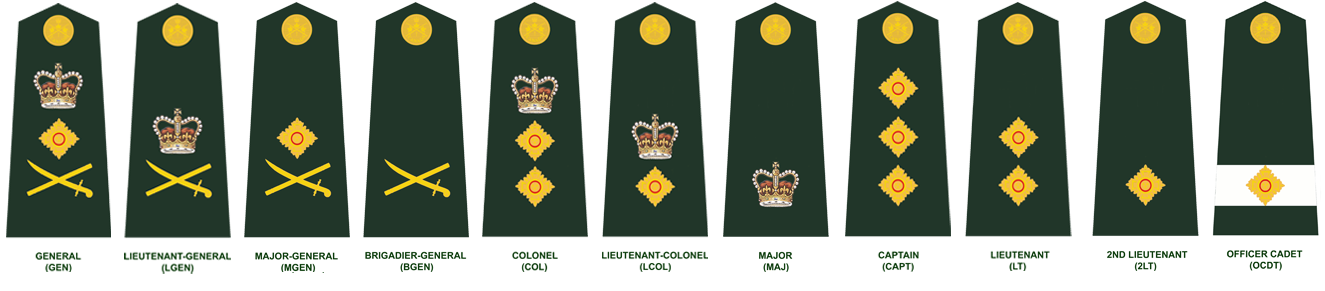
… let’s consider the command and control (C²) superstructure. I’m going to continue to argue that it is beyond “fat,” it is, now, morbidly obese and that condition actually poses a danger to our national defence. Too many cooks do spoil the broth and Canada has too many admirals and generals […] without enough real ‘work’ to keep them all productively busy; so they send each other e-mails and fabricate crises for their own HQ to solve and, generally, just make a nuisance of themselves. Fewer admiral and generals (and Navy captains and Army and RCAF colonels) will be busier and more productive and less dangerous.
I have a couple of concrete suggestions:
Start by reducing the rank of the Chief of the Defence Staff from four stars (admiral or general) to three stars, vice admiral or lieutenant general. We only have something like 65,000 regular force military members and 25,000 reserve force members. In about 1960 the Canadian Army, alone, had nearly 50,000 regular force members and something like 30,000 in the militia (reserve army) and it was commanded by one lieutenant general. Now, some will argue that times have changed and increased complexity means that higher ranks are needed. I call bullsh!t! The Israeli Defence Forces, today, has over 175,000 full time members and over 400,000 in reserve. Gadi Eizenkot, the Chief of Staff of the IDF holds the rank of Rav Aluf ~ lieutenant general, and he is the only Israeli officer to hold that high a rank. Now, let’s play a little mind game … suppose you are (four star) General Joseph Dunford of the United States Marine Corps, the Chairman of the Joint Chiefs of Staff, the most senior officer in the world’s most powerful military; now suppose, also, that your phone is ringing off the hook for some reason and your aide calls in on the intercom and says, “I have (four star) General Vance of Canada on line 1 and (three star) Rav Aluf Eizenkotof Israel on line 2, sir.” Which line does General Dunford pick up? Of course he isn’t impressed by Canadian General Jonathan Vance’s four stars; but he is mightily impressed by the size and power of the force that answers to three star Lieutenant General Eizenkot.
The argument that we need a four star CDS just because everyone else has one is specious … it’s rubbish. The Americans have several four star admirals and generals, they also have over 1¼ million active duty military personnel and 10 aircraft carriers and over 4,000 nuclear weapons. India has has a few four star officers, the Indian Army, with over 1 million regular, professional troops and with almost 1 million reserve soldiers, has one, only one, four star general. Canada does not need any four star officers on a regular basis … our lieutenant generals, vice admirals, rear admirals and so on, including Navy captains and Army colonels may all need generous pay raises but they do not need more gold on their shoulders and sleeves. Canada got its first four star officer back during World War II, when we had over 1 million men and women under arms. The rank returned in 1951, after our main allies, America (in 1947) and Britain (in 1939) established unified Chiefs of Staff committees to coordinate joint operations, when General Charles Foulkes was appointed to the post, which he would hold for almost a decade. Lowering the rank to three stars (vice admiral or lieutenant general) and raising the pay, would set a good example for the rest of the military and, indeed for all of government, in setting senior executive compensation, including perquisites, and status at reasonable levels.
Another thing, which I have mentioned before, is that back in the 1960s, when Defence Minister Paul Hellyer was upsetting every apple cart he and his team decided that the best way to set ranks and pay was to “benchmark” some military jobs with civil service equivalents. Now, in the civil service the appointment of “director” is, usually, the lowest level of executive ~ it is the point where technical expertise meets up with broader government wide responsibility and accountability, ‘ranks’ below that are specialists, ranks above it are, increasingly generalists. Now, anyone who knows much of anything about the military will agree that the first executive level in the Canadian Armed Forces is the captain of a major warship (a frigate, say) or the commanding officer of an Army regiment or battalion or of an Air Force squadron. Those ships and units are commanded by officers in the rank of commander or lieutenant colonel but for some reason, in the mid 1960s, the Hellyer team decided, probably just an error made in haste, that Navy captain and Army colonel and RCAF group captain were the appropriate ranks for directors and some very serious rank inflation was embedded inside the Canadian Armed Forces’ command and control (C²) superstructure … it’s an easy enough problem to fix although it will cause some short term disruption, and it means that the officers’ pay scales probably need to be reformed all the way down to the very bottom.
It has always seemed to me that the hallmark of a great army, of a great defence staff, especially, is a culture of excellence. The ranks of the staff don’t matter much, the staff act of behalf and in the name of the commander they serve. In fact, in a really good staff system the chain of command is always crystal clear because the senior staff are always, without fail, lower in rank (occasionally equal to) than the subordinate commanders. Thus, in an army corps (three or four divisions, perhaps 100,000 soldiers) the corps commander is a lieutenant general (three stars) and the subordinate commanders of divisions and of the corps artillery, are major generals (two star officers); in a proper corps the chiefs of staff of the operations and logistics branches, who control operations on behalf of the corps commander, are one star officers ~ brigadier generals. Ditto in the division (20,000+ soldiers) where the major general is the division commander and brigadier generals are the brigade commanders, the two chiefs of staff (operations, which includes intelligence, and logistics, which includes administration and personnel) are colonels … in each case the subordinate commanders outrank the senior staff officers. But the senior staff are listened to with great regard because they are excellent at their job and because they speak for the superior commander.
September 12, 2018
Forgotten History: The Americans Take Blanc Mont Ridge, October 1918
Forgotten Weapons
Published on 11 Sep 2018http://www.patreon.com/ForgottenWeapons
Cool Forgotten Weapons merch! http://shop.bbtv.com/collections/forg…The German army captured Blanc Mont Ridge in the early months of World War One and occupied it throughout the years of fighting, fending off repeated French assaults throughout 1915 and 1916. While the ridge looks far from imposing, it is a piece of high ground which overlooks a large part of the front in the Champagne region of France, and was a very valuable outlook for artillery observation. Its continuous occupation allowed it to be heavily fortified by the Germans as a major strong point in their defensive lines.
In October of 1918, the task would fall to the American Expeditionary Force to take the ridge as part of the ongoing offensive that was finally pushing the Germans back all along the front lines. Years of war had gradually sapped the strength of the German forces, and the last gasp spring offensive earlier in the year had destroyed the last remaining units of elite German troops. And yet, they still had their fortifications here, armed with more than 350 machine guns on this ridge alone.
On the morning of October 3rd, 1918, a combined force of US Army and Marines (the 2nd and 36th Infantry Divisions) set off on an attack up the gradual slope towards the ridge. The attack was preceded by only a few minutes of artillery fire and then a creeping barrage behind which the men advanced. A thick layer of ground fog was perhaps their best ally, as they began the assault of the German position. A fierce fight left the positions on the front of the ridge in American hands by the end of the day, although the fighting would be tenacious for several days, as the Americans advanced well beyond the supporting French units on their flanks, and were left exposed on the reverse slope of the ridge.
By October 7th, the ridge position was consolidated, and the French and American forces continued their advance towards the next objective, the town of Saint-Étienne-à-Arnes. American casualties in the assault would come to approximately 7,800 men – this was not a position relinquished easily by the Germans. The battle was considered a major accomplishment at the time, although it has been largely forgotten in the century since.
Today, the summit of the ridge is the site of a major American war memorial:
https://www.abmc.gov/cemeteries-memor…
Thanks to Military History Tours for making this video possible! https://www.miltours.com
If you enjoy Forgotten Weapons, check out its sister channel, InRangeTV! http://www.youtube.com/InRangeTVShow
Comments Off on Forgotten History: The Americans Take Blanc Mont Ridge, October 1918
September 5, 2018
Germany’s New Light Howitzer: the 7.5cm le.IG 18
Forgotten Weapons
Published on 15 Aug 2018More info: https://www.forgottenweapons.com/germ…
http://www.patreon.com/ForgottenWeapons
In the aftermath of World War One, every military force immediately began to assess what they thought was most important to improve in their arsenals for the next war. For Germany, one thing they felt lacking was a light howitzer that could be organic to infantry units, mobile enough to remain with the front lines in an advance to provide easy and immediate supporting fire. The Rheinmetall company would develop just such a gun and the German military adopted it in 1932 under the designation 7.5cm leichtes Infanteriegeschutz 18.
The 7.5cm le.IG 18 fired a roughly 12 pound (5.5-6 kg) 75mm high explosive shell out to 4,000 meters, and was capable of both direct and indirect fire (elevation maxed out at 90 degrees). These guns would see service on all fronts with the German military in World War Two, remaining inservice throughout the entire war.
The mechanical operation of the gun is rather unusual for an artillery piece, with a fixed breech and a barrel which tips up from the muzzle for loading and ejection. This did not really convey any particular advantage, but it also did not have any particular weakness and was quite satisfactory in action.
If you enjoy Forgotten Weapons, check out its sister channel, InRangeTV! http://www.youtube.com/InRangeTVShow
Comments Off on Germany’s New Light Howitzer: the 7.5cm le.IG 18
September 3, 2018
Montreal to host urban combat
… oh, sorry, that should be that Montreal will be hosting an experiment involving new technologies for urban combat:
Defence scientists from a number of countries will be in Montreal in mid-September to participate in an experiment to look at new technologies for fighting and conducting operations in cities.
The Contested Urban Environment 2018 experiment will take place from September 10 to 21, and involve Canadian defence scientists and Canadian Forces personnel conducting a series of technology research experiments in the city. They will be joined by participants from nations including Australia, New Zealand, the United Kingdom and the United States. The experiment is being conducted in support of advancing research around how to best conduct military operations in what is being called “complex urban environments,” according to the Department of National Defence.
Postmedia reported last year that Canada will contribute to specific areas of expertise in this field, including technologies in intelligence, surveillance, reconnaissance, communications and small arms.
Canada participated in a similar experiment last year in Australia. Approximately 80 scientists from the U.S, Australia, Canada, New Zealand and the UK took part in that experiment, which began Nov. 20 and ended Dec. 1. The Canadian contingent consisted of 10 staff from Defence Research and Development Canada. In addition, around 100 personnel from the Australian Defence Force were involved.
Comments Off on Montreal to host urban combat
August 25, 2018
Why was Italy so Ineffective in WWII? | Animated History
The Armchair Historian
Published on 27 Jul 2018Potential History’s Video: https://youtu.be/QB2GINNs3Aw
Our Patreon: https://www.patreon.com/armchairhistory
Our Twitter: https://twitter.com/ArmchairHist
Sources:
The Rise and Fall of the Third Reich, William L. Shirer
Fascist Italy’s Military Struggles from Africa and Western Europe to the Mediterranean and Soviet Union 1935-45, Frank Joseph
Hitler’s Italian Allies: Royal Armed Forces, Fascist Regime, and the War of 1940-1943, MacGregor Knox
Comments Off on Why was Italy so Ineffective in WWII? | Animated History
August 21, 2018
Creating An American Army – John J. Pershing I WHO DID WHAT IN WW1?
The Great War
Published on 20 Aug 2018Check Out Desert Operations: https://desertoperations.gamigo.com/
John Pershing already had a long career in in the US forces when World War 1 broke out. When 1917 came around he was tasked with the monumental challenge of creating and expanding the American Expeditionary Forces and send them over to Europe.
Comments Off on Creating An American Army – John J. Pershing I WHO DID WHAT IN WW1?
August 19, 2018
The Dieppe Raid, from Canada at War, 1962
piddflicks
Published on 19 Aug 2012An excerpt from the brilliant 1962 series Canada At War by the National Film Board of Canada focusing on the disastrous raid on Dieppe, 19 August 1942, where more than two-thirds of the 6,000 soldiers were killed, wounded or taken prisoner.
Comments Off on The Dieppe Raid, from Canada at War, 1962
August 8, 2018
Doing military intelligence … backwards
Ted Campbell on what he sees as a big problem with western military command structures and particularly the way military intelligence is being over-centralized away from the fighting troops and pushed high up the chain of command:
Intelligence is vital in modern combat operations … just as it was when Alexander set about conquering the known world. But, as Alexander knew, real intelligence is gathered by the troops in direct contact with the enemy and is augmented by e.g. spies who read the enemies mail (our modern, very effective SigInt services, for example, and drones and so on). There is a now well established ~ and I think wrong headed ~ system which aims to collect ALL intelligence at the highest possible level and then disseminate it down … that’s exactly backwards! Combat intelligence is gathered, in the main, by troops in contact with the enemy, by privates and troopers and corporals and then it is passed up the chain to be collated with reports from other troops in contact and then a refined picture is passed back down … where it is promptly corrected by the troops in contact. Intelligence staffs in HQs almost never know much of anything of real utility but they have convinced commanders that if there can only be more and more highly ranked intelligence officers with more clerks and more drones and more computers and so on, that they will, somehow, get ahead of the enemy. It’s a siren song that has, already, run more than one combat commander up on to the rocks of operational failure. The only people who have a good feel for what the enemy is up to are the people who have them in their sights. Don’t get me wrong: I am a HUGE fan of SigInt and drones and UWB radio devices that can see through walls and so on … I want the micro drones and the cyber bugs to be in the hands of the corporals in the rifle sections who are making their way house-to-house and floor-by-floor.
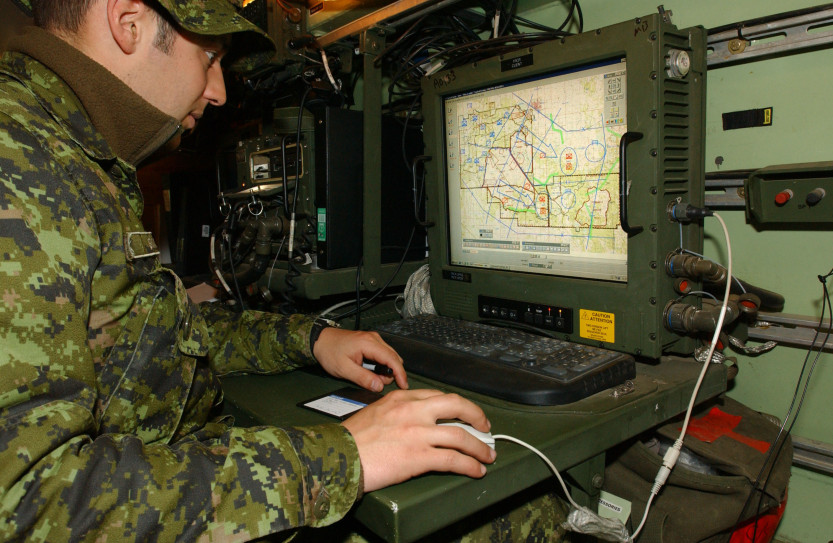
But the bigger threat, by far, is a brigade command post that looks like this …
… than like this:
April 18, 2003, Wainwright, Alberta
Captain Jeremy Small, the Signals Officer with the First Battalion of the Royal Canadian Regiment (1 RCR)(Petawawa, Ontario), works on the Athene Tactical System (ATS) in the Command Post (CP). The ATS is a new battlefield information system being tested by 2 Canadian Mechanized Brigade Group (2CMBG) Headquarters and the 1 RCR. The digital information can be shared in a more timely fashion than the old method, which needed to be drawn by hand. The 1 RCR are part of the is part of the approximately 4,600 Canadian Forces members who are participating in the first major army training exercise of the 21st Century, from April 7 to May 2, 2003 in Wainwright, Alta. After two years of planning, co-operation, strategic resource management, and with assistance from the Air Force, the Army has created Exercise RESOLUTE WARRIOR. Fourteen combat and support units are training together in a multi-element combat environment in preparation for potential and upcoming high readiness tasks at home and abroad. This exercise is the confirmation of the skills and cohesion of the units involved and will be similar to an actual deployment.
Photo: MCpl Paul MacGregor, Canadian Forces Combat CameraThe urban battle of the future, like those of the past will be fought by rifle sections of eight to 12 soldiers, directed by platoon commanders (young, 20-something, lieutenants) overseen and supports by company and battalion commanders. The lessons that my Regiment learned at Ortona, during the Christmas season of 1943, (and which were drummed into my head by ‘old sweats‘ 20 years later) will still apply. Generals and brigadiers and colonels may plan and guide the battle but it will be fought by captains and corporals and privates … hand-to-hand, house-by-house, street-by-street … whether it is a small city or a giant metropolis. Yes, that young soldier would love to have a little drone to see around the corner before he throws the grenade and he might even be interested in knowing that SigInt says that enemy is running low on ammo and food, but at the moment he, like all combat soldiers, must trust, mainly, in his own judgment of the situation as he, and only he, can see it.
But while the privates and corporals are fighting the battle and gathering the real intelligence about the enemy, the legal officer will be wanting to know exactly what (s)he (the rifle section commander) sees and (s)he, the legal officer, will want to advise the brigade commander (who commands 6,500 soldiers) to interfere directly with the the command decisions of the most junior leaders (section (10 soldiers) and platoon (35 soldiers) commanders) and with the control decisions being made by company (125 soldiers) and battalion (900 soldiers) commanders. Good brigade commanders will resist that pressure and they will, equally, close their ears to the urgent warnings of the Public Affairs officer who will say something like “if this goes wrong the Minister will be embarrassed and that will cost you your next star.”

Comments Off on Doing military intelligence … backwards
August 3, 2018
Australian women and the military
Like many other western nations, the Australian government has mandated higher quotas for women in the Australian Defence Forces (ADF), and it’s the military’s job to make it work:

The Australian Defence Force (ADF) is comprised of the three military services: the Royal Australian Navy, the Australian Army, and the Royal Australian Air Force, all of which have been subject to increasing criticism in recent years for being dominated by straight white men. This, it is alleged, makes them, ipso facto, a petri dish for ‘toxic masculinity.’ That allegation has been lent apparent weight by the reporting of multiple gender-related scandals including the ADFA sex scandal, Jedi Council, various hazing rituals, death symbols, and HMAS Success, to name a few.
Some of this criticism has been so strident that past and present military leaders have had no choice but to commission reports and inquiries into standards and practices within the ADF, and to implement various culture change initiatives including Pathway to Change, New Generation Navy, Adaptive Army, and New Horizon. All of these initiatives place significant emphasis on greater integration of women into the respective services but offer limited reasoning other than catch-phrases like ‘diversity,’ ‘equity,’ and ‘modernising.’
All three services are now working toward a target of female representation by 2023. The Navy and Air Force are working toward 25 percent, and the Army is working toward 15 percent. The progress toward these targets, among other commentary on gender issues in the ADF, is detailed in the annual “Women in the ADF” report.
[…]
Concerns with preferential treatment do not end at the recruitment process. Fitness standards for service personnel also differ according to gender, as well as service and age. This means equally-aged men and women in each service are expected to attain different standards of fitness. This, in itself, represents a challenge since both genders complete fitness tests together and are therefore directly exposed to this double-standard from their first day of service. In spite of this policy, many servicewomen elect to continue their fitness assessment to the same level as their male colleagues which is one small contribution to reducing the cultural divide.
The rejection of preferential treatment in the ADF is not just isolated to annual fitness tests. In fact, the 2012 “Review into the Treatment of Women in the Australian Defence Force” led by then-Australian Sex Discrimination Commissioner Elizabeth Broderick includes the following passage:
ADF women strongly believe that when they are singled out, it makes it harder for them to fit in. Highly resistant to any initiative being directed solely at them, ADF women view identical—not differential—treatment as the path to delivering equality. This is most likely in part to avoid the backlash that inevitably trails any treatment perceived as ‘preferential’…
Despite acknowledging this, many of Broderick’s recommendations included gender-specific initiatives that risk being perceived as further preferential treatment, driving a greater wedge between male and female ADF personnel. Perhaps the most troubling recommendation is the targeted recruitment and transfer of women to male-dominated professions that have less female uptake. In practise, this risks techniques akin to coaxing in the recruitment process if these roles are not the preferred choice of female candidates.
Comments Off on Australian women and the military
The obscure, almost-forgotten campaign that ended the First World War
It’s often called the “Hundred Days”, but even for people who stayed awake in their high school history classes, that’s often taken to refer to the last hurrah of Napoleon between his escape from Elba and his ultimate defeat at Waterloo. The WW1’s Hundred Days began with the Allied victory at the battle of Amiens and ended with the Armistice on 11 November, 1918. On Twitter, Engaging Strategy shared a series of tweets about this campaign and how little is generally remembered about it:
Comments Off on The obscure, almost-forgotten campaign that ended the First World War
July 27, 2018
Ludendorff’s Last Swing I THE GREAT WAR Week 209
The Great War
Published on 26 Jul 2018All of Germany’s recent offensives have been building up to Operation Hagen: An offensive in Flanders that was to divide the Allies and drive the British off the continent. But this week German High Command realizes that they don’t have the manpower left to even start the offensive.
Comments Off on Ludendorff’s Last Swing I THE GREAT WAR Week 209
Urban Combat – Room Breaching & Clearing – US Army (2011)
Military History Visualized
Published on 10 Mar 2017This video gives a brief overview on room breaching and clearing techniques based on the US Army Field Manual FM 3-06.11 from June 2011.
Military History Visualized provides a series of short narrative and visual presentations like documentaries based on academic literature or sometimes primary sources. Videos are intended as introduction to military history, but also contain a lot of details for history buffs. Since the aim is to keep the episodes short and comprehensive some details are often cut.
» SOURCES «
Headquarters, Department of the Army: ATTP 3-06.11 (FM 3-06.11) – Combined Arms Operations in Urban Terrain (June 2011)
Headquarters, Department of the Army: FM 3-21.8 – The Infantry Rifle Platoon and Squad (March 2007)
Comments Off on Urban Combat – Room Breaching & Clearing – US Army (2011)
July 24, 2018
The Amazing Life of Ulysses S. Grant
PragerU
Published on 2 Jul 2018No American led a more eventful life than Ulysses S. Grant, the 18th President of the United States and the Union Army’s most celebrated general. Garry Adelman, director of history and education at the Civil War Trust, tells Grant’s amazing story in this inspiring video.
Donate today to PragerU! http://l.prageru.com/2eB2p0hThis video was made in partnership with the American Battlefield Trust. Learn more about the Civil War and America’s Battlefields at: https://goo.gl/mmJMPk
Comments Off on The Amazing Life of Ulysses S. Grant


