… the great British strategist, one of the “fathers” of modern armoured-mechanized-mobile warfare, Major General JFC “Boney” Fuller, wrote in the mid 1930s called Generalship: Its Diseases and Their Cure: A Study of the Personal Factor in Command. In it Fuller was harshly critical of what he saw as an old, fat (quite literally) and out of touch military command structure that was intent on fighting the last war, or even the one before that, and was unable to innovate or accept change. Too many generals, he suggested, were physically and mentally unfit for the stresses of modern war, they could not “rough it” with soldiers and actually needed to be in nice warm chateaux behind the lines while soldiers and colonels fought in the mud. This is related to something that the brilliant British soldier-scholar Field Marshal Lord Wavell said in his comments on “generalship:” commanders need to be “robust … able to withstand the shocks of war.” Fuller, especially, went to great lengths, and back two thousand plus years in history, to say that wars and military leadership require physical and mental vigour and that young people, often very young people can master both war and leadership. I suspect that both Fuller and Wavell would look at our modern Canadian Army, especially at our seasoned, experienced and relatively old sergeant section and tank commanders and so, “No, no, no! You’re wasting all that good training and experience at too low a level. Section commanders need only half that much training; those sergeants should be doing more and more important things.”
I believe that we, the Canadian public, need and deserve a more efficient and cost effective Army, and one way to make it so is to lower the ranks of junior leaders: tank and rifle section and tank troop and rifle platoon commanders. It should be harder but quicker for young soldiers to achieve the ranks of lance corporal, corporal and master corporal and command a tank or a rifle section ~ but the corporals and master corporals should be paid more. Junior officers should spend longer in the ranks of second lieutenant and lieutenant, and be paid more, while they are given the opportunities to master the basics of their profession. If you have first rate platoon commanders you’ll get good generals without too much trouble … if you don’t have a plentiful supply of really good tank troop and rifle platoon commanders then good generals will only appear now and again, by happy accident.
Ted Campbell, “The foundation (2)”, Ted Campbell’s Point of View, 2017-02-21.
November 11, 2018
QotD: “Chateau” generals and the modern Canadian Army
November 10, 2018
War Graves: Honouring the Fallen of the First World War | The Tank Museum
The Tank Museum
Published on 2 Nov 2018On a visit to the Cambrai Memorial to the Missing at Louverval, Curator David Willey took the opportunity to explore the Allied First World War graves. In this video he explains how they were set up by the Commonwealth War Graves Commission during WW1 and why they look the way they do.
SUBSCRIBE to The Tank Museum YouTube channel: ► http://www.youtube.com/channel/UChl-X…
Support the work of The Tank Museum on Patreon: ► https://www.patreon.com/tankmuseumVisit The Tank Museum SHOP: ►https://tankmuseumshop.org/
Press the little bell above to enable NOTIFICATIONS so you don’t miss the latest Tank Museum videos.
Twitter: ► https://twitter.com/TankMuseum
Tiger Tank Blog: ► http://blog.tiger-tank.com/
Tank 100 First World War Centenary Blog: ► http://tank100.com/ #tankmuseum #tanks
November 7, 2018
Romagne 14-18 Museum Tour
Forgotten Weapons
Published on 4 Nov 2018http://www.patreon.com/ForgottenWeapons
Jean-Paul de Vries runs a very interesting private World War One museum in the village of Romagne-sous-Montfaucon in the Meuse region of northeastern France. It is the exact opposite of typical modern museums, as it has a massive number of artifacts on display with almost no printed explanation. It is also unusual in displaying almost exclusively recovered artifacts of the war, the majority of them have been left on the fields or buried for decades. You will not find new specimens here; you will find remnants of war and weather.
That may sound dreary to some, but to me it is a very interesting way to approach the war and its history. You know that every item in this museum was actually used on the field of battle, and that can provide some interesting insights. For example, the American .30-06 Chauchat automatic rifles here indicate, contrary to most printed sources, that those guns were actually used in combat actions by American soldiers and not just for training. Tired of museums that have great open rooms with a single item on a glass case in the center? Then this is one place you will really appreciate!
The museum is an entirely private operation, and includes a small restaurant for sandwiches and such, and a shop offering books, reproduction items, and original artifacts for sale. If it located near the huge American Meuse-Argonne Cemetery, and I would highly recommend it to anyone traveling in the area with an interest in the Great War.
You can see the museum’s web site here:
https://romagne14-18.com/index.php/en/
Contact:
Forgotten Weapons
PO Box 87647
Tucson, AZ 85754
When A British Army Officer Tries A US Ration Pack… | Forces TV
Forces TV
Published on 16 Oct 2018They say an Army marches on its stomach, but who gets the best deal out of British and US troops? One British Army Major has been taste-testing an American ration pack to find out…
Subscribe to Forces TV: http://bit.ly/1OraazC
Check out our website: http://forces.net
Twitter: https://twitter.com/ForcesNews
November 6, 2018
George Patton & Douglas MacArthur In World War 1 I WHO DID WHAT IN WW1?
The Great War
Published on 5 Nov 2018Check out Dessert Operations: http://bit.ly/TheGreatWar_DO
George S. Patton and Douglas MacArthur both served as senior officers in the First World War 1, a conflict that shaped their understanding of military strategy and tactics and formed them into the men that would become legends 20 years later.
November 4, 2018
Why did Soldiers Fight in Colorful Uniforms? | Animated History
The Armchair Historian
Published on 12 Oct 2018Sources:
Barnes, Major R. Money, A History of the Regiments and Uniforms of the British Army, London:
Sphere Books Limited, 1972
Carman, W.Y., Richard Simkin’s Uniforms of the British Army; Infantry, Royal Artillery, Royal
Engineers and other corps, Exeter, England: Webb & Bower, 1985
Chandler, David (Gen.Ed.), The Oxford Illustrated History of the British Army, Oxford: Oxford
University Press, 1994
Mollo, John, Military Fashion, New York, G.P. Putnam's Sons, 1972
www.warhistoryonline.com
Polybius, Histories, (www.perseus.tufts.edu)
https://www.warhistoryonline.com/hist…
Andrew Knighton
https://www.warhistoryonline.com/napo…
Andrew Knighton
The body of this video runs from 0:22 to 5:15. The rest is an extended ad, should you wish to avoid it.
One argument for the adoption of standardized uniforms in the 17th century was to help reduce straggling while the armies were on the move, and to limit desertion (individuals in their bright uniforms were quite visible if they were separated from the rest of their unit). Both straggling and desertion were significant problems for many armies during this period.
October 28, 2018
QotD: Revolutionary price controls and the plight of Washington’s army at Valley Forge
By the end of 1775, Congress had already increased the nation’s money supply by 50 percent in less than a year, and state paper issues had already begun in New England. The Congressional Continental bills followed what was to become a sequence all too familiar in the western world: runaway inflation. As paper money issues flooded the market, the dilution of the value of each dollar caused prices in terms of paper money to increase; since this included the prices of gold, silver, and foreign currencies, the value of the paper money declined in comparison to them. As usual, rather than acknowledge the inevitability of this sequence, the partisans of inflationary policies urged further accelerated paper issues to overcome the higher prices and searched for scapegoats to blame for the price rise and depreciation. The favorite scapegoats were merchants and speculators who persisted in doing the only thing they ever do on the market: they followed the push and pull of supply and demand. In another familiar attempt to deal with the problems of inflationary intervention, they outlawed the depreciation of paper, or the rise of prices.
[…]
State and local governments presumed to know what market prices of the various commodities should be, and laid down price regulations for them. Wage rates, transportation rates, and prices of domestic and imported goods were fixed by local authorities. Refusing to accept paper, accepting them for less than par, charging higher prices than allowed, were made criminal acts, and high penalties were set: they included fines, public exposure, confiscation of goods, tarring and feathering, and banishment from the locality. Merchants were prohibited from speculating, and thereby from bringing the needed scarce goods to the public. Enforcement was imposed by zealots in local and nearby committees, in a despotic version of the revolutionary tradition of government by local committees.
Price controls made matters far worse for everyone, especially the hapless Continental Army, since farmers were thereby doubly penalized: they were forced to sell supplies to the army at prices far below the market and they had to accept increasingly worthless Continentals in payment. Hence, they understandably sold their wares elsewhere; in many cases, they went “on strike” against the whole crazy-quilt system by retiring from the market altogether and raising only enough food to feed themselves and their own families. Others reverted to simple barter.
Murray N. Rothbard, Conceived In Liberty, Volume IV, 1979.
October 17, 2018
Bren vs Spandau part two
Lindybeige
Published on 31 May 2016The WW2 German fanboys didn’t like my first video on this topic, some were quite hostile. Here I explain myself even more fully.
Support me on Patreon: https://www.patreon.com/Lindybeige
Many people didn’t read the description on my last video, and so missed my dealing with most of the objections. People don’t read descriptions, so here I come back at my critics in video form. So terrified were some people to think that someone out there might be suggesting that German WW2 equipment wasn’t superb in every way, or that British equipment might have been as good as adequate, that they were very quick to misinterpret me, and to jump to wild and erroneous conclusions. Most people were not like this, and I was blessed as ever by many pleasant comments, but when a YouTuber concludes that a piece of WW2 German or medieval Japanese kit was sub-perfect, then he will face the wrath and wails of the fan-boys.
Musical stings kindly contributed by David Bevan.
Lindybeige: a channel of archaeology, ancient and medieval warfare, rants, swing dance, travelogues, evolution, and whatever else occurs to me to make.
Follow me…
Twitter: https://twitter.com/Lindybeige I may have some drivel to contribute to the Twittersphere, plus you get notice of uploads.
website: www.LloydianAspects.co.uk
October 16, 2018
Bren vs Spandau – which was better?
Lindybeige
Published on 15 May 2016The Bren gun and the Spandau were rather different, and each the prime infantry weapon of its army. Was one better?
Support me on Patreon: https://www.patreon.com/Lindybeige
After reading the comments, I shall respond with the following, because the same few points were coming up again and again:
1. The two weapons were both section MGs. This makes them comparable. The standard infantry section of a British Commonwealth infantry unit had one Bren per section, and the standard German equivalent had one Spandau. Yes, they were in other ways different weapons. That is largely my point. If they were almost identical in performance and use, then there would be no video to make. The comparison is only interesting because they were different.
2. Yes, I am well aware that there are descendants of the Spandau still around today, notably the MG 74 and MG 3. I never said otherwise. I was talking about the Bren and the Spandau in the context of WW2, when they went up against each other.
3. I say things in praise of both weapons in this video, and point out short-comings of both, and conclude that they were both fit for purpose. I reject, therefore, accusations of bias one way or the other. The usual thing one hears/reads is that the Bren was rubbish and the Spandau excellent, and the reality was more complicated than that.
4. I concede that when I mention some of the good things about one gun, it may imply to some that these things were lacking in the other. For example, I mention that it was easy to change the barrel on a Bren, which some people have mistakenly interpreted as my saying that it was awkward to change the barrel on an MG 42, which it wasn’t.
5. Yes, very obviously there were more factors than Bren guns that explain the advance of the Allies in in 1944/5 in the west. However, the point I make is that the front advanced towards Berlin every day, and this can only happen if infantry are moving forward, and taking and holding that ground. Artillery and air support cannot do this. It is also a way of countering the too-often-repeated notion that the Germans were better troops with better equipment. Yes, the best German troops were excellent, but let us not forget that they lost. If they were consistently better troops with better equipment, then they would not so consistently have lost.
6. Yes, there were differences between the MG34 and the MG42 more than simplicity of manufacture. The MG42 had a higher rate of fire, for example. I lumped them together at the start of the video for convenience. They served the same battlefield role, and were used with the same doctrine. After-action reports written at the time, and memoirs written afterwards almost never differentiate between them. Everything I say about the relative merits of Bren and Spandau are true for both MG34 and MG42, which both fired substantially faster than a Bren, and were both belt-fed.
7. The name ‘Spandau’ originally referred to the MG 08 used in World War One. It was made at the factory in Spandau, a borough of Berlin. The nick-name then got transferred to the machine guns used by the Germans in WW2. It was a misnomer in that the MG 34 and MG 42 were not made in Spandau, as I say in the video, but it is still a good word to refer to the two weapons since it is quick, clear, and was the term used at the time.
8. Yes, the MG 34 was accurate enough for purpose. Had it not been, I would have been sure to mention that. With a new and cool barrel, fired single shot, the MG34, with its double-crescent trigger, lacking in the MG42, could indeed be decently accurate. However, the barrel quickly got hot and worn, and more importantly, that was not the doctrine of use. The gun was designed to put plenty of rounds down against the enemy. Also — psychology. Give a man a gun that can spray bullets really effectively, suppressing his foes and thus keeping him safe, while making a really impressive noise, and he will use it this way, but accuracy will suffer. Give a man a slow-firing MG with a magazine of 28 rounds, and he will take careful aim and fire far fewer bullets, but with greater accuracy.
Musical stings kindly contributed by David Bevan.
Lindybeige: a channel of archaeology, ancient and medieval warfare, rants, swing dance, travelogues, evolution, and whatever else occurs to me to make.
Follow me…
Twitter: https://twitter.com/Lindybeige I may have some drivel to contribute to the Twittersphere, plus you get notice of uploads.
website: www.LloydianAspects.co.uk
October 9, 2018
The Falklands – MiniWars #1
OverSimplified
Published on 22 Oct 2017“HEY OVERSIMPLIFIED, WHERE’S WW2?!”
Don’t worry, WW2 is still coming! Here’s a little something in the meantime!If you would like to see more OverSimplified on a more regular basis, please consider supporting me on Patreon (Patreon rewards coming soon):
https://www.patreon.com/OverSimple
October 6, 2018
Development of the Panzer Arm to 1939
The_Chieftain
Published on 28 Sep 2018Synchronising in with the World War Two channel as they go over the German invasion of Poland, a discussion of how the Germans went from “Bad Germans, no tanks!” to “What hit us?” in the period between 1918 and 1939.
The written article on Panzerjager referenced: https://worldoftanks.com/en/news/chie…
To be clear, Wargaming/WoT is not involved in this video, I just mention them for background.
Selected sources:
The Challenge of Change: Winton & Mets (Chapter by Corum)
Storm of Steel: Habeck
Frieser: The Blitzkrieg Legend
Panzer Tracts: Jentz & Doyle
Interview with Panzermuseum Director Raths. (Upcoming video)
September 25, 2018
Is the UK military situation really as dire as this new book portrays?
In the Daily Mail, there’s an excerpt from a new book on the British military by Michael Ashcroft and Isabel Oakeshott, White Flag? An Examination Of The UK’s Defence Capability:
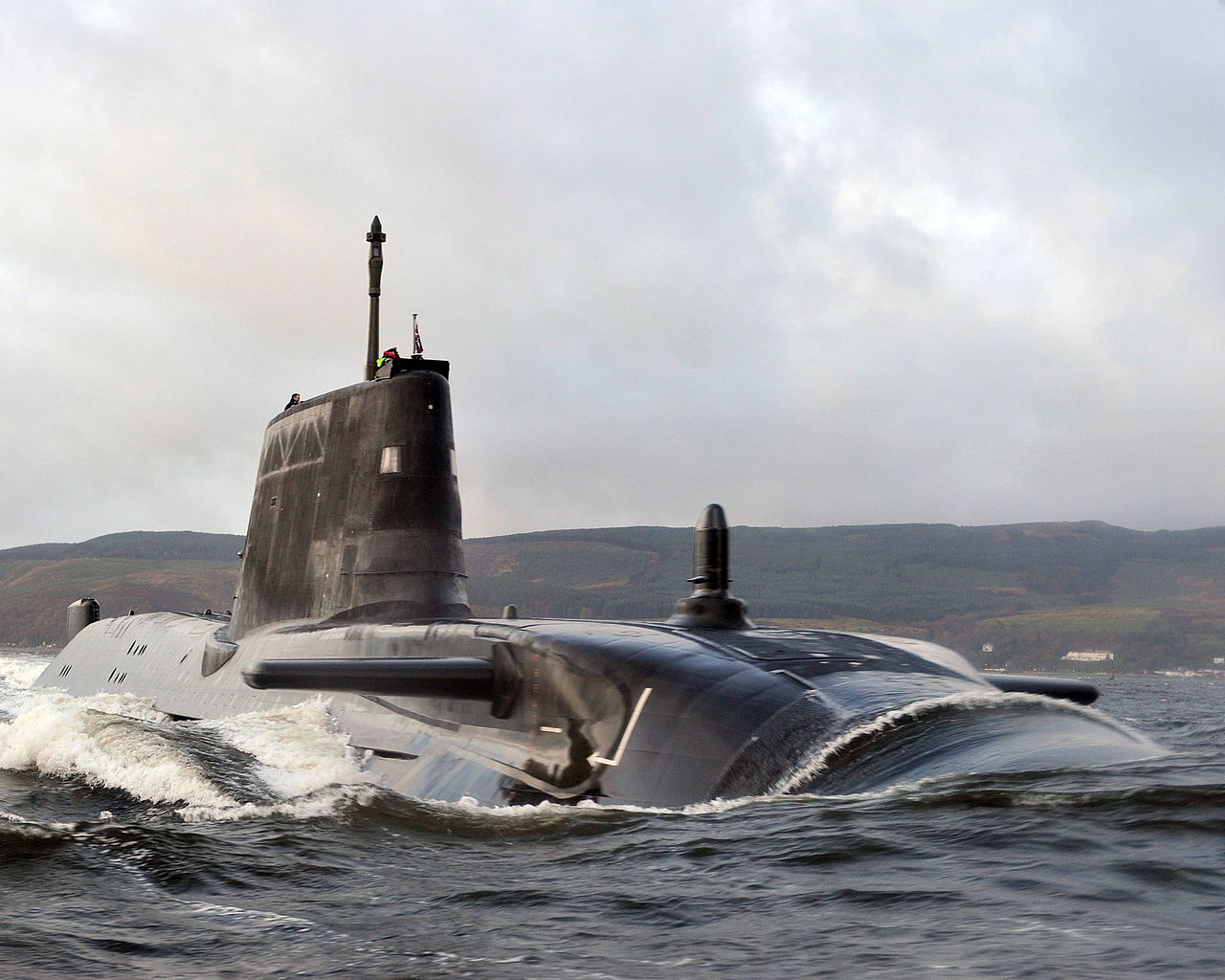
HMS Astute (S119), lead ship of her class, sails up the Clyde estuary into her home port of Faslane, Scotland.
MOD photo, via Wikimedia Commons.
Bluntly, at a time of international crisis, when the prime minister wanted to take a stand against the illegal use of chemical weapons, our Armed Forces did not have what was needed for a full-throttle response.
Naturally, ministers preferred voters to imagine that submarines were on their way to the action. The truth about our limited capability might have fuelled creeping fears that the UK has run up the white flag.
This was one of the many shocks we had during our wide-ranging investigation into the state of this country’s defence capabilities. Thanks to remorseless cuts imposed by successive governments, the Army, Navy and RAF all struggle to meet day-to-day commitments to protect this country and play their part in collective security through Nato and other defence alliances — let alone prepare for serious potential new threats.
The particular problem this time was probably down to maintenance issues.
Hulls need cleaning to stop them rusting, engines need overhauling and nuclear reactors need to be flushed.
When you don’t have very many ships, taking one or two out of circulation leaves quite a gap — in this case, one that could not be filled.
And the fact is that we don’t have enough ships any more. Or aircraft. Or tanks. Or military personnel. Not since Defence became a soft target for governments looking to cut spending.
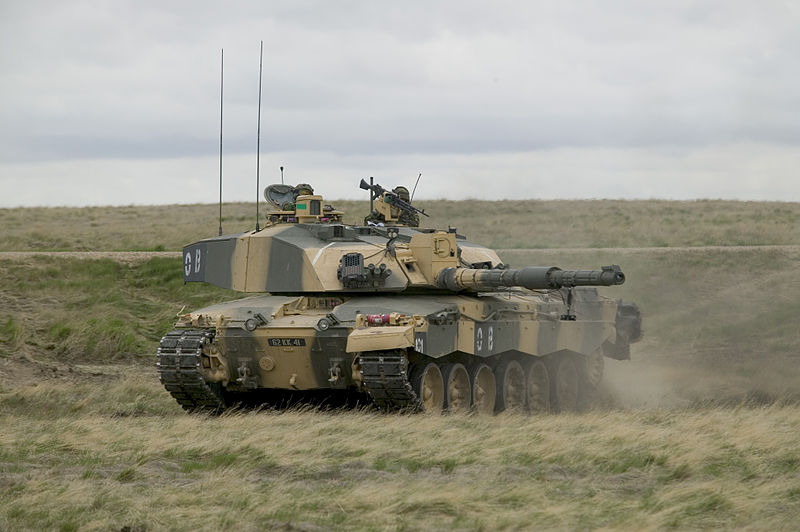
A British army Challenger 2 Main Battle Tank, of 1 Royal Regiment of Fusiliers (1RRF), is shown returning to base after completing a firing mission as part of Exercise MedMan.
1RRF Battle group were based at the British Army Training Unit Suffield (BATUS) in Canada.
MOD photo by Mike Weston via Wikimedia Commons.
What this means on the front line is illustrated by the small but fierce battalion of 800 UK troops stationed at a remote base in the Baltic state of Estonia as a crucial part of Nato’s defences against a Russian attack. They are on their guard at all times, scouring the bleak horizon for anything suspicious.
Inside a vast metal hangar is a fleet of Challenger tanks. The Army wanted to send 18 but the MoD cut this back to ten, of which only eight can be operational because two will always be in for repairs.
Asked if this would be enough if the Russians came over the border, the men we met there shrugged and laughed. They know full well that the Russians could throw as many as 22 tank battalions — that’s more than 650 tanks — at them.
A war-gaming exercise concluded that Nato forces would be ‘woefully inadequate’ in the event of an invasion: the Russians would be in Tallinn, the Estonian capital, within 60 hours.
No wonder the men themselves refer to their assignment as ‘Operation Tethered Goat’. Hopelessly outnumbered, they would be brushed aside, sacrificed to the predatory Putin, like the goat swallowed by the T. rex in Jurassic Park.
September 19, 2018
Belgian Uniforms Of World War 1 I THE GREAT WAR Special
The Great War
Published on 17 Sep 2018Visit the IJser Museum: http://www.museumaandeijzer.be/ijzert…
Indy talks to Peter Verplancke from the Museum at the former Yser front about the Belgian uniforms and their evolution during the war.
September 17, 2018
“Nazis on Drugs” – Wehrmacht & Meth – Wunderwaffe?
Military History not Visualized
Published on 17 Aug 2018There some over-blown claims out there that the “Blitzkriege” were mainly achieved due to the use of Meth (Pervitin) and that historians had ignored this issue. Is it true or false? In this video we take a look at Pervitin, the Wehrmacht, the early German victories aka “Blitzkriege” and various aspects. Was Pervitin a Wunderwaffe? Was the Wehrmacht on Meth? How long was it used? And some aspects.
September 16, 2018
A suggested re-organization for the Canadian Forces
Ted Campbell continues his series on how to reform the Canadian Forces, this time looking at the overall command and control structure:
How the nation’s armed forces should be organized is a topic of nearly endless debate amongst military people. It is no secret, I think, that I favoured the joint force structure that former Defence Minister Paul Hellyer introduced in the 1960s. I was less enamoured with his idea of functional commands, but it was hard to strike a balance. I like the American model of joint, regional commands.
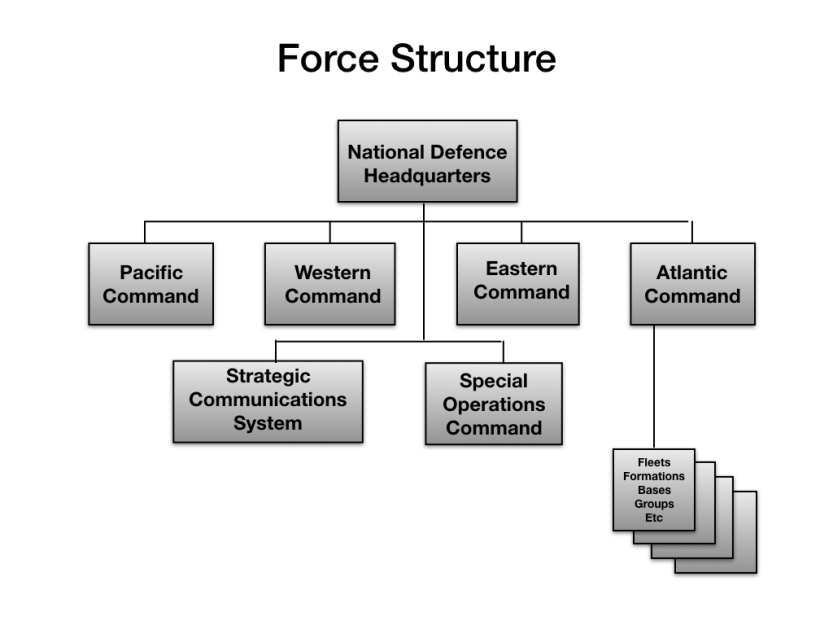
There is, almost always, a need for a few, national, functional organizations ~ for special forces and, perhaps global, strategic command, control and communications (C³) ~ but, in general, I believe that one large, national, strategic/operational HQ can control a half dozen commands, say four or five regional and two or three functional, something like this:
In my model (which reflects my deeply personal and often idiosyncratic views) the three star* Chief of the Defence Staff, in Ottawa, would command, just for example, four two star regional joint commanders (rear admirals or major generals) who would, in their turn, command almost every formation, base, depot, dockyard, base, combat ship and combat brigade, unit or wing in their geographic area. There would be a few exceptions ~ the one star officer (commodore or brigadier general, perhaps only a Navy captain or Army/RCAF colonel is needed) commanding the Strategic Communications System would command the specialized units scattered across the country and, indeed, around the world, but those units would get their day-to-day administrative and logistical support from their regional commander. Ditto for the one star officer commanding the Special Operations Command … except that he might need to have a bit more administrative and logistical power because of the nature of his business. There might be a perceived need for a separate Joint Operations (Overseas) Command but I doubt it is really necessary. The national Joint Staff (headed by a two star officer) in Ottawa can plan and direct the mounting of operations and each regional command should have a one star deputy commander who has a deployable HQ than can go, by sea and or air, to any trouble-spot in the world on fairly short notice.
In my model it seems obvious that Pacific and Atlantic Commands are going to be, primarily joint Navy/Air commands, likely, usually, commanded by a Navy rear admiral or an RCAF major general while Western and Eastern Commands will be, mainly, joint Army/Air commands, usually commanded by Army or RCAF major generals, but, if (s)he is the best person available there is no reason why an Army major general could not command Pacific Command and no reason why a Navy rear admiral could not command Western Command, for example. The commanders will have real commands, full of fighting and support forces … things like the current Canadian Forces Intelligence Command, will revert to being staff branches in the national HQ and the units will be part of the joint commands. Similarly, the Chiefs of the Naval, General and Air Staffs will be the professional heads of their services, responsible for things like doctrine, individual training standards and equipment requirements, but they will not be commanders.
[…]
* One of my critics has chided me for using the term “stars” when we, Canadians, don’t put stars on admirals’ and generals’ shoulders, rather they have maple leaves to indicate the level of their rank … fair enough, except that he is, as we used to say, “picking the fly sh!t out of the pepper” because I’m not using “slang”, as he suggests, but rather, I am using that was, when I served, and I understand is, still, common parlance in Canada and amongst our allies, including in the UK and Australia, too.