Quotulatiousness

May 24, 2010

Racy archaeology

Filed under: Economics, Europe, History — Tags: , , , — Nicholas @ 18:45

The theory is that these coins were created to ease language barriers between non-Latin speaking customers in brothels and the (often non-Latin speaking) prostitutes:

This is a spintria. They were used in ancient Rome to request and pay for different “services” in brothels and from prostitutes on the street. Since there were a lot of foreigners coming to the city that did not speak the language and most of the prostitutes were slaves captured from other places the coins made the transactions easy and efficient. One side of these coins showed what the buyer wanted and the other showed the amount of money to be paid for the act.

[. . .]

They may have been used to pay prostitutes, who at times spoke a different language. While this is subject to argument, the numbers on them line up with known prices for Roman prostitutes (University of Queensland reference). Some theorize them gaming tokens, and they may have been produced for only a short period, probably in the 1st century A.D.

So, either an innovative solution to an ongoing economic problem, or the Roman equivalent to the nudie card decks of the 1940s and 50s.

Images at the link. H/T to Radley Balko for the URL.

March 23, 2010

Anglo-Saxon hoard to stay in the Midlands

Filed under: Britain, History — Tags: , — Nicholas @ 12:18

It’s been called the greatest archaeological discovery in Britain since the second world war, and it’ll now be permanently housed near where it was discovered. The Birmingham and Stoke-on-Trent museums will share the artifacts, thanks to private fundraising and a major grant from the National Heritage Memorial Fund:

A grant of £1,285,000 from the National Heritage Memorial Fund (NHMF) will keep the glittering treasures of the Staffordshire hoard, the most spectacular heap of Anglo-Saxon gold ever found, in the region where an amateur metal detector found it last summer after it spent 1,300 years buried in a nondescript field.

[. . .]

When the find was announced in September the news went round the world. The gold was found by Terry Herbert, a passionate amateur metal detector whose best previous find was a broken piece of medieval horse harness, on farmer Fred Johnson’s land near Lichfield in July. When Herbert had covered his dining room table with gold, and was becoming thoroughly alarmed at the scale of his find, he called in the experts. The archaeologists and forensic scientists who hit the field – under the cover story from the local police that they were investigating a murder – found most of the pieces just below the surface, and some tangled in clumps of grass which had grown up through the delicate filigree gold: eventually they retrieved 2.5kg of silver and 5kg of gold. One gold-and-garnet Anglo-Saxon sword pommel would be regarded as a find of international importance: there were scores in the hoard, along with unique and enigmatic objects still baffling the archaeologists such as the wriggling gold serpents, and a biblical inscription on a strap of gold folded in half like a shirt collar.

Starkey said: “These are pieces from the period which we were brought up to call the dark ages, and they prove that it was no such thing. When the Normans invaded in 1066, they may have been better organised chaps — but it wasn’t that they were the civilised ones invading a primitive backwater, they came because they were desperate to get their hands on the wealth of Harold’s England.”

Earlier posts on this discovery here and here.

In contrast to my usual “the government has no business doing x” attitude, this is actually something in which I think the government has a valid role to play, and this is the sort of thing they should be doing in cases like this: paying a fair market value (rather than the usual governmental response, which is to expropriate, tax, or regulate).

February 23, 2010

Step aside, Stonehenge

Filed under: History, Middle East, Religion — Tags: , — Nicholas @ 07:33

Turkey is apparently the place to be for cutting-edge archaeological work:

Standing on the hill at dawn, overseeing a team of 40 Kurdish diggers, the German-born archeologist waves a hand over his discovery here, a revolution in the story of human origins. Schmidt has uncovered a vast and beautiful temple complex, a structure so ancient that it may be the very first thing human beings ever built. The site isn’t just old, it redefines old: the temple was built 11,500 years ago — a staggering 7,000 years before the Great Pyramid, and more than 6,000 years before Stonehenge first took shape. The ruins are so early that they predate villages, pottery, domesticated animals, and even agriculture — the first embers of civilization. In fact, Schmidt thinks the temple itself, built after the end of the last Ice Age by hunter-gatherers, became that ember — the spark that launched mankind toward farming, urban life, and all that followed.

Göbekli Tepe — the name in Turkish for “potbelly hill” — lays art and religion squarely at the start of that journey. After a dozen years of patient work, Schmidt has uncovered what he thinks is definitive proof that a huge ceremonial site flourished here, a “Rome of the Ice Age,” as he puts it, where hunter-gatherers met to build a complex religious community. Across the hill, he has found carved and polished circles of stone, with terrazzo flooring and double benches. All the circles feature massive T-shaped pillars that evoke the monoliths of Easter Island.

Though not as large as Stonehenge — the biggest circle is 30 yards across, the tallest pillars 17 feet high — the ruins are astonishing in number. Last year Schmidt found his third and fourth examples of the temples. Ground-penetrating radar indicates that another 15 to 20 such monumental ruins lie under the surface. Schmidt’s German-Turkish team has also uncovered some 50 of the huge pillars, including two found in his most recent dig season that are not just the biggest yet, but, according to carbon dating, are the oldest monumental artworks in the world.

February 19, 2010

Bosworth Field, real location now made public

Filed under: Britain, History — Tags: , , — Nicholas @ 12:12

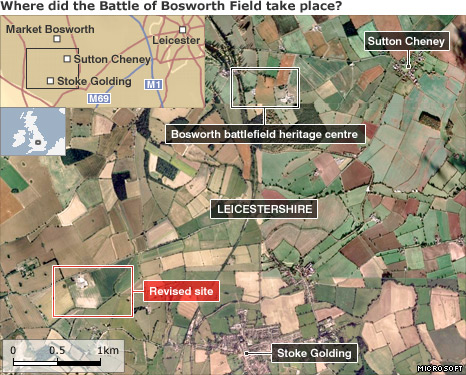
As I mentioned back in October, archaeologists have located the actual site of the Battle of Bosworth Field in 1485. Now that they’ve had time to do more research and examination, they’ve gone public with the location:

The true site of one of the most decisive battles in English history has been revealed.

Bosworth, fought in 1485, which saw the death of Richard III, was believed to have taken place on Ambion Hill, near Sutton Cheney in Leicestershire.

But a study of original documents and archaeological survey of the area has now pinpointed a site in fields more than a mile to the south west.

A new trail will lead from the current visitor centre to the new location.

[. . .]

The original announcement was made in October but the exact location was kept a secret until now to protect it from treasure hunters.

Researchers also believe they have identified the medieval marsh where Richard III was dragged from his horse and killed.

November 26, 2009

Saxon treasure trove valued at more than $6M

Filed under: Britain, History — Tags: , — Nicholas @ 08:49

The recently discovered Saxon treasure (first mentioned here) has been valued at £3.285m by the British Museum and the money will be split between the owner of the land and the man who discovered it:

The value of the 7th century hoard, the largest Anglo-Saxon gold hoard found, was set by a committee of experts.

The haul comprises 1,600 items including sword pommels, helmet parts and processional crosses.

It was discovered by 55-year-old Mr Herbert, of Burntwood, in Staffordshire, in July.

He found it on land owned by Mr Johnson, who said he had not decided how to spend the money yet.

The initial reports seemed to indicate that neither man would be allowed to benefit from the find, so it’s very good to see that this is not the case.

October 31, 2009

Bosworth Field located, finally

Filed under: Britain, History — Tags: , — Nicholas @ 00:06

It may be surprising, but the actual location of Bosworth Field, “one of the four most important battles in English history” was only definitely identifed this year:

Just after midday yesterday, Glenn Foard stood on Ambion Hill in Leicestershire, next to the award-winning Bosworth Battlefield Heritage Centre, pointed at the distant church spire of Stoke Golding and declared an end to 500 years of arguments over the location.

“It’s over there, two miles away,” he said, beyond and below the church, off to the right a bit and spread over 250 acres of what is now flat farmland, crisscrossed by hedgerows, pasture and autumnal trees.

Mr Foard, a battlefield archaeologist who has led a four-year, £1.3 million investigation into the whereabouts of the fighting, funded by the Heritage Lottery Fund and Leicestershire County Council, is convinced that he has unearthed the proof.

In an unexpected and thrilling development for the archaeologists, that proof is in the form of 22 lead cannon and musket balls that dramatically reshape thinking about late medieval combat.

September 24, 2009

Biggest Anglo-Saxon treasure find since Sutton Hoo

Filed under: Britain, History — Tags: — Nicholas @ 07:22

Amateur “metal detectorist” Terry Herbert is the discoverer of an Anglo-Saxon treasure hoard in a field in Staffordshire:

The collection contains about 5kg of gold and 2.5kg of silver, making it far bigger than the Sutton Hoo discovery in 1939 when 1.5kg of Anglo-Saxon gold was found near Woodbridge in Suffolk.

Leslie Webster, former keeper at the British Museum’s Department of Prehistory and Europe, said: “This is going to alter our perceptions of Anglo-Saxon England as radically, if not more so, as the Sutton Hoo discoveries.

“(It is) absolutely the equivalent of finding a new Lindisfarne Gospels or Book of Kells.”

A great exploit for Mr. Herbert, although the report makes what appear to be conflicting statements: “It has been declared treasure by South Staffordshire coroner Andrew Haigh, meaning it belongs to the Crown”, but also “BBC correspondent Nick Higham said the hoard would be valued by the British Museum and the money passed on to Mr Herbert and the landowner”.

I hope that the latter part is true, because if it isn’t, it will only encourage future treasure finders to conceal their discoveries in hopes of selling it off on the black market, likely destroying the historical and archaeological value of the site in the process.

« Newer Posts

Powered by WordPress


