
World War Two
Published 3 Oct 2023Occupied Paris, a paradoxical city of banality and brutality, of resistance and collaboration. Join Anna as she takes you on a tour of the city from occupation, the establishment of the Pétain regime and collaboration, the growth of resistance, and finally liberation. But the story doesn’t end there and into the 21st century, the city of lights is haunted by its occupation.
(more…)
October 4, 2023
Paris under the Swastika – Collaboration and Resistance – On the Homefront 019
Comments Off on Paris under the Swastika – Collaboration and Resistance – On the Homefront 019
September 25, 2023
Something, something “sins of the fathers”, something, something Elon Musk
Chris Bray provides an example of how “mainstream psychosis” has become the new normal, at least among academics and our so-called “elites”:
My argument is not “the news media lies”, or “there’s a lot of misleading discourse”. My argument is that whole overlapping layers of high-status America — in academia, in media, and in politics — are psychotic, fully detached from reality and living in their own bizarre mental construction of a fake world. I don’t mean this figuratively, or as colorful hyperbole. I mean that the top layers of our most important institutions are actually, literally populated by people who are insane, who have cultivated a complete mental descent through the looking glass.
So: Jill Lepore.
Lepore is as high-status as it’s possible to be. She holds an endowed chair at Harvard, she has a Bancroft, and she’s been on the masthead at the New Yorker for almost two decades. She has about as much institutional validation as an academic historian can get. And she just published an essay that wouldn’t be out of place in foot-high crayon letters on the wall of a mental institution.
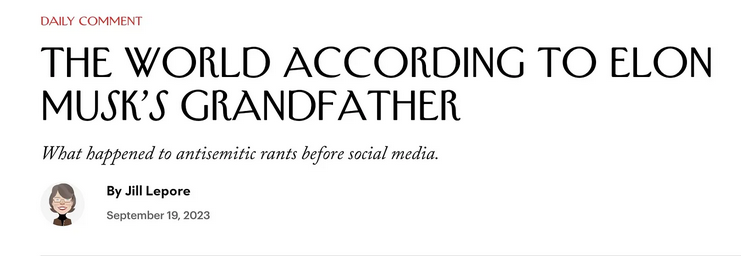
“What happened to antisemitic rants before social media”, is the actual subhed. You see, before Twitter, people who said that Jews were bad were very marginal, and no one ever listened to them. At the risk of giving away too much personal information, I’m writing this in a bar, and the bartender is giving me some fairly aggressive side-eye over the burst of nervous laughter that I just dropped. Musk’s grandfather was named J.N. Haldeman, and he wrote a lot about how much he didn’t like Jews, and here’s what Lepore has to say about that:
But Haldeman’s legacy casts light on what social media does: the reason that most people don’t know about Musk’s grandfather’s political writings is that in his lifetime social media did not exist, and the writings of people like him were not, therefore, amplified by it. Indeed, they were very unlikely to circulate widely, and are now quite rare.
Jill Lepore has a PhD in history, and she thinks that antisemitic speech was quite rare before social media. Here’s a link to a non-paywalled version of the essay, and I encourage you to go read it. Otherwise you’re going to struggle to believe me. See for yourself, and then come back and I’ll talk about it.
How, if you want to argue that negative statements about Jews had little reach before social media, do you explain … Jewish history? Why didn’t they have time for the bread to rise, Jill? Before Twitter, screeds against Jews “were very unlikely to circulate widely,” except for, I don’t know, Mein Kampf? We dip the parsley in the salt water to remember the bitter tears of our ancestors, who never faced any antisemitism because it was very marginal and never allowed to circulate widely.
It gets better, though, because Haldeman was born in Minnesota, then raised in Canada, and then moved to South Africa two years after the formal implementation of apartheid. He wrote white supremacist tracts in apartheid South Africa, and Lepore maintains that the reach of his racist literature was sharply limited by the absence of social media. See, it was very rare to be able to read racist views in apartheid South Africa.
Comments Off on Something, something “sins of the fathers”, something, something Elon Musk
July 5, 2023
QotD: The role of merchants in pre-modern societies
Merchants are a bit of a break from the people we have so far discussed in that they, by definition, live in the realm of the market (in the economic sense, although often also in a physical sense). […] so much of the world of our farmers and even our millers and bakers was governed by non-market interactions: horizontal and vertical social ties that carried expectations that weren’t quite transactional and certainly not monetized. By contrast, merchants work with transactions and tend to be the first group in any society to attempt to monetize their operations once money becomes available. I find students are often quick to feel identity with the merchant class, because these folks are more likely to travel, more likely to use money, more likely to employ or be employed in wage-labor; they feel more like modern people.
It thus tends to come as something of a surprise that with stunning consistency, the merchant class tended to be at best cordially disliked and at worst despised by the broader community (although not typically to the point of suffering legal disability, as did some other jobs; see S. Bond, Trade and Taboo: Disreputable Professions in the Roman Mediterranean (2016) for this in Rome). This often strikes students as strange, both because we tend to think rather better of our own modern merchants but also because the image they have of the merchant class certainly looks elite.
For the farmers who need to sell their crops (for reasons we will get to in a moment) and purchase the things they need that they cannot produce, the merchant feels like an adversary: always pushing his prices to his best advantage. We expect this, but remember that our pre-modern farmers are just not that exposed to market interactions; most of their relationships are reciprocal, not transactional – the horizontal relationships we discussed before. The merchant’s “money-grubbing” feels like a betrayal of trust in a society where you banquet your neighbors in the good years so they’ll help you in the bad years. The necessary function of a merchant is to transgress the “rules” of village interactions which – and this resounds from the sources – the farmers tend to understand as being “cheated”.
At the same time, while most merchant types are humble, the high-risk and potentially high-reward involved in trade meant that some merchants (again, a small number) could become very rich. That, as you might imagine, did not go over well for the traditionally wealthy in these societies, the large landholders. Again, the values here often strike modern readers as topsy-turvy compared to our own, but to the elite large landholders (who dominate the literary and political culture of their societies), the morally correct way to earn great wealth is to inherit it (or capture it in war). The morally correct way to hold that wealth is with large landed estates. Anything else is morally suspect, and so the idea that a successful merchant could – by a process that again, strikes the large landholder, just like the small farmer, as “cheating” – leap-frog the social pyramid and skip to the top, without putting in the work at either having distinguished wealthy ancestors or tremendous military success was an open insult to elite values. Often laws were put in place to limit the ability of wealthy non-aristocrats (likely merchants or successful artisans) from displaying their wealth (sumptuary laws) so as to keep them from competing with the aristocrats; at Rome, senators were forbidden from owning ships with much the same logic (Roman senators being clever, they still invested in trade through proxies while at the same time disapproving of the activity in public politics).
[…] As far as elites were concerned, merchants didn’t seem to produce anything (the theory of comparative advantage which explains how merchants produce value without producing things by moving things to where they are most valued would have to wait until 1776 to be mentioned and the early 1800s to be properly explained) and so the only explanation for their wealth was that they made it by deception and trickery, distorting the “real” value of things (this faulty assumption that the “real value” of things is inherent in them, or a product of their production, rather than their use value to an end user or consumer, does not go away in the modern period).
Merchants also – almost by definition being foreigners in their communities – often suffered as members of “middleman minorities“, where certain tasks, particularly banking, commerce and tax collection are – for the reasons just discussed above – outsourced to foreigners or ethnic minorities who then tend to face violence and discrimination because of the power and prominence those tasks give them in society. Disdain for merchants was thus often packaged with ethnic hatred or racism – anyone exposed to the tropes of European or Near Eastern antisemitism (or more precisely, anti-Jewish sentiment) is familiar with this toxic brew, but the same tropes were applied to other middlemen minorities engaged in trade – Chinese people in much of South East Asia, Armenians in Turkey, Parsis in India and on and on. Violence against these groups was always self-destructive (in addition to being abhorrent on its face) – the economic services they provided were valuable to the broader society in ways that the broader society did not understand.
Bret Devereaux, “Collections: Bread, How Did They Make It? Part IV: Markets, Merchants and the Tax Man”, A Collection of Unmitigated Pedantry, 2020-08-21.
Comments Off on QotD: The role of merchants in pre-modern societies
June 1, 2023
Banning Roger Waters would be playing his game
In Spiked, Daniel Ben-Ami explains why we should reject the arguments about banning Roger Waters, formerly the frontman for Pink Floyd, and lately a pretty out-there antisemite:

Screencapture from a YouTube video.
Pressure is mounting to ban Roger Waters from performing in Britain. The former Pink Floyd frontman and veteran anti-Israel activist stands accused of anti-Semitism. But whatever one makes of Waters’s antics, his performances should not be cancelled.
Waters is set to perform his first UK show tonight in Birmingham, with further concerts scheduled for Glasgow, London and Manchester. These are part of his controversial “This Is Not a Drill” tour, which began its European leg a few months ago. The show contains a number of controversial elements, such as Waters dressing up in a Nazi-style uniform and brandishing a gun, while Anne Frank’s name is projected above the stage. In past tours, he has floated an inflatable pig with a Star of David on it above the stage.
The Waters row came to a head earlier this month, when local authorities in Frankfurt attempted to ban his concert. The ban was successfully challenged by Waters in court and the concert went ahead, despite protests. Waters is now being investigated by the German police for wearing a Nazi-style uniform on stage at his Berlin gig (the display of Nazi symbols is illegal in Germany, except for educational or artistic purposes). According to Waters, he donned the uniform not to endorse Nazism, but in order to make a “scathing critique” of it.
Jewish community organisations in the UK have condemned Waters, with some calling for him to be censored. The Board of Deputies of British Jews has argued that his concerts are probably better described as political rallies. The National Jewish Assembly has called on the UK government to condemn Waters. The Campaign Against Antisemitism, a volunteer-led charity, has not only launched a petition to stop venues hosting him – it has also written to cinema chains demanding they cancel film screenings of his concerts.
[…]
There are also more practical reasons to challenge these attempts to cancel Waters. The campaign against him, first in Germany and now in Britain, has allowed Waters to present himself as a free-speech martyr. To some, this will lend credence to his dubious claim that he is the victim of shadowy, covert forces determined to silence his advocacy for the oppressed.
Besides, banning displays of anti-Semitism does not make the problem go away. On the contrary, it only encourages anti-Semitism to take on more disguised forms. This often includes the demonisation of Israel or of Zionism, rather than Jews as such. Even those who do genuinely hate Jews will rarely admit to it openly. Instead, they typically use coded language, which is harder to challenge and confront.
By all means, protest outside Waters’s concerts and challenge his outrageous antics. But the attempts to ban his concerts are an affront to freedom. And they will do nothing to help the struggle against anti-Semitism. Roger Waters must have the right to perform.
Comments Off on Banning Roger Waters would be playing his game
April 10, 2023
The ADL would like to warn you away from that dangerous source of information, Substack
Chris Bray doesn’t seem to be taking the ADL’s dire warnings seriously here:
The ADL has written a much-discussed hit piece about Substack …
Substack, a subscription-based online newsletter platform for independent writers, continues to attract extremists and conspiracy theorists who routinely use the site to profit from spreading antisemitism, misinformation, disinformation and hate speech.
… and I’m grateful. It’s gloriously stupid and clumsy, and shows how the braindead disinformation racket works. If you read Jacob Siegel’s important examination of the disinformation hoax in Tablet, and then read the ADL’s laugh-out-loud stupid article about Substack, you’ll be inoculated. You’ll be a dead end for this mind virus. See, this discussion is a vaccine, and that means it’s good and you can’t ever question it.
Start with the headline:
So the opening claim, the frame the headline establishes as you wade into the text, is that this is an exposé of antisemitism, of people — like Nazis! — who hate Jews. Substack is a Nuremberg rally, y’all, and Leni Riefenstahl has the film rights. The topic of the piece is hate and bigotry. And then the text says things like this:
1.) Antisemitism is on Substack!
2.) For example, Steve Kirsch criticizes Covid vaccines.
Pretty sure Steve Kirsch is Jewish, by the way, and listed alongside other monsters who publish on the Jew-hating platform Substack. Also a vicious hater writing on the antisemitic platform, as the ADL warns us: Chaya Raichik (of Libs Of TikTok fame), an orthodox Jew. I’m not a technical expert, but this may be poor form for antisemitic publishing. “Anti-Papist mob to publish G.K. Chesterton box set”.
The lumping in of this thing, this thing, and this entirely other thing is a way to dirty up a bunch of Not X by reference to X, warning about antisemitism at the top and then delivering text about people who criticize pharmaceutical products. This website hosts people who love terrorism, genocide, and baking. For example, cupcakes.
Second, and this amazes me, the ADL piece — in 2023! — runs on the premise that the line between good information and dangerous disinformation is perfectly clear and eternally unchanging. Steve Kirsch writes “anti-vaccine conspiracy theories”. See, and not one of those have ever proved to be true. What we think is true now about mRNA vaccines in the spring of 2023 is exactly what we believed in March of 2020. Truth never changes, and no ambiguity ever exists in any scientific question. No debate is ever real or reasoned. No skeptic has ever turned out to be right about anything, ever, on any topic in any field, like eugenics and phrenology. This narrative approach, the rhetorical equivalent of watching a writer hit himself in his own drooling face with a boot, is why every person of ordinary good sense sighs heavily at the first sign that someone claims status as a disinformation expert.


Comments Off on The ADL would like to warn you away from that dangerous source of information, Substack
April 7, 2023
QotD: The effluvium of the university’s overproduction of progressive “elites”
What became of them? No single answer is possible. They joined the work force. Some became baristas, tech supporters, Amazon staffers and real estate agents. Others with intellectual ambitions found positions with the remaining newspapers and online periodicals, but most often they landed jobs as writers or researchers with liberal government agencies, foundations, or NGOs. In all these capacities they brought along the sensibilities and jargon they learned on campus.
It is the exodus from the universities that explains what is happening in the larger culture. The leftists who would have vanished as assistant professors in conferences on narratology and gender fluidity or disappeared as law professors with unreadable essays on misogynist hegemony and intersectionality have been pushed out into the larger culture. They staff the ballooning diversity and inclusion commissariats that assault us with vapid statements and inane programs couched in the language they learned in school. We are witnessing the invasion of the public square by the campus, an intrusion of academic terms and sensibilities that has leaped the ivy-covered walls aided by social media. The buzz words of the campus — diversity, inclusion, microaggression, power differential, white privilege, group safety — have become the buzz words in public life. Already confusing on campus, they become noxious off campus. “The slovenliness of our language”, declared Orwell in his classic 1946 essay, “Politics and the English Language“, makes it “easier for us to have foolish thoughts.”
Orwell targeted language that defended “the indefensible” such as the British rule of India, Soviet purges and the bombing of Hiroshima. He offered examples of corrupt language. “The Soviet press is the freest in the world.” The use of euphemisms or lies to defend the indefensible has hardly disappeared: Putin called the invasion of Ukraine “a special military operation”, and anyone calling it a “war” or “invasion” has been arrested.
But today, unlike in 1946, political language of Western progressives does not so much as defend the indefensible as defend the defendable. This renders the issue trickier than when Orwell broached it. Apologies for criminal deeds of the state denounce themselves. Justifications for liberal desiderata, however, almost immunize themselves to objections. If you question diversity mania, you support Western imperialism. Wonder about the significance of microaggression? You are a microaggressor. Have doubts about an eternal, all-inclusive white supremacy? You benefit from white privilege. Skeptical about new pronouns? You abet the suicide of fragile adolescents.
Russell Jacoby, “The Takeover”, Tablet, 2022-12-19.
Comments Off on QotD: The effluvium of the university’s overproduction of progressive “elites”
January 28, 2023
QotD: Allied anti-semitism in WW2
The following leaflet (printed) was passed to an acquaintance of mine in a pub:
LONG LIVE THE IRISH!The first American soldier to kill a Jap was Mike Murphy.
The first American pilot to sink a Jap battleship was Colin Kelly.
The first American family to lose five sons in one action and have a naval vessel named after them were the Sullivans.
The first American to shoot a Jap plane was Dutch O’Hara.
The first coastguardsman to spot a German spy was John Conlan.
The first American soldier to be decorated by the President was Pat Powers.
The first American admiral to be killed leading his ship into battle was Dan Callahan.
The first American son-of-a-bitch to get four new tyres from the Ration Board was Abie Goldstein.The origin of this thing might just possibly be Irish, but it is much likelier to be American. There is nothing to indicate where it was printed, but it probably comes from the printing-shop of some American organization in this country. If any further manifestos of the same kind turn up, I shall be interested to hear of them.
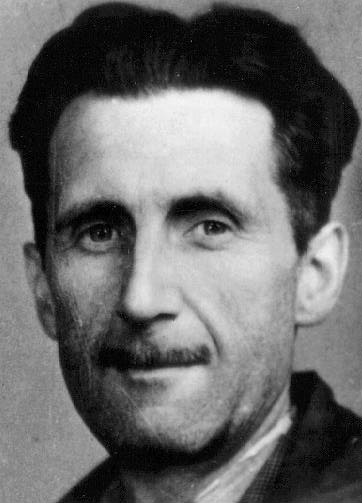
George Orwell, “As I Please”, Tribune, 1944-12-08.
Orwell’s press card portrait, 1943
Comments Off on QotD: Allied anti-semitism in WW2
January 18, 2023
L’affaire Dreyfus
Robert Zaretsky on an espionage scandal that convulsed the French Third Republic and still has resonance down to today:
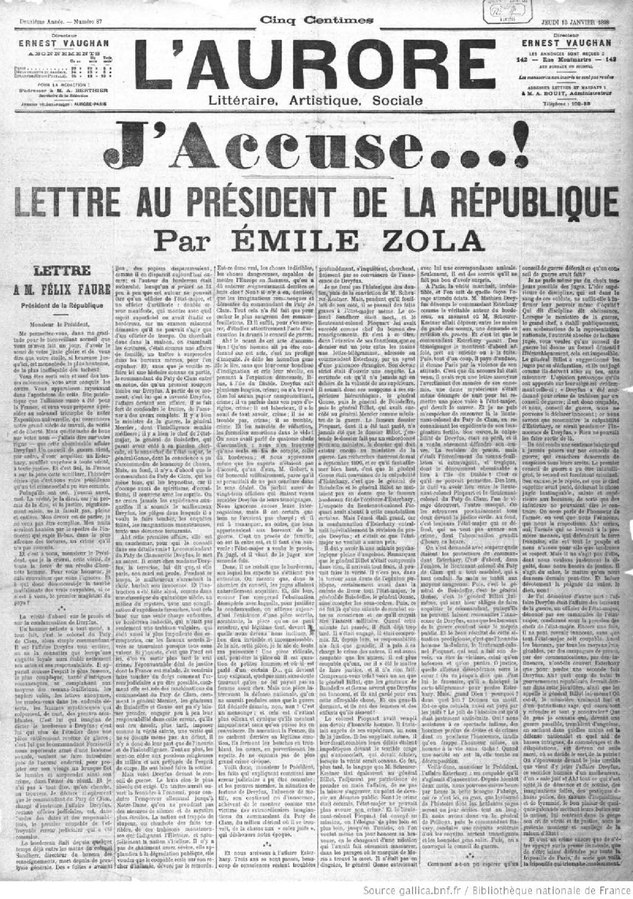
Front page of L’Aurore for 13 January, 1898 with Zola’s J’Accuse headline.
Wikimedia Commons.
On January 13, 1898, Parisians awoke to the chorus of hundreds of news criers who, striding along the grand boulevards and brandishing copies of the newspaper L’Aurore, were shouting passages from the article that sprawled across the front page. It had originally been titled by its author, the novelist Émile Zola, “A Letter to M. Félix Faure, President of the Republique”. But with a flair for the sensational, the newspaper’s editor, Georges Clemenceau, slapped on a punchier headline. Stepping out of a department store or stepping down from a carriage, sitting at a café or standing at an intersection, pedestrians were greeted by two words that continue to resonate 125 years to the day after their first publication: “J’Accuse!”
With this exclamation, Zola’s letter transformed une affaire judiciare into l’affaire Dreyfus or, more simply, the Dreyfus Affair. It catapulted the French novelist onto the world stage at a critical moment in the history of his country, which was reeling from the forces of globalisation and industrialisation and riven by opposing understandings of its revolutionary heritage. It is thus hardly surprising that Zola’s fame rests more heavily on the letter than on his sweeping 20-volume masterpiece of literary realism, the Rougon-Macquart. It took a novelist to heave the facts of this affair into a narrative which, more than a century later, thrums with equal urgency. Moreover, as with the novels of the Rougon-Macquart, the letter thrusts onto centre-stage a lone individual swept up, and all too often swept under, the political and social, irrational and ideological forces of the modern age.
It all began with the contents of a rubbish bin. In September 1894, a cleaning woman at the German Embassy, in the pay of France’s military intelligence service, delivered her nightly harvest to her employers. Buried in the mound of discarded papers was a memorandum, known as the bordereau or note, revealing top secret advances in French artillery technology and tactics. In a frantic scramble to find its author, the war ministry’s suspicion settled on Captain Alfred Dreyfus, an officer in the High Command who stood out for his standoffishness and Jewishness.
Upon being arrested and charged, a bewildered Dreyfus denied the charges, pointing out several things mentioned in the bordereau he could not possibly have known. The seven members of the military tribunal, ignoring these inconsistencies as well as the insistence of their own graphologist that Dreyfus’s handwriting did not match the bordereau‘s, unanimously found him guilty. He was sentenced to life imprisonment in solitary confinement on Devil’s Island, a malarial rock off the coast of French Guyana.
But first came a remarkable ritual of public humiliation. Dreyfus was marched into the courtyard of the École militaire, the renowned military academy a short distance from the recently erected Eiffel Tower. In the shadow of that monument to modernity, an officer preceded to snap Dreyfus’s sword — broken and soldered back together with tin the night before, to make the gesture seem effortless — and tear off his insignia — whose threads were already loosened — while a dense crowd howled with calls for the death of the “Jewish traitor!”
Two years later, as Dreyfus wasted away in solitary confinement, Colonel Georges Picquart, the newly appointed head of military intelligence, found that another missive about French military plans had ended up in the rubbish bin at the German Embassy. Moreover, the handwriting on this new document, which matched that of the bordereau, also matched the hand of Ferdinand Esterhazy, an officer notorious for his womanising and gambling.
Picquart disliked Jews as much as his many of his fellow officers did. But when his commanding officer asked him why it mattered if “this Jew remains on Devil’s Island”, Picquart replied: “Because he is innocent!” The answer earned Picquart a rapid transfer to a desert outpost in North Africa. Before he was packed off, though, Picquart vowed that he would not “carry this secret to my grave”. He then shared what he knew with Auguste Scheurer-Kestner, the leader of Dreyfusards, a small but growing coterie of politicians and writers seeking a retrial for Dreyfus.
In late 1897, Zola met with Scheurer-Kestner, who told him about Picquart’s discovery. As the mesmerised novelist listened, he glimpsed the theatrical as well as moral dimensions of the affair. “It’s thrilling!” he gasped. “It’s frightful! But it is also drama on the grand scale!” It took Zola to scale it to greatness by flipping Oscar Wilde’s sly quip that anyone could make history, but only a great man could write it. Instead, Zola showed, a man becomes truly great only by, in every sense of the word, making history.
Comments Off on L’affaire Dreyfus
December 3, 2022
The end of the old “WASP” upper class
Scott Alexander is reading Bobos in Paradise by David Brooks and summarized the first sixth of the book:
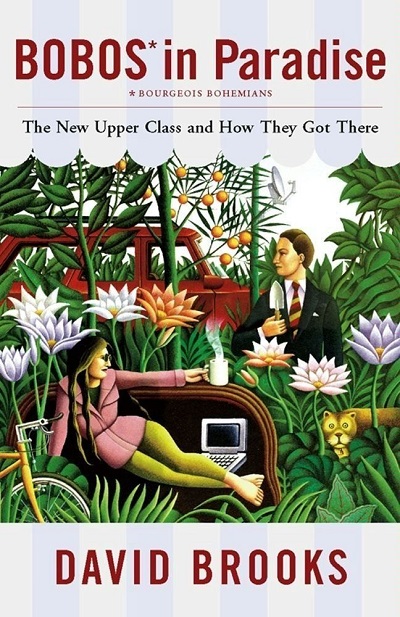
The daring thesis: a 1950s change in Harvard admissions policy destroyed one American aristocracy and created another. Everything else is downstream of the aristocracy, so this changed the whole character of the US.
The pre-1950s aristocracy went by various names; the Episcopacy, the Old Establishment, Boston Brahmins. David Brooks calls them WASPs, which is evocative but ambiguous. He doesn’t just mean Americans who happen to be white, Anglo-Saxon, and Protestant — there are tens of millions of those! He means old-money blue-blooded Great-Gatsby-villain WASPs who live in Connecticut, go sailing, play lacrosse, belong to country clubs, and have names like Thomas R. Newbury-Broxham III. Everyone in their family has gone to Yale for eight generations; if someone in the ninth generation got rejected, the family patriarch would invite the Chancellor of Yale to a nice game of golf and mention it in a very subtle way, and the Chancellor would very subtly apologize and say that of course a Newbury-Broxham must go to Yale, and whoever is responsible shall be very subtly fired forthwith.
The old-money WASPs were mostly descendants of people who made their fortunes in colonial times (or at worst the 1800s); they were a merchant aristocracy. As the descendants of merchants, they acted as standard-bearers for the bourgeois virtues: punctuality, hard work, self-sufficiency, rationality, pragmatism, conformity, ruthlessness, whatever made your factory out-earn its competitors.
By the 1950s they were several generations removed from any actual hustling entrepreneur. Still, at their best the seed ran strong and they continued to embody some of these principles. Brooks tentatively admires the WASP aristocracy for their ethos of noblesse oblige — many become competent administrators, politicians, and generals. George H. W. Bush, scion of a rich WASP family, served with distinction in World War II — the modern equivalent would be Bill Gates’ or Charles Koch’s kids volunteering as front-line troops in Afghanistan.
At their worst, they mostly held ultra-expensive parties, drifted into alcoholism, and participated in endless “my money is older than your money” dick-measuring contests. And they were jocks — certainly good at lacrosse and crew, but their kids would be much less likely than modern elites’ to become a scientist, professor, doctor, or lawyer. Not only that, they were boring jocks — they stuck to a few standard rich people hobbies (yachting, horseback riding) and distrusted creativity or (God forbid) quirkiness. Their career choices were limited to the family business (probably a boring factory with a name like Newbury-Broxham Goods), becoming a competent civil service administrator, or other things along those lines.
The heart of the WASP aristocracy was the Ivy League. I don’t think there are good statistics, but until the early 1900s many (most?) Ivy League students were WASP aristocrats from a few well-known families. Around 1920 the Jews started doing really well on standardized tests, and the Ivies suspended standardized tests in favor of “holistic admissions” to keep them out and preserve the WASPishness of the elite. All the sons (and later, daughters) of the WASPs met each other in college, played lacrosse together, and forged the sort of bonds that make a well-connected and self-aware aristocracy.
Around 1955 (Brooks writes, building on an earlier book by Nicholas Lemann) Harvard changed their admission policy. Why? Partly a personal decision by Harvard presidents James Conant, and Nathan Pusey, who sincerely believed in meritocracy. And partly because Harvard’s Jewish quota was becoming unpopular, as increased awareness of the Holocaust made anti-Semitism déclassé. Conant and Pusey decided to admit based on academic merit (measured mostly by SAT scores). The thing where Harvard would always admit WASP aristocrats because that was the whole point of Harvard was relegated to occasional “legacy admissions”, a new term for something which was now the exception and not the rule. Other Ivies quickly followed.
Brooks on the consequences:
In 1952, most freshmen at Harvard were products of … the prep schools of New England (Andover and Exeter alone contributed 10% of the class), the East side of Manhattan, the Main Line of Philadelphia, Shaker Heights in Ohio, the Gold Coast of Chicago, Grosse Pointe of Detroit, Nob Hill in San Francisco, and so on. Two-thirds of all applicants were admitted. Applicants whose fathers had gone to Harvard had a 90% admission rate. The average verbal SAT score for the incoming men was 583, good but not stratospheric. The average score across the Ivy League was closer to 500 at the time.
Then came the change. By 1960 the average verbal SAT score for incoming freshman at Harvard was 678, and the math score was 695 — these are stratospheric scores. The average Harvard freshman in 1952 would have placed in the bottom 10% of the Harvard freshman class of 1960. Moreover, the 1960 class was drawn from a much wider socioeconomic pool. Smart kids from Queens or Iowa or California, who wouldn’t have thought of applying to Harvard a decade earlier, were applying and getting accepted … and this transformation was replicated in almost all elite schools. At Princeton in 1962, for example, only 10 members of the 62-man football team had attended private prep schools. Three decades earlier every member of the Princeton team was a prep school boy.
There was a one-or-two generation interregnum where the new meritocrats silently battled the old WASP aristocracy. This wasn’t a political or economic battle; as a war to occupy the highest position in the class hierarchy, it could only be won through cultural prestige. What was cool? What was out of bounds? What would get printed in the New York Times — previously the WASP aristocracy’s mouthpiece, but now increasingly infiltrated by the more educated newcomers?
Comments Off on The end of the old “WASP” upper class
November 16, 2022
The Real Reason for Hitler’s War – WW2 Specials
World War Two
Published 15 Nov 2022The murder of the Jews of Europe is not simply conducted alongside the military and political war aims of the Third Reich. For Hitler and the Nazis, the murder of the Jews of Europe is the military-political aim of the war. It confounds all logic, but in the twisted worldview of Nazi ideology, it makes perfect sense. This is a war on the Jewry.
(more…)
Comments Off on The Real Reason for Hitler’s War – WW2 Specials
September 20, 2022
Hannah Arendt in postwar Germany
In Quillette, Roger Berkowitz discusses what Hannah Arendt found when talking to Germans after the Second World War, which she characterized as their collective “escape from reality”:
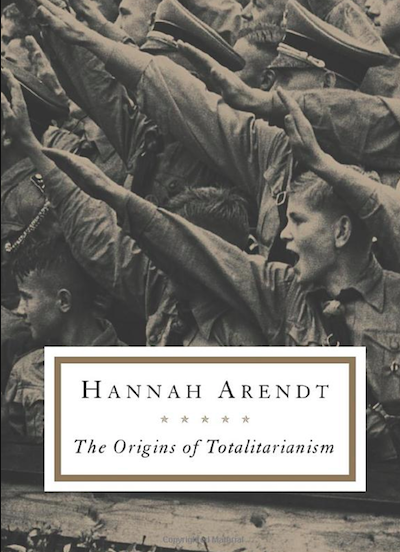
In 1949, when Hannah Arendt (1906–1975) went to Germany as part of the New York-based Jewish Cultural Reconstruction Commission, she was struck by the way the Germans showed an “at times vicious refusal to face and come to terms with what really happened”. This “escape from reality”, as Arendt named it, meant that the reality of the Holocaust and the death factories was spoken of as a hypothetical. And when the truth of the Holocaust was admitted, it was diminished: “The Germans did only what others are capable of doing”.
The Germans, at times, simply denied the facts of what had happened. One woman told Arendt that the “Russians had begun the war with an attack on Danzig”. What Arendt encountered was a “kind of gentleman’s agreement by which everyone has a right to his ignorance under the pretext that everyone has a right to his opinion”. The underlying assumption for such a right is the “tacit assumption that opinions really do not matter”. Opinions are just that, mere opinions. And facts, once they are reduced to opinions, also don’t matter. Taken together, this led to a “flight from reality”.
The focus of Arendt’s lifelong engagement with the human flight from reality was her encounter with ideologies, specifically Nazism and Bolshevism. In The Origins of Totalitarianism and other texts (especially her essay, “On the Nature of Totalitarianism“), Arendt defines an ideology as a system that seeks to explain “all the mysteries of life and the world” according to one idea. Nazism is an ideology that blames economic disaster, political loss, and the evils of modernity on the Jews — inhuman flotsam who must be exterminated to allow a master race to flourish. Bolshevism, on the other hand, “pretends that all history is a struggle of classes, that the proletariat is bound by eternal laws to win this struggle, that a classless society will then come about, and that the state, finally, will wither away”. The bourgeoisie are not simply class traitors, they are a dying class, and killing them only supports a law of history. As ideologies, both Nazism and Bolshevism insist on explaining the events of the world according to theories “without further concurrence with actual experience”. The result, Arendt argues, is that such ideologies bring about an “arrogant emancipation from reality”.
Because an ideology “looks upon all factuality as fabricated”, it “no longer knows any reliable criterion for distinguishing truth from falsehood”. As reality recedes, ideologies organize society to transform their ideas into living reality. If antisemitism as an ideology says that all Jews are beggars without passports, the fact of wealthy and established Jews must be eliminated. If Bolshevism says that the bourgeoisie are corrupt, they must admit their corruption or be killed. The realization of such ideological realities can be accomplished, of course, through terror.
But even before a totalitarian movement takes power and mobilizes the secret police in the machinery of terror, ideological movements can employ propaganda to deny and nullify facts, or change them. The Nazis, she writes, “did not so much believe in the truth of racism as desire to change the world into a race reality”. Similarly, the Bolshevist ideology that classes were dying was not something real, but something that had to be made real. The purges and terror that Stalin unleashed were supposed to “establish a classless society” by exterminating all social groups that might develop into classes. In both instances, the purpose of the ideology was to transform a mere opinion — race consciousness or class consciousness — into the “the lived content of reality”.
The point, as Arendt concludes, is that “ideological consistency reducing everything to one all-dominating factor is always in conflict with the inconsistency of the world, on the one hand, and the unpredictability of human actions, on the other”. What ideology demands is that man — an unpredictable and spontaneous being — cease to exist as such, that all humans be subjected to laws of development that follow ideological truth. That is why the turn from an unreliable reality to coherent fantasy requires an absolute elimination of human spontaneity and freedom.
Comments Off on Hannah Arendt in postwar Germany
September 16, 2022
How “misgendering” shattered the Green Party of Canada
Canada’s Green Party has never been noted for their tight party cohesion, so my use of the word “shattered” in the headline is a bit over-the-top, I must confess. Jonathan Kay provides a quick outline of the party’s history through the leadership of Elizabeth May, Annamie Paul, and most recently, interim leader Amita Kuttner:

Many grumbled that May was too slow to give up her leadership perch. Yet when she finally did step aside in 2019, the party learned that she’d been the only thing holding the outfit together. By the time the 2021 federal election rolled around, the Greens’ leader was a black Jewish woman named Annamie Paul, who got absolutely trounced in her own riding, winning fewer than 4,000 votes. Paul was then quickly run out of the party leadership during a complicated (and often farcical) internecine battle that involved public accusations of bigotry hurled in all directions, and which (predictably) repelled many of the party’s financial supporters.
On Sept. 27 I began the process of stepping down as Green Party of Canada Leader. Today I sent formal notice of my resignation to the GPC. I will also be ending my membership in the GPC.
It was an honour to work for the people of Canada and I look forward to serving in new ways.— Annamie Paul (@AnnamiePaul) November 10, 2021
One might think things couldn’t get any worse for the Greens. But, thanks to the installation of a 30-year-old interim leader named Amita Kuttner, they very much did.
Kuttner self-describes as non-binary, transgender, and pansexual. When asked, “What are your preferred pronouns?” in a 2019 interview, the one-time astrophysicist replied, “they/them”, but then elaborated as follows:
When I write my pronouns, I sometimes write all of them: they/them, she/her, he/him, because I don’t care. There will be days where I’m not always even aware of what my gender is, and I will notice it based on how someone addresses me and whether I respond. I was in choir for many years, and they’d say, “women sing now”, “men sing now”. And I would find myself starting with one or the other group, even though I was obviously supposed to sing soprano. I’d be like, “Oh, I guess I’m feeling that today.”
And yet, despite the fact Kuttner apparently can’t always figure out “what my gender is”, and claims not to “care” in any case, the interim leader felt the need to issue a lengthy statement on September 6th detailing the allegedly devastating emotional effects that ensued when the pronoun descriptor “she/elle” appeared in the electronic caption that sat alongside Kuttner’s name during a Green Party of Canada Zoom call, instead of the Kuttner-approved “they/he/ille”. Indeed, Kuttner described the ordeal as evidence that the Greens were infected by a “system of oppression”:
What happened here impacted me much more than a slip of the tongue. It made me feel hurt and isolated at a moment that should have been filled with inspiration and anticipation … This incident is reflective of a larger pattern of behaviours that a few in the party are perpetuating. Over the years, the party has documented reports which indicate a systemic issue disproportionately affecting Black, Indigenous, and racialized people and 2SLGBTQIA+ people, and I hope many more stories will be able to be shared so that this incident can be a catalyst for change … When things like this happen, people need to see those in leadership positions take some accountability, acknowledge how they have added to this system of oppression and what they must do to break the cycle.
Kuttner’s attempt to weaponize this (apparently very oppressive) instance of miscaptioning forms part of an ongoing civil war that’s been playing out for weeks within the Green leadership. That battle goes to the question of whether the party should proceed with its ongoing party leadership race, or pause it so that Green functionaries can investigate all of the (vaguely expressed) accusations of antisemitism, racism, and transphobia that were flung in every direction during the tumultuous last days of the Annamie Paul era back in 2021.
Comments Off on How “misgendering” shattered the Green Party of Canada
July 14, 2022
QotD: Fascism and anti-semitism
You can have a quite an effective totalitarianism without this; Stalin, for example, never bothered with an SS-equivalent. You can get similar developments under Communism; consider Mao’s Red Guards. And on the third hand, Franco copied that part of the formula without actually being a Fascist. Still – if you think you’ve spotted a fascist demagogue ramping up to takeover, one of the things to check is whether he’s trailing a thug army behind him ready to turn into a personal instrument of force. If he isn’t, you’re probably wrong.
Another thing that follows from the Fascist theory of power is hostility towards markets, free enterprise, and trade. Yes, yes, I know, you’ve heard all your life that fascists are or were tools of capitalist oligarchs, but this is another big lie. In reality about the last person you want to be is a “capitalist oligarch” in the way of one of Maximum Leader’s plans. Because even if he needs you to run your factories, you’re likely to find out all the ways utter ruthlessness can compel you. Threats to your family are one time-honored method. You can’t buy him, because has the power to take anything he really wants from you.
In fact, one of the reasons fascist regimes turn anti-Semitic so often is because Jews are identified with mercantile activity. Which in the Fascist view of things, is corrupting and disruptive of loyalty bonds that should be more important than wealth. Furthermore, Fascism inherited from its parent Marxism the whole critique about capitalism alienating workers from their production.
The political economics of fascism is always state-socialist, and explicitly so. This follows directly from the drive for centralization.
Eric S. Raymond, “Spotting the wild Fascist”, Armed and Dangerous, 2019-04-30.
Comments Off on QotD: Fascism and anti-semitism
July 6, 2022
QotD: Like Communism, “true” Social Credit has never been attempted
The bits of Social Credit that people in Alberta liked, amid the misery of the 1930s, were the hatred of high finance and the promise of an unearned monetary dividend. Alberta Social Credit tried to govern on this general basis, even after Douglas came to Edmonton personally and informed the cabinet that it had failed to comprehend his genius. Despite this, “Douglasite” true believers remained prominent in the party until shortly after the war, when premier E.C. Manning purged them from the Social Credit electoral apparatus. (Many were vague but obvious anti-Semites, like Douglas himself.)
Colby Cosh, “Social Credit may be dead. Long live Social Credit!”, National Post, 2019-04-22.
Comments Off on QotD: Like Communism, “true” Social Credit has never been attempted
June 16, 2022
Secret Foods of the Spanish Inquisition
Tasting History with Max Miller
Published 15 Feb 2022Support the Channel with Patreon ► https://www.patreon.com/tastinghistory
Merch ► crowdmade.com/collections/tastinghistory
Instagram ► https://www.instagram.com/tastinghist…
Twitter ► https://twitter.com/TastingHistory1
Tiktok ► TastingHistory
Reddit ► r/TastingHistory
Discord ► https://discord.gg/d7nbEpy
Amazon Wish List ► https://amzn.to/3i0mwGt
Send mail to:
Tasting History
PO Box 766
Burbank, CA 91503LINKS TO SOURCES**
A Drizzle of Honey by David M. Gitlitz and Linda Kay Davidson: https://amzn.to/3gyf0CY
The Spanish Inquisition by Henry Kamen: https://amzn.to/3B9EbVXRECIPE
1 cup (160g) dried fava beans
1 cup (180g) dried chickpeas
2 1/2 lbs or 1kg beef
¼ cup (60ml) Olive oil
1 tablespoon salt
1 large onion diced
1 quart (1L) beef broth or water
2 teaspoon ground coriander
1 1/2 tsp ground cumin
2 teaspoon ground caraway
2 teaspoon fresh ground pepper
2 Eggplant, peeled and chopped
A large handful of chard leaves1. Coat the eggplant in salt, cover, and set aside for several hours.
2. Boil the fava beans and chickpeas in a large pot for 2 minutes, then drain and set aside. In the same pot, heat half of the olive oil over medium heat then, add the onions and half of the salt and cook until lightly brown, about 8 minutes. Remove the onions and add the beef to the empty pot with the rest of the oil and salt. Cook until lightly brown, about 5 minutes. Add the onions back in as well as the beef broth/water. Bring to a simmer and cover, letting the stew simmer for 1 hour.
3. Drain and rinse the eggplant, then add it into the pot along with the fava bean, chickpeas, and spices. Cover and let cook for another 2 hours.
4. Chop the chard, then pound it flat with a rolling pin, and add it into the pot. Set the pot into the oven at 200°F and cook overnight (or at least 6 hours). Alternately, you can transfer the adafina to a slow cooker overnight. Serve alone or over rice.**Some of the links and other products that appear on this video are from companies which Tasting History will earn an affiliate commission or referral bonus. Each purchase made from these links will help to support this channel with no additional cost to you. The content in this video is accurate as of the posting date. Some of the offers mentioned may no longer be available.
Subtitles: Jose Mendoza | IG @ worldagainstjose
#tastinghistory #jewishcooking #spanishinquisition

Comments Off on Secret Foods of the Spanish Inquisition


