
The Korean War by Indy Neidell
Published 20 Jan 2026There’s discussion — and disagreement — in UN Command and Washington about whether or not to poll all the POWs the UN side holds to see where they would like to go should they be released. There are arguments for and against this, and it brings up a couple different interpretations of the Geneva Convention. This week we also talk a lot about recent medical advances in field medicine in Korea, and the development of the “Medics’ War”.
00:00 Intro
00:44 Recap
01:14 Poll the POWS
04:52 UN Decleration
08:19 52nd Medical Battalion
10:56 Cho-Do Island
11:45 Summary
12:06 Conclusion
12:49 Memorial
(more…)
January 21, 2026
The Korean War Week 83: The Medics’ War! – January 20, 1952
Comments Off on The Korean War Week 83: The Medics’ War! – January 20, 1952
We’ll resist the Yankee hordes with our … um, strongly worded tweets?
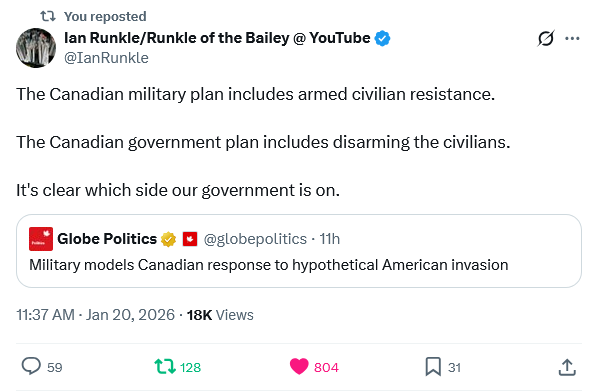
A brilliant example of the general case of progressives never taking into account the impact of their own pet schemes is the Canadian Armed Forces including “armed civil resistance” as part of their contingency planning for an American invasion … at the same time that the Canadian government is moving heaven and earth to disarm as many Canadians as possible:
Jason James writes:

Canadian military planners have modeled a potential US invasion from the south.
Their plan?
An armed civilian resistance.
I’m not sure if they’ve checked in with the Liberal government yet, but they’ve outlawed most “assault style” weapons (meaning anything that could actually be used to mount such a resistance).
And depending on where the US invades, they might have a difficult time finding civilians who actually own anything beyond kitchen knives.
Furthermore, anyone who does own hunting rifles or the few legal “assault style” weapons would be more inclined to fight on the side of the Americans than defend a socialist wasteland that sold their future to China.
So what’s the plan then? Mobilize the Mexican cartels and Chinese organized crime gangs who actually have some fire power? Form a militia of IRGC operatives and Indian drug gangs to fight American special forces?
I highly doubt any of them would be interested in walking into certain death for a country they have no allegiance to.
So I guess we’re down to a handful of lesbians and communists armed with broom handles defending Vancouver and Toronto from the greatest military power the world has ever known.
Good luck with that, comrades.
No disrespect to James, but the weapons the federal government are trying to confiscate are not “weapons of war” or “assault weapons” — they are mostly semi-automatic guns that look vaguely like military weapons. The feds offered to send all confiscated weapons to Ukraine as they fight a desperate war of defence against the Russian invaders and need anything they can get. And Ukraine refused the offer because these weapons would not be useful in combat. But the basis for confiscating them in the first place is that they’re all dangerous military weapons.
This is likely what would happen if such an invasion materialized:
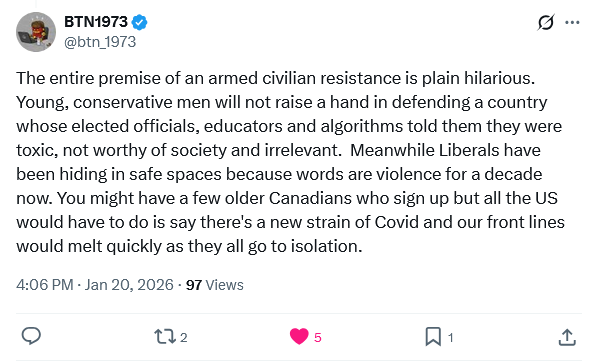
Of course, you can always depend on Not the Bee to provide a tasteful selection of topical memes.
Soviet World War Two 50mm Light Mortars (RM-39 & RM-40)
Forgotten Weapons
Published 25 Aug 2025The Soviet Union decided to adopt a 50mm light mortar in 1937 as a company-level armament. The first such weapon they used was the RM-38, introduced in 1938. It was a complex design, with a gas venting system to adjust range (200m – 800m), a bipod specifically set to either 45 or 75 degrees, and a recoil buffering system. This was clearly too complex, and it was replaced by the RM-39 the next year. This remained a well-made mortar, but now had a freely adjustable bipod. However it quickly proved too complex and expensive and it was in turn replaced by the RM-40.
The RM-40 is a much more efficient (aka, cheap) design. It used simple stamped bipod legs and a heavy stamped baseplate. It still uses adjustable gas venting to set range and retains a simplified recoil buffer, but it is a much more quickly produced weapon. A 1941 model of completely different design did replace it though, and by 1943 the Soviet Union moved to 82mm mortars for better effectiveness.
The Soviet mortars were generally well liked by German troops who captured them, as they were significantly longer ranged than the German 50mm mortar. They were also captured in large numbers by the Finns, who used them as well but found them underpowered. In 1960 some 1,268 Soviet 50mm mortars of all models were sold by the Finnish Defense Forces to Interarms to be imported into the US. Some were registered and sold as Destructive Devices and some were deactivated and sold as dummies.
(more…)
Comments Off on Soviet World War Two 50mm Light Mortars (RM-39 & RM-40)
QotD: White elephant airports
Few things capture modern planning like a multibillion-dollar airport no one’s entirely sure will have any planes. Enter Western Sydney International Airport (WSI), Australia’s shiny $5 billion gamble at Badgerys Creek. It’s a development so hyped it already has merch, an anticipated metro line, and a better skincare routine than most of us, despite rumors it may spend its first year servicing only freight and the occasional confused ibis.
If history teaches us anything, it’s that airports, like wrinkle creams which cost the GDP of a small country but couldn’t iron out a bedsheet, can be wildly overpromised and underdelivered. Western Sydney’s runway might yet join the vainglorious global herd of White Elephant Airports: majestic, expensive, and standing alone in a field wondering where everyone went.
Let’s take a safari.
Mirabel: Montreal’s Monument to Inconvenience
Built in 1975, Mirabel International was meant to replace Montreal’s Dorval Airport and usher in a new aviation era. Instead, it became the architectural embodiment of “We should’ve checked the map”. Located more than 50 kilometers from the city, it was so unpopular that passengers would rather fling themselves onto dogsleds than make the commute.
Eventually, Mirabel stopped pretending to be an airport and transitioned into its second act: a car-racing track and film set. Somewhere in Quebec there’s probably still a baggage carousel being used as a wedding dance floor.
Ciudad Real: A Billion-Euro Garage Sale
Spain saw Mirabel and said, “Hold my sangria”. Ciudad Real International Airport opened in 2009 with a €1.1 billion price tag, dreams of high-speed rail links, and the confidence of a Bachelor contestant in week one. Within three years, it had no flights, no buyers, and no shame.
It was eventually auctioned for €10,000, less than a parking space in Bondi or a bottle of champagne at a Sydney rooftop bar. One imagines the bidding process was just two blokes shrugging in a room and someone whispering, “Ten grand and a paella voucher?”
Berlin Brandenburg: German Efficiency, But Make It Chaos
If you’ve ever wanted to see what happens when a nation famous for precision tries on farce, just pay a visit to Berlin Brandenburg Airport. Construction began in 2006, with an opening scheduled for 2011. By 2015, it was such a national embarrassment that Berliners stopped making jokes about British plumbing to recover emotionally.
In 2020, it finally launched amid the global COVID pandemic, after delays caused by faulty fire systems, suspicious cables, and the ghost of every German engineer pacing in dismay.
Nicole James, “Australia’s New Albino Elephant Sanctuary (Now with Parking)”, The Freeman, 2025-10-16.
January 20, 2026
Those awful AWFLs
On Substack, Rohan Ghostwind responds to a recent New York Times opinion from Michelle Goldberg pretending not to understand why “the right” is against Affluent White Female Liberals (AWFLs):
Michelle Goldberg recently wrote an opinion piece in the New York Times called “The Right Is Furious With Liberal White Women”
Specifically, she talks about the rising contempt for the AWFL: Affluent white female liberal.
The first part of the opinion piece is a play-by-play of the Renee Good situation, pointing out that the right is freaking out about roving bands of Karens.
The part I find interesting is in the final paragraph:
It wasn’t long ago that casual contempt for white women was the domain of the left, at least that part of the left that took books like “White Fragility” seriously. So it’s striking how easily conservatives, who’ve been stewing over insults to white people for at least five years, have singled out a group of white women as the enemy.
Here’s the interesting part: throughout the course of her opinion piece, she touches on White Female Liberal part. Conspicuously missing is the first part of the acronym: affluent.
This is par for the course for an NYT Opinion piece: play into the identity politics aspect while simultaneously downplaying class. This is, of course, a big reason why the Democrats lost ground with working class people during the 2024 election.
[…]
Rob Henderson popularized the term luxury beliefs …
And if it was ever one group of people who embody the most luxury beliefs per capita it would be the AWFL’s.
What makes them uniquely annoying is their persistent refusal to acknowledge how sanctimonious they come across to the rest of the world. As far as they’re concerned, they are the only intelligent and moral group of people, and they will eventually get what they want by scolding everybody else into submission.
People hate this, because people would actually prefer bigotry to infantilization — but the affluent white woman, by virtue of being affluent, never has to reality test her beliefs against the real world.

Comments Off on Those awful AWFLs
Mark Steyn on demographics, Trump, and Greenland
Mark Steyn was warning about demography in the west twenty years ago, and at the time he was dismissed as a crank. Now, not only have the demographic forecasts matched what he predicted, they’re actually worse:

As noted yesterday, twenty years ago this month — January 2006 — The Wall Street Journal and The New Criterion published the first draft of what would become the thesis of my bestselling book, America Alone.
The Journal headline sums it up:
The sub-head makes plain what’s at stake:
The real reason the West is in danger of extinction.
And the lead paragraph spells it out:
Most people reading this have strong stomachs, so let me lay it out as baldly as I can: Much of what we loosely call the Western world will not survive this century, and much of it will effectively disappear within our lifetimes, including many if not most Western European countries.
Two decades ago that scenario was dismissed as “alarmist” by the bleepwits of The Economist. Today it is assumed by elites of all stripes, from the authors of the new US National Security Strategy …
Trump warns Europe faces “civilizational erasure” in explosive new document
… to peer-reviewed papers positing that all Western European nations other than Portugal and micro-states such as Andorra will become majority Muslim …
… to the Deputy Leader of Britain’s supposedly “populist” party reacting to news that native Anglo-Celts will become a minority in the UK by 2063 — and in England rather sooner than that:
I’ll be long gone by then.
So, in the twenty years since my Wall Street Journal essay, the ruling class has gone from “alarmism” to “yeah, it’s happening, but maybe not until 2100” to “okay, it’s a fait accompli, but what’s the big deal?” As to Richard Tice being long gone, which is devoutly to be wished, 2026 to 2063 is thirty-seven years — or Whitney Houston to now.
This is why nobody cares about the pleas of the “expert” class to save the “rules-based international order”, which is a long-winded way of saying “1950”. Trump, for one, is moving on:
The obsession with Greenland, so bewildering to US “allies”, derives from America’s need for an Israeli-style “Iron Dome”, which, as the mighty builder of Trump Tower, the President has upgraded to a “Golden Dome”. Why would he seek such a thing? Because in this scenario America’s Israel …and Western Europe is Gaza, the West Bank, Lebanon, Syria and Iran.
Twenty years ago, my eventual book-length argument was summarised in the Toronto Globe and Mail by the eminent “political scientist” William Christian as “quite possibly the most crass and vulgar book about the West’s relationship with the Islamic world I have ever encountered“. Professor Christian has evidently led a sheltered life: he was born in the Queen Charlotte Islands, which are now officially known as “Haida Gwaii”, a bollocks name invented in hopes of appeasing “the Haida nation”; it turns out that these days nowhere is really that sheltered, don’t you find?
But just because something is “crass and vulgar” doesn’t mean it’s not correct. It’s certainly straightforward. The western world is going out of business because it’s given up having babies. The mid-twentieth-century welfare state, with its hitherto unknown concepts such as spending the first third of your life in “education” and the last third in “retirement”, was carelessly premised on mid-twentieth-century fertility rates, and, as they collapsed, the west turned to “migrants” to be the children they couldn’t be bothered having themselves. The condition of your maternity ward may be “crass and vulgar”, but it’s not a speculative prediction.
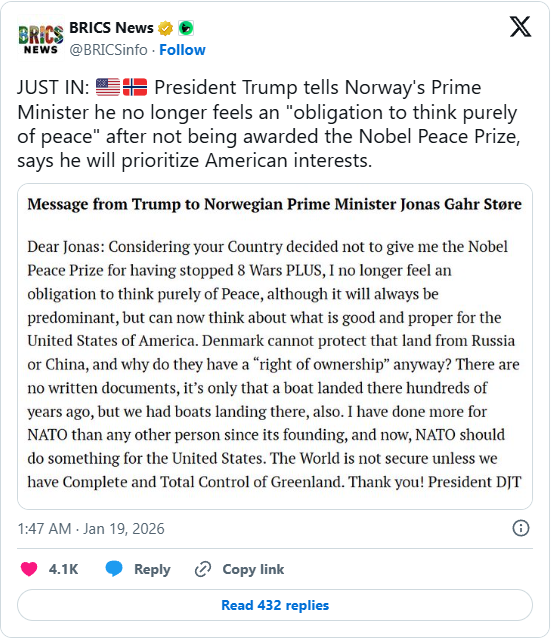
eugyppius discusses the European response to President Trump’s public statements about Greenland:
Eager to
make an epic display of retardationdemonstrate resolve and independence in the face of these sudden American ambitions on Danish territory, a variety of European countries announced they would send soldiers to Greenland in a display of “military solidarity” with Denmark. Germany sent a grand total of 13 or 15 soldiers (reports vary) to defend the icy island against the Americans. They departed on a matte grey A400M Atlas military transport with plenty of press on hand for photographs. You could almost hear Wagner’s “Ride of the Valkyries” between the lines of the press coverage.
Alas, the Eurotards also did not want to possibly in some hypothetical world perhaps overstep by maybe potentially creating conditions for anything that might conceivably be interpreted by the Americans as a show of force on Greenland itself, so the Luftwaffe A400M landed politely in Denmark, thousands of kilometers away from the disputed territory. From there, all the soldiers boarded a completely non-threatening commercial airline to Nuuk, Greenland’s capital. While this was happening, German Defence Minister Boris Pistorius desperately assured the press that it was a purely routine and preplanned mission.
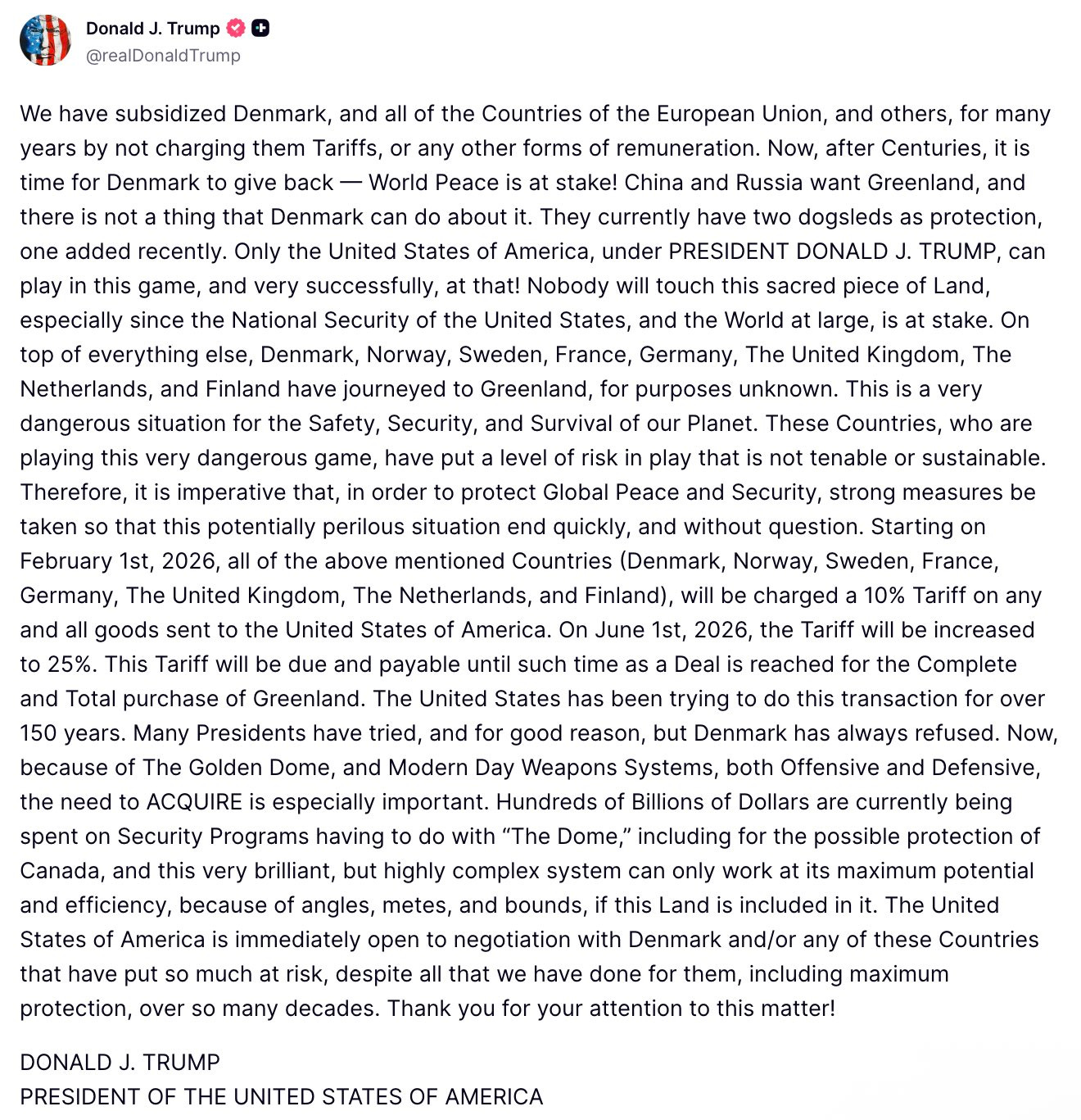
The next thing to happen, while our soldiers were sitting in Greenland for no reason, was that all these efforts to make a statement while not really making a statement to avoid annoying the Americans backfired, in that the Americans got annoyed anyway. U.S. President Donald Trump announced on Truth Social that all participants in this publicity junket would be slapped with punitive 10% tariffs, to be increased by 1 June 2026 to 25% tariffs, “until such time as a Deal is reached for the Complete and Total purchase of Greenland.”
Hours after Trump posted this note, the Greenland weather soured and our soldiers cancelled an “exploratory tour” they had planned for Sunday afternoon and returned to the Nuuk airport to fly home a few hours ahead of schedule. This lent the impression that Trump’s wall-of-text Truth Social post had scared them into a retreat from Greenland, inspiring hours of social media mockery. In the end we did succeed in making a statement, if not precisely the one we had intended.

Update, 21 January: Welcome, Instapundit readers! Have a look around at some of my other posts you may find of interest. I send out a daily summary of posts here through my Substack – https://substack.com/@nicholasrusson that you can subscribe to if you’d like to be informed of new posts in the future.
The US Navy’s twenty years to forget
CDR Salamander takes a wincing glance back at the ship development programs the US Navy planned to implement early in the 2000s and how they all failed to meet even minimal expectations:

20 years seems like a long time, but in many ways it is not. As we look forward to what our fleet will look like at mid-century, we should look back to what we were all promised in January of 2005 that was going to transform into the Navy of the 21st century.
There were four ship classes that were going to be the surface fleet that we were promised at the time, were going to ensure America’s dominance at sea for the next half century.
(NB: most of the hypertext links below go to the tags from my OG Blog that predate my move to Substack three years ago. Those will point you towards my writing two decades ago or so on these programs at the time, if you are so interested.)
LCS. We were once supposed to get 55 of the marketing/consultancy-named Littoral Combat Ship. We’ll wind up with 25. Not suitable for combat in the littorals, but steps are being made to get some use out of them … somehow.
DDG-1000. We were once going to have 32 of these. We got three. Its main weapon, the two 155mm guns, were never made operational and are being removed. The ships are being turned into weapons demonstrators for Conventional Prompt Strike. I hear great things about the engineering plant, but they have yet to do a proper deployment, nine and a half years after the commissioning of hull-1.
Ford Class CVN. A dozen years ago, we thought it would deploy with UAVs as you can see below (pause for a moment in honor of the martyred X-47B, the greatest crime of the Obama Era Navy), but no. Hull-1 took 8 years to commission. Hull-2 will take 12. Can’t seem to have a workable CHT system.
CG(X). In 2005, we thought we would build at least 19. Complete loss of control of the program to the point it was put out of its misery. We still don’t have a proper carrier escort. Looks like the Japanese will build what we should have, and the only hope we have now is … BBG-1.
Why dig all this institutional shame and dishonor up, again? Simple, we need to be humble, and the leaders today need to hoist onboard the errors of the past.
Now, back to last week. For our fleet of the 2030s and on to face the world’s largest navy (in 2005 it was the US Navy. Now it is the People’s Liberation Army Navy. Well done everyone), there are three ships right now that we have to ponder as our future surface force.

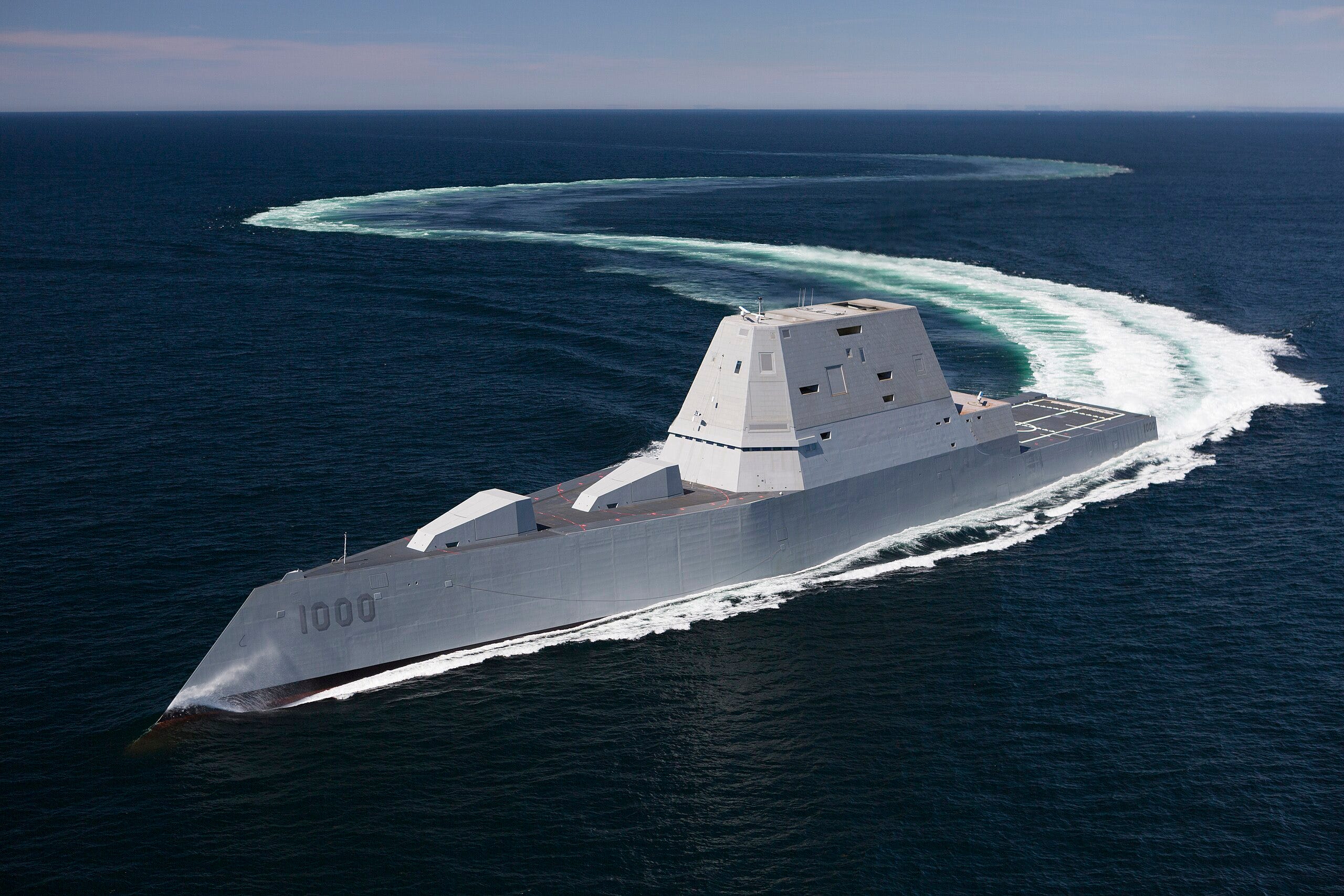

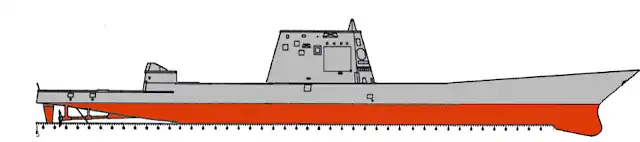
Comments Off on The US Navy’s twenty years to forget
Feeding the Great Mongol Khan
Tasting History with Max Miller
Published 29 Jul 2025Mastic stew with black rice, spices, and lamb, garnished with cilantro
City/Region: Mongol Empire | China
Time Period: 1330The grandson of Genghis Khan, Kublai Khan doubled the size of the largest land empire the world had ever known by conquering China. We actually know quite a bit about the foods that fueled his empire-expanding efforts. Shortly after his death, Yinshàn zhèngyào, or The Proper and Necessary Things for the Emperor’s Food and Drink, was written, and its recipes include ingredients from across Kublai Khan’s vast empire.
The mastic in this stew is a resin from the mastic tree in the Mediterranean, and it has a bitterness along with cedar or pine notes. I really like it in sweet things, but there is no sugar in this dish. The stew is aromatic and smells of cardamom and cinnamon, but they don’t come through in the flavor. The bitterness of the mastic and the lamb dominate the dish, but Kublai Khan was eating this dish to invigorate his chi, so maybe the flavor didn’t matter as much.
I used black rice, or forbidden rice, so named because supposedly it was only eaten by the emperor and his court for much of Chinese history, and it makes the stew a deep purple. You can use long grain white or brown rice, which will make for a lighter colored dish.
Nourishes, warms the middle and grants chi. Leg of mutton, five tsaoko cardamoms, 2 ch’ien cinnamon, one half sheng chickpeas, mash and remove the skins. Boil the ingredients together to make a soup, strain it. Cut up the meat and set aside. Add 2 ho of cooked chickpeas, 1 sheng of aromatic rice, 1 ch’ien of mastic. Mix well with a little salt. Add chopped meat and cilantro.
— Yinshàn zhèngyào by Hu Sihui, 1330
Comments Off on Feeding the Great Mongol Khan
QotD: The rise of Eugenics
But then a funny thing happened. Twice, actually. The first one was the triumph of the Puritan fanatics in the Unpleasantness of 1861-5. Because they were certified Goodpeople (certified by themselves it goes without saying), and because their worldview triumphed through force of arms, they gave themselves a blanket indulgence to peddle the most repulsive kind of “scientific racism”. They just dropped the “racism” part and doubled down on the “scientific”. They called it first “Darwinism”, then “eugenics”, but the upshot of both was that they gave themselves the right, duty, and of course pleasure of pruning the human garden (to use one of their favorite metaphors).
All those mandatory sterilization laws, the kind of “three strikes and you’re permanently out” crime reduction measures we can only dream of? It wasn’t conservatives pushing those. It was Proggies. Sane deal with the “Fitter Family Contests” that proliferated in the US right up to WWII.
We didn’t get that stuff from [Hitler; he] got it from us.
And that was the second thing, of course — all the Nazis’ nonsense about a “master race” […] They would, could, and did point out that what they were doing was in no way different from the stuff agonizingly self-righteous American Proggies were pushing every single day — as the Nazis saw it, they […] merely had the courage of their convictions. St. Margaret Sanger of the Holy Coat Hook, for instance, looked forward to blacks dying out thanks to her abortion activism. As the Nazis saw it, they were just cutting out the middleman.
Severian, “On Duties”, Founding Questions, 2022-04-07.
- Many people made this argument, but Josiah Clark Nott defended it at greatest length, if you’re interested in that odd little branch of American intellectual history. Anthropologists try very hard to be the #wokest people on the planet (even other eggheads find them obnoxious, if you can imagine), so it’s fun to needle them with the history of their field — y’all know the so-called “American School” of anthropology was dedicated almost entirely to justifying slavery, right?
Update, 21 January: Welcome, Instapundit readers! Have a look around at some of my other posts you may find of interest. I send out a daily summary of posts here through my Substack – https://substack.com/@nicholasrusson that you can subscribe to if you’d like to be informed of new posts in the future.
January 19, 2026
British Islamists scare Islamic governments more than the British government
In Spiked, Rakib Ehsan discusses the recent efforts by the governments of some Gulf states to limit potential radicalization of their own people by reducing support for students attending British universities:

Flag of the United Arab Emirates (UAE)
In yet another blow to Britain’s reputation on the global stage, the United Arab Emirates (UAE) has curbed state funding for its citizens seeking to enrol at UK universities, over concerns they will be radicalised by Islamists.
As reported in the Telegraph last week, the Gulf state has taken this drastic step because of the influence in the UK of the Muslim Brotherhood – a transnational Sunni Islamist organisation, which is a designated terror group in the UAE. It is also banned in Egypt, Saudi Arabia and Jordan. The UAE has long offered Emirati students generous grants – including rent and living allowances – for studying “priority” subjects at British universities. These scholarships have now ended because, according to a source quoted in the Telegraph, “the UAE doesn’t want its kids to be radicalised on campus”.
This is not the first time that the UK has been embarrassed for being a soft touch on Islamism by a Muslim country. In January last year, the UAE placed eight UK-based organisations on its local terror list on the grounds of their alleged connections to the Muslim Brotherhood. Most of these entities, which range from property firms to video-production outlets, are registered in London. Then, in April, the head of the Muslim World League, Saudi Arabia’s Sheikh Mohammad bin Abdulkarim al-Issa, warned that the UK should treat poor integration as a national-security issue. He said that young British Muslims had grown disillusioned because of conflicts in the Middle East, advising the UK that “a political situation outside should not interfere with integration inside”.
The UAE’s latest decision should hardly come as a surprise. Indeed, for some time, British universities have embraced the very extremism that Muslim-majority countries have long sought to root out.
Comments Off on British Islamists scare Islamic governments more than the British government
Regulating the clankers
At the Foundation for Economic Education, Kevin T. Frazier and Antoine Langrée consider how artificial intelligence can be regulated by state and federal bodies:

Yes, I’m still 12
President Donald Trump’s executive order on artificial intelligence invites analysis of a question so complex that it rarely gets asked: “What exactly do states have the authority to regulate?”
The current, somewhat trite answer is, “The residuary powers reserved under the Tenth Amendment”. Omitting the legalese, that means that states can do whatever the federal government cannot.
States have the power to look out for the health, safety, and welfare of their residents. Thus, for instance, they have the power to address local concerns through zoning laws, professional certifications via licensing regimes, and ensure public safety through law enforcement. These authorities make up what’s often referred to as a state’s “police powers”.
While this generic reading of state power is not necessarily wrong, it’s imprecise. As the AI Litigation Task Force created by Trump’s EO starts its work, a more specific answer is warranted.
The task force is charged with challenging “unconstitutional, preempted, or otherwise unlawful State AI laws that harm innovation”. Reading between these lines, its mission is to contest state laws that interfere with the Administration’s vision for a national AI policy framework. This isn’t an unlimited charge, though. Federal courts reviewing state laws will only strike them down if they fail to align with the Constitution’s allocation of authority or otherwise prove unlawful.
Many stakeholders in AI debates liberally interpret the authorities afforded to states. Based on concerns of existential risk to humanity and the idea that states must protect the health of their citizens, state legislators have proposed and enacted laws that impose significant obligations on the development of AI. Some assume they must have this right, since protecting the lives of their residents is a core priority and unquestioned authority of state governments. After all, since the founding, states have been able to enforce quarantines out of a concern for public health — aren’t aggressive AI laws just extensions of such public health measures, but tailored to the threat of modern threats?
It’s not that simple. States’ police powers are reasonably broad, but not unlimited. States must respect both an upper bound — the purview of enumerated powers reserved for federal authority — and a lower bound—the rights retained by the states’ citizens. These constraints have been tested in litigation throughout our Constitution’s history, notably when state law conflicts with the federal government’s exclusive authority over interstate commerce and when states unduly limit the freedoms of their residents.
These notions are relatively blurry and highly contextual. As national regulatory policy evolves, so too does the extent of preemption. The Lochner era, for example, was a paradigm shift for state police power: as courts expansively interpreted the individual liberty to contract, states’ police power over health, labor protections, and market regulation shrank significantly — only to be restored later. Likewise, individual liberties and valid justifications for their abridgment have evolved to fit developments in civil rights law — from Brown v. Board to Dobbs and Lawrence.
Despite these significant changes in context, the constitutionality of states’ exercise of their police powers follows a bounded framework. This can be observed in the jurisprudence on public health measures — a prime example of police powers. Quarantine orders, from nineteenth-century epidemics to Covid-19, have a direct link to protecting local communities — one of the most important elements of state police powers. They respect the upper and lower bounds of police powers. First, they are geographically specific: they only affect local residents or people coming into local communities. Second, they directly reduce the risk to state residents: quarantines are known solutions to real threats to the health and safety of local communities. They infringe the individual liberties only insofar as is necessary to protect state residents’ vital interests.
Comments Off on Regulating the clankers
King Tiger V2 – Inside The World’s Oldest Tiger II
The Tank Museum
Published 26 Sept 2025King Tiger V2. It’s the oldest surviving King Tiger in the world. And it’s also the only King Tiger that survives with the unusual pre-production turret. This has, in the past, been referred to as the “Porsche Turret”. But why? And why did they change the turret on later models?
There are many misconceptions and rumours about this tank – the most common of which that the turret was built by Porsche. It wasn’t. How did it end up on this tank? Well, that’s a bit of a confusing story, but it was basically down to Krupp and Henschel working on a winning design.
The production of King Tiger would begin with three prototypes: V1, V2 and V3 – and the V stands for Versuchs, the German word for trial. V1 was a mild steel prototype that was used for demonstrations, and V3 was used as an engine test rig. V2, however, was retained for testing by Henschel and was captured by the US Army before being handed over to the British.
V2 left Germany in one piece, but by the time it reached Bovington in 1952 a number of parts had gone astray – most notably, the gearbox! King Tiger V2 is now a star of The Tank Museum’s collection, and the team have now begun to assess whether a restoration might be possible…
00:00 | Introduction
02:37 | Is it a Porsche?
06:15 | Krupp Gets Lucky
12:52 | V2: Today and Tomorrow
17:34 | V2: The Future
(more…)
Comments Off on King Tiger V2 – Inside The World’s Oldest Tiger II
QotD: Epaminondas and the defeat of Sparta at Leuctra
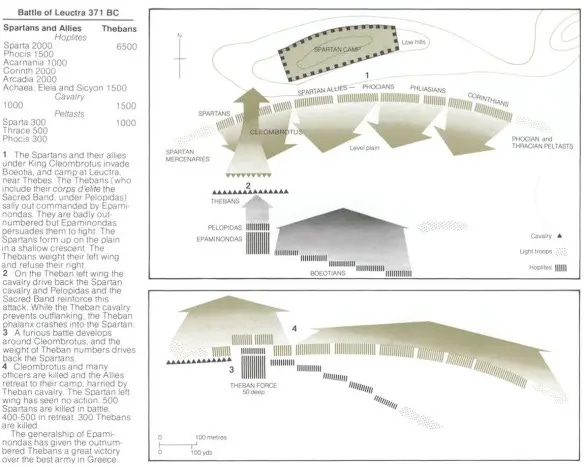
Epaminondas led a smaller force (some 6,000 to Sparta’s 11,000, though historians debate the exact numbers) to a field in front of a Boeotian village called Leuctra. The Battle of Leuctra would not only mark the beginning of centuries of Spartan decline, but also change the way Greek armies battled all the way through the conquests of Alexander the Great.
How did Epaminondas do it? How could he upend the mighty Spartan empire with a force barely half the size? The answer lay in resource allocation, patience, and 300 extremely important gay men.
If you had the misfortune of fighting against a Spartan army in the last few centuries BCE, you had to contend with a phalanx of hoplites. Thousands of men would align shoulder to shoulder, stick out their shields and spears, and push. You probably had a phalanx of your own, but against the Spartan line, you stood no chance.
Epaminondas didn’t have the numbers to directly contend with the Spartan phalanx, but he did have a specific elite force: the Sacred Band of Thebes. The Sacred Band was made of 300 hand-picked warriors paired off into homosexual couples. The idea was that lovers would fight more fiercely for each other.
Instead of a futile effort to out-push a force half their size, the Boeotians overloaded one side. They put a majority of their force on the left side, thinning out the right. They advanced this overloaded left wing before the weaker right wing, hoping to win before the Spartans could fully engage.
The Boeotian left wing, led in part by the Sacred Band, broke through the Spartan line. With enemy forces charging the side and rear, the Spartans quickly routed. When the dust settled, Epaminondas inflicted upon the Spartans one of the most decisive blowouts in Greek history.
Diagram courtesy of WarHistory.org
Over 1,000 Spartans perished in the Battle of Leuctra, including their king and military leader Cleombrotus. The Boetians lost around a hundred, but exact estimates are hard to come by. By anyone’s estimate, their casualties paled in comparison. Sparta’s military reputation would never recover, and the next 200 years marked an era of Spartan decline.
Epaminondas didn’t invent the phalanx. In fact, it’s unclear who really did. There is evidence of a similar strategy in Sumer over 2,000 years earlier. It’s a fairly basic idea — everyone hold your shields together and push. But Epaminondas did advance the strategy. Others would continue to innovate on Epaminondas’ “oblique” advance, up to and including Alexander the Great.
Luke Brown, “Pushing Tush Is Ancient Technology”, Wide Left, 2025-10-13.
Comments Off on QotD: Epaminondas and the defeat of Sparta at Leuctra
January 18, 2026
“Voluntary”. You keep using that word. I do not think it means what you think it means.
The federal government, rather than abandoning its ridiculous and ineffective “voluntary” firearm buyback program, is determined to carry on:

🇨🇦 The “Voluntary” Trap: Ottawa’s Buyback Is Coercion, Not Consent 🇨🇦
by GoC AdminsThe federal government unveiled the next phase of its firearms confiscation program on Saturday, insisting, yet again, that the process is “voluntary”. But as the details emerge, that claim collapses under the weight of its own contradictions.
What the government is offering Canadians is not a choice. It is a trap designed to force compliance through financial coercion and the threat of criminal prosecution.
Beginning January 19, licensed firearm owners will be contacted by the National Firearms Centre and invited to voluntarily declare their property. The declaration period runs until March 31, 2026. Those who comply may receive compensation. Those who do not will be required to surrender, deactivate, or export their legally acquired property before the amnesty expires on October 30, 2026, or face criminal charges for illegal possession.
That is not voluntary. That is coercion dressed in bureaucratic language.
The “Voluntary” Deadline Is a Financial Squeeze
The most manipulative aspect of this program is its timeline.The government has set the amnesty to expire on October 30, 2026, but the window to declare firearms for compensation closes seven months earlier, on March 31, 2026. Owners who wait to see whether a future election, court ruling, or policy reversal intervene are punished for doing so.
This gap is not accidental. It predictably pressures owners to act early, before political uncertainty can resolve itself.
If you wait until the summer or fall of 2026 to see whether the law changes, you will have missed the compensation window entirely. At that point, your only options will be to surrender your property for free or face criminal liability.
Yes, owners can technically wait until October 30, 2026, but only if they are willing to receive nothing in return.
That is not a voluntary choice. It is a financial ultimatum.
🇨🇦 Surrender First, Get Paid … Maybe 🇨🇦
Perhaps the most astonishing revelation from the government’s announcement is that declaring your firearms does not guarantee compensation.
Payment will be issued on a “first-come, first-served” basis, subject to available funding.
In any other context, forcing people to surrender lawfully acquired property without guaranteed compensation would violate basic principles of fairness and due process. Under this program, owners are asked to declare thousands, or tens of thousands, of dollars’ worth of property with no legal assurance that the money to compensate them actually exists.
If the budget runs dry, you are still left holding a prohibited firearm you must destroy or surrender. The cheque may never come.
Compliance is mandatory. Compensation is optional.
🇨🇦 A Pilot Project That Already Failed 🇨🇦
Ottawa insists this national rollout will succeed, despite the fact that the pilot version of this program was an embarrassment.
Public reporting indicates that when the government tested the scheme in Cape Breton, Nova Scotia, it resulted in the collection of approximately 25 firearms from just 16 individuals. After millions spent on administration, IT systems, and police coordination, only a handful of people participated.
If this were a private-sector initiative, it would have been cancelled outright. Instead, the government is expanding it nationwide without addressing the structural failures that doomed the pilot from the start.
🇨🇦 It’s Not About Safety; It’s About Control 🇨🇦
The government inadvertently revealed its true motivation when officials remarked that they do not want owners using compensation money to “buy an SKS”.
This statement exposes the emptiness of the public-safety argument.
The SKS is already licensed, regulated, and subject to existing Canadian firearms law. By acknowledging that owners might simply replace prohibited firearms with other legal ones that function similarly, the government is admitting that the bans are arbitrary.
The objective is not to remove a particular mechanical risk from society. It is to financially exhaust and discourage lawful firearm ownership altogether.
This program is not designed to stop criminals. Criminals do not declare firearms. Criminals do not comply with amnesty deadlines. Criminals do not interact with government portals.
Only compliant, vetted, RCMP-checked Canadians do.
🇨🇦 The Deadlines Are Real. The Logic Is Not 🇨🇦
Government officials closed their announcement by warning Canadians that “the deadlines are real”.
They are right about that.The government is fully prepared to criminalize people who followed every rule it imposed. People who acquired their property legally, stored it safely, and harmed no one. It is prepared to spend billions enforcing a program that criminals will ignore entirely.
This is not a buyback. It is not voluntary. It is a forced surrender program aimed at the easiest possible target: responsible firearm owners.
While those driving Canada’s violent crime problem continue entirely outside the scope of this policy, law-abiding citizens are left facing a stark reality: Comply now, or be punished later.
History will judge this program not by its press releases, but by its results. And all available evidence suggests it will deliver exactly what it already has: massive cost, deepened division, and no measurable improvement in public safety.
Comments Off on “Voluntary”. You keep using that word. I do not think it means what you think it means.
Who Will Be Chancellor? – Rise of Hitler 27, January 1933
World War Two
Published 17 Jan 2026Back to monthly coverage for this month, because too much is happening in Germany just now. Franz Von Papen meets with Adolf Hitler as 1933 gets going, both of them scheming against Chancellor Kurt von Schleicher. Could they possible form a coalition government with a majority of the Reichstag? Can they even trust each other? Also, who is this von Ribbentrop character? And what’s up with President Hindenburg’s son Oskar? So much going on this month, and when it all reaches its head … just … wow!
(more…)
Comments Off on Who Will Be Chancellor? – Rise of Hitler 27, January 1933


