Quotulatiousness

January 16, 2021

Howard Anglin reviews The Riotous Passions of Robbie Burns

Filed under: Books, Britain, History — Tags: , , , — Nicholas @ 03:00

The Line now apparently also does book reviews:

I don’t know what I was expecting before I picked up John Ivison’s new book, The Riotous Passions of Robbie Burns, but it was not this. In my head, I’d already started composing the end of my review. Something round and pat and full of holiday hygge like: “So light the fire, pour yourself a dram of Annandale whisky, and enjoy …” Because Ivison grew up in Dumfries, where Burns spent the last years of his life, I suppose I expected a more personal narrative, not a work of historical fiction. One expects fiction from political journalists in their day jobs, not in a labour of love composed off the clock.

What I really expected was more of Burns’ poetry — the source of his enduring fame, after all — and less of his person, which was the source of his contemporary infamy. Instead, Ivison gives us something more interesting and unusual: the poetry of Burns’ non-poetic speech. Ivison has taken snippets, and sometimes cribbed whole paragraphs from, Burns’s copious surviving correspondence and woven them into dialogue that carries the story of the poet’s stay in Edinburgh between 1786 and 1788. By putting Burns’ actual words into his mouth, even if sometimes out of context, Ivison gives the reader a direct and plausible impression of Burns the man. We hear verbatim both the coarse tavern wit and the elemental passion that spilled into his prolific verse — sometimes into unprintable doggerel (literally: his poems later collected as The Merry Muses of Caledonia were banned as obscene in the U.K. until 1965), sometimes into achingly beautiful verses like “Flow gently, sweet Afton” or “Ae Fond Kiss.”

Ivison’s book sets us in Edinburgh at a time when, as he writes, “it was said if you stood at the Mercat Cross with a pistol, you could hit 50 geniuses, 50 bankers, 50 lawyers and 50 rogues at any given hour” (no doubt allowing for some overlap between latter two categories). Our narrator and guide is the newly-arrived and impressionable young lawyer’s apprentice, John Bruce, a composite and Zelig-like stand in for many young men of the poet’s acquaintance. (The only record of Burns meeting a John Bruce that I can find was a Rev. John Bruce, Minister of the Highland town of Forfar, whom the poet found “pleasant, agreeable and engaging.”) Through Burns, Bruce and the reader are introduced to the ways of women, drink, the printing business, drink, aristocratic libertinism, and a little more drink.

The two main plots, such as they are, link Bruce and Burns to the notorious escapades of Deacon Brodie, whom Burns met in real life, and to the poet’s long, futile, but apparently sincere courtship of the unhappily-married Agnes (sometimes Nancy) Maclehose. The real life letters between Burns and Maclehose, written under the pseudonyms “Sylvander” and “Clarinda,” make for moving reading and, in this telling, for surprisingly convincing dialogue between Burns and Maclehose and between Burns and Bruce. The text is especially affecting when the poet is in the grip of what he called his “low spirits & blue devils” and his usually florid speech turns fatalistic, brooding, and palpably human.

But the plots are not the point of this charming book; they are frames on which to hang Burns’s words and excuses to showcase Edinburgh as it was coming of age as an intellectual and commercial capital, with all the growing pains that entailed. Filling the city with historical characters, Ivison shows us the city as Burns found it, its population bursting out of the overbuilt medieval closes and wynds that lined the Royal Mile running down the hill from the castle and spreading across the North Bridge to New Town and down to the sea port at Leith.


M2 Carbine: Assault Rifle or Submachine Gun?

Filed under: History, Military, USA, Weapons, WW2 — Tags: , , , , — Nicholas @ 02:00

Forgotten Weapons
Published 23 Mar 2017

The M2 Carbine was a mechanically simple modification of the M1 Carbine to allow fully automatic fire. The fire prototypes of the M1 Carbine had actually been selective-fire guns, but that requirement had been dropped by the time the Winchester design was officially adopted as the M1. It was a feature quickly requested by troops once the Carbine entered active service, though.

In 1944 the US Army acknowledged this, and introduced the M2. A total of 217,000 were manufactured at the end of WW2, and did see limited service on Okinawa — and then extensive use in the Korean War and Vietnam War.

The M1 Carbine has long generated controversy among those attempting to rigidly define its role, as it falls awkwardly between the notion of submachine gun and assault rifle, firing a cartridge that is clearly more powerful than a pistol round but equally clearly less powerful than an intermediate rifle round. Its originally intended role was as a personal defense weapon more effective than the 1911 pistol, and in service it always scored high marks for handiness and poor marks for combat effectiveness. The opinion of soldiers using the Carbine in either its M1 or M2 form was very much dependent on what role they expected it to serve.

In my opinion, its light weight and stock design make it a sub-optimal submachine gun, and its light cartridge makes it a sub-optimal assault rifle. But if you need a light and handy carbine to carry a lot and only use in emergencies, it is hard to beat for its time.

http://www.patreon.com/ForgottenWeapons

Cool Forgotten Weapons merch! http://shop.bbtv.com/collections/forg…

If you enjoy Forgotten Weapons, check out its sister channel, InRangeTV! http://www.youtube.com/InRangeTVShow

QotD: Make companies product-focused again

Filed under: Business, Politics, Quotations — Tags: , , — Nicholas @ 01:00

When I go to a coffee shop or a bank, I am not interesting in their views about politics or social issues, indeed, I actively do not want to know. I just want a fucking coffee or to arrange something financial (hopefully not confusing the two). If they want to tell me about how yummy their products are because their beans are lovingly rubbed with civet poo, or how well they are looking after their depositors’ money, that is fine.

But pretty much anything else … please just STFU unless it is directly related to the business. I get that certain “life style” brands might want their logo in a Formula One car or on Eddie Izzard’s frock. But I am not interested in how inclusive the local bookstore is, nor do I want to hear that an auto-parts shop is proud of the blasted NHS.

I do not even want any companies declaiming how much they support causes I like, let alone ones that I either oppose or which just make me roll my eyes at the sheer presumption of their marketing department. For me, this is negative marketing. I already avoid certain shops and restaurants that prominently display their “social awareness” to me: they are actually doing the opposite, emphasising that I am not their target market. So I take them at their word and if I can easily get what they sell elsewhere from someone who doesn’t, that is what I always do.

Make companies product-focused again.

Perry de Havilland, “Make companies product-focused again”, Samizdata, 2020-09-30.

January 15, 2021

Germany Bankrupts Greece – Countless Die in Famine – War Against Humanity 026 – January 1942, pt. 1

Filed under: Europe, Germany, Greece, History, Japan, Military, WW2 — Tags: , , , , , — Nicholas @ 04:00

World War Two
Published 14 Jan 2021

The early weeks of 1942 show how much of a global War Against Humanity this really is. People in occupied zones across the globe suffer under the boot of their tormentors. In Greece, thousands die in a famine, while repressive tactics claim the lives of many more in the Balkans. The Holocaust continues in cities and the extermination camp of Chełmno, while the Japanese army wreaks havoc in South-East Asia as they advance on Allied positions.

Join us on Patreon: https://www.patreon.com/TimeGhostHistory
Or join The TimeGhost Army directly at: https://timeghost.tv

Follow WW2 day by day on Instagram @ww2_day_by_day – https://www.instagram.com/ww2_day_by_day
Between 2 Wars: https://www.youtube.com/playlist?list…
Source list: http://bit.ly/WW2sources

Hosted by: Spartacus Olsson
Written by: Joram Appel
Director: Astrid Deinhard
Producers: Astrid Deinhard and Spartacus Olsson
Executive Producers: Astrid Deinhard, Indy Neidell, Spartacus Olsson, Bodo Rittenauer
Creative Producer: Maria Kyhle
Post-Production Director: Wieke Kapteijns
Research by: Joram Appel and Valantis Athanasiou
Edited by: Miki Cackowski
Sound design: Marek Kamiński
Map animations: Eastory (https://www.youtube.com/c/eastory)

Colorizations by:
Jaris Almazani (Artistic Man) – https://instagram.com/artistic.man
Julius Jääskeläinen – https://www.facebook.com/JJcolorization/
Daniel Weiss

Sources:
Yad Vashem 4147/72, 953, 4613/629, 85EO6
IWM KF 199, FE 255, SE 4819
Bundesarchiv
Narodowe Archiwum Cyfrowe
Museum of Yugoslavia
From the Noun Project: Skull by Muhamad Ulum

Soundtracks from the Epidemic Sound:
Johan Hynynen – “Dark Beginning”
Peter Sandberg – “Document This 1”
Skrya – “First Responders”
Cobby Costa – “From the Past”
Farrell Wooten – “Blunt Object”
Gunnar Johnsen – “Not Safe Yet”
Cobby Costa – “Flight Path”

Archive by Screenocean/Reuters https://www.screenocean.com.

A TimeGhost chronological documentary produced by OnLion Entertainment GmbH.

The Lady Juliana | The 18th-Century All-Women Prison Ship

Filed under: Australia, Britain, History, Law — Tags: , , , — Nicholas @ 02:00

Weird History
Published 13 Nov 2019

A tale as wild as the Seven Seas, the story of the Lady Juliana, a special convict ship full of prisoners sent to Australia, is one of the strangest in the continent’s history. The Lady Juliana had a specific mission: carrying a cargo of female prisoners the British government hoped would help reform the struggling convict colony in New South Wales. This motley crew of British women ultimately had a lasting impact on the history of Australia.

#prisonship #australia #weirdhistory

QotD: Capitalism and socialism, viewed from Harvard in 1942

Filed under: Books, Economics, History, Quotations, Russia, USA — Tags: , , — Nicholas @ 01:00

[In Capitalism, Socialism and Democracy (1942), Joseph Schumpeter] suggested [that] capitalism’s greatest strength — its propensity for “creative destruction” — is also a source of weakness. Disruption may be the process that clears out the obsolescent and fosters the advent of the new, but precisely for that reason it can never be universally loved. Second, capitalism itself tends toward oligopoly, not perfect competition. The more concentrated economic power becomes, the harder it is to legitimize the system, especially in America, where “big business” tends to get confused with “monopoly.” Third, capitalism “creates, educates and subsidizes a vested interest in social unrest” — namely, intellectuals. (Here was the influence of Harvard; Schumpeter knew whereof he spoke.) Finally, Schumpeter noted, socialism is politically irresistible to bureaucrats and democratic politicians.

The idea that socialism would ultimately prevail over capitalism was quite a widespread view — especially in Cambridge, Massachusetts. It persisted throughout the Cold War. “The Soviet economy is proof that, contrary to what many skeptics had earlier believed, a socialist command economy can function and even thrive,” wrote Paul Samuelson, Schumpeter’s pupil, in the 1961 edition of his economics textbook — a sentence that still appeared in the 1989 edition. In successive editions, Samuelson’s hugely influential book carried a chart projecting that the gross national product of the Soviet Union would exceed that of the United States at some point between 1984 and 1997. The 1967 edition suggested that the great overtaking could happen as early as 1977. By the 1980 edition, the timeframe for this great overtaking had been moved forward to 2002–12. The graph was quietly dropped after the 1980 edition.

Niall Ferguson, “Capitalism, Socialism and Nationalism: Lessons from History”, 2020-02.

January 14, 2021

Build an Adjustable Jointer Plane! // Affordable handtool woodworking

Filed under: Tools, Woodworking — Tags: , , — Nicholas @ 06:00

Rex Krueger
Published 13 Jan 2021

You need a jointer plane, so build one from spare parts and wood scraps!

More video and exclusive content: http://www.patreon.com/rexkrueger
Get the plans!: https://www.rexkrueger.com/store/plan…
(more…)

Frankenstein and the Socialist Origins of Electronic Music | B2W: ZEITGEIST! | E.09 – Harvest 1920

Filed under: Europe, History, Media — Tags: , , , , , , — Nicholas @ 04:00

TimeGhost History
Published 13 Jan 2021

There is a surprising connection between sci-fi films and the technological policies of Soviet Russia. Watch to find out …

Join us on Patreon: https://www.patreon.com/TimeGhostHistory

Hosted by: Indy Neidell
Written by: Indy Neidell and Francis van Berkel
Director: Astrid Deinhard
Producers: Astrid Deinhard and Spartacus Olsson
Executive Producers: Astrid Deinhard, Indy Neidell, Spartacus Olsson, Bodo Rittenauer
Creative Producer: Maria Kyhle
Post-Production Director: Wieke Kapteijns
Research by: Indy Neidell and Francis van Berkel
Image Research by: Daniel Weiss
Edited by: Daniel Weiss
Sound design: Marek Kamiński

Colorizations:
Daniel Weiss – https://www.facebook.com/TheYankeeCol…

Sources:
Some images from the Library of Congress

From the Noun Project:
– Mansion By Shane Stieben
– signal by Adrien Coquet
– cowboy man by Adrien Coquet
– signal by Adrien Coquet
– room By Batibull, ES

Soundtracks from Epidemic Sound
– “One More for the Road” – Golden Age Radio
– “Dark Shadow” – Etienne Roussel
– “The Inspector 4” – Johannes Bornlöf
– “The Inspector” – David Celeste
– “Wind Chimes” – Farrell Wooten
– “Last Point of Safe Return” – Fabien Tell
– “Puzzle Of Complexity” – Jo Wandrini
– “What Now” – Golden Age Radio
– “Out the Window” – Wendel Scherer
– “Symphony of the Cold-Blooded” – Christian Andersen

Archive by Screenocean/Reuters https://www.screenocean.com.

A TimeGhost chronological documentary produced by OnLion Entertainment GmbH.

A Pole Lathe For Our Cabin! – Townsends Wilderness Homestead

Filed under: History, Tools, Woodworking — Tags: , — Nicholas @ 02:00

Townsends
Published 25 Jun 2020

Visit Our Website! ➧ http://www.townsends.us/ ➧➧

Help support the channel with Patreon ➧ https://www.patreon.com/townsend ➧➧

Instagram ➧ townsends_official

QotD: Collective-action problems – perfect state response versus flawed private responses

Filed under: Government, Liberty, Quotations — Tags: , , , — Nicholas @ 01:00

Our key insight is a pessimistic one: this is the sort of situation which, though individuals and markets don’t handle it well, isn’t actually handled well by governments either. The fundamental mistake of statist thinking is to juxtapose the tragically, inevitably flawed response of individuals and markets to large collective-action problems like this one against the hypothetical perfection of idealized government action, without coping with the reality that government action is also tragically and inevitably flawed.

The implicit burden of the article, after all, is indignation that the government has been done too little and the wrong things. What the author fails to grasp (because his thinking is warped by the religion of state-worship) is that this sort of dysfunction is not a sporadic accidental failure that could be corrected by sufficiently virtuous thoughts and deeds; it is an essential failure, entirely predictable from the incentives operating on all the actors (including the actors within government).

His sort of fantasy thinking implicitly throws a burden of proof on anarchists to construct a perfect response to something like the Deepwater Horizon disaster in a stateless system, or else have their critique of statism dismissed as heartless and inadequate. But the correct analysis is to notice that we can only do what we can only do, and compare the rationally expectable effectiveness of flawed government action against the rationally expectable effectiveness of flawed individual and market action.

The second level of error, once you get this far, is to require that the market action achieve a better outcome without including all the continuing, institutional costs of state action in the accounting. So, for example, other parts of the continuing costs of accepting state action to solve this individual toxic-exposure problem in the Deep Horizon aftermath is that Americans will be robbed every April 15th of five in twelve parts of their income (on average), and be randomly killed in no-knock drug raids. And it’s no use protesting that these abuses are separable from the “good” parts of government as long as you’re also insisting that the prospect of market failures is not separable from the good behavior of markets!

Irrational anarchists believe that utopia is somehow achievable in a stateless system; they make the exact reciprocal error from statists, believing that all evil proceeds from government. Rational anarchists like myself know that stateless systems will have tragic failures too, but believe after analysis that they would have fewer and smaller ones.

If this seems doubtful to you, do not forget to include all the great genocides of the 20th century in the cost of statism. It was contemplating those that turned me into an anarchist – because that sort of eruption of fire and blood, too, is not accidental but essential given the logic of state collectivism.

Eric S. Raymond, “Pessimistic anarchism”, Armed and Dangerous, 2010-09-15.

January 13, 2021

Waking the Sleeping Giant – America Prepares for War – WW2 Special

Filed under: Economics, Government, History, Military, USA, WW2 — Tags: , , , , , — Nicholas @ 04:00

World War Two
Published 12 Jan 2021

As the United States enters World War Two, a huge industrial giant awakens from hibernation. This episode covers industrial mobilization plans, their execution, and their potential.

Join us on Patreon: https://www.patreon.com/TimeGhostHistory
Or join The TimeGhost Army directly at: https://timeghost.tv

Follow WW2 day by day on Instagram @ww2_day_by_day – https://www.instagram.com/ww2_day_by_day
Between 2 Wars: https://www.youtube.com/playlist?list…
Source list: http://bit.ly/WW2sources

Hosted by: Indy Neidell
Written by: Joram Appel
Director: Astrid Deinhard
Producers: Astrid Deinhard and Spartacus Olsson
Executive Producers: Astrid Deinhard, Indy Neidell, Spartacus Olsson, Bodo Rittenauer
Creative Producer: Maria Kyhle
Post-Production Director: Wieke Kapteijns
Research by: Joram Appel
Edited by: Karolina Dołęga
Sound design: Marek Kamiński
Map animations: Eastory (https://www.youtube.com/c/eastory)

Colorizations by:
Dememorabilia – https://www.instagram.com/dememorabilia/
Norman Stewart – https://oldtimesincolor.blogspot.com/

Sources:
– Library of Congress
– National Archives NARA
– Picture of the first class of the Army Industrial College from National Defense University
– FDR Presidential Library & Museum
– Icons from the Noun Project: Artillery by Creative Mania, Douglas SBD Dauntless by Lluisa Iborra, Man by Milinda Courey, Factory Workers by Gan Khoon Lay, Soldier by Wonmo Kang, Old Car by Andri Graphic, progress 20% & 40% by Roberto Chiaveri.

Soundtracks from Epidemic Sound:
– “The Inspector 4” – Johannes Bornlöf
– “London” – Howard Harper-Barnes
– “Break Free” – Fabien Tell
– “Last Point of Safe Return” – Fabien Tell
– “Force Matrix” – Jon Bjork

Archive by Screenocean/Reuters https://www.screenocean.com.

A TimeGhost chronological documentary produced by OnLion Entertainment GmbH.

Driving people offline will break essential political feedback loops

Filed under: Liberty, Media, Politics, USA — Tags: , , — Nicholas @ 03:00

Larry Correia on the ongoing purge of Trump supporters from many social media networks:

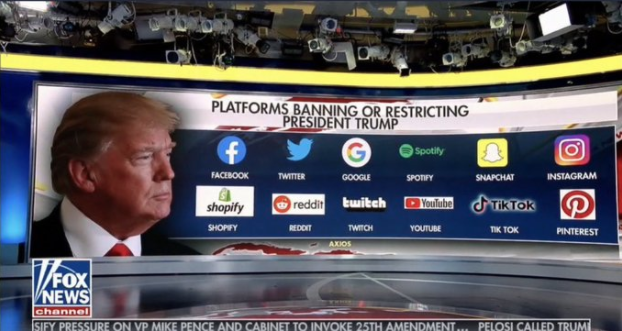
Screencap of a Fox News report on the social media networks that have deplatformed President Donald Trump, January 2021.

For all of history when people have a problem they have been able to talk about it and hash it out. Solutions to complex problems don’t spring fully formed into existence the instant you note the problem. You get ideas from others. Their perspectives help you better articulate the issue and recognize consequences you didn’t expect.

Lawyers know law, engineers know engineering, artists know art, so on. So when there is a big problem that spreads across multiple fields, of course you need to talk it over with people who know those areas, because they know things you don’t. Being smart in one area doesn’t automatically make you an expert in others. We all need help. Big problems require discussion and brainstorming. Even if it isn’t effective, it’s still useful for the clever people who can make solutions to be able to listen to what the regular populace thinks and feels so that they can get the scope and understand how the problem hurts the public.

In the old days these conversations happened at churches, taverns, colleges, that kind of thing. All the famous places where big solutions to big problems were hashed out have a historical marker on them today. For us, those things are now illegal or stifled and we get the internet.

So of course the people who don’t see the problems as problems — or sometimes they are the problem — are trying to stop the rest of us from discussing the problems or they are trying to control where and how the conversations happen. Since they benefit from the problem, they will squash or sabotage people talking about solutions. It is in their best interests to do so, and when you give a bully a stick, they will beat you with it.

The topic of the current problem isn’t the important thing. This is our public square now whether we like it or not. We have foolishly abdicated the public square and now we are paying the price. Of course they can’t just let people they don’t like converse. That’s dangerous to their positions.

So when information they don’t like appears, they hide it. If they can’t hide it, they “fact check” it, and often that’s just a headline screaming false followed by an article full of straw grasping excuses they know most people won’t read. The goal is to shut you up or discredit you.

In the old days, at your pub or church, your drinking buddies or co-religionists probably shared your concerns and faced the same problems. So at least you were working toward a common goal. But now, big tech doesn’t want that. They don’t like groups or forums that don’t share their orthodoxy. They want/need to keep you here, and they need strangers to constantly kick in the doors and blunder in to tell you that you are stupid or crazy, that way we waste time arguing with them. It used to be a village had one idiot. When we talk now we get to deal with a thousand villages worth of idiot.

Semiauto DPM Light Machine Gun Review

Filed under: History, Military, Russia, Weapons, WW2 — Tags: , , , — Nicholas @ 02:00

Forgotten Weapons
Published 7 Mar 2017

I have had a parts kit for a Soviet DPM light machine gun (actually a Polish one, but the design is identical) stashed away for many years now, with the hope to eventually have it built into a live gun. When I found out that SMG (makers of the sweet semiauto FG42 replicas) was making a new production run of DP and DPM barrels, receivers, and semiauto trigger conversions I jumped at my chance. I sent my kit to SMG, and they built it into this complete semiauto rifle.

The DP was introduced in 1928 as the standard Soviet light machine gun, and served through World War Two. In 1944, several defects were acknowledged and improved, notably the location of the recoil spring, the grip, and the bipod. This created the DPM, which did see some slight use at the very end of WW2, as well as use by several eastern bloc nations after the war (including in Korea). It would be updated again in 1946 with the RP46 conversion assembly to feed from Maxim belts instead of the distinctive pan magazines (and in fact, SMG is working on a reproduction of the RP46 conversion as well, although it is not yet ready).

Anyway, I took my new semiauto DPM out to the range and got a firsthand understanding of why these guns were so well liked by troops who used them. The design is nothing if not solid, rugged, and dependable. Like other iconic Soviet firearms, the DP/DPM is elegantly simple and bombproof. It is easy and comfortable to shoot, and SMG’s new and very clever linear hammer-fired semiauto conversion gives it a better trigger than any other semiauto machine gun conversion I have handled. Most such guns have really heavy and really creepy triggers, but this is about 8lb and very crisp – and that makes a huge difference in its shootability.

In a nutshell, the gun zeroed easily and shot well, it had no malfuctions in my 3 or 4 pans of ammo expended (using Czech surplus steel-case ammo), and was really a joy to shoot. I would not hesitate to recommend them, and SMG is offered everything from individual parts for you to build yourself to kit build services, and turnkey complete guns.

http://www.patreon.com/ForgottenWeapons

Cool Forgotten Weapons merch! http://shop.bbtv.com/collections/forg…

If you enjoy Forgotten Weapons, check out its sister channel, InRangeTV! http://www.youtube.com/InRangeTVShow

QotD: Bureaucracy as a filter

Filed under: Bureaucracy, Economics, Health, Quotations — Tags: , , , — Nicholas @ 01:00

Imagine there’s a new $10,000 medication. Insurance companies are legally required to give it to people who really need it and would die without it. But they don’t want somebody who’s only a little bit sick demanding it as a “lifestyle” drug. In principle doctors are supposed to help with this, but doctors have no incentive to ever say no to their patients. If the insurance just sends the doctor a form asking “does this patient really need this medication?”, the doctor will always just check “yes” and send it back. Even if the form says in big red letters PLEASE ONLY SAY YES IF THERE IS AN IMPORTANT MEDICAL NEED, the doctor will still check “yes” more often than a rational central planner allocating scarce resources would like. And insurance companies are sometimes paranoid about refusing to do things doctors say are important, because sometimes the doctor was right and then they can get sued.

But imagine it takes the doctor an hour of painful phone calls to even get the right person from the insurance company on the line. Now there’s a cost involved. If your patient is going to die without the medication, you’ll probably groan and start making the phone calls. But if your patient doesn’t really need it, and you just wanted to approve it in order to be nice, now you might start having a heartfelt talk with your patient about the importance of trying less expensive medications before jumping right to the $10,000 one.

Organizations have a legal incentive not to deny people things, because the people involved can sue them. But they have an economic incentive not to say yes to every request they get. Seeing how much time and exasperation people are willing to put up with in order to get what they want is an elegant way of separating out the needy from the greedy if every other option is closed to you.

This story makes sense and would help explain why bureaucracy gets so bad, but I’m not sure it really fits the evidence. People complain a lot about bureaucracy in places like the Department of Motor Vehicles, but the DMV doesn’t lose anything by giving you a drivers license and isn’t interested in separating out people who really want licenses from people who only want them a little. If the DMV can be as bureaucratic as it is without any conspiratorial explanation, maybe everything is as bureaucratic as it is without any conspiratorial explanation.

Scott Alexander, “Bureaucracy as Active Ingredient”, Slate Star Codex, 2018-08-31.

January 12, 2021

“Big Tech” flexes the muscles and squeezes down the Overton Window online

In the FEE Daily newsletter, Brad Polumbo outlines the collusive mass deplatforming of President Trump and many of his high profile supporters:

Screencap of a Fox News report on the social media networks that have deplatformed President Donald Trump, January 2021.

Amid the fallout from the January 6 attack on the US Capitol, President Trump has been banned from just about every social media platform.

This crackdown is, frankly, unprecedented.

To be sure, social media and tech companies are private companies, and are not bound by the First Amendment. They have no legal obligation to host President Trump’s speech.

But there’s a question beyond can here that ranges into the should.

And I, for one, find it extremely disturbing that the elected President of the United States — who just weeks ago received roughly 75 million votes — is deemed beyond the pale of acceptable speech by Silicon Valley overlords who are overwhelmingly left-wing. Especially so given that these same platforms still allow the literal Chinese Communist Party to post pro-genocide propaganda and allow the members of the Iranian regime to openly foment violence.

The least consumers can demand is some consistency. Personally, I would find it much more reasonable for companies like Twitter to remove individual posts, including by President Trump, that violate rules — like fomenting violence — than to erase prominent political figures from the digital conversation entirely.

We should all want to see a free and open discourse online promoted by the companies we patronize. At the same time, none of this is cause for government control of the internet or meddling with the Section 230 liability shield.

If conservatives don’t like how Twitter CEO Jack Dorsey regulates content, they’d hate how Kamala Harris would do it.

« Newer PostsOlder Posts »

Powered by WordPress