Quotulatiousness

January 12, 2021

Tank Chats #91 | Centurion Conway | The Tank Museum

Filed under: Britain, History, Military, Weapons — Tags: , , — Nicholas @ 02:00

The Tank Museum
Published 13 Dec 2019

Here David Fletcher examines a prototype variant of the Centurion – the Conway, fitted with the American 120mm gun.

Support the work of The Tank Museum on Patreon: ► https://www.patreon.com/tankmuseum

Visit The Tank Museum SHOP: ►tankmuseumshop.org

Twitter: ► https://twitter.com/TankMuseum
Instagram: ► https://www.instagram.com/tankmuseum/
Tiger Tank Blog: ► http://blog.tiger-tank.com/
Tank 100 First World War Centenary Blog: ► http://tank100.com/
#tankmuseum #tanks

QotD: The use and abuse of stigma

Filed under: Health, Quotations — Tags: , , — Nicholas @ 01:00

Let us first take stigma, something which in Dr. Volkow’s social philosophy is entirely harmful and should be abolished. There is no doubt that stigma can be cruel, unjust, and unfeeling. One of the most obvious examples of this was the stigma that attached to illegitimate children, as if they were responsible for the fact of their own illegitimacy.

But stigma, and hence the fear of stigma, can be beneficial in a social creature such as Man. I want the good opinion of my neighbours, I do not want them to think I am rude or dishonest. Fearing the stigma of being thought so, I try harder to be polite and honest.

Of course, wanting the good opinion of others may, in certain situations, have bad effects. Wanting the good opinion of my superior in the Nazi Party would be very bad. But that does not mean that desiring the good opinion of others is always intrinsically bad. In the same way, fear of stigmatization is not always bad (and there can be no fear of stigma without the existence of the thing itself). For example, it might be that people are discouraged from taking drugs, drinking too much, or stealing for fear of being stigmatized.

Theodore Dalrymple, “Stigma and Sympathy”, The Iconoclast, 2020-09-23.

January 11, 2021

E-4 Mafia: Why The U.S. Army Has So Many Specialists | Snapshot

Filed under: Bureaucracy, History, Military, USA — Tags: , — Nicholas @ 02:00

Battle Order
Published 3 Oct 2020

Why does the U.S. Army have so many Specialists? Join us as we go over the history of the “Specialist” in the army and why so many soldiers are in the E-4 Mafia today.

Support us on Patreon and get access to a variety of exclusive perks like wallpapers, video credits, and priority in future Q&As: https://www.patreon.com/battleorder

Check out our merch shop for new prints, apparel and other stuff!: teespring.com/stores/battleorder

Check out our website for more articles, videos, and graphics on military history: https://www.battleorder.org/

Join our Discord chat here: https://discord.gg/75wfBXP

Social Media:
• Instagram: https://www.instagram.com/battle.order/

Music:
Call of Duty 2, Medal of Honor: Airborne & Pacific Asslt OSTs

Sources:
• “United States Army Grade Insignia Since 1776” by Preston B. Perrenot
https://uniform-reference.net/insigni…

QotD: Conspiracy theories

Filed under: Media, Politics, Quotations, USA — Tags: , , , , , — Nicholas @ 01:00

It is hard to know, but most likely the conspiracy theory is one of the oldest parts of human society. In fact, the popularity of conspiracy theories is probably a good measure of social trust. Low-trust societies, like you find in the Middle East, tend to be shot through with conspiracy theories. High trust societies in Northwest Europe tend to have less of it, but even they are prone to bouts of conspiracy mongering. The Great Fear that swept through rural France is a good example.

In modern times, the conspiracy theory has been formalized. The assassination of John Kennedy is probably when this formalization process began. For example, a conspiracy theory needs a series of hard to accept coincidences. In the case of Kennedy, we have the amazing marksmanship of the shooter and then his unlikely assassination at the hands of a Jewish gangster, while he was in police custody. The Jack Ruby part is what made the whole thing perfect for the conspiracy theorists.

The first step in a conspiracy theory is that the obvious answer or the official answer must be eliminated as a lie or implausible. In the case of the Kennedy assassination, the start of the conspiracy dynamic was the dismissal of Oswald as the lone actor. It is a variation on the old Sherlock Holmes line. Once you eliminate the parsimonious explanation, then the more complex and convoluted explanations become more plausible. That opens the door to endless speculation.

We see this with the QAnon cult on-line. All of it starts with the assumption that the obvious answer is wrong. For example, it is plainly obvious that Bill Barr is covering up the FBI spying scandal. He’s had years to do what should have taken a few months. Instead of accepting that rather obvious and plausible explanation, the QAnon people reject it and instead weave wildly complex theories about how half of Washington is about to be charged with crimes.

Another aspect of the formal conspiracy theory is the liberal use of the associative property to connect unrelated events. Person A knows Person B and Person B once had lunch at the same place as Person C. If any of these three people can be tied to the event in question, then it is assumed the other two are connected. The weakest associations are enough to assume a conspiracy. The associative property is an essential element of the modern conspiracy theory.

In the case of Kennedy, for example, organized crime is a popular player, because Jack Ruby was a minor criminal. His tenuous association with organized crime opens the door for linking any number of underworld characters with the assassination. It also opens the door for all sorts of theories about the Kennedy administration’s connections to organized crime. The associative property then ties communism, organized crime and the Cuba situation to the assassination.

The Z Man, “Conspiratorial Rule”, The Z Blog, 2020-10-01.

January 10, 2021

Washington DC Abandons The Troops in the Field – WW2 – 124 – January 9, 1942

World War Two
Published 9 Jan 2021

The US government realizes that it cannot send help to relieve the US and Filipino forces in the Philippines, but it does not tell those forces. Meanwhile in the USSR, a huge Red Army offensive against entrenched German forces begins along the entire frontline. The Germans have pulled back in North Africa, though, to consolidate. The Japanese enter Manila and advance in Malaya, but are forced to withdraw in China.

Join us on Patreon: https://www.patreon.com/TimeGhostHistory
Or join The TimeGhost Army directly at: https://timeghost.tv

Follow WW2 day by day on Instagram @ww2_day_by_day – https://www.instagram.com/ww2_day_by_day
Between 2 Wars: https://www.youtube.com/playlist?list…
Source list: http://bit.ly/WW2sources

Written and Hosted by: Indy Neidell
Director: Astrid Deinhard
Producers: Astrid Deinhard and Spartacus Olsson
Executive Producers: Astrid Deinhard, Indy Neidell, Spartacus Olsson, Bodo Rittenauer
Creative Producer: Maria Kyhle
Post-Production Director: Wieke Kapteijns
Research by: Indy Neidell
Edited by: Iryna Dulka
Sound design: Marek Kamiński
Map animations: Eastory (https://www.youtube.com/c/eastory)

Colorizations by:
– Julius Jääskeläinen – https://www.facebook.com/JJcolorization/
– Jaris Almazani (Artistic Man) – https://instagram.com/artistic.man?ig…
– Carlos Ortega Pereira, BlauColorizations – https://www.instagram.com/blaucolorizations
– Norman Stewart – https://oldtimesincolor.blogspot.com/
– Michał Uchman

Sources:
– IWM FE 239
– Supermarine Spitfire By Joel Wisneski from the Noun Project
– Container by Shocho from the Noun Project

Music from Epidemic Sound:
– “Easy Target” – Rannar Sillard
– “Deflection” – Reynard Seidel
– “Growing Doubt” – Wendel Scherer
– “Secret Cargo” – Craft Case
– “Trapped in a Maze” – Philip Ayers
– “Not Safe Yet” – Gunnar Johnsen
– “Underlying Truth” – Howard Harper-Barnes
– “Spellbound” – Edward Karl Hanson
– “On the Edge of Change” – Brightarm Orchestra
– “Split Decision” – Rannar Sillard
– “Out the Window” – Wendel Scherer

Archive by Screenocean/Reuters https://www.screenocean.com.

A TimeGhost chronological documentary produced by OnLion Entertainment GmbH.

Has the United States reached the same tipping point Canada reached in 1982?

David Warren considers the 1982 tipping point in Canada to have been the implementation of Pierre Trudeau’s Constitution:

Queen Elizabeth II signs Canada’s constitutional proclamation in Ottawa on April 17, 1982 as Prime Minister Pierre Trudeau looks on.

There are two principal political parties in modern America (in which I include up here). In the Natted States, the population is divided roughly equally between those of “progressive” and “regressive” habits of mind; in the Canadas, the former have come to dominate.

The tipping point was reached much earlier up here, and the new “metapower” (Foucault’s term) was seized, politically, from within the Liberal Party. The strategy was to disenfranchise the “conservative” half of the electorate, by undermining all national institutions, and hosing down Canada’s previous identity. I’d count, say, 1982, as the point of no return. That identity was replaced, definitively, under a revised Trudeau constitution, with a new “multicultural” identity, in which citizens were themselves redefined, from free persons whose rights were inalienable, to interchangeable clients of an omnipotent State, which could dispense rights whenever it was in the mood — and withdraw them whenever the mood changed; however frequently.

This is the Democrat strategy in the larger, and still less amenable, country next door. As Andrew Breitbart and Antonio Gramsci might agree, this is an essentially cultural process. Politics are visible at the tip of the iceberg, but “progress” requires a more thorough “cleansing,” of old cultural norms. The cancer metastasized more from Hollywood, than from Washington DC. The takeover of the Democratic Party as the vanguard “agent of change” was only part of the institutional takeover of America. As important was the takeover of the mass media, and even corporate boardrooms. Those who weren’t “progressive” would now be “cancelled”: must cease to be.

All cultural change has a religious dimension. The Democrat representatives of the “powers and principalities” mentioned by Saint Paul, are characteristically godless, themselves. But they depend on a massive, core constituency of low-information, low-intelligence, easily manipulated urban voters.

Those who can still see the stars at night tend to remain in the ancient, God-fearing default. In the cities, where the masses may not grasp that milk comes from cows, let alone that someone must milk them, the belief that the economy is based on government cheques is more common. That is the god of the populous cities, and for most city-dwellers, not voting for their “godless god” of progress, seems a kind of heresy.

The idea that such heretics should be deprived of their freedom, starting with freedom of speech, does not appeal to the “rural” voter, including people like me — a “country hick” type who paradoxically lives in the city. The idea that laws and constitutions should be flexible, to accommodate the latest schemes of a progressive technocratic élite, doesn’t flourish among us country bumpkins. But to the efficiency experts in the city, what is our problem?


Light Machine Guns in Finland: DP-28 vs LS-26

Forgotten Weapons
Published 20 Jul 2017

http://www.patreon.com/ForgottenWeapons

Before the Winter War, the standard light machine gun adopted by the Finnish military was the Lahti-Saloranta LS-26. This was a complex and finely built weapon, using a short recoil action and tilting bolt, chambered for the same 7.62x54mm rimmed cartridge as used by Finland’s Mosin-Nagant infantry rifles. The LS-26 fed from 20-round box magazines which are a bit unusual in having a single-feed presentation (which made them difficult to load without a tool, but also prevented potential problems from rimlock).

In total, about 5,000 LS26 machine guns were made for Finland (and an additional 1,200 sold to China in 8mm Mauser). They were apparently quite accurate, but highly prone to malfunctioning in the cold and dirty field conditions of Finnish combat. When the Winter War broke out and Finns began capturing Russian equipment, the Russian DP-28 light machine gun became a very popular alternative to the LS-26.

The Degtyarev DP-28 may not have been as refined of a weapon, but it was much better suited to real combat. It was simple and reliable, and the 47-round magazine capacity was certainly appreciated as well. By the end of the Continuation War, Finland had some 15,000 Degtyarev light machine guns in its inventory, far outnumbering the LS-26s.

Today Karl and I had a chance to fire both weapons side by side (unfortunately, my trigger time on the LS-26 was quite limited, and I was not able to film a full disassembly of it). We both found the LS-26 to be quite a challenging weapon to use effectively, even without any malfunctions. The Degtyarev was a much more usable machine gun.

One other interesting takeaway for us was the remarkable effectiveness of the semiautomatics DP/DPM made by SMG Guns here in the US. It delivered probably 90% of the utility of the original fully automatic version, which is quite impressive. After this comparison, I would recommend it even more heartily than before.

Special thanks to Varusteleka for arranging this shoot!

All photos in this video are courtesy of the excellent Finnish Defense Forces’ Photo Archive:
http://sa-kuva.fi

Cool Forgotten Weapons merch! http://shop.bbtv.com/collections/forg…

If you enjoy Forgotten Weapons, check out its sister channel, InRangeTV! http://www.youtube.com/InRangeTVShow

QotD: Sexual equality and the risk of demographic collapse

Filed under: Health, Quotations, USA — Tags: , , , , — Nicholas @ 01:00

I like living in a society where women are, generally speaking, as free to choose their own path in life as I am. I like strong women, women who are confident and look me in the eye and see themselves as my equals. But I wonder, sometimes, if sexual equality isn’t doomed by biology. The relevant facts are (a) men and women have different optimal reproductive strategies because of the asymmetry in energy investment – being pregnant and giving birth is a lot more costly and risky than ejaculating, and (b) a woman’s fertile period is a relatively short portion of her lifetime. Following the logic out, it may be that the consequence of sexual equality is demographic collapse — nasty cultures which treat women like brood mares are the future simply because the nice cultures that don’t do that stop breeding at replacement rates.

Eric S. Raymond, “Fearing what might be true”, Armed and Dangerous, 2009-10-23.

January 9, 2021

Three Dumb Italy Stories

Filed under: Architecture, Europe, History, Humour, Italy — Tags: , , , — Nicholas @ 04:00

Overly Sarcastic Productions
Published 8 Jan 2021

If I had the time and energy, I’d have researched for a new video, but I have neither of those things right now, so you get Italy. Don’t worry, I made it extra snarky to compensate.

SOURCES & Further Reading: I, uh, well, most of the anecdotal information in this video came by way of tours I myself went on and somehow managed to retain 9 years later, but as always, you can find more on Florence & Venice in Florence: The Biography of A City by Christopher Hibbert and A History Of Venice by John Julius Norwich.

Our content is intended for teenage audiences and up.

PATREON: https://www.Patreon.com/OSP

PODCAST: https://overlysarcasticpodcast.transi…

DISCORD: https://discord.gg/osp

MERCH LINKS: http://rdbl.co/osp

OUR WEBSITE: https://www.OverlySarcasticProductions.com
Find us on Twitter https://www.Twitter.com/OSPYouTube
Find us on Reddit https://www.Reddit.com/r/OSP/

The (declining) power of the political cartoon

Filed under: History, Humour, Media, Politics, USA — Tags: , , , — Nicholas @ 03:00

In Quillette, Jack Reilly outlines the rise of political cartooning from (of all people) Martin Luther to the present day, as it faces the final phase of its long career:

The first influential cartoon published in an American newspaper has traditionally been credited to Benjamin Franklin, who drew his famous serpent divided into eight parts with the legend Join, or Die — the message being that fellow colonists must band together to repel the enemy forces then threatening their territory. Long after Franklin’s death, the image would be dusted off for reuse by supporters of American unity.

Thomas Nast, whom many consider to be the greatest editorial cartoonist of all time, rose to prominence during the Civil War. Still in his early 20s, the young German immigrant began producing such arresting pro-Union material that Abraham Lincoln — flipping Napoleon’s rueful commentary about James Gillray on its head — referred to Nast as “our best recruiting agent.”

During the national election of 1864, conducted amidst the Civil War, the Democrats pushed a platform of reconciliation with the slaving south. In response, Nast created his famous Compromise with the South cartoon, depicting an injured union soldier, bowing his head and lifelessly shaking hands with a victorious confederate who stands atop the grave of a fallen Yankee, with Lady Liberty weeping in the foreground. The epitaph on a tombstone reads “In memory of the Union heroes who died in a useless war.” Nast’s lurid but masterful image created a sensation, and showed how politically powerful the cartooning medium could be in an age of mass newspaper readership. Two months later, Abraham Lincoln defeated the Democrat candidate, George McClellan, to secure a second term.

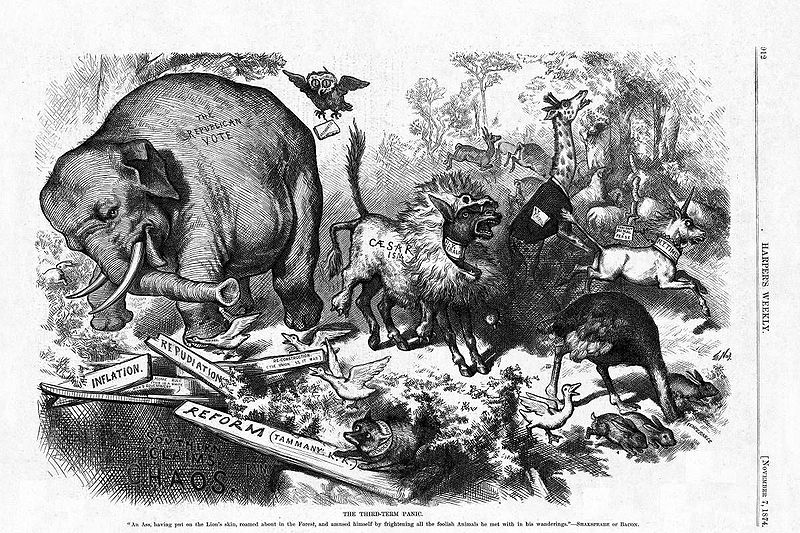
In the decades following the war, Nast would continue to elevate the medium to high art. In 1871, he began an ongoing series for Harper’s Weekly attacking the corruption of Tammany Hall, the Democratic political machine that controlled New York politics. Nast so mercilessly lampooned William M. “Boss” Tweed as the machine’s ringleader, that Tweed was heard to rage, “Stop them damn pictures! I don’t care a straw for your newspaper articles. My constituents can’t read. But they can’t help seeing them damn pictures!”

Eventually, Tweed was convicted of money laundering. (He attempted to escape justice by absconding to Spain, but was soon apprehended by Spanish officials, who reportedly recognized him with assistance from Nast’s cartoons.) As for Nast himself, he’d go on to conceive of the elephant as a symbol for the Republican party, popularize the use of the donkey for the Democrats, and help create the modern image of Santa Claus that Americans have come to love.

“The Third-Term Panic”, by Thomas Nast, originally published in Harper’s Magazine on 7 November 1874.

A braying ass, in a lion’s coat, and “N.Y. Herald” collar, frightening animals in the forest: a giraffe (“N. Y. Tribune”), a unicorn (“N. Y. Times”), and an owl (“N. Y. World”); an ostrich, its head buried, represents “Temperance”. An elephant, “The Republican Vote”, stands near broken planks (Inflation, Repudiation, Home Rule, and Re-construction). Under the elephant, a pit labeled “Southern Claims. Chaos. Rum.” A fox (“Democratic Party”) has its forepaws on the plank “Reform. (Tammany. K.K.)” The title refers to U.S. Grant’s possible bid for a third presidential term. This possibility was criticized by New York Herald owner and editor James Gordon Bennett, Jr.
Image and caption via Wikimedia Commons.

Tank Chats #90 | M26 Pershing | The Tank Museum

Filed under: History, Military, USA, Weapons, WW2 — Tags: , , — Nicholas @ 02:00

The Tank Museum
Published 29 Nov 2019

David Fletcher examines the American M26 Pershing “Heavy” tank. The Pershing saw service in the latter days of the Second World War and Korea.

Support the work of The Tank Museum on Patreon: ► https://www.patreon.com/tankmuseum

Visit The Tank Museum SHOP: ►tankmuseumshop.org

Twitter: ► https://twitter.com/TankMuseum
Instagram: ► https://www.instagram.com/tankmuseum/
Tiger Tank Blog: ► http://blog.tiger-tank.com/
Tank 100 First World War Centenary Blog: ► http://tank100.com/
#tankmuseum #tanks

QotD: Heinlein’s “Future History”

Filed under: Books, Quotations, Space, USA — Tags: , , , , — Nicholas @ 01:00

I’ve been planning to write about Elon Musk’s Bowie-blasting space car ever since the video footage was transmitted back to Earth in the middle of this week. But I did not even notice until I sat down to the job that I have also been rereading Robert A. Heinlein’s “Future History” short-story cycle. This is not exactly a coincidence: I go back to the Future History every few years. This time I had one of those “Surprise! You’re old!” moments upon realizing that my cheap trade paperback of The Past Through Tomorrow, a collection of the Future History stories, must be 30 years old if it’s a day.

Written between 1939 and 1950 for quickie publication in pulp magazines, the Future History is a series of snapshots of what is now an alternate human future — one that features atomic energy, solar system imperialism, and the first steps to deep space, all within a Spenglerian choreography of social progress and occasional resurgent barbarity. It stands with Isaac Asimov’s Foundation trilogy as a monument of golden-age science fiction.

In some respects the Future History has not aged any better than one might expect. Like other young nerds who created the science-fiction canon, Heinlein was interested in rocketry before it was thought to have any practical use. And Heinlein was really, really good at acquiring or faking expert knowledge of those topics in which he happened to get interested. The man knew his Tsiolkovsky.

The result, in the key story of the Future History, is an uncannily accurate description of the design and launch of a Saturn V rocket. (Written before 1950, remember.) But because Heinlein happened not to be interested in electronic computers, all the spacefaring in his books is done with the aid of slide rules or Marchant-style mechanical calculators (which, in non-Heinlein history, had to become obsolete before humans could go to Luna at all). Heinlein sends people to colonize the moon, but nobody there has internet, or is conscious of its absence.

Colby Cosh, “Heinlein’s monster? The literary key to Elon Musk’s sales technique”, National Post, 2018-02-12.

January 8, 2021

Renault’s Backwards Car

Filed under: France, History, Technology — Tags: , , — Nicholas @ 02:00

Big Car
Published 12 Oct 2020

Renault’s Project 900 is certainly an odd-looking car, but it’s also a car designed to break new ground. It used innovative new materials and gave class-leading visibility to try to leapfrog the competition. It also seems they were trying to beat their competition in the “weird” category as well, which given they were up against Citroën was no mean feat! So, what happened to Renault’s backwards car, and what echoes of this strange but innovative design are there in today’s cars?

To get early ad-free access to new videos, or your name at the end of my videos, please consider supporting me from just $1 or 80p a month at https://www.patreon.com/bigcar

Link to my second channel – Little Car: https://www.youtube.com/littlecar

Get Big Car t-shirts, mugs or a tote bag at teespring.com/stores/bigcartv

#bigcar

QotD: Culinary appropriation

Filed under: Americas, Europe, Food, History, India, Quotations — Tags: , , , , — Nicholas @ 01:00

Cultural appropriation is good. When ideas from different cultures are imperfectly absorbed, new ideas ensue. Exchange promotes change. I detest empires, but, in deference to truth, praise them as culturally creative arenas in which new ways of life, thought, art, language, worship, work, government and food take shape, as people swap and circulate biota, behaviour and brilliance.

Some of the resulting dishes are deplorable. I could live happily in a world without chop suey, chilli con carne, or coronation chicken. I’m not going to try a recipe described in Eater magazine as “huevos Kathmandu that paired green chutney and spiced chickpeas with fried eggs”.

Tex-mex cuisine is Montezuma’s most effective revenge. Rijstafel conquered the Netherlands more thoroughly than the Dutch ever subjected the East, and now rivals the drearier Hutspot as Holland’s national dish. Yet Dutch food still lags behind grandes cuisines.

Vindaloo is the epitome of culinary appropriation: a Bengali dish with ingredients from the Americas — potatoes and chillies — and a corruption of a Portuguese name: vinho d’alho, or garlic wine. It has become so British that “Vindaloo nah-nah” was the chorus of a chant popular among English football fans at a World Cup tournament (perhaps they confused it with Waterloo). I still dislike it.

Usually, however, culturally exchanged foods produce admirable dishes. Chocolate, tomato and avocado are among the few English words derived from Nahuatl. The Aztecs never used the items they designate in pain au chocolat, or tricolore, or avocado toast. But the responsible cultural appropriators deserve praise, not blame.

Satay would be unthinkable if Malays hadn’t incorporated peanuts that Portuguese pinched from Brazil. The basics of cajun cuisine reached Louisiana with “Acadian” migrants from French Canada — but cultural appropriation made it what it is today. Black chefs in the same region would be at a loss without African-born yams.

Curries would be historical curiosities if Indians hadn’t appropriated chillies from Mexico. Is Sichuanese cuisine imaginable without American peppers or sweet potatoes. Tempura would be unavailable if Japanese chefs hadn’t annexed and improved Portuguese techniques of frying. Culinary historians bicker over whether Jewish or Italian immigrants developed fish and chips. But almost everyone agrees that the British could never have done it on their own.

Felipe Fernández-Armesto, “Bad taste of PC foodies”, The Critic, 2020-09-19.

January 7, 2021

Banzai Tank Charge – Saipan 1944

Filed under: History, Japan, Military, Pacific, USA, Weapons, WW2 — Tags: , , , — Nicholas @ 04:00

Mark Felton Productions
Published 6 Jan 2020

The story of the largest tank battle of the Pacific Campaign on the island of Saipan.

Dr. Mark Felton is a well-known British historian, the author of 22 non-fiction books, including bestsellers Zero Night and Castle of the Eagles, both currently being developed into movies in Hollywood. In addition to writing, Mark also appears regularly in television documentaries around the world, including on The History Channel, Netflix, National Geographic, Quest, American Heroes Channel and RMC Decouverte. His books have formed the background to several TV and radio documentaries. More information about Mark can be found at: https://en.wikipedia.org/wiki/Mark_Fe…

Visit my audio book channel “War Stories with Mark Felton”: https://youtu.be/xszsAzbHcPE

Help support my channel:
https://www.paypal.me/markfeltonprodu…
https://www.patreon.com/markfeltonpro…

Disclaimer: All opinions and comments expressed in the ‘Comments’ section do not reflect the opinions of Mark Felton Productions. All opinions and comments should contribute to the dialogue. Mark Felton Productions does not condone written attacks, insults, racism, sexism, extremism, violence or otherwise questionable comments or material in the ‘Comments’ section, and reserves the right to delete any comment violating this rule or to block any poster from the channel.

« Newer PostsOlder Posts »

Powered by WordPress