Quotulatiousness

June 24, 2021

“[M]any of the woke genuinely do not understand why anyone finds their politics, or their political tactics, threatening”

Filed under: Media, Politics, USA — Tags: , , , , — Nicholas @ 03:00

In The Line, Joseph Heath tries to explain why many adherents of the wokist ideology fail to understand why anyone could possibly be against their policies or their tactics:
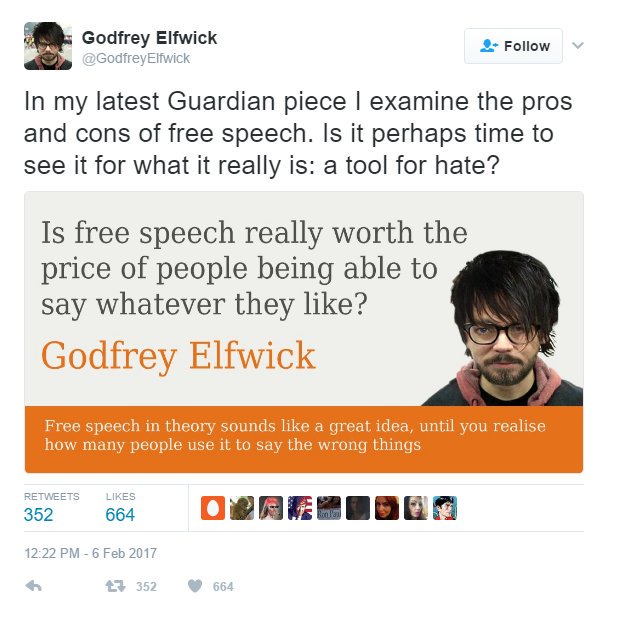
Godfrey Elfwick’s disturbingly accurate summary of free speech support among the woke.

After several years of creeping illiberalism under the guise of progressive politics, American liberals are finally getting their act together. They are pushing back, creating several organizations committed to combating the influence of “woke” politics and ideology. They have momentum, not just because many woke mantras like “defund the police” have proven spectacularly unpopular, but also because there is genuine growing alarm about the intolerant and authoritarian brand of politics that has become associated with the woke left.

Unfortunately, many of the woke genuinely do not understand why anyone finds their politics, or their political tactics, threatening. In particular, the accusation that they are being authoritarian, or that “cancel culture” is a threat to freedom of expression, is one that they are simply unable to process.

There is a reason for this — and one that’s worth understanding. There are several key phrases that play an enormously important role in woke politics (e.g. “safety”, “mental health”, “microaggression”, “bullying” and even “human rights”) which they use to deflect the accusation of authoritarianism. If you adopt the right words, it’s easier to convince yourself that you’re the good guys even as you’re acting like the bad ones.

I want to take a shot at explaining how this works.

The most important thing to understand about woke politics is that it is not a conventional form of illiberalism, it is better thought of as a type of “illiberal liberalism”. It involves making a set of political demands that are fundamentally illiberal, but then articulating them in a way that fits the conventional structure of liberal political discourse. Because of the way that their complaints are packaged, the woke are able to brush off criticism of their tactics.

Take an issue like freedom of speech. There are various versions of this traditionally liberal virtue; predominant among them, is that those who hold this belief are opposed to content-based restrictions on speech. In the old days, lots of politicians didn’t really believe in freedom of speech, as many among the ruling class maintained straightforwardly illiberal views.


The Founder | Based on a True Story

Filed under: Business, Food, History, Media, USA — Tags: , , , , , — Nicholas @ 02:00

The Cynical Historian
Published 27 Jul 2017

This one is a contender for best historical film of 2016. The Founder is an amazing movie about the beginning of the McDonald’s food chain. Seriously, more films should take cues from this.
————————————————————
references:
http://www.historyvshollywood.com/ree…​

http://time.com/money/4602541/the-fou…​

http://content.time.com/time/magazine…​

https://www.bustle.com/p/how-accurate…​

https://www.washingtonpost.com/entert…​

https://www.theatlantic.com/entertain…​

https://www.nytimes.com/2016/05/20/bu…​

http://www.abc.net.au/news/2016-11-24…

http://www.cbsnews.com/news/the-real-…

https://en.wikipedia.org/wiki/Ray_Kroc​
https://en.wikipedia.org/wiki/Richard…​
————————————————————
contribute to my Patreon:
https://www.patreon.com/CynicalHistorian

LET’S CONNECT:
https://twitter.com/Cynical_History
————————————————————
Wiki:
The Founder is a 2016 American biographical drama film directed by John Lee Hancock and written by Robert Siegel. The film stars Michael Keaton as businessman Ray Kroc, and portrays the story of his creation of the McDonald’s fast food chain. Nick Offerman and John Carroll Lynch co-star as McDonald’s founders Richard and Maurice McDonald.

The film premiered at Arclight Hollywood on December 7, 2016 and was released in the United States on January 20, 2017, by The Weinstein Company. It grossed $23 million worldwide and received generally positive reviews from critics, with praise for Keaton’s performance.
————————————————————
Hashtags: #History​ #TheFounder​ #McDonalds​ #Review​ #BasedOnATrueStory​ #RayKroc

QotD: The fantasy world of Canadian geopolitical posturing

Filed under: Cancon, China, Government, History, Quotations, USA — Tags: , — Nicholas @ 01:00

There are two basic things you need to know about Canada’s position in the world. The first is that we are bordered on three sides by ocean. The second is that we are bordered on the fourth side by the United States. That is a simple geopolitical reality whether we like it or not — and Canadians have expended a great deal of energy over the past half century or so making it clear just how much we dislike it.

Yet for all the reflexive anti-Americanism that has been the meat and mead of Canadian nationalism, Canada’s leadership class has usually been pretty good about understanding who is in charge. Over the course of the 20th century, from the Ogdensburg agreement of 1940 and the post-war establishment of NORAD to the Free Trade Agreement of 1988, we cemented that reality with a defence and economic alliance.

Paradoxically, what this continental defence and economic security arrangement has given us is the opportunity to let our internationalist pretensions run wild. One of the weirdest things about Canada is the extent to which we like to frame our place in the world in a-geographic terms. We imagine that we are as threatened as anyone by the mix of post-Cold War failed states, opportunistic terrorism, regional authoritarianism, and humanitarian disasters. By the same token, we like to presume that we are as well-positioned as any other country to do something about all of this.

As the dean of Canadian defence policy Kim Nossal points out in a recent paper, this a-geographic security fantasy is reflected in the official defence reviews that Canadian governments have released since the 1990s. Or take, for example, the 2017 Liberal policy statement, entitled Strong, Secure, Engaged, which rejects the idea that Canada’s privileged geographic location mitigates these global threats for us. As Nossal concludes, when you look at how Canadian governments actually talk about our security situation, you get little sense that, thanks to the Americans, Canada occupies “one of the safest spaces in contemporary global politics.”

You can see the logical leaps, then.

Once you’ve convinced yourself that Canada’s security is disconnected from the geographical imperative of the American security guarantee, it’s only a few steps to the conclusion that who we choose as our global strategic partner is actually a meaningful choice. And if it is true, as China’s president Xi Jinping has claimed, that the East is on the rise and the West is in decline, then why not throw your lot in with the new big dog on the block?

Andrew Potter, “Hedging our bets with China was a mistake”, The Line, 2021-03-23.

June 23, 2021

The RAF and Luftwaffe Bombers of Western Europe – WW2 Special

Filed under: Britain, Germany, History, Military, Weapons, WW2 — Tags: , , — Nicholas @ 04:00

World War Two
PUblished 22 Jun 2021

What aircraft are being sent out by commanders like Hermann Göring and Arthur Harris to blitz and firebomb enemy cities? Watch the video to learn the specs of the Handley Page Halifax, Avro Lancaster, Junkers Ju-88, Dornier Do-17, Dornier Do-217, and Heinkel He-111 as they fly in their respective 1,000 Bomber Raids and Baedeker Blitz.
(more…)

Bad legislation rammed through in the small hours of the morning

Filed under: Cancon, Government, Law, Liberty, Technology — Tags: , , , , , , — Nicholas @ 03:00

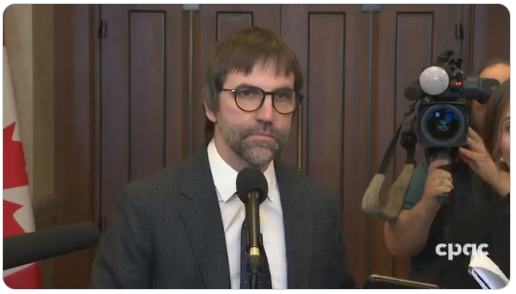
Michael Geist on how one of the worst pieces of legislation to get extruded from the bowels of the Liberal minority government got pinched off by main force and now sits, steaming, on the docket for the Senate to … well, “rubber stamp” isn’t quite the right phrase but it’s pretty rare for our unelected senators to do anything to benefit ordinary Canadians, so we’re depending on them somehow managing to display an almost supernatural effort to slow down this shitty bill until the end of the session:

Canadian Heritage Minister Steven Guilbeault, 3 February 2020.
Screencapture from CPAC video.

The Liberal government strategy of multiple gag orders and a “super motion” to limit debate bore fruit last night as Bill C-10 received House of Commons approval at 1:30 am. The Parliamentary process took hours as the government passed multiple motions to cut short debate, re-inserted amendments that had been previously ruled null and void, and rejected a last-ditch attempt to restore the Section 4.1 safeguards for user generated content. The debate included obvious errors from Liberal MPs who were presumably chosen to defend the bill. For example, Julie Dabrusin, the Parliamentary Secretary to the Minister of Canadian Heritage, said that Section 2.1 in Bill C-10 “specifically excludes content uploaded by users.” Only it doesn’t as Dabrusin should know given that 2.1 covers users not content and she was the MP who introduced the amendment at committee to remove Section 4.1, which was the provision that excluded content uploaded by users.

Given the public support from the Bloc for cutting short debate, the outcome last night was never really in doubt. Perhaps the most interesting vote of the night came with a motion from Conservative MP Alain Rayes, which once again called for the re-insertion of Section 4.1. While the motion was defeated with the support of Liberal, NDP, and Bloc MPs, there were several notable exceptions. Liberal MPs Nate-Erskine Smith and Wayne Long both abstained and former Justice Minister (and now independent MP) Jody Wilson-Raybould voted in favour of the motion. The report stage was limited to one hour of debate, which meant that the 23 amendments were again subject to no real debate or discussion. Once the bill passed the report stage, it was on to third and final reading, which was limited to 15 minutes of debate per party. The vote followed just before 1:30 am with the Liberals, NDP, and Bloc once again supporting Bill C-10. Wilson-Raybould joined with the Conservatives in voting against it.

A rational government would comprehend that their pitch that the real purpose of the bill is to “make the web giants pay” is completely undermined by the obvious and deliberate attempt to introduce government censorship of what ordinary Canadians watch on the internet and share through social media. It’s all about the control, not about any imaginary financial windfall from shaking down tech companies for spare change. Why the rush to get it rammed through parliament right now, with so many other rather more pressing concerns at hand?

Tank Chats #112 | Churchill Mk I and II | The Tank Museum

Filed under: Britain, History, Military, Weapons, WW2 — Tags: , , — Nicholas @ 02:00

The Tank Museum
Published 4 Dec 2020

Tank Museum Historian David Fletcher discusses the British Second World War Churchill Mark I, the very first Churchill, as well as its successor, the Mark II. This chat also covers the development of the A20 prototype and how this became the production Mark I variant. The Churchill displayed is actually a Mark II made to look like a Mark I, and is the oldest surviving Churchill in the UK.
(more…)

QotD: Churchill’s support for Stalin

Filed under: Britain, History, Military, Quotations, Russia, WW2 — Tags: , , , , , — Nicholas @ 01:00

Churchill threw all of his support behind Stalin’s armies despite Stalin’s alliance with Hitler during the first 21 months of the war — the USSR having invaded the same number of countries as Nazi Germany (seven), having supplied the German Wehrmacht as it invaded France and the Low Countries, and having literally fueled the Luftwaffe as it bombed London in 1940.

This support was more than rhetorical. In a gesture of astonishing (and short-sighted) selflessness, Churchill responded to news of Nazi Germany’s invasion of the Soviet Union by sending Stalin 200 brand-new Hawker Hurricane pursuit planes which had been pledged to defend Singapore against Japanese attack. Churchill then “re-gifted” Stalin 200 Tomahawk fighters and 300 Douglas A-20 Havoc bombers from Britain’s own Lend-Lease consignments, and shipped Stalin 2,000 tonnes of processed aluminum for Soviet warplane factories, despite it being desperately needed at home.

Even more striking was Churchill’s decision to ship Stalin nearly 600 tanks, which helped tip the balance in the Battle of Moscow in December 1941. Churchill even agreed to strip Cairo command of hundreds more tanks in 1942, routing them to Stalin’s USSR via Iran to bail out the Red Army at Stalingrad, which left Egypt vulnerable to Rommel’s Afrika Korps.

Churchill doubled down on his pro-Soviet policies even in areas where Britain had her own clients, such as Yugoslavia. Despite hosting the Yugoslav exile government in London, by September 1943, Churchill abandoned that government’s commander on the ground and threw his full support behind Stalin’s man, Josip Broz (“Tito”). Bamboozled by a Soviet smear campaign against Colonel Draža Mihailovic, Churchill cut off Mihailovic’s Chetniks and shipped Tito more than 100 times more war materiel over the next nine months than Mihailovic had received in the previous two years.

Sean McMeekin, “Churchill’s enigma: the real riddle is why he cozied up to Stalin”, Spectator, 2021-03-21.

June 22, 2021

History Summarized: The Athenian Temple at Sounio

Filed under: Architecture, Europe, Greece, History, Humour, Religion — Tags: , , — Nicholas @ 02:00

Overly Sarcastic Productions
Published 29 Sep 2017

On my summer vacation, I had the distinct pleasure of visiting Cape Sounio, at the southern tip of Attica at sunset, and I have to say it was one of the most historically exciting moments of my life. For all I myself have said about the Athenian empire, seeing the view from this temple made everything click into place and feel tangibly real for the first time ever (even my 10+ trips to the Parthenon over the course of my childhood didn’t do that). So uh … here’s 7 minutes of me gushing about it under the thin guise of persuasive historical argumentation.

PATREON: www.patreon.com/user?u=4664797

MERCH LINKS:
Shirts – https://overlysarcasticproducts.threa…​
All the other stuff – http://www.cafepress.com/OverlySarcas…​

Find us on Twitter @OSPYouTube!

QotD: The “Stringbag”, formally known as the Fairey Swordfish

Filed under: Britain, History, Military, Quotations, Weapons, WW2 — Tags: , , — Nicholas @ 01:00

The British torpedo bomber [of 1939] was the Fairey Swordfish (138mph, 2 x .303mg, 1,600lbs torpedo or bombs — later rockets, 1,030 miles range). A slow but reliable biplane, with more lift and range than the [American Douglas TBD] Devastator, and more combat survivability than the [Japanese Yokosuka B4Y] “Jean”. (It frequently astounded even the crews how much damage a Swordfish could absorb and keep flying. Ragged anti-aircraft holes in the wings and tail and fuselage, lines of tracer holes across various surfaces, broken struts, cut control cables, the Swordfish would absorb them all and make it home.) Nevertheless the Swordfish was quickly proved to be a deathtrap for daylight operations against an enemy with fighter cover, and was scheduled for replacement by a more modern torpedo bomber for combat ops. Yet, amazingly, the Swordfish was the only allied pre-war naval carrier aircraft still in production when the war ended.

There are three reasons for this feat. The first is that the British were early adaptors of night operations, and performed successful Swordfish strikes (such as the amazingly successful strike at the Port of Taranto which crippled or sank several major warships – becoming the Japanese model for Pearl Harbor), and successful night attacks at sea once the second innovation came in. This was the development of airborne radar, which was first operational on Swordfish operating on British carriers six months before Pearl Harbor. The British were to hold this unique ability to use radar for carrier aircraft operations for a couple of years before the Americans deployed similar concepts in 1943. They were to hold their unique advantage of night-time strikes also. (Both the Japanese and Americans lost many pilots over the next few years in strikes that failed to get home before dark!) So the Swordfish could soldier on under the cover of night, and continued to be useful as a strike aircraft long after its use in daytime had been demonstrated to be suicidal by the easy slaughter of those attempting to attack the Scharnhorst and Gneisenau during the Channel Dash in 1941.

The third, and unexpected reason, why the Swordfish was still in production at the end of the war, was that its unrivalled flying characteristics made it the only aircraft capable of surviving operations from small escort carriers operating in the Arctic Circle in bad weather. Whereas more modern, higher speed aircraft, like the Hurricane, Wildcat and Avenger could work from escort carriers in calmer seas, none of those would even consider operations under the sort of conditions that a Swordfish could easily manage. So the venerable old bus continued to serve successfully purely in an anti-submarine role until the final days of the war. This was not because there weren’t many better aircraft available, but simply because no other aircraft available could do the job as well. An example of a World War Two aircraft still having a (slightly reduced) role, long after being technically obsolete — see the many inadequate fighters that lived on as very successful night fighters. (Though the fact that “modern” B-52s are scheduled to still be operational 80 or 90 years after their initial deployment shows that new roles are always possible for reliable old aircraft, even when their technology is fifty years out of date.)

Nigel Davies, “Comparing naval aircraft of World War II”, rethinking history, 2010-12-20.

June 21, 2021

“The public are getting a little bit fed up of virtue-signalling police officers when they’d really rather we just locked up burglars”

Filed under: Britain, History, Law, Politics — Tags: , , , — Nicholas @ 05:00

Gawain Towler on the sudden, unexpected — and undoubtedly unwelcome to self-appointed guardians of the official narrative — appearance of what sounds surprisingly like common sense from a top police officer in Britain:

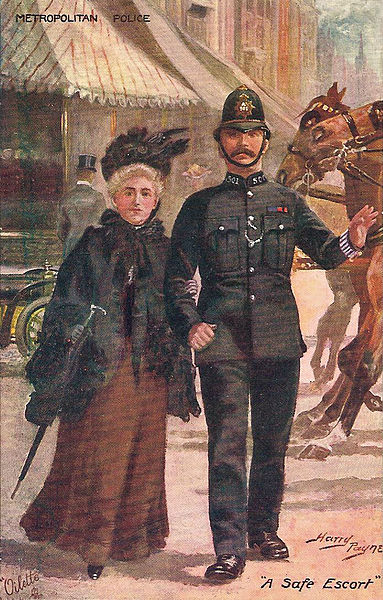
“A Safe Escort” by Harry Payne (1858-1927), first published in August 1911 but possibly painted a few years earlier. From the back of the card: “Among the hundred and one duties of the London Policeman he is here depicted as a kindly protector, halting the traffic as he escorts a Lady across the congested streets. This is essentially a London incident, and has no parallel in any other Police Force in the world.”
Photo of the Tuck’s Oilette by Leonard Bentley via Wikimedia Commons.

Has Robert Peel been reincarnated as the Chief Constable for Manchester?

“But officer, if you are not on your knee, and wearing a rainbow lanyard, how do we know that you are on the side of the oppressed, the intersectional, the poor, downtrodden graduates of minor universities?”

“I’m sorry madam, may I call you madam? I am on the side of the law.”

The promotion of Stephen Watson as the new Chief Constable for Manchester comes as a shaft of light cutting through the murk of muddled thinking. He has said two things that will resonate with millions and will cause consternation amongst thousands:

    I would probably kneel before the Queen, God and Mrs Watson, that’s it … The public are getting a little bit fed up of virtue-signalling police officers when they’d really rather we just locked up burglars.

It sounds like the first blast of the trumpet, but not only does it strike an astonishingly different note than the honky tonk tunes played by other constabularies. Stentorian and self confident it also marks a huge departure in that he makes a very public statement that he would kneel before God. A very courageous statement in the current climate in itself. But it is his approach to policing that strikes the eye.

One almost feels that as was once the case, each new officer in the Manchester Metropolitan Area will be issued with Sir Robert Peel’s 1829 Nine Principles of Policing. It is worth our while looking at those principles and deciding whether or not to accept that they should remain at the core of policing, or be junked as impossibly dated.

What is clearly apparent is that Peel’s principles are at heart about consent. Famously it described the police as merely the citizens in uniform, or that “the police are the public and that the public are the police, the police being only members of the public who are paid to give full time attention to duties which are incumbent on every citizen in the interests of community welfare and existence”.

Underlying this basic thought is an understanding that the police rely, entirely on the goodwill of the populace, if they wish to carry out their basic duties. In order to fulfil their functions and duties they are “dependent on public approval of their existence, actions and behaviour and on their ability to secure and maintain public respect”.

Etruscans: Italian Civilization Before Ancient Rome

Filed under: Europe, History, Italy, Religion — Tags: , , , , — Nicholas @ 04:00

Kings and Generals
Published 20 Feb 2020

Our new animated historical documentary talks about the Etruscans. Their origins, culture, religion, lifestyle and how they influenced the Roman Republic and through it the world.

Support us on Patreon: http://www.patreon.com/KingsandGenerals or Paypal: http://paypal.me/kingsandgenerals

We are grateful to our patrons and sponsors, who made this video possible: https://docs.google.com/document/d/1_…

The video was made by our friend András Szente-Dzsida while the script was researched and written by Leo Stone

This video was narrated by Officially Devin (https://www.youtube.com/user/OfficiallyDevin)

✔ Merch store ► teespring.com/stores/kingsandgenerals
✔ Podcast ► Google Play: http://bit.ly/2QDF7y0 iTunes: https://apple.co/2QTuMNG
✔ Twitter ► https://twitter.com/KingsGenerals
✔ Instagram ► http://www.instagram.com/Kings_Generals

Production Music courtesy of Epidemic Sound: http://www.epidemicsound.com

#Documentary #Etruscans #KingsandGenerals

“… the GOP needs an inflammatory issue to rile their racist base, and so this entire foofaraw is really just an astro-turfed, ginned-up partisan gambit about nothing”

Filed under: Education, Media, Politics, USA — Tags: , , , , — Nicholas @ 03:00

An excerpt from Andrew Sullivan’s most recent Weekly Dish looks at the burgeoning fight over the use of Critical Race Theory in public schools:

The stories in the mainstream media this past week about the broadening campaign to ban critical race theory in public schools have been fascinating — and particularly in how they describe what CRT is. Here’s the Atlantic‘s benign summary of CRT: “recent reexaminations of the role that slavery and segregation have played in American history and the attempts to redress those historical offenses.” NBC News calls it the “academic study of racism’s pervasive impact.” NPR calls CRT: “teaching about the effects of racism.” The New York Times calls it, with a straight face, “classroom discussion of race, racism” and goes on to describe it as a “framework used to look at how racism is woven into seemingly neutral laws and institutions.”

How on earth could merely teaching students about the history of racism and its pervasiveness in the United States provoke such a fuss? No wonder Charles Blow is mystified. But don’t worry. The MSM have a ready explanation: the GOP needs an inflammatory issue to rile their racist base, and so this entire foofaraw is really just an astro-turfed, ginned-up partisan gambit about nothing. The MSM get particular pleasure in ridiculing parents who use the term “critical race theory” as shorthand for things that just, well, make them uncomfortable — when the parents obviously have no idea what CRT really is.

When pushed to describe it themselves, elite journalists refer to the legal theories Derrick Bell came up with, in the 1970s — obscure, esoteric and nothing really to do with high-school teaching. “If your kid is learning CRT, your kid is in law/grad school,” snarked one. Marc Lamont Hill even tried to pull off some strained references to Gramsci to prove his Marxian intellectual cred, and to condescend to his opponents.

This rubric achieves several things at once. It denies that there is anything really radical or new about CRT; it flatters the half-educated; it blames the controversy entirely on Republican opportunism; and it urges all fair-minded people to defend intellectual freedom and racial sensitivity against these ugly white supremacists.

What could be more convenient? NBC News “reporter”, Brandy Zadrozny, even decried parents’ attempts to discover through FOIA requests just what their children are being taught — and argued this week that, “for longtime ultra conservative activists, CRT is the opportunity of a lifetime.” CRT, she explains, is not a threat at all, and there is no proof that it is even being taught. It’s “just a catch-all term repurposed as a conservative boogeyman.” She goes on: “it harnesses pushback against 2020’s racial justice movement, covid denialism, and depends on a base still energized by Trump and misinformation, looking for political power.”

I’m sure the MSM will continue to push this narrative indefinitely. They are still insisting, after all, that “white supremacy” is behind hateful attacks on Asian-Americans, and that soaring murder rates are purely a function of Covid19. And you can see why: this dismissive take is extremely helpful in avoiding what is actually happening. It diverts attention from the stories and leaks and documents that keep popping up all over the place about extraordinary indoctrination sessions that have become mandatory for children as early as kindergarten.

Turner Semiauto SMLE Conversion

Filed under: Britain, Cancon, History, Military, USA, Weapons, WW2 — Tags: , , , , — Nicholas @ 02:00

Forgotten Weapons
Published 12 Nov 2016

Cool Forgotten Weapons Merch! http://shop.bbtv.com/collections/forg…​

Russell Turner was a Pennsylvania gunsmith and inventor who developed this semiautomatic conversion of an SMLE bolt action rifle circa 1940. It was intended for trial and potential sale to the Canadian military, as it would allow them to retrofit existing rifles into semiautomatic configuration and still use existing supplies of .303 British ammunition. Rather than try to devise a reliable system to rotate the original Enfield bolt, Turner replaced the bolt entirely, using instead a side-tilting design much like what he used in his M1 Carbine trials rifle for the US military. This was coupled with a long stroke gas piston and a hammer firing trigger mechanism.

Reportedly the rifle was tested by Canadian authorities, and performed quite well, with the adjustable gas system allowing it to function reliably even in temperatures of 25 below zero (where the Garand, tested alongside, experienced problems). However, Turner’s rifle was deemed too complex for military adoption.

That decision against the rifle was probably the right one for Canada, although Turner’s conversion is one of the better semi auto bolt acton conversions I have handled. It was remarkably non-awkward — that may not sound like much to crow about, but it sets a pretty high standard for this type of rifle.

http://www.patreon.com/ForgottenWeapons​

QotD: The young Richard Nixon

Filed under: Education, Football, History, Politics, Quotations, USA — Tags: , , , — Nicholas @ 01:00

As a schoolboy he hadn’t a single close friend, preferring to cloister himself up in the former church’s bell tower, reading, hating to ride the school bus because he thought the other children smelled bad. At Whittier, a fine Quaker college of regional reputation unknown anywhere else, he embarked upon what might have been his most humiliating job of all: learning to be a backslapping hail-fellow-well-met. (“I had the impression he would even practice his inflection when he said ‘hello'”, a reporter later observed.) The seventeen-year-old blossomed when he realized himself no longer alone in his outsiderdom: the student body was run, socially, by a circle of swells who called themselves the Franklins, and the remainder of the student body, a historian noted, “seemed resigned to its exclusion.” So this most unfraternal of youth organized the remnant into a fraternity of his own. Franklins were well-rounded, graceful, moved smoothly, talked slickly. Nixon’s new club, the Orthogonians, was for the strivers, those not to the manner born, the commuter students like him. He persuaded his fellows that reveling in one’s unpolish was a nobility of its own. Franklins were never photographed save in black tie. Orthogonians wore shirtsleeves. “Beans, brains, and brawn” was their motto. He told them *orthogonian* — basically, “at right angles” — meant “upright,” “straight shooter.” Also, their enemies might have added, all elbows.

The Orthogonians’ base was among Whittier’s athletes. On the surface, jocks seem natural Franklins, the Big Men on Campus. But Nixon always had a gift for looking under social surfaces to see and exploit the subterranean truths that roiled underneath. It was an eminently Nixonian insight: that on every sports team there are only a couple of stars, and that if you want to win the loyalty of the team for yourself, the surest, if least glamorous, strategy is to concentrate on the nonspectacular — silent — majority. The ones who labor quietly, sometimes resentfully, in the quarterback’s shadow: the linemen, the guards, the punter. Nixon himself was exemplarily nonspectacular: the 150-pounder was the team’s tackle dummy, kept on squad by a loving, tough, and fatherly coach who appreciated Nixon’s unceasing grit and team spirit — nursing hurt players, cheering on the listless, even organizing his own team dinners, entertaining the guests on the piano, perhaps favoring them with the Orthogonian theme song. It was his own composition.

Nixon beat a Franklin for student body president. Looking back later, acquaintances marveled at the feat of this awkward, skinny kid the yearbook called “a rather quiet chap about campus,” dour and brooding, who couldn’t even win a girlfriend, who attracted enemies, who seemed, a schoolmate recalled, “the man least likely to succeed in politics.” They hadn’t learned what Nixon was learning. Being hated by the right people was no impediment to political success. The unpolished, after all, were everywhere in the majority.

Rick Perlstein, Nixonland: The Rise of a President and the Fracturing of America, 2008.

June 20, 2021

L’Affaire Annamie Paul – “… it’s like every Liberal across the land forgot about politics”

Filed under: Cancon, Media, Politics — Tags: , , , , , , — Nicholas @ 05:00

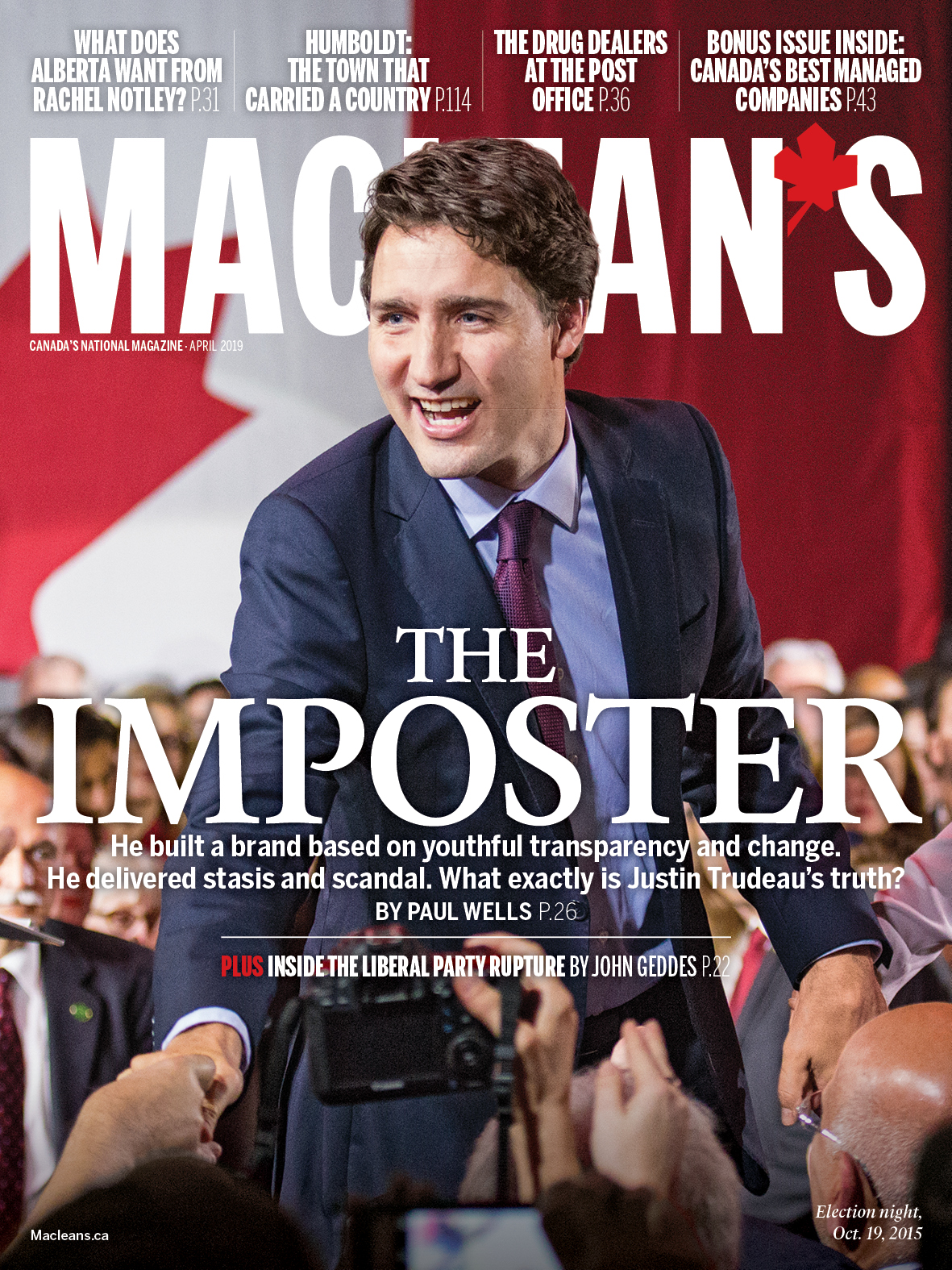
The weekly wrap-up from The Line wonders why Canadian media outlets pay so much attention to the Green Party (far in excess of their political influence normally), but recent Green Party fratricidal bun-fighting merits attention just because of the injured bystander, the Prime Minister of the current year:

The background of all of this is complicated, and we’re not going to bother recapping it. If you care enough about Canadian politics to follow the Greens, you know it all already. What’s interesting to us — and funny as all hell — is how angry the PM’s die-hard fanbase was, how shocked and sincerely surprised they were, when Paul turned her guns on the PM instead of her own rebelling party executives and grassroots:

    “To the prime minister, Justin Trudeau,” Paul said at a press conference, “I say to you today, you are no ally. And you are no feminist. Your deeds and your words over these past weeks prove that definitively. A real ally and feminist doesn’t end their commitment to those principles whenever they come up against their personal ambition.”

And, gosh. Liberals everywhere were just stunned.

It was cute. As we said, it’s like every Liberal across the land forgot about politics. And that’s ridiculous. Canadian Liberals are the most ruthlessly effective vote winners precisely because they are relentlessly amoral and craven. We don’t even mean this as an insult! Your typical Canadian Liberal constitutes the purest sample of raw partisanship known to human science — which is why they’re so good at winning.

And that’s why they should have instantly understood what Paul was doing when she attacked the PM. She was picking a fight she could win because she’s losing the one she’s actually facing. Paul is a black woman. She’s Jewish. She’s obviously lost control of her own party. The only chance in hell she has of surviving is to lay every possible identity group card down on the table, declare herself the champion of those oppressed groups, and then dare her own party to purge her. She’s adopting the mantle of the WOC woke champion. It’s a lot easier for Paul to fight that battle against the PM than it is for her to fight it against her own party.

As much as Liberals hate to admit it — and they really, really, really hate to admit it — the PM is vulnerable to accusations of hypocrisy on the feminism and racial equality files. Obviously.

Paul is desperate. She’s in a fight for her political life, and she seems to be losing. So she’s picked a fight with a powerful white man to play up her own “voice of the oppressed” credentials. It’s cynical and desperate. Frankly, the Liberals ought to be honoured. What’s that they say about imitation and flattery?

« Newer PostsOlder Posts »

Powered by WordPress