
World War Two
Published 5 Jul 2022The Gestapo deals a devastating blow to French Resistance, and in Bengal, British India the famine is only getting worse.
(more…)
July 6, 2022
Decapitating the French Resistance – WAH 066 – June 26, 1943
Comments Off on Decapitating the French Resistance – WAH 066 – June 26, 1943
“The Great Charter of the Liberties” was signed on June 15, 1215 at Runnymede
Ed West on the connections between England’s Magna Carta and the American system (at least before the “Imperial Presidency” and the modern administrative state overwhelmed the Republic’s traditional division of powers):
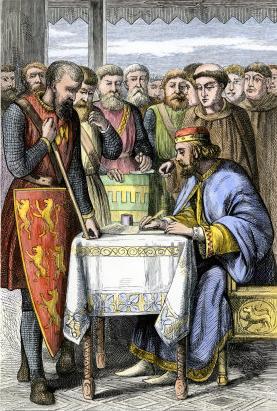
King John signs Magna Carta on June 15, 1215 at Runnymede; coloured wood engraving, 19th century.
Original artist unknown, held by the Granger Collection, New York. Image via Wikimedia Commons.
England does not really go in for national monuments, and when it does they are often eccentric. There is no great shrine to Alfred the Great, for example, the great founder of our nation, but we do have, right in the middle of London, a large marble memorial to the animals that gave their lives in the fight against fascism. And Runnymede, which you could say is the birthplace of English liberty, would be a deserted lay-by were it not for the Americans.
Beside the Thames, some 10 miles outside London’s western suburbs, this place “between Windsor and Staines”, as it is called in the original document, is a rather subdued spot, with the sound of constant traffic close by. Once there you might not know it was such a momentous place were it not for an enclosure with a small Romanesque circus, paid for by the American Association of Lawyers in 1957.
American lawyers are possibly not the most beloved group on earth, but it would be an awful world without them, and for that we must thank the men who on June 15, 1215 forced the king of England to agree to a document, “The Great Charter of the Liberties”.
Although John went back on the agreement almost immediately, and the country fell into civil war, by the end of the century Magna Carta had been written into English law; today, 800 years later, it is considered the most important legal document in history. As the great 18th-century statesman William Pitt the Elder put it, Magna Carta is “the Bible of the English Constitution”.
It was also, perhaps more importantly to the world, a huge influence on the United States. That is why today the doors to America’s Supreme Court feature eight panels showing great moments in legal history, one with an angry-looking King John facing a baron in 1215.
Magna Carta failed as a peace treaty, but after John’s death in 1216 the charter was reissued the following year, an act of desperation by the guardians of the new boy king Henry III. In 1300 his son Edward I reconfirmed the Charter when there was further discontent among the aristocracy; the monarch may have been lying to everyone in doing so, but he at least helped establish the precedent that kings were supposed to pretend to be bound by rules.
From then on Parliament often reaffirmed Magna Carta to the monarch, with 40 such announcements by 1400. Clause 39 heavily influenced the so-called “six statutes” of Edward III, which declared, among other things, that “no man, of whatever estate or condition he may be … could be dispossessed, imprisoned, or executed without due process of law”, the first time that phrase was used.
Magna Carta was last issued in 1423 and then barely referenced in the later 15th or 16th centuries, with the country going through periods of dynastic fighting followed by Tudor despotism and religious conflict. By Elizabeth I’s time, Magna Carta was so little cared about that Shakespeare’s play King John didn’t even mention it.
Comments Off on “The Great Charter of the Liberties” was signed on June 15, 1215 at Runnymede
Look at Life — Playing Trains (1967)
Classic Vehicle Channel
Published 19 Apr 2020

Comments Off on Look at Life — Playing Trains (1967)
QotD: Like Communism, “true” Social Credit has never been attempted
Brands die hard, in politics as in a grocery store. When Alberta Social Credit made its astonishing conquest of the Alberta legislature 84 years ago, the party was immediately accused by the crank inventor of the Social Credit economic doctrine, C.H. Douglas, of having gotten the theory all wrong. One suspects that Douglas, whose writings are incomprehensible when they are not preaching patent lunacy, would have said this as a matter of self-defence to any organized group that tried to use his theories as a basis for actual governing. Still, it technically means that no political manifestation of “Social Credit” was ever really Social Credit at all.
The bits of Social Credit that people in Alberta liked, amid the misery of the 1930s, were the hatred of high finance and the promise of an unearned monetary dividend. Alberta Social Credit tried to govern on this general basis, even after Douglas came to Edmonton personally and informed the cabinet that it had failed to comprehend his genius. Despite this, “Douglasite” true believers remained prominent in the party until shortly after the war, when premier E.C. Manning purged them from the Social Credit electoral apparatus. (Many were vague but obvious anti-Semites, like Douglas himself.)
Colby Cosh, “Social Credit may be dead. Long live Social Credit!”, National Post, 2019-04-22.
Comments Off on QotD: Like Communism, “true” Social Credit has never been attempted
July 5, 2022
The Republic of China’s “Porcupine strategy”
Originally published in the New York Sun and reposted by the New English Review, Conrad Black believes any attempted amphibious invasion of Taiwan will become the worst invasion outcome since the Athenians assaulted Syracuse in 414-413 BC:
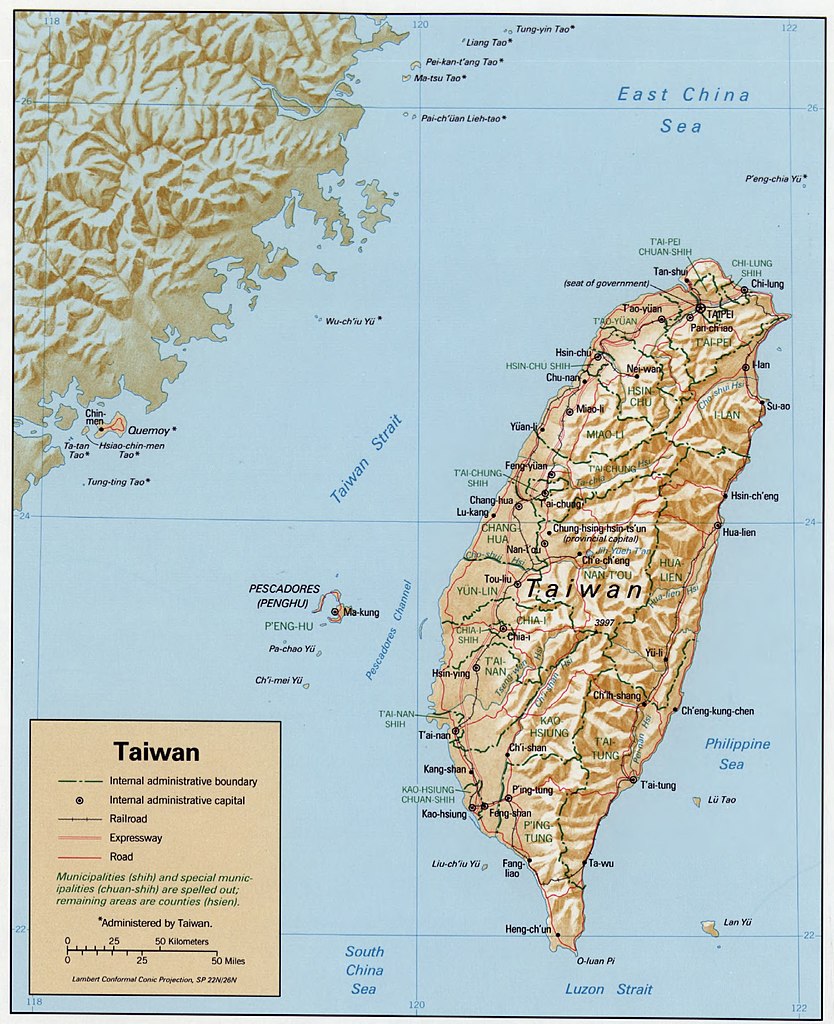
Taiwan relief map.
Library of Congress Geography & Map Division via Wikimedia Commons.
There has for some time been a good deal of flippant talk about a Communist Chinese invasion of the Republic of China on Taiwan, as if that would be a simple military undertaking. It seems to be inadequately appreciated that Taiwan has thought of little else for many years, and is, unlike Ukraine, a very prosperous and technologically sophisticated country that is armed to the teeth with the most advanced American weaponry, and has plotted out a defense in depth that is called its “porcupine strategy”.
Though it is probably accidental, “porcupine” is the word applied to Switzerland by Adolf Hitler in 1941, when, after careful analysis by the German General Staff, he concluded Swiss defenders would inflict a much larger number of casualties on a German invasion force than could possibly be justified by the occupation of the country. (It can be lamented that more recent Western strategists did not apply the same test to Afghanistan.)
Comparisons with Ukraine are inapplicable, other than the fanatical determination of the defenders. Most obviously, Taiwan is not only an island but the Formosa Straits are three to four times as wide as the English Channel from the southern British ports to the beaches of Normandy. The People’s Republic of China would have no choice but to attack amphibiously as they could not possibly imagine success with fewer than 500,000 combat soldiers and no force remotely as large could be parachuted onto Taiwan.
A strike force of 500,000 would probably have to be supplemented by a follow-up force at least as large, all conveyed in a huge armada of slow and vulnerable craft. Taiwan has been supplied with the precise ground and air-launched missiles that the Ukrainians have used to such deadly effect in the Black Sea, including the sinking of the Russian flagship, the heavy missile cruiser Moskva.
Taiwan has a front-line Air Force of about 300 of the latest fully equipped fighter and interceptor aircraft that along with shore batteries could rain a dense and prolonged fire of missiles upon any invasion fleet. Such a fleet, even in the best of weather, would plod through open water for at least ten hours. They would be sitting, or at least slowly moving, ducks throughout that journey. It brings to mind the conclusion of one of Churchill’s Demosthenean addresses in the autumn of 1940: “We are still awaiting the long-promised invasion; so are the fishes.”
Comments Off on The Republic of China’s “Porcupine strategy”
How to Fool a Führer – Operation Mincemeat – WW2 – Spies & Ties 19
World War Two
Published 4 Jul 2022Glyndwr Michael, the dead secret agent, has deposited his deceptive letters in Spain. Now the next phase of Operation Mincemeat begins. If Charles Cholmondely of MI5 and Ewen Montagu of Naval Intelligence have done their job right, the letters should make their way into Hitler’s hands.
(more…)
Comments Off on How to Fool a Führer – Operation Mincemeat – WW2 – Spies & Ties 19
Dijon mustard … made from Canadian and Ukrainian mustard seeds
In the New English Review, Theodore Dalrymple explains why Europeans have been experiencing higher shelf prices and shortages for Dijon mustard recently, over and above the ordinary supply chain disruptions of the pandemic years we’ve all had to get used to:

Among myriad smaller consequences of that war is an acute mustard shortage in France. Mustard has all but disappeared from supermarket shelves, having first increased in price dramatically. This has surprised everyone who lazily assumed that Dijon mustard came from Dijon. Why should a war waged in Ukraine lead to the disappearance of mustard throughout France? After all, the famous brands, familiar to everyone, proudly announce on their labels that they are Dijon mustard. Can there be anything more French than Dijon mustard?
Perhaps the mustard is elaborated in Dijon, but the mustard seed, it turns out to everyone’s surprise, is imported from Canada and Ukraine. Apparently, Canada has seen a disastrous harvest of mustard seed, while there is no need to explain the shortage in Ukraine. Dijon mustard is about as local to Dijon as a modern soccer team is local to the city in which it has its stadium.
What is striking about this mustard crisis, unimportant except to those trying to make a proper vinaigrette or lapin à la moutarde, is its revelation of a perennial aspect of social psychology: namely, a resort to conspiracy theory. For some say that there is not really any mustard shortage at all — that mustard has disappeared from supermarket shelves because the supermarket chains are hoarding it, that they have a plentiful supply in their warehouses and will release it little by little, thereby profiteering by the resultant high prices. The war in Ukraine is only a pretext.
This is an old, indeed medieval, trope in times of shortage. There may well have been times, of course, when people really did hoard for the purposes of profiteering, but people rarely hoard something that is in abundant supply.
Yet many people require no evidence or proof to believe in the hoarding story. Does it not, after all, stand to reason? Do not merchants try to maximize their profits, and is hoarding not an easy way to do so? Practically all the mustard in France is sold in supermarkets — themselves a cartel that could easily agree to remove the product from the shelves. Surely no further evidence is needed.
Comments Off on Dijon mustard … made from Canadian and Ukrainian mustard seeds
Julius Caesar and the City of Rome
toldinstone
Published 14 May 2021Julius Caesar was not only a gifted general and fiercely ambitious politician. He was also a great builder, who reshaped the heart of Rome in his own image.
For much more on Caesar and his successors, check out my book Naked Statues, Fat Gladiators, and War Elephants: Frequently Asked Questions about the Ancient Greeks and Romans.
https://www.amazon.com/Naked-Statues-…
If you’re so inclined, you can follow me elsewhere on the web:
https://www.patreon.com/toldinstone
https://www.reddit.com/r/AskHistorian…
https://www.instagram.com/toldinstone/
https://www.goodreads.com/author/show…0:00 Introduction
1:29 The Forum in Caesar’s time
3:30 Caesar’s new forum
4:42 The Temple of Venus Genetrix
5:37 The Basilica Julia
6:10 The Curia and Rostra
6:57 Dedication games
8:02 Caesar the godThanks for watching!

Comments Off on Julius Caesar and the City of Rome
QotD: The Great Enrichment
In particular, it is ideas that people have for commercially tested betterment that matter. Consider alternating-current electricity, cardboard boxes, the little black dress, The Pill, cheap food, literacy, antibiotics, airplanes, steam engines, screw-making machines, railways, universities, cheap steel, sewers, plate glass, forward markets, universal literacy, running water, science, reinforced concrete, secret voting, bicycles, automobiles, limited access highways, free speech, washing machines, detergents, air conditioning, containerization, free trade, computers, the cloud, smart phones, and Bob Gordon’s favorite, window screens. …
And the Great Enrichment depended on the less famous [but] crucial multitudes of free lunches prepared by the alert worker and the liberated shopkeeper rushing about, each with her own little project for profit and pleasure. Sometimes, unexpectedly, the little projects became big projects, such as John Mackey’s one Whole Foods store in Austin, Texas resulting in 479 stores in the U.S. and the U.K., or Jim Walton’s one Walmart in Bentonville, Arkansas resulting in 11,718 stores worldwide.
Letting people “have a go” to implement such ideas for commercially tested betterment is the crux. It comes, in turn, from liberalism, Adam Smith’s “obvious and simple system of natural liberty”, “the liberal plan of [social] equality, [economic] liberty, and [legal] justice”. Liberalism permitted, encouraged, honored an ideology of “innovism” — a word preferable to the highly misleading word “capitalism,” with its erroneous suggestion that the modern world was and is initiated by piling up bricks and bachelors’ degrees.
Dierdre McCloskey, “How Growth Happens: Liberalism, Innovism, and the Great Enrichment (Preliminary version)” [PDF], 2018-11-29.
Comments Off on QotD: The Great Enrichment
July 4, 2022
A first, tentative step to reining back the juggernaut that is the modern administrative state
Brad Polumbo has words of praise for US Supreme Court Justice Neil Gorsuch:

Panorama of the west facade of United States Supreme Court Building at dusk in Washington, D.C., 10 October, 2011.
Photo by Joe Ravi via Wikimedia Commons.
“Vesting federal legislative power in Congress [rather than bureaucrats]”, Gorsuch writes, “is vital because the framers believed that a republic — a thing of the people — would be more likely to enact just laws than a regime administered by a ruling class of largely unaccountable ‘ministers’.”
But what about those, like dissenting Justice Elena Kagan, who say that federal bureaucrats need wide latitude because Congress is failing to, in their view, adequately address climate change?
“Admittedly, lawmaking under our Constitution can be difficult,” Gorsuch acknowledges. “But that is nothing particular to our time nor any accident.”
“The framers believed that the power to make new laws regulating private conduct was a grave one that could, if not properly checked, pose a serious threat to individual liberty …” he said. “As a result, the framers deliberately sought to make lawmaking difficult by insisting that two houses of Congress must agree to any new law and the President must concur or a legislative supermajority must override his veto.”
With an empowered, unelected bureaucracy, “agencies could churn out new laws more or less at whim”, Gorsuch adds. “Intrusions on liberty would not be difficult and rare, but easy and profuse.”
This isn’t hypothetical speculation — it’s exactly what we’ve seen under the status quo.
For a glaring example, just consider the Centers for Disease Control’s pandemic-era “eviction moratorium”. The federal agency unilaterally declared that evictions nationwide were prohibited in many circumstances by citing an old statute that gave the CDC director the ability to order in specific places “such measures to prevent such spread of the diseases as he/she deems reasonably necessary, including inspection, fumigation, disinfection, sanitation, pest extermination, and destruction of animals or articles believed to be sources of infection.”
They went from that to a nationwide “eviction moratorium”. Stretch, much?
That’s right: Unelected government officials effectively commandeered the nation’s rental market, which caused tremendous dysfunction, trampled over property rights, and sabotaged the supply of rental housing. (For which prices are now surging. Shocker!) And, it was years before the courts finally stopped them and struck down the “moratorium”.
Comments Off on A first, tentative step to reining back the juggernaut that is the modern administrative state
A Dish for the First 4th of July … and why it should be on the 2nd
Tasting History with Max Miller
Published 30 Jun 2020While we may think of BBQ, hot dogs, and potato salad as traditional 4th of July fare, the Founding Fathers certainly did not. We’ll take a look at one of the earliest celebratory meals and explore why John Adams wasn’t a fan of July 4th.
Follow Tasting History with Max Miller here:
Instagram: https://www.instagram.com/tastinghist…
Twitter: https://twitter.com/TastingHistory1
Reddit: r/TastingHistoryHelp Support the Channel with Patreon: https://www.patreon.com/tastinghistory
LINKS TO INGREDIENTS & TOOLS**
Organic Nut Milk Bag: https://amzn.to/3i6D3sh
Wilton Candy Thermometer: https://amzn.to/3i0KkdbLINKS TO SOURCES**
1776 the Musical: https://amzn.to/3eDvXZX
John Adams by David McCullough: https://amzn.to/3i3SBNj
1776 by David McCullough: https://amzn.to/3i8cAKY
Townsends: Spanish Cooking – Salmon and Onions From 1750 https://www.youtube.com/watch?v=DjrGc…
The Martha Washington Cook Book: A Compendium of Cookery and Reliable Recipes: https://amzn.to/38dRwhz
Did you know… Independence Day Should Actually Be July 2nd?: https://www.archives.gov/press/press-…**Amazon offers a small commission on products sold through their affiliate links, so each purchase made from this link, whether this product or another, will help to support this channel with no additional cost to you.
MENTIONED LINKS
Everlasting Syllabub: https://www.youtube.com/watch?v=CQksG…Poached Salmon in Egg Sauce
ORIGINAL RECIPES (From The Martha Washington Cook Book)
EGG SAUCE
Make a drawn butter; chop two hard-boiled eggs quite fine, the white and yolk separately, and stir it into the sauce before serving. This is used for boiled fish or vegetables.TO MAKE DRAWN BUTTER
Put half a pint of milk in a perfectly clean stewpan, and set it over a moderate fire; put into a pint bowl a heaping tablespoonful of wheat flour, quarter of a pound of sweet butter, and a saltspoonful of salt; work these well together with the back of a spoon, then pour into it, stirring it all the time, half a pint of boiling water; when it is smooth, stir it into the boiling milk, let it simmer for five minutes or more, and it is done.Drawn butter made after this recipe will be found to be most excellent; it may be made less rich by using less butter.
Boiled Salmon
The middle slice of salmon is the best. Sew up neatly in a mosquito-net bag, and boil a quarter of an hour to the pound in hot, salted water. When done, unwrap with care, and lay upon a hot dish, taking care not to break it … Garnish with parsley and sliced eggs.MODERN RECIPE
INGREDIENTS
– 2 Hard Boiled Eggs, chopped into small pieces
– 1 Cup (240ml) of whole milk
– A heaping tablespoon of flour
– 1 Stick or 113g of softened butter
– ½ teaspoon salt
– 1 Cup of boiling water
– Salmon
– Salted WaterMETHOD
1. Add the milk to a sauce pan and set over medium heat and simmer making sure not to scorch it.
2. In a small bowl, add the flour, the butter, and the salt, and mix together. Slowly add the boiling water while continuing to stir. Once smooth, pour into the milk and allow to simmer for 5 minutes. Then stir in the chopped eggs and allow to simmer for another minute, then remove from the heat.
3. Fill a medium saucepan half full with water and add some salt (about 2 tsp). Set over low heat and bring to a simmer of 175-180°F/80°C. Place salmon into the water and cook until ready (12-15 per pound). Make sure not to let the temperature raise past the 180°F.
4. Once cooked, place salmon on a warm dish and pour the egg sauce on top. Garnish with parsley.PHOTO CREDITS
Richard Henry Lee: National Portrait Gallery / CC BY (https://creativecommons.org/licenses/…)MUSIC CREDITS
Record Scratch – Raccoonanimator https://freesound.org/s/160909/#tastinghistory #colonialcooking #4thOfJuly #IndependenceDay
Comments Off on A Dish for the First 4th of July … and why it should be on the 2nd
(Very expensive) roads, bridges, and railways to nowhere
In Palladium, Brian Balkus wonders why American can’t build anything any more:

Construction of the Fresno River Viaduct in January 2016. The bridge is the first permanent structure being constructed as part of California High-Speed Rail. The BNSF Railway bridge is visible in the background.
Photo by the California High-Speed Rail Authority via Wikimedia Commons.
Sepulveda’s cost and schedule overrun aren’t even the worst of it. Just as unattainable as a shortened commute is the Californian dream of building a bullet train that could take you from Los Angeles to San Francisco in under three hours. In 2008, a year before the Sepulveda project began, the state tried to turn this dream into a reality after voters approved a 512-mile high-speed rail (HSR) project. Amid failing overseas wars and financial crises, at the time it could’ve become a symbol of renewal not just for California but the entire country. Instead, it came to exemplify a dysfunctional government that lacks the capacity to build.
At the time California began accelerating the development of its HSR system it only had 10 employees dedicated to overseeing what was the most expensive infrastructure project in U.S. history. It ended up 14 years (and counting) behind schedule and $44 billion over budget. Incredibly, the state has not laid a single mile of track and it still lacks 10 percent of the land parcels it needs to do so. Half of the project still hasn’t achieved the environmental clearance needed to begin construction. The dream of a Japanese-style bullet train crisscrossing the state is now all but dead due to political opposition, litigation, and a lack of funding.
Despite its failure, the HSR project inaugurated the U.S.’s megaproject era. Once a rare type of project, by 2018 megaprojects comprised 33 percent of the value of all U.S. construction project starts. An alarming number of these have spiraled out of control for many of the same reasons that killed the California bullet train. The decade that followed the financial crisis was a kind of inflection point in the industry; this was when construction projects became noticeably worse and when the long-term implications could no longer be ignored. One of the most cited studies of the U.S.’s declining ability to build reviewed 180 transit megaprojects across the country, revealing that today, U.S. projects take longer to complete and cost nearly 50 percent more on average than those in Europe and Canada.
Having joined Kiewit in 2010, I witnessed these changes first-hand. I have since moved on, but have remained in the broader industry, including working on what are called “strategic pursuits” — the process by which companies compete for megaprojects. This experience has provided insight into the mechanics of how these projects are awarded and why they so frequently fail.
Even if the construction had proceded close to schedule, the economic justification for California’s high speed rail line was never strong … and it’s unlikely the service would have come close to breaking even. It almost certainly would have added significant ongoing costs to Californian taxpayers, and due to the nature of high speed rail services, been effectively a subsidy from working-class Californians to the laptop elites of Los Angeles and the San Francisco Bay area.
All of that, however, are merely additional reasons to believe the project was doomed from inception. Broadly speaking, all major infrastructure projects in the United States are struggling with paperwork and compliance requirements mostly driven by state and federal environmental regulations passed with the best possible intentions (as the saying goes):
Sepulveda’s numerous lawsuits and stakeholder conflicts are an example of a phenomenon that can be traced back to the passage of the National Environmental Policy Act (NEPA) in 1969. NEPA mandates developers to provide environmental impact statements before they can obtain the permits necessary for construction on huge swathes of infrastructure.
Shortly following the passage of NEPA, California’s then-governor Ronald Reagan signed the California Environmental Quality Act (CEQA) into law, which required additional environmental impact analysis. Unlike NEPA, it requires adopting all feasible measures to mitigate these impacts. Interest groups wield CEQA and NEPA like weapons. One study found that 85 percent of CEQA lawsuits were filed by groups with no history of environmental advocacy. The NIMBY attitude of these groups has crippled the ability of California to build anything. As California Governor Gavin Newsom succinctly put it, “NIMBYism is destroying the state”.
It is also destroying the U.S.’s ability to build nationally. The economist Eli Dourado reported in The New York Times that “per-mile spending on the Interstate System of Highways tripled between the 1960’s and 1980’s.” This directly correlates with the passage of NEPA. If anything, the problem has gotten worse over time. Projects receiving funding through the $837 billion stimulus plan passed by Congress in the aftermath of the financial crises were subject to over 192,000 NEPA reviews.
The NEPA/CEQA process incentivizes the public agencies to seek what is often termed a “bulletproof” environmental compliance document to head off future legal challenges. This takes time, with the average EIS taking 4.5 years to complete. Some have taken longer than a decade. A cottage industry of consultants is devoted to completing these documents, earning themselves millions in fees.
Comments Off on (Very expensive) roads, bridges, and railways to nowhere
Planes I True My Wood With | Paul Sellers
Paul Sellers
Published 18 Mar 2022There is no doubt that truing up wood using hand planing methods can be a daunting thought. So we hope that this video of Paul’s strategy will make planing wood much easier for you.
Using a combination of planes and techniques makes the highs low and brings the lows high. This system works like no other so enjoy a strategy that Paul has used for decades in straightening and squaring his wood ready for joinery.
——————–Want to learn more about woodworking?
Go to Woodworking Masterclasses for weekly project episodes: http://bit.ly/2JeH3a9
Go to Common Woodworking for step-by-step beginner guides and courses: http://bit.ly/35VQV2o
http://bit.ly/2BXmuei for Paul’s latest ventures on his blog
——————–
Instagram: http://bit.ly/2oWpy7W
Twitter: http://bit.ly/33S7RFa
Pinterest: http://bit.ly/35X5uTf

Comments Off on Planes I True My Wood With | Paul Sellers
QotD: The French solution to trench warfare
On the defensive, the French had adopted many of the same principles of the German defense-in-depth we’ve already discussed. On the offense, they came to favor (particularly under the influence of Philippe Pétain and […] Ferdinand Foch) an offensive doctrine designed to maximize France’s position in an attritional contest: that is to limit losses and maximize enemy casualties while still taking and holding ground. The system favored limited “bite-and-hold” attacks, ideally limited such that the attack stopped before triggering the inevitable German counter-attack. Remember that it was when the attacker ran out of steam and the defender’s counter-attack came that the casualty ratios tended to shift to favor the defender. In French thinking, the solution was just to not reach that point.
Instead, the French came to favor – and the British and Americans picked up the same method by the end – elaborately prepared small offensives. The elaborate preparation meant planning out the attack carefully, using shorter but carefully planned hurricane barrages (all of this planning, of course took time) and then seizing the enemy’s forward positions and just their forward positions. Instead of then trying to push through – the old French notion of assault brutal et continu (“brutal and continuous” – a “keep up the pressure till they break” method) which Robert Nivelle had favored – methodical battle focused on “bite-and-hold”.
Once you hit your limited objectives in that first rush where enemy resistence is disoriented (from the short, hurricane barrage) and weaker – and thus where the casualty ratio favors you – you stop and begin fortifying your position. You dig those communications trenches, move up your artillery and brace for the counter-attack. By the time the enemy realizes you aren’t going to attack his second or third line positions (and trigger his devastating counter-attack), you are dug in and prepared for his attack (the hold part of “bite-and-hold”). To reestablish defense in depth, the defender now has to back up to establish new lines to the rear (or launch his own fresh offensive, but by late 1918, the Germans were too weak for this). A long series of such attacks – with significant intervals for fresh careful planning and stockpiling resources – could slowly but surely lever your opponent off of key positions, one by one. It would also preserve a favorable balance of casualties, ensuring that in the end, the enemy runs out of men and shells before you do (that is the “rupture” that Joffre had always hoped for, but which arrived but two years too late for his career).
Such a slow, expensive, bloody and unglamorous strategy was in some ways only politically possible once, by 1918, it had become apparent that all other options were exhausted. That said, to argue that this bite-and-hold operational doctrine broke the trench stalemate is probably not fair either. The progress of allied offensives in 1918 was extremely slow by even the standards of 1914. The German Spring Offensive was well and truly done in July and the Allied offensive picked up in August and ran through November as fast as it could (with Foch doing everything short of getting out and pushing the offensive to try to speed it up) and yet the final allied positions by November were not even in Germany. Even at its greatest distance in 100 days of unbroken victories by a force with materiel and numerical superiority, the front moved less than 100 miles and the overall casualty ratio was roughly even (around a million on both sides).
Bret Devereaux, “Collections: No Man’s Land, Part II: Breaking the Stalemate”, A Collection of Unmitigated Pedantry, 2021-09-24.
Comments Off on QotD: The French solution to trench warfare
July 3, 2022
David Warren waves the flag
As noted the other day, the official period of mourning sickness that enveloped Canada last year after the blockbuster revelations about residential schools has not been followed-up by any substantive proof of any of the sensational claims that Prime Minister Trudeau seized upon to lecture Canadians about our historical guilt (the “genocideal nation” that he claimed we were) and to haul the national flag down to half-staff for half a year. David Warren chooses to wave the flag instead:
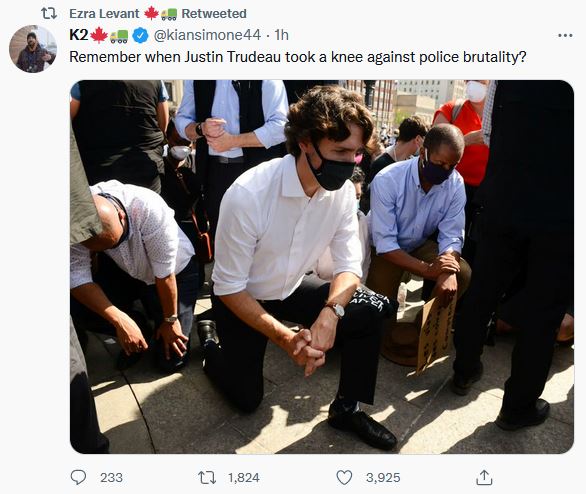
Justin Trudeau has always had a strong affinity for the symbolic gesture, especially when the media are around to record it.
The latest trick in what we might call “eco-commie-perv agitprop”, emerged while shaming Canadian history and traditions. I’ll touch on it in a moment. It is a product chiefly of the Indian Wars of the last few years. The White Man, and more specifically when Catholic, has been accused of massacring the Native People in 20th-century residential schools, just as he did upon coming to the continent. He then ploughs the anonymous victims into mass graves, showing his affinity to, exempli gratia, the Nazis.
This propaganda campaign, which quickly reached the tedious stage, was founded on a series of oft-repeated unambiguous lies, driven into our susceptible children in our compulsory public schools, and throughout life by such agencies as the CBC. (All our significant media are now under government control, subsidy, and watch.) White men, especially the Catholics, contaminate Canadian history by their Satanic essence, according to this malicious fantasy. Goodness and innocence can be found only in their victims, the “visible minorities” (or majorities, as the case may be). Shame is inculcated among persons exhibiting the wrong race.
I write of Canada, but something similar is happening in the United States, and has been carried to Europe on the sails of Hollywood and popular “music”. Canada is, however, an extreme example — of brazen idiocy — and even to underprivileged (all-white) rural places the message is piped in. Disharmonious voices must expect state interference, and eventual arrest.
For Canada now has political prisoners, including many who participated in the Freedom Convoy of truck drivers. Tamara Lich, a prominent organizer of this demonstration, has been gratuitously jailed, though she didn’t even try to commit a plausible crime. This week she was gaoled again, apparently for receiving a freedom medal. (Persons it was in her bail conditions not to meet may have been in the audience.) She was put out of sight for “Canada Day” (the former Dominion celebration, yesterday). This manipulation of Canadian law is, sadly, no longer unprecedented. It seems to be ordered directly from the Prime Minister’s Office.
Comments Off on David Warren waves the flag


