
… while I was on the road, I went to visit a buddy who’s still deep cover in academia. He teaches at a really SPLAC-y SPLAC, the kind that bills itself as “Minnesota’s answer to Princeton”. He’s part of a team running this course that, back in my undergrad days thirty years ago, would’ve been called “Paideia” or something similarly pretentious, taught to the “honors college” (or equivalent). Twenty years before that, it would’ve been called “Western Civ I” and required of all incoming freshmen, regardless of major.
Twenty years before that, and it would’ve been called “basic cultural literacy”; the kind of thing any college man — indeed, any graduate of a remotely decent high school — would know cold. I’ve written many times that the not-elite-but-certainly-very-respectable school which awarded my PhD wouldn’t have admitted me as an undergrad as late as 1960; they would’ve been sticking me in some serious remedial classes as late as 1980. Watching my buddy struggling mightily — and failing miserably — to get even the ridiculously watered-down, extremely fake and utterly gay version of this stuff across to the brown-nosing test-acers of the Current Year sent me sobbing into the arms of Jack Daniel.
Not because I would’ve done better, mind you, but because I would’ve done so much worse. The only way I got through my last few semesters in academia was to regard it as acting. The University is paying me to stand on stage and say my lines, so I’ll stand there and say them. Aside from that, all they want to do is check the appropriate box: Students have attended thus-and-such class, taught by someone with a PhD (crucial for those “best college” rankings!), and … there it is.
What actual knowledge am I supposed to be conveying? What skill set? What world view?
Category error. If it doesn’t fit on the standardized test, which is the only thing that matters to the bottom line, then it’s useless.
Severian, “On the Absurdity of Life”, Founding Questions, 2022-09-12.
October 6, 2026
QotD: The decline of academic standards over the years
October 5, 2026
Communism and the DSA
The fortunes of America’s self-described socialists are clearly on the rise, as DSA-backed candidates gain more media attention and come closer to being elected to office. The DSA really could rename itself the DCA without much pushback, as communism has lost a lot of its massive historical baggage in the minds of average American voters.

Photo via Rob Henderson’s Newsletter
Communism is on the rise in America. More than that: It is being celebrated.
With the midterm elections just over one month away, at least eight congressional candidates with avowedly socialist perspectives are poised to take office, polling well ahead of their opponents in states from New York to Colorado.
Think there’s no connection between socialism and communism? Think again. Nearly half of the members of the Democratic Socialists of America‘s (DSA) leadership body identify as communists. As Stu Smith reported earlier this summer, “Members with Communist political tendencies now significantly shape the DSA’s leadership”. In their December 2025 newsletter, members of the DSA’s Red Star Caucus celebrated Mao Zedong’s 132nd birthday.
All of which raises some natural questions: Where is this revolutionary romance coming from? And as it steadily seeps into our leadership class, where will it lead?
The best guide to understanding these questions is a book published more than 50 years ago under a pseudonym — because the author feared what pro-Maoist intellectuals would do to him if they discovered who wrote it.
Simon Leys, whose real name was Pierre Ryckmans, was a Belgian-Australian scholar of Chinese art and literature. In 1974, he published Chinese Shadows, a record of the cultural and political destruction he saw in China in the years just after the Cultural Revolution. The book is full of eerily relevant observations. One of them, which I will get to, is the most haunting thing I’ve read about what political terror does to the human soul. And nearly all of them describe habits of mind that didn’t die with Mao. In fact, they are now alive in America.
First, some background. In The Cultural Revolution: A People’s History, 1962-1976, the historian Frank Dikötter explains how it began. Mao Zedong wanted to purge rivals at the top of the Communist Party. So he turned to radical students, giving them permission to denounce every authority except his own. Party officials egged on these young militants as they raided the homes of “class enemies” and turned them into social outcasts. What followed was violence, looting, the legitimization of hatred, and the denunciation of family, friends, neighbors, and coworkers.
When the resulting catastrophe became impossible to deny, Mao and the regime’s officials disavowed their own shock troops, claiming that an “extreme left” had been responsible for the atrocities.
Sound familiar? Americans witnessed a milder version of this in the summer of 2020. Rioting and looting that year caused between $1 billion and $2 billion in damages. As this transpired, prominent voices in politics and media minimized the destruction. And some leading officials quickly insisted that the destruction was not the work of their own residents. Minnesota governor Tim Walz, later the 2024 Democratic nominee for vice president, estimated that 80 percent of those causing damage came from out of state, while Minneapolis mayor Jacob Frey declared that “the people that are doing this are not Minneapolis residents”. Jail records showed the opposite.
If the scale is different, the pattern is the same: indulgence first, followed by disingenuous disavowal after the damage is done.
There’s never any good news on the climate front
John Robson calls out the extreme rhetoric employed by environmentalists and their journalist flappers to try to keep climate anxieties as high as possible, especially if there haven’t been any new alarming climate-related events to build on:
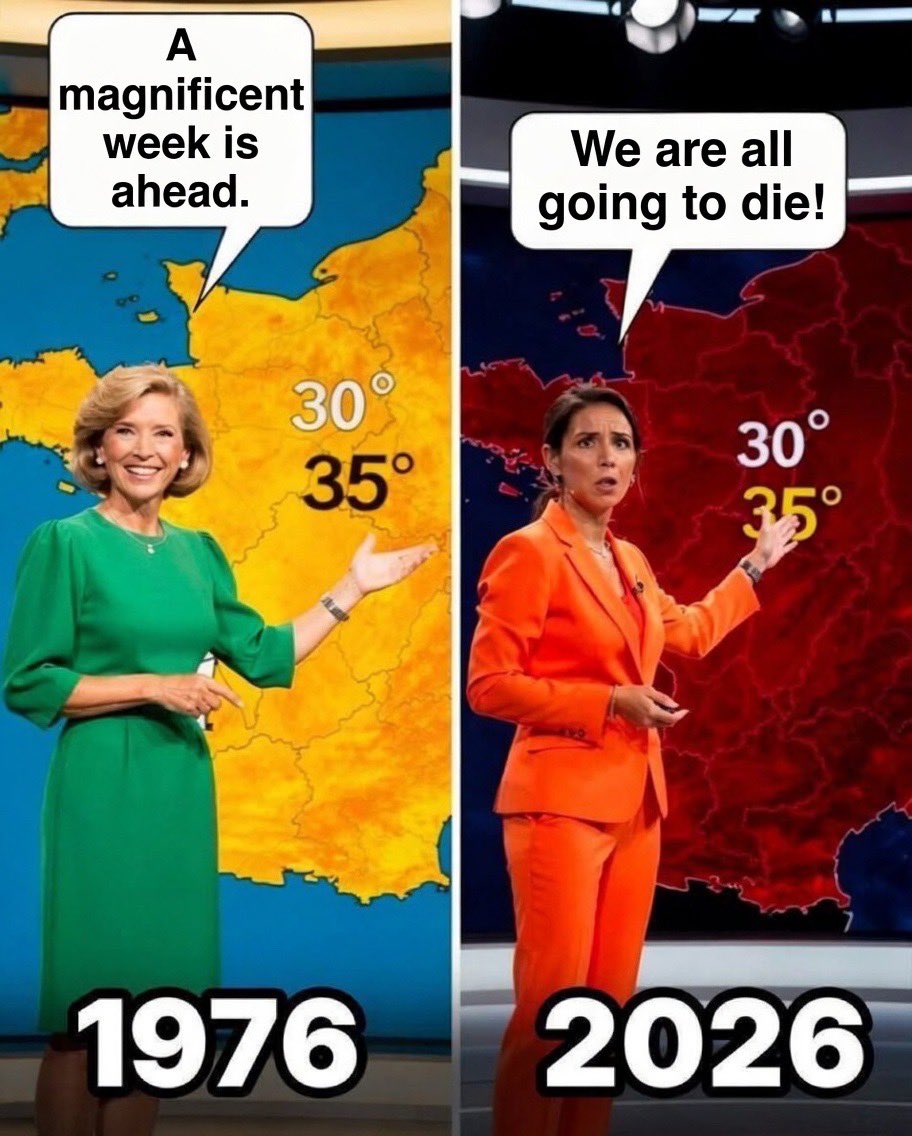
The New York Times engages in some classic yellow journalism with “Climate: Disaster Survivors Sticking Together” teasing to a column by David Gelles that starts “Extreme weather is hitting more people with each passing year”. But it’s not, even though there are more people for it to hit with each passing year as the climate crisis coincides strangely with unprecedented human material flourishing and a 99 percent drop in climate-related fatalities. We accept that there is room for intelligent and well-meaning debate about facts as well as their meaning. But the drumbeat of assertions by climate fanatics that the weather is getting worse when it’s just not crosses the line into bad-faith bellowing ignorance.
Another Times story titillates with a “CALCULATOR” of:
Is Your City Prepared for Climate Disaster? A new report ranks the world’s large cities on how well they have adapted to face climate risk.
What exactly “climate risk” is, unless they mean bad weather, is not explained. Why the Times thinks bad weather is new is also not explained. What the Times thinks of the fact that even as global population soars, the number of people killed every year by bad weather has plummeted, not the proportion but the absolute number, is apparently nothing. Instead they lead off:
When it comes to the effects of hostile climates – flood, fire and more – what matters isn’t just inherent risk, but rather the ability of a place to withstand that risk.
Well, duh. And clearly wealthier societies are far better able to withstand that risk, so even if you believe that fossil fuels make the weather a bit worse, the tradeoff is well worth making. But so is the effort to see if the weather is getting worse.
Now we don’t deny that “fire” is a hostile climate. But if it’s an “effect” of hostile climate, then the climate has always been hostile since what evidence we have says there were a lot more wildfires two and three hundred years ago than there are now. Don’t wait for them to credit CO2 with the decrease though … since they didn’t bother looking it up.
That story also blathers about how things from “early warning systems” to “governance” can “significantly mitigate the effects of climate change” although climate change is not a causal force it’s a statistical description of how the weather has altered in some place over at least 30 years. And it says Chicago is the most resilient city with “low hurricane risk” due, we point out, not to them building a big windbreak or something but it not being in the path of the hurricanes that regularly sweep through other parts of the US and have for as long as there have been observers to flee them shouting “Whoa Nelly a twister!” Moreover:
Many of the least resilient places were South Asian cities with extreme exposure to floods and monsoons to which they were poorly adapted.
And if the Times seriously thinks monsoons are a new and horrible consequence of the gasoline-powered automobile you should cancel your subscription before it puts some other nonsense in your head. Like that floods and mudslides in rural Nepal and Tibet are relevant to urban resilience.
Media outlets have always had a strong bias toward reporting bad news, “If it bleeds, it leads!” but on the climate beat, there’s never any good news to report because everything — warming, cooling, precipitation, seasonal change — has to be presented in a negative light.
“The fertility crisis is really the equality crisis”
On the social media site formerly known as Twitter, Devon Eriksen responds to a post about the need for middle class couples to budget excessive amounts of money before starting a family:
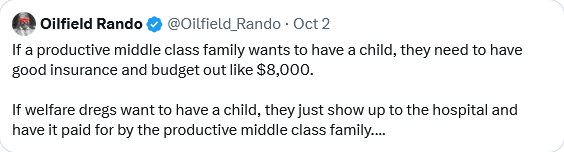
It’s not about the money.
Money has an effect, yes, but it’s a part of something bigger.
Women are genetically programmed to mate up. Not down. And not even across. Up. If she doesn’t regard a man as superior to her, she generally doesn’t want to have his babies.
What this means is that there is an extremely simple control dial on fertility.
More male power and status = more babies.
More female power and status = less babies.Yes, it really is that simple.
Why? Because every species has a mating ritual, and can only breed if they can carry it out. That’s why you can breed rats and chickens in cages, but not pandas. Different mating ritual.
And a critical element of the human mating ritual is “male impresses female”.
Not charms. Not bribes. Definitely not respects.
Impresses.
So, if you take power, wealth, and status away from men, and give it to women, you are just plain reaching for the controls and turning down the fertility dial.
If you let men keep power, wealth and status — you don’t have to give it to them because they’re the ones who create it — fertility goes up.
The fertility crisis is really the equality crisis.
This idea might horrify you. You might have been taught all your life that everyone is equal, or must be, and anything else is unfair.
Well, have you looked around you at universe? Unfairness is baked into the life cycle of every living organism, not mention the food chain. Evolutionary processes don’t care about fairness. They care what works.
Perhaps someday, we will be able to code DNA as easily as we code C++, and can decide what we want our instincts to be. But until that day, we are faced with a choice.
1. Stop using the political, legal, and mass media processes to force female equality, if not outright female supremacy, on the first world.
Or
2. Die out and be replaced by third world retards, who will stay on this planet fighting wars with increasingly rusty AK47s and then spears, until the next asteroid comes along.
Tom Holland Explains the Entire History of Wine in 72 Minutes
The Rest Is History
Published 5 May 2026What does The Odyssey teach us about the history of wine in the ancient world? How did Julius Caesar use wine to conquer the world? And why was The Judgement of Paris – when America took on France – the most controversial incident in the history of wine?
Join Dominic and Tom as they discuss the long history of wine; from ancient Jordan, to Bronze Age Greece, to the Vikings, and beyond …
00:00 The complete history of wine in 8,000 years
00:41 Lloyds
02:14 Pliny the Elder and the first wine snob
06:02 Why wine is such a rich subject for history
09:27 Noah, Mount Ararat and the biblical origins of wine
11:31 Georgia, Armenia and the world’s first wineries
13:15 The Canaanites and the invention of the wine trade
16:19 The Phoenicians, Greeks and wine culture across the Mediterranean
18:32 How Rome created the first international wine culture
20:32 Wine, slavery and the Roman conquest of Gaul
23:12 Italy becomes the heartland of Roman wine
24:40 How Christianity preserved wine after Rome’s fall
27:22 Why Islam transformed the history of wine
30:09 Wine drinking, loopholes and the caliphs
33:41 Rumi, Sufism and wine as a metaphor for divine love
37:29 England and the invention of the modern wine bottle
40:08 Kenelm Digby and the rise of English bottles
43:22 Cork, port and the Methuen Treaty
45:12 The English invention of the corkscrew
47:10 How French became the language of wine
50:07 Samuel Pepys discovers Haut-Brion
52:33 First growths, Bordeaux and the hierarchy of wine
56:09 Why wine was once an elite English obsession
57:49 Terroir and the spiritual language of French wine
1:00:59 The Judgment of Paris
1:03:57 Prohibition and the collapse of Californian wine
1:06:19 The blind tasting that humiliated France
1:08:08 Stag’s Leap and California’s victory
1:09:11 How New World wine changed the industry
1:10:44 Wine, competition and partnership
1:11:46 Henry Jeff, the bonus episode and the Mona LisaVideo Editor: Jack Meek, Adam Thornton & Harry Swan
Social Producer: Harry Balden
Producers: Aaliyah Akude & Tabby Syrett
Senior Producer: Callum Hill
Executive Producer: Dom Johnson
Head of Digital & Social: Sam Oakley
QotD: Socialism and the world wars
The tragedy was that those who promised utopia generally delivered hell on earth. According to the estimates in the Black Book of Communism, the “grand total of victims of Communism was between 85 and 100 million” for the twentieth century as a whole. The lowest estimate for the total number of Soviet citizens who lost their lives as a direct result of Stalin’s policies was more than 20 million, a quarter of them in the years after World War II. Mao alone, as Frank Dikötter has shown, accounted for tens of millions: two million between 1949 and 1951, another three million by the end of the 1950s, a staggering 45 million in the man-made famine known as the Great Leap Forward, yet more in the mayhem of the Cultural Revolution. Even the less bloodthirsty regimes of Eastern Europe killed and imprisoned their citizens on a shocking scale. In the Soviet Union, 2.75 million people were in the Gulag at Stalin’s death. The numbers were greatly reduced thereafter, but until the very end of the Soviet system its inhabitants lived in the knowledge that there was nothing but their own guile to protect them from an arbitrary and corrupt state. Other communist regimes around the world, including the very durable dictatorships in North Korea and Cuba, were strikingly similar in the miseries they inflicted on their own citizens.
The various socialist regimes could not even justify their murderous behavior by providing those they spared with higher living standards than their counterparts living under capitalism. On the contrary, they were economically disastrous. The collectivization of agriculture invariably reduced farming productivity. A substantial proportion of the victims of communism lost their lives because of the famines that resulted from collectivization in the Soviet Union and China. North Korea had a similarly disastrous experience. Central planning was a miserable failure for reasons long ago identified by Ludwig von Mises, Friedrich Hayek, and Janos Kornai, amongst others. Indeed, the economic performance of strictly socialist countries got worse over time because of rigidities and perverse incentives institutionalized by planning.
Moreover, the evidence is clear that, as countries moved away from socialist policies of state ownership and toward a greater reliance on market forces, they did better economically. The most striking example — but one of many — is that of China, which achieved a true great leap forward in economic output after beginning to dismantle restrictions on private initiative in 1978. After the collapse of “real existing socialism” in Central and Eastern Europe in 1989 and the dissolution of the Soviet Union in 1991, there was widespread recognition (the “Washington consensus”) that all countries would benefit from reducing state ownership of the economy through privatization and from lowering marginal tax rates. […] the highest marginal personal income tax rate was reduced in nearly all Organisation for Economic Co-operation and Development (OECD) countries between the mid-1970s and mid-2000s.
Niall Ferguson, “Capitalism, Socialism and Nationalism: Lessons from History”, 2020-02.
October 4, 2026
Mark Carney’s … complicated … relationship with America
On her Substack, Melanie in Saskatchewan wonders what is going on in Mark Carney’s world whenever the United States comes up. At times, you would assume he hates the US, yet the vast majority of his personal wealth is invested there. His family members live there. It’s a paradox:

AI-generated image from Melanie in Saskatchewan
I’m starting to think Mark Carney has a passionate, personal hatred of America.
And I don’t mean Donald Trump. Plenty of people hate Donald Trump. I mean America itself, or at least the enormous role America has played in Canada’s economy for generations. Because the longer I listen to Carney talk about where he wants Canada to go, the more I wonder whether Trump caused this economic divorce at all … or whether he was simply the spectacular act of infidelity Carney needed to finally file the papers.
Maybe hate is too strong. Maybe geopolitical jealousy has stages too: irritation, resentment, righteous indignation and finally whatever stage comes after, “I’d love to go out sometime, but unfortunately I’ll be washing my hair indefinitely”. Whatever stage Carney has reached, I’m increasingly convinced this is about considerably more than Donald Trump.
Because we can document Carney publicly talking about a changing world order more than fifteen years ago. How long he had been developing those ideas before putting them into speeches, I have no idea. We don’t need to invent an origin story. The public record is interesting enough.
I can’t prove Carney hates America. Maybe he loves it. Maybe there’s a Louisville Slugger sticking out of a Davos swag bag somewhere between six conference lanyards, a King Charles commemorative tea towel and a couple of those luxury Normandy butter cups that apparently require their own travel arrangements. But if Mark Carney loves America, somebody should probably tell America the relationship is still on.
He certainly never seemed troubled by American money. His disclosed investments included hundreds of companies, many of them American. And I don’t begrudge him that. If American companies offered a good return, invest away. What makes it interesting is that while his money was quite comfortable in America, Carney had already spent years publicly describing a world becoming considerably less centred on American economic power. Donald Trump didn’t inspire that. He came crashing through the front door years later, apparently oblivious to the fact that Carney had already furnished the room.
Canadians have since been handed a wonderfully tidy explanation for everything happening now. Trump returned. Trump threatened tariffs. Trump called Canada the 51st state. Trump made governor jokes. CBC, our publicly funded national broadcaster, and a Canadian media industry operating alongside various government support programs amplified every provocation until everybody knew exactly which Trumpism could send Canada through the ceiling.
He said “51st state”. Canada erupted, so he said it again. Trump noticed. The media noticed. And I have a very hard time believing Liberal strategists somehow failed to notice the political value of an issue resonating that powerfully with Canadians.
But heaven forbid an opposition MP or ordinary Canadian asks to see where our money went. Suddenly negotiations, contracts and records disappear behind confidentiality, redactions and “national security”. Apparently telling Canadians what our own government is doing requires security clearance, but advertising precisely which Trump taunts are working required something closer to a neon sign: YES, DONALD. RIGHT THERE. THAT BUTTON!
Why not circle the red button, write DO NOT PRESS across it and explain exactly what happens when he does? Because if humanity has established anything about a big red button labelled DO NOT PRESS, it’s that nobody has ever wanted to press that bastard more.
From MG 34 to MG 42: Building Hitler’s Buzzsaw – Nazi Rearmament 08
World War Two
Published 3 Oct 2026The MG 34 pioneered the modern general-purpose machine gun. The MG 42 preserved that battlefield versatility while cutting manufacturing labor roughly in half and producing the terrifying sound remembered as “Hitler’s Buzzsaw”.
In this Nazi Rearmament episode, Spartacus traces the development of the MG 34 and MG 42 from clandestine German weapons programs during the 1930s through mass production and combat in World War II.
We examine how one basic weapon could accompany an infantry squad, deliver sustained long-range fire, engage low-flying aircraft, and serve inside tanks and fortifications. We also explore why the beautifully machined MG 34 became an industrial problem, and how stamped steel, roller locking, rapid barrel changes, and a cyclic rate reaching 1,500 rounds per minute transformed its successor.
But this is more than the story of two famous German machine guns. It is also a study of Nazi Germany’s war economy: technically ambitious and capable of remarkable innovation, yet ultimately unable to overcome the manpower and industrial resources of the coalition it chose to fight.
Finally, we follow the weapons beyond 1945, from the continued foreign service of the MG 34 to the MG 42’s postwar descendants, the MG 1, MG 2, and MG 3.
Which small arm should we cover next: the MP 40, FG 42, or StG 44?
Jaguar – a case study in brand suicide
The Jaguar E-type was, in my opinion, the best-looking car of the 20th century. It was all downhill from that point, sadly:

Jaguar killed itself. No villain required, no recession to blame, no supply chain disruption to hide behind. Tata Motors bought a fading but salvageable brand in 2008 for $2.3 billion and spent the next fifteen years turning it into a case study in how to destroy capital.
The rebranding campaign of late 2024 was the public execution. Jaguar dropped its leaping cat logo, fired its entire existing customer demographic via press release, and replaced a century of racing heritage with a pastel-colored advertisement featuring zero cars. The marketing team apparently decided the path to profitability ran directly through alienating the people who actually bought Jaguars. Brilliant.
The rebrand was just the visible wound. The rot started earlier. Jaguar spent years producing vehicles with reliability ratings that made Land Rover look like a Swiss watch, while charging Mercedes money for the privilege. The F-Pace, the E-Pace, the I-Pace: each one a beautiful object that dealers apologized for in advance. You bought the badge and got a subscription to your mechanic’s vacation fund.
The pivot to an all-electric lineup, announced with great fanfare in 2021, then delayed, then sort-of-delayed-again, captured everything wrong with a company led by government subsidy chasers rather than engineers. Jaguar chased EV tax credits and green virtue points instead of fixing the fundamental problem. Nobody trusted the cars.
Markets are merciless precisely because they are honest. Customers stopped buying, and no amount of rebranding or regulatory coddling reversed that verdict. Capital allocated to a brand that cannot hold a customer is capital destroyed. Tata learned this lesson expensively. You, having never bought the car, learned it for free.
The ad campaign is just a sign on the door that reads, “This company is woke trash”. The real rot lies beneath the surface. Firing the marketing agency won’t change that.
Why the Allies Lost the Battle of Gallipoli 1915
The Great War
Published 8 May 2026On April 25, 1915 Australian, British, New Zealand and French forces landed at the mouth of the Dardanelles to capture the Gallipoli peninsular and march on Constantinople. But the Ottoman defenders, including legendary officer Mustafa Kemal, held firm and the Battle of Gallipoli would last for 7 bloody months.
(more…)
QotD: Auditors and the taxation system
One thing that’s really unfair about our tax system is that it is rigged in favor of people who have more resources. Government meddling makes it more costly to conduct business. The more complicated the regulatory burden, the more smaller companies can’t compete. Make the laws complicated enough and the only companies that stay in business are the ones who can afford to pay for twenty guys like me. (my last regular accounting job paid extremely well, and nearly everything I did was jump through government mandated hoops, filling out government mandated paperwork which nobody in the government would probably ever read)
Trump has those resources. I bet he’s got a room full of accountants, and their leader is probably a grizzled old CPA with an eye patch and a raven who sits on his shoulder. The raven also has an eye patch and an accounting degree. This man has wrestled bears, and he’s going to take advantage of every tax break in the US Code for his client, and do so gleefully, knowing that many of those laws were signed by Barack Obama and Bill Clinton.
On the other side, you know damned good and well that the IRS has sent their most fearsome auditor against him. This man sold his soul to the devil, and then fined the devil for failing to list that soul as a depreciable asset. When he shows up to audit your company, he appears a flash of fire and brimstone, as a Finnish death metal band plays his theme song. He is an auditor bereft of mercy, compassion, or pity, and beneath his leathery wings serve a legion of IRS goblins, who will crawl into every nook and cranny of the Trump Corporation’s P&L looking for errors, and if a mouse so much as shits a turd large enough to unbalance that ledger, there will be hell to pay.
Is it unfair that rich guys can employ Gandalf level CPAs and take advantage of more complicated tax laws, while regular people use TurboTax? Yep. But in the meantime, as long as those tax laws are there, the rich guys would be utter fools not to take advantage of them.
Larry Correia, “No, You Idiots. That’s Not How Taxes Work – An Accountant’s Guide To Why You Are A Gullible Moron”, Monster Hunter Nation, 2020-09-28.
October 3, 2026
Portuguese propaganda maps
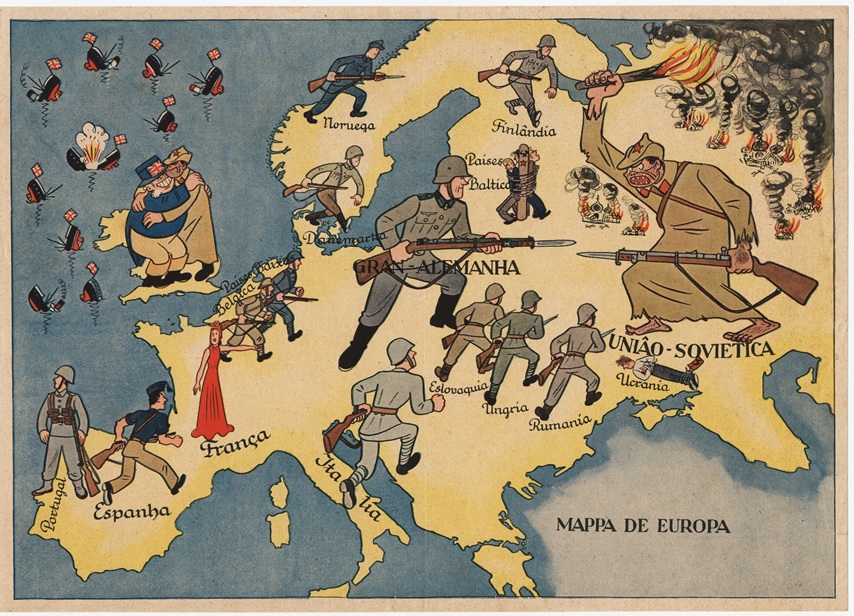
I swear this isn’t a deliberate ploy to attract Sarah Hoyt’s attention … although her links from Instapundit are always a welcome boost to daily readership. This is a post from Merryn Walters’ Mapping History Substack trying to determine the origins and intent of a map created for Portuguese use in WW2:
Maps are a weapon – a powerful weapon – because maps look, simply, like facts. A map says, “this is how things are”, and a mapmaker can change the world … so it’s no surprise, mapping had its run as a propaganda tool during the Second World War.
Our main map in this article, for example, begs the question: is it a propaganda map of Portugal or a Portuguese propaganda map? The two are very different, and between 1939 and 1945 the difference mattered. A Portuguese propaganda map was one made by Portugal, for Portuguese purposes. A propaganda map of Portugal – or, more often, one dressed up in Portuguese – was made by someone else entirely, and slipped under Lisbon’s door. Portugal was neutral, you see, which made it one of the few places left in Europe where both sides could still advertise their intentions: British and German propagandists worked the same streets targeting the same people, each assuring the Portuguese that the other lot were dastardly fellows.
A map was ideal for this. There’s a snag though, in this propaganda metier, and it’s worth keeping at the back of our minds as we admire the pretty pictures; no matter how good the mapmaking, the actual map can only inform and persuade a person who’s able to read it.
THIS IS NOT A SMALL COUNTRY
Portugal não é um país pequeno
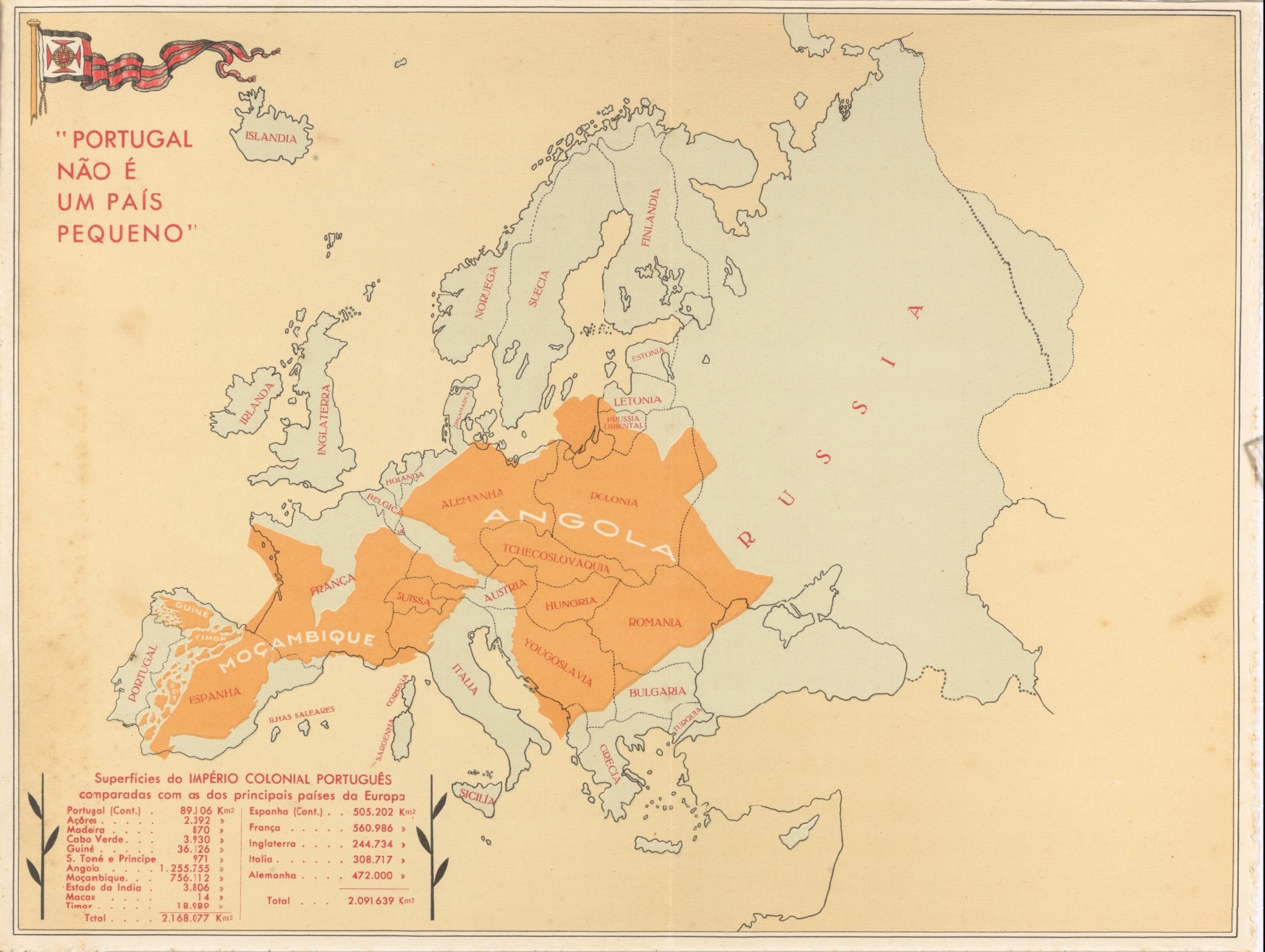
Let’s start with the real thing. Portugal não é um país pequeno – “Portugal is not a small country” – was produced in 1934 by Henrique Galvão, an army officer and colonial administrator, for the First Portuguese Colonial Exhibition in Porto; an exhibition he also happened to be directing, which does rather simplify the commissioning process somewhat. The map was printed by Litografia Nacional, of Porto, and uses a simple trick that’s mirrored today by online whizzymajigs. thetruesize.com is one such.
Take Angola, Mozambique and the rest of the empire; colour them brightly; and lay them down, right across Europe, as if you’re floofing a blanket. Add a table of figures proving that Portugal and its colonies, together, outsize Spain, France, England, Italy and Germany combined. Small country? Certainly not, mon ami. Just badly folded.
This map worked so well, Salazar’s regime reprinted it for decades: postcards in Portuguese for home consumption; French and English versions for visitors; and — by 1951 — an edition from the Secretariado da Propaganda Nacional laid the whole lot over the United States instead – for the benefit of American tourists, who presumably needed a unit of measurement they could relate to. People ask where Brazil has gone. Independent since 1822, I’m afraid – a century too late to help with the arithmetic.
Galvão himself deserves more than a footnote. Post-war, in 1947, he reported on forced labour in those same colonies, concluding only the dead were truly exempt; he fell out with Salazar, was arrested in 1952, escaped – and in 1961 hijacked a liner, the Santa Maria, to make his point. Not many mapmakers manage a second act like that.
Singapore’s “Social Development Unit”
We don’t tend to hear very much about Singapore, so I hadn’t heard of the “Social Development Unit” that they set up (appropriately, in 1984):

Haha this reminds me of when Singapore had this thing called the Social Development Unit which my American sociology professor told me was “basically government-sponsored eugenics”.
Back in the 80s, Lee Kuan Yew observed that female university graduates were not getting married, and that smart people weren’t breeding enough which he treated as a national emergency.
This led to the birth of the Social Development Unit in 1984 — government-sponsored parties, dinners, trips and even “love boat” cruises so that clever people could meet each other and, ideally, produce more clever babies. Locals immediately nicknamed it Single, Desperate and Ugly
There were other politically incorrect fertility policies of the era: the Graduate Mothers’ Scheme (kids of degree moms got priority school places), and higher tax breaks for those who were more educated with more kids. Meanwhile, cash grants were given to the lower educated and lower income parents who got sterilized after one or two kids.
To which Carl Benjamin responded:
Lee Kuan Yew is what happens when an autistic map gamer becomes president.
More on that change to student loan eligibility rules
Larry Correia’s comments on Trump’s executive order changing eligibility for federally guaranteed student loans generated a fair amount of discussion, so I felt linking to Copernican’s post on the same topic would be of interest to many of you:
As a White Western Man, I am unaccustomed to seeing or hearing “good news” in a larger geopolitical sense. That is, actions of our leaders tend to lead one to be somewhere between depressingly blackpilled and defiantly optimistic even in the face of overwhelming evidence to the contrary.
Recently, Donald Trump and his Department of Education have engaged in some more executive shenanigans. Once again bypassing our Congress, whose dysfunctional role is best thought of as the kidneys in our diabetic, alcoholic body politic. With that said, a relatively minor update to the Department of Education rules regarding underwriting federal student loans might have a dramatic long-term effect on our entire cultural system.
Take a look for yourself:
Of all the actions the Executive Branch can take, this is one of the best. Most notably, because it’s boring. Changing the rules on federal fiscal underwriting is boring, so the media and the population at large will have a hard time holding on to it as a talking point. The most dramatic cultural changes are precipitated from the most boring types of fiscal action. Flashy is fun, but boring is often effective. Something to keep in mind when our generation finally seizes the reins of power.
The recent update that takes effect in 2027 is functionally removing the federal guarantee from student loans for useless degrees. Predominantly degrees that fall under the “female daycare” category. That is, the reason why every employer in the United States demands a degree to flip burgers or fill out spreadsheets is due to the fact that everyone can get a degree. Removing a significant portion of the federally backed degree-mill system will force a top-down restructuring of the American cultural academic-caste system.
The fallout from this decision is going to be immense, but we won’t see it unless the current policy holds long enough for several generations of university students to grow up under it (say around 12 years). First, it’s going to cut off universities from the endless money of cheap federal student loans that’s been flooding into useless departments. Women’s studies, social studies, English majors, and early-childhood-education majors are about to see a significant drawdown in the number of attending students.
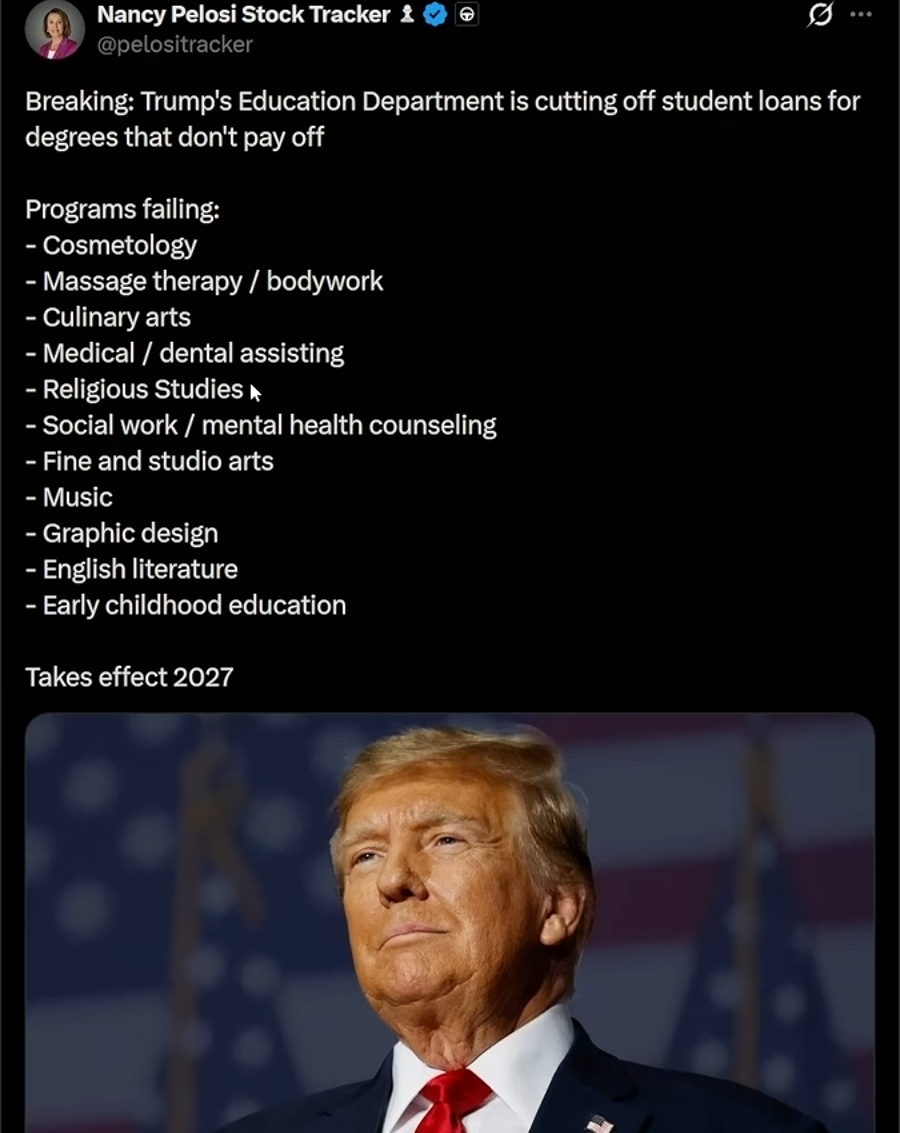
As many have pointed out, it’s only an Executive Order, so it can be easily set aside by the next president, but it may have a salutary effect on those who do see a university degree as just a way to stay out of the working world for a few more years.
Altered Carbon: Immortality Breaks Humans
Feral Historian
Published 29 May 2026Richard K. Morgan’s Altered Carbon builds on a simple premise, what if everyone’s consciousness was digitally transferable, regardless of class or wealth. The world he depicts has an undercurrent of dread permeating everything and hints at some even more terrifying possibilities.
00:00 Intro
03:10 Not Human Anymore
06:25 Social Disconnect
11:07 Make it Personal
15:15 The Netflix Adaptation
(more…)


