
Areas that became densely set with trace italienne fortresses [Wiki] – particularly the towns of the Low Countries – became almost impossible to conquer. The Army of Flanders [Wiki], then arguably the finest in Europe, tried for eighty years to subdue the Dutch and largely failed: the cost of endless sieges of trace italienne fortified towns made the task effectively hopeless. Once again, I don’t want to imply that this is the only factor (it isn’t, by any means), but after the long series of remarkably decisive wars from 1450 to 1550, the trace italienne contributed to the frustratingly inconclusive (but expensive and bloody) wars of the following century.
At the same time, this shift back towards defensive stalemate didn’t lead towards more fragmentation – as the castle had – because trace italienne fortresses were too expensive for any individual aristocrat to build merely to protect his house. Not merely because of the massive fortifications themselves, but the large garrisons they required, either of full-time soldiers or town militia, which were simply beyond the resources of what was left of the old medieval aristocracy. Indeed, warfare in this period (both offensive and defensive) largely proved to be beyond the resources of Europe’s newly centralizing states; the Spanish crown, for instance, went bankrupt, primarily from military expenses, in 1557, 1560, 1575, 1596, 1607, 1627, 1647 and 1653.
It is part and parcel of the era that as much as building and defending a trace italienne fortress was an exercise in mathematics, so was attacking one. Because the entire point of the fortress is to project firepower – often at great distances (with cannon) – the attacker cannot simply form up outside or just set up their artillery in an open field and begin firing; they’d be cut up by counter-battery fire before they had gotten very far. So the attacker had to set up their own earthworks, which naturally being based on the same principles and weapons as the defender’s, would resemble them.
First, the attacking army would generally set up its own fortified camp, outside of cannon-shot. Because that camp needed to be resistant to enemy attack either from the garrison of a relieving army, it was likely to be built in the same style as a trace italienne fortification, albeit with earthworks and gabions (wicker baskets filled with earth) in place of the heavier stonework of the fort. The attacker then has to isolate their target from help, preventing the defenders from leaving, or supplies or reinforcements from arriving. The act of enclosing a besieged settlement in a wall is called circumvallation (recall our word vallum there; this is “walling around”). The act of constructing a line of outward facing defenses to defend that line from attack by a relieving army from behind is called contravallation. Armies in this period would do both.
The first such line of defenses was often started from the fortified camps and was built effectively out of range of the fort; this was the “first parallel”. Now, by the time this project was well along, both the defenders and the attackers could do some basic calculations. They both might have a sense of how quickly reinforcements could arrive and if they were likely to be large enough to give battle or lift the siege. Both sides also know how long their supplies will last and can probably have a decent guess of how long their opponent’s supplies will last. And at this point, they can both calculate fairly well how many meters of earthwork and trench the attackers can dig per day and how many they need to dig to complete their siege operations.
But – and this is important – no one wants this siege to come down to its conclusive, final assault. The attackers don’t want this: every day their siege army sits out here, it is eating money such that each day wasted besieging this town limits what this army can accomplish overall before supplies and money run out. Moreover, the actual assault is likely to incur very high losses on the attackers, because even with a breach, they have to cross all of that open, fire-swept ground and then force the breach in close combat – and the defenders will know exactly where they are going days in advance. On the other hand, if the defenders make the attackers go through all of that effort, danger and death and lose – and they must assume the attackers wouldn’t have laid siege if they weren’t confident they had enough men to take the breach when it comes to it – then the city would be looted, its populace raped or massacred as the attackers vent their rage on the city. This was, at the time, considered the normal result of holding out, to the point that it seems to have been general practice that it was appropriate to wait something like three days before beginning the process of getting control of an army that had breached a city in this fashion.
So once the attacker has completed that first parallel, he is going to send a message to the garrison, announcing that he has done so and offering them the chance to surrender. The standard terms for such surrender was called the “honors of war” – normally the defenders would be permitted to march out, with its flags flying, bayonets fixed, matches (for their matchlock muskets) lot on both ends and “ball in mouth” (that is, a musketball held in their mouth ready to be swiftly loaded as protection against treachery). The defeated army was generally required to turn over its arms, but generally allowed to march back to their own territory. And finally, a town that surrenders like this might have to pay a ransom, but ought to be immune from pillage. To modern readers, these sorts of rituals seem quaint, like having a battle break for tea in the midafternoon (a thing that, to be clear, did not happen), but in fact these were fairly hard-nosed considerations: generous surrender terms aimed to induce a garrison or town to surrender and so spare the attacker both the time but also the blood of storming the place, because after all the goal here isn’t to destroy the enemy garrison but to get control of the town.
One that first parallel is completed, assuming the defender, upon doing the math, doesn’t decide the matter is hopeless and just give up, the attacker now proceeds to begin digging his works forward to set up advanced firing positions (most of the digging was done at night when enemy artillery couldn’t accurately fire at the work parties); there were typically three parallels, the first two providing protection to the digging works and the third parallel, dug into the glacis, providing the firing position directly into the structure of the fort. Once the cannon were emplaced, the attacker might again report that he was prepared to begin firing but if the defenders would just surrender, we could all skip that nasty business. If not, the attacker’s cannon – now secured in their own trace italienne-style firing positions – would start working on the enemy fortifications in a gunnery duel (since the defender’s guns are firing back). Progress here would mean both demolishing ravelins and other outworks which shielded the main curtain wall, as well as storming assaults on various outworks to take them and deny them to the enemy (Americans may note effectively all of these steps in the Siege of Yorktown (1781), albeit on fast-forward since this was a siege of a fairly small town defended merely by field fortifications rather than a large trace italienne fortress complex). The final option to surrender came once the curtain wall had been breached (there was little use in trying to “rush” the breach since it would take days to produce so everyone knew where the final fight would be). The defender then had the terrible choice of either surrendering or risking the terrible slaughter that would follow if the breach was forced (as it was very likely to be).
This whole process could take a really long time and it involved a lot of digging, but it was almost mechanistic in its push towards success. In a sense, those demands forced European states to develop the sort of state capacity that had been the norm under Rome or in China in order to run this new version of the “big army” siege playbook which demanded such tremendous amounts of work. As I’ve noted elsewhere, sieges of these sorts against large trace italienne complexes could last a long time; Parker (Military Revolution, 13) notes the siege of Breda in 1624 lasted nine months and was fairly short while the siege at Ostend in Flanders in 1601 lasted three years and was fairly long, to give a sense of the range.
Bret Devereaux, “Collections: Fortification, Part IV: French Guns and Italian Lines”, A Collection of Unmitigated Pedantry, 2021-12-17.
October 3, 2026
QotD: How to besiege a trace italienne fortress
October 2, 2026
Britain’s best general in World War II
If you’ve been following for a while, you’ll know that I’m a big fan of Field Marshal Bill Slim, the best but also least well known British general of the Second World War. His achievements in Burma and India are overshadowed in popular memory by the struggle against the Nazis in Europe and the vast Pacific campaigns against the Japanese by primarily American forces. In recent years, there’s been a bit more attention paid to the XIV Army’s long and bitter fight, but there’s always more to discover about that incredible struggle:
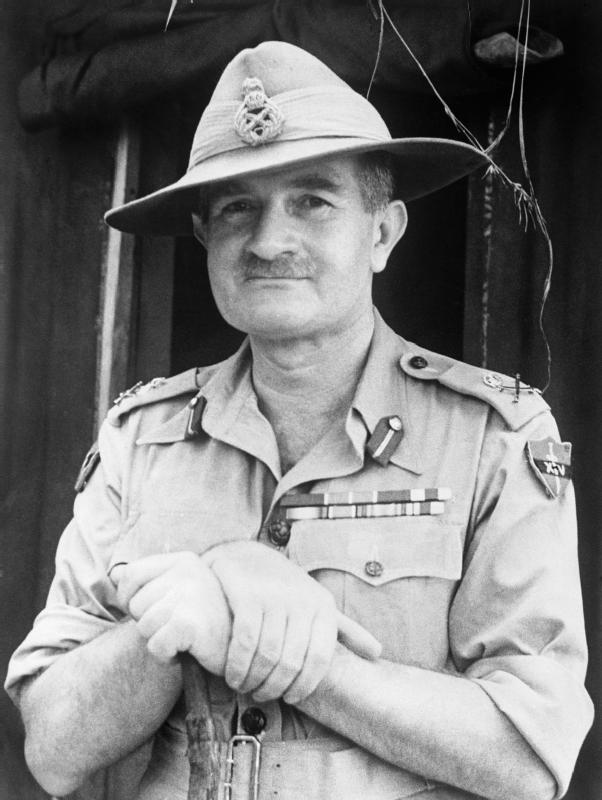
Field Marshal Sir William Slim (1891-1970), during his time as GOC XIVth Army.
Portrait by No. 9 Army Film & Photographic Unit via Wikimedia Commons.
But I see him clear, with that robber-baron face under the Gurkha hat … looking like a rather scruffy private with a general’s tab — which of course is what he was.
– one of General Slim’s soldiers remembers
A search on Amazon using the term “military memoir” yields more than forty thousand results. With so many choices, why read Field Marshal William Slim’s World War II memoir entitled Defeat into Victory? Interestingly enough, there are two answers. The short answer was revealed in 2011 when the National Army Museum in London held a debate and a public poll to answer the question — Who is Britain’s greatest general? Great Britain, of course, has a long and distinguished military history with a great many famous military commanders who could all vie for this honor. In what turned out to be a surprise to many, Field Marshal Slim tied with the Duke of Wellington as the winner. So, if you are considering whether to read Slim’s memoir, ask yourself — how much do you know about someone who might be one of the greatest generals in history?
Before continuing this essay with a longer, more structured answer about the value of Slim’s memoir, a few words about William Slim himself. He began his military career as a temporary lieutenant at the beginning of World War I, without the benefit of a university education or Sandhurst training. By the end of World War I, he had achieved a sterling military record — wounded twice, awarded the Military Cross and temporarily promoted to major. He spent the inter-war years assigned to the Indian Army and was notably associated with the 6th and 7th Gurkha Rifles. At the beginning of World War II, he was given brigade command in East Africa and then command of the 10th Indian Division in the Middle East. His memoir begins in early 1942 when Slim is suddenly and unexpectedly told to leave his command and report immediately to Army Headquarters in India. The summons was so abrupt that Slim thought he was being relieved of command. He didn’t know it at the time but he was about to spend the rest of the war in India and Burma.
A distinct three-act narrative arc forms the structure of his book. In Act I (1942), Slim takes command of Burma Corps. This was an ad hoc two-division force that was in the middle of conducting a fighting retreat while being overwhelmed by the surging Japanese Army. Slim and his men end up suffering through a one hundred day, nine-hundred-mile retreat back to India in what historians have called the longest retreat ever conducted by a British army. By May 1942, the remnants of his Corps finally reached safe haven in India.
In Act II (1943), Slim regroups, retrains and resupplies his forces in preparation for his reconquest of Burma. This was not as straightforward a task as it sounds. Slim now commands the Fourteenth Army which, at its height, consisted of nearly one million soldiers and was one of the largest armies in the world. But the size of the Fourteenth Army was not as striking as the diversity of its composition. Slim had to make a disciplined, cohesive and effective fighting force using regiments from England, Scotland, South Africa, Nigeria, Kenya and a vast array of Indian units including Sikhs, Rajputs, Pathans and Gurkhas from Nepal. Later in the war, Slim described a routine tactical operation: “The Japanese had for some time been harassing 28 East African Brigade Group … and a Punjabi battalion had been sent in to stiffen it”. The Japanese counterattacked “and a British battalion was hurriedly transferred from the east bank and joined them”. One routine tactical operation — involving allied soldiers from three continents.
In Act III, (1944-45), Slim and his army return to Burma and achieve triumph after triumph. The first triumph is the battle of Imphal (March-July 1944). The famed novelist George MacDonald Fraser was a young Scottish soldier in Slim’s Fourteenth Army and he later wrote; “I imagine that every teenager today has heard of Stalingrad and Alamein and D-Day but I wonder how many know the name of Imphal … where Japan suffered the greatest catastrophe in its military history”. The subsequent battle of Meiktila (February- March 1945) was equally significant and has been characterized by British military historian Corelli Barnett as, “the cleverest, boldest and most brilliant single British victory in World War II”. By mid-1945, Slim’s victorious Fourteenth Army had retaken Rangoon and destroyed the Japanese army in Burma.
There are three dimensions to Slim’s memoir that make it so memorable. It is a tale well-written, it is a tale of wonder and it is a tale filled with wisdom.
Generational incomprehension
On Substack Notes, GenX Anecdotes expresses the frustration a lot of Gen X/Generation Jones folks have felt in their dealings with Millennial and Gen Z co-workers, supervisors, and managers:

Experience tells me that I need to add an eye-catching graphic to every non-video post, but finding appropriate images is sometimes difficult. I hope GenX Anecdotes won’t mind me using yet another meme instead of something more sober and appropriate to her point.
One of the things people tell you when you are young about getting old is how quickly it sneaks up on you.
What they don’t tell you, is that it’s not linear or obvious. It’s not like you have a specific moment where you think “OK. NOW I am middle aged”. It doesn’t work like that. You remain “you”.
You might change your outlook over time. You might get wiser (hopefully) and more content with who you are. You might have more serious responsibilities. More experiences and memories to draw upon. But you’re still YOU.
For me, I don’t really feel like I’m that much “older” going about my day-to-day business doing my thing. I actually still feel quite young in myself in many ways.
It’s how the world greets you that’s different. And that’s when little things will remind you. It gives you a kind of shocking “jolt”.
Being around younger people is what really brings it home. And I don’t mean kids or young teens. I mean young adults. Or even adults in their 30s who tell you they feel “old”.
I am in my mid 50s.
When someone in their late 20s or 30s tells me what year they were born it blows my mind.
When they were born in a year that I clearly remember, feels like last month to me, and when I was well into adulthood, that’s when it really hits home.
Also, it’s how younger people view you and act around you.
In my last job, most people were in their 20s and 30s.
I won’t lie. Some of them treated me like garbage. Like I didn’t exist.
I was a bit of a “cute” novelty to them. Like “aaawww bless her”.
I had the misfortune of being “trained” in one of my part-time jobs I had when my daughter was in junior school, by a 20 something. The job was a local convenient place holder during school hours.
What she was showing me was very “basic” and tedious. But if I questioned anything about it like “why can’t we just do this instead? Surely that would make more sense?”
She looked at me, not like someone who had 30 plus years experience working in different industries who might have a point. But someone “old” and passed it, who didn’t understand.
Like a silly backwards old woman who had no idea.
The amount of times I would say “Yeah. I DO get it. I am just wondering why it’s done this way? It seems a bit impractical?”
She looked at me blankly. Like I was asking her why water is wet …
I learned to just shut up and do the bloody tedious thing in the convoluted, dumb way. Because … because … that’s how it’s done.
Then I knew all those 20/30 year olds just saw me as an annoying old relic who “didn’t understand” how things worked.
I was there about a year before moving house.
I couldn’t wait to leave.
One of the HR women hauled me in at one point to give me an “appraisal”. There I was with a 20 something asking me if I was “happy at work” and going through other annoying questions on her ipad.
She obviously was irritated that I wasn’t taking the whole fake charade “seriously” enough. She wanted me to give her bullshit standard answers that she could tick a box to.
But I kept saying things that weren’t “tick box” worthy.
And that just signified further to her that “I didn’t understand” what was going on.
Oh I understood.
I just didn’t want to play along.
And just to emphasise how insane this whole scenario felt.
She still lived with her Mum and Dad and had soft toys on her desk.
That’s what getting “old” feels like.
Those who are attracted to power are the ones least capable of using it wisely
Lord Acton, something, something, corrupts absolutely:

Power selects for a specific personality type, and it is not yours.
F.A. Hayek spelled this out in 1944. In a centrally planned system, the people who rise are not the most competent or the most honest. They are the most willing to exercise force against strangers, the most comfortable with contradiction, and the most skilled at coalition-building through favors rather than merit. Government filters for the bad ones from the start.
The mechanism is straightforward. Political power means controlling resources you did not earn. Capturing that control requires outcompeting rivals who have no ethical constraints. A principled candidate refuses to promise contradictory things to different voter blocs. An unprincipled one does it without blinking. The unprincipled one wins. Repeat this selection pressure across hundreds of electoral cycles and you get the U.S. Congress in 2026: a body where the average member has held office for over a decade, raised millions from interested parties, and delivered almost nothing measurable to the people who voted for them.
Bureaucracy compounds the problem. Once entrenched, state agencies attract people who want authority without accountability. You cannot fire most of them. The FDA, the TSA, the Federal Reserve all function this way, staffed by individuals whose career advancement depends on expanding the agency’s reach, never on serving you efficiently.
Explaining the Yugoslav / Zastava M70 Series of Rifles
Forgotten Weapons
Published 30 May 2026Yugoslavia never received a technical data package or license for the AK; they reverse engineered the system themselves in the 1960s. In the process, they created a version of the AK noted for its ruggedness. In addition, they added a number of features to facilitate rifle grenade usage. Over the course of many iterations the rifle remained designated the M70, leading to a lot of confusion about what models are what. Today we are going through the whole series of changes.
M70 – Original milled receiver, with bolt hold-open, fixed stock, and screwed-in barrel
M70A – Underfolder version of the M70M70B – Milled receiver, pinned-in barrel, standard magazines, fixed stock
M70AB – Underfolder version of M70BM70B1 – Stamped receiver (1.5mm), bulged trunnion, fixed stock
M70AB1 – Stamped receiver (0.9mm), flat trunnion, underfolder
M70AB2 – Stamped receiver (1.5mm), bulged trunnion, underfolderThanks to Zastava USA for making this video possible!
(more…)
QotD: Ketchup, US vs British
American tomato ketchup is unapologetically sweet – basically a tomato-flavored sugar delivery system that goes perfectly with everything from french fries to scrambled eggs (yes, we do that). It’s thick, rich, and designed to be squeezed with abandon.
British tomato ketchup, I discovered, has more of an edge. Less sweet, more vinegar-forward, with a thinner consistency that actually enhances rather than masks the food it touches.
Heinz may have started in America, but the British version tastes like its more sophisticated cousin who studied abroad and came back with refined tastes.
The real revelation? Many Brits find American tomato ketchup cloyingly sweet, while I initially found British tomato ketchup disappointingly tart. It took a few months of adjustment before I appreciated the more nuanced British approach – though I still secretly prefer the American version on certain foods.
Turns out it’s not just my imagination. American Heinz uses high fructose corn syrup while the British version uses regular sugar, which explains why my taste buds were a bit confused.
Marianne Jennings, “Beyond Ketchup & Ranch Dressing”, An American’s Guide to British Life, 2025-05-25.
October 1, 2026
“Motte and bailey” doesn’t work with this argument
Yesterday was nominally “Truth and Reconciliation Day” in Canada, but the government and progressive activist groups are actively trying to suppress honest questions about the whole Residential Schools topic and threatening jail time to those who refuse to mouth the slogans:

This is an interesting thread, because he makes the motte and bailey explicit in a way they’re not usually careless enough to do.
No one denies that the residential schools were rough, that the kids who went there were probably kind of sad, and that some of them died, due to contagious disease mostly. That’s all very unfortunate but doesn’t amount to much more than “kids get homesick at boarding school, discipline back then was often severe by modern standards, and medicine was primitive especially in remote areas”. This is the motte and it isn’t all that impactful because none of it is all that different from conditions that white kids lived through at the time, particularly in remote areas.
But it was very specifically the claim of mass graves due to deliberate genocide that supercharged this issue back in 2021, with the implication that the residential schools were actually a cover for a policy of systematic extermination. At least I assume this is the charge, as they keep saying “genocide” and that’s what genocide is commonly understood to mean. This is the bailey.
The problem is that there is no evidence for mass graves. The few times that they’ve been investigated no bodies were found. At the Kamloops site they deliberately refuse to even dig, which strikes people as suspicious. So people ask questions. It’s only natural to want something more concrete than “because I said so” when you’re being accused of genocide.
So they then retreat to the motte of “well things were hard in the schools”, and okay, yes, they were, but that isn’t genocide. But the implication is that anyone asking for evidence in support of the genocide claim – anyone attacking the bailey – is engaging in “denialism” that the schools even existed or that conditions in the schools were often not ideal. Which literally no one does.
This entire debate comes down to one question. Is the Canadian government guilty of a deliberate, systematic policy of genocide? Did it set out to exterminate the First Nations via the mass murder of their children? That’s it, that’s the issue, that’s what we’re fighting about.
And there’s a very high bar of evidence for proving something like that. At a minimum, you need a whole lot of bones.
Got any bones out in that bailey?
Marc Emery argues that the reservation system was a mistake and it has permanently immiserated most First Nations people and enriched a tiny minority who capture most of the benefits for themselves:

We should have abolished reservations and this idea of tribal land. Each native should have been given land that stays in that person’s family in perpetuity, and then we should have been done.
Instead, tribal lands, reservations, the Rez, have been the worst places on Earth to have been a child or female.
Rape, incest, predation, neglect and child abuse, alcoholism, drug addiction, abandonment, murder, violent assault, domestic violence; no child or youth was spared being witness to this grim experience in their tribal homes.
Statistics don’t lie. No one hates their women more than native men.
The residential schools were much safer.
That was one of the main reasons for residential schools and the 60’s Scoop, get the children away from the dangerous and predatory reserve life. Many mothers who sent their children to residential schools knew this.
This is the truth that must be reconciled. The Whites have paid their dues in triplicate. No more tribute, no more money, no more land.
The natives have to raise themselves up. Blaming the Whites is over. The children of today should not be tax slaves to a pay tens of billions of dollars in annual tributes to a culture that has been so barbaric to women, children, that had slaves, were in constant warfare before the establishment of Canada, that invented nothing, that received the benefits of every technological advance at no cost to these “indigenous” who gladly — eagerly — abandon their ancient traditions for every benefit of European/Canadian invention and wonder.
Trump’s student loan policy change
On the social media site formerly known as Twitter, Larry Correia applauds President Trump’s decision to stop providing goverment-backed student loans for courses that don’t provide students who graduate with a viable career path:

Now this sounds like a good policy.
Only they’re not “banning” anyone from majoring in anything. Kids can still major in whatever dumb shit, gender studies, no job having degree, they want, and liberal academics will still make bank ripping off those kids and their parents.
This is just the rest of us tax payers not being on the hook for their good times.
Most regular loans the bank isn’t going to lend you money unless there’s some assurance that they’re not going to get screwed. If you went to your bank with a business plan that said you needed $250k up front so you could make $20 an hour after, they’d laugh at you.
Student loans were the one goofy ass outlier because Uncle Sam said it’s cool to go a quarter million dollars into debt to get a useless degree that qualifies you to get some specific $20 an hour job … except wait, due to all these loans for bullshit degrees the supply of eligible employees far exceeds the demand, so all those $20 an hour jobs are already filled, so now you’re working fast food where your coworkers are teenagers or illegal aliens, only you’re still $250k in debt.
Of course none of what I am saying will make sense to people who majored in the degrees in question because they weren’t required to take any math, econ, or accounting classes.
The headline says social work, art, religious studies, and music will be hardest hit! (teaching aides need a degree? WHY?!?) And now I’m gonna get yelled at by people who think what America really needs is more social workers.
Going off of what I’ve seen from creative writing degrees, MFAs, and the many art and music professionals I know, I’m guessing art and music degrees are mostly a huge waste of time. Just go get a real job to pay the bills and practice your art on the side until you get good at it (says the bestselling novelist who got an accounting degree).
Going deeply into debt for a “religious studies” degree from a university baffles me. Go to church. Read your scriptures. Serve your fellow man. But mostly I’m betting they included this one to try and pull at conservative heart strings because we all know in reality this policy change is going to overwhelming hit liberals.
But, Correia, you barbaric anti-intellectual* with the free taxpayer money faucet shut off this will irreparably harm America’s pretentious snooty sheltered ivory tower scholars of pointless fields who exist in a state of perpetual bossy uselessness in their little university bubble!
Oh no! Anyways.
* for the record, I’m not anti-intellectual. I’m all in favor of scholarly pursuits. I just think much of the education business is a scam, and the people who label themselves “intellectual” usually aren’t.
How to Eat Like Benjamin Franklin
Tasting History with Max Miller
Published 7 Apr 2026Deep golden fried toast topped with anchovy filets and melted parmesan
City/Region: England
Time Period: 1759While spending time in London, Benjamin Franklin wrote about lodging with an elderly widow whose food was meager, but whose conversation was excellent. He wrote of one meal consisting of a bit of anchovy on a strip of bread and butter and a little ale. He was also a big fan of Parmesan cheese and fervently longed for a recipe for it, which he did eventually receive.
It almost goes without saying, but if you like anchovies and Parmesan, you’ll like this dish. It’s also quite salty, and unfortunately, I’m not the biggest fan of very salty foods or anchovies, but the toast is wonderfully crunchy and rich.
Des anchoise au Parmesan.
Anchovies, with Parmesan cheese.
Fry some bits of bread about the length of an anchovy in good oil or butter, lay the half of anchovy, with the bone upon each bit, and strew over them some Parmesan cheese grated fine, and colour them nicely in an oven, or with a salamander, squeeze the juice of an orange or lemon, and pile them up in your dish and send them to table. This seems to be but a trifling thing, but I never saw it come whole from table.
— A Complete System of Cookery by William Verral, 1759
QotD: The “auction of the empire” – Didius Julianus buys the highest office for himself
The elite unit of imperial bodyguards known as the Praetorian Guard arranged for an army officer named Pertinax to succeed Commodus as Emperor. We know that money played a role; Pertinax offered a tidy sum of 12,000 sestertii each to the guardsmen, but it was done in the more typical way (quietly and behind the scenes). After 87 days in which Pertinax attempted to clean house of Praetorian corruption, the dissatisfied Guard stabbed and beheaded the would-be reformer. That set the stage for an act so brazen in its scope that the next emperor would be remembered primarily for that, and for not much more.
Knowing the Praetorian Guard could be bought, two men appeared at its headquarters and presented themselves as rival claimants for the Roman throne. One was Titus Flavius Sulpicianus, who was the father-in-law of the deceased Pertinax. The other was 60-year-old Didius Julianus, who had distinguished himself in both politics and the military. In his Chronicle of the Roman Emperors, historian Chris Scarre notes,
No attempt was made to hide the nature of the negotiations: the Praetorians stationed heralds on the walls to announce that the position of emperor was up for sale … The bidding went on for some time, but eventually the soldiers’ choice fell on Didius Julianus. He not only bid the higher price, but also warned them that if they elected Sulpicianus they might expect revenge at his hands for the murder of Pertinax.
This notorious “Auction of the Empire”, as Edward Gibbon would call it centuries later, was described by another historian who was alive and writing as it happened, Cassius Dio (155-235 A.D.). In his 80-volume history of Rome, he described the scandalous episode this way:
So when he [Didius Julianus] heard of the death of Pertinax, he hastily made his way to the imperial throne. Then ensued a most disgraceful business and one unworthy of Rome. For, just as if it had been in some market or auction-room, both the city and its entire empire were auctioned off. The sellers were the ones who had slain their previous emperor, and the would-be buyers were Sulpicianus and Didius Julianus, who vied to outbid each other … They gradually raised their bids up to 20,000 sestertii for each soldier. Some of the soldiers would carry word to Julianus, “Sulpicianus offers so much; how much more do you make it?” And to Sulpicianus in turn, “Julianus promises so much; how much more do you raise him?” Sulpicianus would have won the day, being prefect of the city and also the first to name the figure 20,000, had not Julianus raised his bid by a whole 5,000 at one time, shouting the sum out in a loud voice and indicating the amount with his fingers.
Sold! One gigantic empire and the top position in it — for a mere 25,000 sestertii per guardsman, or approximately the value at the time of ten horses.
Upon assuming the mantle of Emperor, Didius Julianus devalued the currency by reducing the precious metal content of Roman coinage. But not even that measure made the price he offered affordable to him. He never fully coughed up what he promised. After 66 days in power, he met the same fate as his predecessor — assassination at the hands of disgruntled Praetorians.
“But what evil have I done?” he is said to have cried with his last words. “Whom have I killed?”
Before the year was over, three other men would attempt to claim the title of Emperor until one man emerged as the unquestioned ruler — Severus.
The Year of the Five Emperors was drenched in power lust, scandal and blood. For the Empire, it was mostly downhill from there. When it fell to foreign invasion in 476, many Romans welcomed the invaders because they figured they couldn’t be worse than their own rulers.
And, sadly, they were probably right.
Lawrence W. Reed, “Didius Julianus: The Roman Emperor Who Bought the Imperial Throne – and Paid With His Life”, Foundation for Economic Education, 2021-08-11.
September 30, 2026
That “far-Right” fantasy that “never really existed”
Gawain Towler responds to the claims of a British MP that the nostalgic view of the rural life in England that George Orwell praised is something that the “far-Right” will try to capitalize on even though, she says, it “never really existed”:
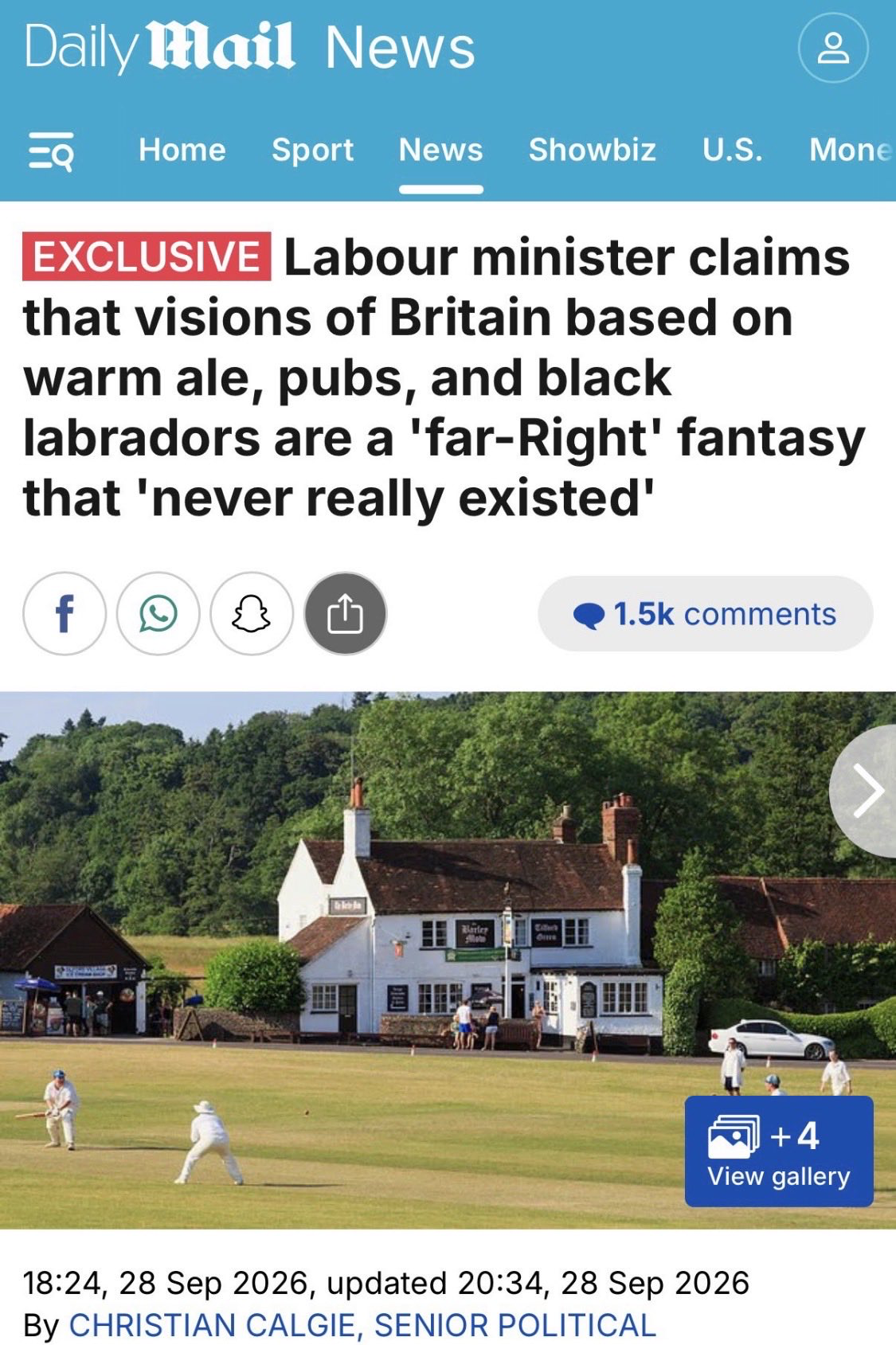
I was going to go to bed, but the malevolent inanity that is Jenny Riddell-Carpenter MP has riled me. She has disturbed my sleep, because she says that she cannot sleep. She told a Labour fringe meeting in Liverpool today what keeps her awake, and it was not rural bus cuts or the last shop closing in a Suffolk village. It was her own voters. She fears the far right will fight the next election on “a nostalgic vision of Britain that never really existed“, one of “warm ale, a black Labrador by your feet in a pub that doesn’t exist, and with symbolism of fox hunting all around them“.
A pub that doesn’t exist. The Minister for Nature represents Suffolk Coastal. Allow me to draw her a map.
Adnams brews in Southwold, just inside the protected landscape of the Suffolk Coast and Heaths, and the town is in her seat. From there a rowing-boat ferry crosses the Blyth to Walberswick for a pound, worked by a family that has pulled the oars for generations. The Bell on the far bank is six hundred years old and lets dogs in. The Cross Keys at Aldeburgh has served drink since 1540, and the Crown at Snape is a fifteenth-century inn with its own allotment. Most MPs would put these places on the constituency Christmas card. Ms Riddell-Carpenter prefers to tell a hall in Liverpool they are a far right hallucination.
Her non-existent warm ale has a pedigree she ought to recognise. She must be thinking of John Major in 1993, but he lifted it from George Orwell, who had written of “old maids biking to Holy Communion through the mists of the autumn morning“. Orwell was a socialist who spent years at his parents’ house in Southwold. The fantasy she fears was written by a man of the left, in her constituency. She clearly doesn’t know.
Then comes the sentence that gives her away. Labour, she said, must make the case for “what we believe rural communities look like“. Not what they are. What Labour believes they look like. The countryside is not to be listened to but corrected, its shape agreed at a fringe meeting and posted back to the people who live in it. When they describe their own lives, the pub, the dog, the Saturday match, their MP hears Ladybird nostalgia and smells fascism.
Cricket will be next on the charge sheet. Yoxford plays at Grove Park beside St Peter’s church and fields girls’ sides at under-11, under-13 and under-15, alongside women’s teams. At Orford the Sudbourne Hall ground drained well enough to save every home game in a previous sodden summer, and women’s sessions ended with a Pimm’s at close of play. This is the reactionary idyll that haunts her nights. It is busy doing, on a village green, what her party only issues press releases about.
She cannot plead ignorance, which makes it worse, no culpable. Her family moved to Martlesham Heath when she was seven, and she went to Woodbridge School. At eighteen she left and did not come back until the voters sent her. The years between went to London, to SOAS (oh brother), to the housing developer L&Q and to the lobbying trade, where she rose to run Cratus Group. Her husband still works in London social housing. She came home remembering every pub by name and having learned in town to be embarrassed by all of them. She now chairs the Labour Rural Research Group, which is a little like putting a vegan in charge of the pork pie.
A rural minister’s job is to carry the countryside’s case into Whitehall. This one carries Whitehall’s sneer back out and waits for the applause. Nobody who talks about her own patch like this can be trusted to defend it when a solar farm or a trail-hunting ban comes over the hill. She will side with the department and call it progress. She will be wielding the new Landuse Framework that tokenises the countryside, and she hates what exists before.
The Korean War Week 119 – Americans Troops Can’t Understand Each Other – September 29, 1952
The Korean War by Indy Neidell
Published 29 Sept 2026At the Panmunjom Truce Table, the UN presents three different plans to solve the POW issue, the only one standing in the way of an armistice. All three are rejected by the Communist delegation, but US President Harry Truman is not going to make any concessions, and have an armistice just “for the sake of having one”. In the field, the fight for Outpost Kelly flares up again, but the UN forces are unable to retake the position.
00:00 Intro
00:48 Recap
01:12 The POW Deadlock
04:12 Dean Acheson
06:54 Plans Being Made
08:53 Outpost Kelly
14:32 Summary
14:48 Conclusion
15:26 Call to Action
Undermining any attempt to discover truth and achieve any reconciliation
The urge to uncover past wrongs in the Canadian government’s dealings with First Nations groups isn’t a bad thing … but the government’s unwillingness to require factual evidence in support of claims of past wrongs will do exactly the opposite of working toward cultural reconciliation:

Photo from Woke Watch Canada
Why is the federal government trying to prevent Canadians from learning the truth about Indian residential schools?
On 24 September 2026, six days before Canada’s National Day for Truth and Reconciliation, Minister of Crown-Indigenous Relations Rebecca Alty issued a statement about so-called ‘Residential Schools denialism’.
Alty claims so-called ‘Residential Schools denialism’ “spreads false information by denying or casting doubt on the history of Residential Schools and the lasting harm they caused”. She offers no examples, which strongly suggests she could not provide examples if pressed to do so. The federal government is thus using Canadian taxpayer funds to attack a straw man of its own creation.
In fact, the federal government has gone far beyond using Canadian taxpayer funds to attack the straw man it calls ‘Residential Schools denialism’. It has even entertained bills which would criminalize it.
The federal government refuses to release residential school attendance records to the public which would disprove claims of missing children
In addition to using Canadian taxpayer money to attack so-called ‘Residential Schools denialism’ — a straw man of its own creation — and entertaining bills which would criminalize it, the federal government has actively prevented the truth about Canada’s Indian residential schools from coming out.
For years there have been tales of thousands of missing Indian residential school students. The federal government has allowed these baseless rumours to proliferate, despite the fact that not a single name of a missing Indian residential school student has ever been produced by anyone, including the federal government.
Moreover the federal government has allowed these baseless tales of missing Indian residential school students to proliferate while actively concealing from the Canadian public the attendance records in its possession which disprove them.
An example is the attendance records for the Kamloops Indian Residential School. A close examination of the quarterly returns for the Kamloops Indian Residential School from 1943-1952, which are available online, establishes that every student is accounted for during that decade.
The government also has quarterly returns and other attendance records for the remaining years of the existence of the Kamloops Indian Residential School, 1952-1977, which it has not released to the public. Their existence is attested to by the federal government itself in the school narrative it prepared for use in the Independent Assessment Process.
Quarterly returns were the basis on which the Department of Indian Affairs calculated the per capita grant which covered the operating costs of the school. School officials ensured they were meticulously accurate in order to obtain as large a grant as possible based on current student enrolment, and the Department of Indian Affairs likewise demanded that they be meticulously accurate to avoid the federal government overpaying the school.
It is thus of the greatest significance that on pp. 7-8 of the attached school narrative, the federal government provides a table of total attendance figures for the years of the Kamloops Indian Residential School’s existence. The figures given by the federal government for the years from 1952-1977 are not estimates. They are very precise numbers — 402, 424, 381, 390, for example — indicating that they are derived from attendance records in the federal government’s possession, and in fact the federal government’s heading on the table reads “most are September figures for each year and based on Quarterly Returns where possible“.
It is thus clear that if released by the federal government, the quarterly returns underlying the figures in this table would establish conclusively that not a single student from the Kamloops Indian Residential School went missing between the years 1952-1977, yet the federal government refuses to release these attendance records so that the Canadian public can learn the truth. Instead, the federal government allows the damaging and completely unfounded myth of thousands of missing Indian residential school students to proliferate, and even to be promulgated beyond Canada’s borders (as, for example, in the recent hearings of the Rome-based Permanent Peoples’ Tribunal).
The federal government needs to release these attendance records, not just for the Kamloops Indian Residential School, but for all Indian residential schools in Canada, so that the Canadian public can learn the truth, i.e., that federal government records establish that not a single student is missing from an Indian residential school.
On X, Mr Bench points out that First Nations’ political representatives see literally no end to the need for reconciliation for generations yet to come:

Will reconciliation ever end?
According to Candice … NO.
Plan for this to continue for generations.
She says some people haven’t even started healing yet.
Her son will need healing.
Her future grandchildren will need healing.
And she admits:
“Don’t know how many generations it’s gonna take for us to heal, and healing is forever.”
So when does reconciliation end?
It doesn’t. So keep the funds flowing
If “healing is forever”, apparently there is no finish line.
L. Wayne Mathison speaks for an increasing number of Canadians here:
I’m sick and tired of being told that people generations from now will still need to “heal” from events they never personally experienced. My ancestors went through terrible things too. History is full of conquest, poverty, discrimination, war and displacement.
Remember the past. Teach it accurately. Deal with specific injustices that still exist. But at some point adults also have to build a life in the present.
I do not believe anyone should inherit permanent victimhood, and I do not believe anyone alive today should inherit permanent guilt.
Reconciliation without measurable goals, accountability or any conceivable end point stops looking like reconciliation to me, period.
Keep this up, and I am totally done with this.
What’s the Point of Armoured Cars?
The Tank Museum
Published 29 May 2026Even though we call ourselves The Tank Museum, at heart we are the museum of the Royal Armoured Corps. That means we don’t just have tanks — we have a wide range of armoured fighting vehicles that tell the story of the Corps. Within that collection sits the armoured car.
On the surface it can seem redundant: tanks are better armoured, have superior cross-country mobility and usually carry bigger guns. So why do armoured cars — a concept that predates the tank — remain in service today? After all, a Ferret doesn’t sound nearly as intimidating when up against the likes of the Chieftain.
00:00 | Introduction
01:25 | Starting Small
02:49 | Speed Demons
09:40 | Going Global
13:13 | Only the Enemy in Front
19:28 | Go Big or Go Home
(more…)
QotD: “Have you ever been surprised to learn that someone was a Leftist?”
It never happens, right? Like vegans and Harvard alums, you never have to wonder if someone is an SJW — they’ll tell you, right off the bat. Usually they don’t even have to tell you; the hair and the tats and the fishing tackle in the face do that. Like putting the “Bernie 2024” sticker on the bumper of the Prius or the Subaru Outback, actually declaring yourself an SJW is overkill. So much so that it’s a cliché — of all the budding shitlords I mentored in my years in academia, none of them “came out” to me because of anything I said or did. It was all the stuff I didn’t say or do — I didn’t spend half of each class period ranting and raving about The Current Thing, which was so unusual that they figured I must be on the other side.
The Left, I think it’s fair to say, enjoys total freedom here in AINO. Total liberty, too, and that’s a distinction we should probably make at some point, but for right now let’s hold fire on that. Whichever one you want to use, though, it’s obvious that the Left have it, with pretty much zero restraint. Nothing is too weird or gross or obnoxious that the Left won’t champion it.
But even more than that, all the traditional restraints on behavior — what we should probably call decorum — have been systematically destroyed, and that’s the heart of what I want to talk about. Since we’re discussing the Left here, let’s use one of their favorite terms: Privilege. I think we can take it as read that there has never been a more privileged person, in any sense of the word “privilege,” in all of human history, than Karen (or her JV version, the Basic College Girl). And what battleaxes they are! Constantly lecturing everyone else about their privilege while plowing through every social situation like a tsunami. Like the Clintons, Karen triumphs because you just can’t believe anyone has the sheer brass-balled audacity to pull the antisocial shit they do.
Have you no shame, madam? At last, have you no shame?
Severian, “On Liberty”, Founding Questions, 2022-10-12.


