Quotulatiousness

January 14, 2024

Tristin Hopper imagines the thoughts of the Toronto Police Service

Filed under: Cancon, Law, Media, Politics — Tags: , , , , — Nicholas @ 05:00

Every week, Tristin Hopper helps us understand an element of the week’s news by “imagining” the diary entries of the people or organizations involved. This week, it’s the turn of Toronto’s police department:

The Toronto police have not had a good week. After receiving widespread criticism for refusing to disperse an anti-Israel blockade targeting a north Toronto Jewish neighbourhood, video emerged this week of officers delivering coffee and donuts to the blockaders.

And so, only after a cross-section of local politicians and Jewish leaders had expressed bafflement at police inaction, did Toronto police announce plans on Thursday to actually put a stop to protests at the Avenue Road bridge. They even charged one protester with incitement of hatred for allegedly carrying a hate group’s flag at a protest in downtown Toronto.

Monday
I’m sorry — is that the sound of people wanting us to enforce the law? As in, “hey there, sworn peace officer, get in your car, go identify some criminality and use force to stop it?”

Are you sure about that, Toronto? You sure you don’t want us to instead try fixing this with a solidarity flag raising? Or maybe this is something that could be diffused with one of those equity roundtables you keep forcing us to attend.

After all, enforcing the law is a messy business. People could get hurt. This isn’t like handing out a traffic ticket or a jaywalking citation: You’re asking us to confront people who may not care that their actions are illegal, and may employ additional illegal methods to dispute that.

Tuesday
I’m still trying to get my head around this new paradigm. So to refresh: when people break laws, you want us to stop that? The Criminal Code. The Highway Traffic Act. The Controlled Substances Act. You want our officers to read up on contemporary legislation, seek out violators of said legislation, and then apply appropriate sanctions?

This is a minefield, frankly. We’re talking raised voices. Mean tweets. People in handcuffs. Unflattering videos. Outraged Toronto Star columns. This is how we board an escalator that may soon make us pine for the days when our only problems were an easily ignored minority demographic having their overpass shut down.

Wednesday
When we’re enforcing these laws, are you absolutely sure you want us to do this without first checking if they’re politically acceptable? I mean, it would obviously streamline everything if roadways were only ever blockaded by white supremacist cannibal pedophiles, but that’s rarely the case.

And what if they’re doing an illegal thing that is tangentially related to something you like? I had our legal guy look into it and he said that any laws broken as a result of a public protest are still illegal – the right to protest only covers legal things, it turns out. So bear with me; this could result in a city in which graffiti, blockades and vandalism OF ANY KIND could end up banned. It’s a slippery slope.

Soviet and American Massive Attacks – Week 281 – January 13, 1945

World War Two
Published 13 Jan 2024

In the East, the Soviets launch a massive series of new offensives. In the West, Monty holds an ill-judged press conference about the Battle of the Bulge. Operation Nordwind, the German offensive in Alsace, continues. In Hungary, there’s house to house fighting as the Red Army besieges Budapest. In Asia, the Allies wrestle with the Kamikazes, begin their landings on Luzon, and advance in Burma.

00:54 Intro
01:12 Recap
01:22 Montgomery’s Press Conference
05:53 Operation Nordwind
07:07 The battle for Hungary
09:38 The huge Soviet offensive begins!
12:22 American landings on Luzon
15:29 Anti-Kamikaze tactics
18:11 Slim’s advance in Burma
21:11 Conclusion
(more…)

The insane miscarriage of justice in Britain’s Post Office and the courts

Filed under: Britain, Bureaucracy, Law — Tags: , , — Nicholas @ 03:00

The British Post Office (formerly the Royal Mail) has spent the last several years prosecuting many of its own staff for financial skulduggery uncovered by the Post Office’s computer system. Many people have been convicted and punished, yet it now comes to light that the real culprit is the faulty accounting methods used in the Post Office’s Horizon software:

“Atten-SHUN! EIIR Red Pillar Boxes” by drivethr? is licensed under CC BY-SA 2.0 .

What went wrong at the Post Office over that Horizon computer system is being described as very difficult, complicated, we’ll never really find out and Whocouddaknowed?

This is not correct. The Post Office knowed, ICL knowed, Fujitsu knowed.

Therefore and thus, as I’ve said before, just Jail Them All. There will be some who will be able to argue their way out on the basis of their innocence and that’s fine, even great. But let’s start with everyone on the right side of the bars.

It’s long been — as I’ve said — common gossip among programmers that the base problem really was pretty base. The Horizon system counted incompletes as a transaction. So, a transaction is going through and it doesn’t quite make it. Communication problems, something. A sensible system looks at incompletes and ignores them. Only completes, fully handshaken and agreed, change the accounting ledgers. Horizon did not do this. It would count the incomplete as one transaction, then when the full one came through count that as an additional, extra, transaction.

This is how a branch thought it had one number, the centre another. Because the branch regarded the incomplete and the resend as only the one transaction, the centre as two.

But common gossip among programmers isn’t enough, obviously.

It’s bad enough that glitchy software could cause such human tragedy, but it’s worse: Post Office management knew and chose to cover it up.

Inside Pz II Luchs | A WW2 Time Capsule

Filed under: Germany, History, Military, Weapons, WW2 — Tags: , — Nicholas @ 02:00

The Tank Museum
Published 13 Oct 2023

A remarkably rare vehicle, with just 100 built and just two still in existence, the Panzer II Ausf.L “Luchs” is a reconnaissance variant of the Panzer II and this is one of the most intact and original vehicles we have in our collection. Join Chris Copson as he looks inside this Second World War rarity.
(more…)

QotD: The misleading wisdom of the ancient world

Filed under: Europe, History, Quotations, Science, Technology — Tags: , — Nicholas @ 01:00

It is difficult for us, today, to take some of the teachings of the ancients seriously. The ancient Greeks believed, for example, that peacock flesh did not rot, and that various small creatures — think mice, maggots, and clams — spontaneously generated from inanimate matter like wheat, meat, and sand.

These seem, today, to be so obviously wrong that our ancestors seem stupid. But they were not. Have you, for example, ever actually observed a mouse being born? And if you’d never seen a peacock, might you not also believe that its flesh really does not rot? We generally do, even now, take our facts on authority, trusting that somebody, somewhere, has observed them or performed the relevant experiments and found them to be true. In fact, things can get all the more convincing when we try the experiments ourselves. I described last week how the rapid “growth” of metals in certain solutions seemed to confirm the theory that they also grew, albeit much more slowly, underground. Or take Jan-Baptiste van Helmont, who in the early seventeenth century reported that, having placed some wheat and a sweaty shirt in a barrel, lo and behold, a few days later there appeared some mice. Spontaneous generation confirmed! (He also, somehow, found that small scorpions spontaneously generated from placing basil under a brick in the sun.) In fact, the persistence of spontaneous generation as a theory should give us pause — although it was tested from the seventeenth century onwards, it was only finally completely debunked by Louis Pasteur in the 1860s.

How could the authority of the ancients be so potent for so long? Well, consider the context. Today, in a world of skyscrapers, indoor plumbing, and the widespread use of horse-less metal chariots, we rarely think that the ancients were in any way more advanced than us. We would, automatically, question them. In the sixteenth and seventeenth centuries, however, in a world of wooden houses, dirt floors, and carts, then the still-standing achievements of the ancients must have been mind-blowing: centuries-old pyramids, aqueducts, amphitheatres, and arenas, not to mention the written accounts of technologies long lost. Archimedes had allegedly set fire to Roman ships at the siege of Syracuse in the 3rd century BCE, using only mirrors focusing the sun’s beams. Archytas had apparently made a flying pigeon out of wood, and Daedalus had achieved human flight. Perhaps Vulcan’s legendary army of iron men might have been real automata.

Anton Howes, “Trusting the Ancients”, Age of Invention, 2019-10-10.

January 13, 2024

The ongoing encrapification of the internet – “When I hear the phrase ‘web platform’ I reach for my gun”

Filed under: Business, Economics, History, Media, Technology — Tags: , , — Nicholas @ 05:00

Ted Gioia used to be a techno-optimist, eagerly looking forward to ever-improving online experiences. He, like so many of us, has reluctantly come to the conclusion that those hopes are fading out of sight:

I once loved new technology. I lived in the heart of Silicon Valley for 25 years, and was bursting with enthusiasm for its free-wheeling mission to transform the world — and have some fun along the way.

When the Worldwide Web made its debut, I thought I’d found Nirvana. It was like tech was turning everything into a game.

But look at me now. When I hear the phrase “web platform” I reach for my gun.

Where did it go wrong? Did I just get old and embittered? Or did something change in the tech world?

Let me share a story that might help us decide.

What kind of business spends hundreds of billions over 10 years — just to get worse?

This is a story about the birth of the search engine.

There were no commercial search engines back in 1993. But a Stanford student named David Filo compiled a list of his 200 favorite websites.

His buddy Jerry Yang helped turn this into an online list. They called it “Jerry’s Guide to the Worldwide Web”. Filo and Yang added new websites every day to their list — and classified them according to categories.

This turned into Yahoo.

Here’s my favorite part of the story: These two students didn’t even know they were running a business.

They did it for fun. They did it out of love. They did it because it was cool. “We wanted to avoid doing our dissertations”, Yang later explained.

But a venture capitalist named Mike Moritz heard about Filo and Yang, and tracked them down. The founders of Yahoo were living in total squalor in a trailer littered with stale food and pizza boxes, strewed alongside sleeping bags and overheating computers. A phone rang constantly — but nobody bothered to pick it up.

Moritz was dismayed by this dorm-room-gone-wild ambiance, but he was impressed with the students’ web searching technology. So he asked them the obvious question: How much did they plan to charge users?

Filo and Yang had no answer for this. They wanted to give their tech away for free.

Yahoo wasn’t even selling ads back then. It wasn’t tracking users and selling their private information. It didn’t even have a bank account.

But it was a community and had millions of users.

That was a word you heard frequently in Silicon Valley in the early days. People didn’t build web platforms — they formed online communities.

It was a FUN community. People enjoyed being a member. Even the absurd name Yahoo was part of the game — although early investors hated it.

Yang’s job title was “Chief Yahoo”. Filo’s position was “Cheap Yahoo”.

Investors always hate those kinds of things.

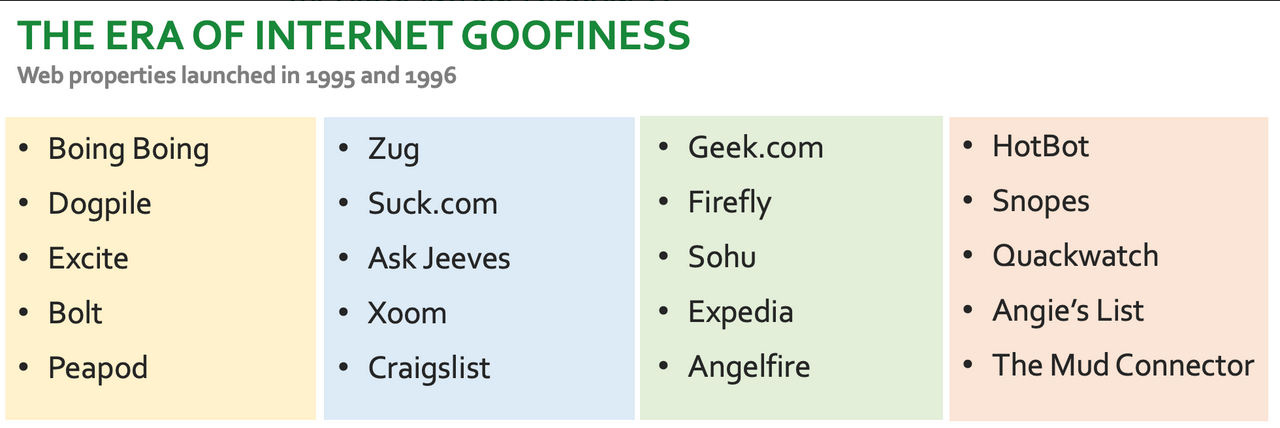
But a new web business, back then, was expected to have a silly name. Here are some of the websites launched in the mid-1990s.

Moritz wanted to turn Yahoo into a business. And the founders realized that their fun community was growing faster than they could handle in their down-and-out trailer. So they sold out 25% of Yahoo for $1 million.

Troubled by Rob Henderson

Filed under: Books, USA — Tags: , , , , , — Nicholas @ 04:00

Stephanos Bibas reviews Rob Henderson’s autobiography Troubled: A Memoir of Foster Care, Family, and Social Class for the University of Chicago Law Review:

Life at the bottom is troubled. Charles Dickens, Victor Hugo, and many others have long shown us that. To understand criminal justice, education, and family law, we lawyers typically look to social scientists, and their external expertise does teach us much. But we often neglect lived experience. Occasionally, we should toggle from the dry regressions and clinical detachment of social science to the internal perspective and expertise of those who live through family breakup, foster care, disrupted schooling, drugs, and crime. And that is what Rob Henderson’s breakout memoir, Troubled, gives us: a window on troubled youth.1

Henderson, a brilliant young psychologist, illumines how harmful childhood instability is by reflecting on his own experience. He never knew his father, was abandoned by his drug-addicted mother, and bounced around foster care. After squandering much of his early education and drowning his rage in alcohol, drugs, fights, and vandalism, he managed to make his way through the Air Force to Yale and now Cambridge. But few of his friends escaped the wounds from their childhoods; many wound up unemployed, in prison, or dead. His eye is as keen as his intellect, recalling and reporting how adults in his life kept abandoning him and his fellow foster children and how they in turn acted out. As an outsider to the elites who dominate the Ivies, he also turns his critical eye on the groupthink and victimhood culture that is strongest among the most privileged. And building on literary historian Paul Fussell’s work, Henderson develops his own critique of the shibboleths that educated American elites use to set themselves—ourselves—apart while ignoring the harm to the rest of society.2

Henderson has much to teach us lawyers and legal scholars. He shows us how much we miss by focusing public policy on educational attainment and cost-benefit analysis, overlooking what is priceless: love and emotional attachment. The most important things in life can’t be quantified; at best, outcomes are mere proxies for them. We are more than our résumés! His account undermines our persistent habit of viewing humans as fully informed rational actors — a habit that makes much more sense in corporate law than in criminal law and the like. He showcases how poorly used adult autonomy harms children, leading to broken homes, drug addiction, numbness, and rage.

Lastly, Henderson critiques “luxury beliefs”, the term he coins for sociological opinions that are popular only among those who need not worry about their own survival. These beliefs are status signals to the educated elite who are not harmed by the fallout from any cultural shifts they might cause. But these beliefs corrode the social structures that children need to develop. (He could do more to develop the causal nexus to social harm, but his claims are still powerful.)

In short, Henderson’s memoir powerfully challenges prevalent views of education, family policy, and class. It shows how we hyperfocus on educational outcomes and other quantifiable goals at the expense of softer emotional goods. And it does it all in a plainspoken, understated voice that illustrates his points from his own lived experience and that of his buddies. Many will disagree with Henderson’s conclusions, of course, but scholars should grapple with his challenge.

Part I of this Review summarizes Henderson’s long journey from foster care to Yale. Part II canvasses his argument that adult instability breeds chaotic childhoods, leaving neglected kids to raise themselves in Hobbesian competition, impulsive indulgence, or reckless rage. Part III then develops Henderson’s signature concept of luxury beliefs and how nonjudgmentalism backfires on those at the bottom. Though one can quibble with some of his causal claims, his thrust is compelling. Finally, Part IV considers how Henderson’s account suggests reorienting some criminal justice, education, and family law reforms toward children’s need for stable structures to guide them.


    1. Rob Henderson, Troubled: A Memoir of Foster Care, Family, and Social Class (forthcoming 2024) (on file with publisher). All further citations to this work are by page number in parentheticals in the text.

    2. See generally Paul Fussell, Class: A Guide Through the American Status System (1983).

It’s not lying lying

Filed under: Britain, Environment, Media — Tags: , , , , , — Nicholas @ 03:00

Paul Homewood on how Brits are propagandized through slanted reporting on the weather (which has always been a topic of interest in the British Isles):

Storm Gerrit arrived the day after Boxing Day, accompanied by the usual headlines: “85mph gales barrelled down on Britain”, screamed the Daily Mail.

As usual the public were being deliberately deceived. The 85mph claim was based on one site in North East Scotland, at the top of a 400ft cliff overlooking the North Sea, marked in red below.

Inverbervie, Kincardineshire

A few miles away at sea level average wind speeds never got above 30mph. The Met Office never reports any of this, preferring to publish its favourite sites on clifftops or halfway up mountains.

It was the same story a week later, when another system of low pressure came along to be given yet another silly name, “Henk”.

“94mph winds pummel the UK”, shrieked the Mirror. This time the wind speeds were measured on the Met Office’s go-to weather station, the Needles, off the Isle of Wight. As this column has discussed before, the Needles sit at the end of a long, narrow peninsula, and the station is on top of a 260ft cliff. Winds there are routinely 30mph higher than even exposed sites nearby, such as St Catherine’s Point. Meanwhile average winds inland were typically around 30mph.

It rained as well last week! During the two days of Storm Henk, about an inch fell in parts of southern and central England. There is nothing at all unusual about this amount; it is the sort of thing which happens every year. Because the ground was already saturated, following wet weather last month, there was inevitably some flooding. But, for the most part, this was little more than flooded fields, overflowing river banks and localised flooding. Again, normal scenes in England. And as Patrick Benham-Crosswell pointed out in TCW this week, many houses built on flood plains were once again flooded. There was certainly none of the major river flooding which has hit the country many times in the past.

According to the Environment Agency, about 2,000 properties were flooded, a tragedy for everybody involved. But in overall terms, this is a tiny number. For instance, 55,000 were flooded in 2007.

Inevitably, the media jumped to blame it all on climate change. According to ITV: “Henk is the eighth named storm to have hit the country this winter and the pattern is likely to continue due to the effects of climate change. ‘This is climate change and the impacts we are seeing,’ the Environment Agency’s Tom Paget added. ‘We are seeing these increasingly wet and blustery winters. We are seeing storm upon storm which is exacerbating the issues’.”

Claims like this explain why the Met Office decided to start giving every low-pressure system a silly name back in 2015. But as it admitted in its State of the UK Climate last year, storms used to be much stronger:

    The most recent two decades have seen fewer occurrences of max gust speeds above these thresholds [40, 50, 60 kts] than during the previous decades, particularly comparing the period before and after 2000.

    This earlier period [before 2000] also included among the most severe storms experienced in the UK in the observational records including the “Burns Day Storm” of 25 January 1990, the “Boxing Day Storm” of 26 December 1998 and the “Great Storm” of 16 October 1987. Storm Eunice in 2022 was the most severe storm to affect England and Wales since February 2014, but even so, these storms of the 1980s and 1990s were very much more severe.

Nor is there any evidence that December or the autumn last year were unusually wet.

We look like getting a few weeks of cold, dry weather from now on – so expect drought warnings soon!

History RE-Summarized: The Byzantine Empire

Overly Sarcastic Productions
Published 29 Sept 2023

The Byzantines (Blue’s Version) – a project that took an almost unfathomable amount of work and a catastrophic 120+ individual maps. I couldn’t be happier.

SOURCES & Further Reading:
“Byzantium” I, II, and III by John Julius Norwich, The Byzantine Republic: People and Power in New Rome by Anthony Kaldellis, The Alexiad by Anna Komnene, Osman’s Dream: The History of the Ottoman Empire by Caroline Finkel, Sicily: An Island at the Crossroads of History by John Julius Norwich, A History of Venice by John Julius Norwich. I also have a degree in classical civilization.

Additionally, the most august of thanks to our the members of our discord community who kindly assisted me with so much fantastic supplemental information for the scripting and revision process: Jonny, Catia, and Chehrazad. Thank you for reading my nonsense, providing more details to add to my nonsense, and making this the best nonsense it can be.
(more…)

QotD: Brahmins and Mandarins

Filed under: Bureaucracy, China, History, India, Quotations — Tags: , , , , — Nicholas @ 01:00

Traditional Hindu society knew hundreds of hereditary castes and subcastes, but all broadly fit into four major “varna” (“colors”, strata):

  • Brahmins (scholars, clerisy)
  • Kshatriya (warriors, rulers)
  • Vaishya (traders, skilled artisans)
  • Shudras (farmers)
  • The un-counted fifth varna are the Dalit (“untouchables”, outcasts in both senses of the word)

Historical edge cases aside, membership in the Brahmin stratum was hereditary, even more so than in the nobility of feudal Europe. At least there, kings might raise a commoner to a knighthood or even the peerage for merit or political expedience: one need not wait for reincarnation into a higher caste.

The Sui dynasty in China, however, took a different route. Seeking both to curb the power of the hereditary nobles and to broaden the available talent pool for administrators, they instituted a system of civil service examinations. With interruptions (e.g. under the Mongol emperor Kublai Khan) and modifications, that system remained in place for thirteen centuries until finally abolished in 1904. Westerners refer to laureates of the Imperial Examinations (from the entry-level shengyuan to the top-level jinshi) by the collective term Mandarins. Ironically, this term comes not from any Chinese dialect but (via Malay and Portuguese) from the Sanskrit word mantri (counselor, minister) — cf. the Latin mandatum (command) and its English cognate “mandate”.

Initially, the exams were limited to the scholar and yeoman farmer classes: with time, they were at least in theory opened up to all commoners in the “four occupations” (scholars, farmers, artisans, merchants), with jianmin (those in “base occupations”) still excluded. The process also was ostensibly fair: exams were written, administered at purpose-built examination halls with individual three-walled examination cubicles to eliminate cribbing. Moreover, exam copies were identified by number rather than by name. […]

In practice, the years of study and the costs of hiring tutors for the exam limited this career path to the wealthy. Furthermore, the success rate was very low (between 0.03% and 1%, depending on the source) so one had better have a fallback trade or independent wealth. In some cases, rich families who for some reason were barred from the exams would sponsor a bright student from a poor family. Once the student became a government official, he would owe favors to the sponsor.

Moreover, the subject matter of the exam soon became ossified and tested more for conformity of thought, and ability to memorize text and compose poetry in approved forms, than for any skill actually relevant to practical governance. (Hmm, artists or scholars in a narrow abstruse discipline being touted as authorities on economic or foreign policy: verily, there is nothing new under the sun.)

Nitay Arbel, “Brahmandarins”, According to Hoyt, 2019-10-08.

January 12, 2024

“… normal people no longer trust experts to any great degree”

Theophilus Chilton explains why the imprimatur of “the experts” is a rapidly diminishing value:

One explanation for the rise of midwittery and academic mediocrity in America directly connects to the “everybody should go to college” mantra that has become a common platitude. During the period of America’s rise to world superpower, going to college was reserved for a small minority of higher IQ Americans who attended under a relatively meritocratic regime. The quality of these graduates, however, was quite high and these were the “White men with slide rules” who built Hoover Dam, put a man on the moon, and could keep Boeing passenger jets from losing their doors halfway through a flight. As the bar has been lowered and the ranks of Gender and Queer Studies programs have been filled, the quality of college students has declined precipitously. One recent study shows that the average IQ of college students has dropped to the point where it is basically on par with the average for the general population as a whole.

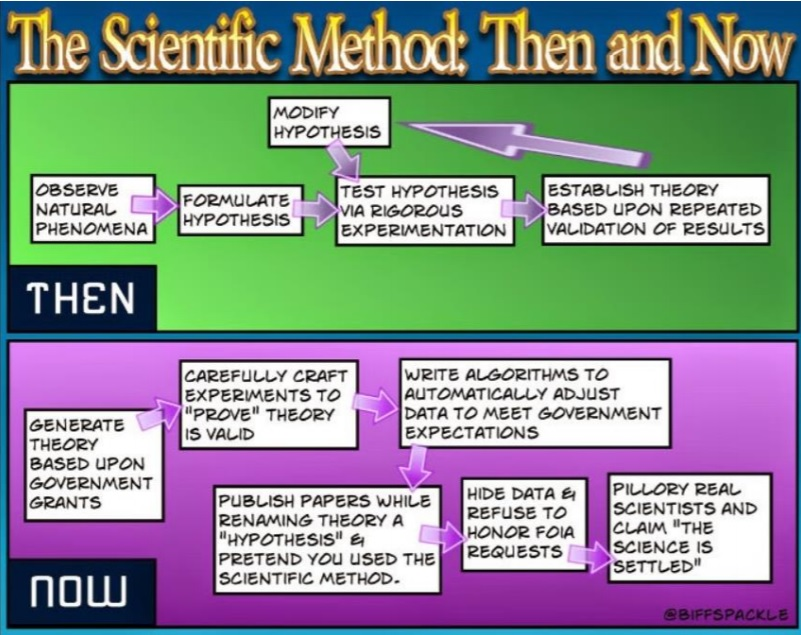
Another area where this comes into play is with the replication crisis in science. For those who haven’t heard, the results from an increasingly large number of scientific studies, including many that have been used to have a direct impact on our lives, cannot be reproduced by other workers in the relevant fields. Obviously, this is a problem because being able to replicate other scientists’ results is sort of central to that whole scientific method thing. If you can’t do this, then your results really aren’t any more “scientific” than your Aunt Gertie’s internet searches.

As with other areas of increasing sociotechnical incompetency, some of this is diversity-driven. But not wholly so, by any means. Indeed, I’d say that most of it is due to the simple fact that bad science will always be unable to be consistently replicated. Much of this is because of bad experimental design and other technical matters like that. The rest is due to bad experimental design, etc., caused by overarching ideological drivers that operate on flawed assumptions that create bad experimentation and which lead to things like cherry-picking data to give results that the scientists (or, more often, those funding them) want to publish. After all, “science” carries a lot of moral and intellectual authority in the modern world, and that authority is what is really being purchased.

It’s no secret that Big Science is agenda-driven and definitely reflects Regime priorities. So whenever you see “New study shows the genetic origins of homosexuality” or “Latest data indicates trooning your kid improves their health by 768%,” that’s what is going on. REAL science is not on display. And don’t even get started on global warming, with its preselected, computer-generated “data” sets that have little reflection on actual, observable natural phenomena.

“Butbutbutbut this is all peer-reviewed!! 97% of scientists agree!!” The latter assertion is usually dubious, at best. The former, on the other hand, is irrelevant. Peer-reviewing has stopped being a useful measure for weeding out spurious theories and results and is now merely a way to put a Regime stamp of approval on desired result. But that’s okay because the “we love science” crowd flat out ignores data that contradict their presuppositions anywise, meaning they go from doing science to doing ideology (e.g. rejecting human biodiversity, etc.). This sort of thing was what drove the idiotic responses to COVID-19 a few years ago, and is what is still inducing midwits to gum up the works with outdated “science” that they’re not smart enough to move past.

If you want a succinct definition of “scientism,” it might be this – A belief system in which science is accorded intellectual abilities far beyond what the scientific method is capable of by people whose intellectual abilities are far below being able to understand what the scientific method even is.

Eastern Front Deployments, January 11, 1945 – a WW2 Special

Filed under: Europe, Germany, History, Military, Russia, WW2 — Tags: , , , , — Nicholas @ 04:00

World War Two
Published 11 Jan 2024

The Soviets are just about to kick off a series of enormous offensives all along the Eastern Front. Here’s a look at the forces who are to attack, and those who will be defending.
(more…)

The rise of “anti-woke” comedy

Filed under: Media, Politics — Tags: , , — Nicholas @ 03:00

Andrew Doyle suggests we should stop calling Ricky Gervais “anti-woke”:

Stop me if you’ve heard this one. A man’s wife divorces him and shacks up with his boss. Soon after, a friend suggests that he should remarry. “What for?” he asks. “Are you looking for a wife as well?”

It may not be the funniest joke, but that’s because it’s an anecdote from The Lives of the Caesars by the Ancient Roman historian Suetonius. The comedian in this case was a senator called Aelius Lamia whose wife had left him for the Emperor Domitian. For making this casual quip, Domitian had Lamia put to death. Now that’s a bad review.

It might be worth keeping this anecdote in mind when the usual debates flare up about whether comedy “goes too far”. The notion of people being offended by jokes is as old as comedy itself, and often people react angrily if humour isn’t to their taste. The current manifestation of this age-old debate takes the form of a simple dichotomy: “woke comedy” versus “anti-woke comedy”.

Already we are in treacherous waters. It is very unwise to define whole genres by terms that have no settled definitions. The actor Kathy Burke believes that “woke” simply refers to people who are neither racist nor homophobic, which would surely mean that the overwhelming majority of us would happily embrace the term. But for those who have been on the receiving end of the bullying, harassment and intimidation by activists who self-define as “woke”, it is clear this issue is not so straightforward.

Over the past few years, we have seen the emergence of a new comedy movement, one branded by commentators as “anti-woke”, that seeks to push back against the orthodoxies of our time. Its closest historical precedent is the “alternative” comedians of the Eighties, who also took aim at establishment norms and were often similarly blunt in their approach. The key difference today is that there is no broad agreement about where the power in society lies, and so while “anti-woke” comedians see themselves as anti-establishment, their critics insist that the opposite is true.

Consider the example of Ricky Gervais, whose new Netflix stand-up special Armageddon has sparked this most recent round of discussions about the supposed red lines in comedy. Some have accused Gervais of taking a reactionary stance, most notably because of jokes relating to migrants and disabled children. Gervais has been branded an “anti-woke” comedian, but I doubt very much that he would see it in such reductive terms. Anyone familiar with his work will know that he has always lampooned closed systems of thought, and it just so happens that “wokeness” currently represents the dominant incarnation. There was a time when many of Gervais’s critics were perfectly happy to see him take a wrecking ball to the certainties of religious faith. It would appear they take a different view when it’s their own belief system taking a battering.

Slavery in the Roman World: A Lecture Given in September 2023

Filed under: Europe, History — Tags: , , , , , , — Nicholas @ 02:00

seangabb
Published 24 Sept 2023

A lecture given in absentia to the 2023 meeting of the Property and Freedom Society in Bodrum. The subject is Slavery in the Roman World. It covers these issues:

Introduction: Sean Gabb, face to camera – 00:00:00
Classical Liberalism, the Natural Law and Slavery – 00:06:38
The Growth of Roman Slavery – 00:16:27
Slave Markets – 00:21:20
The Valuation of Slaves – 00:24:07
Slave Occupations – 00:29:41
The Treatment of Slaves: Galen and the Broken Cup – 00:33:04
Sex and Slavery – 00:38:32
Other Mistreatment of Slaves – 00:00:00
Escape and Punishment – 00:45:49
Slaves and the Arena – 00:48:10
The Moral Effects of Slavery – 00:49:18
The Slave Revolts – 00:58:20
Manumission – 01:03:14
Conclusion and Bibliography – 01:10:20
(more…)

QotD: Rome’s Italic “allies”

Filed under: Europe, History, Law, Military, Quotations — Tags: , , , , , , — Nicholas @ 01:00

The Roman Republic spent its first two and a half centuries (or so) expanding fitfully through peninsular Italy (that is, Italy south of the Po River Valley, not including Sicily). This isn’t the place for a full discussion of the slow process of expanding Roman control (which wouldn’t be entirely completed until 272 with the surrender of Tarentum). The consensus position on the process is that it was one in which Rome exploited local rivalries to champion one side or the other making an ally of the one by intervening and the other by defeating and subjecting them (this view underlies the excellent M.P. Fronda, Between Rome and Carthage: Southern Italy During the Second Punic War (2010); E.T. Salmon, The Making of Roman Italy (1982) remains a valuable introduction to the topic). More recently, N. Terranato, The Early Roman Expansion into Italy (2019) has argued for something more based on horizontal elite networks and diplomacy, though this remains decidedly a minority opinion (I myself am rather closer to the consensus position, though Terranato has a point about the role of elite negotiation in the process).

The simple (and perhaps now increasingly dated) way I explain this to my students is that Rome follows the Goku Model of Imperialism: I beat you, therefore we are now friends. Defeated communities in Italy (the system is different outside of Italy) are made to join Rome’s alliance network as socii (“allies”), do not have tribute imposed on them, but must supply their soldiers to fight with Rome when Rome is at war, which is always.

It actually doesn’t matter for us how this expansion was accomplished; rather we’re interested in the sort of order the Romans set up when they did expand. The basic blueprint for how Rome interacted with the Italians may have emerged as early as 493 with the Foedus Cassianum, a peace treaty which ended a war between Rome and [the] Latin League (an alliance of ethnically Latin cities in Latium). To simplify quite a lot, the Roman “deal” with the communities of Italy which one by one came under Roman power went as follows:

  • All subject communities in Italy became socii (“allies”). This was true if Rome actually intervened to help you as your ally, or if Rome intervened against you and conquered your community.
  • The socii retained substantial internal autonomy (they kept their own laws, religions, language and customs), but could have no foreign policy except their alliance with Rome.
  • Whenever Rome went to war, the socii were required to send soldiers to assist Rome’s armies; the number of socii in Rome’s armies ranged from around half to perhaps as much as two thirds at some points (though the socii outnumbered the Romans in Italy about 3-to-1 in 225, so the Romans made more strenuous manpower demands on themselves than their allies).
  • Rome didn’t impose tribute on the socii, though the socii bore the cost of raising and paying their detachments of troops in war (except for food, which the Romans paid for, Plb. 6.39.14).
  • Rome goes to war every year.
  • No, seriously. Every. Year. From 509 to 31BC, the only exception was 241-235. That’s it. Six years of peace in 478 years of republic. The socii do not seem to have minded very much; they seem to have generally been as bellicose as the Romans and anyway …
  • The spoils of Roman victory were split between Rome and the socii. Consequently, as one scholar memorably put it, the Roman alliance was akin to, “a criminal operation which compensates its victims by enrolling them in the gang and inviting them to share to proceeds of future robberies” (T. Cornell, The Beginnings of Rome (1995)).
  • The alliance system included a ladder of potential relationships with Rome which the Romans might offer to loyal allies.

Now this isn’t a place for a long discussion of the Roman alliance system in Italy (that place is in the book I am writing), so I want us to focus more narrowly on the bolded points here and how they add up to significant changes in who counted as “Roman” over time. But I should note here that while I am calling this a Roman “alliance system” (because the Romans call these fellows socii, allies) this was by no means an equal arrangement: Rome declared the wars, commanded the armies and set the quotas for military service. The “allies” were thus allies in name only, but in practice subjects; nevertheless the Roman insistence on calling them allies and retaining the polite fiction that they were junior partners rather than subject communities, by doing things like sharing the loot and glory of victory, was a major contributor to Roman success (as we’ll see).

First, the Roman alliance system was split into what were essentially tiers of status. At the top were Roman citizens optimo iure (“full rights”, literally “with the best right”) often referred to on a community basis as civitas cum suffragio (“citizenship with the vote”). These were folks with the full benefits of Roman citizenship and the innermost core of the Roman polity, who could vote and (in theory, though for people of modest means, only in theory) run for office. Next were citizens non optimo iure, often referred to as having civitas sine suffragio (“citizenship without the vote”); they had all of the rights of Roman citizens except for political participation in Rome. This was almost always because they lived in communities well outside the city of Rome with their own local government (where they could vote); we’ll talk about how you get those communities in a second. That said, citizens without the vote still had the right to hold property in Roman territory and conduct business with the full protection of a Roman citizen (ius commercii) and the right to contract legal marriages with Roman citizens (ius conubii). They could do everything except for vote or run for offices in Rome itself.

Next down on the list were socii (allies) of Latin status (note this is a legal status and is entirely disconnected from Latin ethnicity; by the end of this post, Rome is going to be block-granting Latin status to Gauls in Cisalpine Gaul, for instance). Allies of Latin status got the benefits of the ius commercii, as well as the ability to move from one community with Latin status to another without losing their status. Unlike the citizens without the vote, they didn’t automatically get the right to contract legal marriages with Roman citizens, but in some cases the Romans granted that right to either individuals or entire communities (scholars differ on exactly how frequently those with Latin status would have conubium with Roman citizens; the traditional view is that this was a standard perk of Latin status, but see Roselaar, op. cit.). That said, the advantages of this status were considerable – particularly the ability to conduct business under Roman law rather than what the Romans called the “ius gentium” (“law of peoples”) which governed relations with foreigners (peregrini in Roman legal terms) and were less favorable (although free foreigners in Rome had somewhat better protections, on the whole, than free foreigners – like metics – in a Greek polis).

Finally, you had the socii who lacked these bells and whistles. That said, because their communities were allies of Rome in Italy (this system is not exported overseas), they were immune to tribute, Roman magistrates couldn’t make war on them and Roman armies would protect them in war – so they were still better off than a community that was purely of peregrini (or a community within one of Rome’s provinces; Italy was not a province, to be clear).

The key to this system is that socii who stayed loyal to Rome and dutifully supplied troops could be “upgraded” for their service, though in at least some cases, we know that socii opted not to accept Roman citizenship but instead chose to keep their status as their own community (the famous example of this were the allied soldiers of Praenesti, who refused Roman citizenship in 211, Liv. 23.20.2). Consequently, whole communities might inch closer to becoming Romans as a consequence of long service as Rome’s “allies” (most of whom, we must stress, were at one point or another, Rome’s Italian enemies who had been defeated and incorporated into Rome’s Italian alliance system).

But I mentioned spoils and everyone loves loot. When Rome beat you, in the moment after you lost, but before the Goku Model of Imperialism kicked in and you became friends, the Romans took your stuff. This might mean they very literally sacked your town and carried off objects of value, but it also – and for us more importantly – meant that the Romans seized land. That land would be added to the ager Romanus (the body of land in Italy held by Rome directly rather than belonging to one of Rome’s allies). But of course that land might be very far away from Rome which posed a problem – Rome was, after all, effectively a city-state; the whole point of having the socii-system is that Rome lacked both the means and the desire to directly govern far away communities. But the Romans didn’t want this land to stay vacant – they need the land to be full of farmers liable for conscription into Rome’s armies (there was a minimum property requirement for military service because you needed to be able to buy your own weapons so they had to be freeholding farmers, not enslaved workers). By the by, you can actually understand most of Rome’s decisions inside Italy if you just assume that the main objective of Roman aristocrats is to get bigger armies so they can win bigger battles and so burnish their political credentials back in Rome – that, and not general altruism (of which the Romans had fairly little), was the reason for Rome’s relatively generous alliance system.

The solution was for Rome to essentially plant little Mini-Me versions of itself on that newly taken land. This had some major advantages: first, it put farmers on that land who would be liable for conscription (typically placing them in carefully measured farming plots through a process known as centuriation), either as socii or as Roman citizens (typically without the vote). Second, it planted a loyal community in recently conquered territory which could act as a position of Roman control; notably, no Latin colony of this sort rebelled against Rome during the Second Punic War when Hannibal tried to get as many of the socii to cast off the Romans as he could.

What is important for what we are doing here is to note that the socii seem to have been permitted to contribute to the initial groups settling in these colonies and that these colonies were much more tightly tied to Rome, often having conubium – that right of intermarriage again – with Roman citizens. The consequence of this is that, by the late third century (when Rome is going to fight Carthage) the ager Romanus – the territory of Rome itself – comprises a big chunk of central Italy […] but the people who lived there as Roman citizens (with and without the vote) were not simply descendants of that initial Roman citizen body, but also a mix of people descended from communities of socii throughout Italy.

Bret Devereaux, “Collections: The Queen’s Latin or Who Were the Romans, Part II: Citizens and Allies”, A Collection of Unmitigated Pedantry, 2021-06-25.


« Newer PostsOlder Posts »

Powered by WordPress