
The first thing to note is that when we talk of “Roman roads”, we almost always mean the viae publicae, roads built by public officials (Initially censors who let out the contracts to build such public works, although later roadways get named after the consuls and praetors who constructed them as the Romans build more of them) and was maintained by the state. But of course these major state highways existed within a wider network of local roads (a via vinciales or actus, pl. actus – everybody loves the Fourth Declension! It’s a step in the right direction) which might or might not be private (a privatum iter). That distinction is important, because it wasn’t that all Roman roads were of the high quality we tend to think of – the roads we’re thinking of were prestige projects undertaken by the state, but a whole [mess] of private lanes and dirt paths existed too.
That said, for the major viae publicae, the combination of archaeologically preserved examples and a few references in literary sources gives us a good sense of what “best practices” for Roman road construction were. To start with, obstructions were cleared and then a trench was dug where the road would go. The trench was then filled with three packed layers: a stone layer, then a gravel layer and finally a sand or cement layer. On this was placed the surface of stone blocks, cambered so that rainwater drained to the sides of the road. The stone surface was then held in place by an umbo (literally a “knob” or “swelling”, the same word is used for shield bosses) on the edges of the road. Within a town, the umbo might in turn border a stone sidewalk, but out in the countryside, that wasn’t present.
On the one hand, we know that the high-quality construction of Roman paved roads impressed in the ancient world; Dionysius of Halicarnassus proclaims them one of Rome’s three most magnificent works (alongside aqueducts and sewers, Dion. Hal. Ant. Rom. 3.67.5; note also in this vein Strabo 5.3.8; Plin. HN 36.125). On the other hand, we also know that not all Roman roads were built to the same high standard. While we know that various Roman legislation spelled out required road widths, for instance, the actual width of Roman roads varied widely. And while we’re here, I should note, the story you have heard that modern roadway width or standard railway gauge being based on Roman road width (or, heaven help us, Roman “war chariots”, a thing the Romans did not have) is rather wrong. Nor were they always well-constructed or maintained; Julian, for instance, bemoans a poorly maintained road in a letter to Libanius in 363.
Also, if I may stop a moment, one thing I hear frequently said about Roman roads is that their survival serves as some sort of indictment on modern road construction, “they don’t build them like they used to!” There are a few layered bad assumptions here. The first, of course, is survivorship bias; that road outside of Chalcis that Julian complained was sinking into a swamp probably isn’t available for us to see and similarly badly maintained or poorly constructed Roman roads are simply gone or only visible with archaeological methods and so unavailable for comparison. At the same time, modern roads are asked to do things which ancient roads were not; I do not suspect many Roman roads would last very long if hundreds of 20-ton (or more) trucks were rumbling over it daily. Indeed, preserved Roman roads outside of the cities often have deep ruts worn several inches deep in the stone from the passage of carts (carts and other vehicles were generally banned inside of Roman cities; city streets were for pedestrians). Finally we know that Roman roads, just like modern ones, required maintenance and reconstruction fairly regularly in the period of their use; Laurence (op. cit., 66) has a neat table of inscribed milestones on the Via Appia, for instance, referring to repair or reconstruction, with sections of the roadway repaired in stages from 97 to 110AD.
Nevertheless, the generally high quality of Roman roads, as noted, was recognized in antiquity and is still apparent in their survival today. In contrast to many unpaved sections of Persian royal roads, for instance, Roman viae publicae were paved as a matter of course and standard widths (c. 3.5m wide; the oldest Roman laws, the Twelve Tables, set a minimum width on straights of c. 2.4m though as noted this was not always followed) were fairly generous. And they tended to be well-engineered, with relatively flat surfaces (which are often quite a bit less flat today due to ground shifting as well as the erosion of concrete between paving stones) and straight lines, though the notion that all Roman roads were ruler-straight is, of course, wrong (though some are!). In particular, the Roman system of road construction, while it demanded considerable up-front labor costs, was seemingly designed to keep long-term maintenance demands low. This was a style of road building which accepted big up-front costs in exchange for lower long-term maintenance, which of course demands a lot of initial state capacity to manage the costs and labor demands (something Rome’s successors would mostly lack).
So as roads go, the Roman ones were uncommonly good (albeit with a wider degree of variation than is often appreciated), but the marvel of the Roman roads is not that they had a few good, paved roads – states had been building paved roads for some time, as noted above – but that they had a massive system of them. Scale, more than quality, was the Roman achievement here, though the quality was also quite high.
Bret Devereaux, “Collections: Roman Roads”, A Collection of Unmitigated Pedantry, 2023-06-02.
August 28, 2026
QotD: Roman roads
August 27, 2026
Women and power
Sara the Editor (that is, not Sarah Hoyt the SF author and Instapundit co-blogger) posted this on Substack Notes a couple of weeks ago before the Lindsay Clancy trial began, but it discusses some of the things that have become common topics of interest since then:

Pink-clad supporters of Lindsay Clancy
Photo from Aged Well
Women are weak, and that’s why they’re evil.
Women are never taught how to restrain their own power. This wasn’t bred into them, either. A woman never had to grapple with what every man faces at some time in his life: the realization that he can easily overpower and hurt a significant portion of the population, including women, children, and the elderly.
Men are taught not to do this wantonly, and if they do, we used to execute them. So we’ve been actively breeding it out of men.
Women are more valuable in terms of childbearing and bore little risk to society as long as men had the right to raise his own hand against a violent woman.
Women can only abuse children, old women, and crippled men. And they do, frequently, unless they fear repercussions for it.
Now women have political power. Now they have access to weapons that are small, light, and easy for a weakling to wield. They can now easily abuse men, and the men will sit there and take it, because they dare not defend themselves and are terrified of the woman-worshipping state police force, a mercenary army of cucks and degraded white knights.
Why would you expect a creature who never had to grapple with power to suddenly wield it with virtue?
You wouldn’t.
Every believable story where random people get superpowers gets one core thing right: the former weaklings are the most vengeful. They can’t wait to make the strong whimper at their feet.
This is literally every feminist ever. They say it out loud. They are razing the world with their newfound powers. Because women were never virtuous, just incapable of evil at scale.
Just look what they did when mass murder was put within female reach.
The oceans of infant blood that women have spilled in the last hundred years dwarfs every death caused by men in every war throughout all of recorded history. And yet feminists, they sit on that pile of tiny skulls lecturing men about how evil they are because they have more innate physical strength.
Do not fear the strong. Fear the ones who have become strong overnight.
They have all the spite and the will to spread their own misery.
More specifically dealing with the phenomena of women publicly proclaiming their support for a woman who deliberately murdered her own children:

This week was a pretty extreme wake-up call on the state of women online.
We learned that there are a shockingly large number of women who not only identify with a child murderer, but are ostentatiously, publicly performing that identification: posting videos of themselves sobbing while clutching infants, captioned “Same, Lindsay”.
They’re posting AI videos of Lindsay Clancy — a woman who sent her husband on an errand so that she could strangle their three children to death — receiving the warm embrace of the Sisterhood. Some are even running the “no uterus, no opinion” playbook but for actual infanticide. (I will not post examples, they’re easy to find.)
Clearly, this is not a feeling about which they are furtive or ashamed. It is baffling to imagine them setting up their camera so that they can publicly “break down”, Just Like Lindsay, to an audience of millions.
[…]
What these women are thinking is: “being a mom is Seriously Super Hard, and I am being Super Brave, look how Brave I’m being.”
That’s really all it is. The best defense you can make of this behavior is that it is sincerely, completely superficial and self-involved.
A social media hysteria has given them moral and social permission to complain in maximally dramatic terms, and to participate in a chorus of mutual validation.
There’s an echo in the “I choose the bear” discourse from a few months back.
Millions of women claimed that they would rather be alone in a room with a bear than alone with a man — and men responded with shock, in the mistaken belief that women were saying that they would actually literally rather be alone in a room with a bear.
This was not helped by the fact that many women, in the interest of making their point more vividly, said, “You’re not hearing me — I literally actually would rather be alone in a room with a literal bear and I’m not kidding”.
These women mean what they say, but not in the way that you mean things when you say them.
One of the emotional engines of this controversy is the perception that Lindsay Clancy was “crying out for help” and was “failed by the system” — that she wasn’t Heard or Taken Seriously.
But of course, her situation was being taken as seriously as such a situation could possibly be taken. There was a small army of doctors and therapists (and her husband, and a nanny) actively monitoring her.
If she had expressed a desire or plan to kill her children, they would have been immediately removed from her custody — but she didn’t.
The reason psychiatrists don’t institutionalize people or snatch their children when they report feeling depressed — or even when they report having certain categories of scary thoughts — is that they want people to speak up when they’re having trouble.
The only intervention that would have stopped this is for someone to suspend her parental rights or institutionalize her, with no judicable evidence (across a battery of clinical encounters) that she intended to harm her kids.
Obviously, these thousands of women are not actually suggesting that they are literally, actively experiencing what Lindsay Clancy experienced, or actually demanding the only intervention that would have made any sense (to have their children confiscated by the state.)
Maybe it’s waste of time to spell out that these demands have no practical content, but whatever: they have no practical content. Women are Using Language Differently. They want to Feel Heard. It’s Not About the Nail.
On her Substack, Janice Fiamengo helpfully points out that western cultures have always had a more lenient view of female murderers of their own children:
Do any of these advocates care about the principles of justice? Do they believe in equality before the law? Are they concerned with the possibility that a not guilty verdict in Clancy’s trial will encourage other unhappy mothers to kill their children? (Mothers are already, according to U.S. government data, the most frequent perpetrators of child homicide, see p. 65).
It seems not. The primary impulse is to see Lindsay Clancy and, by extension, all unhappy mothers as the true victims now and forever, never to be held responsible for any bad act, deserving of boundless sympathy.
Perhaps there has never been a case that illustrated women’s incoherent morality so clearly.
But it is not, alas, a new thing, and men in the west have tolerated and furthered it for centuries. In his 1913 book The Fraud of Feminism, British barrister Ernest Belfort Bax described, with his characteristic wit, how the female criminal is “surrounded by a halo of injured innocence”, “convinced of the maliciousness of her accusers” and of her own lack of responsibility (89-90).
Bax showed that nineteenth-century criminal law had great difficulty conceiving of and punishing female violence. Where there was any doubt as to a woman’s guilt, juries were reluctant to convict; and even where there was no reasonable doubt, they were eager to find mitigating circumstances such as temporary insanity, victimhood, or male coercion to justify leniency.
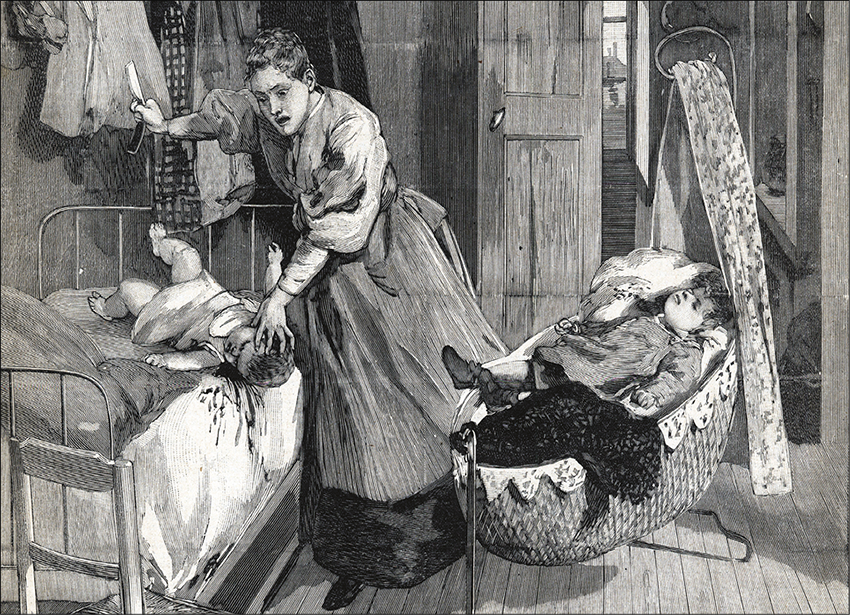
A now-famous Philadelphia case involved a mother, Harriet Vaughn (variously spelled Vaughan), who had murdered her newborn baby within hours of its birth in 1868, and was championed by her feminist supporters as a wronged innocent. The severely beaten dead baby, which Vaughn had attempted to conceal under her bed after crushing its skull with a blunt instrument, was hardly mourned at all (for a full account, see Sarah Barringer Gordon, “Law and Everyday Death: Infanticide and the Backlash against Woman’s Rights after the Civil War” in Lives in the Law).
Although Vaughn was convicted of murder and sentenced to death by hanging — a highly unusual sentence in that no woman had been hanged in Philadelphia since 1737 — her plight almost immediately became a cause célèbre, with advocates rallying to her defence. Elizabeth Cady Stanton, leader of the American feminist movement, spent months agitating on Vaughn’s behalf. In the pages of The Revolution, the feminist newspaper she ran with her associate Susan B. Anthony, Stanton portrayed Vaughn as a sexually-abused maiden, and a loving but desperate mother forced to kill her child because she had no other options. She described her as “a poor, ignorant, friendless and forlorn girl who had killed her new-born child because she knew not what else to do with it” (Stanton, “Infanticide”, The Selected Papers of Elizabeth Cady Stanton and Susan B. Anthony, p. 158).
None of this was founded in fact — Vaughn herself did not claim she had been raped and there were many institutions for foundlings in Philadelphia where she might have left her baby — but it was a familiar sentimental narrative guaranteed to stir indignation against the sentence.
Members of the Working Women’s Association of Philadelphia held a mass rally on Vaughn’s behalf, visited Vaughn in prison, and petitioned the Pennsylvania Governor for her pardon, which was granted in May of 1869. Released from prison, Vaughn left Philadelphia for her birthplace of England and was heard from only once more, when she wrote some months later to request the $300 that she had heard feminists had raised for her.
Sympathy for infanticidal, especially unwed, mothers was widespread in nineteenth-century English-speaking countries, where the killing of babies was “an unsavoury but surprisingly common feature of life” (Constance Backhouse, Petticoats and Prejudice, p. 113). Law Professor Sarah Gordon reports that “In 19th century Philadelphia, thousands of dead newborns were found in alleys, ash heaps, privies, rivers, and so on”. Professor of History Ann R. Higginbotham gives examples from 19th century London to show that “juries were extraordinarily reluctant to convict women accused of murdering their illegitimate infants”, often out of sympathy for the women’s difficult circumstances (Sin of the Age: Infanticide and Illegitimacy in Victorian London, p. 329).
“Welcome to Holiday Camp UK”
On Substack Notes, Earl describes the horrific plight of refugees in the UK, specifically those housed under brutal conditions at a camp in Essex, the Wethersfield Airfield Asylum Accommodation:
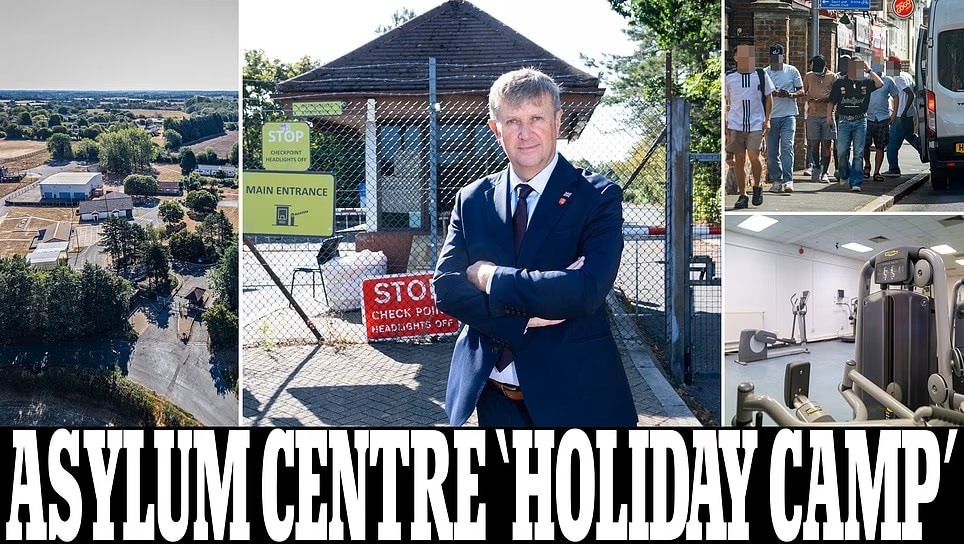
Inside the asylum centre “holiday camp”: A gym, football pitch, snack bar — and 17 minibuses to ferry migrants into towns. Leader of Essex County Council was given access to Wethersfield former RAF base … this is what he found
Welcome to Holiday Camp UK. For the 800 guests enjoying the luxury sports facilities, this place is unbeatable.
As I saw for myself this week on a visit to the camp in Wethersfield, deep in the Essex countryside, residents want for practically nothing. There’s a fully equipped gymnasium, a fitness room, a full-sized football pitch and a substantial indoor sports hall with all the equipment for five-a-side soccer, basketball and cricket – all free.
For those who want to kick back and take it easy, there are recreation rooms with televisions and pool tables, and a snack bar.
Mobile phones are provided for all, with generous allowances for free calls.
The main restaurant, serving two dining halls, provides three meals a day with a wide choice of meals, including vegetarian options.
All the food is free. The only restriction is that all meat is halal – non-Muslims don’t get a choice about that.
Similarly, though the prayer rooms are described as a multi-faith area, most of the religious material is Islamic, with plenty of Korans and no Bibles. Prayer mats cover almost all the available floor space.
A squadron of free minibuses, 17 of them, are laid on three times a day, seven days a week – even on Christmas Day – to take the 800 camp residents into the nearby towns of Braintree, Chelmsford and Colchester.
And how much does it cost to stay here? For residents, that’s the best bit. Not only is everything free, but there’s a tenner a week extra in every pocket … or, to be absolutely accurate, an allowance of £9.95 per person, to cover any incidental costs, loaded onto a prepaid debit card.
The official name for this place is Wethersfield Airfield Asylum Accommodation.
And although it’s free for the hundreds of “happy campers”, the bill for Britain is eye-watering. According to a National Audit Office report last year, asylum accommodation contracts are estimated to cost the taxpayer £15.3billion over the next ten years.
So-called “dispersal sites”, mostly former military properties, are regarded as cheaper than the short-term solution of placing illegal migrants in hotels. But the impact on surrounding communities is immense and the sheer unfairness of the financial burden is shocking.
Not that all the illegal migrants here seem to appreciate it. The most frequent request posted in the suggestion boxes is not for educational resources, or even pleas for news of loved ones supposedly left behind in war zones and terror states. What irks them most, apparently, is the lack of a swimming pool.
As a Reform UK councillor and leader of Essex County Council, I have been deeply concerned about the impact of Wethersfield on local people for three years.
Memoranda of understanding: the illusion of action
One of Prime Minister Mark Carney’s signature differences from the Trudeau era is his passion for negotiating and signing memoranda of understanding with foreign governments, corporations, organizations, and NGOs. Most Canadians had probably never encountered the term before 2025 brought a regular stream of media reports of yet another MoU signed in a nice little performance for the cameras. Carney loves MoUs because they allow him to travel around the world, meet foreign dignitaries, bankers, and business leaders in luxurious settings, and produce mediagenic signing ceremonies on the regular. Most MoUs are about as valuable as the paper they’re signed on in real-world terms, but they allow Carney and his ministers to present a façade of purposeful motion, action, and success for minimal effort. Perfect for a government that lives and breathes to the media cycle.
L. Wayne Mathison points out that previous flurries of MoU negotiations have resulted in almost no change, regardless of the media fuss at the time of signing:
This is why I am skeptical when politicians announce billions of dollars in MOUs as if the money is already in the bank.
We have seen this movie before. Jean Chrétien’s Team Canada missions produced hundreds of signed agreements and plenty of impressive headlines.
Yet research by UBC economists Keith Head and John Ries found no statistically significant increase in bilateral trade attributable to those missions.
That does not mean trade missions are useless. Relationships matter. Opening doors matters. Some individual companies may land real business.
But an MOU is not a completed investment, a new factory, an export shipment or a permanent job.
Judge governments by what actually gets built, invested and sold after the cameras leave.
Announcements are easy. Results are the hard part.
Britain’s Greatest Hero Never Existed!
The History Chap
Published 22 Apr 2026The most celebrated British hero of the First Anglo-Afghan War was brave, resourceful, and utterly magnificent under fire. He was also completely fictional – Harry Flashman.
Chris Green is The History Chap; telling stories that brings the past to life.
QotD: Useless and irritating computer tricks
Stop trying to grab my attention, dammit!
No, I do not want windows to fade in and out, or riffle like a deck of cards, distort into a crescent while they get sucked into the dock, or whatever other cute effect some UX designer thought up this week. Just no.
I’m sitting at my machine to work on something. I’m concentrating. I’m a human with a Mark I meat-brain, so my flow state is fragile. When I tell my interface to do a state change, I want it to go fast and clean, not razzle-dazzle at me in a way that risks breaking my concentration.
Actionable advice for people designing desktop environments: I get it about the eye candy, it’s marketing. All I’m saying is, have a freaking OFF switch? Give me a way to shut all that distracting shit right down.
Cosmic Desktop, which I’ve truly loved ever since I started using the alpha, doesn’t have animations. The roadmap mutters about adding them in a future release. I’m going to be very sad if they are mandatory.
To sharpen the point about distraction, let me talk about a fancy new-school desktop-environment hack that I do like; the ability to set a translucency level on terminal windows and docks and things.
I tried setting translucency on my terminal background. At first, it looked pretty over the deep-sky astronomical photograph that Cosmic uses as a default background (and which matches my taste — I’ve been using a collection of similar deep sky photographs as backgrounds for many years). But it got old after about five minutes; when I’m reading text, and my eyes trip over a detail in the background, that’s distracting.
On the other hand, I really like being able to set translucency on my application dock. I can mouse up and pop up the dock to select an application without losing visual continuity with whatever is going on under the translucency. That is anti-distractive.
I want my whole environment to be anti-distractive. Pretty is nice when I have the bandwidth to notice it on my own (yes, Cosmic I do like your default dark mode with neon-blue piping), but the moment an interface design tugs on my sleeve to say “look how cool I am!”, that’s when I reach for my revolver.
ESR, The social media site formerly known as Twitter, 2026-05-19.
August 26, 2026
Octavian “found Rome a city of bricks and left it a city of marble”
Octavian, if you’re new around here, is far better known as Augustus, the founder of the Principate. Over at SteynOnline, Tal Bachman continues his interesting series by touching on what the Roman Republic looked like to Octavian at the end of the civil wars:
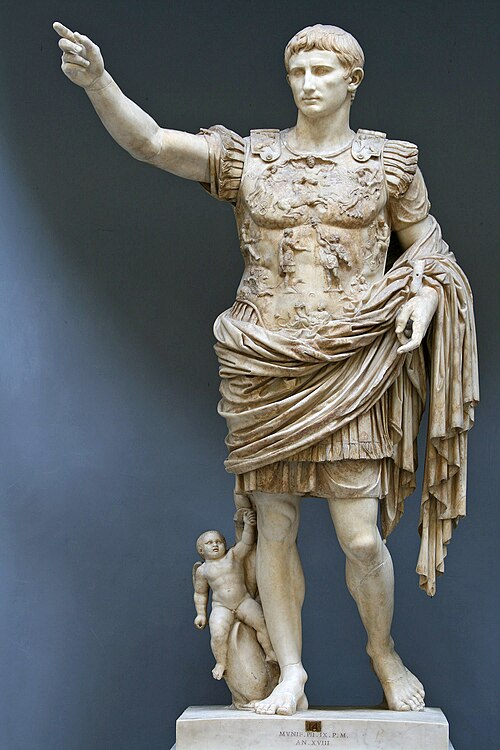
Augustus of Prima Porta
Currently in the Chiaramonti Museum of the Vatican Museums (image from Wikimedia Commons).
So as Octavian thought about his grand plans for renewing Rome, he naturally thought of Virgil. He didn’t need anyone like Horace telling everyone to give up. He needed positivity. He needed the guy who might even have been prophesying about him as Rome’s savior (Octavian was only 23 when Virgil wrote about Rome’s boy-rescuer).
Besides, Virgil’s prophecy had so far proved quite correct: the oft-heralded imminent demise of Rome hadn’t arrived yet. Maybe it never would. In fact, for the first time in over a century, things were looking up. And they were looking up because of what had happened in the previous year and a half.
The most important thing had been Octavian’s victory over the traitor Mark Antony at the Battle of Actium, September of 31 BC. (None other than Octavian’s best friend, Marcus Agrippa, had masterminded the victory as commander of the navy. Over the years of tumult and civil war since Caesar‘s assassination, Marcus had revealed himself to be as much of a natural military genius as Octavian was a political genius).
With his victory over Antony, Octavian had demolished the last of the traitorous military contingents threatening Rome. Less than a year later, Antony and his lover, Queen Cleopatra of Egypt, committed suicide in Alexandria. Suddenly, after decades of bloodshed, the civil war had come to an end.
Or so it seemed. Octavian was too smart to count on that. After all, in politics, an end is never really an end; a beginning is never really a beginning. Each is only a connecting point in time between what has come before, and what will now come to pass. Above everything else, politics is the art of shaping those moments.
It was at just this sort of moment Octavian now stood. Finding himself the undisputed great man of Roman politics, he now controlled (in reality, if not always in law) Rome’s senate, all its provinces, its vast military, its vast resources, its bureaucracy and administration, its appointments, and the immensely valuable, recently-acquired grain powerhouse of Egypt. He also held great influence over the city’s religious activity as part of the sixteen member College of Pontiffs. Moreover, after Actium and Antony’s suicide, no internal or external threat remained. Octavian had spent years making war. Now, with every last foe vanquished, he needed to make — and preserve — peace. The question was how.
A full description of Octavian’s comprehensive answer to that question is beyond our scope here. But what we can explore briefly is how he pushed cultural, spiritual, religious, and even psychological renewal — particularly through Virgil’s Aeneid — and how translation can best communicate that to us.
On that note, it’s worth pointing out that Octavian’s intention wasn’t quite to Make Rome Great Again. It was far more ambitious: he wished to make Rome much greater than anyone had ever imagined it could be, and much greater than any other nation had ever been, or ever would be again. For this to happen, Rome, in a real way, had to start over.
For Octavian, starting over meant laying the right foundation in the right way. What was that foundation? Devout reconnection to the gods. Everything, he believed, would flow from this: peace, identity, cohesion, stability, lawful behavior, ethical behavior, contentment, prosperity, flourishing, valor, self-discipline, excellence, and more. Octavian would do what he could in politics to initiate this renewal; Virgil would do what he could in literature. Together with others in their circle, they would remind people what it meant to be truly Roman, starting with the very first Romans of all. They would tell, and re-tell, in a hundred different ways, the story of who they were, who they weren’t, where they’d come from, and what the gods wanted.
I’ve added links to my Roman Glossary for some of the names and events mentioned in the article.
“Women who see in Clancy something not just sympathetic, but martyr-esque”
David Dennison clearly views-with-alarmhorror the phenomenon of women publicly demonstrating their support and claiming understanding for a woman who murdered her three children:
Pink-clad supporters of Lindsay Clancy
Photo from Aged Well
A disclaimer first: NOT ALL.
The Lindsay Clancy verdict could come as early as this week. If you have no idea what that sentence meant, honestly, just stop reading and go do something else. This case is not one you want in your head if it isn’t already. Trust me.
There really aren’t many things that are more distressing than what actually happened here. My complaining about other aspects of the Clancy saga is a bit like if somebody you loved died in a terrible car wreck and I said, “It’s a shame there was so much damage to the paint”. Still, that’s what I’m going to do.
The Lindsay Clancy trial has sparked an on and offline movement of women who see in Clancy something not just sympathetic, but martyr-esque. These women get her. They see themselves in her. They feel what they know she felt, and regard her as an avatar of the unsung stress of motherhood, and the woeful lack of attention paid to women’s struggles.
You may–especially if you are among the penis-havers – be asking yourself several things about now. Perhaps things like:
- The stress of motherhood is unsung?
- Women’s struggles receive insufficient attention?
- Other moms see themselves in a woman who shooed her husband out of the house so she could wrap exercise bands around the necks of her three children and slowly choke the life out of them one by one while they stared into the deranged eyes of the person who brought them into this world in the first place? Really? That’s relatable?
Yes to all three, apparently.
These women are organized too. They are showing up. Clancy has pleaded not guilty by reason of lack of criminal responsibility – or in layman’s terms, not guilty by reason of insanity. Clancy was suffering from severe postpartum psychosis, was on enough meds to stock a pharmacy, and was, per her own reports, hearing voices.
[…]
Wrong Side
What is wrong with these women defending Lindsay Clancy? I can understand a sincere belief that postpartum depression and psychosis aren’t taken seriously enough (I don’t actually think that’s true, but I can understand somebody thinking it is). But I actually cannot understand somebody looking at Clancy’s actions and thinking, “Same, girl.”
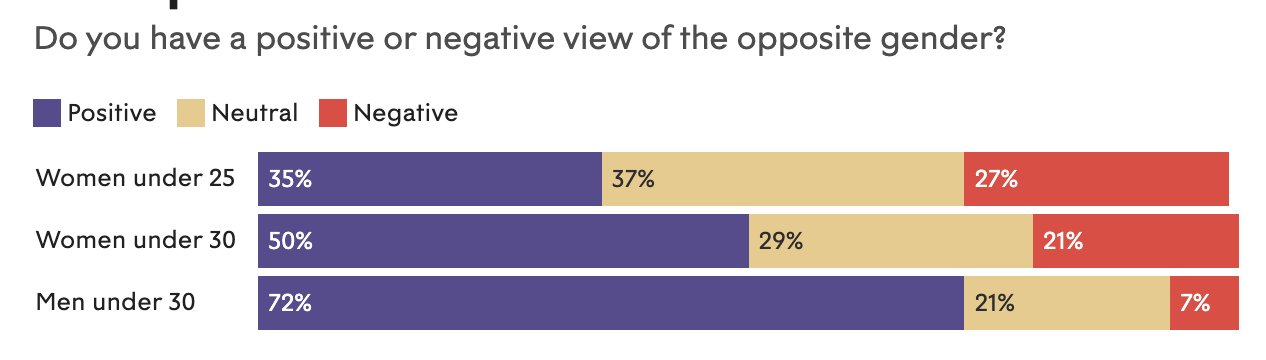
I’m not alone. We may be seeing the beginnings of a backlash to a backlash. The first backlash is the intense, unreturned dislike young women are experiencing these days for the coarser sex. A manifestation of that, I submit, is blaming the supposed inattentiveness of a man for his wife throttling his children to death.
Survey of British women done for The New Statesman.
This backlash though is one of men asking themselves, just as I did, what the fuck? Where is this tribalism coming from? What causes a person to look at Patrick Clancy, who returned home from a drug store after picking up his wife’s meds to find her sprawled on the yard, his three children strangled inside, and think, “I don’t like the look of him …?”
The Korean War Week 114 – Stalin’s Secret Plan – August 25, 1952
The Korean War by Indy Neidell
Published 25 Aug 2026Heavy rains prevent action in the field in Korea this week, so the big story worldwide is talks in Moscow between Josef Stalin and Chinese Foreign Minister Zhou Enlai. They talk about Five Year Defense Plans, artillery production, Soviet aid for the Chinese, and exactly how they see the war in Korea and what they think of the American forces.
00:00 Intro
01:09 Bunker Hill
01:51 South Korean Prisoners of War
02:44 Chinese Soviet Talks
05:06 Five Year Defense Plan
07:26 Artillery Production
11:23 Stalin and the USA …
12:52 Eisenhower and the War
16:05 Summary
16:18 Conclusion
18:29 Sign Up
Regulating away small company benefits in the EU
Cláudia Ascensão Nunes discusses yet another example of regulatory capture, as new European Union regulations will choke off business opportunities for small companies to the benefit of big companies and multinationals who can absorb the costs of the new environmental regulations:

Today, the European Commission estimates that the Single Market has increased the European Union’s GDP by 3–4% and created 3.6 million jobs since its creation. A study by Bertelsmann Stiftung estimated that integration increases European citizens’ incomes by an average of about €840 ($974) per person per year.
Yet the benefits created by this integration, and the freedom that made these benefits possible, began to come under threat on August 12, 2026, quietly and through an apparently harmless packaging regulation.
The Packaging and Packaging Waste Regulation (PPWR) will force sellers, both European and foreign, to comply with a complex set of rules that may be manageable for large brands but suffocating for small businesses.
The most problematic requirement is that sellers shipping packaged products to an EU country where they are not established must appoint a local authorized representative. That representative will act on behalf of the seller before that country’s recycling authorities. The representative must register the company in the national Extended Producer Responsibility, or EPR, system, file annual reports on the packaging the company places on that market, and charge a service fee of between €200 ($232) and €500 ($580).
The process of appointing a representative in one country is both bureaucratic and expensive. Doing so across several countries can become impractical for small sellers, who lack the scale to spread these fixed costs across a large volume of sales, especially since the PPWR does not provide a volume-based exemption.
Several businesses are already announcing the suspension of shipments to other EU countries or disabling shipping options to the EU altogether. The German company Copiaro, for example, suspended shipments to other EU member states while continuing to ship to European markets such as Switzerland, Norway, and the United Kingdom, which are outside the EU’s regulatory framework.
We are therefore returning to something resembling the old national markets, with barriers to entry.
The entire model of cross-border trade for small businesses risks being undermined in the name of environmental protection. Yet if larger companies, which produce far more packaging waste, are the ones best able to absorb these costs, we are facing a contradiction. Packaging regulations can shield large sellers from competition by smaller businesses, creating a more closed and concentrated market.
Europe may become greener by becoming poorer. European entrepreneurship is being strangled, and small business owners are paying the price.
Who Destroyed the Japanese Economy in WW2?
Real Time History
Published 20 Mar 2026As the war in the Pacific develops, the United States takes the fight to Japan itself – by crippling its economy, destroying its industry, and crushing civilian morale. To do this, American submarines and heavy bombers wage campaigns beneath the sea and above the clouds. And even 80 years later, there’s a fierce debate about which of these campaigns did more to bring Japan to its knees – perhaps even more than the atomic bombs.
(more…)
QotD: Putting US power generation in perspective
John Robson, “Tidbits”, Robson on Climate Nonsense, 2026-05-24.
August 25, 2026
The new missile gap – between manufacture and deployment
Edward Luttwak offers some suggestions to help explain why the vast and lavishly funded US Military-Industrial Complex seems incapable of manufacturing enough weapons to allow the US military to fight more than a brief demonstration war before running short of the things that go boom:

Royal Navy Tomahawk Land Attack Missile (TLAM) in flight.
MOD photo via Wikimedia Commons.
It is a strange thing indeed that among the countless stories about America’s shortage of long-range weapons — a truly crippling scarcity that now both limits President Trump’s strike options against the Islamic Republic, and might weaken responses to other looming threats — I have not found one that raises the most elementary question of all: why?
Why was Iran attacked with scarce and expensive BGM-109 Tomahawk Land Attack Missiles — costing around $3 million each — rather than ordinary gravity bombs dropped by fighter-bombers? Accuracy cannot be the answer: with so-called “JDAM” guidance kits, regular bombs become very accurate indeed, and they are still simple enough to be mass-produced cheaply.
Nevertheless, US forces had launched 850 Tomahawk missiles against Iran by 27 March this year, amounting to almost half the country’s global stockpile, though the Pentagon has since announced a huge $22.9 billion contract for more Tomahawks. Air-launched AGM-158 missiles, some of whose models can fly up to 1,000 miles, and which cost as much as $1.6 million apiece, were also used, along with Army’s Precision Strike Missiles are yet more expensive.
What makes these missiles so costly is their great virtue: they are all so-called “stand-off” weapons, which can safely be launched hundreds of miles from their targets. This means an attacker’s aircraft can remain outside enemy air space, where they could be exposed to detection by radars, and then to interception by air-defence fighters and surface-to-air missiles. There is simply no way of producing such missiles cheaply. They need powerful rocket propulsion and complicated electronic guidance to fly such vast distances and hit their targets successfully.
[…]
Nor, of course, are the implications here limited to Iran and the Gulf. Having needlessly used so many stand-off missiles to target Iran, US inventories are worryingly low in the event of the “Chinese contingency”: the invasion of Taiwan that Xi Jinping, unlike his predecessors, refuses to rule out. Any Chinese assault might start with subversion, with the activation of Chinese agents in Taiwan’s armed forces, but amphibious landings would have to follow — against which Tomahawk missiles would be the prime US weapon, alongside local anti-ship missiles.
But having examined all these technical details, we nonetheless arrive at something else entirely, a much more intractable problem than any munitions shortage could ever be: a fundamental change in the entire American attitude to war, which I described as “post-heroic” as far back as the Nineties when its first signs emerged.
This amounts to a truly drastic shift. What started with a proper striving to limit the casualties of war by every means possible — starting with prudent statecraft to avoid war in the first place, and extending to prudent tactics — has now devolved into the current predicament: whereby the US must spend billions on extremely elaborate stand-off missiles so as to further reduce risks to its pilots, which were already very low to begin with, against the vainglorious and incompetent Iranian enemy.
Of course, it’s always a possible explanation that the big defence contractors felt the need for another boost in their income, so it wouldn’t take much to persuade friends in the War Department or in the US Navy to toss a few more TLAMs at Iranian positions …
The Halftrack That Made Blitzkrieg Possible
World War Two
Published 23 Aug, 2026The tanks get the glory. But Blitzkrieg could not work on tanks alone.
The Sd.Kfz. 251 was designed to solve one of the fundamental problems of armored warfare: how do you keep infantry moving fast enough to fight alongside the Panzers? Germany’s answer was an armored half-track that helped turn infantry from a slow-moving follow-up force into an integral part of the Panzer division’s combined-arms assault.
In this German Rearmament special, we trace the Sd.Kfz. 251 from clandestine development under the restrictions of the Treaty of Versailles to its first production runs on the eve of World War Two. We examine its design, its role in the emerging doctrine of Bewegungskrieg, its deployment in Poland and France, and the extraordinary range of variants that turned it into one of the Wehrmacht’s most versatile vehicles.
But the 251 also exposes the limits behind the image of a fully mechanized German war machine. It was complicated and expensive to manufacture, there were never enough of them, and most German infantry continued to march or rely on horses and trucks. Even as production soared later in the war, Germany’s shortages of fuel, materials, manpower, and industrial capacity increasingly overwhelmed the advantages its engineers and tacticians had created.
The Sd.Kfz. 251 helped make the early German style of armored warfare possible. It also became another example of a sophisticated weapon system serving a war of aggression that Nazi Germany ultimately lacked the resources to sustain.
This is the story of the half-track that made Blitzkrieg possible.
Never Forget.
Rome’s annona civilis
In the late Roman Republic, the rapid increase among the urban poor in Rome itself eventually led to the Senate introducing food relief for the very poorest Roman citizens, the Annona civilis. It should be no surprise to anyone who’s been paying attention that giving away free stuff attracts people happy to accept free stuff:
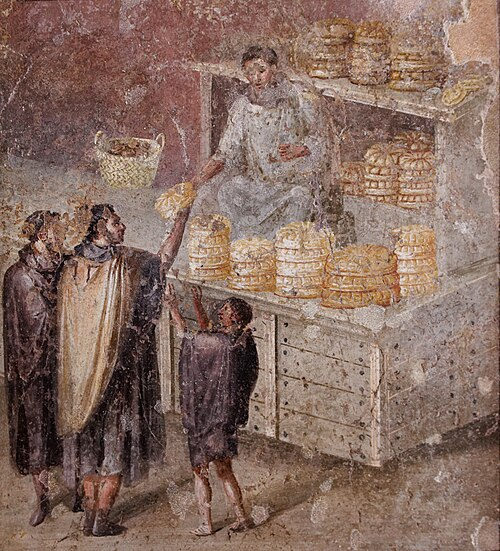
Rome handed out free grain to 40,000 citizens in 73 BC. By 46 BC, Julius Caesar found 320,000 people lining up for their monthly ration. That eight-fold expansion happened in under three decades, and it shows you how welfare states actually grow.
No Roman senator stood up and announced a plan to addict a third of the city to government bread. It happened incrementally, through political competition. Each magistrate who wanted votes expanded eligibility. Each expansion normalized the next one. The citizen who once considered the dole shameful eventually expected it, then demanded it, then organized politically to protect it.
This is the core mechanism free market thinkers have identified across every era: once you create a transfer program, you create a constituency for that program. Recipients vote. Administrators build careers. Grain merchants who supply the state develop a stake in keeping the contracts flowing. The political economy locks in.
Caesar, to his credit, actually cut the rolls back to 150,000 through verification audits. It was one of his more economically coherent moves, though the Senate still murdered him. His successors quietly let the numbers climb again.
What did the dole require? Massive grain imports from Sicily, Sardinia, and Egypt, organized through state logistics at state expense, funded by taxation and conquest. When the conquest revenue dried up, the obligation remained. Rome had written a check against future military success, and future military success eventually failed to arrive.
The lesson is not complicated. Distribute a benefit and you distribute dependency. Distribute dependency and you distribute political power to whoever controls the distribution. The grain dole didn’t weaken Rome overnight, but it made every subsequent reform politically impossible.
The simple-but-not-easy-fix is to only allow people not accepting the free stuff to vote. You can imagine just how well that would go down in an election campaign at any level, can’t you?


