
Forgotten Weapons
Published 8 Apr 2026Guatemala was one of the handful of countries to purchase original AR-10 rifles, made at Artillerie Inrichtingen (AI) in the Netherlands. The sale was made by Sam Cummings, legendary arms dealer. He spent much of 1957 and 1958 traveling through Central and South America demonstrating the new AR-10 to virtually every country’s military. In Guatemala, his demonstration resulted in an immediate order for 450 rifles to be delivered to the Escuela Politécnica (the military academy) for more extensive testing. The guns were delivered in late 1958, with serial numbers between approximately 3000 and 3500 (they were made immediately following production of the Sudanese contract batch). These Guatemalan rifles are distinctive for their ventilated bayonet shrouds, which were provided on no other rifles. While none of the Guatemalan rifles were fitted with bipods, a shortage of regular hand guards led AI to fit many of them with leftover Sudanese contract hand guards contoured for folding bipod legs.
The Guatemalan AR-10s were sold as surplus by the Escuela Politécnica to an American importer in 1985, and they were brought into the US as a mix of parts kits and pre-86 Dealer Samples. Today, most of the intact and unmodified Dutch-production AR-10s in the US (including this example) are from the Guatemalan contract.
(more…)
August 25, 2026
Battle Rifles in the Jungle: Guatemalan AR-10
QotD: “… and called it macaroni”
… this morning I was thinking about monasteries. Specifically, monasteries as the one place in the Middle Ages where you might could test my theories about Information Velocity and Caloric Surplus.
I don’t know whether you need much in the way of background, but since some of you seem to enjoy the “inside baseball” stuff … History, as an academic discipline, has always suffered from a “source base” problem. We deal with artifacts; more specifically with documents. If it ain’t written down … see what I mean? This is why whoever-it-was wasn’t wrong when he said that History is just the biographies of Great Men. It’s the biographies of the best-documented men, anyway. I’m exaggerating for effect, obviously, but you see what I mean.
So when, in the Seventies, we had the “cultural turn“, a whole new series of techniques had to be developed to expand the source base. Some of those were good and necessary. Others … well, Wiki quotes Frederic Jameson, one of the most prominent early-90s obfuscators (Indie band name?):
The very sphere of culture itself has expanded, becoming coterminous with market society in such a way that the cultural is no longer limited to its earlier, traditional or experimental forms, but it is consumed throughout daily life itself, in shopping, in professional activities, in the various often televisual forms of leisure, in production for the market and in the consumption of those market products, indeed in the most secret folds and corners of the quotidian. Social space is now completely saturated with the image of culture.
Translated from the PoMo, it’s your standard, tiresome stuff about “critique”. Culture just IS Capitalism, which IS Consumerism, blah blah blah, you know the drill. It’s tedious, but it’s not entirely wrong — what people “consume” (in the egghead sense, not the biomechanical sense) can give us important clues about their world. So long as you avoid the teleological temptation (didn’t they tour with EVC?) of attributing everything to “Capitalism”, you can do good work.
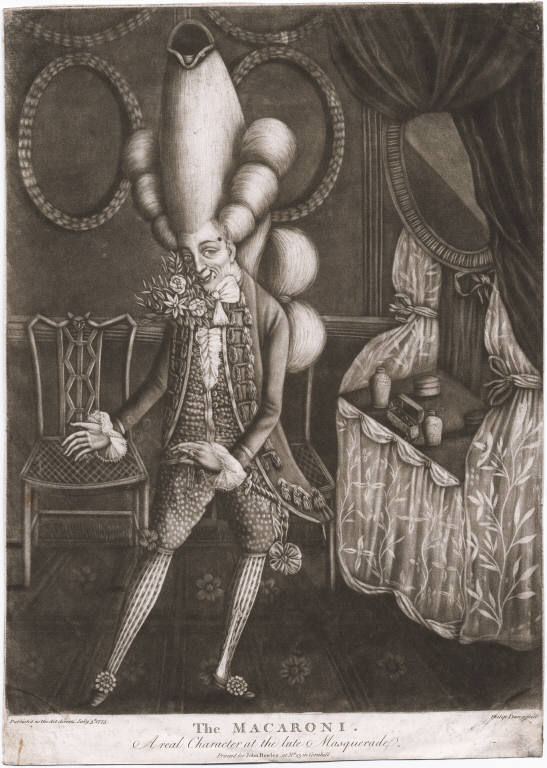
The “problem” with recent history is that the “centers of cultural production” do seem to be identifiable, and so are their motives. They are “Madison Avenue” and “to make money”, respectively, and so it’s easy — and profitable!! — to do the tiresome PoMo CultMarx thing. The further back into The Past you go, though … well, consider this:
As you can see from the caption, that style is called “macaroni” — like from the old song “Yankee Doodle,” which the Colonials appropriated in an early example of “owning the insult.” Wiki sez:
Stereotypically, men in the macaroni subculture dressed, spoke, and behaved in an unusually epicene and androgynous manner. The term “macaroni” pejoratively referred to a man who “exceeded the ordinary bounds of fashion” in terms of high-end clothing, fastidious eating, and gambling. He mixed Continental affectations with his British nature …
… The macaronis became seen in stereotyped terms in Britain, being seen as a symbol of inappropriate bourgeois excess, effeminacy, and possible homosexuality – which was then legally viewed as sodomy. At the time, homosexuality was frowned upon, and was even punishable by death. Many modern critics view the macaroni as representing a general change in 18th-century British society such as political change, class consciousness, new nationalisms, commodification, and consumer capitalism.
You see the typical “critical” blah blah blah there at the end, and it’s not wrong, just tedious, predictable, and tediously predictable. It’s also much harder to find a “purpose” for this behavior. It’s easy to do for the modern analogue of the macaroni, the hipster […] which Wiki documents extensively, because of course they do, it’s right there underneath “macaroni”. But the whole “culture industry” thing wasn’t there yet in the 18th century, so it might actually be down to an individual person. It’d be theoretically possible to find “the first macaroni” — it was the Marquis de Whatever, and he decided to dress like that because reasons, and all the best people decided to copy him, also because reasons, and that’s pretty much all your “cultural turn” can do, because that’s the only documentation we have.
Since we here are not bound by the canons of scholarship, however, we can speculate. I want to focus on this bit about macaronis:
In the 18th century, wealthy young British men traditionally took a trip around Europe upon their coming of age, known as the Grand Tour. Italy was a key destination of these tours. During their trip, many developed a taste for maccaroni, a type of pasta little known in Britain then, and so they were said to belong to the Macaroni Club, founded in 1764 by those returning from the Grand Tour. They would refer to anything that was fashionable or à la mode as “very maccaroni”.
That’s Information Velocity, preindustrial-style. They had to go there personally — or, at the very least, have access to the in-house journals of those who did:
The song “Yankee Doodle” from the time of the American Revolutionary War mentions a man who “stuck a feather in his hat and called it macaroni”. Dr. Richard Shuckburgh was a British surgeon and also the author of the song’s lyrics; the joke which he was making was that the Yankees were naive and unsophisticated enough to believe that a feather in the hat was a sufficient mark of a macaroni.
In America, only a select few persons would have access to that kind of thing, because only a few would move in those circles.
Go back a bit further, and cultural trends are far less traceable, but “centers of cultural production” are much easier to find, in one specific sense: They’re monasteries. And there you have a group which speaks a common language — extremely rare in the Middle Ages — is literate (ditto), and has something close to, if not caloric surplus, then at least “chronic caloric sufficiency”, I guess we’ll have to call it. Monks worked hard in the Middle Ages, by our standards, but not as hard as the peasantry. They were well-fed, or at least consistently fed, in a way the peasantry weren’t.
In other words, whatever Information Velocity existed in the Middle Ages, they had it. They made a virtue out of circulating books, and all those books were in a common tongue. Since they also produced books — indeed, were pretty much the only ones who did — they were also, by definition, au courant with whatever the high fashions were, because they illustrated the books that were such a crucial part of the aristocracy’s gift-giving culture.
Severian, “Monastic Vices”, Founding Questions, 2026-01-13.
August 24, 2026
It’s no wonder that people have lost trust in formerly prestigious institutions
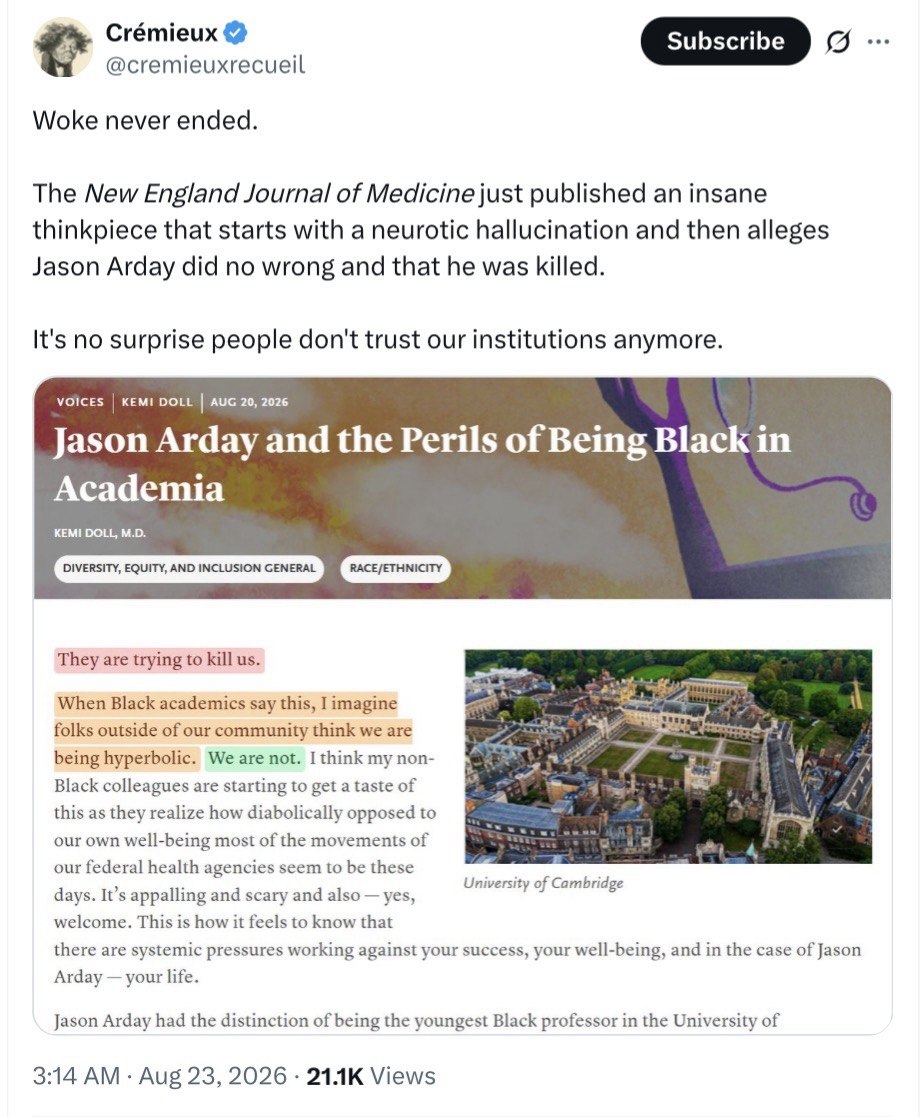
Lorenzo Warby on the two cases that are currently front-and-centre with the terminally online left, one a recently deceased academic grifter and another a confessed multiple murderer (of her own children):
We are currently observing attempts to turn the late Jason Arday — a fabulist who produced nothing of intellectual merit — and Lindsay Clancy, a woman who murdered her three children, into moral heroes. The former is allegedly a martyr for the cause of anti-racism and care for the neurodivergent/autistic, the latter for motherhood — or at least postpartum depression and psychosis. Both are construed as victims.
There is a real push to put the truly awful into Affluent White Female Urban Liberal. It’s almost as if there are some issues with feminisation. On the other hand, a woman being an open supporter of Lindsay Clancy is an excellent negative signal for men.
Just when you think progressivist purity spirals can’t get any worse, they do. Thus, we not only get the above hagiographical elevations of the grotesquely unworthy, we also see the physical mutilations of trans-surgery used to rehabilitate female genital mutilation.
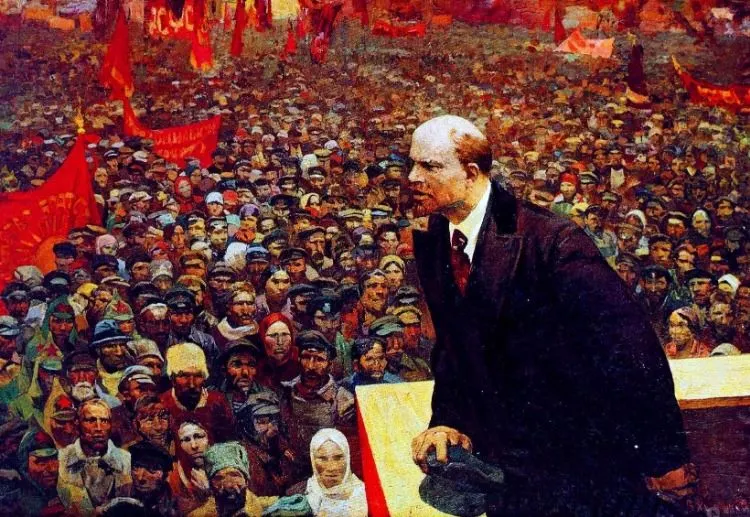
But, of course, any such surprise is having far too contemporary a focus. Left-progressivism has a long history of elevating some of history’s most appalling monsters, most tyrannical mass murderers — Lenin, Stalin, Mao — as heroes of world-history and human liberation.
The use and abuse of moral mascots
The worse a group or individual behaves, the more progressives like them. If a group is noted for high levels of violence or various social dysfunctions, left-progressives adopt them as moral mascots.
The concept of such mascots comes from economist Thomas Sowell. Mascots are people or individuals that “the Anointed” — those who see themselves as at forefront of human liberation — adopt to be extolled and defended. This is connected to Thomas Sowell’s analysis of Constrained and Unconstrained political visions.
The Constrained Vision says there are no complete solutions, there are just trade-offs, all the way down. Human nature is one of those constraints. Biologist E.O. Wilson‘s famous observation about Communism — great idea, wrong species — is a pithy expression of the Constrained Vision.
In the Constrained Vision, history is an enormous memory well where we learn about ourselves. This is because the humans who made history are just like us. Their experience, their triumphs and failures, even their mundanities, are lessons for us.
History is contingent, it has no particular direction. The Constrained Vision finds it easy to take people’s choices as having authority because there is no direction of historical travel to which they must conform.
The Unconstrained Vision denies that human nature is a constraint in that way, so it’s possible to create a society of transformative human liberation. History is not a source of lessons, but a record of failures to achieve that liberation — a record of corruption and sin.
Moreover, history has a proper direction — towards transformative human liberation or another, related telos. Hence, choices that support that direction are legitimate, those that go against it are not. The politics of the Unconstrained Vision turns elections into legitimating rituals: citizens’ votes are blocked from overturning any of the policies the Anointed have decided represent history’s proper direction.
The Anointed evince what writer Wesley Yang labels the non-electoral politics of institutional capture. If you want to see that in its most complete form among the Western democracies, PM Tony Blair’s debauching of Britain’s constitutional order through quangoes, human rights legislation that empowered judges over elected ministers, and devolving decision-making to the EU — thereby massively increasing the degree to which elections became legitimating rituals that change remarkably little — is the current gold standard case. However, all Western democracies face similar pressures, albeit to considerably differing degrees.
The commitment of The Anointed to this vision of human liberation gives them such a sense of trumping moral authority that they see themselves as owning morality. They have the right-to-decide what is moral and then to impose their decisions on everyone else.
“Communism is an ideology designed to liquidate nations”
I nearly skipped this post by Celina, as it started off appearing to be pretty much of interest only to Australians, but that was just the opening sections:
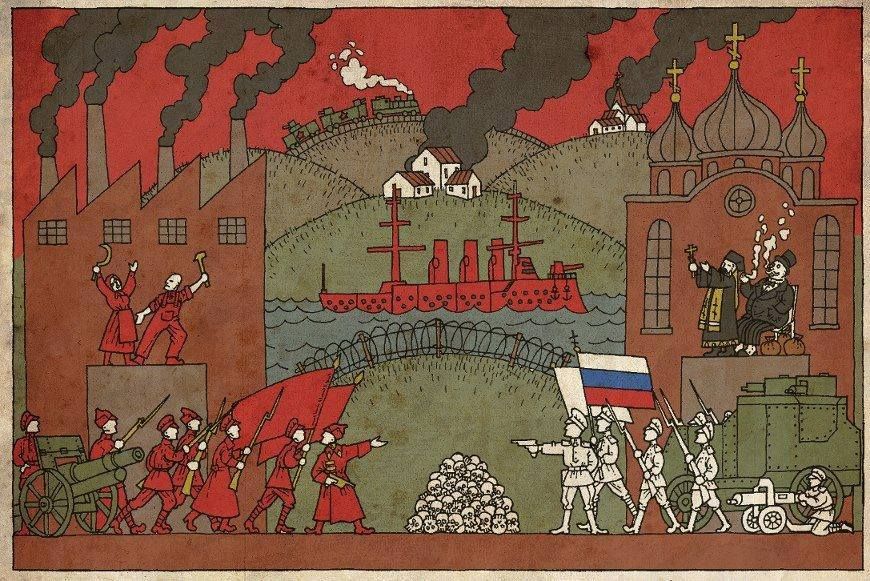
The Bolsheviks were the first governing power of the modern era to write the suppression of “national enmity” into a systematic criminal code. The RSFSR Criminal Code of 1922 penalised agitation and propaganda arousing national enmity or dissension, its successor, the 1926 Code, carried the provision forward as Article 59-7, under the chapter dealing with especially dangerous crimes against the order of administration, punishing “propaganda or agitation directed towards arousing national or religious enmity or discord”, with sharply escalated penalties, up to and including death, where the offence occurred in wartime or amid mass disturbances. From the earliest years of the Soviet state, in other words, speech about nationality was not a civil-society problem to be argued out, but a category of state crime sometimes punishable by death.
To understand why, it is necessary to understand something about communism that conservatives and libertarians have largely obscured. If you ask the average conservative what communism is, he will most likely start discussing government ownership, five-year plans, bread queues etc.
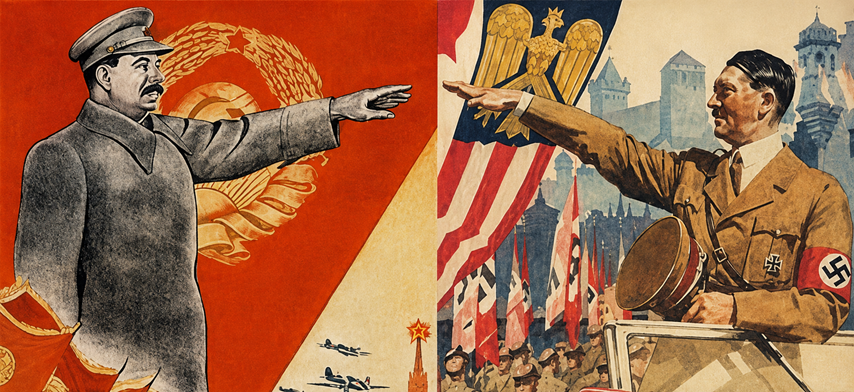
Communism, from this point of view, is essentially capitalism with the economic settings reversed. The government “does and owns everything“. This is why so much conservative analysis eventually degenerates into horseshoe theory: fascists liked government intervention and communists liked government intervention, therefore fascism and communism were basically versions of the same thing.
But that completely misses the ideological conflict which defined twentieth-century Europe. Communism was not just some economic theory about who should own what. It was an internationalist theory about who you are.
Communism is an ideology designed to liquidate nations. Literally.
Marxism insisted that the fundamental political division of mankind was class. The worker was not ultimately supposed to understand himself principally as English, German, Italian, French or Russian. He belonged to the proletariat. His historical interests were shared with workers beyond the borders of his own country, while his supposed national solidarity with his own bourgeoisie concealed the class relationship upon which capitalism depended. Hence the language that runs through the entire communist tradition: Workers of the world, unite; The proletariat has no fatherland; No war but class war. You’re not Italian, you’re not German, you’re the proletariat, and all you have to lose is your chains.
The political logic here is blatantly obvious. Nationality competes with class consciousness, patriotism competes with proletarian internationalism. The nation tells a German worker that he shares something profound with another German who happens to own a factory. Marxism tells him that this solidarity is false and his real political brother is the French, Russian or Italian worker standing on the other side of the border.
That is why the nation became one of the great obstacles confronting revolutionary socialism. The theory said workers possessed common international class interests. Yet, history repeatedly demonstrated that workers continued to behave like members of nations.
In 1914, the workers of Europe did not unite against their governments and refuse the coming war. They rallied overwhelmingly to their respective countries. Socialist parties fractured along national lines. Men who Marxists expected to understand themselves as an international proletariat marched into battle as Germans, Frenchmen, Russians, Austrians and Britons. And the same problem returned after the Bolshevik Revolution.
That is why the great twentieth-century conflict between communism and nationalism was not accidental. It was ideological. Communism was internationalist not in the banal sense that communists in different countries cooperated with one another, but in its conception of history itself. The nation was something history would ultimately transcend. Lenin said this openly: socialism aimed not simply to bring nations closer together, but eventually to “merge them“. Elsewhere he described the centralised state as a historical step towards the future “socialist unity of the whole world“.
Stalin, grasping this principle, forged civic nationalism as the indispensable stepping-stone toward that communist universalism. Inside the borders of the revolutionary state the old nationalities were to be liquidated into a single Soviet identity: you are not Ukrainian, you are not Russian, you are not Jewish, you are not Georgian, you are a Soviet patriot, loyal only to the revolution. That state, once purged of national loyalties, would then project its universalist ideology outward, seeking global hegemony by liquidating, in turn, every nation that still dared to resist it.
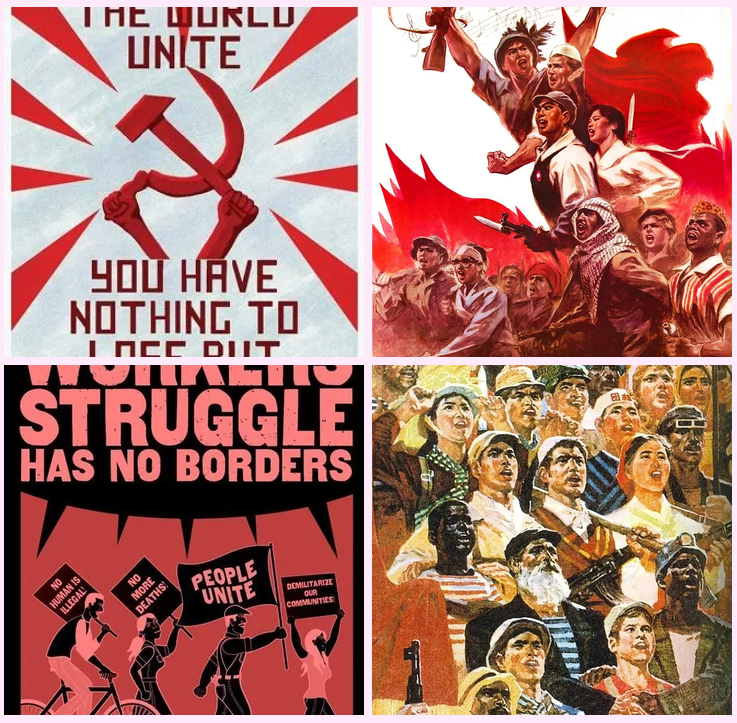
Update, 25 August: Welcome, Instapundit readers! Have a look around at some of my other posts you may find of interest. I send out a daily summary of posts here through my Substack – https://substack.com/@nicholasrusson that you can subscribe to if you’d like to be informed of new posts in the future.
Trade negotiations degrade into full-on trade war
As I mentioned the other day, I don’t believe Prime Minister Mark Carney ever intended to reach a trade agreement with the United States, because it was far better for his domestic political situation to have the US — and especially Donald Trump — as a focal point for retired Canadian boomers to trigger a two-minute hate. Every time the name Trump appeared in a state-sponsored newspaper or TV story, Carney’s popularity went up. After a decade of economic stasis and relative decline under Justin Trudeau, Carney’s more staid persona told the boomers that “the adults were back in charge”, yet Carney’s policies have been largely the same as Trudeau’s with a bit less hamming it up for the cameras.
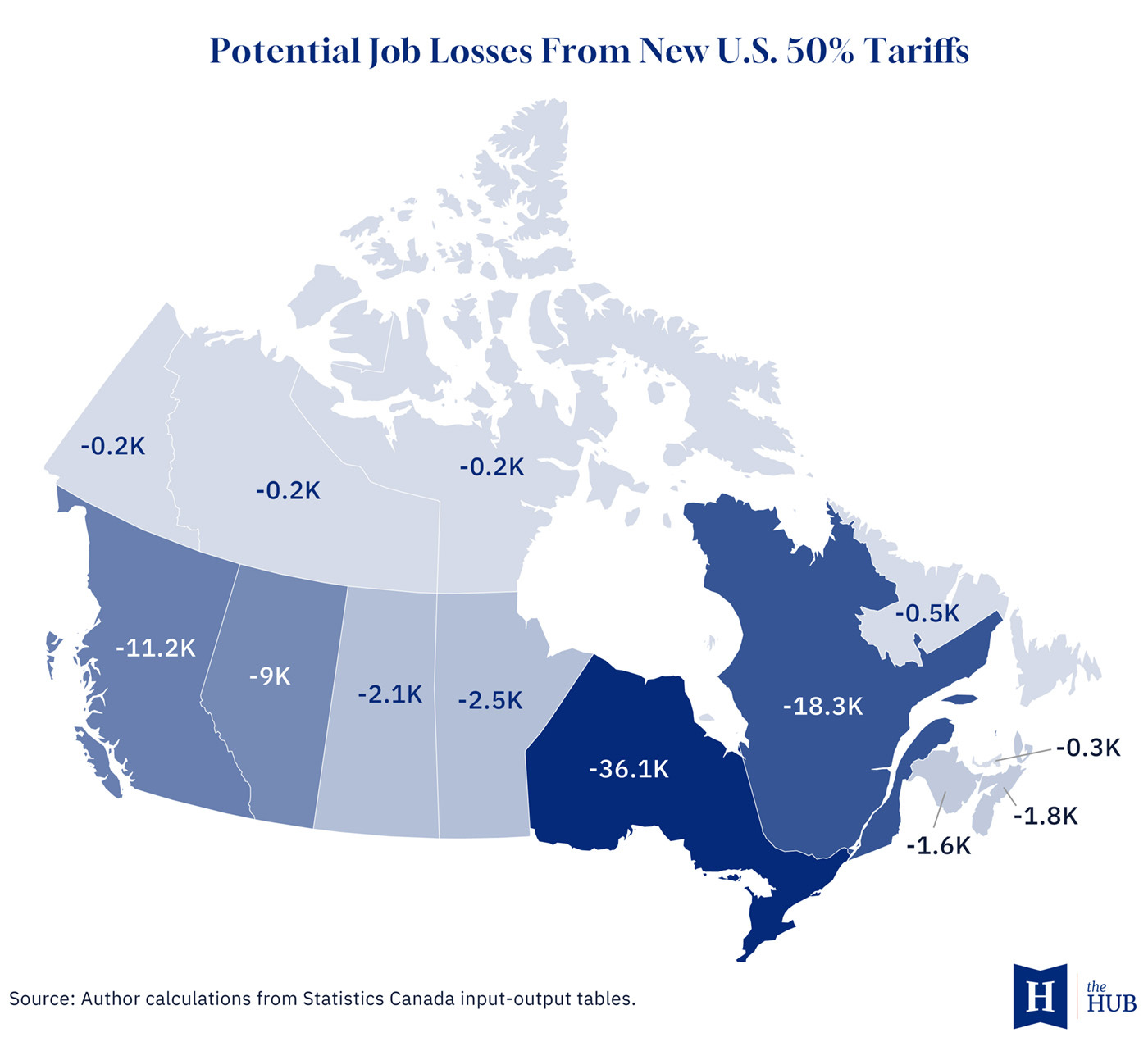
On his Substack, Brian Lilley considers the potential economic damage of the increased tariffs:
“You’re at war when you get attacked, we got attacked.”
That’s what Prime Minister Mark Carney said when he was asked why it sounded like was going to war after his Saturday morning speech.
Carney used references to war multiple times in his speech and during his Q & A with reporters.
“We’re stronger now than when the United States started this trade war. More unified, more determined, more ambitious,” he said in his speech.
Not sure that I believe that to be the case, though we could be if we take the right steps, something I was writing about in my latest column for the Sun.
Previously, I have questioned whether we should consider this a trade war between Canada and the United States. The Americans say they don’t see it that way, they see it a change in trade policy, an attempt to rebalance trade.
My thinking that perhaps the Americans were right was that calling it a trade war put us in the wrong mindset. Canadians were looking for a fight with the Americans, many still are and are happy that Carney walked away from this deal.
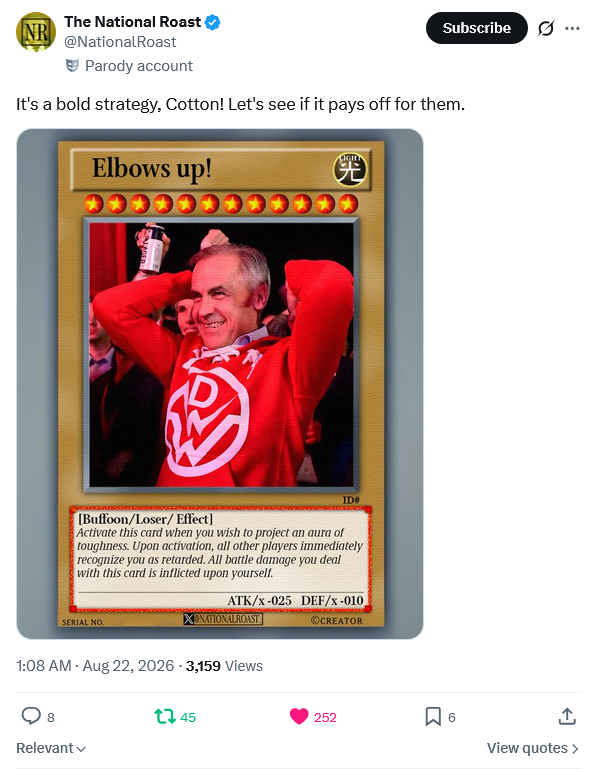
Of course, for the devoted “Elbows Up” crowd, no deal was always the best deal. They foolishly believe we can and should walk away from the United States.
After this latest round of tariffs though, I’m fine calling it a trade war.
Melanie in Saskatchewan calls it “the most convenient failed trade deal in Canada”:
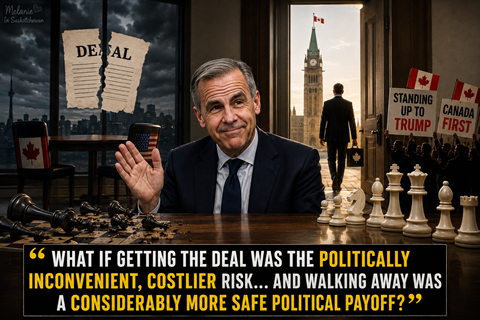
AI-generated image from Melanie in Saskatchewan
Imagine, if you will, a prime minister first installed and then elected, because Canadians believed he was uniquely equipped to deal with Donald Trump. Our hypothetical prime minister has impeccable credentials, international connections, central banking experience, serious suits, and the reassuring manner of a man who appears to know exactly which fork to use while the dining room burns down around him.
Most importantly, his political identity rests on one enormously useful proposition: Only he can handle Trump.
Now imagine the negotiations aren’t going particularly well. Not outright disastrous, at least not yet. Just difficult. Canada makes concessions. Ottawa drops the Digital Services Tax, removes most retaliatory tariffs, and American alcohol and supply management are on the table.
Still, negotiations continue, but then something changes.
On August 18, Trump postpones the new 50 per cent tariffs for three days after the two sides report “substantial progress”. By August 20, Canada’s trade minister says they’re “very close” to a deal. Reporting suggests the agreement under discussion could halve steel and aluminum tariffs and reduce tariffs on Canadian-built vehicles from 25 to 15 per cent.
And then … poof!
No deal. Do not pass go, consider this farce terminated.
The 50 per cent tariffs take effect. Carney suspends negotiations, the Canadian negotiators come home, and Ottawa announces retaliation. Washington says Canada backed away from commitments while Ottawa resolutely asserts Washington changed the terms at the last minute.
Well, that’s pretty fricking interesting, isn’t it?
So naturally our hypothetical prime minister takes to the airwaves and explains exactly what happened. Except he doesn’t, not with any actual clarity.
He speaks for more than twenty minutes, probably moistly, wandering from storms and changing climates to sovereignty and resilience, then through infrastructure, LNG, nuclear power, housing, defence, diversification and investment. By the time he finishes, we’ve practically navigated the entire federal government, several industries and the weather forecast.
Canada, we learn, is “master in our own home”. Well, isn’t that just terrific! What happened to the bloody trade deal?! Carney says the Americans introduced new terms that were “uneconomic” and “unfair”. They “asked too much and offered too little”. Who is going to draw the short straw and tell Carney those are adjectives and conclusions, and not terms?
Then comes a particularly curious bit. Carney says Washington also sought restrictions affecting Canada’s future trade relationships with other countries.
Other … countries.
But he never actually tells us which countries Washington was talking about, exactly what restrictions were being demanded, or which “certain sectors” he meant when he admitted the Americans wanted Canada to coordinate tariffs against other countries. Stranger still, Carney conceded that Canada could actually see merit in some of it as part of the right deal.
So which countries? Which sectors? And which parts of this supposedly unacceptable assault on Canadian sovereignty did you actually find reasonable? Suddenly the man who just spent twenty minutes talking develops an acute shortage of proper nouns.
The Ancient Greeks 04 – The Persian Invasion 4 – The Fall of Athens
seangabb
Published 26 Mar 2026Greece: A Brief History, c.700 BC – 500 AD
What happens when resistance fails?
In this lecture, we examine the dramatic collapse of Greek resistance after Thermopylae and the advance of the Persian army into central Greece. With the Spartan force destroyed, the road to Athens lay open.
We explore:
– The consequences of Thermopylae
– The evacuation of Athens under Themistocles
– The Persian capture and destruction of the city
– The psychological and strategic impact on the Greek world
– Why, at this moment, Persian victory seemed inevitableThis is the darkest point of the war for the Greeks — a moment when everything appears lost, and yet the story is far from over.
QotD: The difference between “book smart” and “street smart”
Joca @jocadbz
Translated from Portuguese
How many geniuses have you heard about in recent years? They all had very superior IQs and were supposedly going to change the world
Know what happened? Nothing. Nothing ever happensWe hear a lot of people go on about the difference between “book smart” and “street smart”.
But psychologists who test and study intelligence know there’s no such thing. Smart is smart. So is this all just a way of coping with envy of higher IQs?
No. We’ve all met that guy who is clearly very intelligent, but can’t seem to accomplish anything outside a cloistered academic environment.
But we always seem to find him in a academic environment, don’t we?
“Book smart” is an incorrect name for a person who is intelligent, but has been mentally and psychologically harmed by an educational system, to the point where he can’t actually use that intelligence properly for tasks outside that environment.
Ironically, the more a child is obviously intelligent, the more the education system conspires to destroy him … because everyone with a “degree in education”, almost without exception, is either actually stupid, or is himself the end product of this same sort of mental mutilation.
Here’s how it works.
There are two types of intelligence tasks: answer tasks and result tasks.
A result task is graded by the reaction of the environment to your work. Either your software runs, or it doesn’t. Either your rockets fly, or they don’t. Customers buy millions of your product, or none.
You have unlimited tries unless you run out of money, but there’s no partial credit, and you can’t talk the universe into accepting your answer if it doesn’t.
Result tasks typically require a lot of work, are data-intensive, and have lots of sub-problems, because the ones that didn’t are already solved.
Result tasks are why we care about smart at all. Because smart people are the ones who can do this. And every human advancement or achievement ever was a result task.
Answer tasks are quite different. They are artificial problems created by a human being for another human being, whose goal is to produce the known answer.
Tasks like this have useful features. They can be tightly calibrated for appropriate difficulty. They are easy to grade. They can be used to teach particular subjects or skills.
But there are certain things they don’t teach.
How to do the boring parts that don’t impress anyone with how talented you are.
How to fail and try again.
How to change the question instead of answering it, because the question itself was wrong.
How to absorb from others what they had to learn the hard way, instead of reinventing the wheel.
How to deal with problems that have no solutions, only tradeoffs.
How to work with others and pass the ball.
How not to adapt instead of freezing when the universe gives the exam before the lesson.
How to substitute the adequate you can afford for the ideal you can’t.
How to prioritize what is needful over what is elegant or cool.
Without this learning, and other similar lessons, the talent child turns into an adult with an unbalanced intellectual development, like a bodybuilder who skipped far too many leg days.
You’ll find a lot of men like this in academia because it provides them with a sheltered, tightly controlled environment, where the problems are abstract if not utterly fake, and the persuasiveness of a solution trumps its workability.
They tend to scorn achievers, especially achievers with modest academic credentials or none, and this invites scorn in turn from people with real jobs.
But really what they are is victims. Entire campuses and networks full of what was potential greatness, crippled in it youth by bureaucracies that claim to serve it.
Homeschool your children.
Give them projects, not puzzles.
Teach them to build things.
Devon Eriksen, the social media site formerly known as Twitter, 2026-05-05.
August 23, 2026
Julius Caesar’s will
At SteynOnline, Tal Bachman continues his study on “The Art of Translation”, this time touching on the unlikely and unlooked-for rise of Caesar’s grand-nephew and eventual successor Octavian — better known to history as Caesar Augustus, the founder of the Principate:
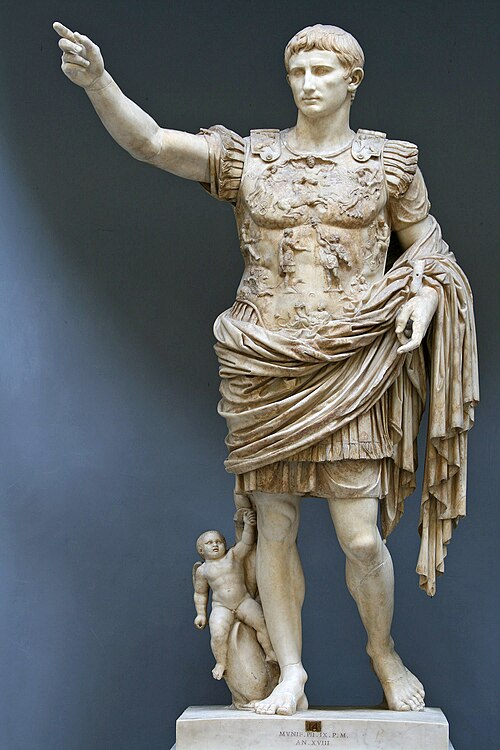
Augustus of Prima Porta
Currently in the Chiaramonti Museum of the Vatican Museums (image from Wikimedia Commons).
You’d think someone who’d just won as much power as the 32 year old Octavian would appreciate a best-selling epic poem in praise of himself. Only fourteen years earlier, in 44 BC, the then-obscure teenager still expected to live a quiet life in his hometown of Velitrae. True, he did have family connections to the political big leagues 25 miles up the road in Rome; but as things stood, a lower-key path looked a lot more likely for the frail, bookish student.
Alas, a quiet life was not to be. On Tuesday, March 15, his great-uncle, Julius Caesar — ruler of Rome — had just seated himself in the senate meeting hall when dozens of senators stabbed him to death. In the assassins’ minds, they’d done something noble: they’d protected the republic — the Roman people — from a future tyrant-king. Surely, they thought, ordinary Romans would now rise up and hail them as republican heroes.
Ordinary Romans, it turned out, thought much more highly of their favorite war-hero than the treacherous senators who’d killed him. Whatever his flaws, Caesar had at least imposed some long-overdue order on Roman life. Now that he was gone, the terrible troubles of former times would return, and probably in a form far worse than before. Shock, anger, despair, and fear filled the city.
It didn’t help that as the hours bled into the next day, it became clear the senator-assassins had no plan for what to do next. They’d eliminated the energetic, enterprising man who’d led Rome the previous five years, but the senate itself was deeply fractured, with a number of the assassins now second-guessing what they’d done. The senate wasn’t stepping up. No one was. As a result, in that moment, the city and empire had no functioning government.
Sensing the possibility of violent conflict, Caesar’s colleague Lepidus quickly ordered troops into the city to keep things stable. It worked. But a possible trigger appeared the next day in the form of Caesar’s father-in-law, Lucius Piso, who stepped forward as the custodian of Caesar’s will and informed the senate he was ready to settle Caesar’s affairs as duty demanded. The senate panicked. Not knowing what the will contained, the now-rattled group begged Piso to keep it confidential for fear its contents would provoke riots. Piso refused: Caesar was a public official, and the public deserved to know, come what may. He demanded a day be set for revealing the will.
Surveying the precarious situation, Caesar’s right-hand man, Mark Antony, called a senate meeting to figure out what to do next. In that Friday meeting, the senate and Antony agreed to let the assassins escape punishment, while still enforcing all of Caesar’s policies. This compromise, they hoped, would appease both the pro- and anti-Caesar factions, and keep Rome from convulsing in violence.
This, and much more, all happened within three days of the assassination. But what happened on the fourth day — Saturday, March 19 — would prove just about as shocking as anything else: it was on that day that Lucius Piso appeared before the senate to open up, and read aloud, the will left by his murdered son-in-law.
To put that moment in perspective, I note that by the time of his death at age 55, Julius Caesar was one of the richest men on earth. Moreover, he had no legal descendants: his daughter, Julia, had passed away at the age of 22 during childbirth, along with her child. The Egyptian queen Cleopatra claimed Caesar had fathered her son, but Caesar never felt certain the child was his, and never acknowledged him under Roman law.
In addition to all this, Caesar commanded the loyalty of tens of thousands of Roman soldiers, active and retired, along with the admiration of tens of millions of residents and citizens around the Mediterranean. Among these were many of Rome’s most influential movers and shakers.
In short, Caesar had a lot to bequeath. (This was especially true in a world in which the lifelong loyalty of others easily transferred from a deceased person to his named heir.) Surely, in the senate meeting hall that Saturday sat a number of figures who expected to receive extraordinary gifts from the man they’d served—Mark Antony in particular. Antony, after all, had fought with Caesar for years, worked side by side with him in government, and been his closest confidante and colleague.
So you can imagine the humiliation, shock, and indignation around the room as the bereaved father-in-law Lucius Piso stood reading a will which named not Antony, not Lepidus, not any of Caesar’s other comrades, but Caesar’s eighteen-year-old grand-nephew, Octavian, as his adopted legal son and heir to nearly everything he had. Octavian—whose biological father had died when he was five—would receive Caesar’s name, most of his incalculable fortune, his lands, the benefit of his status and loyalties, and the automatic approval of all those who trusted the judgment of the great-uncle who’d adopted him.
By all accounts, Octavian had no idea about any of this. Yes, he’d spent some time with his great-uncle, even visiting him during his Spanish military campaign the year before. But Caesar had kept his will entirely secret.
When Octavian — away studying in Apollonia, in present-day Albania — heard about the assassination and will a couple of weeks later, he found himself facing The Mother of All Crossroads. He could either travel to the now violent, dangerous, nearly-anarchic Rome, risking his own assassination in demanding all Caesar had left him (and accepting all the attendant obligations), or he could decline and pursue the safe, quiet life he’d always imagined for himself.
It is indeed a great curse to get everything you wished for
I have no idea how authentic these are, but even if they were dreamed up in the 1940s by a chain-smoking ad guy trying to sell pre-printed matchbooks to Chinese restaurants, they have a distinct ring of truth to them:
- May you live in interesting times
- May you be recognized by powerful people
- May you get what you wish for
John C. Wright suggests that the third curse adequately explains why womens’ organizations are always so angry:
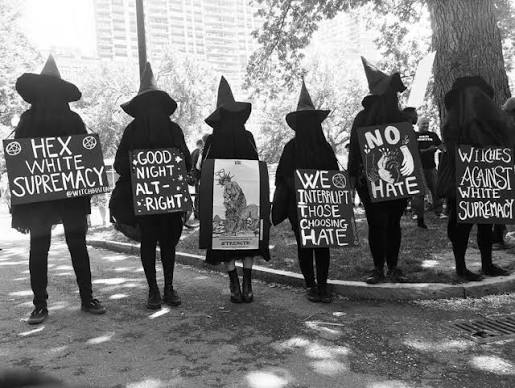
Photo from John C. Wright
Here is a comment from Twitter from a writer with the persican but cutting name of Peachy Keenan:
Why are so many women sooo angry? They won. They got everything they wanted.
Men have never been doing this badly, and women have never been doing this well.
They make more, they have the majority of jobs, they are the majority of college graduates, (UCLA undergrad is 60% female), they make more money, have much lower rates of suicide, addiction, and alcoholism, and live longer.
They won: they took over all men-only spaces, they took over the Boy Scouts, they ended men’s bathrooms, they can fly fighter planes and be in combat.
Marriage is optional, divorce is no-fault, they win 99% of the custody battles, they can control fertility at will, and they can’t get drafted. We are all living in the female future they promised.
So many women are so angry precisely because they won.
Women are naturally submissive and self sacrificial, loving and supportive. Feminine.
The lone wolf quality of being one’s own man is lonely, self supportive, selfish and domineering. Masculine.
But the sole reward for being a lone wolf, a pioneer, a masterless man, is the promise that one day, after proving yourself, you will win the love of wife and child, and she will turn your cave or hut into a home. The reward of being an independent man, a lonely man, a rebel who plays by his own rules, is finding a wife who will love, honor, and obey.
Woman obviously cannot have that reward. Women are attracted to rebels, bad boys, wolves, winners. They do not want to be them.
Women do not want to win wives.
Woman naturally want to turn huts into homes, and make their man happy. They do not want to live in the hut, run in the rat race, fight in the war.
Women do not want to crush their enemies and drive their enemies before them and hear the lamentation of their women. That is Conan.
Women, by and large, far prefer character assassination, whisper campaigns, false friendships, as the means to undermine enemies: alive but humiliated, and forced to recant and apologize.
A womanly way to win a debate is not through facts and logic, obeying the rules of debate. That is the behavior of a sportsman, a knight in a joust. A womanly way to win a debate is by humiliating the opponent into silence, by threat, by backstabbing. Cancel culture is the perfect tool for the feminine approach.
Women as well as men would rather live in a world run by men. Men aspire to run a world with rules, with honor, with chivalry, where confrontations are direct, juries rule on evidence rather than feelings or group-loyalty, innocence is rewarded and virtue punished. Women, and womanly men, aspire to run a world as a welfare state, a nanny state, where good intentions matter more than good results, and you never get a change to confront the accuser nor answer the whispered accusations. No arguments, no debate, no discussion is allowed, because that would produce conflict, disharmony, and someone might get his feelings hurt.
We have seen in countless cases how a feminized world works: if a mother strangles her children to death, the female world defends her. If a notorious academic fraud is awarded a position far beyond his competence to serve, and commits suicide rather than face the shame of exposure, the female world defends him. Cowardly assassins shooting bankers or public speakers, third-world rape gangs, cross-dressers in woman’s sports or prisons, Mohammedan child-molesters, spotted owls, endangered whales, or anything or anyone who is or who can be shoehorned into being a victim, a sad sack, a crybaby … the female world leads the otherwise healthy and normal maternal instinct to comfort crying babies into comforting any and every monster and madness imaginable, and female fear of social disapproval does not allow her, even in her own mind, to question her master.
The End of the Battleship Era – Force Z
TimeGhost Cartographic and World War Two
Published 22 Aug 2026In December 1941, Britain is fighting a global war on multiple fronts when Japan enters the conflict in Southeast Asia. At the centre of Britain’s strategy is Singapore, and the arrival of two powerful warships is meant to demonstrate that the Royal Navy can still project its power across the region.
HMS Prince of Wales and HMS Repulse, accompanied by a small destroyer force, form Force Z and sail into increasingly dangerous waters. But without the aircraft carrier originally intended to accompany them, the squadron is operating under a serious disadvantage.
As Japanese forces begin their invasion of Malaya, Force Z sets out to disrupt the landings. What follows becomes one of the most dramatic naval actions of the early Pacific War, as British battleships find themselves facing a threat they were never designed to fight alone.
Trade deal? What trade deal? Best we can do is more tariffs
My sense has always been that the Carney government didn’t really want to get a deal done with Trump, because it was far more politically useful to keep the eLbOzOs all angry and posturing than to negotiate in good faith. Canada’s premiers, taken as a group, have been a never-ending stream of clown car antics, political gamesmanship, and schoolyard baiting. Yes, Trump is infuriating, inconsistent, obnoxious, and even more performative than Justin Trudeau but he’s the current American president and we needed to send sensible politicians and diplomats to work with him.
The presstitutes in the Canadian relic media have been eagerly fanning the flames of Trump Derangement Syndrome across the country, so when the latest episode of The Line podcast popped up yesterday, I had to provide a helpful edit to their episode title:
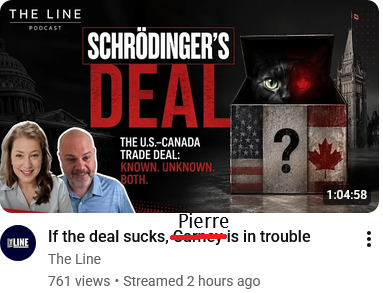
They’re going to do everything they can to deflect blame from their beloved paymaster, Dear Leader, and point accusingly at Pierre Emmanuel Goldstein and his band of anti-Canadian wreckers and looters in the Conservative party.
On the social media site formerly known as Twitter, @jaycurrie discussed this when the news broke of the breakdown in talks:
The last minute collapse of trade negotiations between Canada and the US demonstrates a fecklessness on the Canadian side which is astonishing. The walking resume — in the very good suits — could not get’er done.
Apparently those damn Yankees had unacceptable last minute changes. No shit. You are dealing with serious negotiators who will squeeze hard. It is said of Trump that he regarded signed contracts as the beginning of the negotiation.
Brutal, unscrupulous, nasty. Orange man very, very, bad. But you play the hand you’re dealt. Had Canada sent serious negotiators a year ago rather than posturing and dumbly sticking the official elbows in the air, we’d have a deal.
Or, had we had negotiators who did not take Dudley Doright as a model, we would have signed a “bad deal” and gone right back to the table to get a better deal. I’d love to know what the show stopper American last minute “demands” were.
Trade is a constant series of negotiations. A deal in place would have avoided the BS 50% tariffs and set the stage for the next deal. This collapse just puts us in a deep hole smarter people will have to climb out of.
“That’s my final offer” is a tactic. Is it an offer you like? No. Is it an offer you can live with? Probably. Again, the devil is in the details. But unless the offer required Canada to cede territory (which Eby is already more than willing to do) it was workable.
“A bad deal is worse than no deal at all” when there are 50% tariffs looming as a consequence of “no deal” is a very dumb position to take. Brace for “defense of Canadian Sovereignty” in a matter of minutes.
These trade talks have been bungled from the beginning simply because a combination of the political advantages of TDS and an inflated view of Canada’s relative bargaining strength created a reality free bubble.
The sheer arrogance and vile political opportunism of the Carney Liberals has been on full display for a year. Trump and his people called BS. Carney was euchred. Canada is, frankly, boned.
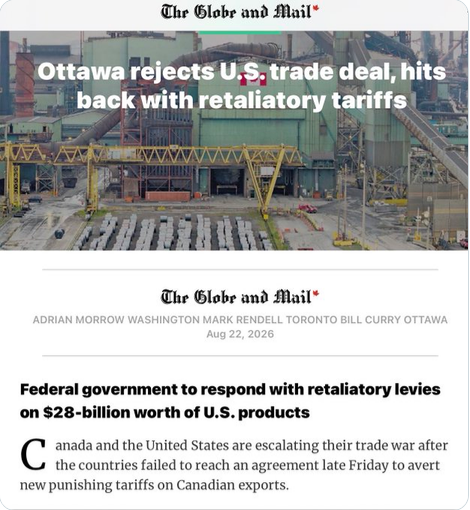
New 50-per-cent levies will hit around $28-billion worth of Canadian goods, which is roughly 5 per cent of Canada’s exports to the United States.
Carney has said it will respond with retaliatory tariffs on $28-billion worth of U.S. products.
Escalation is a very bad idea! Tariff retaliation has just triggered an escalatory trade war we cannot win. The U.S. economy is 10 times larger than ours.
A study released last week by the Canadian American Business Council concluded that the end of USMCA would have a surprisingly small impact on the Canadian economy.
It estimates that, even with high and long-lasting tariffs, Canada’s economy would only be about 1.6 per cent smaller in 2035 than if the USMCA were renewed and respected, and tariffs fell to near zero.
We are further damaging our economy with these “dollar-for-dollar” counter-tariffs.
Retaliatory tariffs are NOT a weapon. They are a tax on Canadians.
Who do you think absorbs that cost?
Canadian consumers, businesses, and workers.Let’s be brutally honest: the Canadian government is worsening the situation. Canadian families will pay the price at the checkout counter.
The National Roast gets it:
Why This “Foreign” Commonwealth Truck Was Built In 800,000 Units And Supplied Every Front
BritishWarLegends and BritishWarArmory
Published 31 Mar 2026The Canadian Military Pattern truck was built by two rival factories in Ontario for a nation of eleven million people. It ended up supplying the British Eighth Army across North Africa, Italy, Normandy, and Burma — and Canada built more of them than Germany, Italy, and Japan built trucks combined.
Almost nobody knows it existed.
When Rommel captured two thousand of them at Tobruk in 1942, he didn’t scrap them. The Afrika Korps pressed them straight into active German service. An enemy with his own purpose-built military trucks chose to keep using captured Canadian vehicles instead.
The full forgotten story.
Update: I generally try to avoid watching or re-posting clearly AI-generated slop, but this was the first video I’d encountered discussing the hundreds of thousands of CMP trucks that Canada built during WW2. At some point between me scheduling the video and today, the channel has been banned. You’ve undoubtedly seen CMP vehicles in WW2 stills or movie footage, as they’re pretty distinctive – https://en.wikipedia.org/wiki/Canadian_Military_Pattern_truck
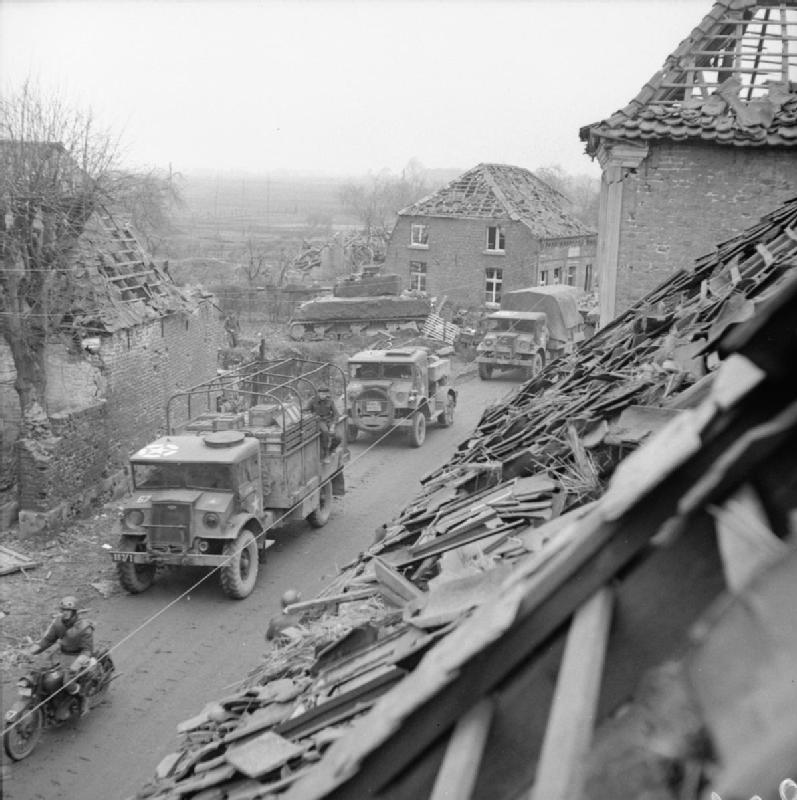
From The British Army in North-west Europe 1944-45,
CMP lorries passing through Uedem, 2 March 1945.
Photo by Carpenter (Sgt), No 5 Army Film & Photographic Unit, Photograph B 14966 from the Imperial War Museums via Wikimedia Commons.
QotD: “I found a million dollar baby in a five and ten cent store”
I once asked a friend in the French music biz how the song went over there. I hummed him the tune and he sang me the French lyrics and, although I can’t recall any of them, I remember they were entirely different from the English words. It’s not just the five-and-ten that’s hard to translate or the million dollar baby. But the concept of finding the latter inside the former is also very American. There are a ton of Mitteleuropean operettas in which the prince or duke or count wanders into the streets in disguise and falls in love with a serving wench, but the serving wench usually turns out to be a Countess or Margravine or some such also wandering around in disguise. Even the British are prone to this syndrome (Spring In Park Lane, etc). But in an American song the shop girl is a genuine shop girl, and she’s still a million dollar baby. That’s what makes it American.
In the Sixties, by the way, you could have found a future billion dollar baby in a five and ten cent store: Sam Walton, founder of Wal-Mart, got his start in retail as a franchisee at a Ben Franklin’s, founded in 1920 by the Butler brothers, who’d been in the five-and-dime business since the 1870s. I’m not saying “I Found a Million Dollar Greeter in the Big Box Store at the Strip Mall on the Edge of Town” would be as big a hit, but there is an historical continuity from the Butlers to Wal-Mart.
Mark Steyn, “I Found a Million Dollar Baby (in a Five and Ten Cent Store)”, Steyn Online, 2020-10-25.
August 22, 2026
“No pleasure is worth giving up for the sake of two more years in a geriatric home in Weston-Super-Mare”
On his Substack, Christopher Gage discusses how to shorten your life (but not for the usual reasons):

St George’s Nursing Home in Weston-Super-Mare. I’m sure the staff are fine, but this reminds me strongly of the hospice my grandmother ended her days in.
My Dharma or reason for being is devilishly simple: to maximise pleasure and to shuffle off this mortal coil before the nursing home beckons.
Fatally, at least for those with a yen for acronyms and self-hatred, my ultimate goal corrupts their hallowed SMART strictures. It is not quite specific. It is measurable. It is attainable. It is relevant. It is not time-based. I’m not resolved to stubbing out the fags, abandoning the booze, or chasing around Soho the doomed affections of neurotic artists. I refuse to wake at 5 a.m., invest in crypto, or bore my tastebuds with rainbow carrots.
I’ll take my cue from the great novelist, ardent womaniser, and prodigious piss artist, Kingsley Amis: “No pleasure is worth giving up for the sake of two more years in a geriatric home in Weston-Super-Mare”.
In an age which toggles between grind-culture puritanism and brain-rot hedonism, we must chart a more amenable path. So, the pursuit of pleasure, it is. I resolve to pursue pleasure deliberately, intelligently, doggedly, ethically and without apology — not to escape but to evolve.
Pleasure gets a bad name. What, with all our competing isms and illities. Those journeys of immiseration and self-loathing. One cannot move for ice baths and magnesium supplements and alcohol-free and protein-rich and wellness retreats and fucking motivational podcasts. Antisocial tech billionaires inject the blood of teenagers in a demented bid to live forever. It is a new secular puritanism. These longevity bros trade the profound depth of life for its mere length. They are terrified of death, yet terrified to actually live. It must stop.
For myself, I’m not at all eager to die, but I don’t view the mechanical prolongation of life as a worthwhile end in itself. Living a bit longer, but at the cost of giving up some or all of the things that make life worth living seems a particularly bad bargain. I’ve never smoked, so that quick’n’easy “stay healthy” recommendation doesn’t apply, but I enjoy drinking wine and beer. Not to excess, as I don’t enjoy being drunk, but as a social relaxant, a pleasure in its own right, something to look forward to at the end of a long day. Matching the right wine to the food on your plate is a worthwhile skill to develop, as it increases two pleasurable things at the same time.


