
Drachinifel
Published 22 Apr 2026Today we look at some of the worst thought out naval strategies and plans of all time, as selected by me.
00:00 – Intro
00:34 – Selection Criteria
02:17 – The 1914 Dardanelles Bombardment
11:38 – Britain’s post-WW2 Carrier Plan
29:01 – Germany’s High Seas Fleet Build-Up
38:43 – French attempts to invade Ireland
44:16 – The US “we don’t need a navy” plan
August 31, 2026
Terrible Naval Plans – Five of the worst ideas of naval history
Comments Off on Terrible Naval Plans – Five of the worst ideas of naval history
QotD: India, “coasting on inertia”?
There are lots of examples of “nations” that don’t have any real reason to exist as coherent political entities. All of Africa, for instance, but also India, and they’re a pretty good test case for how far coasting on inertia can take you. I didn’t get into any trouble when I was there – I’m the law-abiding sort, and besides, I was a guest in their country — but I knew that, should trouble find me, the first thing I was going to do was hand Officer Friendly-ji my passport … in which he would find two nice crisp Tubmans. And if that didn’t solve the problem, I’d invite him to come down to the ATM with me and figure it out from there.
Moreover, if I happened to witness a crime … well, that wasn’t going to happen. I’d make sure of it. Pro wrestling referees got nothing on me. But if somehow I did get roped into an investigation, I was going to flee to the nearest Western embassy and hole up like Julian Assange. As with the Tubmans-in-the-passport thing, this is not because I condone or encourage crime. I really hope they find the guy whodunit, and nail his balls to the wall … in the abstract. But in the concrete, my main concern is that Officer Friendly-ji will have much less paperwork, and far more business opportunities, by pinning it on the burra sahib, so sahib — that would be me — is making his pasty pale ass scarce.
This is not a blanket condemnation of the Indian police. Rather, it’s an acknowledgement of reality. India is a huge country of over a billion people, in which there are at least 30 major languages (= “spoken by over a million people”) and a thousand minor ones. There are at least six major religions, the adherents of which are always bickering with each other. Even granting that every single national official in India has the wisdom of Solon, how the hell are they supposed to pass laws that mean anything under those conditions?
The administration of “justice”, then, devolves to the lowest common denominator in the localities. About which I know nothing, which makes me a nice fat target, so … yeah. How many dolla dolla bills to make this go away, Inspector?
Severian, “Friday Mailbag”, Founding Questions, 2022-07-22.
August 30, 2026
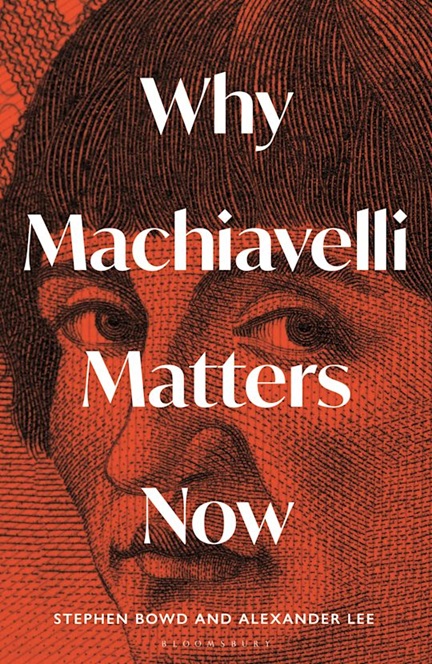
Why Machiavelli Matters Now by Stephen Bowd and Alexander Lee
In The Critic, Tom Jones reviews a new work on Niccolo Machiavelli by Stephen Bowd and Alexander Lee:
Machiavellian is rather a dirty idea in politics, conjuring tired images of scheming Wormtongues, smoke and mirrors, nights of long knives, Peter Mandelson.
But a new book hopes to change that, by offering us a more rounded view of this important figure, who has been sadly lost — like Sun Tzu and Marcus Aurelius, but thankfully not Edward Gibbon or Carl von Clausewitz — to business bros who buy their books in branches of TG Jones in regional airports.
The first chapter of Why Machiavelli Matters Now is dedicated to the closest thing to methodology the Italian ever laid out. Halfway through The Prince, he writes that “it has seemed only proper to go straight to the effectual truth of the matter [alla verità effettuale della cosa], rather than to how it is imagined”. This, authors Stephen Bowd and Alexander Lee claim, “is perhaps the most crucial sentence in the whole of Machiavelli’s writings”.
But it might be best summarised as wanting to understand things not as they were, but as they came to be — or, more precisely, what caused them to change. That wasn’t all; since he used the concept in relation to a prince’s relations to “his subjects and friends”, it means the specifics of how human behaviour produces political change. This, as the authors note, “was genuinely revolutionary. No one until then had thought of politics in such overtly dynamic terms.”
This, at least, was Strauss’ reading. But as with most of Machiavelli’s work, the thing is more subtle than it first appears. Informed by both Aristotle and Lucretius (it should be obvious at this point how heavily I am cribbing from this interesting, short and consumable book), it was:
a truth that had to be decided pragmatically, through experience, on the basis of what felt right, rather than what could be rigorously verified – and all too often shaded off into mere verisimilitude. It sought to explain changes of all kinds but was preoccupied above all with the causes of civil unrest and factional struggles, which undermined rulers and republican regimes more than anything else
Understanding the effectual truth was, for Machiavelli, essential if princes were to avoid being either baffled or frightened by political developments. Alas, were our own princes aiming for such lofty ideals of governance.
Comments Off on Why Machiavelli Matters Now by Stephen Bowd and Alexander Lee
The short-term impact of widespread LLM usage
I haven’t used any of the latest tranche of LLM agents, although I’m assured by those who do use them that they’re significant improvements over the previous iterations, so I don’t really have an opinion about the state of the “AI Revolution”, but Freddie deBoer has a rare non-catastrophist yet also non-utopian take:
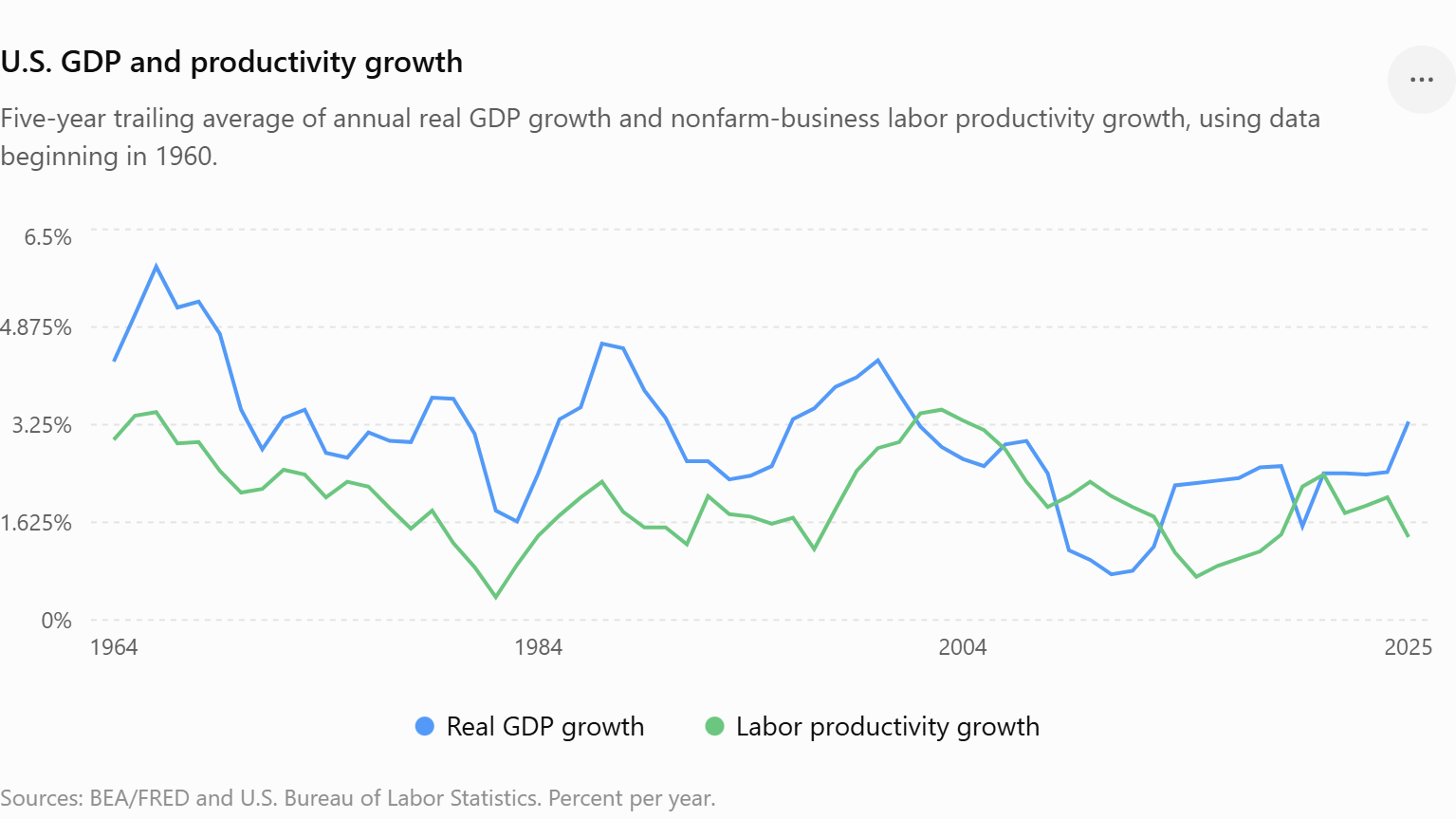
My LLM skepticism is really pretty simple: immense practical consequences have been predicted for them, essentially none of those consequences have come true or can be proven to be imminent, and because reality has a powerful status quo bias it’s not sensible to simply assume that they’re coming. Extraordinary claims require extraordinary evidence and no one has produced such evidence. My position is not a complicated one to understand and shouldn’t be controversial. I’m acting with no more skepticism towards AI claims than I regularly demonstrate towards claims about religion or astrology or New Age woowoo.
And, crucially, I’m not the one who has set the comically over-the-top expectations here; the AI maximalists and their enablers in the media have. Sundar Pichai, who as the CEO of Google is one of the ten most consequential figures in the business world, said that LLMs were a bigger deal than the discovery of fire or electricity. AI maximalists frequently insist that the LLM era is equivalent to or more important than the Industrial Revolution. Dario Amodei, CEO of Anthropoic, went on a podcast from The New York Times (the stentorian, buttoned-down New York Times) and talked about a future where AI colonizes Mars of its own volition. Reports out of Silicon Valley hold that many tech workers sincerely believe that they’re a few years from owning their own asteroid mines and will be so wealthy they essentially step outside of the human experience when it comes to material desire. (If you look, you can find concerning stories on Reddit and similar places of techies spending down all of their saving and taking out large loans, on the theory that in the next few years they will become trillionaires thanks to LLMs.) Scott Alexander seems increasingly unwilling even to countenance the possibility that “AI” is not all its cracked up to be. None of this is serious, let alone convincing. I keep using the example of indoor plumbing to establish a baseline of what actual civilization-altering technological change looks like because that’s what civilization is built on. Videos where AI Chuck Norris beats up AI Vladimir Putin are not on that level.
None of this means that I believe what I am frequently accused of believing, that LLMs have literally no consequences. I don’t think that. I think that the winners of the current AI war will end up with important enterprise software that meaningfully changes how administrative and clerical tasks are completed in the average American workplace. The winners of all of this will make a lot of revenue off of this technology. Certain tasks are going to be presumed to be automated from now on. You’ll ask computers to do things in natural language that you used to do with clicks and commands. And, as we’re already seeing, human culture is going to become even lonelier, less authentic, more crass, less creative, more artificial, and less fulfilling than before. Those are consequences. They’re just, you know, consequences in a fundamentally mundane and boring world. But, yeah. Somebody’s going to make a lot of money on this stuff — conventionally a lot, I mean, not these absurd hundreds of trillionaire dreams, but a lot of money.
The trouble is that, clearly, none of this is enough, precisely because of those outsized expectations. The problems with “LLMs are going to prove to be highly consequential and remunerative enterprise software in a more-or-less unchanged economy and world” are multiple:
- The amount of money and time and energy and attention and manpower that’s been invested in LLMs is so massive that nothing resembling an ordinary economic return can ever pay it off; with AI now essentially propping up the entire American economy, this is a dire circumstance even though specific firms will survive and eventually thrive.
- You can’t cure cancer because cancer is not one disease and also it evolves under natural selection pressures and sometimes when we reduce rates of one cancer rates of other cancers rise etc etc etc; interstellar travel is a fantasy thanks to basic rules of physics and physiology, not because we’re not smart enough; asteroid mines make absolutely zero sense in basic economic terms; you can’t upload your consciousness because consciousness is not software but embedded into the very cells of our bodies that inevitably die; we already experienced radical life extension thanks to immense reductions in infant mortality and smoking cessation, the add-another-25-years-to-the-average-lifespan stuff is just a slow unglamorous chipping away; limitless cheap energy is being kept from us by thermodynamics, not how advanced our microprocessors are; on and on, the things we’re demanding failing to materialize because they’re not sensible things to demand.
- It’s impossible that all of the major players in this field (OpenAI and Anthropic but also Meta and Google and Nvidia and Oracle and Caterpillar and Modine Manufacturing and Constellation Energy …) survive the next decade; some of them are going to fail, and they’re going to cause an immense amount of collateral damage on the way down.
- Some very informed people will tell you that the future is not LLMs but SLMs, small language models you run locally on your own computer, which would have potentially devastating downstream effects for chip manufacturers, model developers, construction firms, energy companies, etc.
- We have absolutely no idea about where the next big growth field might be if it isn’t this, and this period of permanently irrational stock market growth (which has underwritten all economic optimism) is dependent, more than anything, on that one organizing story.
- The emotional investment in AI is even less likely to pay off than the financial investment; a huge number of people, including a lot of people who spend their lives being too cool for this sort of thing, have staked their emotional health on the idea that the mundane world is imminently going to end, but the mundane world never ends and we will all spend the rest of our days downloading apps to pay for parking a single time and emptying the diaper pail and trying to figure out how to avoid the third round of small talk with the same coworker in a day.
Honestly, I think Google’s recent shakeup tells us a lot about where LLMs are going. Google, for a thousand reasons, is the “frontier” company most likely to make a ton of money off of AI in the next decade — and also, they’ve slipped far down the rankings in terms of the best model and they don’t appear to care very much. Google’s Gemini was briefly seen as the class of the field, but in the past year or more they’ve consistently underperformed OpenAI and Anthropic’s best models. (To say nothing of the rapidly-ascending Chinese competitors, which is a whole other thing.) Google’s top AI guys, Demis Hassabis and Jeff Dean, have both moved on from active development of Gemini because they’re more interested in moonshot AI; the implicit concession is that Google doesn’t think that Gemini can ever be “AGI”, that utterly vague, non-falsifiable construct so many people are now chasing. Instead, Google seems to understand that its vast preexisting base of users allows the company to make a mint without any absurd sci-fi premises: when you ask an AI agent to do your grocery shopping, you’ll probably do it through Google in one way or another, and they can take a few cents off of each of those interactions to the tune of billions. It’s not glamorous and it doesn’t allow you to pretend that you’re going to live forever. But pragmatism of that kind is the soil in which modern day fortunes grow. Moonshot Google is long dead, and for a reason.
Comments Off on The short-term impact of widespread LLM usage
The unspoken dividing line between “BCE” and “CE”
I’m not a trained historian, so I don’t know if it’s a guild requirement for modern historians to ostentatiously avoid using traditional “BC” and “AD” to denote historical dates or if it’s just another sop to the easily offended like so many other things:

An Olmec head, By Marshall Astor (Life on the Edge), CC BY-SA 2.0, https://commons.wikimedia.org/w/index.php?curid=19349056
Although I work primarily as a computer programmer, my college degree is in History. Over the years, I have retained a high level of interest in history, both recent and ancient.
A few months ago I listened to a Great Courses presentation about the Olmecs — one of the lesser known Central American civilizations — given by Dr. Ed Barnhart. The course lived up to its name and taught much about the history and society, as well as the giant heads, of the Olmecs. However, one thing bothered me about Dr. Barnhart’s presentation.
Dr. Barnhart generally uses CE and BCE for dates. CE stands for “common era” and BCE stands for “before common era”. Other than that fact, CE perfectly coincides with the previous AD and BCE perfectly coincides with BC.
Perhaps Dr. Barnhart should not be singled out. He is not alone in the use of these terms. In fact, the majority of historical presentations these days employ CE and BCE. And it may be that using these terms is not a personal decision; rather, it may be that a department-wide or even university-wide convention.
However, in my view, using CE and BCE instead of AD and BC is not okay. As an (amateur) historian, I believe that it’s bad for history. And as a Christian, I find it a bit offensive. I will probably never have the opportunity to tell Dr. Barnhart why he should not use CE/BCE, but if I did, here’s what I would tell him:
1) The prime commitment of a historian should be to history. A historian should be careful that the information presented is the most accurate, the most complete, and most contextually grounded. CE/BCE fails to be most accurate because it takes an obviously true historical fact — that the currently used Julian/Gregorian calendar is based on the birth of Christ — and obscures that fact. It is not the most complete because there is no way on its own to understand that CE/BCE means to present the same system as AD/BC. To truly understand the system, the AD/BC system would need to be explained. The AD/BC system can stand on its own, but the CE/BCE can only be understood along with AD/BC.
And it lacks context because the terms “common era” and “before common era” give no indication as to what exactly is the demarcation between the two eras. Since CE/BCE gives no referent, a student could reasonably conclude that the dating system is entirely arbitrary. For these reasons, using CE/BCE leaves students or listeners knowing less than they should and perhaps even having a wrong understanding of the dating system. AD/BC preserves important historical information. CE/BCE does not. On the basis of that alone, CE/BCE should not be used by historians who want to be as accurate and complete as possible.
2) Using AD/BC does not require anyone to profess Christianity. Some might say that AD/BC unfairly burdens non-Christians, but the terms Anno Domini and Before Christ are clearly not confessional statements. There is no serious historical dispute that Jesus Christ existed in approximately the time and place given in the Scriptures, and AD/BC merely recognizes that this is the basis for the year numbering system. Anno Domini, or year of the Lord, doesn’t require the user to say “my Lord” or otherwise confess Christianity, just to recognize that the calendar was created by people who did confess Christianity. That is an important fact, not something to be hidden.
The fact is that every calendar starts dating from something, generally from an important event. Some examples are:
- Roman dating: years counted from the traditional founding of Rome, Ab Urbe Condita, conventionally placed in 753 BC.
- Hebrew calendar: years are traditionally counted from a calculated date for the creation of the world.
- Islamic calendar: years are counted from the Hijra, Muhammad’s journey from Mecca to Medina in AD 622.
- French Republican calendar: years were counted from the establishment of the French Republic in AD 1792.
To use a particular calendar says nothing about one’s religious beliefs.
Comments Off on The unspoken dividing line between “BCE” and “CE”
The Ancient Greeks 05 – The Greeks Fight Back 1 – The Way to Salamis
seangabb
Published 29 Mar 2026Greece: A Brief History, c.700 BC – 500 AD
How did the Greeks recover from what looked like total defeat? In this lecture, we pick up the story at the darkest moment of the Persian invasion. Athens has fallen. The Acropolis has been burned. Xerxes appears on the verge of total victory. And yet, the Greek resistance does not collapse.
We examine the extraordinary political and strategic crisis of 480 BC, including:
– The evacuation of Athens and the transformation of the city into a “nation at sea”
– The internal divisions within the Greek alliance
– Spartan reluctance to defend central Greece
– The decisive leadership of Themistocles
– The strategic importance of naval powerAt the centre of this lecture is the question of strategy: should the Greeks abandon the north and defend the Peloponnese, or risk everything in a naval battle at Salamis?
This is the turning point of the war — not yet a victory, but the moment at which survival becomes possible.
Comments Off on The Ancient Greeks 05 – The Greeks Fight Back 1 – The Way to Salamis
QotD: Cant
Without hypocrisy, there would be no gossip; without gossip, there would be no literature and precious little conversation. The dose of hypocrisy necessary to maintain social intercourse is a matter of judgment, for while many individual instances of hypocrisy are reprehensible and properly the subject of adverse comment, and some instances are beyond the pale, hypocrisy is as necessary to human existence as love or laughter. We should never forget La Rochefoucauld’s dictum that hypocrisy is the tribute that vice pays to virtue: but at least he knows that there is a difference. The only effective way to eliminate hypocrisy entirely from human affairs is to have no moral standards.
Cant is more destructive than hypocrisy because it is harder to expose and because a humbug deceives himself as well as others, while a mere hypocrite retains some awareness; he is a rogue rather than a villain. Cant is the vehement public expression of concern for others, or of anger at an opinion casting doubt on some moral orthodoxy that is not, and cannot be, genuinely felt, its vehemence being a shield for insincerity and lack of confidence in the orthodox opinion. Doctor Johnson defined cant as “a whining pretension to goodness, in formal and affected terms.” Cant is contagious, and, when widespread, it creates an atmosphere in which people are afraid to call it by its name. Arguments then go by default; and if arguments go by default, ludicrous, bad, or even wicked policies result.
Theodore Dalrymple, “The Age of Cant”, City Journal, 2020-11-27.
Comments Off on QotD: Cant
August 29, 2026
On the scenic shores of “Lake America”
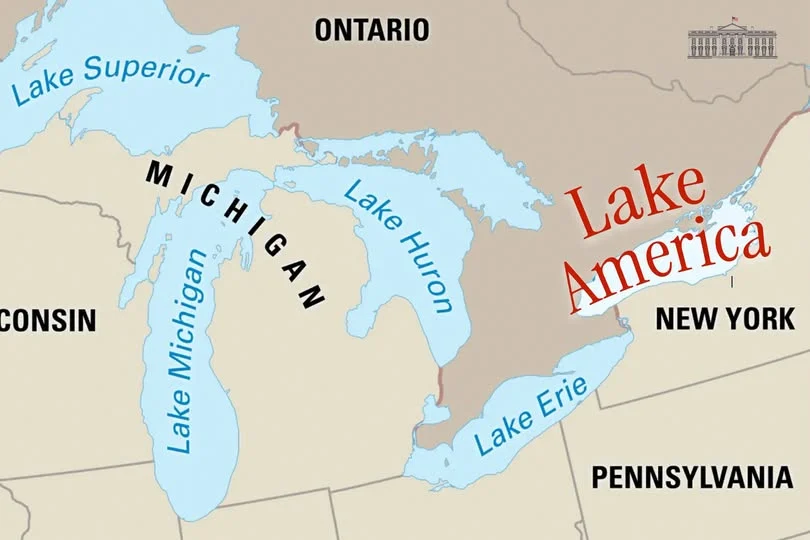
One thing Trump does better than any other politician is finding ways to send his opponents crazy. It’s not a skill I’d want to have myself, but it’s amazing how Trump can do or say something outrageous … and pretty much every time his opponents take the bait and make themselves even more ridiculous in trying to react to his provocations. Like randomly renaming Lake Ontario by executive order:
I don’t think Carney has Trump Derangement Syndrome, the citizens who vote for him do. Carney knows this, he counted on it to win the election. Elbows up was about preparing Canadians for a breakdown in relations with the U.S. – A breakdown that Carney and the other Laurentian elites who run things in Canada saw as inevitable. To anyone paying close enough attention, Carney is the de facto new leader of the globalists (the WEF mob). He ascended to that position at the moment he became the Canadian prime minister. Trump and the MAGA movement, on the other hand, are the singular force in the world effectively opposing globalism as it has emerged in the post-WWII “rules based order”.
This effectively places Canada at the center of an existential global struggle. However, we are not only at the center, but oppositionally set against the most powerful nation the world has ever seen, locked in a “trade war” with the largest economy in the history of humanity. Pardon my use of acronymic French as I blurt out an unruly “WTF!”
I am sure Carney has read The Art Of The Deal and knows how to win diplomatically with Trump – which is all one needs to read to gain the key insights prerequisite to mutually successful negotiations with the orange one. But Carney is not interested in mutually beneficial trade relations with the U.S. because that would mean tacit support for the American led reset of global political economy (which of course follows from America’s new economic policy, because yes absolutely America is that powerful), or put another way, it would mean Carney supporting the thing which is opposing the thing that he actually supports.
Elbows up Canadians have been manipulated by the most cynical government in the history of Canada. Carney is a smooth operator but a cunning wirepuller. He has essentially pulled the wool over the eyes of a malinformed citizenry who have been fed an endless diet of state-sponsored anti-American, Anti-Trump, and Anti-Poilievre propaganda since at least the final scenes of the Trudeau premiership set the stage for Carney the globalist show closer.
[…]
And at last we come unceremoniously to the supreme troller who has cast his line in the newly anointed Lake America. He is fishing for a major catch of Canadian TDS, and he is bound to fill his nets. Indeed, Trump has signed an executive order officially changing the name of Lake Ontario to Lake America. Canadians are of course triggered and are whining insufferably. I think it is funny, and I like that for once an Indian name is being changed to a European one. Trump is the greatest troller in the history of trolling. However, the move is a serious one, in twenty years the world will be flooded with maps and globes that label the former Lake Ontario as Lake America, in spite of the impotent protestations of butt hurt Canadians. America has vastly more power in this world, if they want our lake known as Lake America it will be so. Canadians who have a hard time accepting this simply have no clue about the dynamics of power.
Carney’s response to Trump’s redesignation of the lake was replete with a self-own only one as invested in a globalist “new world order”, and oblivious to actual domestic concerns could muster. He posted the following to X:
The name Lake Ontario comes from the Wendat word Ontari’io, which, appropriately, means “the lake is beautiful, the lake is big”.
The name is more than 400 years old, predating both the Confederation of Canada and the Declaration of Independence of the United States of America.
We know that America is changing. Their trading relationships, their foreign policies, their national monuments, their hydronyms.
Canadians also know that naming reality means calling it Lake Ontario – then, now and always.
A hilarious response to this which appeared on X was posted by Miranda Veracruz de la Jolla Cardinal, which I am assuming is a parody account since Miranda was a recurring character in the 1980s sitcom Married With Children. MVdlJC wrote:
“How dare Trump rename Lake Ontario!”
“Anyways, here I am at Sankofa Square …”
If that is not the cat’s pajamas then I have no idea what type of a response to Carney’s boundless smugness would adequately compliment a feline’s slumber. Carney says that Canadians know about “naming reality”, yet how many unpronounceable aboriginal terms have been grafted over the real names of Canadian places in the past decade or so.
Amnesty International
Frederick Alexander wonders “what the hell happened to Amnesty International”?

I’m firmly in middle age, and the signs are all there. I can’t have a lie-in any more; I just wake up early, feeling unrested, and have to mainline caffeine for the first hour before I can get anything done. My lower back aches constantly and now works like a barometer, the pain increasing with an approaching cold front. And I’m old enough to remember when Amnesty International was an admirable organisation that defended the oppressed – back when that word described people suffering in the real world rather than grievances the sociology department workshopped into existence. Such are some of the complaints of a middle-aged Englishman, but it’s the third that vexes me most today.
Amnesty really was something special once. It stood for dissidents and prisoners of conscience: the Chinese journalist tortured for saying something that embarrassed the CCP; writers like Václav Havel, imprisoned by communist Czechoslovakia before later becoming the country’s president. I loved The Secret Policeman’s Ball, the Amnesty benefit shows associated with John Cleese. My record collection was full of Peter Gabriel, Tracy Chapman and the like, who helped carry the cause into stadiums around the world. Who could not admire an organisation devoted to freedom – that most contested of political ideals, and the one closest to my heart?
Today Amnesty International is a case study in everything that has gone wrong with our institutions.
Consider the latest episode, one entry in a long and growing list of absurdities. In July, Amnesty International UK published a list of organisations it said belonged to an “anti-rights ecosystem”, including Beira’s Place, the female-only support service for victims of sexual violence founded by JK Rowling. Other names among the 117 supposedly malign bodies were For Women Scotland and Sex Matters – whose great offence is essentially to insist that women exist as a biological category.
Compiling lists of ideological offenders is a bit … what’s the word? Totalitarian? Fascistic? The organisation that once existed to defend prisoners of conscience decided it would be a good idea to draw up a register of thought-criminals, a rape-crisis centre among them. I can’t imagine Tracy Chapman strumming a guitar for that. I don’t know what Peter Gabriel makes of it either. If either of them is still sane (I’m too afraid to check), they’ll likely frown on the direction of travel.
Rowling, who once worked for Amnesty back when it defended people with the “wrong” beliefs rather than compiling lists of them, threatened legal action and offered to help other organisations on the list do the same. Amnesty first expressed regret – the standard move while they work out how much trouble they’re in – and then issued an apology when they realised she was not mucking about, saying the briefing should never have been published.
Amnesty said, “We regret that this briefing was uploaded to our website without going through the established internal review processes”, which is the institutional equivalent of “the dog ate the homework”. But I’ve worked in this kind of outfit. Things like this don’t go up by accident. This wasn’t a pocket tweet. Reports go through layer after layer of review before sign-off – after which everyone holds a little drinks party to congratulate themselves on a job well done, and someone gives a small speech while another has a bit of a cry.
Comments Off on Amnesty International
The Origins of Aldo Uberti and Reproduction Cowboy Guns
Forgotten Weapons
Published 11 Apr 2026In 1958, Val Forgett of Navy Arms contracted with Beretta engineer Aldo Uberti to produce 1,000 reproductions of the Colt 1851 Navy revolver. That turned into the beginning of many decades of production of a wide variety of revolvers and rifles, from the LeMat to a line of Winchester lever actions. Fueled by both organized Cowboy Action competition and general widespread interest in these guns, Navy Arms grew very successful in the market, attracting many other companies who continue to exist to this day. Today I’m talking with Val Forgett’s son (also Val Forgett) about some of the interesting details of the business.
(more…)
Comments Off on The Origins of Aldo Uberti and Reproduction Cowboy Guns
QotD: Peter Green’s vengeance against the Hellenistic Age
But telling the actual narrative of the Hellenistic world, however bizarre and entertaining it gets, is really only the superficial purpose of Alexander to Actium. No, the real point of the book, and the real reason to stick around for all 700 pages, is to witness Peter Green’s incredible, almost maniacal act of vengeance against an era he despises.
Whether it’s playwrights …
The poet-playwright Menander … has always struck me as a classic example of a growth industry created by papyrological accident.
… poets …
Callimachus, like Ben Jonson, has always had a rather better press than he deserves, and for much the same reason: his academic ideals and credentials can hardly fail to appeal to those other academics … I cannot help finding him at once pretentious and faintly distasteful, a literary exhibitionist with an unpleasant groveling streak about him, a sycophant implacable in his attacks on rival sycophants[.]
… philosophy …
Popular philosophies — and Stoicism must be accounted one of the most popular ever — almost always tend to have an intellectually suspect quality about them.
… coin portraits …
Prusias I of Bithynia is porcine, crass, and self-satisfied. The early kings of Pontus resemble nothing so much as a family of escaped convicts: Pharnaces I has the profile of a Neanderthaler, and Mithridates IV that of a skid-row alcoholic.
… or academia itself …
Museum faculty developed a reputation for symposia, frivolous research topics, and alcoholism: to anyone in the same profession there cannot fail to be a certain sense of deja vu.
… Green knows how to write a burn. It’s not simply that he’s a hater: his book about the Battle of Salamis overflows with love and admiration for the golden age Greeks who defeated the Persians. No, Green specifically has a bone to pick with the Hellenistic era and its rulers, its people, its art, and its ideas. For those who read for entertainment, the best part of Alexander to Actium isn’t the battles, the George R.R. Martin-esque politics, or the even more Martin-esque incest — it’s tagging along as Peter Green gets revenge on the Hellenistic Age by writing a definitive textbook about it, so that all students of history who come after him will read of his scorn and contempt.
Green’s harsh attitude is clear right from the preface, when he sets the book’s scope.
[I will not] devote specific sections either to law or to school education, on the grounds that during our period the first … was little more than an elaborate sham masking the realities of power, while the second offered nothing, in essence, but literary rote learning, elementary mathematics, music, athletics, and — most important — a rhetorical grab bag that would enable men at the top to talk their way into, or out of, anything.
Hellenistic historiography fares just as badly:
Polybius remains the only worthwhile historian of the Hellenistic period whose work substantially survives. Diodorus, as we are too often reminded, is a third-rate compiler … I have no wish to burden an already overlong book with yet another imaginative analysis of his chronological inconsistencies and synthetic rhetoric. Like Plutarch, he believed that one virtue of history lay in “recording the nobility of distinguished men, publicizing the vileness of the wicked, and in general promoting the good of mankind”. Successful statesmen, he thought, were righteous, while evil ones met with frustration: nothing, in short, succeeds like success. None of this inspires confidence.
From there the savagery continues almost non-stop, right down to the last page when Green ridicules imperial Roman literature for “guttering out” by the mid-2nd century. Virtually nothing escapes.1
Take philosophy, that most noble of ancient endeavors. The Hellenistic world’s biggest philosophical contribution was Stoicism. Today, Stoicism enjoys a good reputation for encouraging adherents to be stolid and uncomplaining in the face of difficulties. Green, though, puts the spotlight on Stoicism’s lesser-known traits like its determinism and pantheism, then singles it out as a shallow ideology perfect for helping elites rationalize their own hypocrisies.
Sandbach correctly notes that “the belief that the world was entirely ruled by Providence would have an appeal to the ruling class of a ruling people”. What Stoicism offered, in fact, was a built-in justification — moral, theological, semantic — for the social and political fixed order: it was the most powerful and subtle instrument of self-perpetuation that the Hellenistic ruling class ever conceived. The mere fact of anything happening meant that it had been fated to happen; and since nature was providentially disposed toward mankind, what was fated could not fail to be all for the best. This interesting version of determinism is most often presented as a source of comfort when things seemingly went wrong; but of course, as I have suggested, it would be of even greater benefit to those who were anxious to have some moral principles to offer the world in justification of ruthless self-interest. If it was bound to happen, it had to be right.
People have always wanted to learn the future, but Stoicism’s belief in a deterministic yet providential cosmos drove a tremendous increase in the popularity of astrology, divination, and other woowoo, often egged on by the philosophers themselves.2 Green even hypothesizes that Stoicism’s popularity directly sabotaged whatever nascent scientific progress there was in the late Hellenistic age.
Blake Neff, “GUEST REVIEW: Alexander to Actium, by Peter Green”, Mr. and Mrs. Psmith’s Bookshelf, 2025-10-20.
- Don’t assume that you, the reader, will be free from Green’s scorn. Green studied the classics at Cambridge back when standards were standards. The preface alone includes untranslated phrases in Greek, Latin, French, and even German, a norm that continues throughout the book for the first three languages (and for the fourth in the highly-entertaining footnotes). Green has no patience for the puny monolinguists of today.
- Posidonius of Apamea, one of the most famed Stoic writers of the ancient world, was also one of its most famed astrologers.
Comments Off on QotD: Peter Green’s vengeance against the Hellenistic Age
August 28, 2026
“The Maple Mujaheddin Insurgency is not going to happen”
Of all the potential military conflicts facing the west, a US invasion of Canada has to be among the least likely — not just because it’s been attempted more than once in the past. For one thing, I don’t think even the best social media posting is going to bring ordinary Americans around to getting boots on the ground across the 49th parallel … there’s remarkably little passion about seizing our maple syrup and confiscating our strategic reserves of poutine among voters. Unlike places that Americans have strong feelings about, Canada just doesn’t move the needle.
The Operational Art of War has the first of a promised three-part series on Operation Maple Stomp, the biggest and best invasion of Canada — everyone says so:
In the latest round of “let’s do everything the dumbest way possible” the two nations in the world sharing the most in common keep taking to social media to fantasize going to war with each other.
It is deeply annoying, brings out the worst tendencies on both sides, and (to my mind worst of all) illustrates no one understands the Operational Art of War!
Americans take to social media and claim Canada doesn’t have a military, the military wouldn’t fight and be so outnumbered that resistance would collapse within hours.
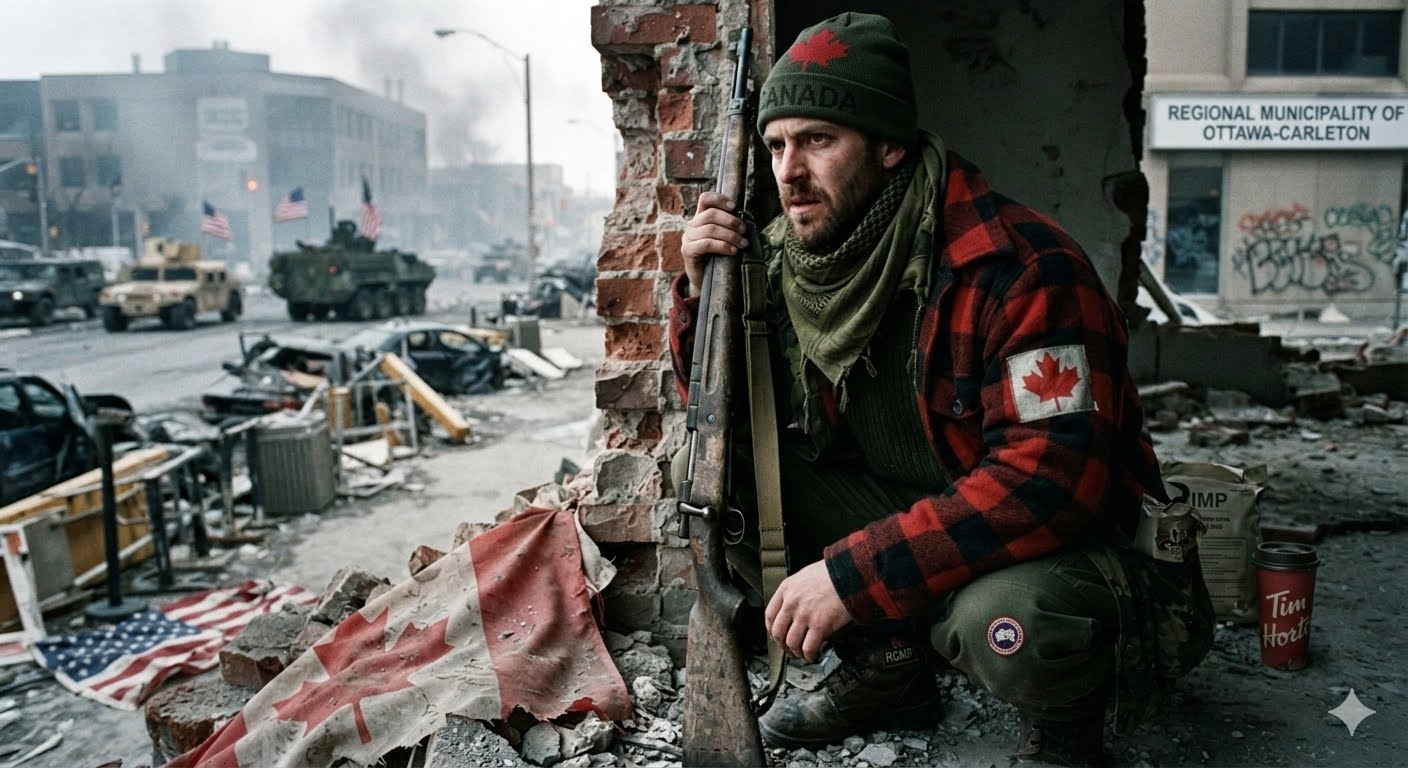
Canadians usually agree the conventional war would be over in an afternoon, but then America would face a long and bloody insurgency (just wait till Uncle Sam meets the Maple Mujahedeen!).
Google AI’s idea of what a Canadian Insurgent looks like.
You can definitely count me as a member of Team Mere-matter-of-marching, at least as far as the tactical operations necessary to occupy the most populous parts of Soviet Canuckistan. Here’s a sketch map that Big Serge updated for the 2020s, based on the mid-1930s details for an attack on southern Ontario from War Plan Red:
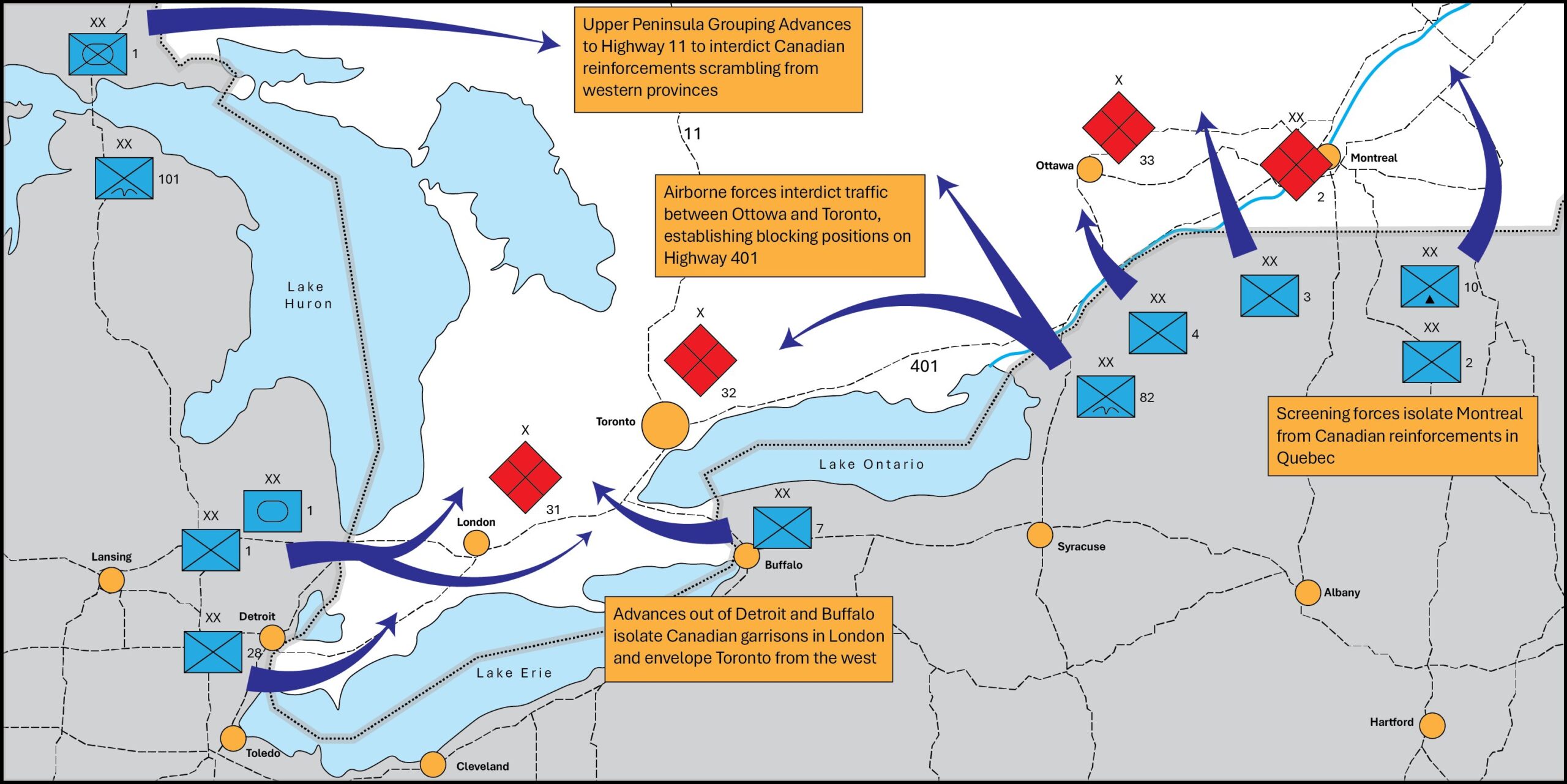
Manifest Destiny, 2025? Big Serge’s updated map for the old US War Plan Red for a military invasion of Canada.
The distances are short enough and the chances of significant military resistance low enough, that US Army vehicles would probably not need to refuel before reaching the initial stop-lines for their advance. Canadian infrastructure is not pre-wired for destruction, so unless local hotheads manage to temporarily block road bridges, volume of traffic will be a bigger friction factor than actual defensive fire.
Trump’s legions would reap the benefit of more than a century of demilitarized populations and the (small, but real) Canadian military being oriented to expeditionary operations rather than home defence. But taking the territory is only the first step. There are Canadians scattered throughout the continental United States, looking and sounding pretty much like any other American, and it wouldn’t take too many of them to decide that Trump’s fight was also their fight. Canada isn’t the only one enjoying the benefits of decades of lack-of-worry about homeland defence. Look how exposed the US has been to Islamic terrorists who, for the most part, don’t look or sound like Americans and still managed to pull off one of the greatest terror attacks of the modern age.
I mean, don’t misread what I’m saying here: the US would win. That’s not even remotely in doubt. There are at least ten of you for every one of us, and more of you have military training and access to personal weapons. (One wonders if the Canadian government’s fanatic devotion to civil disarmament is a kind of pre-surrender to this imagined US invasion we’re discussing …)
But the cost of winning might be more than even the most government-worshipping progressive might be willing to pay. We look like you. With a few exceptions (French-speaking Quebecers and Newfoundland-speaking Newfoundlanders, mostly), we fit in very well with you. We come from very, very similar cultures (some like Vancouver vlogger J.J. McCulloch argue it’s the same culture). Rather than a war of conquest, this would be much more like that “Second Civil War” that’s been so much a topic of conversation on far left and far right social media. The kind of civil war that takes far too long to settle back into peaceful co-existence.
You don’t like government surveillance? Too bad, bucky, because every level of government is going to be eager to ensure that you’re a good, loyal American … at all hours of the day and in everything you do. Cut down a Flock camera? That’s not going to be a mere vandalism issue … that’s tantamount to treason. What if that Flock camera was watching one of those undercover Canucki guerilla fighters?
Don’t like the feds watching every financial transaction? Too bad, bucky, ’cause you giving $5 to that sketchy Canuck for some bootleg maple syrup might be funding a terror attack on your nearest USAF base.
To fight the threat of Canuck infiltration, your every car trip will need to be logged, and your patterns of travel will need to be recorded and analyzed. Who you talk to will also need to be observed, in case one of your buddies is a covert maple-slurping spy!
Oh, wait, there’s more from the Operational Art of War:
There Won’t Be a Maple Mujahadeen
If the United States annexes Canada, there will not be a long-standing violent insurrection by a nation of hunters. The Maple Mujahadeen isn’t going to happen.
A successful insurgency has several requirements:
- A pre-existing structure to organize around;
- The structure having access to weapons;
- The insurgent group not having a future in the new regime; and
- The broader population being willing to shelter the insurgency.
Canada does have factions that meet all four of these factors, but spread across different factions. Like any complex modern society, Canada does have pre-existing structures of voluntary organizations. Virtually none of them are organized around any kind of collective defense or skills that easily translate to an insurgency.
For #2 (access to weapons) you either need armed citizens, government weapons cashes or weapons brought in by a rival power supporting the insurgency. In Canada’s case, the only viable supply of weapons for an insurgency is its armed citizens. As with most statistics, Canada only looks like a gun free country because it’s beside America.
The graph below shows the top 10 countries for estimated firearms per 100 people, plus the EU and global average for comparison (excluding countries with a population under one million). Countries that were recently warzones are in orange, as their rate of firearm ownership is something of a special case.
The number for Canada is likely too low. This is based on a 2017 data set, and firearm ownership is growing faster than the population. It also assumes there are five unregistered firearms to every registered firearm in Canada. The last time Canada had hard data on unregistered firearms (2003 to 2012) the ratio was 10:1. Assuming a similar ratio today, firearms per 100 jumps to 1/2 that of America and nearly 4x the European average.

Orwell’s real-life inspiration for Animal Farm
Although I consider myself a fan of George Orwell’s work, it had never occurred to me that there might be a real Manor Farm that inspired its fictional counterpart in Orwell’s Animal Farm:
One of life’s small pleasures is the uncanny sensation of exploring a place previously encountered only in fiction. Those who have read Howards End by E. M. Forster will remember the vivid descriptions of the old property that Mrs Wilcox so adored. But are they aware that it exists in the real world in the form of Rooks Nest House near Stevenage? Similarly, fans of James Joyce’s Ulysses can step into Buck Mulligan’s shoes by visiting the Martello tower where he lived, still standing today at Sandycove just south of Dublin.
Locations that have been immortalised in novels tend to inspire a chill of familiarity. On a recent trip back to England I took one of my favourite country walks to another literary landmark. My house is not too far from Wallington, the village where George Orwell lived and worked from 1936 to 1940. It was here that he conceived Animal Farm (1945), and it was only by walking there myself that I discovered there is an actual “Manor Farm” – the apparent model for the farm in the novel – just a few hundred metres from where the great man lived.
The story opens with the farmer, Mr. Jones, locking up the hen houses for the night and making his way up to bed. Then the protagonists of our “fairy story” are introduced …
As soon as the light in the bedroom went out there was a stirring and a fluttering all through the farm buildings. Word had gone round during the day that old Major, the prize Middle White boar, had had a strange dream on the previous night and wished to communicate it to the other animals. It had been agreed that they should all meet in the big barn as soon as Mr. Jones was safely out of the way.
There follows Old Major’s famous speech to the animals in which he lays out his dream of revolution. The “big barn” remains to this day and is the first structure of Manor Farm that one sees from the road. The farm is still working, so I was reluctant to risk trespassing to see whether it still contains the raised platform from which the mighty beast – a porcine Lenin – delivered his oration. Still, it’s definitely there. It’s big, it’s a barn, and to settle all ambiguity it bears the sign of “Manor Farm”.
It’s worth a visit. There’s not so much as a pub in the village itself and, with its population of one hundred and fifty, you’ll be noticed if you start taking photographs. But walking along those lanes to the faint trilling of birdsong, it’s easy to find oneself momentarily seeing the village through Orwell’s eyes.
Orwell’s cottage on the corner of Kits Lane has a small plaque to commemorate his time there. This late seventeenth-century property used to be called “The Stores” because it was once a local shop. Orwell and his wife Eileen sold groceries here, as well as sweets and packets of aspirin. The income helped to offset the rent, and afforded him time to write in peace. If you do manage a visit, take note of the low front door. Orwell, being a tall man, would often bang his head against the ceiling.

Comments Off on Orwell’s real-life inspiration for Animal Farm
“Single mother households produce the worst results for children”
Spaceman Spiff does that thing with data where you point out the most unpalatable results from a given set of statistics and place it front and centre:
Any mention of Cofnas by academics or the media comes with an obligatory dismissal of his work as “controversial” or “far-right”. It is often labelled as “pseudo-science”.
Yet if critics were confident in their position, that the research is incorrect, they would not react as they do.
This is easy to illustrate with a fake example. Imagine research into another sensitive area, female behaviour.
We can draw conclusions based on the research that will anger feminists in much the same way research into the heritability of intelligence and behavioural patterns within distinct groups angers most of academia.
One stark observation dominates our view, in everything we can measure, from mental health to life success, single mother households produce the worst results for children.
The literature is crystal clear.
With a wide variety of measurable outcomes, including life quality, criminality and recidivism, adjustment to society, academic achievement, material success, and mental health issues, the best results are produced by two-parent households closely followed by single-father households.
Single-mother households trail far behind on virtually everything we value. Being raised by a single mother is detrimental to the wellbeing of children compared to other options.
This is reflected in the historical record too. Females gaining custody of children after divorce is a recent novelty. In the Victorian era the father usually retained custody. Women were seen as too emotionally unstable to raise children alone. They needed the strong presence of a father.
One really damning factoid to emerge from crime statistics is most infanticide is committed by women, not men. Of children killed by their parents it is almost unheard of for the father to murder his own children. In some 98 percent of cases it is the mother.
We can use these observations to reach a sensible conclusion.
Single mothers should not be allowed to raise their own children.
Trashing the research not the researchers
Our conclusion is not very good. Academics would find it easy to challenge. This process follows a predictable course.
The first stage is to examine the papers and point out their flaws. What studies show these outcomes? What variables were measured? How were they measured?
Then there are the definitions. What do we really mean by life outcomes? Success is a subjective concept at best. Even something nominally objective like incarceration rates are complex with many variables of which the childhood environment is only one.
What other factors were measured? Were there control groups? What about sample sizes? How many people did they track? Many papers reach bold conclusions with small sample sizes. Which leads to the next question, has anyone replicated this finding? The replication scandal is well documented in multiple academic disciplines; one-off studies no one can reproduce, even quite famous experiments that have entered popular culture.
The quality of the studies is often assessed first because if they are flawed this inevitably damages the credibility of any conclusions drawn.
As for our conclusion, that children should always be taken from single mothers, even widowed women, this is not supported even with the evidence outlined above. Studies would need to demonstrate fostered or adopted children did better than those raised by a widowed mother, an unlikely proposition and just one alternative view possible from the evidence.
Importantly, serious critics would generally avoid motive except as a last resort. Sexism, misogyny and hatred of women may be there in a hypothesis that paints women in a negative light, but compared to challenging the research and its foundations, speculating about motive is weak and too easy to dismiss.
Jumping straight to perceived hate or bigotry, particularly when it makes the accusers look morally superior, is a tell.

Hatshepsut – The Pharaoh they tried to Erase from History
Tasting History with Max Miller
Published 3 Mar 2026Fritters as they are depicted in ancient Egyptian tombs
City/Region: Egypt
Time Period: 15th Century B.C.E.Hatshepsut ruled as regent for, and then co-pharaoh with, her stepson, Thutmose III for twenty one years in the 15th century BCE. While she ruled, Egypt enjoyed a golden age as she opened trade routes, built monuments, and ensured that the economy thrived.
The inspiration for this recipe comes from the many paintings of food on temple walls in Egypt. One of these shows ball-shaped items piled up on a serving platter, which could be an ancient form of the modern dessert zalabiya.
Using ingredients available to ancient Egyptians around the time of Hatshepsut’s reign, I’ve made my interpretation of the food painted on the temple walls. They are delicious and full of wonderful cardamom flavor with a light crunch. I think they’re best served with a little honey for dipping.
(more…)
Comments Off on Hatshepsut – The Pharaoh they tried to Erase from History


