
“I would strangle everyone in this room if it somehow prolonged my son’s life.” That’s what I blurted into a microphone during a panel discussion on ethics. I was laughing when I said it, but the priest sitting next to me turned sharply in horror and the communist sitting next to him raised her hand to her throat and stared daggers at me.
Why was I on a panel with a priest and a revolutionary communist? Long story — not very interesting: we were debating the future of ethics with special attention to the role of religion. The interesting part, however, is that at some point, after we all shook hands like adults and I was on my way home, I realized that I meant it — I would choke them all. Well, of course, one can’t be entirely sure that one’s actions will follow one’s intentions. The best-laid plans of mice and men, and all that. But, given some weird Twilight Zone scenario wherein all their deaths somehow saved my son’s life, I was at least hypothetically committed. The caveman intentions were definitely there.
The utilitarian demand — that I should always maximize the greatest good for the greatest number — had seemed reasonable to me in my 20s but made me laugh after my son was born. And my draconian bias is not just the testosterone-fueled excesses of the male psyche. Mothers can be aggressive lionesses when it comes to their offspring. While they are frequently held up as icons of selfless nurturing love, that’s mostly because we offspring — the ones holding them up as icons — are the lucky recipients of that biased love. Try getting between a mammal mother and her kid, and you will see natural bias at its brutal finest.
Stephen T. Asma, “Confucius Got It Right: Giving in to ‘Bias’ is Part of Living an Ethical Life”, Quillette, 2020-02-01.
February 19, 2025
QotD: The inborn bias of all mankind
February 18, 2025
Canadian academic life now entails mandatory indoctrination about “settler colonialism”
In Quillette, Jon Kay talks about the pervasive indoctrination of Canadian university students in that invasive intellectual weed from Australia, “settler colonialism”:

Last month, I received a tip from a nursing student at University of Alberta who’d been required to take a course called Indigenous Health in Canada. It’s a “worthwhile subject”, my correspondent (correctly) noted, “but it won’t surprise you to learn [that the course consists of] four months of self-flagellation led by a white woman. One of our assignments, worth 30%, is a land acknowledgement, and instructions include to ‘commit to concrete actions to disrupt settler colonialism’ … This feels like a religious ritual to me.”
Canadian universities are now full of courses like this — which are supposed to teach students about Indigenous issues, but instead consist of little more than ideologically programmed call-and-response sessions. As I wrote on social media, this University of Alberta course offers a particularly appalling specimen of the genre, especially in regard to the instructor’s use of repetitive academic jargon, and the explicit blurring of boundaries between legitimate academic instruction and cultish struggle session.
Students are instructed, for instance, to “commit to concrete actions that disrupt the perpetuation of settler colonialism and articulate pathways that embrace decolonial futures”, and are asked to probe their consciences for actions that “perpetuate settler colonial futurity”. In the land-acknowledgement exercise, students pledge to engage in the act of “reclaiming history” through “nurturing … relationships within the living realities of Indigenous sovereignties”.
My source had no idea what any of this nonsense meant. It seems unlikely the professor knew either. And University of Alberta is not an outlier: For years now, whole legions of Canadian university students across the country have been required to robotically mumble similarly fatuous platitudes as a condition of graduation. It’s effectively become Canada’s national liturgy.
After my tweet went viral, I was contacted by a US-based publication called The College Fix, which covers post-secondary education from a (typically) conservative perspective. Like many observers from outside Canada, reporter Samantha Swenson couldn’t understand why Canadian students were being subjected to this kind of indoctrination session. “I hope you can answer,” she wrote: “Why do schools make mandatory classes like these?”
I sent Swenson a long 13-paragraph answer — which, at the time, felt like a waste of my time: I assumed the reporter would pluck a sentence or two from my lengthy ramble, and the rest of my words would fall down a memory hole.
So when her article did come out — under the title, Mandatory ‘Indigenous Health’ class for U. Alberta nursing students teaches ‘systemic racism’ — I was pleased to see that I’d been quoted at length. I especially appreciated the fact that Swenson had kept in my point that educating Canadians (especially students in the medical field) about Indigenous issues is important work; and that courses such as Indigenous Health in Canada would provide value if they actually served up useful facts and information, instead of self-parodic faculty-lounge gibberish about “decolonized futurities”.

Trump is a lot of things, but he’s no Neville Chamberlain
Tom at The Last Ditch reacts to his European friends’ facile association of Trump’s overtures to Putin with Chamberlain’s ill-fated attempts to appease Hitler:
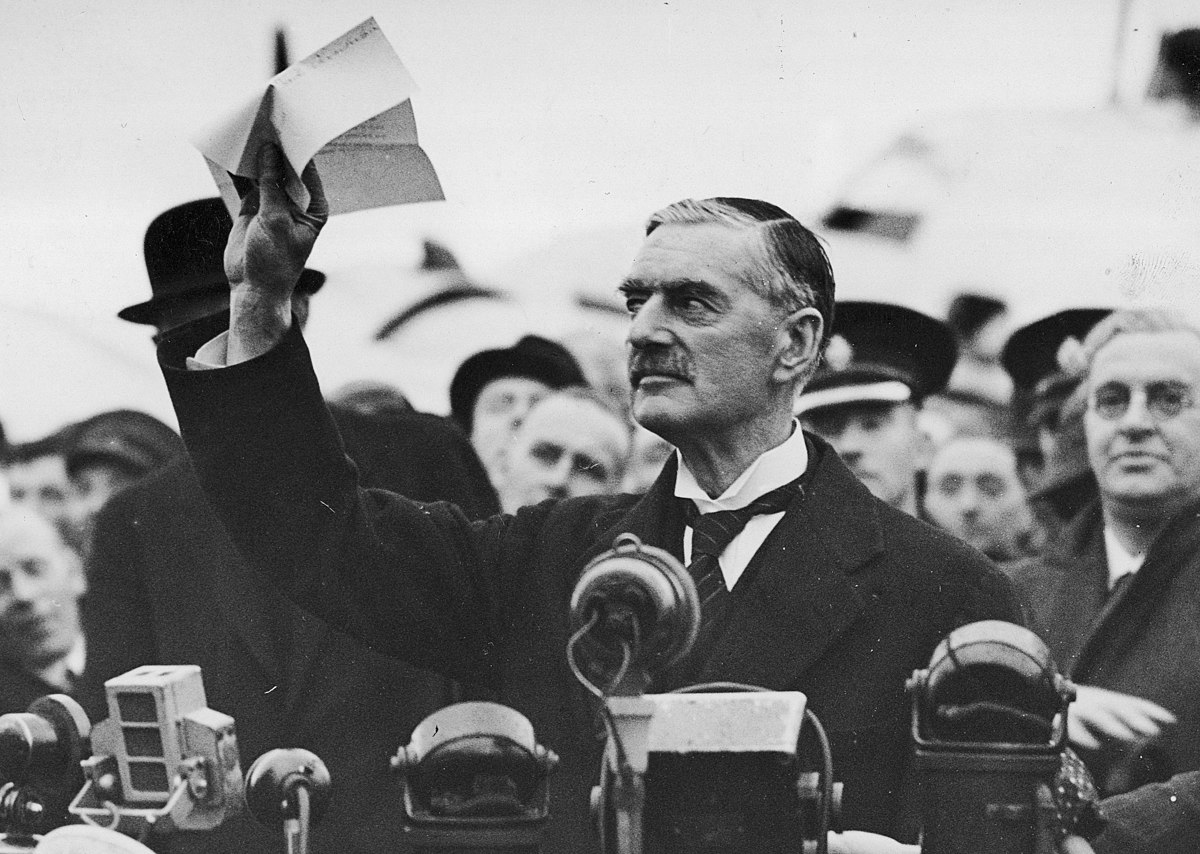
Prime Minister Neville Chamberlain at Heston Aerodrome, waving a copy of the Anglo-German Declaration he had negotiated with Adolf Hitler, 30 September, 1938.
Narodowe Archiwum Cyfrowe via Wikimedia Commons.
It’s interesting to watch my Continental friends react on their socials to President Trump’s overtures to that monster Putin — the greatest modern example of a real life Bond villain. Their sympathies, like mine, are with plucky Ukraine. Its soldiers, outgunned and outmanned, have fought like lions and their place in history is assured. Toasts will be drunk and songs will be sung, for sure. But they’re losing and not one European power is ready to send in troops. Under Biden the policy of the West was to fight to the last Ukrainian. Trump sees it in more practical terms.
[…]
Trump’s drama, trolling and exaggeration is in the same category. Most people just don’t get it and react to his bluster like that naive articled clerk I once was. Everything he says and does is calculated to find a path to the best achievable outcome. There’s not a virtue-signalling molecule in his body and yet there’s more actual virtue than in his hypocritical critics.
My European friends are comparing Trump to Chamberlain and Putin to Hitler. Europe seems unable to move on from World War II. Every issue is analysed through the historical lens of how they mishandled the rise of the Nazis. As someone once said, all we really learn from history is that we never learn from history.
The hypocrisy here is breathtaking. If his critics were any more ready than him to send in their troops, they’d have the moral high ground over him. They aren’t and (Poland perhaps excepted) they never will be. So whether it’s just or not, Ukraine can’t win. The only people the Germans and French are ready to see die in this war are Ukrainians, Americans and their loyal English-speaking sidekicks — as usual. So they have no moral basis for their maiden auntery
The post-war settlement has expired. Continental Europeans have to meet their long-neglected NATO obligations and stop expecting Uncle Sam (already carrying more debt than the world has assets) to pay for everything.
Putin is evil, yes, but Ukraine is every bit as corrupt as Russia and would add nothing to NATO’s strength. It’s in the right here as a matter of international law and (for what it’s worth in war) morality. But international law is a myth unless the rich nations enforce it by (plausible threat of) military action. Europe is just standing by signalling virtue while breaching sanctions and sending half the military matériels it promises. Meanwhile Ukraine loses men and wealth with no hope of victory. When the last Ukrainian soldier has died or surrendered, what do Europeans think the outcome will be? Ukrainian flags on your socials won’t win it mes amis.
My advice to my Continental chums? They should let the President try to make peace and hold their comments until they see the result. Based on all my years working in Continental Europe, I expect them all to decry the result and pretend their leaders (prepared to sacrifice nothing) would have done better. It’s bullshit. War is hell and has to end eventually. This is not a Hollywood movie. There are no guarantees that the (relatively) good guys will win. If you won’t end it with arms, then jaw jaw is all you have. This man is much better at jaw jaw than you are so shut up and stop assisting the enemy by showing him how divided the West is.
World War 2 rations on the British Home Front
Tasting History with Max Miller
Published 8 Oct 2024Mock banana cream on whole grain National Loaf
City/Region: United Kingdom
Time Period: 1944British rationing lasted from 1940 all the way to 1954, and they had to completely do without foods like bananas for years. The National Loaf began to be distributed in 1941. Made of 85% wholemeal flour enriched with vitamins B and C, it was nutritious, but dense, gummy, and went stale very quickly.
My National Loaf, based on the Imperial War Museum’s version, is dense, but I like the complex flavors from the whole grains. The mock banana cream has a texture that’s really close to mashed bananas, though the taste is an interesting mixture of parsnip and banana. Not bad, but not quite banana.
Mock Banana Cream
Here is a more economical banana cream recipe. Prepare and boil 1lb. parsnips until soft. Add 2 ozs margarine, 1 level tablespoonful sugar, 2 teaspoonfuls banana flavouring and beat until creamy. This must be used quickly, but half the quantity can be made if desired.
— Daily Record, Glasgow, May 27, 1944
QotD: The soft sexism of low expectations
- She’s been told she’s great — fabulous! — just the way she is.
- She’s been taught to dismiss all push-back as misogynistic.
- She’s been assured that she’s entitled to success — and that any failures to achieve said success are the fault of men.
- She’s been trained to demand that these dastardly men — who are totes holding her back — kindly step aside and let her take the trophy — whether she’s actually earned it or not.
You might think I’m being unfair here, but frankly? I don’t agree. Given all the stuff I’ve read in the news for the past decade plus, I believe I’m right on the money.
Everywhere I look, I see illustrations of all four of the above bullet points. I hate to keep harping on the fat acceptance movement, but really: isn’t that a textbook example of point number one? Go ahead, ladies: eff those unrealistic beauty standards and rock on with your 300 pound selves. Yas, queen, slay! (And don’t worry that you can’t make it up a single flight of stairs without getting winded. The negative impacts of extreme obesity are way over-stated, amirite?)
Then there are all the times leftists of the distaff persuasion have thrown down the poor-me-I’m-being-harassed-by-meanie-sexist-men card each time they start losing an online argument. To be sure, in the absolute dumpster fire that is internet discourse, such women probably do get burned with the occasional “die, bitch!” PM or email. But as I noted on my fan blog, men get that crap too — and oddly, I don’t see them whining about it nearly as often. (Probably because crying doesn’t work for men. Only women get picked up by the waaaaaambulance.)
And just to hit on bullets three and four: everywhere I look, I see leftists justifying moves to ease standards to give vag a hand up. Just last month, for example, it was reported that Oxford is considering removing Homer and Virgil from a foundational classics course due to “attainment gaps between male and female candidates”. Don’t buckle down and study your Latin and Greek, dears. We’ll remove that pesky obstacle for you. And oh my great and fluffy Lord, I can’t even count the number of times I’ve heard feminists complain about the academic weeding that goes on in engineering or computer science — because apparently, advanced math is oppressive and patriarchal. As a woman who numbers pretty good — indeed, I even teach that stuff for a living! — I headdesk so hard whenever I hear this BS that I’m surprised my skull is still intact.
Where does all this anal-smoke-blowing lead? When you’re told constantly that you should get prizes simply for being a good little girl — as leftist women are — the result is predictable: you stop developing. If you’re already Ms. Polly Perfect, well — that obviates the need for critical self-examination and the consequent moves towards self-improvement. If your naysayers are all dismissible as “women-hating men bitter over the loss of their privilege” (or as women suffering from “internalized misogyny”), then your arguments are almost certainly untested and malformed. And if people have always been clearing the road for you and shielding you from any real challenges, you’re no doubt much stupider than your competition — and much weaker.
Stephanie S., “Prizes for Good Little Girls Syndrome”, Conservative Thoughts, 2020-03-07.
February 17, 2025
A maple-flavoured DOGE? Maxime Bernier proposed this in 2020
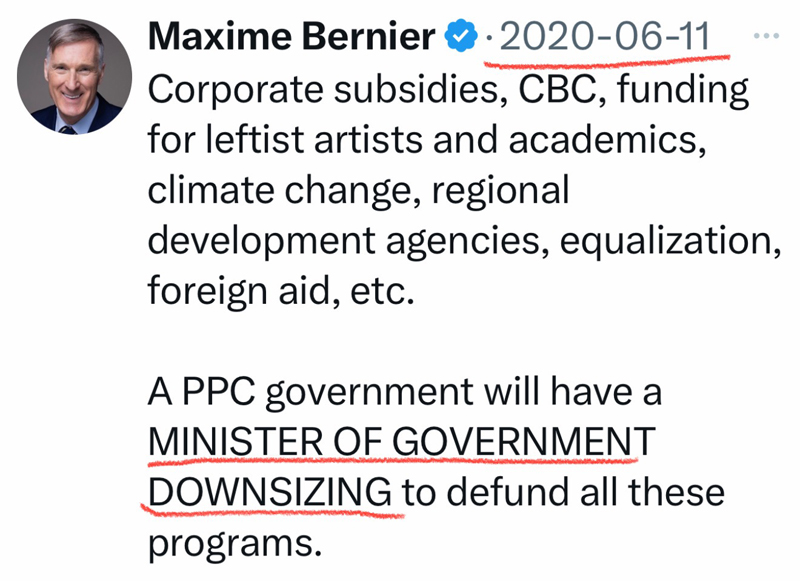
It’s both amusing and alarming seeing the kind of things the US government has been pouring money into, as the young auditors of Elon Musk’s DOGE dig into the accounts. Some folks on social media have been asking for a Canadian version of DOGE, but they’re nearly five years behind PPC leader Maxime Bernier:
Did you know that the Canadian government is spending $143,000 to help the African country of Senegal implement a “sectorial gender strategy” in its armed forces?
Or $46,793 to improve healthcare for intersex people in the Chinese province of Shandong?
What about $4.6 million to develop programs promoting a “positive masculinity” in Cuba?
There are hundreds of such crazy programs costing Canadian taxpayers billions of dollars every year to fund the Liberals’ woke ideology in other countries.
Many people on social media just found out that these programs exist last week, after they started looking for them on the website of the Government of Canada.
They were inspired by similar crazy programs that Elon Musk has unearthed with his DOGE team in Washington.
The DOGE – or Department of Government Efficiency – was created by President Trump and has already cut tens of billions of dollars in frivolous spending after only a few weeks.
I’m being asked if I support having the equivalent of a DOGE in Canada.
Not only do I support it, but I didn’t wait for Trump and Musk to do it to propose one. I did years ago!
In 2020, I stated that a PPC government would have a Minister of Government Downsizing to examine every federal program and cut or abolish everything that is inefficient, wasteful or not essential.
And speaking of DOGE, Coyote Blog shares some thoughts about some of the reasons Democrats are critical of the organization’s efforts:
… having thought about this longer, I think this is about more than just money. It is also about class. Just listen to how the cool kids in the media talk about Musk’s group of young weirdly-nicknamed geeks. This is fairly typical:
He was speaking specifically about a Trump executive order that decrees that the Department for Government Efficiency can force federal agencies into firing four people for every new hire. “Who the hell voted for Mr. Musk?” Begala raged. “Who the hell voted for — excuse the phrase — a guy who calls himself Big Balls? A 19-year-old kid going in there and trying to fire cancer researchers and scientists and teachers and agricultural specialists. It’s, it’s appalling.”
This is moderately hilarious from a) a party who still has not told us which unelected people really were making decisions behind the curtain for a senile Joe Biden; and b) an individual (Begala) who wielded immense power and influence across all departments of the Clinton Administration. The department staffs in DC are 99.99% people who are both unelected and unconfirmed by Congress. The issue is not that they are unelected, the issue is that they are “the wrong sort”. I am reminded of the British aristocracy in the 19th century that would tolerate almost any sort of governmental incompetence or malfeasance as long as the people were “the right sort” — meaning of their class.
The mention of Victorian England reminds me of another way that class is likely involved here. In the English aristocracy the oldest son inherited the title and often all the land and income (which was entailed to the title). This left little for any additional sons, so an income had to be found somewhere for them in a profession that did not require them to sully themselves with “trade” (daughters were handled a different way, through the marriage market). Reading for the law was an acceptable profession for a son with brains, and the army or navy were outlets for many. But most families needed a way for their sons without too much brains or ability and not militarily inclined to make a living. A position in the Church was often the solution.
Modern American blue-blood parents are no different — they need a way to secure a living for their kids who won’t or can’t land a job in the modern elite career choices (law, consulting, investment banking, or a sexy startup). Unlike in Victorian times, the military or the Church are no longer preferred elite options. So what to do with your 22-year-old gender studies major? The parents need her to get an income and they need her to do it in a context that they can proudly report to their friends — Paul Begala does not want to tell his friends that his son’s job is maintaining distributor pricing lists (anyone who does not believe the latter criteria should have been at my Princeton or Harvard Business School 25th reunions).
The solution? Get them a job at a non-profit, the modern American version of going to the Church. As Arnold Kling noted once, non-profits tend to have much higher status than do for-profits. And without competition they don’t have to carry the same performance standards as for-profits. And they are incredibly susceptible to trading a position for your kid in exchange for a nice donation.
The employment rosters of non-profits and NGO’s are stuffed with the children of privilege. So much so that there are many non-profits that seem to do nothing EXCEPT employ and pay the travel expenses of 20-something kids from rich and/or influential families. I have been writing about the non-profit scam for years. As I wrote then:
From my direct experience, I would go further. There is a tranche (I don’t know how large) of non-profits that are close to outright scams, providing most of their benefits to their managers and employees rather to anyone outside the organization. These benefits include 1) a salary with few performance expectations; 2) expense-paid parties and travel; 3) myriad virtue-signalling opportunities; 4) opportunities to build personal networks. This isn’t just criticizing theoretical institutions — people I know are in such jobs in these organizations.
The spending that DOGE is going after at USAID and other departments likely threatens the income of a number of under-qualified elite kids. So I will update my meme:

France Starts the Vietnam War – W2W 005
TimeGhost History
Published 16 Feb 2025In 1946, tensions in Indochina explode into full-scale war. As France struggles to reclaim its empire, Ho Chi Minh’s Viet Minh fight for independence, setting the stage for a brutal conflict that will shape the next three decades. With international powers pulling the strings, Vietnam becomes the first battleground of the post-war era’s colonial struggles.
(more…)
The growing problem of “America’s hat”
John Carter’s latest post is excellent — but that’s his usual standard — but it’s of particular interest to inhabitants of what used to be the proud Dominion but who now live in a “post-national state” with “no core identity” as our outgoing prime minister so helpfully explained it:

Canada and the US have been frenemies for most of the last two hundred years. With the exception of some spats in the 19th century, they’ve fought on the same side in all major wars, and haven’t taken up arms against one another. At the same time, Canada has from the very beginning fiercely guarded its independence. Through the 1950s, this came from Canada’s self-conception as an outpost of sober, orderly British traditionalism, in stark contrast to the chaotic liberal revolutionaries across the border. Following the Liberal Party’s cultural revolution in the 1960s, Canada increasingly came to see itself as different from the US primarily in that it was more liberal, in the modern sense, than it’s Bible-thumping, gun-toting redneck cousins – which is to say more socialist, leftist, multicultural, gay-friendly, internationalist, feminist, and so forth. In fairness to Canada, the British government, having long-since fallen under the sway of the Labour party, had followed the same ideological trajectory, so Canada was really just taking its cue from Mother England as it always had. In further fairness to Canada, all of this has been aggressively pushed by Blue America, which has been running American culture (and therefore everyone else’s) until about five minutes ago.
Despite these differences, the US could always rely on Canada being a stable, competently run, prosperous, and happy neighbour – perhaps a bit on the prickly side, given the inferiority complex, but much less of a headache than the entropic narcostate to the south that keeps sending its masses of illiterate campesinos flooding over the banks of the Rio Grande. Canada might be annoying sometimes, but it didn’t cause problems. To the contrary, Canada and the US have maintained one the world’s most productive trading relationships for years: America gets Canadian oil, minerals, lumber, and Canada gets US dollars, technology, and culture.
Now, however, Canada has become a problem for America. Not yet, perhaps, the biggest problem – America has a very large number of extremely pressing problems – but a significant one nonetheless, with the potential to become quite acute in the near future.
The problem is that Canada has become a security threat.
[…]
The next security problem is the border, an issue which Trump has repeatedly stressed as a justification for tariffs. The 49th Parallel is famously the longest undefended border on the planet. It is much longer than the Southern border; there are no barbed wire border fences; most of the terrain is easily traversed – forest, lake, or prairie – in contrast to the punishing desert running across the US-Mexico border. Militarizing the US-Mexico border is already a huge, costly undertaking. Doing the same on the Canadian border would be vastly more challenging.
Canada’s extraordinarily lax immigration policy has, in recent years, led to a much higher encounter rate at border crossings with suspects on the terrorism watch list. These people come into Canada legally, part of the millions of immigrants Ottawa has been importing, every year, for the last few years. When you’re bringing in over one percent of your country’s population every single year, it is simply not possible to properly vet them, and it seems that Ottawa barely even bothers to try. Given that not every such person of interest will get stopped at the border, and that not every terrorist is on a watch list, one wonders how many enemies have already slipped across into the US by way of Canadian airports.
RCMP officers with their haul from a fentanyl superlab. Only one person was arrested.
The second border problem is fentanyl. Like the US, Canada has a raging opiod epidemic. We’ve got tent cities, zombies in the streets, needles in the parks, and this is not limited to the big cities – it spills out into the small towns, as well. Like Mexico, Canada has fentanyl laboratories. Precursor chemicals are imported from China by triads, turned into chemical weapons in Canadian labs, and then distributed within Canadian and American markets by predominantly Indian truckers. The occasional busts have turned up vast quantities of the stuff, but have resulted in very few arrests. The proceeds are then laundered through casinos or fake colleges, with the laundered cash then parked in Canadian real estate. There are estimates that the volume of fentanyl money flowing through Canada’s housing markets is significant enough to be a major factor (immigration is certainly the main factor) distorting real estate prices – keeping the housing bubble inflated, propping up Canada’s sagging economy, and pricing young Canadians out of any hope of owning a home or, for that matter, even renting an apartment without a roommate or three.
It’s generally understood, though essentially never acknowledged at official levels, that poisoning North America with opiods is deliberate Chinese policy, both as revenge for the Opium Wars of the 19th century, and as one element in their strategy of unrestricted warfare i.e. the covert but systematic weaponization of every point of contact – economic, industrial, cultural, etc. – between Chinese and Western societies. By allowing the fentanyl trade to continue, the Canadian government is complicit in an act of covert war being waged by a foreign power, one whose casualties include the Canadian government’s own population.

Forgotten War Ep 9 – Kohima – Hell in the Hills
HardThrasher
Published 16 Feb 2025The Battle of Kohima.
Please consider donations of any size to the Burma Star Memorial Fund who aim to ensure remembrance of those who fought with, in and against 14th Army 1941–1945 — https://burmastarmemorial.org/
(more…)
QotD: Decisive factors in the Roman victory over the Seleucids
Ironically for a post covering land battles, the most important factor may be naval: Rome’s superior naval resources (and better naval allies), which gave the Romans an enormous operational advantage against Antiochus. In the initial phase, the Romans could get more troops to Greece than the king could, while further on, Roman naval supremacy allowed Roman armies to operate in Anatolia in force (while Antiochus, even had he won in Greece, had no hope of operating in Italy). Neutralizing Antiochus’ navy both opened up options for the Romans and closed down options for Antiochus, setting the conditions for Roman victory. It would have also neutered any Roman defeat. If Antiochus wins at Magnesia, he cannot then immediately go on the offensive, after all: he has merely bought perhaps a year or two of time to rebuild his navy and try to contest the Aegean again. Given the astounding naval mobilizations Rome had shown itself capable of in the third century, one cannot imagine Antiochus was likely to win that contest.
Meanwhile, the Romans had better allies, in part as a consequence of the Romans being better at getting allies. The Romans benefit substantially from allied Achaean, Pergamese and Rhodian ships and troops, as well as support from the now-humbled Philip V of Macedon and even supplies and auxiliaries from Numidia and Carthage. Alliance-management is a fairly consistent Roman strength and it shows here. It certainly seems to help that Roman protestations that they had little interest in a permanent presence in Greece seem to have been somewhat true; Rome won’t set up a permanent provincia in Macedonia until 146 (though the Romans do expect their influence to predominate before then). By contrast, Antiochus III, clearly bent on rebuilding Alexander’s empire, was a more obvious threat to the long-term independence and autonomy of Greek states like the Pergamum or Rhodes.
Finally, there is the remarkable Seleucid glass jaw. The Romans, after all, sustained a defeat very much like Magnesia against Hannibal in 216 (the Battle of Cannae) and kept fighting. By contrast, Antiochus is forced into a humiliating peace after Magnesia, in which he cedes all of Anatolia, gives up any kind of navy and is forced to pay a crippling financial indemnity which will fatally undermine the reign of his successor and son Seleucus IV (leading to his assassination in 175, leading to yet further Seleucid weakness). Part of this glass jaw may have been political: after Magnesia, Antiochus’ own aristocrats seem pretty well done with their king’s adventurism against Rome.
But at the same time, some of it was clearly military. Antiochus didn’t have a second army to fall back on and Magnesia represented essentially a peak “all-call” Seleucid mobilization. A similar defeat at Raphia had forced a similarly unfavorable peace earlier in his reign, after all. Part of the problem, I would argue, is that the Seleucids needed their army for more than just war: they needed it to enforce taxation and tribute on their own recalcitrant subjects. As a result, no Seleucid king could afford to “go for broke” the way the Roman Republic could, nor could the Seleucids ever fully mobilize the massive population of their realm. The very nature of the Hellenistic kingdom’s ethnic hierarchy made fully tapping the potential resources of the kingdom impossible.
As a result, while Antiochus III was not an incompetent general, he ruled a deceptively weak giant. Massive revenues were offset by equally massive security obligations and the Seleucids seem to have been perenially cash strapped (with a nasty habit of looting temples to make up for it). The very nature of the Seleucid Empire – like the Ptolemaic one – as an ethnic empire where Macedonians ruled and non-Macedonians were ruled kept Antiochus from being able to fully mobilize his subjects. It may also explain why so many of those light infantry auxiliaries seem to have run off without much of a fight. Eumenes and his Pergamese troops fought for their independence, the Romans for the greater glory of Rome and the socii for their own status and loot within the Roman system, but what could Antiochus offer a subjected Carian or Cilician except a paycheck and a future of continued subjugation? That’s not much to die for.
Bret Devereaux, “Collections: Phalanx’s Twilight, Legion’s Triumph, Part IVb: Antiochus III”, A Collection of Unmitigated Pedantry, 2024-04-05.
February 16, 2025
Canada – parliamentary democracy or elected dictatorship?
During the entire dramatic confrontation with Donald Trump, Canada’s parliament has been prorogued … effectively meaning that the opposition can’t hold the government to task for how it is handling Trump’s aggression. In any other western country, parliament would have been in session all the way through this, but because Justin Trudeau was aware that his government might be defeated in the house, he chose to ask the Governor General to prorogue until late March.
Not everyone has been meekly accepting Trudeau’s position, and the Justice Centre for Constitutional Freedoms is challenging the prorogation in Federal Court. Dan Knight updates us on the progress of the hearing:

Arms of the Federal Court of Canada
We are now in Day 2 of the Federal Court hearing, where Justin Trudeau’s government is trying to convince a judge that shutting down Parliament to avoid Well, folks, here we are. Day two of the Federal Court showdown, where the Trudeau government is desperately trying to convince Canadians that shutting down Parliament to protect their own hide was a completely reasonable thing to do. They want you to believe that this is all perfectly normal, that it’s routine, that it’s just a quirk of the system. Nothing to see here, folks!
But the problem with lying is that eventually, you get caught. And on Day 2 of this hearing, Justin Trudeau’s legal team got caught. Over and over again.
If you watched what unfolded in court, you saw the Trudeau government’s lawyers flailing like fish on dry land, fumbling through weak excuses as Chief Justice Paul S. Crampton shredded their arguments one by one. At one point, they actually misrepresented a legal precedent in court, only for the Chief Justice to read the case aloud and reveal that it actually contradicted their argument. Humiliating.
And that was just the start.
This case isn’t just about whether Trudeau technically had the ability to prorogue Parliament. It’s about why he did it — and more importantly, whether Canada is now a country where the Prime Minister can shut down democracy whenever it gets inconvenient for him. Because if the courts let this stand, what’s stopping the next Prime Minister from proroguing indefinitely? What’s stopping the government from suspending Parliament every time there’s a corruption scandal, every time they fear a non-confidence vote, every time they need to cover up a mess of their own making?
And that’s exactly what Trudeau did. His government was facing multiple crises all at once — a massive financial scandal, a looming non-confidence vote, and an economic firestorm caused by Trump’s tariff threats. So rather than actually dealing with it, he shut Parliament down. The question is: Did he have the right to do that?
[…]
The Chief Justice has promised to issue a ruling before Parliament resumes on March 24. That means this case will be decided before Trudeau can walk away and pretend none of this ever happened.
If the court rules against the government, it will mean that future Prime Ministers cannot abuse prorogation to avoid scrutiny. It will send a clear message that shutting down Parliament to protect yourself is unconstitutional and illegal.
But if the government wins, it will mean that the Prime Minister can shut down democracy anytime he wants. It will mean that Canada is no longer a functioning parliamentary system but a country where the executive can do whatever it pleases.
And if that happens, ask yourself this: What’s stopping the next Prime Minister from just shutting down Parliament indefinitely?
Trudeau might be stepping down soon, but his legacy of corruption, incompetence, and political cowardice will haunt this country for years. The question now is whether the courts will allow him to rewrite the rules of democracy on his way out the door.
We’ll find out soon.
Update: Fixed broken link.
Bismarck’s Final Battle – The Bismarck Part 4
World War Two
Published 15 Feb 2025It is the end for the Bismarck; crippled by airstrikes, there is no hope of salvation. As the British battleships close in, Admiral Gunter Lutjens gives a final Sieg Heil, readies his guns, and prepares to meet his destiny.
(more…)
Free-market economist grapples with a new kind of tariff
With US President Donald Trump seemingly utterly entranced by the possibilities of killing off as much world trade as he can using tariffs, I did not expect to read that renowned libertarian economist David Friedman is not sure about the latest kind of tariffs being proposed:

I have finally encountered a kind of tariff that I am not sure I am against. The idea is to impose the same tariff on another country’s exports that they impose on your exports. A tariff makes the country that imposes it worse off, a fact that neither Trump or most of the media appear to understand — Vance may — but it makes the country it is imposed against worse off as well. Imposing a tariff can be in the interest of the politicians who impose it for public choice reasons, as a way of buying support from a concentrated and well organized interest group such as the auto industry at the expense of a dispersed interest group such as their customers. That is one of the two reasons tariffs exist, the other being that the false theory of trade economics is simpler and easier to understand than the true theory.1
But another country’s tariff barriers against your exports make both your country and its politicians worse off. So if imposing tariffs on their imports results in tariffs being imposed on their exports, it might be in the interest of the politicians as well as the country they rule to lower, even abolish, their tariffs — and free trade, zero tariffs, is my first best tariff policy.
Reciprocal reduction of tariffs is, of course, a routine objective of trade negotiations. What Trump appears to be proposing is to automate the process. That might have some advantages. It would reduce the amount of time and effort spent on trade negotiations. More important, it would make it harder for a government that wanted to keep its tariffs to pretend to its citizens that negotiations for mutual reductions had broken down over details.
It is not obvious what “reciprocal tariffs” means in practice, because tariffs, typically, are on particular goods. China imports oil and exports textiles. If they impose a tariff on American oil there would be no point to the US retaliating by imposing a tariff on Chinese oil — we don’t import Chinese oil.
Under the Plan, my Administration will work strenuously to counter non-reciprocal trading arrangements with trading partners by determining the equivalent of a reciprocal tariff with respect to each foreign trading partner. (Reciprocal Trade and Tariffs Memo)
It isn’t clear what “the equivalent” means. One possible approach would be to figure how much revenue a country collects from tariffs on American exports and set a uniform tariff on that country’s exports set to bring in the same amount of revenue. That would be simple and would reduce the political support for tariffs, since they could not be targeted to protect specific industries.
For which reason I don’t expect it to happen. The closest version that seems politically plausible is a nonuniform tariff schedule that brings in the equivalent revenue. Unfortunately that would let the administration protect favored industries with tariffs high enough to reduce imports, and revenue, to near zero.
Of course, the target country could, in a true system of reciprocal tariffs, solve the problem by reducing their tariffs to zero.
1. I discuss the relevant economics in Ptolemaic Trade Theory.
Pope Fights: The Pornocracy – Yes it’s really called that
Overly Sarcastic Productions
Published 25 Oct 2024Guard your browsing histories, the Popes are at it again …
SOURCES & Further Reading:
Rome: A History in Seven Sackings by Matt Kneale
Absolute Monarchs: A History of the Papacy by John Julius Norwich
Antapodosis by Liutprand of Cremona
A. Burt Horsley, “Pontiffs, Palaces and Pornocracy — A Godless Age”, in Peter and the Popes (Provo, UT: Religious Studies Center, Brigham Young University, 1989), 65–78.
(more…)
QotD: Why we’re stagnating
Their explanation for our doldrums is simple: we’re more risk averse, and we don’t care as much about the future. Risk aversion means stagnation, because any attempt to make things better involves risk: it could also make things worse, or it could fail and turn out to be a waste of time and money. Trying to invent a crazy new technology is risky, going into consulting or finance is safe. Investing in unproven startups or speculative bets is risky, investing in index funds is safe. Trying to overturn the scientific consensus is risky, keeping your head down and publishing papers that don’t say anything is safe. Producing challenging new art is risky, spewing an endless stream of Marvel superhero capeshit is safe. Even if, in every case, the safe option is the “rational” choice for an individual actor in maximin expected value terms, the sum total of these individually rational choices is a catastrophe for society.
So far this is a lame, almost tautological, explanation. Even if it’s all true, we still haven’t explained why people are so much more fearful of failure than they used to be. In fact, we would naively assume the opposite — society is much richer now, social safety nets much more robust, and in the industrialized world even the very poor needn’t fear starvation. In a very real sense, it’s never been safer to take risks. Failing as a startup founder or academic means you experience slightly lower lifetime earnings,1 while, in the great speculative excursions of the past, failure (and sometimes even success) meant death, scurvy, amputations, destitution, children sold into slavery or raised in poorhouses — basically unbounded personal catastrophe. And yet we do it less and less. Why?
Well, for starters, we aren’t the same people. Biologically, that is. We’re old, and old people tend to be more risk-averse in every way. Old people have more to lose. Old people also have less testosterone in their bloodstream. The population structure of our society has shifted drastically older because we aren’t having any children. This not only increases the relative number (and hence relative power) of older people, it also has direct effects on risk-aversion and future-orientation. People with fewer children have all their eggs in fewer baskets. They counsel those kids to go into safe professions and train them from birth to be organization kids. People with no children at all are disconnected from the far future, reinforcing the natural tendency of the elderly to favor consumption in the here and now over investment in a future they may never get to enjoy.
Old age isn’t the only thing that reduces testosterone levels. So does just living in the 21st century. The declines are broad-based, severe, and mysterious. Very plausibly they are downstream of microplastics and other endocrine-disrupting chemicals. The same chemicals may have feminizing effects beyond declines in serum testosterone. They could also be affecting the birth rate, one of many ways that these explanations all swirl around and flow into one another. Or maybe we don’t even need to invoke old age and microplastics to explain the decline in average testosterone of decisionmakers in our society. Many more of those decisionmakers are women, and women are vastly more risk-averse on average.2
John Psmith, “REVIEW: Boom, by Byrne Hobart and Tobias Huber”, Mr. and Mrs. Psmith’s Bookshelf, 2024-11-11.
1. And given the logarithmic hedonic utility of additional money and fame, that hurts even less than it sounds like it would.
2. If you’re too lazy to read Jane’s review of Bronze Age Mindset but just want the evidence that women are more cautious and consensus-seeking than men on average, try this and this and this for starters.


