
90s music was all fake and gay. Let’s get that right out front. We hadn’t invented the phrase “fake and gay” yet, though, so we were forced to make due with a phrase from Lit Crit: “Deconstruction”.
[Not to be confused with Disintegration, which as we all know is the greatest album ever].
Nirvana’s genre-defining hit “Smells Like Teen Spirit” was a deconstruction of Boston’s “More Than a Feeling”. Pearl Jam were the deconstructed Doors (though this is more because of Eddie Vedder’s “kinder, more sensitive Jim Morrison” act than for the music). The Counting Crows were deconstructed Sixties folk, the Smashing Pumpkins were deconstructed Pink Floyd (I like Smashing Pumpkins), the Gin Blossoms were the deconstructed Eagles, and so on, finally reaching its nadir with Oasis, the “deconstructed” Beatles who were so deconstructed, McCartney et al could’ve sued them for plagiarism and probably won.
Severian, “Alt Music Thread”, Founding Questions, 2022-07-06.
September 6, 2026
QotD: 90s music
September 5, 2026
The most stupid tax (yet)
Tim Worstall sings the “praises” for some of the worst taxation ideas in history:
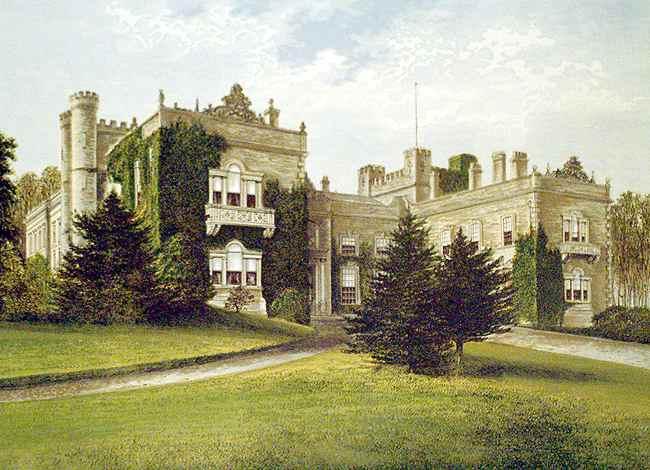
Aske Hall from Morris’s Seats of Noblemen and Gentlemen (1880).
Wikimedia Commons
Imagine having a tax even more stupid than the one generally agreed to be the most stupid ever?
Mansion tax inspectors will target homes with views of the countryside and driveways, The Telegraph can reveal.
The Government valuation agents will be sent out with a checklist of features supposed to signal an increase in a property’s estimated value.
They include whether the house is set in scenic surroundings, if it has a conservatory, and even the number of parking spaces and bathrooms.
It comes after The Telegraph revealed that HMRC agents will be able to demand entry to people’s properties to assess their value for the levy.
Sigh. So, the most stupid tax ever is generally agreed to be the Windows Tax. This led to people bricking up their windows in order to avoid the tax and therefore live in the dark just to middle-finger the revenue. Well, OK, giving the revenue the middle-finger is an honourable thing to do but still, forcing people to live in the dark and dank via your choice of taxation methods is generally agreed to be very stupid indeed.
The thing is this is not, in fact, the most stupid tax ever. This was actually a replacement — a less bad replacement — of the tax which went before. Which was the Hearth Tax. Window tax was under Willie III and it replaced the hearth tax of Charlie II — if you are unblessed by being English yes, C II was before W III.
The aim and intent was the same with both — tax those rich bastards with large houses. A mansion tax that is. But taxing hearths means getting into the house to count the number of hearths. Which then runs up against that Englishman’s home and castle and all that — basic civil liberties stuff. And, of course, the expense of a team of people going around to count fireplaces. And the protection thugs they’ll need when knocking on the door of Squire Haggard. So, not sensible, that. Plus, of course, people will reduce their tax bill by blocking up fireplaces and generally living worse, poorer and colder lives by doing so — but being able to middle-finger the taxman.
The windows tax was an advance on this. We still get the poncey rich bastards in their big houses but we can do so by a clerk walking down the street and counting. No civil liberties violations there and it’s hugely, vastly, cheaper.
Except, of course, we’ve now only got the second most stupid tax in all history.
And back to the present day. There’s that desire to tax the poncey rich in their big houses. So, they’re going back to the hearth tax. Instruments of the State get to invade the righteous castle and thereby — very expensively — tot up the tax. When what we actually want is a simple, from the street, method of valuing the big poncey houses.
60th Anniversary of Star Trek: A Very Brief Look Back
Feral Historian
Published 4 Sep 2026On September 8th 1966, Star Trek premiered and has since reflected shifts in American popular culture from the Vietnam era to today. It hasn’t always been good, but it has been a ride. Perhaps one that has come to an end.
00:00 Intro
04:32 A New Trek
06:15 Overlap
09:04 Stuck In Itself
10:00 Enterprise
12:37 JJ
13:28 Trek TodayThe link for Sean Munger’s video: • Star Trek and the Vietnam War (Part I)
Obviously this is not a statement of agreement with every point in that video.🔹 Patreon | patreon.com/FeralHistorian
🔹 Ko-Fi | ko-fi.com/feralhistorian
🔹 and Merch! | feral-shop.fourthwall.com
🔹 Oh, and book 2 of Stellar Drift is out. https://www.amazon.com/dp/B0GTVXK4CN
The high-water mark of Cancel Culture
This Noahpinion piece is from last year, but I hadn’t seen it before and I think it outlines fairly accurately why “we” allowed Cancel Culture to temporarily take over social media and cause so much personal damage to disfavoured individuals. It gave the mob the power to identify their own Emmanuel Goldsteins and drive them from the public sphere:
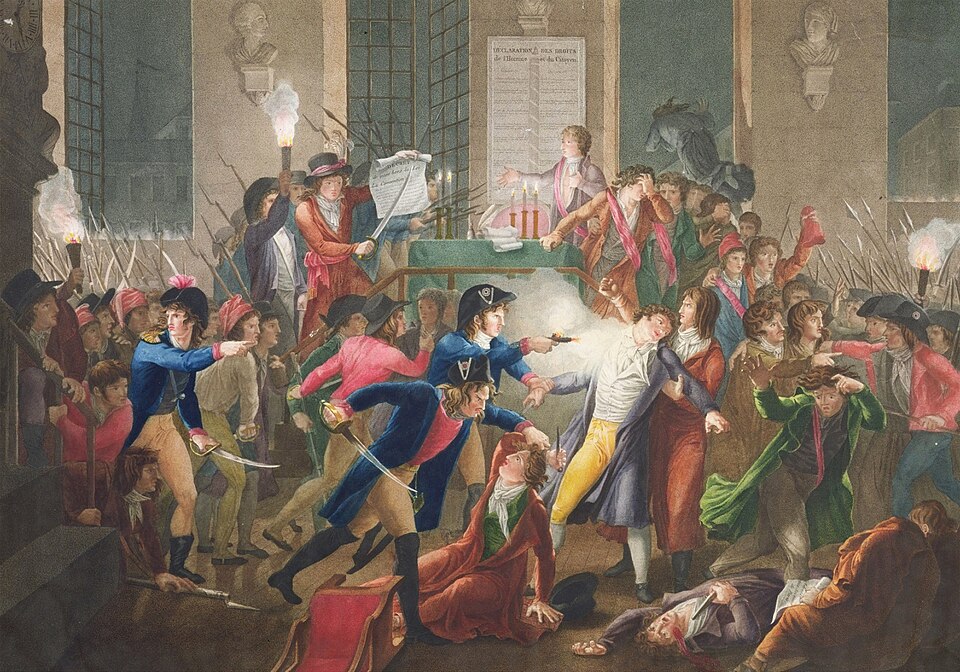
The Arrest of Robespierre, The Night of the 9th to 10th Thermidor, Year II, 27th July 1794
Colour engraving by Jean-Joseph-François Tassaert (1765 – ca.1835) via Wikimedia Commons.I think about this when I think about cancel culture.
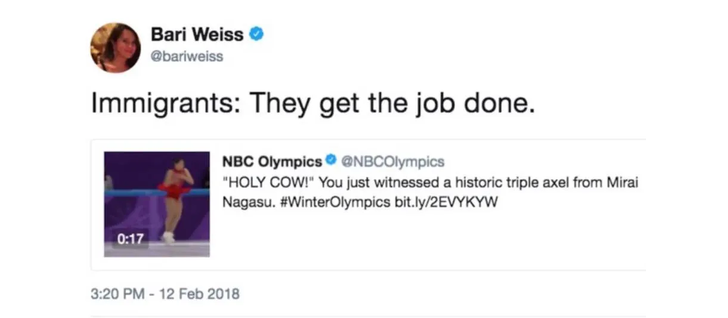
Back in 2018, Bari Weiss got dogpiled on Twitter for an anodyne liberal tweet. Weiss congratulated Olympic skater Mirai Nagasu on pulling off a difficult move, quoting a line from the musical Hamilton about immigrants being great:
Weiss was viciously attacked for this tweet by thousands of people who called her racist over the course of several days. Why? Because Mirai Nagasu isn’t actually an immigrant — she was born in the U.S. According to Weiss’ many attackers, Weiss’ statement implied that nonwhite people are perpetual foreigners.
That was, of course, complete hogwash. Nagasu’s parents are immigrants; the use of the term “second-generation immigrants” to describe the children of immigrants is utterly standard terminology in academic sociology. And by quoting a line from Hamilton in praise of a second-generation immigrant athlete competing on behalf of the U.S., Weiss was clearly advocating in favor of (nonwhite) immigration as something that makes America stronger — a very standard liberal viewpoint.
Whether this particular pile-on had long-term negative consequences for Weiss’ life isn’t clear, but she encountered an increasingly hostile climate at the New York Times, the paper where she worked, and eventually was forced to quit. It would have been reasonable for people observing that pile-on — and similar attacks directed at Weiss over the years — to conclude that speaking up is dangerous and that Twitter mobs hold a lot of real power.
The perception that cancel culture was the progressive H-bomb — an invincible weapon that could be fired any time at anyone who didn’t conform perfectly to a set of progressive mores that had only emerged a few years ago — reshaped much of American society in the 2010s. Every organization in the country, from knitting circles to romance novelist associations to sci-fi conventions, had its internal hierarchy disrupted by the fear that disgruntled or opportunistic subordinates would take their grievances online and summon the dreaded cancel-mob against their superiors.
Why was cancel culture both so powerful and so popular for those few years? The most obvious reason is that it worked. If you were a progressive in 2018 who really believed that calling a second-generation American an “immigrant” was racist, then you could often effectively strike at that person by raising a hue and cry about them on Twitter. Companies were afraid of boycotts, of course. But beyond that, the Gen Xers who ran those companies came from an age when having a thousand people yelling in your face meant that you were in grave danger; corporate managers would often cave out of pure fear of online negativity.
Another reason was that cancel culture was a quick route to online clout. As Eugene Wei wrote in his famous blog post “Status as a Service (StaaS)“, social media offers most people the opportunity to get much more social status than they have any hope of getting in their daily lives, if they happen to get lucky and go viral and become an influencer.
But to get that clout, you have to stand out. Attacking the same old progressive targets — Donald Trump, Republican senators, conservative influencers — is a low-yield activity, because the field is too competitive. Everyone attacks those people. But finding more novel targets for mob attack — like an NYT writer who calls a second-generation American an “immigrant” — can be a high-yield activity. It’s basically outrage entrepreneurship.
Of course, this means that there was an incentive for progressive purity spirals and tent-shrinking. If you’re a progressive looking for new people to denounce, the most tempting targets are probably center-left liberals who have heretofore been safe from cancellation. Hating Donald Trump is old news. But hating Matt Yglesias? That could get you some real attention!
And so the ranks of the online cancel-mobs were probably also swollen by people who participated in the mobs out of fear that if they didn’t, they too would be canceled. This gave rise to a phenomenon I call ponzi screaming — berating the person immediately to your right on the political spectrum, out of fear that if you don’t berate them, people further to your left will berate you. You have people like the progressive online shouter and failed Congressional candidate Will Stancil berating Nate Silver even as he gets frequently dogpiled and berated by leftists.
Between outrage entrepreneurship, purity contests, and ponzi screaming, late-2010s progressive cancel culture started to look like a farcical imitation of the French Terror or the Chinese Cultural Revolution. The stakes were obviously much lower — losing your job is a lot less bad than losing your head — but many of the social dynamics and behavior patterns were recognizably similar.
Rebates, Rabbets and Fillister Planes | Paul Sellers
Paul Sellers
Published 24 Apr 2026Sometimes we see planes and think that they are essential to our woodworking, but in reality, they might be more of a luxury than a necessity.
On the other hand, they can get us out of a bind, too.
I wanted to present my perspective on special planes designed to work on rebates that you might come across and question their worth to you. This video will help you make an educated decision.
——————–
(more…)
QotD: The first (of many) near-death experiences of William Marshal, the greatest knight
He would have been far from the first child to die on Stephen’s account, because at this point England was fourteen years into a civil war so brutal that the Peterborough Chronicle recorded that men “said openly that Christ slept” (þa sæden openlice ðæt Crist slep. ⁊ his halechen),1 but this time was different. This time, the king had to order the boy’s death himself.
The medieval English royal succession was never as neat as Crusader Kings mechanics would have you believe, but even so Stephen I (and only) was an unlikely king. His mother Adela was the youngest child of William the Conqueror. She had four older brothers, three of whom survived their father, and Stephen himself was the third of her sons. But the Conqueror’s eldest son, Robert Curthose, mortgaged his duchy of Normandy to fund his participation in the First Crusade and would go on to spend the decades after his return in comfortable captivity. His second son, Richard, was killed as a teenager in a hunting accident in the New Forest in 1070, and his third son, William Rufus, succeeded him as king, never married, and was also killed in a hunting accident in the New Forest (this time in 1100). If this seems suspiciously convenient, it was: the youngest brother, Henry, was also on the fatal hunting trip. He immediately rode hard for Winchester, where he was crowned three days later.
Henry I promptly married Matilda, whose father was the king of Scotland and whose mother Margaret (later canonized by Innocent IV) was the sister of Edgar Ætheling: Henry and Matilda’s son William, born in 1103, united the blood of the Norman conquerors and the old Anglo-Saxon House of Wessex. Their daughter, another Matilda, was sent off to Germany at the age of eight to marry the twenty four-year-old Holy Roman Emperor Henry V. And that was it: Henry I also fathered at least twenty-two attested bastards, but William and Matilda were his only legitimate children. Which meant that when a drunken helmsman wrecked the ship carrying William and at least three hundred other flowers of the Anglo-Norman nobility across the Channel, Henry was in deep trouble. Luckily for him, his daughter soon returned from Germany a childless widow and once he had remarried her to Geoffrey of Anjou he was able to browbeat his barons into accepting her as his heir. Unluckily for him, they didn’t mean it: Empress Matilda was deeply unpopular even beyond the fact that she was a woman, and as soon as Henry died they were happy to crown his nephew Stephen instead.
The ensuing civil war, known to history as “the Anarchy,” was exciting and dramatic and featured such moments as a king captured on the battlefield, a queen climbing out the window of a besieged castle and escaping through a snowstorm, and a teenage boy invading England with a mercenary army he couldn’t afford to pay. For our purposes, though, all you really need to know is that in 1152 Stephen laid siege to a castle in Berkshire that John Marshal, a supporter of Matilda, had built without royal authorization. (These are apparently called “adulterine castles“, which I think is delightful.) Marshal asked for a truce to consult with his constable and organize the garrison’s surrender and offered his youngest son William as a hostage for his good behavior. Stephen accepted, took the boy into his camp, and withdrew to let Marshal enter with his men.
And then John Marshal stayed in the newly-reinforced castle instead.
Using your children as diplomatic hostages was standard practice in this era. Abandoning them to be executed as punishment for your bad faith was definitely not. But when Stephen’s men told John Marshal that his son’s life would be forfeit for his treachery, Marshal is said to have replied that he didn’t care, because he still had “the anvils and the hammers to forge even finer ones”. Stephen was not, in the end, able to bring himself to kill young William: the story has it that he lost his nerve when the boy asked on his way to the gallows whether he could play with a guard’s spear “afterwards”, and then again when William happily climbed into the catapult they planned to use to send him over the walls to his father (he thought it was a swing). He did, however, remain a hostage in Stephen’s camp until the end of the war a year later.2
Our only source for this story of William’s childhood, and for most of the truly excellent stories medievalist Thomas Asbridge recounts in The Greatest Knight, is a 19,215 line rhyming poem in medieval French. Probably composed a few years after William Marshal’s death at the behest of his friends or children, and pretty well corroborated by other sources where other sources exist, the poem is our only surviving example of a medieval biography of a “normal” person. (Relatively speaking; that little boy grew up to be an incredibly accomplished man but neither a king nor a saint, which is who usually got written about.) Moreover, it seems to have been compiled from stories told by people who actually knew him — which probably means that he was the one who told them about the child who thought the catapult was a swing. The poem exists in only one manuscript,3 discovered by Paul Meyer in the late 19th century and published with partial translations into modern French as L’histoire de Guillaume le Maréchal. (You can find Meyer’s version here or here.) More recently, Nigel Bryant published a full English translation, the text of which isn’t available online, though I’ll point out that even Claude Sonnet does a pretty decent job with screencaps of the original.4
Jane Psmith, “REVIEW: The Greatest Knight by Thomas Asbridge”, Mr. and Mrs. Psmith’s Bookshelf, 2026-04-27.
- As a measure of the degradation of the times, the chroniclers’ English no longer employed grammatical gender.
The ⁊ is a Tironian note for “and”, incidentally, and halechen is obviously cognate with “hallowed”. Like and subscribe for more Old English in the least expected places.
- Stephen’s son and heir Eustace having died by this point, it was agreed that he would keep the English throne but be succeeded by Matilda’s son, the future Henry II, who had already conquered Stephen’s duchy of Normandy.
- Yes, like Beowulf. It’s depressing to realize how many incredible medieval texts survive in only one manuscript. Thank a Benedictine today!
- Claim not verified by anyone who actually reads medieval French, but I didn’t see any obvious errors.
September 4, 2026
Never discount the political muscle of “King Coal”
On the social media site formerly known as Twitter, John Ringo remembers when a friend of his accidentally discovered that “King Coal” is still a behind-the-scenes political factor that cannot be ignored:

Soooo, guy I knew in of all places National Guard in Florida.
He was taking a master’s in Optics at University of Central Florida. He had to do a paper. Just one of the random “do a paper” assignments you do in a master’s program. He’d heard that tailings from coal mines could be a bit suspect in terms of radiation. Not in his direct field but in “physics”. Good enough.
There’s a coal plant about 20 miles from Orlando. Goes out, goes to the big pile of tailings, sticks a Geiger counter probe in it, expecting a bit above background.
HOLY MOTHER OF ROENTGEN! THAT’S FREAKING HOT!
There’s a thin layer of ash over the tailings that isn’t and blocks most of the release. So, a Geiger counter casually waved over it, all good.
Stick a probe in and it’s a different story. It’s hot as the hinges of hell radioactively. (And quite a bit of that material is released by coal plants. Much more likely to cause lung cancer than smoking, btw.)
So, he writes up the paper and submits it.
Couple of weeks later, he’s called into his thesis advisor who sadly and shamefacedly tells him he’s being dropped from the master’s program.
“WTF?”
Enter the late and VERY unlamented Senator Robert Byrd. Byrd’s people had noses in every department everywhere and ANYTHING that MIGHT harm King Coal MUST be nipped in the bud.
Even a guy getting an Optics master’s who just happened to stick his probe in the wrong mound.
Ask me why the 1000 Nukes program was scrapped right after Nixon left office and why Byrd might just have been behind Watergate and performed essentially a coup d’état. (Or why Nixon pushed the Thousand Nukes Program for that matter.) Or why it’s taken so long for Small Modular Reactors to have any chance of getting off the ground. (“Technological advancements” is not the answer. We’ve been doing them for the Navy for 70 years.)
Biden’s “War on Coal” really pissed me off but along with natural gas it MIGHT have finally killed King Coal for good and all and that is something to heave a sigh of relief.
And following up to a question down-thread:
Absurdus – @AdAltum
How did a senator hear about a random paper from some random master’s student? How did he get him expelled from a program he was in?
“The Senator” probably never even heard about it. It was handled at a much lower level.
How did his people hear about it?
Byrd was Chairman of the Budget Committee and the Rules Committee as well as Chairman Pro Tem any time the Dems held the Senate (which was constantly up until Newt Gingrich.)
He was also “Chairman Emeritus” of the Energy Committee. He was on the committee despite being a previous chairman. (Because he was only allowed to chair two and Rules and Budget were more important.)
Energy provides funds to colleges for research. Budget approves it. That meant he had ears all over every college and research facility in the United States.
Say one bad thing about Coal and your days were numbered if you were some minor master’s candidate. Hell, adjunct professor.
You probably aren’t old enough or didn’t follow politics back then to know just how ruthless, corrupt and evil Byrd and his people were.
BTW: Probably also why Freeman Dyson lost his funding for bottle fusion in 1974.
Marius Saved Rome … Then They Turned To His Greatest Rival | Rome’s First Civil War
The Rest Is History
Published 3 Sep 2026What was the ancient city of Rome actually like in the first century BC? Who was Lucius Cornelius Sulla, another great, but aristocratic, Roman general who would clash with Gaius Marius in a totemic struggle termed the Social War? And, who were the terrifying Germanic tribes amassing on the borders of the empire, potentially spelling its doom …?
Join Tom and Dominic as they discuss Rome’s apocalyptic threat from the North, Marius’ wars in defence of the empire, and the rise of his greatest adversary: Sulla.
0:00 Rome’s Most Unlikely Saviour
4:25 The Barbarian Threat to Rome
9:15 Rome’s Catastrophic Defeat
14:04 Marius Rebuilds the Roman Army
16:48 Marius Takes on the Teutones
19:36 The Cimbri Are Annihilated
23:41 Marius Becomes Too Powerful
27:00 The Rise of Sulla
31:02 Sulla’s Ruthless Ambition
35:05 Amazon
36:15 The Extraordinary Wealth of Roman Italy
42:49 Italy’s Second-Class Citizens
46:18 The Social War Erupts
50:44 Rome Fights Back
52:35 Sulla Becomes Rome’s New Hero
56:05 A New War in the East
58:18 Mithridates Takes on Rome
1:02:00 Marius Makes His Comeback
1:04:39 Violence Erupts in Rome
1:07:01 Marius Takes Sulla’s Command
As Tom and Dominic mention during this episode, there’s a members-only bonus episode discussing the (much contested) “Marian reforms” of the Roman army with … Bret Devereaux who is a strong proponent of the notion that the Marian reforms were not a thing.
Loyalist Canada to Liberal Canada, a political devolution
On Substack Notes, John Carter discusses the old, stable Canada that the Liberals have spent sixty years trying to destroy, with great success, sadly.

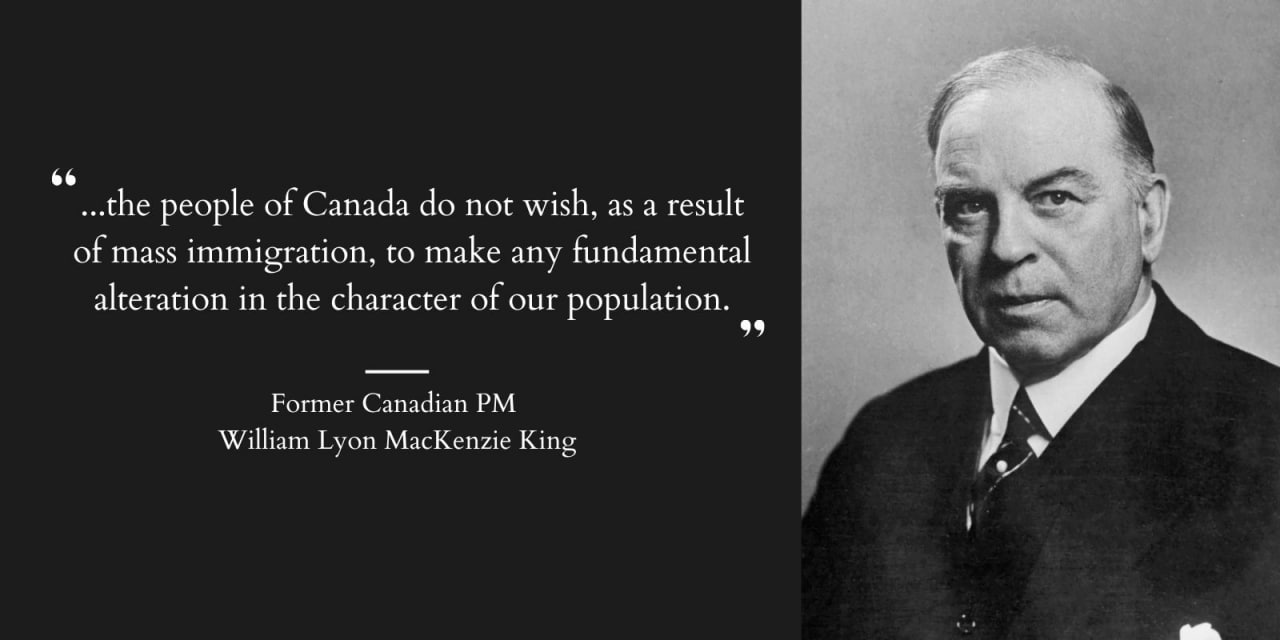
For all intents and purposes, post-1965 Liberal Canada is a completely different country from the Loyalist Canada that it erased. Different flag, different basis for moral legitimacy, different constitution even.
Liberal Canada loves to wear poppies on Remembrance Day, but this is stolen valour. Liberal Canada has never won a single war. Loyalist Canada won every war it fought in.
Liberal Canada built no great works. Most of the infrastructure of Canada was constructed before Liberal Canada. The Trans Canada Highway, the Trans Canada Railroad, the Pickering Nuclear Power Plant, the Toronto subway, the Montreal Metro — all were built or initiated by Loyalist Canada. Liberal Canada completed the projects that began under Loyalist Canada, but initiated none of its own, and at best can be said to maintain the infrastructure it inherited … badly. Liberal Canada cannot even build a pipeline to bring its oil to market. Liberal Canada cannot even refine its own oil.
Loyalist Canada built out an organizational infrastructure of Crown Corporations which were once the envy of the world. Liberal Canada dismantled them, giving us toll roads owned by foreigners.
Loyalist Canada built all of this infrastructure, and won all of those wars, without incurring a national debt. The national debt was accrued entirely by Liberal Canada, and is entirely a function of social welfare programs it uses to turn Canadians into domesticated clients of Liberal Party patronage, and indentured servants of the banks.
Then of course there are the demographics. Loyalist Canada was a white Canada, a British and French Canada, and a fecund Canada, with one of the world’s highest birth rates. Liberal Canada is a barren Canada, with one of the world’s lowest birth rates, and it has presided over the systematic replacement of the Canadian people with Indians, Chinese, Africans, and Muslims, to whom it moreover extends preference for social services, university admissions, and employment. Liberal Canada makes Canadians second class citizens in the land their ancestors built.
Liberal Canada is a parasitic entity that is rapidly killing its host. It is an exhausted Brezhnevian sclerocracy that destroys ambition because even the most modest of ambitions are a threat to the soft men, the mild bureaucrats and glassy-eyed ideologues who subsist on the arbitrage of national decline. Liberal Canada is weak, and so it demands that its subjects be even weaker, as this is the only way for weak men to rule.
Liberal Canada is not the real Canada, and Canadians are beginning to wake up from this long nightmare of mismanagement and institutionalized treason, and to remember who they are.
Making Shepherd’s Pie from an 1894 Recipe – Beef or Lamb?
Tasting History with Max Miller
Published 10 Mar 2026Minced beef filling covered in browned mashed potatoes
City/Region: North Ayrshire, Scotland
Time Period: 1894Cottage pie is made with beef, and shepherd’s pie is made with lamb. Or so they would have you believe. This division between mashed potato-topped meat pies is actually only about 50 years old. Before that, recipes for shepherd’s or cottage pie could call for beef or lamb, or didn’t specify a kind of meat at all.
The clove and the mushroom ketchup are both present but not overpowering, and the potatoes are creamy and delicious. Shepherd’s pie is my absolute favorite way to make meat and potatoes, and this 1894 version holds up.
Shepherd’s Pie
Minced beef or lamb; if beef, put in a pinch of pulverised cloves; if lamb, pinch of summer savoury to season it, very little pepper and some salt, and put in a baking-dish; mash potatoes and mix them with cream and butter and a little salt, and spread them over the meat; beat up an egg with cream or milk, a very little, spread it over the potatoes and bake it a short time, sufficient to warm it through and brown the potatoes.
— Irvine Herald and Kilwinning Chronicle, October 5, 1894
QotD: My generation
That’s why one of the weirdest things about getting older is realizing just how much of what you took for granted as part of the permanent furniture of the world was actually highly transient: The Iron Curtain. Guitar rock. Your own hopes and dreams and ambitions. Sometimes they all come wrapped together like a package deal, and failing at one makes it seem like you’ve failed at it all.
Andrew Potter, “Eddie Van Halen, Bill and Ted, and mourning a generation”, The Line, 2020-10-14.
September 3, 2026
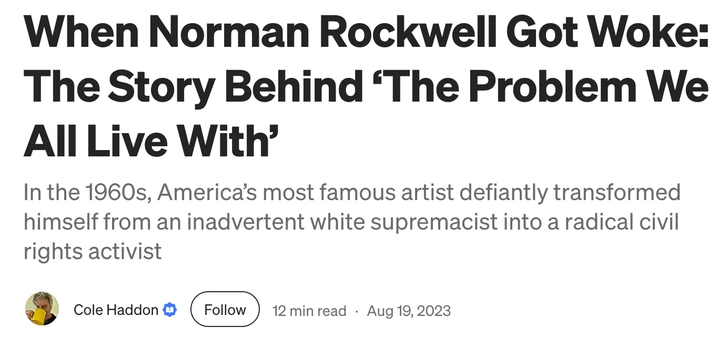
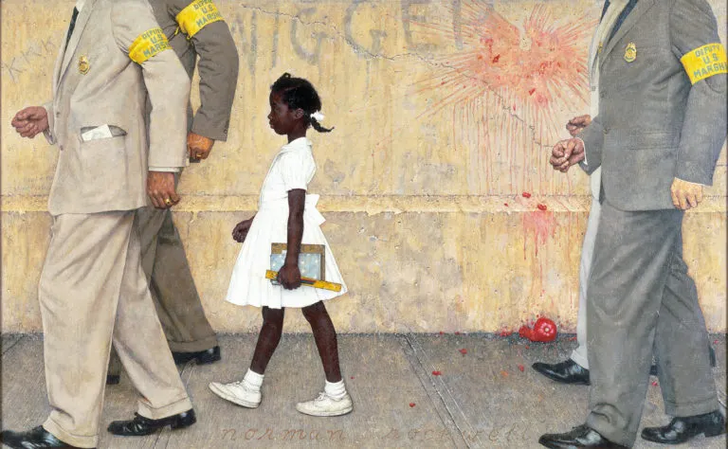
That problematic arch-conservative New-Dealer … Norman Rockwell?
Chris Bray was in Stockbridge Massachusetts recently and discovered that the notorious arch-conservative artist Norman Rockwell … supported the New Deal and FDR … which is unquestionably extreme-right, yet somehow “got woke” in the 1960s:
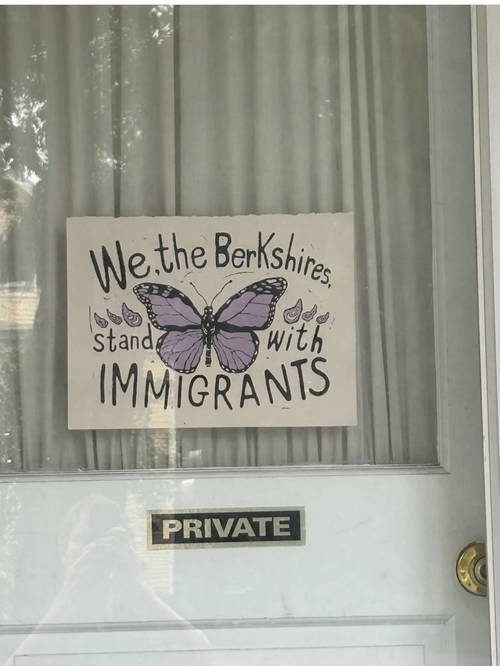
Stockbridge is in the (astonishingly pretty) Berkshires, where you can’t sell a latte or a $14 egg and cheese sandwich without a trans pride flag and a sticker in the window boldly supporting a woman’s right to choose and a “No Kings in America” sign and on and and on and on.
I’m an outsider, so they won’t show me the manual. But it’s a lot of virtue, signaled with a great deal of self-consciousness, and also there are a ton of German SUVs with New York license plates. Status status status. We stand with immigrants / new Mercedes.
Rockwell lived and painted in Stockbridge, and that’s … that’s … (ambiguous facial expression). He painted images that demonstrated a bone-deep fondness for America and Americans, especially small-town Americans, so he was a huge far-right figure, OBVIOUSLY, and also a major white supremacist, but maybe kind of accidentally a big Klan figure?
You can find this stuff everywhere: Rockwell’s name was “a symbol of an idealized, conservative, white American past”. Click on that link: It’s an essay that says Rockwell is known for an idealized conservative past, and it’s illustrated with a 1943 painting that celebrated FDR’s declaration that Freedom From Want is a basic freedom that that all Americans should enjoy. So, to wrap a bow around this amazing cultural artifact, Rockwell’s idealized conservative past was a celebration of the New Deal president’s declaration that government should assure material comfort for everyone. See, huge right-winger.
[…]
But Rockwell painted a massive quantity of routine shitlibbery alongside his depictions of small-town America as a place he didn’t despise, and, I’m repeating myself, several of his most famous paintings express his affection for that huge far-right figure Franklin Delano Roosevelt. He was a registered Republican who painted Democrats and Democrat political themes with great warmth, and also liked Ike, and then went on to paint important depictions of the Civil Rights Movement. So he’s … he’s … a huge Trumper who didn’t hate black people? Which lawn sign should we display about this? The past has to be sorted into the categories of right now, in ways that should feel comfortable to an NPR personality: This Thucydides person, was he a Trumper?
The just absolutely amazing leftist discourse about Rockwell is that he changed: He used to be a brutal Republican Nazi like ORANGE MAN, but then he turned into a good person. These essays tend to have the subtlety of a claw hammer to the face. Go read this example at the reliably boneheaded Vox, which describes Rockwell’s “late-life political transformation” and says that the “tumultuous ’60s would convert Rockwell into an overt social liberal”. He turned from right to left! He became good! See, he had an “awakening!”
The reason all of this confuses them is that Rockwell was a social type that no longer exists: a liberal Republican who thought that America had flaws that needed fixing, but who also at the same time loved the country and loved its people. He was sort of center-left on some stuff and center-right on some stuff, and culturally attuned to a nation that he viewed fondly. He liked FDR and the Four Freedoms and he personally liked Eisenhower, who had him over for dinner.
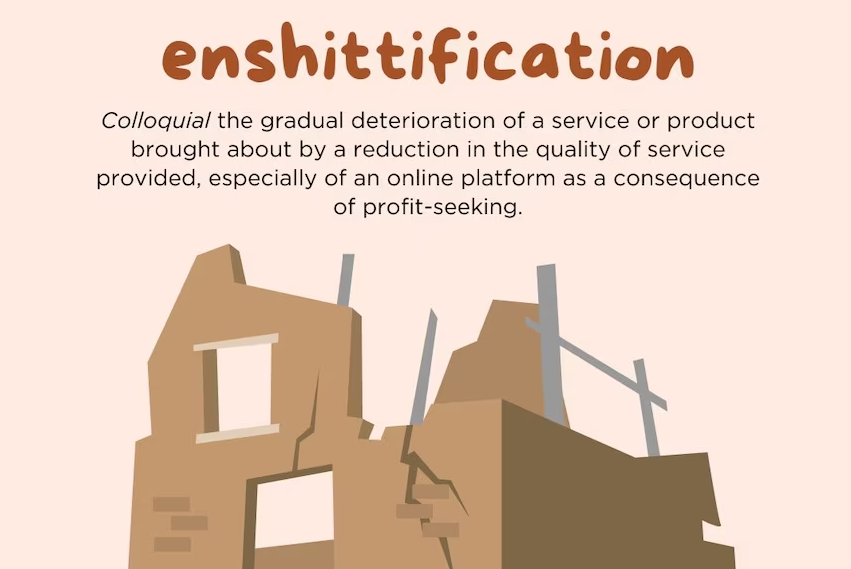
Enshittification of technology today
On his Substack, Ted Gioia provides nine rules to measure technological innovation based on the work of the late Wendell Berry:
(1) The new tool should be cheaper than the one it replaces.
This is a very persuasive selling point for new technology. And for most of my life, tech companies worked hard to lower prices.
I still recall my parents scrimping and saving in order to buy a color television when I was seven years old. It cost almost $500 — a huge amount in those days.
They probably should have waited. A few months later, RCA dropped prices to $399. Prices continued to drop in later years. You can buy a high tech TV today at Best Buy for less than what my parents paid in the 1960s.
Computers also got more affordable — at least until recently. I got my first computer (an Apple IIE) when I was in graduate school — it was an expensive gift from the Boston Consulting Group in exchange for accepting their job offer.
The list price back then was $1,400. I could never have afforded to buy it on my tight student budget.
But, over a period of many years, each subsequent computer I acquired was better and cheaper than my previous model. Alas, that happy trend has now ended.
[…]
(2) It should be at least as small in scale as the one it replaces.
This is another good reason to upgrade your setup. And tech did get smaller for many decades.
Guess who played a key role in that? Yes, Steve Jobs again. Because of his obsession with product design, we now carry a huge amount of advanced tech in our pocket.
Just consider this remarkable fact: Every device featured in this Radio Shack advertisement from 1991 has been replaced by your tiny phone.
But this, too, changed soon after Jobs died. (Are you noticing a pattern here?)
The thinnest iPhone ever was the iPhone 6 (2014) — at a slim 6.9mm. The company continued to launch “mini” models for a few years, but stopped after iPhone 13.
Tech is now bulking up. It’s not just the devices — wait until you see those AI data centers. A single facility can spread over two kilometers.
(3) It should do work that is clearly and demonstrably better than the one it replaces.
This is the most obvious requirement for new tech. It needs to work better than old tech.
But Silicon Valley has totally abandoned this ideal. Every web interface I use has gotten worse over time — from search engines to social media to software to shopping apps.
Google is worse than ever. Social media is worse than ever. Amazon is worse than ever. Facebook is worse than ever. Everything I get from Microsoft is worse than ever.
So here, too, we see that new tech previously fulfilled Berry’s requirement — but stopped doing so around the time Steve Jobs died.

John Carter reports on “the largest gathering of Canadian nationalists in generations”
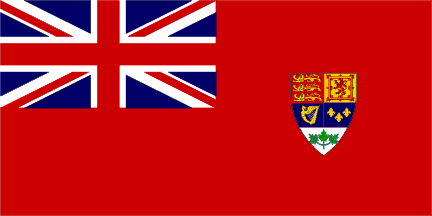
Canadian Red Ensign 1921-1957
Having been peripherally involved in party politics in Canada since the mid 1970s, I hope you’ll forgive my occasional bout of cynicism about getting political change in this country through peaceful means … the long comfortable decades under the US nuclear umbrella has allowed Canadian political parties to get ever more unserious and willing to pretend that taking a two-and-a-half generations-long vacation from the world of realpolitik has been somehow our birthright. I love my adopted homeland and it is distressing to see how easily the Liberal propagandists (supported by the state-funded relic media) can get elbow-flapping choruses of Canadian boomers to chant the slogans and blandly accept the grand theft from their children and grandchildren without a blush of shame.
John Carter says there may still be hope that enough Canadians have recognized the awful situation we’re in and are willing to do what’s necessary to change our collective ways and get back onto a path of constructive nationalism rather than the tame opposition of the current Conservative Party:
I don’t want to overstate things, but I think this was an historic moment.
It was also a hell of a ride.
The Dominion Society was founded barely over a year ago, and rapidly exploded to over three thousand members across the country. It is a peaceful and explicitly non-partisan political advocacy group dedicated to advancing the cause of remigration within Canadian civil society. So far its activities have consisted mainly of selling branded merchandise, putting up posters, cleaning up parks, rallies to oppose Canadian towns from tearing down statues of Sir John A MacDonald and Samuel de Champlain, and a whole lot of social media campaigns.
To anyone in possession of some shred of sanity, all of this would seem to be entirely unobjectionable and non-threatening. To the Canadian government, which long ago released its hold on the last tenuous threads of sanity, this is a five-alarm political fire. They are, it seems, terrified of the Dominion Society to the point of hysteria.
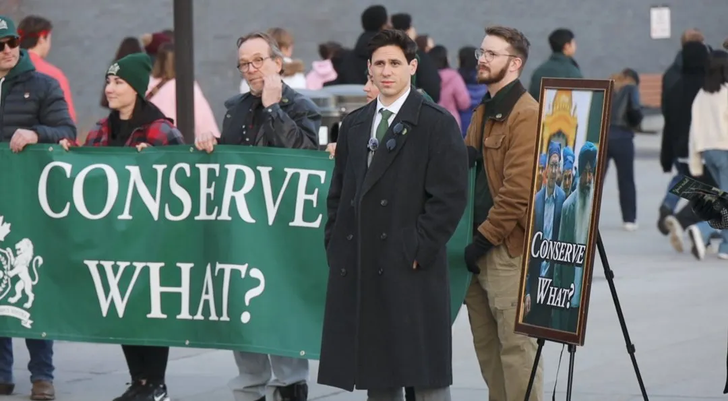
Until recently the Canadian media – which by virtue of a generous state funding apparatus is de facto state media – has for the most part done its best to ignore the Dominion Society, treating it as an irrelevant collection of disgruntled kids who aren’t worth reporting on. That isn’t to say that the political class was not aware of DomSoc. Their founder, Daniel Tyrie, showed up at the Conservative Party conference several months ago with a number of supporters, trolling the Conservative Party of Canada with a big “Conserve What?” sign outside the front door of the venue, showing a picture of CPC leader Pierre Poillievre wearing a Sikh temple hat during one of his many ethnic pandering junkets. The CPC very much noticed this, and were not impressed.
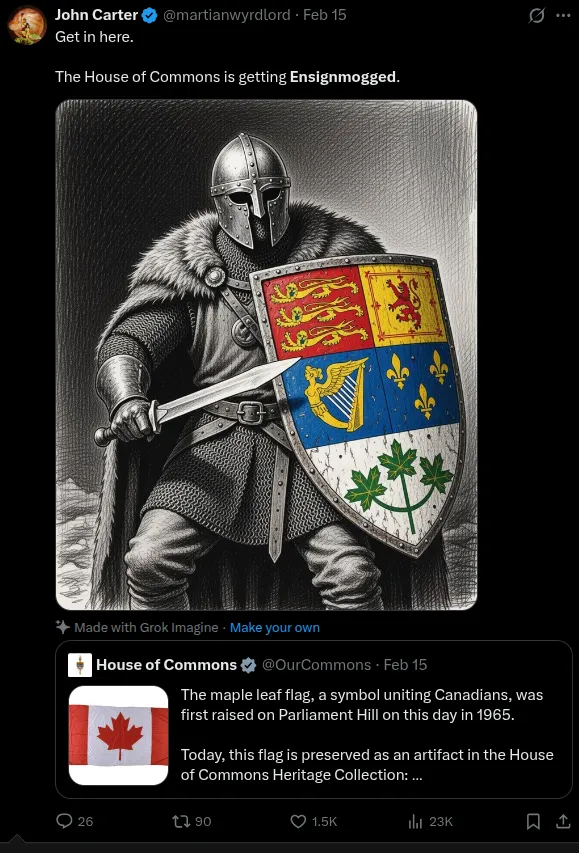
Since then Tyrie and his supporters have sparred with various CPC politicians on X, ratioing them on a fairly regular basis. On February 15th, the Flag Day that marks the 1965 transition from the original Canadian flag to the Maple Leaf, the House of Commons account got thoroughly ensignmogged by a swarm of Canadian nationalists declaring that the Red Ensign was their real flag.
Seriously, just look at the replies and quote tweets. An unending sea of red ensigns.
The flag day ensignmogging was a remarkable eruption of nationalist energy, and it’s very difficult to imagine that the Canadian government has not noticed the sudden popularity of the Red Ensign and the Canadian shield as symbols of Canadian nationalism. This use of these discarded symbols makes Canadian politicians palpably anxious. They have spent many decades patiently erasing Canada’s past in order to socially engineer the wild colonials into the universal economic subject, and the revival of ethnically particular medieval heraldry signals something stirring within the deep recesses of the mass psyche. The natives are restless. Old and terrible gods are awakening.
The question of course is what they can do about that. So far the answer has been “not much that matters”. It would be one thing if the Dominion Society was a bad optics skinhead cult called the White Reich Front or something, brandishing sonnenrads on their shield walls as they formed up for street battle with Trantifa. This would be easily dealt with as something obviously frightening and foreign. But the Dominion Society is none of these things. It is named the Dominion Society, as in the Dominion of Canada – Canada’s official, full name, being a Dominion of the British Crown. Its symbolism draws upon Canada’s own traditional symbolism, symbols that are indeed still quietly used by the Canadian government itself, and it is therefore quite impossible for the regime to characterize DomSoc as something frightening and foreign on aesthetic grounds alone. Worse still, DomSoc is very smart about how it operates. They don’t march through the streets shouting and getting in fights: they’re polite and friendly, focusing on media activism and political pressure campaigns. Their messaging stays strictly within legal boundaries. Their over-arching goal is direct and simple: to popularize the concept of remigration, normalizing it as a topic in the national conversation, such that voters will begin spontaneously raising the issue with politicians: “If we can bring people in, why can’t we send them back? Planes fly in any direction.”
Canada’s “softer, gentler, more inclusive, more sensitive” cadet movement
I was in the army cadets from 1972-76. We were still wearing British-style battledress uniforms rather than the CF Green delivery driver uniforms, but we weren’t in cadets for the pseudo-scouting experience … we wanted to be army cadets. Not long after I left cadets for the reserves, the leadership vision changed to (I assume) make cadet organizations more “inclusive”, as John Carter describes:
This unfortunately isn’t new. I was in Army Cadets back in the 90s. Even then female fatbodies in the adult officer corps weren’t unknown, and cadets was coed.
I didn’t actually mind the coed aspect at the time, I picked up a lot of my hs gfs through cadets. What I did mind was how ridiculously soft it was. Weapons training, in particular, was essentially impossible to obtain unless you joined the marksmanship team (which I did for that specific reason), and even then they only gave us ancient Lee-Enfields with .22 inserts. We did a lot of camping and rucking, including in winter, which was great, but aside from the exercises being on army bases and conducted in combat fatigues using old surplus kit, there was almost nothing to mark it out as military in character. Nor for that matter was there anything in the way of physical conditioning.
I wasn’t the only one annoyed by that. The kids who joined cadets wanted to be little warriors. They wanted to crawl through mud with a knife clenched between their teeth, they wanted to get emotionally abused as they struggled through obstacle courses, and they wanted to handle firearms. There was a rumor that all of us had signed an agreement that in event of war, if the rest of the military had been wiped out, we could be called up for the last line of defence. I doubt that was true but we thought it was the coolest thing.
Instead, the only cadets who were allowed to handle C7s were the honour guard, who were issued (rubberized) rifles before parades.
Unfortunately it didn’t matter what the cadets themselves wanted. The adults had decided that softer, gentler, more inclusive, more sensitive was the name of the game. I didn’t make the connection with the presence of female cadets at the time, though in retrospect that’s obvious. What was obvious to me at the time however was that this was all downstream of liberal females aghast at the very concept of a militarized youth, and weak men who couldn’t tell the females to shut their fool mouths.
As an epilogue, when I turned 17 I joined the Army Reserve, only to discover that this infernal feminine softening had long since infected the military, as well.

The cadet Lee-Enfields firing .22LR were an important part of our weapons training … although due to a weird bit of timing, the very first rifle I ever fired was a full-size .303 Lee Enfield that seemed to have enough kick to push me right out of the rifle pit when I fired it (I was small for a 12-year-old). We hadn’t yet learned about hearing protectors, so my ears were ringing for about an hour after the range trip.


