
Forgotten Weapons
Published 22 Apr 2026The M26 Modular Accessory Shotgun System (MASS) was designed by C-More Products company as a new shotgun option for the US military. First prototyped in 1999, it was not actually adopted until 2012, but had been purchased in significant numbers since then. The idea is that the M26 can function as either a standalone weapon or attached under the barrel of an M4 Carbine, thus replacing a couple of different items in inventory. It weighs just 3.5 pounds in the under barrel configuration, significantly less than the Masterkey system, and is much more convenient for a breacher to carry than an M4 along with a separate Mossberg 500.
The M26 is a bolt-action 12ga shotgun that feeds from both 3- and 5-round magazines. It has folding integrated aperture sights and is envisioned for use in a wide variety of roles. Military ammunition supplies include #7.5 and #9 birdshot, classic #00 buckshot, rubber buckshot, rubber slugs, and breaching rounds (powdered metal in a wax binder). For use with breaching, the M26 includes a retractable breaching muzzle device.
September 9, 2026
M26 MASS (Modular Accessory Shotgun System)
QotD: Subordinate officers in pre-modern armies
[B]efore we go any further, we need to clarify what we mean by this term “officer”. Militaries, as I have stressed before, recreate their civilian social institutions; since different societies have different institutions, that produces differences in the division of class structure.
One of the key divides that shows up repeatedly is the division between commoners elevated to positions of minor authority and aristocrats in positions of command. Indeed, we have this in our modern armies: this is the distinction between non-commissioned officers (NCOs) which are generally soldiers promoted from the lower ranks and commissioned officers who enter the military typically at the rank of lieutenant (or its equivalent). That system is a hold-over from the origins of modern military structure in Europe’s early-modern gunpowder armies: the commissioned officers (whose commission, to be clear, came from the king) were drawn from the aristocracy and often the nobility, while their non-comissioned subordinates were drawn from the common soldiery who were in turn recruited from the peasantry. Because no peasant could become a knight or noble (under normal circumstances) so too no sergeant could (under normal circumstances) become a lieutenant; the social orders were thus kept separate, civilian mirroring military.
But exactly where that divide occurs and its significance varies wildly. In the modern military structure, a second lieutenant, the lowest commissioned officer, typically commands a platoon of c. 40 soldiers while a sergeant typically leads a squad or section (around 10 soldiers). By contrast in the Roman army, the centurion – a senior NCO like the sergeant promoted from the common soldiers – led a century of 60-80 soldiers; more senior centurions (the primi ordines) commanded an entire cohort (480 soldiers). So the line between NCO and commissioned officer can be drawn in very different places in different societies.
Likewise an important distinction is often made around the emergence of a professional officer class (following on the emphasis made on this point by Samuel P. Huntington in The Soldier and the State (1957)) and the officers who came before which Huntington describes as “amateurs”. This is, I’d argue, a mistaken understanding of the role of military aristocrats in their societies; they were no more amateurs at war than a person born into serfdom is am amateur farmer. Neither the serf nor his military aristocrat overlord is a professional, but neither of them is an amateur either; the categories are not exclusive. Nevertheless there is a difference between truly “amateur” officers (which certainly existed), military aristocrats for whom war is a born-calling, and professional officers.
For this discussion, however, much of this complexity is beside the point. That isn’t to say it is unimportant generally (it is very important generally) but that for this topic here, we can define “officer” very broadly and so avoid having to untangle the particular social context of each military in question. Consequently we’re going to just define officer here as anyone who has command over other combatants, effectively lumping NCOs and commissioned officers (and their ancient equivalents) together. That isn’t because those distinctions are unimportant (they are important!) but because they aren’t quite relevant here, since we are really focused on how command structures enable armies to respond with ability and execute complex plans. It is command, not social status per se that we’re focused on.
Bret Devereaux, “Collections: Total Generalship: Commanding Pre-Modern Armies, Part IIIb: Officers”, A Collection of Unmitigated Pedantry, 2022-06-24.
September 8, 2026
We should stop using the terms “capitalism” and “capitalist”
On his Substack, Lorenzo Warby returns to the issue of how we describe the (theoretical) predominant economic system by which the west has risen to wealth and power using terms coined by the man who hated it more than any other:
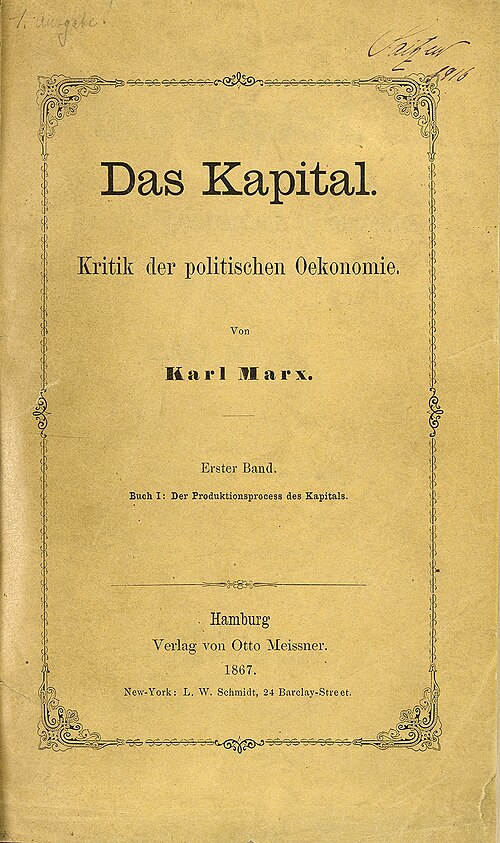
Title page of Das Kapital in the first German edition of Volume 1.
Wikimedia Commons.
It would be a great improvement to our understanding of social dynamics if people stopped using the terms capitalism and capitalist. Given how ubiquitous these terms are, this may seem a strong claim, but it is one that is easy to sustain.
The Marxist definition of capitalism is:
The socio-economic system where social relations are based on commodities for exchange, in particular private ownership of the means of production and on the exploitation of wage labour.
According to Wikipedia:
Capitalism is an economic system based on the private ownership of the means of production and its use for the purpose of obtaining profit.
The first problem is the ism. There is no role for the state here. The state becomes, implicitly or explicitly, a “reflection” of the economic system, despite the fact that people do not describe non-state societies as “capitalist” even though such societies can have lots of private ownership used for the purposes of gaining income.
Non-state societies cannot manage the scale of economic activity so as to have, for example, firms. Their economic production is overwhelmingly centred on households.
Sedentism — living in dwellings — created households that then became, for millennia, the centre of most economic activity. Even states were governed out of royal or imperial households. It is factories, and offices, that move economic activity out of households.
The mass energy-use take-off we call the Industrial Revolution has brought the arc of economic history that began with sedentism to an end. When economist Robin Hanson writes about the shift from farmer “back” to forager patterns, it is the effects of the supplanting of households from the centre of economic activity that he is pointing to (without fully grasping that).
Note that this shift away from households being central to economic activity is very much about energy use: it applies to both commerce and to state activity (including state production). It is not inherently “capitalist”.
State production also produces commodities: calling such “state capitalism” just shows how much capitalism is a ridiculously protean term.
Eliding the state
The exclusion of the state in defining capitalism is not analytically benign. A classic and continuing use of the term capitalism is to romanticise the state. By viewing the state as a “reflection” of the economic system, all bad things, all disliked features, can be based on the malign influence of “capitalists”, of the dynamics of “capitalism”, with the state reduced to an instrument or reflection of such dynamics. (The same thing can be done in reverse, blaming all bad things on the state — see anarcho-capitalism — but that is much less common.)
The natural — and used — implication of blaming private commerce for all bad things is that, if good people, with good intentions, and proper understanding, run the state, it can do anything needed for their program to be achieved. This is very obvious if one, for example, reads the program of the Democratic Socialists of America.
The term capitalism thereby becomes a vehicle for getting the state profoundly wrong; for not understanding that the state is a fundamental structuring feature of any state society; for not understanding that, across history, states have been the dominant extractor and creator of surplus, and so of class structures. That, when it comes to state societies, the state itself is fundamental.
Sulla Seized Rome… Then Marius Returned for Revenge | Rome’s First Civil War
The Rest Is History
Published 7 Sep 2026What shocking, unprecedented act did Sulla commit with his legions after having his ambitions frustrated once more by his bitter rival, the tribune Marius? How did Marius escape capture and death? And, would Marius retaliate …?
Join Tom and Dominic as they unfold the mounting rivalry between two Roman generals — Marius and Sulla — as they battle for ultimate control of the empire, and Sulla takes a fateful step that will change the fate of the Republic forever …
0:00 Sulla: The First Roman General to March on Rome
4:31 Marius Seizes Sulla’s Command
11:47 Sulla Marches on Rome
19:50 Mithridates: Rome’s Great Enemy in the East
23:25 The Massacre of the Romans in Asia
26:46 Athens Revolts Against Rome
30:34 Rome’s Generals Become Warlords
34:38 Pressure
35:46 Marius: Fugitive and Outlaw
41:02 Rome Descends Into Political Violence
45:13 Marius Raises a Private Army
48:15 Marius Returns to Rome
49:06 Marius’s Seventh Consulship and Death
51:44 Sulla Goes to War in Greece
53:40 The Siege of Athens
56:59 Sulla Storms Athens
59:51 Sulla Faces Mithridates’ Army
1:00:48 Sulla Makes Peace with Mithridates
1:03:33 Sulla’s Revenge on Athens
1:04:58 Rome’s First Civil War Looms
The legacy of Top Gear
I’m not really a “car guy” … I’ve generally driven pretty unexciting vehicles and don’t have a burning desire to own a “supercar” or even a “sports car”. Yet I always enjoyed being able to catch an episode of BBC’s Top Gear, which was usually years and years after that particular episode had been originally aired. There’s lots of YouTube channels that serve up Top Gear clips and even some multi-episode supercuts. It may well have been the only “car show” whose primary audience were not “car guys”:

The original Top Gear that launched in 1977 was a useful programme. The 2002 reboot, cooked up by Clarkson and producer Andy Wilman, was something else: a studio with a live crowd, a mute racing driver in a white suit called The Stig, celebrities sent around a track in a “reasonably priced car”, and three presenters who treated cars as punchlines, characters and passports.
When James May replaced Jason Dawe in series two, the chemistry locked. Clarkson was the loud, power-obsessed ringmaster. Hammond was the sharp witted, enthusiastic hamster who would try anything. May was Captain Slow, the pedant with the soul of an engineer. Their arguments weren’t bits. They felt like three mates who actually liked each other and enjoyed winding each other up. The show became a sitcom that happened to have supercars in it.
Cars stopped being appliances. They became the excuse for “how hard can it be?” challenges, £1,500 sports cars that immediately exploded, races against trains and boats and planes, and specials that sent three middle-aged men across Botswana, Vietnam, Bolivia, Patagonia and the Arctic. The cinematography — helicopter shots, dusk light, engines echoing off mountains — made a car show look like cinema. People who had never cared about torque curves suddenly cared about whether Hammond would survive the next cheap-car challenge.
The numbers were absurd — In the UK it regularly pulled six million-plus viewers and peaked near seven or eight million. At its height it was the BBC’s most valuable commercial property, worth tens of millions a year in overseas sales, DVDs, tours and merch. The UK version was sold into 170-plus countries. BBC figures put the cumulative worldwide audience around 350 million people — not every week, but over the life of the show, an astonishing reach for a programme that started as a poky little motoring magazine.
Sunday night became a ritual. Families who couldn’t name a camshaft still sat down together. Kids who would never own a Veyron learned what one sounded like. People in countries with no British TV tradition quoted “POWERRRR,” “Oh, cock,” and “Some say …” as if they were local slang.
They invented the template everyone still copies — Look at YouTube car culture. Cinematic reviews. Personality-first presenting. Budget road trips with mates. “We bought three terrible cars and drove them across a continent.” That whole language exists because Clarkson, Hammond and May made it look like the most fun job on earth, years before every 22-year-old had a gimbal and a channel. Writers have argued, not unreasonably, that for a generation they mattered more to car enthusiasm than many of the great manufacturers. Ask a random person to name someone famous associated with cars. They will not say Enzo Ferrari. They will say Jeremy Clarkson.
They also made loving cars socially normal. You didn’t have to be a garage hermit. You could be a bloke who liked engines and jokes and scenery. The specials doubled as travel films. A lot of people booked flights to Vietnam or Botswana because three idiots on BBC Two made the world look reachable.
The impact wasn’t just ratings. It was companionship. For more than a decade, millions of people had three familiar voices in the living room every week. Bad day? Cheap-car challenge. Need wonder? Polar special. Need to laugh at human incompetence? Almost any episode. The friendship on screen — real enough that it survived crashes, controversies, a BBC firing and a move to Amazon — made the show feel like hanging out with people you knew.
They were messy. They caused diplomatic incidents. They said things that would not survive a modern compliance meeting. That is part of why they felt like television from a different era: three men who were allowed to be large, rude, authentic, sentimental and ridiculous in the same hour. When they finally signed off from The Grand Tour, it really did feel like the end of something that television no longer quite knows how to make.
And on that bombshell …
Why The Soviet Union Lost In Afghanistan
Real Time History
Published 3 Apr 2026In February 1989, the last Soviet combat troops leave Afghanistan after almost a decade of war. Despite military superiority, the superpower was not able to establish a stable Moscow-friendly regime in the country. Yet, the mujahedeen are also deeply divided and influenced by outside forces such as Pakistan, Saudi Arabia, and Osama Bin Laden.
(more…)
QotD: Why the revolution envisioned by Marx didn’t happen
The prescriptions of The Communist Manifesto were in any case singularly unappealing to the industrial workers they were aimed at. Marx and Engels called for the abolition of private property; the abolition of inheritance; the centralization of credit and communications; the state ownership of all factories and instruments of production; the creation of “industrial armies for agriculture”; the abolition of the distinction between town and country; the abolition of the family; “community of women” (wife-swapping); and the abolition of all nationalities. By contrast, mid-nineteenth-century liberals wanted constitutional government, the freedoms of speech, press, and assembly, wider political representation through electoral reform, free trade, and, where it was lacking, national self-determination (“home rule”). In the half-century after the upheaval of 1848 they got a great many of these things — enough, at any rate, to make the desperate remedies of Marx and Engels seem de trop. In 1850 only France, Greece, and Switzerland had franchises in which more than a fifth of the population got to vote. By 1900 ten European countries did and Britain and Sweden were not far below that threshold. Broader representation led to legislation that benefited lower-income groups. Free trade in Britain meant cheap bread, and cheap bread plus rising nominal wages thanks to union pressure meant a significant gain in real terms for workers. Building laborers’ day wages in London doubled in real terms between 1848 and 1913. Broader representation also led to more progressive taxation. Britain led the way in 1842 when Sir Robert Peel introduced a peacetime income tax; by 1913 the standard rate was 14 pence in the pound. Prior to 1842 nearly all British tax revenue had come from the indirect taxation of consumption via customs and excise duties, regressive taxes that take a proportionately smaller amount of your income the richer you are. By 1913 a third of revenue was coming from direct taxes on the relatively rich. In 1842 the central government had spent virtually nothing on education and the arts and sciences. In 1913 those items accounted for 10 percent of expenditures. By that time, Britain had followed Germany in introducing a state pension for the elderly.
Marx and Engels were wrong on two scores, then. First, their iron law of wages did not exist. Wealth did indeed become highly concentrated under capitalism, and it stayed that way into the second quarter of the twentieth century, but income differentials began to narrow as real wages rose and taxation became less regressive. Capitalists understood what Marx missed: that workers were also consumers. It therefore made no sense to try to grind their wages down to subsistence levels. On the contrary, as the case of the United States was making increasingly clear, there was no bigger potential market for capitalist enterprises than their own employees. Far from condemning the masses to immiseration, the mechanization of textile production created growing employment opportunities for Western workers — albeit at the expense of Indian spinners and weavers — and the decline in the prices of cotton and other goods meant that Western workers could buy more with their weekly wages. The impact is best captured by the exploding differential between Western and non-Western wages and living standards in this period. Even within the West the gap between the industrialized vanguard and the rural laggards widened dramatically. In early seventeenth-century London, an unskilled worker’s real wages were not so different from what his counterpart earned in Milan. From the 1750s until the 1850s, however, Londoners pulled far ahead. At the peak of the great divergence within Europe, London real wages were six times those in Milan. With the industrialization of northern Italy in the second half of the nineteenth century, the gap began to close, so that by the eve of the First World War it was closer to a ratio of 3:1. German and Dutch workers also benefited from industrialization, though even in 1913 they still lagged behind their English counterparts.
Niall Ferguson, “Capitalism, Socialism and Nationalism: Lessons from History”, 2020-02.
September 7, 2026
“Don’t forget to like and subscribe!”
Along with the earlier post on the recent steep decline in basic literacy, here’s Christopher Gage discussing the same phenomenon of younger Brits’ increased dependency on videos while also demonstrating reduced verbal skills. A mere co-incidence, we can be sure:

La Cigarette by Henri Lebasque (1921)
A friend of a friend of a friend — a primary school teacher — reckons her pupils spend so much time glued to screens that they speak in YouTube English.
Rather than greet one and other with “Hello” they say, “Hi, guys! Welcome to my channel!” When saying goodbye, it’s “Don’t forget to like and subscribe!” Apparently, these little dopamine fiends cannot endure one moment without suckling on the eternal teat of Mother iPad. With their scrolling fingers they tear the pages in strange, ad-free artefacts once known as “books”. Reader, I don’t know if this little fable is entirely true or some semblance of the truth. But it rings truer than false.
Am I being facetious? Not really. The British government, in a rare bout of usefulness, conducted a study into screen-time amongst primary school children. That recent study by the education department found that the more a child spends scrolling on a screen, the less good their vocabulary be.
Please excuse that example of mongrelised English. Then again, perhaps we should call it Future English given that, in just a few years, the YouTube kids will speak in that very bastardised tongue.
According to a bleak wave of childhood study, spending hours tethered to screens quite literally dissolves learning. Researchers found that the “heavy users” — a term usually reserved for heroin addicts — recalled significantly fewer words from a list than their less addicted peers. These screen-addled sprogs spend more than five hours chasing that dopamine dragon. In Plain English, them don’t talk good and shit. At least when compared to their mates who spend less than one hour on a screen. Them kids know more words and shit.
They asked kids to recall words from a list of 34. The ones double-stitched to iPads upwards of five hours daily recognised barely half the words whilst their peers recalled two thirds. Eighty-six minutes. That figure represents the tipping point between literacy and a life talking in the mangled English of a failed rapper.
The study arrived at a rather chilling conclusion: If a child spends over an hour and a half each day thumbing through brain-bleaching bilge on YouTube, their grasp of language withers faster than a doormat outside a crack den.
Of course, these are hyper-sensitive times. The researchers keenly doled out the old “correlation doesn’t imply causation” disclaimer mandatory in a neurotic culture which treats truth like hazardous waste. And who am I to judge? The ability to express one’s thoughts isn’t utterly essential. The development of language — I’m sure a Foucault-addled academic might agree — is elitist and racist and sexist and ableist and all that.
And so, I am intensely relaxed about this brave new world in which the brains of the next generation dissolve in a swamp of TikTok reels and YouTube videos. There is nothing to worry about. This is progress. And progress must always progress. Words are just words and you can still talk good and shit without knowing them words in them things that don’t even have videos on them pages.
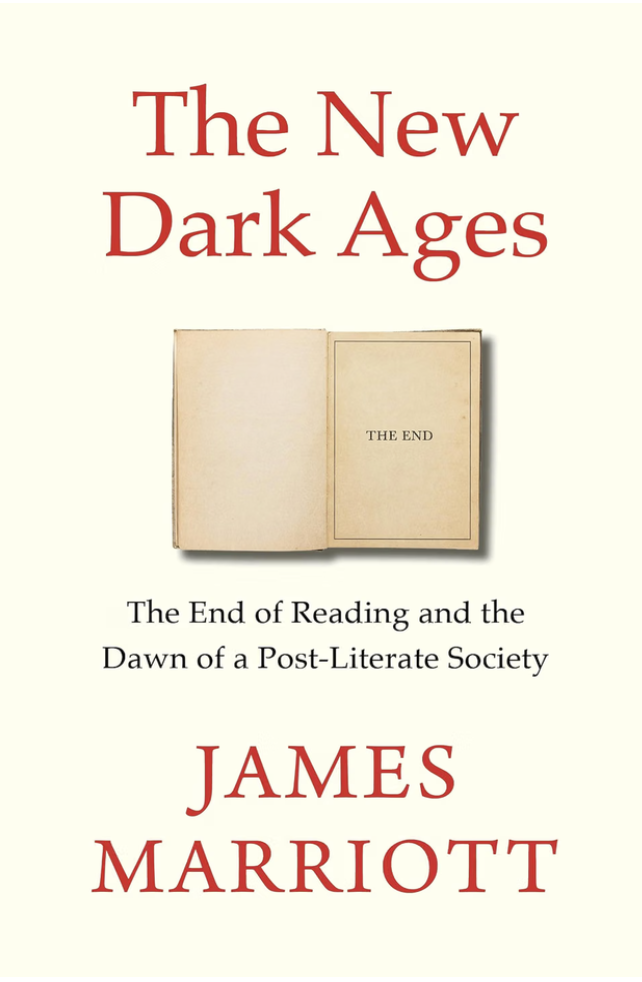
The New Dark Ages by James Marriot
Ed West reviews James Marriot’s The New Dark Ages, which covers issues that are certainly of deep concern to parents as GenZ and Gen Alpha appear to have almost completely abandoned literacy in any written form:
I’m not the only parent who feels increasingly anxious about their children’s media diet. For teenage boys in particular, entertainment often comes in the form of YouTube, which for any adult briefly glancing at the screen seems to feature an array of thumbnailed gawping imbeciles, besides an invitation to watch the latest work of creativity: “I took a bath full of Diet Coke and Mentos” or “I cemented a microwave to my head”. In comparison to this, the mindless television I watched in the 1990s seems as narratively complex as Dostoevsky.
Most of all, it’s notable that many children aren’t reading anymore, and it’s steadily become a topic of interest among fellow parents, then worry, and now panic. It’s impossible to ignore the fact that something quite bad is happening.
Every catastrophe needs its Jeremiah, and for this we have Times columnist James Marriott, whose increasing anxiety about the decline of literacy was articulated in a hugely popular substack post last year. Having written extensively about how no one reads books anymore, he decided to turn the subject into a book, The New Dark Ages, published this week.
I wouldn’t call the book “urgent” because I usually take that to mean “worthy scolding by an ideological ally”; it’s entertaining, informative, often amusing and makes a coherent case in 50,000 or so words, which many of us can still manage. But the implications he lays out are disturbing, and influence everything around us.
James and I have become friends over the past couple of years, drawn together by a mutual sense of despair, and he’s probably the only person in journalism even more pessimistic than I am. If you believe the media to be a circle-jerk of people helping their mates (which it is, obviously), bear that in mind, but reading his prose one gets a sense of how likeable as well as articulate he is, even if born in the wrong decade. His upbringing will seem as alien to those raised in the coming years as the world of Boethius would have been to Alfred the Great.
Literature was our religion: the way we explained and interpreted our lives. As a child I quickly learned that every possible event — from a major bereavement to a minor playground contretemps — could be cross-referenced against a novel by Thomas Hardy or a poem by Philip Larkin. There was a quote for everything. I was dragged off to Shakespeare plays at what now strikes me as a rather cruelly young age (“if you’re not enjoying it”, I remember my dad telling me, “you can just read your book instead”). We worshipped pretty much all the canonical English poets but in our pantheon of literary saints, Shakespeare was Jesus or, more probably, God.
We celebrated his birthday every year with a homemade cake and in the holidays we were taken on solemn pilgrimages to Stratford-upon-Avon. I recall that I was once presented with a Shakespeare-themed stuffed bear (it was wearing a t-shirt with a quotation from Hamlet).
Such a veneration for the written word naturally made him sensitive to disturbing stories about declining literacy that began circulating around the turn of the decade. “The first rumours that something important was happening reached me via friends working in universities”, he writes: “I came close to going into academia myself (though I don’t think the world is a poorer place for the loss of my proposed PhD on landscape imagery in post-war British poetry)”.
Anecdotes were soon backed up by data, showing significant declines in reading comprehension among students, as well as an even sharper drop in the number of adults and children reading for pleasure. The chief suspect seemed obvious: it’s the phones. (Everything’s “the phones”). Yet the more Marriott looked into it, the more he came to believe that the real transformation came with television, as Neil Postman had warned in his 1985 polemic Amusing Ourselves to Death.
“Postman believed that the rise of TV — with its bias towards triviality and charismatic personalities — was beginning to undermine the kinds of reasoned and productive public discourse on which a civilised democracy depends. He was dismissed by some of his critics as a crank and a Luddite. The passing of time has revealed that he was a prophet.”
The Backbone of the Nazi Panzer War – Panzer III
World War Two
Published 5 Sep 2026The Panzer III was intended to become the backbone of Nazi Germany’s panzer divisions. Emerging from clandestine Weimar-era experimentation and formally developed from 1934, it combined mobility, a five-man crew, a three-man turret, and comprehensive radio communication in one highly effective prewar design.
In this episode, Spartacus follows the Panzerkampfwagen III from secret German-Soviet tank trials at Kama through its production and deployment in Poland, France, North Africa, and Operation Barbarossa. We examine its evolution from the 3.7 cm gun to increasingly powerful 5 cm weapons, the advantages provided by crew specialization and radio-coordinated warfare, and why the Soviet T-34 and KV-1 exposed its diminishing margins in armor and firepower.
By 1943, the Panzer III had been displaced as Germany’s principal gun tank by the more adaptable Panzer IV. Its chassis, however, found an extraordinarily productive second life beneath the Sturmgeschütz III. The Panzer III was not a failed tank. It was an effective prewar design overtaken by an armored arms race it lacked the capacity to survive. Its fate also reflected Nazi Germany’s wider strategic failure: it had built weapons for short campaigns, then unleashed a coalition war whose demands exceeded Germany’s resources.
Watch our episode on the Sd.Kfz. 251: • The Halftrack That Made Blitzkrieg Possibl…
Watch Ten Days in Sedan: • Ten Days in Sedan
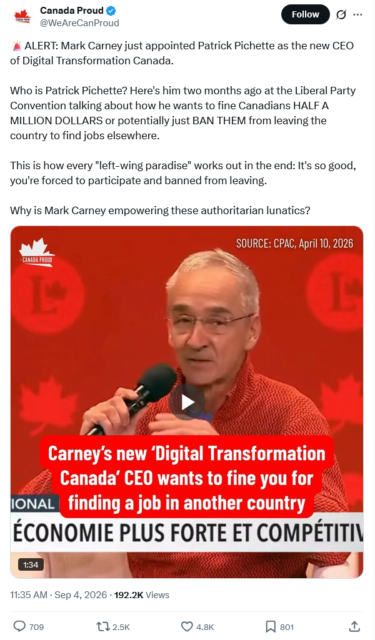
An “exit tax”? What next, internal passports?
A few months back, there was a brief online reaction to the Liberal Party idea of imposing a ridiculously high “exit tax” on young Canadians taking jobs in other countries — and by “other countries” they really only meant the United States. I dismissed it at the time as just someone letting their Liberal freak flag fly … but:
Jesus Christ. These boomer leaflibs, man.
It doesn’t occur to him to ask why highly trained Canadian engineers would rather work in the US. Actually no, he tacitly admits this: they get paid more. Why is that? Why can’t they get paid well in Canada, putting their skills to work here, developing innovative, world-leading technologies right at home in Canada?
The answer is obvious. Because there is no opportunity in Canada. It’s all but impossible to develop high tech industry here. The regulations are too thick, and all the available investment capital gets sucked up into real estate development.
Maybe Canada should try and fix that, so that Canada is actually an attractive country for talented young Canadians?
But nah fuck those kids, we should just charge them a half million dollar exit tax so if they can’t pay that they can just let their dreams die and get a job at BMO.
Oh and at the same time we should flood Canada with “world leading talent” (from Calcutta), in order to make it that much more impossible for Canadian engineers to find employment in their fields at home.
The Ancient Greeks 05 – The Greeks Fight Back 3 – Plataea
seangabb
Published 31 Mar 2026Greece: A Brief History, c.700 BC – 500 AD
How was the Persian invasion finally defeated on land?
In this lecture, we examine the final phase of the Persian invasion, culminating in the decisive Greek victory at the Battle of Plataea in 479 BC. After the withdrawal of Xerxes, a large Persian army remains in Greece under the command of Mardonius. Through diplomacy and force, he attempts to break Greek resistance — but fails.
We explore:
– Persian diplomatic strategy and the offer to Athens
– The reoccupation and second destruction of Athens
– The mobilisation of the Spartan army under Pausanias
– The Battle of Plataea and the destruction of the Persian land forces
– The simultaneous Greek victory at MycaleThis lecture shows that Salamis was not the end of the war, but the beginning of a final, decisive Greek victory on land and sea.
QotD: “Knackered”, “shattered”, and other useful Britishisms
The surprised expressions caught me off guard at first. “Blimey!” and “Crikey!” initially felt theatrical coming out of my mouth, as if I were performing in a period drama. But they’ve grown on me. There’s something deeply satisfying about a good “blimey” when you’ve just discovered the cost of your heating bill (although, if I’m honest, my partner would be far more expletive about it).
Then there are the words that capture concepts and objects I didn’t even know I needed:
Faff — The act of fussing around with something, whether it’s organizing (like a “bag faff” when you’re rearranging everything in your bag) or just messing about when you should be just getting on with it. [NR: “Faffing about” is a regular bit of my vocabulary — I picked it up from my wife’s uncle on our first trip back after we got married.]
Cheeky — That delightful word for something (or someone) playfully impudent. A cheeky pint. A cheeky biscuit. A cheeky comment from a cheeky child. Americans don’t have an equivalent that carries the same affectionate mischief. [NR: I use the word occasionally, but only in the “cheeky comment” sense. I suspect the other usages developed after we came to Canada.]
Chinwag — A chat or conversation, usually informal and friendly. “Having a chinwag over tea.”
Wheelie bin — A bin with wheels, which is exactly how I explained it to my sister-in-law when she asked what one was. Somehow it sounds less depressing than “trash can” when you’re dragging it to the kerb in the rain, though I can’t explain why. [NR: My cousin in Edinburgh used this term and we laughed ourselves silly … but it’s a useful phrase as wheelie bins are much more common here now.]
Bits and bobs — Covers all those miscellaneous things better than any American phrase. “I need to pick up some bits and bobs” is so much more charming than “I need to run errands”. [NR: I use this phrase all the time, also referring to accessories, jigs or associated “bits”.]
Picky bits — Those yummy nibbles you put out before a meal or during drinks. Americans would say “appetizers” or “snacks”, but “picky bits” is somehow more fun and less formal.
Lashings — A generous amount of something, usually used with food. “Lashings of butter” sounds so much more indulgent than just “a lot of butter”.
A lie in — Sleeping in, staying in bed late. “I had a lovely lie in this morning” sounds so much more luxurious than “I slept in”.
When I’m pleased about something, I’m chuffed to bits. It’s the British equivalent of my American “tickled pink”, though somehow “chuffed” sounds a bit less old-fashioned. When something’s gone wrong, I’m gutted — which is just more emotionally accurate than “disappointed” when your team loses or your train’s been cancelled. When someone’s being ridiculous, they’re a pillock (an insult that somehow sounds almost friendly).
Daft has replaced “stupid” in most contexts because it’s softer, more affectionate, somehow. Posh carries weight that “fancy” just doesn’t. And I’ve learned that “taking the mick” means teasing someone, though I’m still not entirely confident I’m using it right.
Pants can mean trousers, underwear, or that something’s rubbish (as in “that film was pants”) — that was a confusing first month trying to figure out which meaning applied when.
Speaking of films — it’s always a film, never a movie, and you see them at the cinema, not a movie theater. I still slip up on this one regularly. Pro tip: when browsing Netflix or BBC iPlayer in the UK, search for “films”, not “movies”, or you’ll come up empty-handed.
Dodgy covers everything from suspicious strangers to questionable leftovers. When something’s sorted, it’s all taken care of. My spouse uses “lovely” for everything from a cup of tea to a sunset to the bins being collected on time.
When it’s cold outside, it’s not just chilly — it’s parky. When I mentioned it was “a bit parky” on a call with my family, they immediately asked, “So that means you wear a parka when it’s parky?” Fair question, honestly.
When it’s very windy, it’s blowing a hoolie — which sounds far more dramatic than “blustery”, and right now with Storm Amy hitting the UK, it’s particularly relevant (I hope my readers in Scotland are all ok).
When a place is packed, it’s chocker. The pub’s chocker. The motorway’s chocker. It works for everything, where Americans would say “packed” for a pub or “bumper to bumper” for traffic. These words just have more personality than their American equivalents.
The car vocabulary is starting to creep in, and I have to think about it more now. The boot sometimes wants to replace “trunk”. The bonnet makes sense when I hear it instead of “hood”.
And then there’s reckon, which occasionally slips out instead of “think”. I’m trying to hang onto my Americanisms for as long as I can, but it’s getting harder to resist.
Marianne Jennings, “Squeaky Bum Time and Other British Phrases I Never Knew I Needed”, An American’s Guide to British Life, 2025-10-05.
September 6, 2026
Scientific American used to be a respected science publication
A few years ago, it became clear that Scientific American had been captured by the woke gender warriors, but as ESR points out, the publication had been somewhat in the hands of propagandists for much longer than that:

I was once a Scientific American subscriber. I loved that magazine; reading it was one of the highlights of my month. I canceled, and wept for what the magazine was becoming, when they published a theme issue that was a transparent political hit job.
Sounds like current news? No. That was 40 years ago. The hit job was on the Strategic Defense Initiative. Reagan was in the White House.
And I … I couldn’t figure out why nobody was saying the obvious in public. That SciAm had been sock-puppeted by a Soviet influence operation desperate to keep the US from exploiting its technological advantage.
Ideological capture of the scientific establishment is not a new problem. As much as I hate the Communists behind it, I’m even angrier with all the scientists who averted their eyes and never pushed back while the capture was going on. Our civilization gave them a position of high status, privilege, and trust. A priori I don’t think we were wrong to do that — until they failed in the duty that went with that trust.
It’s difficult for me to express how personally painful I found this. I revered research scientists as a child and young man — I could not imagine any higher calling than to be one myself. Until they betrayed civilization, and in the process betrayed me.
So, this isn’t a new problem. What’s new is that the post-2014 woke insanity has made it too obvious to miss.
It’s time for a dissolution of the monasteries. The culture of science, to the extent it is transmitted forward, must learn a harsh and terrible lesson about the consequences of allowing scientific neutrality to be abandoned for a mess of politics.
Henry Deringer’s Remarkable Percussion Pocket Pistols
Forgotten Weapons
Published 15 Apr 2026Henry Deringer Jr was born in Easton PA in 1786 to German parents. As a young man he apprenticed to a gunsmith, then spent 1808 working in the Virginia Manufactory making guns, and then opened his own business in 1809 at 612 North Front Street in Philadelphia. He remained there until his death in 1868, making a great many guns. Early on his work was largely in flintlock muskets, both for the Army and the commercial trade, but he became best known for his single-shot percussion pocket pistols. These guns became synonymous with his name, a feat not even accomplished by Samuel Colt.
Deringer’s pistols were available in a range of caliber from .31 to .50, but .41 was most common. Barrel length was also widely variable, from barely over an inch to 4 inches or more — but between 2 and 2.5 inches was typical. These were popular guns for self defense, easily carried in a coat pocket and generally sold in pairs. A flintlock of such a size was just unfeasible to conceal in a pocket, but the advent of the percussion system made these guns eminently practical. Obviously the most famous use of one was in Booth’s assassination of President Lincoln, but the guns were very popular before that.
In addition, Deringer became a part of trademark law when he filed suit against a sales agent, A.J. Platt, in San Francisco. Platt handled his inability to get enough pistols from Deringer to meet demand by setting up production of his own copy, complete with the marking “Deringer Philadel”. Deringer’s trademark infringement case was successful, and created a precedent for awarding a judgement based on the lost revenue suffered by the plaintiff — in Deringer’s case, $1,700 instead of his initial demand for $15,000.
Incidentally, Platt’s response after losing the case was to find a man in Philadelphia named “Derringer” and license his name, so that he could continue to make guns that his customers would not recognize as being counterfeits. This would be the basis for a further lawsuit today, but Deringer died in 1868 before pursuing the issue farther.
(more…)


