
England is the most class-ridden country under the sun. It is a land of snobbery and privilege, ruled largely by the old and silly. But in any calculation about it one has got to take into account its emotional unity, the tendency of nearly all its inhabitants to feel alike and act together in moments of supreme crisis. It is the only great country in Europe that is not obliged to drive hundreds of thousands of its nationals into exile or the concentration camp. At this moment, after a year of war, newspapers and pamphlets abusing the Government, praising the enemy and clamouring for surrender are being sold on the streets, almost without interference. And this is less from a respect for freedom of speech than from a simple perception that these things don’t matter. It is safe to let a paper like Peace News be sold, because it is certain that ninety-five per cent of the population will never want to read it. The nation is bound together by an invisible chain. At any normal time the ruling class will rob, mismanage, sabotage, lead us into the muck; but let popular opinion really make itself heard, let them get a tug from below that they cannot avoid feeling, and it is difficult for them not to respond. The left-wing writers who denounce the whole of the ruling class as “pro-Fascist” are grossly over-simplifying. Even among the inner clique of politicians who brought us to our present pass, it is doubtful whether there were any conscious traitors. The corruption that happens in England is seldom of that kind. Nearly always it is more in the nature of self-deception, of the right hand not knowing what the left hand doeth. And being unconscious, it is limited. One sees this at its most obvious in the English Press. Is the English press honest or dishonest? At normal times it is deeply dishonest. All the papers that matter live off their advertisements, and the advertisers exercise an indirect censorship over news. Yet I do not suppose there is one paper in England that can be straightforwardly bribed with hard cash. In the France of the Third Republic all but a very few of the newspapers could notoriously be bought over the counter like so many pounds of cheese. Public life in England has never been openly scandalous. It has not reached the pitch of disintegration at which humbug can be dropped.
George Orwell, “The Lion And The Unicorn: Socialism and the English Genius”, 1941-02-19.
November 15, 2021
QotD: Britain at war
November 14, 2021
Axis and Allies Both Invade France – WW2 – 168 – November 13, 1942
World War Two
Published 13 Nov 2021Operation Torch goes off this week, the Allied invasion of French Northwest Africa, but this prompts the Germans to invade Vichy France. This is the Allies’ first combined major offensive in the Western Hemisphere. The Germans launch another offensive of their own this week, though — Operation Hubertus in Stalingrad. And in the South Pacific, a major naval battle begins off Guadalcanal.
(more…)
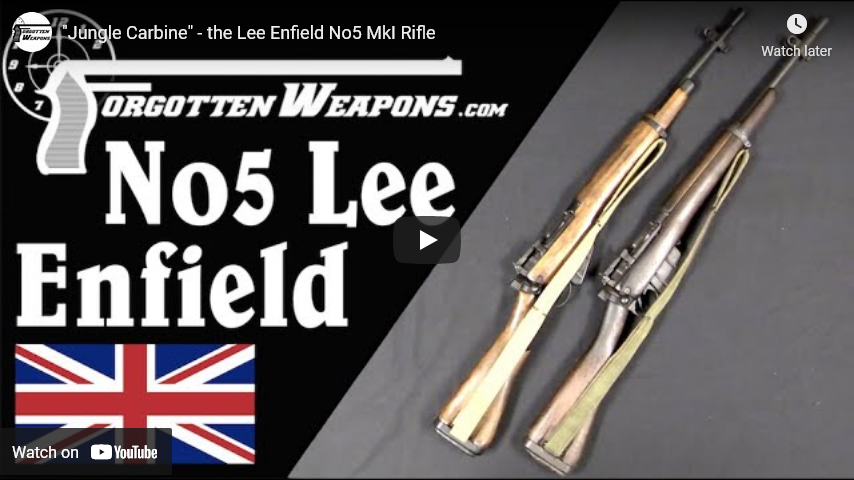
“Jungle Carbine” – the Lee Enfield No5 MkI Rifle
Forgotten Weapons
Published 4 Aug 2021http://www.patreon.com/ForgottenWeapons
https://www.floatplane.com/channel/Fo…
Cool Forgotten Weapons merch! http://shop.forgottenweapons.com
Today I am concluding our series on the standard-issue Lee Enfield system with the No5 MkI — the “jungle carbine”. Developed in 1943 as a shorter and handier pattern of rifle than the No4, the carbine went into production in 1944 and saw use during World War Two. It featured a number of lightening cuts, as well as a shortened barrel, conical flash hider, side-mounted sling, 800-yard sights, and rubber buttpad. Unfortunately, the No5 was beset by a problem of “wandering zero”. A significant number of the rifles failed to properly hold zero when they were widely issued. The problem was never fully resolved, but appears to have been the result of receiver flex due to the lightening cuts. Efforts to fix it were essentially abandoned, as it was recognized that a new self-loading rifle was going to be adopted soon, and it would be a waste of time and money to continue development of the Lee Enfield by that point.
Contact:
Forgotten Weapons
6281 N. Oracle 36270
Tucson, AZ 85740
November 13, 2021
Here’s Looking at You, Bill – The Secret Preparations for Operation Torch – WW2 – Spies & Ties 10
World War Two
Published 12 Nov 2021To smooth the way for the Allied invasion of French North Africa, Operation Torch, a massive spy operation is set up in 1941 and 42.
(more…)
Creation of Israel
The Cold War
Published 1 Jun 2019Our series on the history of the Cold War period continues with a documentary on the creation of Israel, Zionist movement, reactions and diplomatic maneuvers of other states and the build-up to first Arab-Israeli war
Consider supporting us on Patreon: https://www.patreon.com/thecoldwar

November 12, 2021
Armored Vehicles of Operation Torch Pt. 1, by the Chieftain
World War Two
Published 11 Nov 2021Chieftain returns to the North African theatre to talk us through the armored fighting vehicles in action around the time of Operation Torch. This episode is part one of two with Chieftain covering the German and Italian vehicles. Here, Chieftain looks at everything from the fearsome Tiger to the nemesis of LRDG: the Sahariana.
(more…)
November 11, 2021
In memoriam
A simple recognition of some of our family members who served in the First and Second World Wars:
The Great War
 Private William Penman, Scots Guards, died 16 May, 1915 at Le Touret, age 25
(Elizabeth’s great uncle)- Private Archibald Turner Mulholland, Argyll & Sutherland Highlanders, mortally wounded 25 September, 1915 at Loos, age 27
(Elizabeth’s great uncle) - Private David Buller, Highland Light Infantry, died 21 October, 1915 at Loos, age 35
(Elizabeth’s great grandfather) - Private Harold Edgar Brand, East Yorkshire Regiment. died 4 June, 1917 at Tournai.
(My first cousin, three times removed) - Private Walter Porteous, Durham Light Infantry, died 4 October, 1917 at Passchendaele, age 18
(my great uncle) - Corporal John Mulholland, Argyll & Sutherland Highlanders, wounded 2 September, 1914 (shortly before the First Battle of the Aisne), wounded again 29 June, 1918, lived through the war.
(Elizabeth’s great uncle)
The Second World War
- Flying Officer Richard Porteous, RAF, survived the defeat in Malaya and lived through the war
(my great uncle) - Able Seaman John Penman, RN, served in the Defensively Equipped Merchant fleet on the Murmansk Run (and other convoy routes), lived through the war
(Elizabeth’s father) - Private Archie Black (commissioned after the war and retired as a Major), Gordon Highlanders, captured at Singapore (aged 15) and survived a Japanese POW camp
(Elizabeth’s uncle) - Elizabeth Buller, “Lumberjill” in the Women’s Land Army in Scotland through the war.
(Elizabeth’s mother) - Trooper Leslie Taplan Russon, 3rd Royal Tank Regiment, died at Tobruk, 19 December, 1942 (aged 23).
Leslie was my father’s first cousin, once removed (and therefore my first cousin, twice removed).
For the curious, the Commonwealth War Graves Commission the Royal British Legion, and the Library and Archives Canada WW1 and WW2 records site provide search engines you can use to look up your family name. The RBL’s Every One Remembered site shows you everyone who died in the Great War in British or Empire service (Canadians, Australians, New Zealanders, South Africans and other Imperial countries). The CWGC site also includes those who died in the Second World War. Library and Archives Canada allows searches of the Canadian Expeditionary Force and the Royal Newfoundland Regiment for all who served during WW1, and including those who volunteered for the CEF but were not accepted.
In Flanders fields the poppies blow
Between the crosses row on row,
That mark our place; and in the sky
The larks, still bravely singing, fly
Scarce heard amid the guns below.We are the Dead. Short days ago
We lived, felt dawn, saw sunset glow,
Loved and were loved, and now we lie
In Flanders fields.Take up our quarrel with the foe:
To you from failing hands we throw
The torch; be yours to hold it high.
If ye break faith with us who die
We shall not sleep, though poppies grow
In Flanders fields.Lieutenant Colonel John McCrae, MD Canadian Army Medical Corps (1872-1918)
QotD: War and human capital
The blame for this is always put on Hitler and that’s a good place to start, but the Germans had a brain power problem throughout the planning layer. This is obvious in how they went about making tanks. Instead of going for a tank that was cheap and easy to produce by a civilian workforce, they tried to build tanks that were complex and required specialists to produce. The effects of allied bombing raids were amplified by this strategic blunder in production planning. This is a very basic error in planning and execution.
One possible cause of this was that the middle-aged men who would have been sorting these production and design problems had died during the Great War. The German army tended to “use up” their units, rather than cycle them in and out of lines. That meant that a lot of experience with supply and logistics was lost in the trenches. The British and the Americans rotated units in and out of the lines, thus they came out of the war with a vast number of people with experience in the nuts and bolts of war fighting.
The current ruling class needs the Germans to be seen as the ultimate in super villains, but the truth is the Germans were dumb about a lot of important things. The Russians came up with sloped armor, for example, and the Germans never bothered to steal the idea, even after Kursk. The Germans got their hands on the Churchill tank, but never bothered to learn anything from it. They never learned from the Americans how to use communications to coordinate their artillery and their armor.
In many respects, the story of the tank in the war is a great proxy for the story of human capital and cultural intelligence. The Germans had the best trained military on earth, but they lacked human capital in the strategy and tactics layer. Either the culture was unable to produce it or there was simply not enough smart people to create the necessary smart fraction. That was ultimately why Germany was wiped from the map. It’s probably why no new culture has arisen from that place on the map either.
The Z Man, “Tanking It”, The Z Blog, 2019-03-01.
November 10, 2021
Wives – What Soldiers Left Behind – WW2 – On the Homefront 012
World War Two
Published 9 Nov 2021With men away at the front, couples have to separate and manage the struggle of war on their own. For women who stay at home, this is not any easier than for the man: worry, longing, loneliness, meaningless sex, the temptation of falling in love with others – it is an emotional rollercoaster.
(more…)
November 9, 2021
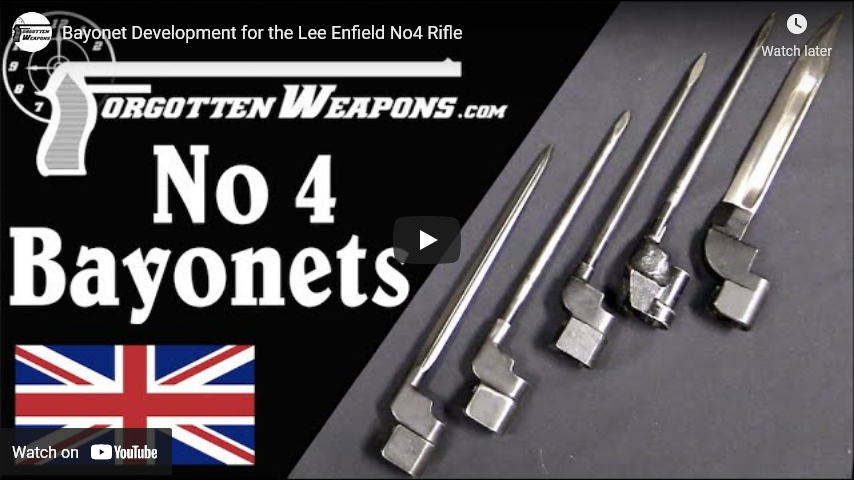
Bayonet Development for the Lee Enfield No4 Rifle
Forgotten Weapons
Published 22 Jul 2021http://www.patreon.com/ForgottenWeapons
https://www.floatplane.com/channel/Fo…
Cool Forgotten Weapons merch! http://shop.forgottenweapons.com
Having wrapped up our series on the major development of the Lee Enfield rifle in British service, I figured it would be a nice addendum to talk about the bayonets developed for the No4 rifle. These went through a substantial evolution, and are an interesting field for collectors all by themselves.
During World War One, the British used the Pattern 1907 bayonet, a long blade type essentially copied from the Japanese Type 30. By the 1920s, this was being reconsidered – the long blades were expensive, fragile, and perhaps not really necessary. When the No1 Mk VI rifle was put into trials, it was given a new bayonet style. This was inspired by the Swiss cyclists’ bayonet, with a cruciform spike instead of a true blade. It was only 8 inches long; this was determined to be long enough for virtually all use cases and being short minimized weight and bulk.
As World War Two progressed, the spike bayonet was simplified several times. Before the initial production of the first standard model (No4 MkI) was completed, the cruciform pattens had already been abandoned for a much simpler (and faster and cheaper) round body spike with a screwdriver-like point at the end. This was in turn simplified by separating the socket and spike into two parts for easier production, and then further simplified by casting the socket instead of forging it. After the war, the spike was replaced by a short blade-type socket bayonet (the No9), although this was rather short-lived because of the adoption of the SLR (FN FAL).
Contact:
Forgotten Weapons
6281 N. Oracle 36270
Tucson, AZ 85740
November 8, 2021
Look at Life — Rendered Safe (1962)
PauliosVids
Published 20 Nov 2018A look at the work of a bomb disposal squad.

November 7, 2021
The Allies Break Through! – WW2 – 167 – November 6, 1942
World War Two
Published 6 Nov 2021After all these months of fighting, the British 8th Army breaks through Erwin Rommel’s Axis positions in North Africa, but the Allies have even bigger plans for that theater of war — a huge invasion of Vichy French North Africa to take place next week. The Soviets also have a plan for a huge invasion to take place very soon near Stalingrad, though the fighting in the city itself sees a lull the second half of this week.
(more…)
November 6, 2021
Is the Answer in Uranus? – The Soviet Plan to Win at Stalingrad – WW2 SPECIAL
World War Two
Published 4 Nov 2021Georgy Zhukov told Josef Stain in September that if the Red Army could just hold out until November, he could put together a counteroffensive that would defeat the enemy. Well, November is here, and that counteroffensive is ready to kick off, but how was it put together? Let’s find out.
(more…)
November 5, 2021
A United Front Against Nazi Atrocities – WAH 045 – October 1942, Pt. 2
World War Two
Published 4 Nov 2021As the war intensifies on all fronts, the occupied world is aflame with resistance and reprisals. From Paris to Papua New Guinea, Humanity is under attack — but it is also fighting back.
(more…)
November 4, 2021
Anti-Tank Chats #2 | Panzerbüchse 39 | The Tank Museum
The Tank Museum
Published 2 Jul 2021Welcome to Anti-Tank Chats, a brand-new series on the history of infantry weapons used in Anti-Tank warfare. In the second episode, Archive and Supporting Collections Manager, Stuart Wheeler explores the Panzerbüchse 39 Anti-Tank Rifle.
(more…)


