Quotulatiousness

January 4, 2024

“Missing from Gay’s note was some important … context”

Filed under: Education, Politics, USA — Tags: , , , — Nicholas @ 04:00

Oliver Wiseman and Bari Weiss consider the resignation-under-pressure of Harvard President Claudine Gay:
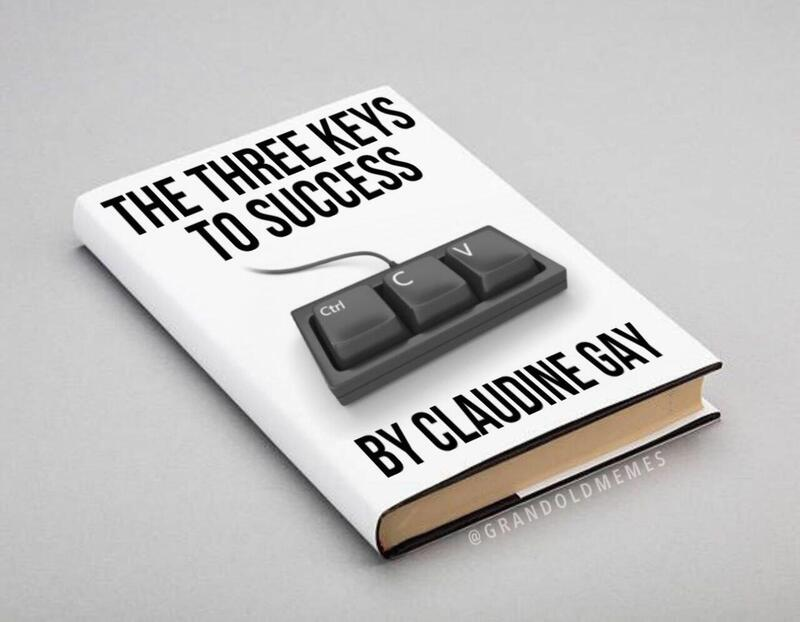
Why did Claudine Gay step down yesterday as president of Harvard? In a letter announcing the bombshell decision, Gay wrote that it was in “the best interests of Harvard for me to resign so that our community can navigate this moment of extraordinary challenge with a focus on the institution rather than any individual.”

She also blamed racism: “It has been distressing to have doubt cast on my commitments to confronting hate and to upholding scholarly rigor — two bedrock values that are fundamental to who I am — and frightening to be subjected to personal attacks and threats fueled by racial animus,” Gay wrote in her email Tuesday.

Missing from Gay’s note was some important … context.

In particular, there was no mention of the twin scandals that have plagued Gay and captured the attention of the country in recent weeks. The first: her handling of antisemitism and free expression on Harvard’s campus since October 7, including her appalling appearance before Congress in December.

The second: the ever-growing list of plagiarism allegations against Gay. On Monday night, the dogged journalists over at The Washington Free Beacon reported six more charges of plagiarism. That brought the number of allegations against Gay close to 50 and implicated half of her published works in the scandal. The next day, Gay was gone, making her the shortest-serving president in Harvard’s history: the Kevin McCarthy of higher ed.

Within minutes the crowing began. Major props went to Bill Ackman, the billionaire investor who has relentlessly criticized his alma mater since the attacks of October 7; to Chris Rufo, the Manhattan Institute senior fellow who was early on the story of plagiarism allegations against Gay; and to Free Beacon reporter Aaron Sibarium (more about him in a minute).

But does Gay’s resignation — and apparently she will remain on the faculty — actually change things?

Our sense — and recent events have only reinforced it — is that Claudine Gay is only the symptom of a deeper rot, both at Harvard and across higher education more generally.

One of the people who has been outspoken about that deeper crisis is Jeffrey Flier, who was the dean of Harvard Medical School from 2007 to 2016 and is a member of the Council on Academic Freedom at Harvard, a group founded by Harvard academics last year to fight the free speech crisis on their campus. (Harvard ranks dead last with a score of 0.00 in FIRE’s college free speech rankings.)

We spoke to Flier hours after Claudine Gay’s resignation. He said he sees the present crisis as a chance for the university to fix itself. “Her departure may have been necessary. But the university needs to do more than appoint a new president,” he explained.

“Before October 7, few people thought fixing problems at Harvard was a really urgent need. I am with a group that wanted real change, but relatively few people were listening. But now there is real opportunity for change,” explains Flier.


QotD: Displays of intelligence as a status good

… noblemen in France (in the rest of Europe too, but France’s old kingdom was special for how wide the disparity was) were used to being by far the richest in their surroundings. And they were used to the peasants being less than dirt under their feet. Or their chariot wheels.

And then that changed, in what is a cultural eye-blink. Forget the crazy slogan. Humans don’t like change. Particularly they hate change that challenges their status. Unable to actually increase their net worth (within the prescribed realms in which noblemen could do such) or stop spending, the nobility instead went for displays of wealth. Big and extravagant ones. And the wigs were … quite, quite insane.

So what does that have to do with Facebook?

For a few generations, since the left captured the academia, entertainment and the industrial-news complex, aka, the opinion makers, to be a leftist has been synonymous with being smart.

And being smart, since the renaissance, but definitely since the world wars has been the greatest social “good” there is.

No, I’m not saying the left was smart. Increasingly, most of them weren’t, because as it became a matter of social display, the easily led started imitating it.

No, I’m saying that to parrot leftist ideas was to be considered smart. Partly because of the left’s conceit that Marxism was “scientific” there has always been, attached to the modern left the idea that to believe as they do is “rational” and “smart” and that their opponents are stupid.

Not only did they hold onto this while their ideas were proven wrong by reality over and over again, but having captured academia, they pushed leftist ideas as synonymous with being educated. I mean, if you’d attended an elite school, you received these ideas, and the way to signal you’ve attended the school is to parrot it. Thus leftism became the old school tie (mostly around the neck of our economy, but never mind.)

While they had full control of the media, be it entertainment or informational, they could reinforce the message, as well as revile anyone who challenged them as stupid, wrong and illiterate, and GET AWAY WITH IT.

With intelligence being the highest status-good in our society, the left had secure status. Forever, they thought.

The change has been very rapid. The fall of the USSR and [the rise of] talk radio were the beginning, and since the internet took off, they’ve been trying to hold on to the tail of the comet, as it streaks away from them.

I’ve said it before and I maintain it. If Mr. Obama had been president in a country where the information tech was the same as in the 30s, all his failures would have been hidden, and people would believe him a staggering genius, instead of the little man who wasn’t there. Because that’s how the industrial-media complex presented him.

And then … And then they went all in for Hillary! They were “With her” 300%.

Unbelievably, it didn’t work.

I think they’d suspected, before, that things had changed. But they could still tell themselves stories, dismiss the opposition, preen on having all the power. And then … it failed.

Since then they’ve been running scared with social insecurity. They display their “brilliance” for all the world, and it didn’t work? Oh. Must signal louder, larger, crazier.

All the “Wokeness” over everything possible (and mostly imaginary) in the last few years? That’s social signaling by a social group losing power and trying to regain it.

The less it works, the more extravagant it will get. I am in premonitory awe over what will happen should Trump beat the margin of fraud in 2020. You thought the Democratic Socialist meeting was funny? You ain’t seen nothing yet. They won’t be able to open their mouths without announcing “point of personal privilege” and their pronouns, and interrupting each other with ever finer intersectional victimhood.

If you think having a woman who won an SF award malign the person the award is named after with a bunch of ahistorical nonsense, and seeing the institution cave within days was peak wokeness, you’re deluding yourself.

Soon and very soon the “Wokeness” displays will be the equivalent of having live birds in your hair.

Because in their subconscious, if they just signal loud enough they’ll regain their status as “smart” and “educated”.

Meanwhile, we’ll be buying popcorn stocks and saying “Is that a ship on your head, or are you that insecure?”

Sarah Hoyt, “Is That A Ship On Your Head?”, Libertarian Enterprise, 2019-09-01.

January 3, 2024

They all spy on you, the FBI, RCMP, MI5 … and apparently your Subaru

Filed under: Business, Liberty, Technology, USA — Tags: , , — Nicholas @ 03:00

JoNova linked to this disturbing little article explaining what legal rights you give away merely by being a passenger in a modern Subaru vehicle:

Subaru is a Japanese car company started back in the 1950s. Their all-wheel drive, sporty SUVs and cars are popular with outdoor types and the LGBT+ community (and your privacy researcher’s Mom … Mom swears by Subaru and has since the 1980s). Popular models in the Outback, Forester, Crosstrek, Impreza, Legacy, the sporty WRX, and the electric Solterra. The MySubaru app and Subaru’s Starlink connected services offer up all the usual connected car things like remote start/stop, lock/unlock, honk your horn and flash your lights from bedroom, automatic collision notification, multimedia services like navigation and news, trip logs, and a way to manage other people who might drive your Subaru with boundary, speed, and curfew alerts. So, do we love Subaru’s privacy? Not really. But hey, they aren’t the worst car company we reviewed, so there’s that.

Here’s something you might not realize. The moment you sit in the passenger seat of a Subaru that uses connected services, you’ve consented to allow them to use — and maybe even sell — your personal information. According to their privacy policy, that means things like your name, location, “Audio recordings of Vehicle Occupants“, and inferences they can draw about things like your “characteristics, predispositions, behavior, or attitudes“. Call us bonkers, but we don’t think that simply sitting in the passenger seat of someone’s Subaru should mean you consent to having any of your personal information use for, well, pretty much anything at all. Let alone potentially sold to data brokers or shared with third party marketers so they can target you with ads about who knows what based on the the inferences they draw about you because you sat in the back seat of a Subaru in the mountains of Colorado. We’re gonna really call out Subaru for this, because they lay it out so clearly in their privacy policy, but please know, Subaru isn’t the only car company doing this sort of icky thing.

If you go read Subaru’s privacy policy (or don’t, we did it for you, you can just read our review here), you’ll see at the very start they say this: “This Privacy Policy applies to each user of the Services, including any ‘Vehicle Occupant’, which includes each driver or passenger in a Subaru vehicle that uses Connected Vehicle Services, such as Subaru Starlink (such vehicle, a ‘Connected Vehicle’), whether or not such driver or passenger is the vehicle owner or a registered user of the Connected Vehicle Services. For the avoidance of doubt, for purposes of this Privacy Policy, ‘using’ the Services includes being a Vehicle Occupant in a Connected Vehicle.” So yeah, they don’t want there to be any doubt that when you sit in a connected Subaru, you’ve entered the world of using their services.

January 2, 2024

Deplatforming the Substack Nazis

Filed under: Media, Politics, USA — Tags: , , , , , — Nicholas @ 04:00

Well-known Substack Nazi Freddie deBoer explains why “we” need to immediately throw all the Nazis off all the publishing platforms to save democracy:

Professional mediocrity Jonathan M. Katz has started a little bit of an echo of 2021-era media handwringing about what kind of content is allowed on Substack. You may remember that in early 2021, when Substack’s (now shuttered) advance program gave money to me and several other disreputable sorts — that is to say, writers who do not enjoy the approval of The Village — it kicked off a minor fuss about, like, male privilege or something. (These things are always a little vague.) Katz thinks Substack has a Nazi problem and should either aggressively prune every writer who doesn’t own a Kamala Harris t-shirt or else the company should be ostracized from the media community. This is a little funny in that it assumes that there will be a media community in another six months, which given financial trends is not a great bet. Mostly the piece just makes me very tired; The Atlantic is of course the perfect venue for such an essay, since 90% of the people who write there are elite liberal art grads who disappeared up their own ass twenty years ago and who derive the lion’s share of their self-worth from writing for a high-falutin place like that. The Atlantic published Frederick Douglass! But now I’m afraid it publishes David Brooks, and I think Spencer Kornhaber is chained to a desk somewhere, forced to churn out five pieces a day about how Beyoncé’s work constitutes a new Black dream imaginarium, or whatever else Tumblr thought six months ago. I’m not impressed, Jonathan, is the point.

Nevertheless, points must be made.

  1. This will blow over and no one will remember it. Most people who read and write on Substack have no idea there is a controversy and wouldn’t care if they did. If 2020 proved anything, it’s that even the loudest controversies have a habit of suddenly dying down as soon as the news cycle changes. Remember when we were having a racial reckoning, and it was the most important thing ever, and then people were back to blogging about fast fashion and Squid Game? I remember!
  2. All of this is always panhandling first — everyone who’s ever performatively quit this platform or any other has been doing so to juice subscriptions or generate sympathy that could lead to a staff writer job. It’s one of the most aggressively, shamelessly self-celebratory genres I can imagine.
  3. A basic part of the point is that, as the past decade and a half proves, contemporary liberals have an incredibly expansive view of what a fascist is. I am a pro-choice, pro-reparations, pro-trans rights, pro-Palestinian, pro-redistribution Marxist, and I am routinely called a fascist by the kind of people who are pushing this line. I promise you that if Substack started banning “literal Nazis”, people would make an effort to include me — it’s happened before on other platforms — and if that effort arose, a lot of people pushing the “we’re only talking about literal Nazis” line would have no problem pushing for me to be deplatformed. Because it’s “only literally Nazis” but then “well Tucker Carlson is basically a Nazi” and then “well Sean Hannity is just like Tucker” and then “well Glenn Greenwald is shrill” and the next thing you know anyone who doesn’t have an Obama bobblehead on their dashboard is banned by policy from these platforms. (Maybe if liberals wanted people to take the fascist threat more seriously they shouldn’t have spent the past fifteen years calling everyone they don’t like a fascist.)
  4. You cannot censor your way out of extremism, and that is an “is” statement, not an “ought” statement. I highly recommend you click that link. The question of whether we should censor far-right figures off of the internet is irrelevant in the face of the fact that we can’t do that. As I point out in the piece, Germany and France have very aggressive laws against Nazism, and they have never stopped having a significant Nazi problem in their societies. Those laws don’t work! The flow of information cannot be stopped, especially in the era of the internet! We couldn’t shut down ISIS’s communications. China, both one of the most repressive and most technologically advanced societies on earth, have not been able to stop digital communications by activists and resistance groups. There will always, always, always be some sketchy server farm in Chechnya that will host these people, and there will always be Indonesian crypto exchanges with no physical address that will facilitate payments for them. If they can’t stop terrorists, I assure you that they can’t stop those “manosphere” frauds. Whatever hope of total control of information died the day some computer science professor figured out how to send ASCII porn to a colleague. What is it going to take for you guys to understand that there is no button to push marked “shut up all the Nazis”?
  5. Before malevolent doofus Elon Musk bought Twitter, it was a hive of self-impressed pussyhat liberals who had hegemonic control over the conversation thanks to Twitter’s sympathy towards their position; after he bought Twitter, it became a cesspit of anime racists and crypto scams, and those useless liberals are big mad that their clubhouse got taken over. Now a bunch of people who think they’re entitled to an audience have sat around for a year typing “Guys? … is anyone there?” into Mastodon and they’re really wounded about it all. I absolutely, 100% believe that Twitter’s demise has contributed to the urge to attack Substack. People who enjoyed pride of place on that version of the network are now looking to throw their weight around in the old style, not seeming to understand that without Twitter functioning as the organizing committee, the juice just isn’t there anymore.
  6. Can someone please tell me who the actual “literal Nazis” are? Katz does a lot more broad gesturing in his Atlantic piece than he does actually proving that there’s a problem or its size. Shouldn’t there be some effort to a) quantify this problem, b) compare it to the size of the platform as a whole, and c) determine if the problem is growing? Is this a crazy thing to ask?

Nobody will like the new rules

Chris Bray points out just how bad the “new rules” are going to be … and not just for the Bad Orange Man:

The danger is that you concede an argument about a personality or an event, then find at some future point that you’ve accepted new systems and structures that are far more broadly applicable than you noticed at the moment you accepted the new rules. Everyone of every political persuasion should see the weapon on the table, because it’s going to be pointed at you and yours: libertarians, anti-war leftists, populists, paleocons, others too weird to name. Outliers. If your votes and your views fall outside an extremely narrow band of corporate-state “centrism”, what follows is about you.

So.

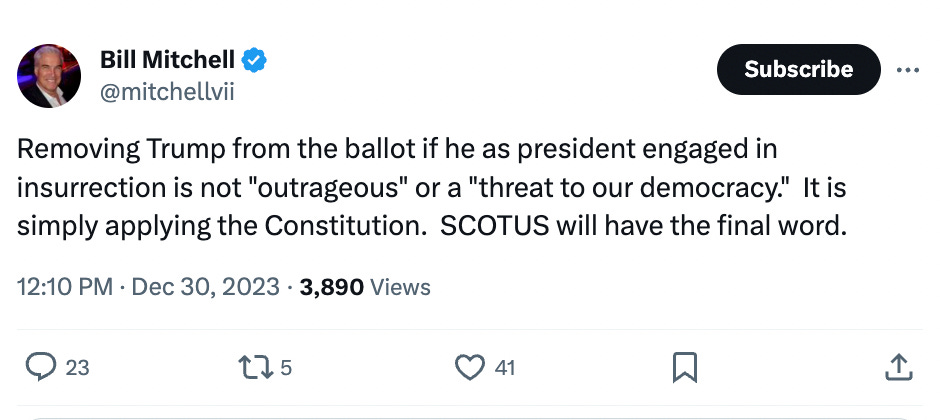
Bill Mitchell, a media figure and DeSantis supporter, doesn’t see the big deal:

The problem is that Trump is “super toxic”, so whatever. Orange Man is bad, so the things you do to Orange Man are unobjectionable. Of course you can take him off the ballot — he’s a jerk. That’s, like, the Constitution.

But the constant background music for me in these discussions is that the government of Canada construed a peaceful protest against vaccine mandates as a national emergency, on par with a foreign invasion, and started freezing bank accounts and mobilizing force for mass arrests. A “Western democracy”, hearing dissent, started turning off the dissenters’ money, which means that government took away the ability of peaceful protesters to pay for things like housing and food. The patience of the global political class for disagreement is narrowing, fast and hard. (Cf. e.g. Ardern, Jacinda.)

So see what’s happening in the United States, and see where it points. On January 6, thousands of protesters turned into maybe hundreds of rioters; many people at the Capitol were peaceful and calm, while some weren’t. Almost none were armed, none used guns, and the question of law enforcement infiltration, provocation, and entrapment remains open.

But no one published a manifesto calling for the violent overthrow of the United States government, and the crowd didn’t line up at the Capitol with rifles and homemade bombs to launch waves of armed attacks on Congress. Compare: here’s Bernardine Dohrn of the Weather Underground declaring war on the United States, and announcing on the radio that “our job is to lead white kids into armed revolution”. Find me that moment on January 6, the explicit declaration of armed revolution aimed at the destruction of the federal government. No one has been charged under the Insurrection Act because no one has violated the Insurrection Act. The “insurrection” is a political construction, not a legal case.

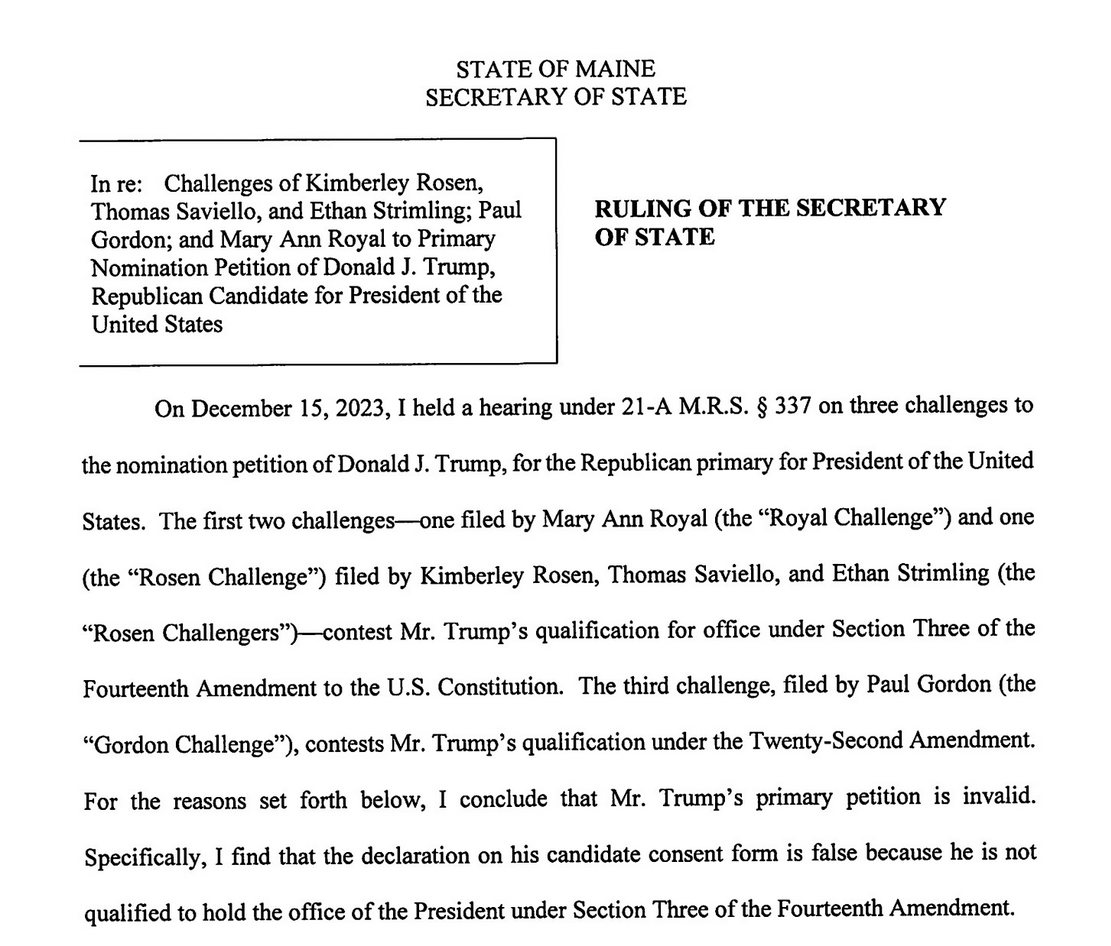
So a riot can be an “insurrection”, in the complete absence of insurrection charges and convictions, if Maine Secretary of State Shenna Bellows (D-Longhouse) feels like an insurrection happened. She can “rule” on that.

Lone officials can unilaterally declare that American citizens are ineligible for participation in elections, because the activities of [insert name of bad people here] can be politically construed as insurrectionist — in the absence of due process and a jury trial.

QotD: Cigarette smuggling and the powers-that-be

Filed under: Economics, Government, Liberty, Quotations, USA — Tags: , , , , , , — Nicholas @ 01:00

[In the 1960s and 70s,] smoking was rapidly becoming an expensive vice … so expensive, in fact, that shaving a few cents per pack could make a real difference in your daily quality of life. If you could get your smokes off the back of a truck at even 30 cents per pack …

At that point, the Powers That Be were in trouble. Butt-smuggling was cutting into their projected tax revenues — tax revenues which, being governments, they’d already spent several years in advance. That’s bad.

Much worse, though, was the realization that, the more people bought their smokes off the back of a truck in Weehawken, the more those people realized that 99% of law “enforcement” is really “convincing people to voluntarily comply with the law”. As they should’ve realized from Prohibition back in the Twenties, and would soon have the opportunity to learn again with the War on Drugs, 1980-present, lifestyle laws are effectively unenforceable. Not even the most draconian techno-fascists, armed with 100% realtime surveillance, can stop people from getting high off something.

And that’s the worst knock-on effect of all, because the attempt turns “getting high” into a rebellious little thrill. You’re not just getting drunk / burning one down / smoking a Mob-supplied cigarette, you’re sticking it to The Man. If you don’t believe me, watch what happens to pot consumption in college towns once it’s fully legalized. Hint: It’s the same thing that happens to college kids’ alcohol consumption after they turn 21 — now that the cheap little thrill of being the rebel with the fake ID is gone, drinking loses a lot of its charm. Similarly, 99% of the “legalize it!” crowd’s “arguments” are just virtue signaling — they’re letting you know what rebels they are by breaking the pot laws. If you really want to cut down the consumption of intoxicants in a college town, at least, simply legalize ’em all. Your few true addicts will provide a spectacular lesson in Darwinism to the student body, but the vast majority of kids will be all but straight-edge.

Severian, “The Mob, Faux-tism, and the Ever-Rising Costs of Compliance”, Founding Questions, 2021-02-02.

January 1, 2024

“On numerous occasions in 2023 I’ve been tempted to go places with a placard saying ‘Ultimi barbarorum‘”

Filed under: Britain, Europe, History, Media, Politics, USA — Tags: , , , , , , — Nicholas @ 03:00

Brendan O’Neill in Spiked:

Portrait of Benedictus de Spinoza (1632-1677)
Unknown artist, from the Herzog August Library via Wikimedia Commons.

My favourite story about Spinoza concerns the time he lost his cool. A philosopher, a Jew and history’s finest defender of Enlightenment, Spinoza was normally a picture of quiet reason. But when he heard about the lynching of Johan and Cornelis de Witt he became gripped by an uncommon fury. The de Witt brothers were key political figures in the Dutch Republic, the enlightened new nation in which Spinoza enjoyed such great liberty to think and write. On 20 August 1672, at The Hague, they were set upon by a ferocious mob that held them responsible for the invasion of the republic by a French-English alliance. They were murdered, mutilated and clumps of their flesh were eaten.

Spinoza was enraged. He made a plan to visit the site of the mob’s savagery to hold a one-man protest. Think Greta Thunberg, but enlightened. He prepared a placard to hold up. But his landlord restrained him, fearing he too would be slain by the mob. And so history was denied the image of one of our great philosophers staging a lonely, angry protest. What did his makeshift placard say? It had two words on it. “Ultimi barbarorum“. Rough translation: “You are the greatest of barbarians”.

This year more than any other I’ve understood how Spinoza felt. On numerous occasions in 2023 I’ve been tempted to go places with a placard saying “Ultimi barbarorum“. To the kibbutzim of southern Israel following Hamas’s fascistic savagery against the Jews there on 7 October. To George Washington University after students projected the words “Glory to our martyrs” on the side of the library building: young Americans of unimaginable privilege taking pleasure in the butchery of Jews. To the lovely, leafy campus of Columbia in New York City where students planned to hold a meeting on Hamas’s stirring “counter-offensive”. To those “pro-Palestine” marches in London at which the morally treacherous middle classes marched alongside individuals dressed as Hamas terrorists and extremists chanting for yet more slaughter in Israel: “Jihad, jihad, jihad!

To New York University where students shouted, “We don’t want no Jew state / We want all of it”: a cry by the comfortable for Hamas to finish the genocidal job of eliminating Jews in the Middle East. To the streets of Manhattan where protesters shouted “Shame on you!” at an Israeli woman whose daughter was kidnapped and brutalised by Hamas. Shaming the victims of racist terror – a low even for the unhinged woke. To any gathering of politically minded Gen Zers, to be frank, after polls found that huge numbers of them view Jews as an “oppressor class” and believe Hamas’s pogrom was “justified”. And to the Sydney Opera House, where radical Islamists chanted “Gas the Jews” and “Fuck the Jews” mere days after Hamas murdered the Jews. Nazi-style parades, uncontained glee at genocidal violence, on the streets of a Western city.

At every place I’ve wanted to say “Ultimi barbarorum“. To call out both barbarism and its intellectual apologists. To express Spinoza-style disgust for these new enemies of Western civilisation. For make no mistake, that’s what they are. From Hamas to the radical Islamists in Europe who feel inspired by Hamas to the West’s own sons and daughters of privilege who make excuses for Hamas – all have proven themselves in 2023 to be the adversaries of truth, culture and reason. Surely no one will now deny that Western civilisation is under assault on two fronts: from without and within?

The West’s bourgeois left loves to larp as Marxists, often quoting the great Rosa Luxemburg: “Socialism or barbarism!” This year we discovered which side of that clash they take – it isn’t Luxemburg’s. The apologism for Hamas in privileged circles has been mind-blowing. Hamas’s bestial violence against the Jews has been denied, downplayed or outright justified. A “day of celebration” is how one privately educated pretend radical in Britain described the racist butchery of 7 October. This sympathy with barbarism, this receptiveness to acts of staggering dehumanisation, goes beyond Israelophobia. It speaks to more than the witless hate for Israel that’s been rampant in right-thinking circles for years.

December 31, 2023

Budapest Under Siege – WW2 – Week 279 – December 30, 1944

World War Two
Published 30 Dec 2023

In the west, the Allies break the siege of Bastogne, but the fight for the Ardennes continues. and British commander Bernard Montgomery is maneuvering to take command of the Western Front ground forces. In Hungary Budapest is cut off by the Soviets and under siege, with hundreds of thousands of civilians still in the city. The fight in Italy is winding down for the winter, but the fight in the Philippines continues. In fact, American landings on Luzon are planned to go off soon.

00:00 INTRO
01:22 The Siege of Bastogne
03:10 The failure of 5th and 6th Panzer Armies
06:11 Montgomery wants command
09:27 Guderian appeals to Hitler, “stop the Ardennes Offensive!”
12:11 Budapest surrounded and under siege
17:04 Wrapping up the Gothic Line Campaign
19:29 Churchill in Athens
20:30 The fight in the Philippines
23:07 SUMMARY
(more…)

December 27, 2023

Eating like a Lighthouse Keeper from the 1800s

Filed under: Food, History, USA — Tags: , , , , , — Nicholas @ 02:00

Tasting History with Max Miller
Published 19 Sep 2023
(more…)

December 25, 2023

Repost – “Fairytale of New York”

Filed under: Europe, Media, USA — Tags: , , , — Nicholas @ 03:00

Time:

“Fairytale of New York” by The Pogues featuring Kirsty MacColl

This song came into being after Elvis Costello bet The Pogues’ lead singer Shane MacGowan that he couldn’t write a decent Christmas duet. The outcome: a call-and-response between a bickering couple that’s just as sweet as it is salty.

QotD: Washington Irving and American Christmas traditions

Filed under: Books, Britain, History, Quotations, USA — Tags: , , , — Nicholas @ 01:00

… the man who did more than any other US citizen to shape the American Christmas. I am not sure how many people read Washington Irving these days, but I would wager that a large proportion of those who don’t are still vaguely familiar with his creation Rip van Winkle — and, if only through his memorialization in institutions like the New York Knicks, his fictitious Dutch historian Diedrich Knickerbocker.

An even larger number may be unaware of how much they’re honoring Mr Irving in their Christmas jubilations. He it was who, in the 1812 edition of his History of New York, threw in a whimsical vignette in which St Nicholas flies over the treetops in a wagon while puffing on his pipe. No reindeer, but all the other elements of the American Santa are there.

Washington Irving loved the great village revelries of the old English Christmas, which the Puritans had left far behind them when they landed at Plimouth Plantation. The parlor games and community feasting and the notion of the Saviour’s birth as a cause of merriment all appealed to him. In his famous and bestselling Sketch Book of 1819-1820 five chapters are devoted to lovingly detailed scenes from an English family Christmas as observed by a young visitor, and they proved so popular that half-a-century later (by which time almost all the elements had been imported into American life) they were published as a stand-alone book.

Mark Steyn, “Dangling Hares and Rosy-Cheeked Schoolboys”, SteynOnline, 2021-12-20.

December 24, 2023

The Siege of Bastogne Begins – WW2 – Week 278 – December 23, 1944

World War Two
Published 23 Dec 2023

The German Ardennes Offensive, called by the Allies the Battle of the Bulge, is in full swing in Luxembourg and Belgium this week, and the Germans have the key junction town of Bastogne under siege. On the Allied side there comes a large American surrender, plans for counterattacks, and tension growing between British and American Commands. The fight in both Italy and the Philippines continues, and in Hungary the Soviets have nearly surrounded Budapest.

00:26 Intro
01:06 The Battle of the Bulge
03:54 The Malmedy Massacre
06:25 Bastogne
10:00 American Surrender on Schnee Eifel
12:06 Patton plans a counterattack
15:44 Bernard Montgomery and Omar Bradley
18:12 The Red Army advances around Budapest
21:39 Fighting in Italy and Greece
22:45 Leyte and Mindoro
25:07 Conclusion
(more…)

QotD: Dreaming of George Bailey’s world while living in Pottersville

Filed under: Economics, Government, Media, Quotations, USA, WW2 — Tags: , , , , , , , — Nicholas @ 01:00

George Bailey, the hero of It’s a Wonderful Life, missed the two events that made the ideal man of his time, place, and social class: going to college and serving (as an officer, of course) in the Second World War. Instead of doing those things, either of which would have sent him out into the world beyond the limits of Bedford Falls, he remained at home, taking care of his family, his business, and his community. In other words, the hero of America’s favorite exercise in Yuletide nostalgia epitomized a way of life that, in the season of the film’s cinematic debut (the summer of 1946), was already on its way to the dustbin of history.

This, the most enduring of the many works of Frank Capra, became the Atlantis myth of post-war America. That is, those who, over the course of the last half-century, saw It’s a Wonderful Life on television, knew well that the age of community and connection depicted on their screens had already passed into the realm of legend. Moreover, to add injury to insult, they also knew that, if they wished to enjoy the fruits of a middle-class existence, they would have to live in the manner of vagabonds.

In the movie, slum-lord Henry Potter tries, but fails, to turn the provincial paradise of Bedford Falls into a run-down haunt of spinsters, drunks, and floozies. In the real world, it was Franklin D. Roosevelt who put the kibosh on the original Main Street, USA. To be more precise, the principal achievements of America’s greatest tyrant, the Great Depression and the Second World War, undermined the financial, legal, and cultural foundations of the “wonderful life”. Thus, by the time this process had run its course, inflation had made a fool’s game of simple thrift, the replacement of law with regulation had hobbled private enterprise, and people who had left home for the sake of college, work, or military service found themselves lost in a sea of strangers.

In response to these changes, colleges and universities stepped up to the proverbial plate, happy to offer substitutes for the things that had been lost. They gave young people a chance to obtain certificates that would attest to both their suitability for service in the ranks of corporate minions and their social respectability. At the same time, these institutions gave older people a way to convert their value-losing cash into an asset that promised to pay dividends that would benefit their children (and, indeed, their grandchildren) for decades to come.

Thus arose the people I have come to call the MICE (Mobile, Individualistic, College Educated) people. Bereft of regional accents, productive property, and deep connections to friends and relations, they wandered the world, building networks, acquiring degrees, and padding resumés. However, after two generations of such peripatetic solipsism, the age of the MICE people is coming to an end.

Young men of parts, who realize that college has nothing to do with either liberal learning or vocational training, are simultaneously taking up skilled trades and stocking their MP3 players with learned podcasts. At the same time, young women of quality are beginning to think that the traditional troika of Kirche, Küche, und Kinder offers better odds of deep satisfaction than life as a hormone-hobbled, Starbucks swilling, girl boss.

So, if you know young people like the ones I’ve just described, do posterity a favor, and put them in contact with each other. After all, they deserve a life as wonderful as that of George and Mary Bailey.

Bruce Ivar Gudmundsson, “College, Class, and Christmas”, Extra Muros, 2023-08-06.

December 23, 2023

DON’T GET SCREWED!!! Get the best deals on vintage handplanes

Filed under: History, Tools, USA, Woodworking — Tags: , , , , — Nicholas @ 04:00

Rex Krueger
Published 22 Dec 2023

When it comes to purchasing a piece of the past, a little knowledge goes a long way.
(more…)

Ribbon Candy for Christmas at Lofty Pursuits

Filed under: Food, History, USA — Tags: , — Nicholas @ 02:00

Lofty Pursuits
Published 19 Dec 2016

Public displays of Confection use a very old ribbon candy machine to finally make some nice ribbon candy just before Christmas 2016. This batch was cherry, but we’ve made tutti frutti, and peppermint too. Lofty Pursuits makes candy on equipment made from the late 1800’s until the modern day. We concentrate on finding and restoring old candy equipment and re-learning the dying art of hard candy making.

http://www.pd.net to see the candy we sell.

« Newer PostsOlder Posts »

Powered by WordPress